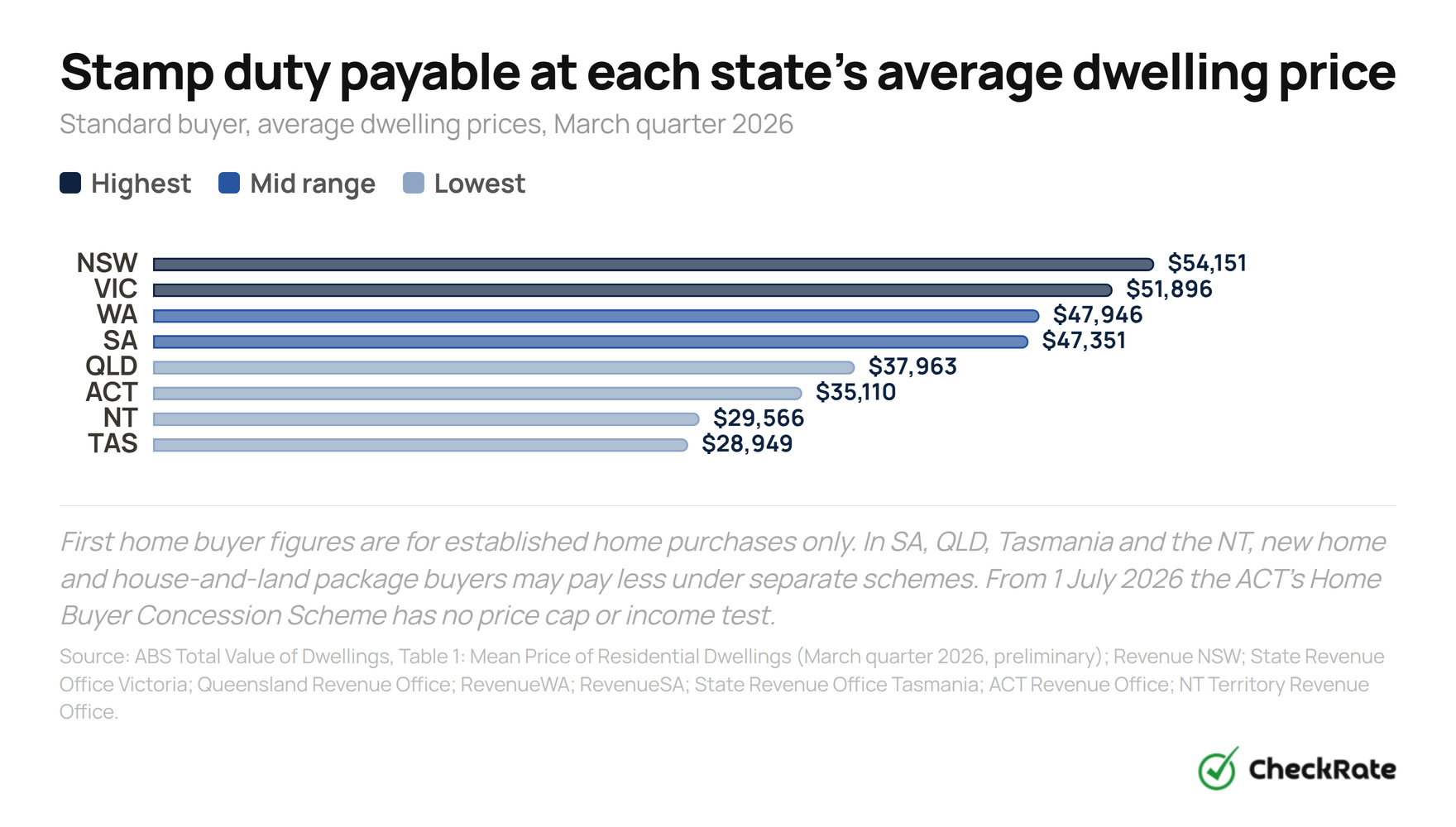
Stamp duty adds between $28,949 and $54,151 to the cost of buying an average home in Australia, depending on the state. NSW has the highest bill, Tasmania the lowest, and the gap between them is about $25,200. Each state and territory sets its own rates and concession rules, so the amount owed varies significantly by location.
All calculations are based on a standard buyer purchasing an established dwelling, unless stated otherwise.
How does stamp duty work when buying a home?
For most home buyers, stamp duty is the single biggest upfront cost after the deposit, adding between $28,949 and $54,151 at average state dwelling prices in March quarter 2026. It is a state government tax paid when a property changes hands. Each state and territory sets its own rates and discount schemes, the federal government is not involved.
Stamp duty is calculated on whichever is higher: the sale price or the property's market value. It is an upfront cost that cannot be added to a home loan in most cases, so it is usually treated as a separate upfront cash cost. The obligation to pay arises when the purchase contract is signed. A conveyancer collects and pays the duty on the buyer's behalf at settlement.
The payment deadline depends on which state or territory the property is in. Deadlines range from 14 days in the ACT to three months in NSW and Tasmania. Missing the deadline can result in penalty interest charges.
| State or territory | Typical current deadline |
|---|---|
| NSW | Within 3 months of signing the contract, or by settlement if settlement comes sooner. Buyers purchasing off the plan (before the property is built) may be able to defer payment by up to 12 months. |
| Victoria | Within 30 days of settlement. Penalty charges apply if the deadline is missed. |
| Queensland | Within 30 days of signing the contract. If an authorised agent processes the paperwork, the deadline is 14 days from lodgement. |
| Western Australia | Within 1 month of receiving the duty assessment. In practice, duty must be paid before settlement because proof of payment is required to complete the title transfer. |
| South Australia | At settlement, when the property title transfers to the buyer. |
| Tasmania | Within 3 months of settlement. |
| ACT | Within 14 days of the title being registered. The ACT sends out a duty assessment after registration is complete. |
| Northern Territory | Within 60 days of signing the contract. |

Which state has the highest stamp duty in Australia?
New South Wales records the highest standard stamp duty bill at the average dwelling price, while Tasmania records the lowest. The NSW bill is almost twice Tasmania's and more than 40% higher than Queensland's Home Concession result. From 1 July 2026, only the ACT shows a different first-home-buyer result at the average dwelling price. Every other state and territory charges first home buyers the same as standard buyers for an established home at the average price.
When the first home buyer view is selected, only the ACT shows a change. In seven of eight states and territories, first home buyers purchasing an established home at the average price pay the same duty as any other buyer — either because the average price is above the concession threshold, or, in Tasmania's case, because the concession itself has expired.
Queensland's result stands out. At the state's average dwelling price of $1.12 million, a standard Queensland buyer pays $37,963 under the Home Concession, compared with $45,138 under the general rate that applies to investors. The Home Concession, available to buyers who move into the property within 12 months of settlement, accounts for that $7,175 difference.
Stamp duty in NSW: average cost and rates in 2026
At $54,151, NSW has the highest stamp duty bill in Australia. The rate reaches 5.5% on amounts above $1.29 million, which applies to the state's average dwelling price of $1,324,800. Rates start at 1.25% on the lowest values, with a separate premium rate above $3,870,000.
| Property value | Duty payable | Rate for this band |
|---|---|---|
| $0 to $18,000 | $1.25 per $100 (min. $20) | 1.25% |
| $18,001 to $38,000 | $225 plus $1.50 per $100 over $18,000 | 1.50% |
| $38,001 to $103,000 | $525 plus $1.75 per $100 over $38,000 | 1.75% |
| $103,001 to $387,000 | $1,662 plus $3.50 per $100 over $103,000 | 3.50% |
| $387,001 to $1,290,000 | $11,602 plus $4.50 per $100 over $387,000 | 4.50% |
| Over $1,290,000 | $52,237 plus $5.50 per $100 over $1,290,000 | 5.50% |
| At state average price of $1,324,800: duty = $54,151 | ||
Stamp duty in Victoria: average cost and rates in 2026
Victoria uses two rate schedules. Most buyers pay the general land transfer duty rate. Buyers who plan to live in the property may qualify for an owner-occupier discount on purchases up to $550,000. Above $550,000, the general rate applies: 5.5% on values between $960,000 and $2 million, stepping up to 6.5% above that.
At the average dwelling price of $947,100, a standard buyer pays $51,896. The owner-occupier discount only applies at $550,000 or below, saving up to $3,100.
| Property value | Rate |
|---|---|
| Up to $25,000 | 1.40% |
| $25,001 to $130,000 | $350 + 2.40% over $25k |
| $130,001 to $960,000 | $2,870 + 6.00% over $130k |
| $960,001 to $2,000,000 | 5.50% of property value |
| Over $2,000,000 | $110,000 + 6.50% over $2M |
| At the state average of $947,100: $51,896 | |
| Property value | Rate |
|---|---|
| Up to $130,000 | General rate applies |
| $130,001 to $440,000 | $2,870 + 5.00% over $130k |
| $440,001 to $550,000 | $18,370 + 6.00% over $440k |
| Over $550,000 | No concession; general rate |
| Saves up to $3,100 at $550,000 | |
How much is stamp duty in Queensland?
Queensland buyers who plan to live in their home pay $37,963 in stamp duty at the state's average dwelling price of $1,123,700. This is $7,175 less than the $45,138 general rate.
Queensland has two rate schedules: the lower Home Concession rate for buyers who move in within 12 months, and the higher general rate for investors, which is $38,025 plus $5.75 per $100 over $1,000,000.
| Purchase price | Duty amount | Rate for this band |
|---|---|---|
| Up to $350,000 | $1.00 per $100 | 1.00% |
| $350,001 to $540,000 | $3,500 plus $3.50 per $100 over $350,000 | 3.50% |
| $540,001 to $1,000,000 | $10,150 plus $4.50 per $100 over $540,000 | 4.50% |
| Over $1,000,000 | $30,850 plus $5.75 per $100 over $1,000,000 | 5.75% |
| At state average price of $1,123,700: duty = $37,963 (general rate would be $45,138) | ||
How much is stamp duty in WA, SA, Tasmania, the ACT and Northern Territory?
The five remaining states and territories each use a different rate structure, and the outcomes at average prices range from $28,949 in Tasmania to $47,946 in Western Australia. The ACT is the only jurisdiction in this comparison with a long-running policy of progressively reducing conveyance duty. From 1 July 2026 it is also the only one offering first home buyers uncapped full relief, subject to eligibility rules.
- Western Australia: at an average dwelling price of $1,103,500, stamp duty comes to $47,946, now the highest of these five. Most buyers pay the standard rate, with no meaningful owner-occupier discount above $200,000. The top rate is 5.15% on values above $725,000.
- South Australia: at an average dwelling price of $973,100, duty is $47,351, just below WA. SA's top rate of 5.5% applies above $500,000, compared with WA's 5.15% above $725,000: a higher marginal rate, although WA's higher average dwelling price now produces the larger dollar figure. There is no separate rate for owner-occupiers.
- Tasmania: at an average dwelling price of $750,300, the lowest nationally, duty is $28,949, still the lowest of any state or territory. The average has now moved just above the $725,000 mark and into the top 4.5% band, rather than sitting in the 4.25% band as it did previously.
- ACT: at an average dwelling price of $1,018,000, an eligible owner-occupier pays $35,110 in standard conveyance duty. The ACT has a long-running policy of progressively reducing conveyance duty, with rates reduced over time since 2012. Despite Queensland's average price being nearly $106,000 higher, the ACT's owner-occupier duty is still below Queensland's Home Concession rate.
- Northern Territory: at an average dwelling price of $597,300, duty is $29,566. A flat rate of 4.95% applies above $525,000. Below $525,000, the NT uses a formula rather than fixed rate bands.
| State or territory | Average dwelling price | Standard duty | Effective rate | Top rate |
|---|---|---|---|---|
| Western Australia | $1,103,500 | $47,946 | 4.35% | 5.15% (above $725,000) |
| South Australia | $973,100 | $47,351 | 4.87% | 5.50% (above $500,000) |
| Tasmania | $750,300 | $28,949 | 3.86% | 4.50% (above $725,000) |
| ACT | $1,018,000 | $35,110 | 3.45% | 4.54% (flat, above $1,455,000) |
| Northern Territory | $597,300 | $29,566 | 4.95% | 4.95% (flat above $525,000) |
Do first home buyers pay stamp duty in Australia?
Most concession thresholds sit below current average dwelling prices. As a result, many first-home buyers purchasing at or near average prices receive no stamp duty discount on established homes.
Only the ACT provides full stamp duty relief at the average price. From 1 July 2026, the Home Buyer Concession Scheme waives duty on all eligible purchases regardless of value or household income, so the $1,018,000 territory average is covered. Tasmania's established-home exemption, which previously covered purchases up to $750,000, was not available for settlements after 30 June 2026, and the state average of $750,300 is now slightly above that former cap.
In every other state and territory, first home buyers at the average price pay the same stamp duty as any other buyer. The exemption ends at $800,000 in NSW, $600,000 in Victoria, $700,000 in Queensland and $500,000 in Western Australia, none of which reach the average dwelling price in their respective state.
| State or territory | Average price | Standard duty | First home buyer duty | Saving | Exemption threshold (established homes) |
|---|---|---|---|---|---|
| NSW | $1,324,800 | $54,151 | $54,151 | None | Full exemption to $800,000 |
| Victoria | $947,100 | $51,896 | $51,896 | None | Full exemption to $600,000 |
| Queensland | $1,123,700 | $37,963 | $37,963 | None | Full exemption to $700,000 |
| South Australia | $973,100 | $47,351 | $47,351 | None | No current relief for established homes |
| Western Australia | $1,103,500 | $47,946 | $47,946 | None | Nil duty to $500,000 (First Home Owner Rate) |
| Tasmania | $750,300 | $28,949 | $28,949 | None | Exemption to $750,000 expired 30 Jun 2026 |
| Northern Territory | $597,300 | $29,566 | $29,566 | None | No current first home buyer relief for established homes |
| ACT | $1,018,000 | $35,110 | $0 | $35,110 | Home Buyer Concession Scheme: $0 duty, no price cap (from 1 Jul 2026) |
The "none" entries show first home buyers pay the same as any other buyer at the state average price, whether because the concession threshold has been outpaced by prices, or, in Tasmania's case, because the scheme itself has lapsed.
How much is stamp duty in Australian capital cities?
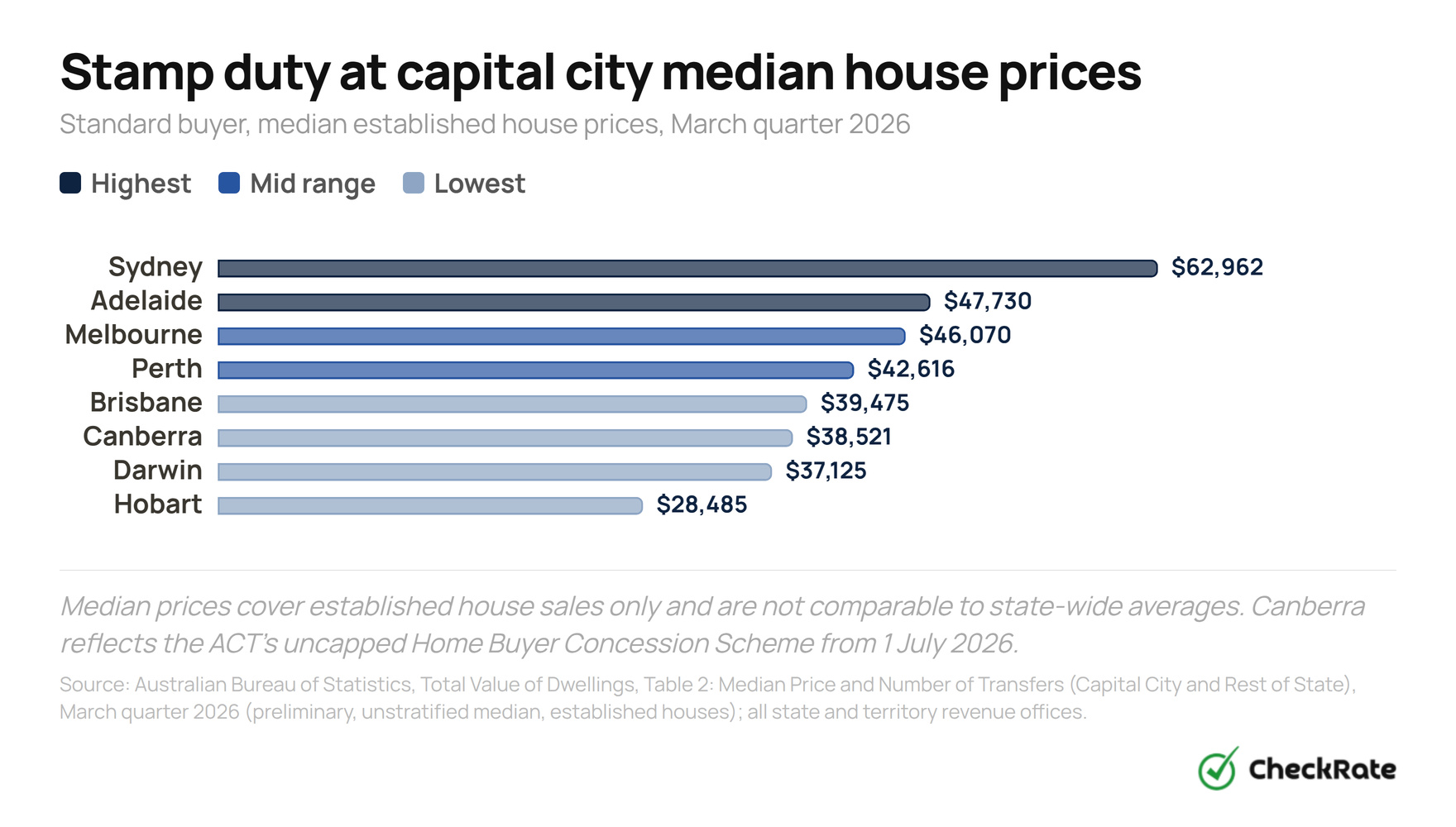
Sydney buyers pay $62,962 in stamp duty on the city's median house price of $1,485,000, the highest of any capital city, based on March quarter 2026 figures, the latest ABS capital city median established house price data available at the time of writing. Hobart buyers pay the least at $28,485. The gap between the two cities is $34,477. Capital city figures cover established house sales only and use medians, while the statewide figures above use mean dwelling prices across all dwellings, so the two series are not directly comparable.
In seven of eight capital cities, first home buyers now pay the same duty as anyone else at the median price. Canberra is the only exception: from 1 July 2026 the ACT's Home Buyer Concession Scheme has no price cap or income test, so an eligible Canberra first home buyer pays $0. Hobart's own established-home exemption, which previously would have applied at the city's median price, was not available for settlements after 30 June 2026.
| Capital city | Median house price | Standard duty | Effective rate | First home buyer duty | First home buyer saving |
|---|---|---|---|---|---|
| Sydney (NSW) | $1,485,000 | $62,962 | 4.24% | $62,962 | None |
| Adelaide (SA) | $980,000 | $47,730 | 4.87% | $47,730 | None |
| Melbourne (VIC) | $850,000 | $46,070 | 5.42% | $46,070 | None |
| Perth (WA) | $1,000,000 | $42,616 | 4.26% | $42,616 | None |
| Brisbane (QLD) | $1,150,000 | $39,475 | 3.43% | $39,475 | None |
| Canberra (ACT) | $1,071,300 | $38,521 | 3.60% | $0 | $38,521 |
| Darwin (NT) | $750,000 | $37,125 | 4.95% | $37,125 | None |
| Hobart (TAS) | $740,000 | $28,485 | 3.85% | $28,485 | None |
Melbourne's effective stamp duty rate of 5.42% is the highest of any capital city, because Victoria's general rate charges 6% on most of the purchase price. Adelaide now records the second-highest dollar figure of any capital, but Sydney's total bill remains the largest even though its effective rate of 4.24% is comparatively low, because most of the purchase price falls in NSW's 4.5% band rather than the top 5.5% band.
Stamp duty calculator by state and territory
The calculator allows users to select a state or territory, enter a property price and choose the buyer type. The calculator uses current official rate schedules for each state and territory and provides indicative results based on the assumptions listed below.
References
- 1Australian Bureau of Statistics, Total Value of Dwellings, March quarter 2026, Table 1: Mean Price of Residential Dwellings.
- 2Revenue NSW, How to calculate transfer duty, 2026-27 financial year rates.
- 3Revenue NSW, First Home Buyers Assistance Scheme, 2026-27 thresholds.
- 4State Revenue Office Victoria, Land transfer duty rates, current residential rates.
- 5State Revenue Office Victoria, First home buyer duty exemption, concession or reduction, current thresholds.
- 6Queensland Revenue Office, Transfer duty rates, current residential rates.
- 7Queensland Revenue Office, Transfer duty home concession rates, current residential rates.
- 8Department of Treasury and Finance WA, Transfer duty assessment, current residential rates.
- 9RevenueWA, First Home Owner Rate of Duty, current first home owner rate rules.
- 10RevenueSA, Rate of stamp duty, current residential rates.
- 11RevenueSA, Stamp duty relief for eligible first home buyers, current scheme rules.
- 12State Revenue Office Tasmania, Rates of duty, current property transfer duty rates.
- 13State Revenue Office Tasmania, First home buyers of established homes duty relief, 18 February 2024 to 30 June 2026.
- 14ACT Revenue Office, Conveyance duty for non-commercial property, eligible owner-occupier rates, 2026-27.
- 15ACT Revenue Office, About the Home Buyer Concession Scheme, 2026-27 scheme rules.
- 16Northern Territory Government, Stamp duty: buying or selling a home, current residential duty rules.
- 17Northern Territory Government, Land or property transfer stamp duty calculator, current transfer duty calculator.
- 18Northern Territory Government, Stamp duty exemption, House and Land Package Exemption, 1 July 2022 to 30 June 2027.
- 19Australian Bureau of Statistics, Total Value of Dwellings, March quarter 2026, Table 2: Median Price and Number of Transfers.
Data Snapshots