What upfront costs apply when buying a house?
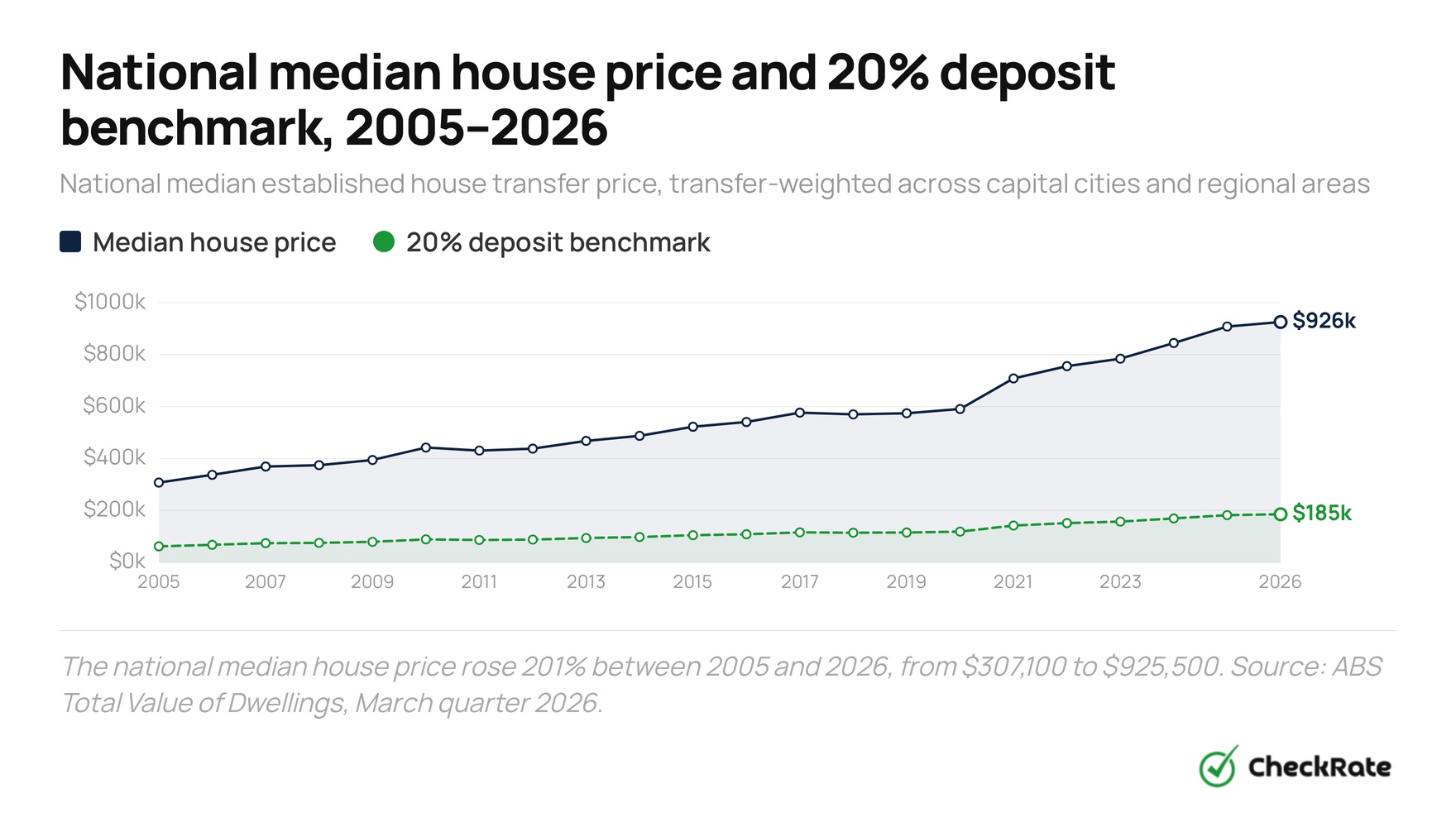
Applying a 5% allowance for non-deposit upfront costs to the national median house price of $925,500 adds around $46,275 to the cash required at settlement. On the national mean dwelling price of $1,111,100, the same 5% allowance amounts to around $55,555. The exact amount depends on the state, property type, purchase price, and whether first-home buyer concessions apply.
Buying costs fall into two categories. The deposit is the buyer's equity contribution toward the property: it reduces the loan amount and builds ownership. Most other upfront costs are transactional and are paid at or before settlement. These can include stamp duty, conveyancing, registration charges and settlement adjustments, as well as building, pest or strata inspection fees and moving costs in some transactions. Unlike lenders mortgage insurance, most of these costs are usually paid separately rather than added to a standard mortgage.
How much deposit is needed to buy a house in Australia?
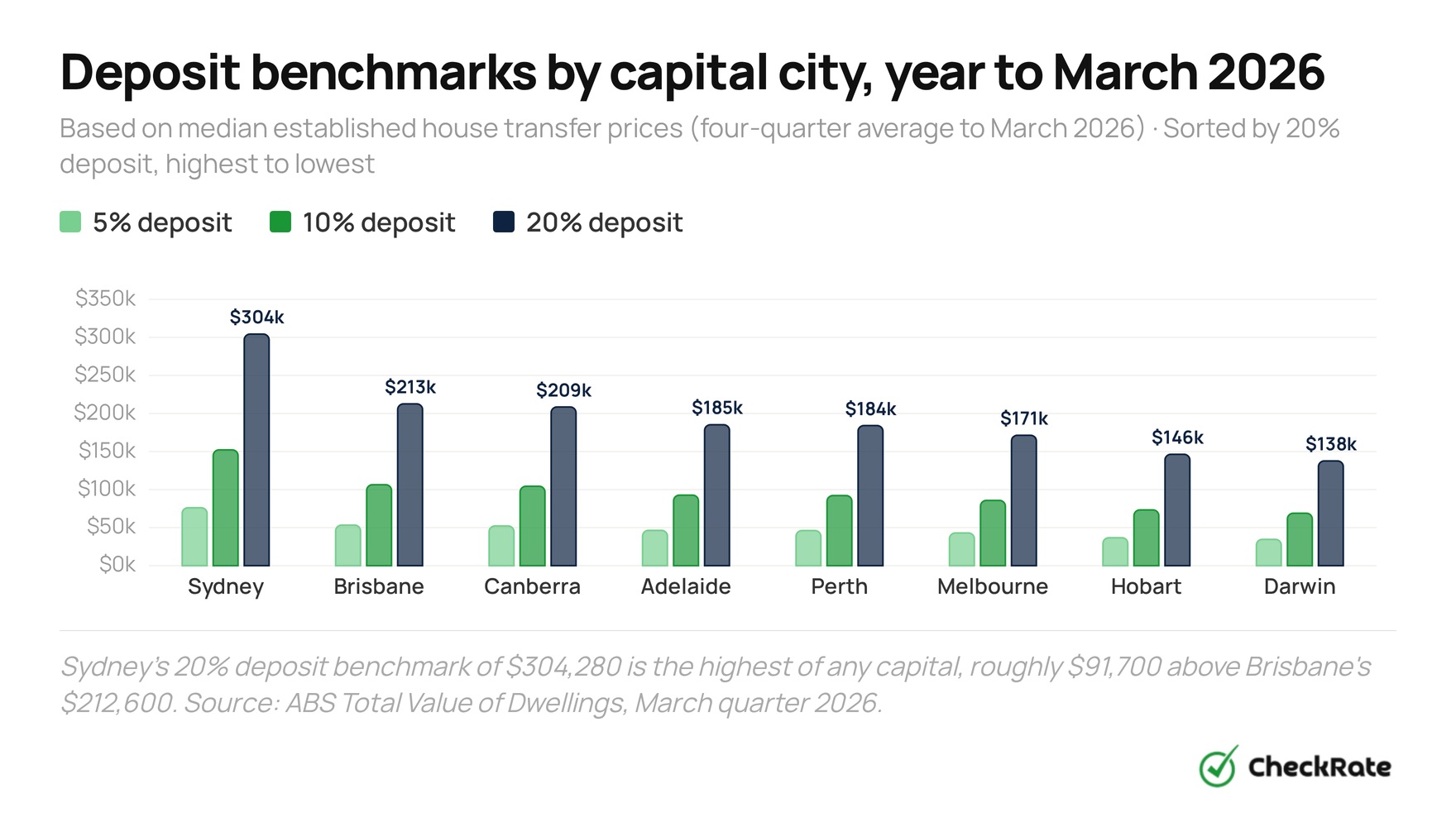
The 20% deposit benchmark ranges from $137,620 in Darwin to $304,280 in Sydney, a difference of more than $166,600 based on prices for the year to March 2026.
At the national median of $925,500, a 5% deposit is $46,275, a 10% deposit is $92,550, and a 20% deposit is $185,100. Sydney's 20% benchmark is around 64% above the national figure and more than double Darwin's $137,620.
Brisbane's median house price of $1,063,000 has moved past $1 million and overtaken Canberra's $1,042,500, making Brisbane the second-most expensive capital city market for houses, behind Sydney. Adelaide's median of $926,100 remains above Melbourne's $856,800, while Perth ($920,600) now sits within $5,500 of Adelaide, the closest the two markets have been in this series.

How much does lenders mortgage insurance cost in Australia?
On an $800,000 property, LMI at 95% LVR costs an estimated $34,000 to $35,500. At 90% LVR, the same property attracts around $17,000. Reducing a deposit from 10% to 5% lowers the upfront deposit by $40,000, but roughly doubles the insurance cost. Most lenders allow the premium to be added to the loan, meaning interest can accrue on the premium over the life of the mortgage.
Despite being paid by the borrower, LMI protects the lender rather than the borrower. If the property is sold after a default and the sale price falls short of the outstanding loan, the insurer covers the lender's loss and can then seek to recover that amount from the borrower. Most states also charge duty on the LMI premium itself, though New South Wales has exempted LMI policies from insurance duty since 1 July 2017. Where it applies, insurance duty on the LMI premium is typically 9% in Queensland, 10% in Victoria, Western Australia, the Northern Territory and Tasmania, and 11% in South Australia.
| Deposit size | LVR | Cash deposit ($800k) | Estimated LMI premium | LMI required? |
|---|---|---|---|---|
| 20% | 80% | $160,000 | None | No LMI |
| 15% | 85% | $120,000 | $6,500–$9,000 | LMI applies |
| 10% | 90% | $80,000 | $16,500–$17,500 | LMI applies |
| 5% | 95% | $40,000 | $34,000–$35,500 | LMI applies |
Which state has the highest stamp duty in Australia?
Stamp duty, also called transfer duty, ranges from $28,949 in Tasmania to $54,151 in New South Wales at each state's mean dwelling price, using current rates. The $25,202 gap reflects both NSW's higher mean dwelling price and its steeper upper-bracket rates. Victoria ranks second at $51,896, despite having a mean dwelling price $377,700 lower than NSW's. Western Australia now edges out South Australia for third place, $47,946 to $47,351, a gap of less than $600.
Stamp duty is charged by state and territory governments using progressive rate structures. As property prices rise, more homes move into higher duty brackets. This has increased the effective duty cost on ordinary homes in several major markets.
| State/territory | Mean dwelling price | Standard stamp duty | FHB full exemption cap | FHB saving |
|---|---|---|---|---|
| New South Wales | $1,324,800 | $54,151.00 | $800,000 | $0 (above threshold) |
| Victoria | $947,100 | $51,896.00 | $600,000 | $0 (above threshold) |
| Western Australia | $1,103,500 | $47,946.00 | $500,000 | $0 (above threshold) |
| South Australia | $973,100 | $47,351.00 | No established-home exemption | $0 for established homes |
| Queensland | $1,123,700 | $37,963.00 | $700,000 existing; uncapped new builds | $0 for existing homes |
| ACT | $1,018,000 | $35,110.00 | No cap; no income test | $35,110 (full duty, if eligible) |
| Northern Territory | $597,300 | $29,566.00 | None (cash grant instead) | $0 |
| Tasmania | $750,300 | $28,949.00 | None (exemption ended 30 June 2026) | $0 (concession has ended) |
First-home buyer stamp duty concessions
For established homes, the ACT is now the only jurisdiction in this comparison where eligible first-home buyers receive a full stamp duty exemption with no property price cap and no income test, following changes that took effect on 1 July 2026. Queensland and South Australia also offer uncapped exemptions, but only for eligible new builds, not established homes. Every other established-home exemption either caps out below current mean dwelling prices, doesn't exist (South Australia), or has expired (Tasmania, from 1 July 2026).
How much are conveyancing fees when buying a house?
Conveyancing costs for a standard residential purchase typically range from $1,180 to $2,150. This covers the professional fee, statutory searches and the mandatory PEXA electronic settlement charge. A licensed conveyancer or solicitor usually manages the title transfer, coordinates with the mortgage lender and handles settlement.
The fee has two main parts: the professional service fee and disbursements. Disbursements are third-party or government charges for title searches, planning certificates, council checks and water clearances.
Settlement adjustments are a separate cash cost due at settlement. Where the vendor has prepaid council rates, water charges or body corporate levies beyond the settlement date, the buyer reimburses the vendor for the unused portion. These adjustments typically add $1,500 to $3,500, with the higher end more common for strata properties where quarterly levies can be significant.
| Cost component | Typical range | Description |
|---|---|---|
| Professional legal fee | $800–$1,500 | Contract review, title transfer, and legal execution |
| Disbursements and searches | $250–$500 | Title searches, planning certificates, council and water clearances |
| Electronic settlement (PEXA) | $130–$150 | Mandatory fee for digital title and funds transfer |
| Total estimated cost | $1,180–$2,150 | Standard residential purchase |
How much do building and pest inspections cost?
Indicative market pricing puts a combined building and pest inspection at around $500 to $1,000 for a standard property, with Sydney and Melbourne usually at the higher end. Inspections are not legally required in all transactions, but after settlement, structural and pest-related defects generally become the buyer's responsibility, depending on the contract and state rules. A report usually covers accessible areas such as the roof void, subfloor, retaining walls and load-bearing elements, as well as visible signs of termites, timber borers and moisture damage.
Costs vary by property size and location. Lower-cost inspections of around $300 may involve less time on site or a more standardised report template, offering less detail than a more comprehensive inspection.
| Market | Apartment/unit | Standard 3–4 bed house | Large or complex home |
|---|---|---|---|
| Sydney metro | $400–$550 | $600–$750 | $800–$1,000+ |
| Melbourne metro | $400–$550 | $600–$750 | $800–$1,000+ |
| Brisbane / Gold Coast | $350–$500 | $550–$700 | $700–$800+ |
| Regional areas | $300–$450 | $500–$650 | $650–$900 |
How much do moving and setup costs add after buying a house?
Moving and setup costs typically add around $2,400 to $4,900 for a standard three-bedroom home. The main costs are removalists, estimated at $1,200 to $2,500, building insurance, estimated at $1,000 to $2,000 per year, and utility connections for NBN, electricity and gas, estimated at $200 to $400. Building insurance may need to be in place before settlement, depending on the lender, contract and state rules, so the first premium can fall due before moving day.
| Cost item | Typical range |
|---|---|
| Professional removalists (3-bedroom move) | $1,200–$2,500 |
| Utility connections (NBN, electricity, gas) | $200–$400 |
| Building insurance (annual premium) | $1,000–$2,000 |
| Total estimated moving and setup | $2,400–$4,900+ |
What extra costs are paid at property settlement?
Bank fees, registration charges and settlement adjustments can add around $1,400 to more than $5,300 to the total cash needed at settlement, depending on the state, property value and settlement adjustments. These three cost categories cover lender fees, government land registry charges and pro-rata reimbursements to the vendor. Unlike LMI, these costs are generally paid in cash at settlement rather than added to the mortgage.
Bank application and valuation fees
Most lenders charge an application or establishment fee to cover underwriting and loan setup. Some also require an independent property valuation to confirm that the property supports the loan amount. These fees are sometimes waived, particularly in competitive lending environments.
| Fee | Typical range | Notes |
|---|---|---|
| Application/establishment fee | $500–$1,000 | Covers loan underwriting and facility setup; sometimes waived |
| Property valuation fee | $200–$300 | Independent valuation to confirm security value; often absorbed by lender |
| Total estimated bank fees | $700–$1,300 |
Mortgage and title registration fees
Mortgage registration fees range from $125.70 in Victoria to $238.14 in Queensland, based on the most recently published schedules cited in this article. Mortgage registration is a fixed government charge that records the lender's security interest against the property title. A separate title transfer fee records the change of ownership. These fees are reviewed periodically and typically change on 1 July, so figures can vary by jurisdiction and transaction date.
In most states, the title transfer fee varies by property value and is charged on top of the fixed mortgage registration fee. NSW is the exception in this comparison, with a flat $182.73 fee for both mortgage registration and title transfer, effective from 1 July 2026.
| State/territory | Mortgage registration | Title transfer fee | Combined total |
|---|---|---|---|
| Queensland | $238.14 | Varies by value | $238.14+ |
| Western Australia | $216.60 | Varies by value | $216.60+ |
| South Australia | $198.00 | Varies by value | $198.00+ |
| ACT | $178.00 | Varies by value | $178.00+ |
| Northern Territory | $176.00 | Varies by value | $176.00+ |
| New South Wales | $182.73 | $182.73 | $365.46 |
| Tasmania | $163.30 | Varies by value | $163.30+ |
| Victoria | $125.70 | Varies by value | $125.70+ |
Settlement adjustments
Settlement adjustments are cash payments calculated at settlement. When a vendor has prepaid council rates, water charges or body corporate levies for a period that extends beyond settlement, the buyer reimburses the vendor for the unused days. The conveyancer calculates the amount based on the settlement date and the daily rate of each charge.
Like the other costs in this section, settlement adjustments are generally paid in cleared funds on settlement day and are not usually added to the mortgage.
| Adjustment type | Typical amount | Applies to |
|---|---|---|
| Council rates (pro-rata) | $400–$600 | All properties |
| Water availability charges (pro-rata) | $200–$300 | All properties |
| Body corporate/strata levies (pro-rata) | $1,000–$2,500 | Units and apartments only |
| Total estimated settlement adjustments | $600–$3,400 | Varies by property type and settlement timing |
Taken together, stamp duty, conveyancing, bank fees, registration charges and settlement adjustments can add tens of thousands of dollars to the cash required at settlement, depending on the state, purchase price and concession eligibility.
How much cash is needed to buy an $800,000 NSW home?
To purchase an $800,000 established home in New South Wales with a 10% deposit, a buyer would need an estimated $116,852 in cash at settlement, using current NSW duty and registration rates. That is more than $36,000 above the deposit alone. Stamp duty accounts for $30,187 of that gap. The remaining $6,665 covers legal fees, inspections, bank fees, registration charges, settlement adjustments and moving costs. LMI at 90% LVR adds approximately $17,000 to the loan, but because it is capitalised in this example, it is not included in the cash settlement total.
| Cost item | Amount | Notes |
|---|---|---|
| Deposit (10%) | $80,000 | Equity contribution toward the property |
| Stamp duty (NSW) | $30,187 | Current standard progressive rate on $800,000 transfer |
| Conveyancing and legal fees | $1,600 | Professional fee, statutory searches, PEXA settlement |
| Building and pest inspection | $600 | Combined inspection for a standard Sydney property |
| Bank application and valuation fee | $800 | Establishment fee and independent property valuation |
| Mortgage registration fee (NSW) | $182.73 | NSW Land Registry charge for recording lender's security |
| Title transfer registration fee | $182.73 | NSW Land Registry charge for change of ownership |
| Settlement adjustments | $1,500 | Pro-rata reimbursement for prepaid council and water rates |
| Moving, utilities, and building insurance | $1,800 | Removalists, connections, first year of building insurance |
| Total cash required at settlement | $116,852 | Excludes approximately $17,000 LMI capitalised into the loan |
First-home buyer grants, concessions and guarantee schemes
Since October 2025, the Australian Government 5% Deposit Scheme, formerly the Home Guarantee Scheme, has had no income limits, no waitlists and expanded access. Eligible buyers, including first-home buyers and people who have not owned property in the past ten years, may qualify with a 5% deposit while the government guarantees part of the loan. This removes the LMI that would otherwise apply at 95% LVR.
On an $800,000 property, the LMI cost that would otherwise apply at 95% LVR is estimated at $34,000 to $35,500. Property price caps still apply by state and region. In NSW capital city and regional centres, the cap is $1,500,000. In Queensland capital city and regional centres, the cap is $1,000,000. These caps are reviewed periodically.
| State | FHB exemption (established) | FHB exemption (new builds) | Cash grant |
|---|---|---|---|
| NSW | Up to $800,000; partial to $1,000,000 | Up to $800,000; partial to $1,000,000 | $10,000 (new builds to $600k) |
| VIC | Up to $600,000; partial to $750,000 | Up to $600,000; partial to $750,000 | $10,000 (new builds to $750k) |
| QLD | Up to $700,000; partial to $800,000 | Uncapped (from May 2025) | $30,000 for eligible new homes, with the increased grant continuing beyond 30 June 2026 |
| WA | Up to $500,000; partial to $700,000 metro | Up to $500,000; partial to $700,000 | $10,000 |
| SA | No established-home exemption | Uncapped | $15,000 (new builds, no cap) |
| TAS | None (ended 30 June 2026) | Up to $750,000 (permanent) | $20,000 (new builds, from 1 July 2026) |
| ACT | Uncapped, no income test (from 1 July 2026) | Uncapped, no income test (from 1 July 2026) | None |
| NT | None | None | $50,000 |
Estimate your total upfront buying costs
Enter a state, purchase price, and deposit size to estimate the total cash needed at settlement. Stamp duty is calculated using each state's standard progressive rate schedule, with first-home buyer concessions applied where the purchase price falls within the relevant threshold. This calculator assumes an established home; new-build and vacant-land concessions in Queensland, South Australia and elsewhere are not modelled.
REFERENCES
- 1.Australian Bureau of Statistics, Total Value of Dwellings, March Quarter 2026: national mean dwelling price, state mean dwelling prices and median established house transfer prices.
- 2.National Housing Supply and Affordability Council, State of the Housing System 2026: time needed for a median-income household to save a 20% deposit in 2025.
- 3.ASIC Moneysmart, Buying a home: deposit, upfront buying costs and lenders mortgage insurance context.
- 4.ASIC Moneysmart, Lenders mortgage insurance: LMI definition, lender-protection context and 80% loan-to-value threshold.
- 5.Revenue NSW, Transfer duty, 2026–27 rates: NSW transfer duty rates and thresholds.
- 6.State Revenue Office Victoria, Land transfer duty, current rates: Victorian transfer duty rates and first-home buyer concessions.
- 7.Queensland Revenue Office, Transfer duty home concession rates, current rates: Queensland home and first-home buyer transfer duty rates.
- 8.RevenueSA, Stamp duty relief for eligible first home buyers, current rates: South Australian first-home buyer stamp duty relief.
- 9.WA Department of Finance, Duties fact sheet, First Home Owner Rate, current rates: Western Australian transfer duty and first-home buyer duty rates.
- 10.State Revenue Office Tasmania, Property transfer duty concessions and exemptions, 2026: Tasmanian transfer duty concessions and ended established-home duty relief.
- 11.ACT Revenue Office, Home Buyer Concession Scheme, from 1 July 2026: ACT first-home buyer conveyance duty exemption.
- 12.Territory Revenue Office, Stamp duty and grants, 2025–26: Northern Territory stamp duty schedules and first-home buyer grant information.
- 13.Australian Government, 5% Deposit Scheme, from 1 October 2025: eligibility, no income caps, no waitlists and no lenders mortgage insurance.
- 14.Australian Government, 5% Deposit Scheme Property Price Caps, current caps: state and regional property price caps.
- 15.Queensland Government, First Home Owner Grant, 2026: $30,000 grant for eligible new homes and extension beyond 30 June 2026.
- 16.Australian Institute of Conveyancers: conveyancing fee context, indicative conveyancing cost context.
- 17.NSW Fair Trading, Pre-purchase property inspection reports: pre-purchase inspection scope and buyer report context.
- 18.Consumer Affairs Victoria, Inspect properties before buying: pre-purchase inspection context and provider variation.
Data Snapshots