How much is the average house deposit in Australia?
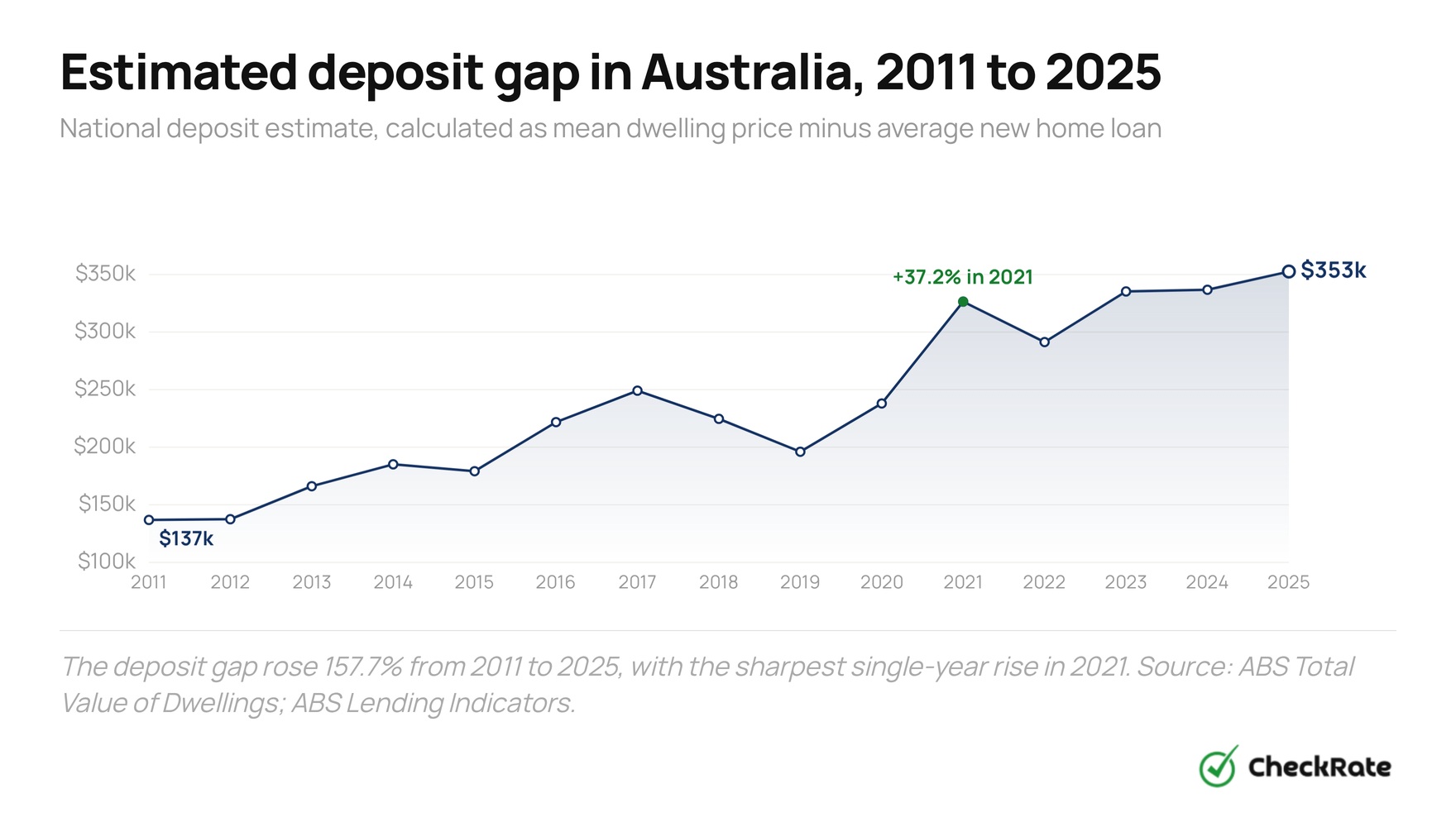
The estimated average deposit gap in Australia was about $352,500 at the end of 2025, equal to roughly 32.4% of the average property price. That figure has risen by about 96.7% since 2015.
Benchmark deposits on the 2025 national house price benchmark are lower: $150,375 at 20%, $75,188 at 10% and $37,594 at 5%. First-home buyers using a government guarantee had an implied deposit of around $31,000 to $33,000, based on 2024–25 scheme-user data.

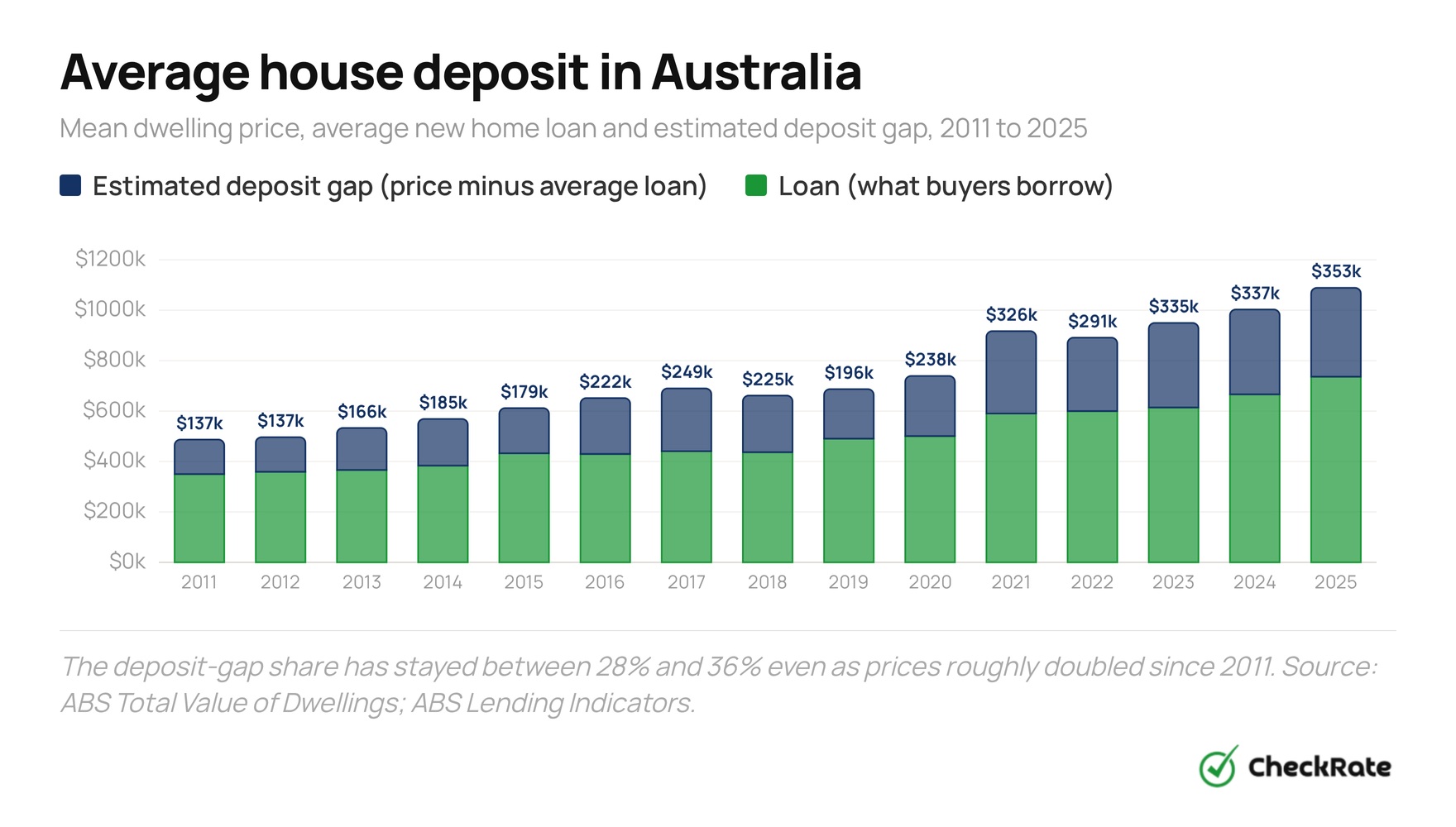
Two patterns stand out. The average property price has more than doubled since 2011, from about $486,900 to $1.09 million by December 2025. At the same time, the estimated deposit gap as a share of price has held in a fairly narrow band of 28% to 36%.
In simple terms, the deposit gap looks much larger today because the average property price underneath it has grown. As a share of the property price, the gap has been more stable.
How does the deposit change at 5%, 10% and 20%?
Using the 2025 national house price estimate of $751,875, the cash amount varies by tens of thousands of dollars depending on the deposit percentage. Fixed-percentage deposits show the cash required at 5%, 10% and 20%, while the estimated average deposit gap shows the difference between mean dwelling prices and average new loan sizes across the market.
5% of the $751,875 national house price estimate. LMI is more likely at this level unless a government guarantee applies.
10% of the $751,875 national house price estimate. LMI may still apply, although premiums are usually lower than at 5%.
20% of the $751,875 national house price estimate. This is the common benchmark at which LMI is usually not required.
The gap between 5% and 20% on the same house is more than $112,000. For a unit at the 2025 median of $603,500, those benchmarks drop to $30,175 at 5% and $120,700 at 20%.
Dwelling type and deposit percentage together make a larger difference to the cash benchmark than any single national average.
The estimated average deposit gap is the average property price minus the average home loan. It approximates what buyers may contribute as cash or equity across the whole market, rather than a direct survey of individual deposits. Benchmark deposits at 5%, 10% and 20% apply a fixed percentage to the median sale price, showing standard deposit scenarios rather than what buyers actually pay.
The national house and unit benchmark prices used in this article, $751,875 and $603,500, are modelled calculations built from ABS capital-city and rest-of-state median transfer prices. ABS does not publish a single national median transfer price directly in Table 2. Capital-city figures are shown as published.
First-home-buyer figures from the RBA and Housing Australia track specific buyer groups rather than the whole market and are covered in Section 07. No single government dataset records deposits for every property purchase in Australia, so the figures here combine the best available sources from multiple angles.
Which states need the largest house deposits?
In December 2025, the estimated average deposit gap was about $446,700 in New South Wales and $63,600 in the Northern Territory, a gap of about $383,100 between the highest and lowest jurisdictions. Geography is one of the largest drivers of the estimated deposit gap.
In 2025, the average property in New South Wales cost $1,319,500 and buyers borrowed an average of $872,752. That leaves an average deposit of $446,748, or 33.9% of the property price. The average deposit is up +80.3% compared with 2015. Across 2025, the average new home loan was about $830,900.
The deposit estimate is calculated as the ABS mean dwelling price at the December quarter minus the average new owner-occupier loan size for the same quarter. Median house and unit prices shown are capital-city medians, not separate state-wide medians.
Where has the estimated deposit gap grown fastest?
Queensland's estimated average deposit gap rose about 191.9% from 2015 to 2025, the biggest increase of any state. Tasmania followed at +185.2% and South Australia at +171.1%. All three started from a relatively low base in 2015 and have closed much of the gap to NSW. Victoria recorded the smallest mainland increase at +54.2%, and the Northern Territory was the only state where the estimated deposit gap fell, down about 50.9%.
Sorted by 2025 deposit size. The national average rose about 96.7% from $179,200 to $352,500 over the same period.
Source: ABS Total Value of Dwellings, Table 1; ABS Lending Indicators, Table 4. December-quarter endpoints.
How have Australia's house deposits changed over time?
The national deposit estimate rose from $136,800 at the end of 2011 to $352,500 at the end of 2025, an increase of about 157.7% over 14 years.
The estimate was little changed from 2023 to 2024, edging up from about $335,300 to $336,800, before rising to $352,500 in December 2025 as prices grew faster than loan sizes over the year.
How have rising loan sizes changed the deposit gap?
The national deposit estimate rose about 4.7% across 2025, as property prices grew slightly faster than average loan sizes. Average loan sizes grew from about $638,600 across 2024 to $694,400 across 2025 on a calendar-year average basis.
When average loan sizes rise closer to dwelling prices, the calculated deposit gap can stay flatter even as prices increase.
How much is the average house deposit in 2026?
Nationally, the mean dwelling price rose from $1,088,800 to $1,111,100 between December 2025 and March 2026, while the average new owner-occupier loan size was little changed, easing slightly from $736,257 to $734,881. Because loan sizes did not keep pace with mean dwelling prices, the estimated deposit gap widened faster in this one quarter than it did across all of 2025.
| State | Dec 2025 gap | Mar 2026 gap | Quarter change |
|---|---|---|---|
| New South Wales | $446,700 | $464,400 | +4.0% |
| Western Australia | $341,800 | $400,800 | +17.3% |
| Queensland | $338,300 | $382,600 | +13.1% |
| Australian Capital Territory | $345,700 | $352,800 | +2.0% |
| South Australia | $280,700 | $309,100 | +10.1% |
| Victoria | $272,800 | $272,500 | -0.1% |
| Tasmania | $217,700 | $229,300 | +5.3% |
| Northern Territory | $63,600 | $61,100 | -3.9% |
| Australia | $352,500 | $376,200 | +6.7% |
Source: Calculation from ABS Total Value of Dwellings, Table 1, and ABS Lending Indicators, Table 4. March Quarter 2026 compared with the December Quarter 2025 figures used elsewhere in this article.
State patterns varied widely in the first quarter of 2026. Western Australia recorded the largest increase, with its estimated deposit gap rising 17.3% in the quarter to about $400,800. That moved Western Australia ahead of Queensland and the ACT to become the second-largest estimated gap in the country.
Queensland rose 13.1%, and South Australia rose 10.1%. The Northern Territory was the only jurisdiction where the gap fell, down 3.9%, while Victoria was little changed, down 0.1%.
How much is a 20% house deposit by capital city?
A 20% deposit on the 2025 Sydney median house price of $1.51 million is $302,525, the highest of any Australian capital. Canberra is second at $203,675.
At the other end, Darwin's 20% benchmark is $130,110, less than half of Sydney's.
| Capital city | Median price | 5% deposit | 10% deposit | 20% deposit |
|---|---|---|---|---|
| Sydney | $1,512,625 | $75,631 | $151,263 | $302,525 |
| Canberra | $1,018,375 | $50,919 | $101,838 | $203,675 |
| Brisbane | $1,012,250 | $50,613 | $101,225 | $202,450 |
| Adelaide | $894,125 | $44,706 | $89,413 | $178,825 |
| Perth | $875,625 | $43,781 | $87,563 | $175,125 |
| Melbourne | $853,075 | $42,654 | $85,308 | $170,615 |
| Hobart | $725,000 | $36,250 | $72,500 | $145,000 |
| Darwin | $650,550 | $32,528 | $65,055 | $130,110 |
| Australia | $751,875 | $37,594 | $75,188 | $150,375 |
Source: ABS Total Value of Dwellings, Table 2, for capital-city median transfer prices. Figures use 2025 quarterly median house prices. The Australia row is a calculation from ABS Table 2 capital-city and rest-of-state median transfer prices, not a directly published ABS national median.
How much has a 20% house deposit increased in Australia?
A 20% deposit on the national house benchmark was $84,150 in 2015 and $150,375 in 2025, an increase of $66,225, or 78.7%, in a decade. The national house benchmark price rose from $420,750 in 2015 to $751,875 in 2025.
Regional vs capital city house deposits
A 20% deposit in the rest of South Australia is $105,475, about $73,000 less than the Adelaide equivalent of $178,825.
The 2025 medians outside the capitals are $527,375 for the rest of South Australia, $750,625 for the rest of Queensland and $780,500 for the rest of NSW.
Regional median prices can therefore produce lower 20% benchmark deposits than capital-city medians, although the size of the gap varies by state.
How much is a 20% unit deposit in Australia?
The largest dollar difference is in Sydney: a 20% deposit on the unit median of $840,575 is $168,115, which is $134,410 less than the Sydney house deposit.
Perth sits between Darwin and Melbourne, with a $49,975 gap between its house and unit 20% deposit figures. Units cost less than houses in every capital, so the 20% deposit is also lower.
Source: ABS Total Value of Dwellings, Table 2. Median house and unit or apartment transfer prices for each capital city. The national 20% deposit figures, $150,375 for a house and $120,700 for a unit, are built from ABS capital-city and rest-of-state median transfer prices, not directly published ABS national figures.
How has the deposit gap between houses and units changed?
The deposit gap between houses and units has grown from $10,370 in 2005 to $29,675 in 2025, nearly tripling over two decades.
In 2005, a 20% benchmark deposit on the median house was about $55,750, compared with $45,380 for a unit. House prices have risen faster than unit prices, particularly since 2020.
What is the average first-home buyer deposit in Australia?
Couples using the First Home Guarantee had an implied deposit of about $33,000 in 2024–25, based on a median purchase price of $660,000 and a 95% loan-to-value ratio.
Single borrowers had an implied deposit of about $31,000, based on a median purchase price of $521,000 and a 94% loan-to-value ratio.
First-home-buyer deposits vs the broader market
The median first-home-buyer deposit across the broader market was about $68,200 in the three years to 2019–20, measured in 2022–23 prices.
Among non-scheme first-home buyers from January 2020 to May 2022, the average deposit was $122,000, compared with about $34,000 for scheme participants.
The gap reflects that scheme borrowers typically purchased at lower price points and used higher loan-to-value ratios.
How much are first-home buyers borrowing?
The national average new first-home-buyer loan rose from $360,500 in 2015 to $607,600 in 2025, up 68.5% in a decade.
South Australia, Queensland and Tasmania recorded the biggest decade increases. A higher loan does not always mean a higher deposit, because many first-home buyers use a 5% to 10% deposit and borrow the rest.
Repayments on a loan of this size vary by interest rate, loan term, repayment type, lender and borrower profile.
House deposit calculator
Using the article's 2025 national house price estimate of $751,875, a 20% deposit is $150,375.
The worked example also includes a simplified upfront-cost allowance of $22,556, based on 3% of the property price. The example uses the national house price estimate; deposit and upfront-cost estimates change with the property price, state and buyer status.
- ABS: Total Value of Dwellings, March quarter 2026, mean dwelling prices and median transfer prices.
- ABS: Lending Indicators, March quarter 2026, owner-occupier and first-home-buyer loan commitments.
- Reserve Bank of Australia: Super for Housing, 2025, first-home-buyer deposit estimates from the ABS Survey of Income and Housing.
- Housing Australia: Home Guarantee Scheme Trends and Insights Report 2024–25, First Home Guarantee purchase prices and loan-to-value ratios.
- Housing Australia / NHFIC: First home buyer insights, 2022, broader first-home-buyer and scheme-borrower deposit comparison.
- Methodology: estimated deposit gap calculated as ABS mean dwelling price minus average new owner-occupier loan size for the same quarter; national house and unit price estimates are built from ABS median transfer-price data.
Data Snapshots