Average council rates in Australia: what ratepayers pay by state
Australian councils and the ACT government collected $25.1 billion in municipal rates in 2024–25. Indicative average annual bills for a typical residential property range from $1,775 in Adelaide to $3,188 in Sydney; Canberra's $4,241 reflects a single ACT Treasury household scenario rather than a comparable city average.
8 min read 15 June 2026Updated 08 July 2026 Fact checked
Key findings
$25.1bn
Total national municipal rate revenue in 2024–25, up from $16.9 billion a decade earlier
Highest indicative capital-city average annual rate, in Sydney (NSW)
48.8%
Growth in total national municipal rate revenue over the past 10 years, 2015–16 to 2024–25
Section 01What is a council rate
What are council rates and how do they work in Australia?
Australian councils and the ACT government collected $25.1 billion in municipal rates in 2024–25, up 49% over the previous decade. This figure covers all rateable land, including residential, commercial, industrial and rural properties, not residential ratepayers alone. The amount an individual property owner pays depends on the property's official value, the council's rate settings and any fixed charges added to the notice.
Unlike a power or water bill, council rates are not based on how much a person uses local services. A higher-value property usually pays more, but rate revenue is pooled and spent on shared local infrastructure and services. Most properties must pay rates. Depending on the state or territory, some land may be exempt, including certain Crown, charitable, religious or educational land. Each year, a council sets a rate multiplier, applies it to each property's official value, then adds fixed charges where they apply.
What council rates fund
Roads & footpaths
Construction, sealing, resurfacing, and ongoing maintenance of local roads, kerbing, gutters, and pedestrian paths.
Parks & open space
Maintenance of parks, ovals, playgrounds, street trees, and public green space across the local area.
Waste & recycling
Kerbside rubbish, recycling, and green waste collection, tip access, and household hazardous waste programmes.
Public libraries
Staffing, collections, digital resources, and building operations across branch and regional library networks.
Emergency management
Local flood and fire mitigation, evacuation infrastructure, emergency planning, and state emergency services levy contributions.
Community facilities
Aquatic centres, community halls, aged care services, arts facilities, childcare support, and local planning administration.
How a council rates notice is structured
Every rates notice has two main parts. The first is a variable charge based on the property's official value, which is usually set by a government valuer. The second is a set of fixed charges that can apply regardless of property value. These fixed charges, mainly waste collection and emergency services levies, help explain why a unit owner can sometimes pay a similar total bill to a nearby house owner despite owning a lower-value property.
Rates notice anatomy: how the bill is built
2025–26 financial year
Variable component: scales with the property value
General rate
Government-assessed property value × the council's rate multiplier
Varies per property
Fixed, minimum or service-based components: may apply depending on property type, council and services used
Waste collection charge
Set by the council; covers kerbside pickup and recycling services
Flat fee
State emergency services levy
Collected by the council on behalf of the state government
Flat fee
Minimum rate
Applied when the standard rate charge falls below the council's minimum (e.g. $1,206 in West Torrens, SA for 2025–26)
If applicable
Total annual rates notice
Payable annually or in quarterly instalments
General rate + fixed charges
Issued July–August each year
Council rates payment options and due dates
Councils usually send rates notices at the start of each financial year, often between July and August. Notices may arrive by post or email. Most councils allow ratepayers to pay the full annual amount upfront or split the bill across quarterly instalments. Late payment can attract penalty interest.
A
Option A: annual payment
Pay the full year in a single transaction
1
July – August
Rates notice issued and sent to the property owner
2
August – September
Full annual amount due. Exact date is printed on the rates notice.
Late payment: penalty interest applies from the due date. Victoria: 10% a year. Brisbane: 12.12% a year in 2025–26, rising to 12.19% for 2026–27, charged daily.
B
Option B: quarterly instalments
Four equal payments spread across the financial year
Q1
September
First instalment due
Q2
December
Second instalment due
Q3
March
Third instalment due
Q4
June
Final instalment due (financial year closes)
Payment dates are indicative. Exact due dates are printed on the rates notice and vary by council. Many councils offer quarterly instalments, and some also offer monthly direct debit, though exact payment options are set by each council and jurisdiction. Many councils publish hardship policies or payment arrangement options for ratepayers experiencing payment difficulty.
Section 02Council rates by state
Average council rates by state and capital city
What is the average council rate in Australia?
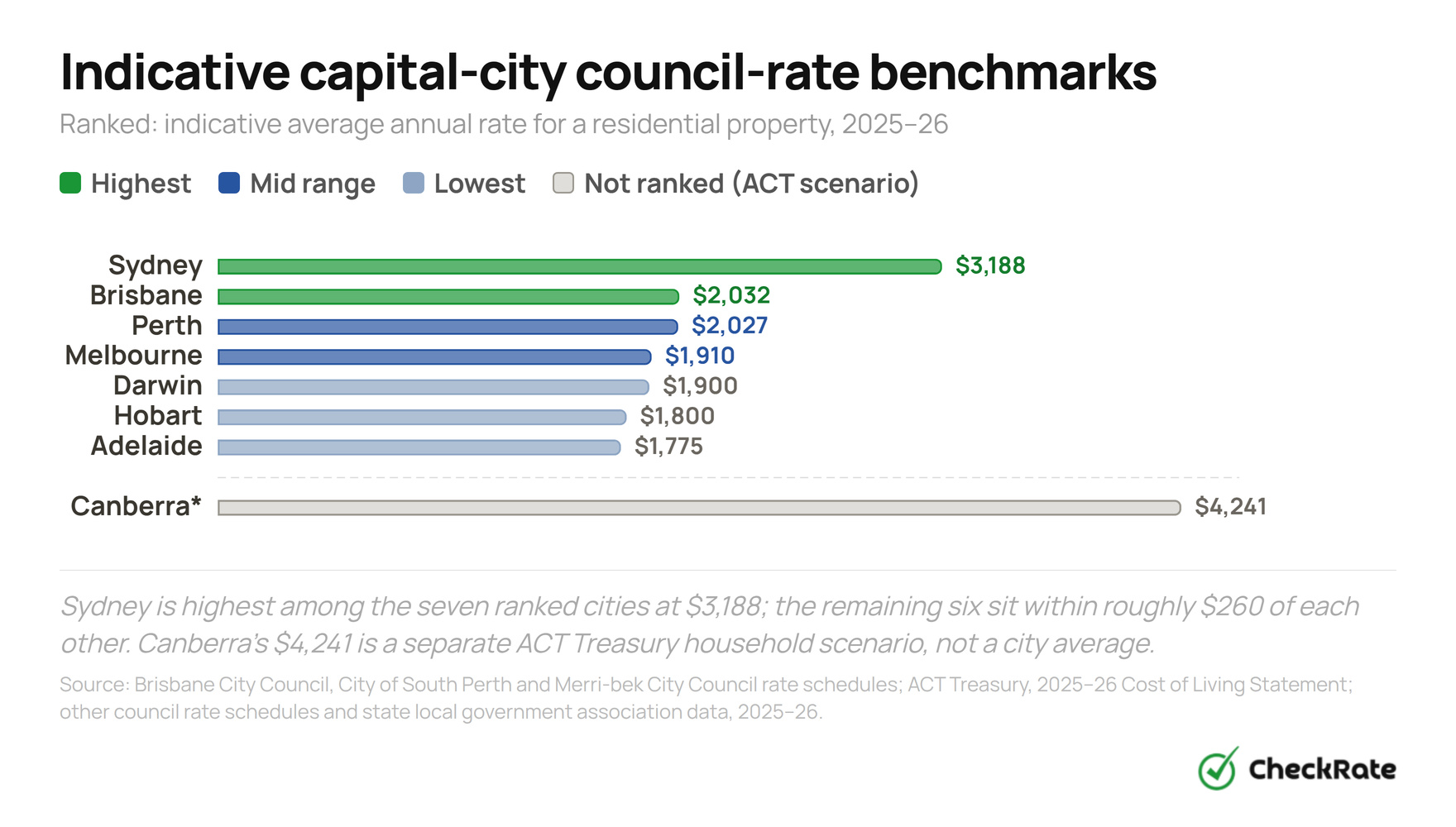
Across Australia's capital cities, the indicative residential council-rate benchmarks used in this article range from $1,775 in Adelaide to $3,188 in Sydney. These figures are not a standardised national survey and should not be read as directly comparable city averages. Canberra is excluded from that range because no equivalent average exists for it; the best available figure used here is a $4,241 ACT Treasury household scenario, discussed below. National municipal rate revenue, across all property types, reached $25.1 billion in 2024–25, up from $16.9 billion in 2015–16. The increase may reflect a mix of rising property values, population growth, new rateable properties and changes in council revenue settings.
Canberra's indicative figure of $4,241 is higher than every other capital-city benchmark used here, but it is not a like-for-like city average. It comes from ACT Treasury's Cost of Living Statement, which models household scenarios rather than publishing a single territory-wide rates figure. The $4,241 figure is the "Rates, PFESL, SFL, Health Levy" line for one scenario: a single, fixed-income retiree in an owner-occupied house in Cook, in the 2025–26 Budget papers. The ACT is also structurally different from the other capitals because it operates as a single-tier government with no separate municipal councils, and its long-running tax reform programme has shifted more revenue away from stamp duty and toward general rates. This makes ACT rates structurally different from council rates in other states.
Brisbane's indicative rates-only figure of around $2,032 is based on a $1,519 general rate for an owner-occupied house plus a standard $513 Waste Utility Charge, both published by Brisbane City Council for 2025–26. This separates council rates and waste charges from water and sewerage charges, which are billed separately in Brisbane and can make combined property-related bills look much higher.
Indicative capital-city council-rate benchmarks
Ranked: indicative average annual rate for a residential property, 2025–26
1
Sydney
$3,188
2
Brisbane
$2,032
3
Perth
$2,027
4
Melbourne
$1,910
5
Darwin
$1,900
6
Hobart
$1,800
7
Adelaide
$1,775
Highest
Mid range
Lowest
Not ranked with the cities above
Canberra: ACT Treasury household scenario
$4,241
Sydney is highest among the seven ranked cities at $3,188, and the remaining six sit within roughly $260 of each other. Canberra is shown separately below, unranked, because its $4,241 figure is an ACT Treasury household scenario for a single retiree's owner-occupied house, not a city average. The ACT's own 2026–27 Budget papers restate that same 2025–26 scenario at $4,990 (see Section 06).
Source: Brisbane City Council, City of South Perth and Merri-bek City Council rate schedules; ACT Treasury, 2025–26 Cost of Living Statement; other council rate schedules and state local government association data, 2025–26. See methodology note below.
About the data and the city figures
Sourcing quality varies across these seven cities. Brisbane, Melbourne and Perth are confirmed against council-published rate schedules; Sydney, Hobart and Darwin are directional estimates without a single named primary source. Adelaide's $1,775 is lower than the City of Adelaide's own reported average of about $2,260, likely because it reflects a different South Australian council rather than the capital's own CBD council. Canberra is excluded from this comparison; see below.
$6.6bn
Victoria generates the most rate revenue of any state
Victoria collected $6.636 billion in municipal rate revenue in 2024–25, ahead of NSW at $6.2 billion, even though NSW has more residential dwellings overall. This likely reflects a mix of rate base composition, valuation settings, council revenue requirements and the number and type of rateable properties across each state, rather than any single factor.
Victoria also limits how much councils can increase their total rate revenue each year. The cap was 3.0% for 2025–26, and the Essential Services Commission has since set a lower cap of 2.75% for 2026–27. That means councils cannot automatically convert rising property values into equivalent increases in total rate revenue.
National municipal rate revenue, 2015–2025
Total municipal rates collected by Australian councils and the ACT government, $ billions
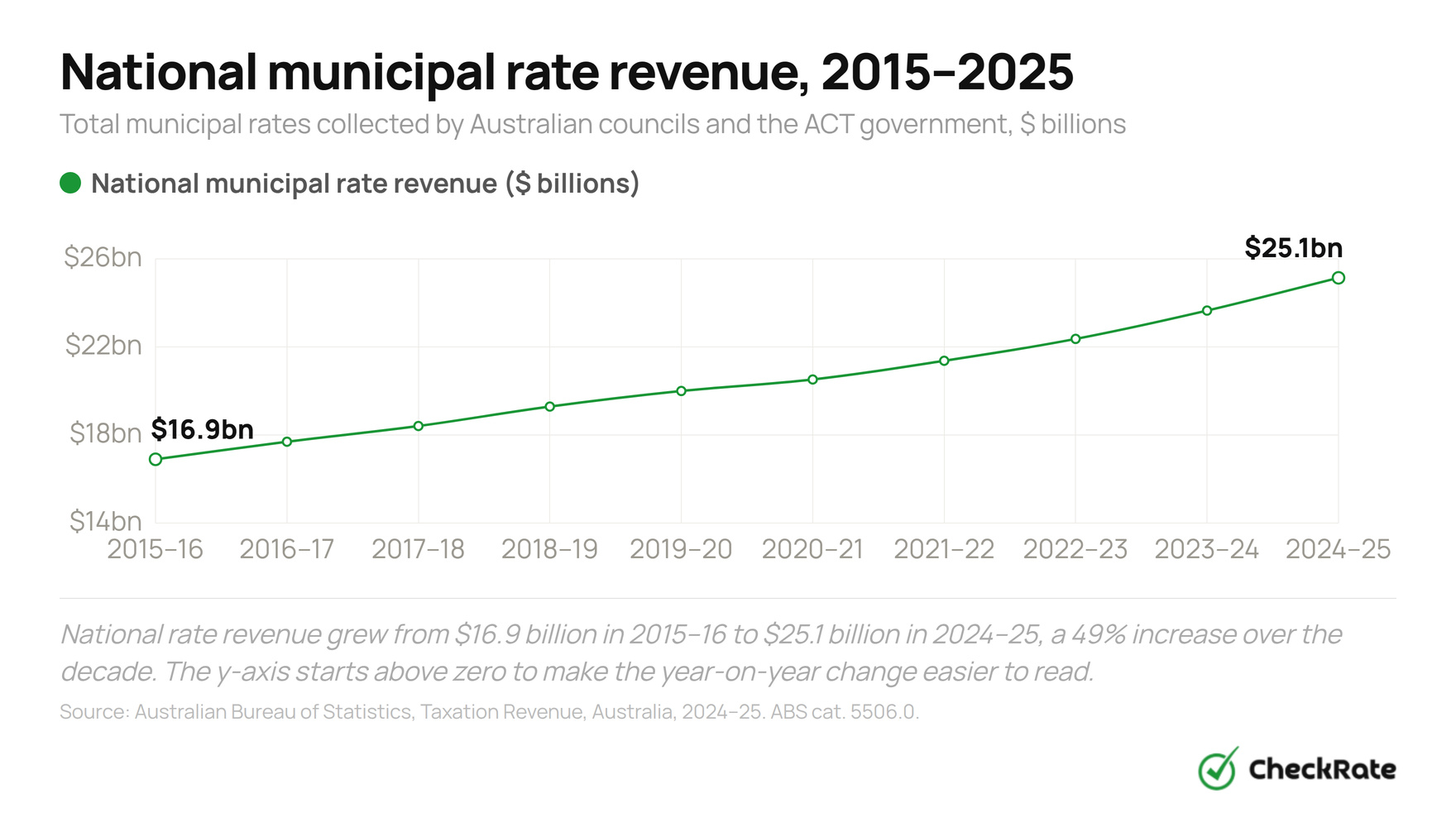
National rate revenue grew from $16.9 billion in 2015–16 to $25.1 billion in 2024–25, a 49% increase over a decade. The increase may reflect rising property values, population growth, new rateable properties and changes in council budgets or charges. Note: the vertical axis starts above zero to make the year-on-year change easier to read; the underlying growth is accurately stated as 49% regardless of the axis scale.
Source: Australian Bureau of Statistics, Taxation Revenue, Australia, 2024–25. ABS cat. 5506.0.
Property values increased across Australia over this period, but rate revenue growth does not come from property values alone. Total collections can also rise when the number of rateable properties increases, when councils change budgets or when charges and levies are adjusted. Victoria's rate cap limits annual increases in council rate revenue.
Municipal rate revenue by state, 2024–25
Rates revenue by jurisdiction, $ millions
State or territory
Total rate revenue
10-year change
Victoria
$6,636m
+39.8%
New South Wales
$6,200m
+49.5%
Queensland
$5,455m
+55.2%
Western Australia
$3,152m
+47.1%
South Australia
$2,134m
+48.8%
ACT
$812m
+92.0%
Tasmania
$568m
+51.5%
Northern Territory
$182m
+51.7%
Australia total: $25,138m · +48.8% over 10 years
Victoria and NSW collected the most rate revenue of any state, a combined $12.8 billion in 2024–25. Queensland recorded the highest mainland-state growth over the decade, at 55.2%. ACT municipal rates are recorded by the ABS under ACT State Government rather than local government, because the ACT does not have separate municipal councils; the figure here is drawn from ACT Treasury's own budget papers for consistency with the rest of the table. Rows sum to $25,139m against a published total of $25,138m; totals may not sum exactly because jurisdiction figures are independently rounded to the nearest million.
Source: Australian Bureau of Statistics, Taxation Revenue, Australia, 2024–25, detailed local government rates revenue tables; ACT Treasury, Budget 2025–26 for ACT general rates revenue.
The state totals can seem counterintuitive. NSW has more residential dwellings than Victoria, and Sydney's own average rate is higher than Melbourne's, yet Victoria collects more total rate revenue than NSW. This likely reflects differences in valuation bases, rate multipliers and the mix of properties across each state's full population of councils, rather than any single explanation. Queensland and Western Australia have seen strong growth in total collections, which may reflect population growth adding new rateable properties to the system.
Section 03Council rates for houses
Which capital city has the highest council rates for houses?
Among the seven non-ACT capital-city benchmarks used in this article, the indicative annual council-rate figure ranges from $1,775 in South Australia to $3,188 in New South Wales. These are capital-city proxies, not state-wide averages. The ACT's $4,241 figure sits above this range, but it is a modelled ACT Treasury household scenario rather than a directly comparable benchmark, so it is shown separately.
As a share of median house value, the ACT scenario is higher than any of the seven benchmarks at 0.40%. Because it is a single household scenario, that percentage should not be compared directly with the other figures. Among the seven benchmark states, the Northern Territory and Tasmania are highest at 0.25% and 0.24%, while Queensland and South Australia are lowest at around 0.18%. NSW has the highest capital-city median house price in the table at $1,485,000, and its indicative rate works out to 0.21% of that value.
Once Brisbane's figure is separated from water and sewerage charges, Queensland no longer appears as a high-rate jurisdiction in this proxy calculation. It sits among the lowest, alongside South Australia.
Indicative council-rate benchmarks for houses by state, 2025–26
Capital city median house price (March 2026) vs indicative annual council-rate benchmark (2025–26)
State (capital city)
Median house price
Benchmark annual rate
Rate as % of value
NSW (Sydney)
$1,485,000
$3,188
0.21%
VIC (Melbourne)
$850,000
$1,910
0.22%
QLD (Brisbane)
$1,150,000
$2,032
0.18%
SA (Adelaide)
$980,000
$1,775
0.18%
WA (Perth)
$1,000,000
$2,027
0.20%
TAS (Hobart)
$740,000
$1,800
0.24%
NT (Darwin)
$750,000
$1,900
0.25%
ACT (Canberra)*
$1,071,300
$4,241
0.40%
*The ACT row is not a capital-city benchmark like the other seven: it is ACT Treasury's Cook household scenario (a single retiree in an owner-occupied house), included for reference rather than direct comparison. Among the seven benchmark states, the Northern Territory is highest at 0.25%, while Queensland and South Australia are lowest, both at around 0.18%. Rate as a percentage is calculated by dividing the indicative annual council rate by the median house price. These figures are indicative because councils use official property assessments, which can differ from sale prices, and because rate settings, valuation bases and what counts as a "rate" vary by council and jurisdiction; see the methodology note in Section 02 for which figures are directly confirmed against a named source and which remain directional.
Source: Australian Bureau of Statistics, Total Value of Dwellings, March Quarter 2026, Table 2: Median Price and Number of Transfers; Brisbane City Council, City of South Perth, Merri-bek City Council, ACT Treasury and other council rate schedules, 2025–26.
A higher property price does not automatically mean a higher rate bill. NSW has the highest median house price in the country but a below-average effective rate percentage, since Sydney's rate multiplier is applied to a larger property value base. Queensland's earlier appearance of having a high effective rate was an artefact of combining rates with water and sewerage charges; on a rates-only basis it is one of the lowest in the country.
No single median house or unit price exists per state
The ABS publishes median house and unit prices by capital city only, not by state, so the tables and charts above use each capital city's median price as a proxy for its state. The ABS does publish one state-wide figure, the mean price of all residential dwellings (from $597,300 in the NT to $1,324,800 in NSW), but it blends houses and units together, so it can't be used in the house/unit breakdown above.
Section 04Council rates for units
Do unit owners pay higher council rates than house owners?
When the same indicative annual rate is compared with median house and unit prices in each capital city, units show a higher rate as a percentage of property value than houses in the same city. The gap is widest for the ACT scenario, where the modelled house is charged at 0.40% of property value and the modelled unit at 0.68%, a difference of 0.28 percentage points. This reflects one ACT Treasury household bill measured against two different median prices, not separately observed house and unit rates. Elsewhere, the gap is narrower: in Queensland, once the rates figure is corrected to exclude water and sewerage charges, the gap is about 0.06 percentage points, with units at 0.24% compared with houses at 0.18%.
Outside the ACT scenario, the main reason for the gap is fixed charges. A rates notice can include waste collection charges, emergency services levies and minimum contributions that do not always change based on what a property is worth. These charges can apply to both lower-value units and higher-value houses. Because fixed charges make up a bigger share of a lower-value property, this proxy calculation shows a higher effective rate for units than houses. Actual bills can differ where councils set different fixed charges, minimum rates or rating categories for units and houses.
Proxy effective council-rate burden for units by capital city, 2025–26
Capital city median unit price (March 2026) vs the same house benchmark rate applied as a proxy (2025–26)
State (capital city)
Median unit price
Benchmark rate applied†
Rate as % of value
NSW (Sydney)
$848,000
$3,188
0.38%
VIC (Melbourne)
$615,000
$1,910
0.31%
QLD (Brisbane)
$834,500
$2,032
0.24%
SA (Adelaide)
$740,000
$1,775
0.24%
WA (Perth)
$735,000
$2,027
0.28%
TAS (Hobart)
$610,000
$1,800
0.30%
NT (Darwin)
$430,000
$1,900
0.44%
ACT (Canberra)*
$625,000
$4,241
0.68%
†"Benchmark rate applied" reuses each state's house-table figure as a proxy, divided by the median unit price rather than the median house price; it is not an independently observed unit rate. *The ACT row uses the same ACT Treasury household scenario as the house table, measured against the median unit price instead, so it records the highest effective rate at 0.68%. This is a modelling artefact of one bill divided by a lower property value, not a separately observed unit rate. The Northern Territory has the highest state average at 0.44%.
Source: Australian Bureau of Statistics, Total Value of Dwellings, March Quarter 2026, Table 2: Median Price and Number of Transfers; Brisbane City Council, City of South Perth, Merri-bek City Council, ACT Treasury and other council rate schedules, 2025–26.
The ACT scenario's 0.68% is higher than every state average, but it describes one ACT Treasury household bill of $4,241 measured against a median unit price of $625,000, not a separately calculated unit rate. Once that ACT scenario is set aside, the house-versus-unit gap across the rest of the country ranges from about 0.06 percentage points in Queensland, South Australia and Tasmania to about 0.17 to 0.19 percentage points in NSW and the Northern Territory.
Fixed charges help explain higher effective rates for units
Fixed charges, such as the West Torrens minimum of $1,206 for 2025–26, apply regardless of property value. A flat $1,200 charge is 0.26% of a $460,000 unit but only 0.12% of a $1 million house. This is one reason effective rates run higher on lower-value properties, though exact rules vary by council.
Section 05How council rates are calculated
How are council rates calculated in Australia?
The short answer
Each council works out how much revenue it needs from rates, then applies its rating method to the official value of rateable properties in its area. Where a council uses capital value or capital improved value, the rate multiplier, also known as the rate in the dollar, is usually a small decimal. The exact multiplier varies by council, property category and valuation method. Councils that use a different valuation basis, such as Western Australia's Gross Rental Value system, use a differently scaled rate in the dollar, so one range cannot be applied nationally.
All Australian councils follow a similar seven-step process to set rates each year. A property owner's bill has two parts: a variable charge based on the property's official value, and a set of flat or service-based fees. Most people focus on the variable charge, but the flat fees can make up a large share of the total notice.
01
Council sets its annual budget Foundation step
Each council determines the total expenditure required to deliver community services and infrastructure for the upcoming financial year. This includes roads, waste collection, parks, libraries, and emergency management programmes.
02
Identify the funding shortfall
The council subtracts expected income from government grants, user fees, and other non-rate sources. The remaining gap is the amount that must be raised through property rates.
03
Independent property valuations are completed State government role
An independent government valuer assesses properties in the council's area. The value used for rates is an official assessment, not the property's sale price. This official value can differ from what the property would sell for on the open market, and the valuation basis itself differs by state: for example, capital value, unimproved value, gross rental value or assessed annual value.
04
Calculate the rate in the dollar
The council divides the total amount it needs by the combined official value of rateable properties in its area. Under a capital-value-based system, the resulting rate multiplier is usually between 0.001 and 0.005, meaning that for every $1,000 of a property's official value, the owner pays between $1 and $5 in the variable part of their rates. Councils using a different valuation basis, such as Gross Rental Value in Western Australia, apply a differently scaled rate in the dollar to reach a comparable bill.
05
Apply the rate to individual properties
Each property's official value is multiplied by the rate multiplier. A higher-value property usually produces a higher rate charge. Some councils charge different rates for different property categories, such as homes, businesses or farmland.
06
Add fixed supplementary charges Flat components
Fixed fees are added to the variable rate charge. These can include rubbish collection charges, state emergency services levies and minimum rates. They can apply regardless of property value, depending on the council and charge type. Many councils also set a minimum rate so that each rateable property contributes at least a base amount.
07
Issue the rates notice Payment due
The final rates notice is sent to the property owner and must be paid either as an annual lump sum or in quarterly instalments. Paying late can attract penalty interest.
Late payment attracts penalty interest
In Victoria, unpaid rates attract penalty interest at 10% a year. In Brisbane, it was 12.12% a year in 2025–26, rising to 12.19% for 2026–27, charged daily. Many councils publish hardship policies or payment arrangement options for ratepayers experiencing payment difficulty.
Section 062026–27 outlook
What's changing for council rates in 2026–27?
The short answer
The 2026–27 financial year began on 1 July 2026, and several jurisdictions have already confirmed their new rate settings. NSW's rate peg is lower than last year, Victoria's cap has been trimmed to 2.75%, Brisbane has confirmed a 3.97% average general rate rise, and the ACT's average residential bill is set to rise by around 5% even after a cost-of-living levy was scrapped. Other states set rates council by council each July without a single state-wide figure, so this section reports what has been confirmed so far rather than a complete national update.
Confirmed council rate movements for 2026–27
Rate caps, pegs and confirmed increases by jurisdiction
Jurisdiction
2025–26 setting
2026–27 setting
What changed
NSW
Base Cost Change 3.6%; core rate pegs 3.6%–5.1%; final pegs 3.7%–7.6%
Base Cost Change 3.0%; core rate pegs 2.5%–4.2%; final pegs 2.7%–5.7%
IPART's "core" pegs exclude each council's population factor; "final" pegs include it and are the more relevant figure for most ratepayers
VIC
Rate cap 3.0%
Rate cap 2.75%
Set by the Essential Services Commission; applies to each council's total rate revenue, not individual bills
QLD (Brisbane)
General rate $1,519
+3.97%
Brisbane City Council's confirmed 2026–27 average general rate increase for an owner-occupied house
ACT
$100 Health Levy (residential/rural); PFESL $426
Health Levy scrapped; PFESL $458
General rates component up an average 8% for residential and commercial; average total residential bill including levies still rises about 5% once the Health Levy removal is factored in
South Australia, Western Australia, Tasmania and the Northern Territory do not set a single state-wide rate cap or peg. Each council sets its own rate in the dollar as part of its annual budget, typically finalised in June or July, so there is no single confirmed 2026–27 figure to report for these states at this time.
Source: IPART, Information Paper: Rate pegs for NSW councils for 2026–27 (30 September 2025); Essential Services Commission Victoria; Brisbane City Council, Annual Plan and Budget 2026–27; ACT Treasury, 2026–27 Budget, handed down 10 June 2026.
In the ACT, the average figures hide a wide spread. Rate rises for houses in the 2026–27 Budget range from 4% in Belconnen to 13% in the inner-south suburbs of Forrest and Griffith; for units, the range runs from 2% in Wright and Hackett to 19% in Ainslie. The Police, Fire and Emergency Services Levy rises by $32 to $458, and the Safer Families Levy rises by $10 to $70, while the $100 Health Levy charged to residential and rural properties in 2025–26 (reduced from an originally announced $250 after negotiations with the ACT Greens) ends from 1 July 2026. Because the ACT calculates rates from suburb median values rather than a single territory-wide figure, the change for an individual property depends heavily on which suburb it is in.
The $4,241 Canberra scenario used earlier has since been restated by ACT Treasury
ACT Treasury's 2025–26 Budget put the Cook household's bill at $4,241. Its 2026–27 Budget restates that same 2025–26 figure as $4,990 and projects $4,309 for 2026–27, without explaining the gap. This article keeps $4,241 elsewhere for consistency with the 2025–26 reference year used for other states, but treat every Canberra figure here as indicative only.
In NSW, IPART says the 2026–27 core rate pegs range from 2.5% to 4.2% before each council's population factor, and the final rate pegs range from 2.7% to 5.7%. In Victoria, the Minister for Local Government has set the 2026–27 average rate cap at 2.75%. Brisbane City Council's 2026–27 Budget states that the average general rate increase for residential owner-occupied houses is 3.97%.
Section 07Calculator
Council rate calculator
Estimate a council rate
Select a state and enter a property value to estimate the annual council rate. This is a house-based proxy: it applies each capital city's indicative house rate as a percentage of property value, and does not separately model units or council-specific fixed charges; see the note below for ACT.
State or territory
Property value
Indicative capital-city rate as % of median property value: NSW 0.21% · VIC 0.22% · QLD 0.18% · SA 0.18% · WA 0.20% · TAS 0.24% · NT 0.25% · ACT* 0.40%
Estimated annual rate
$1,717
Based on New South Wales average
Quarterly payment
$429
If paying by instalments
Effective rate
0.21%
Rate as % of property value
This is a general estimate that applies the house-table effective rate for each capital-city proxy to the entered property value. It does not model a council-specific rates notice, and it does not separately account for units or council-specific fixed charges. Actual council rates depend on the council's official valuation, rate schedule, fixed charges, levies and concessions. For the ACT, the estimate uses one ACT Treasury household scenario rather than a territory-wide average.
General information only
This article is based on publicly available data from the ABS, local government sources and council rate schedules. It is general information only and does not constitute financial, legal or tax advice. Council rates can vary depending on the property, official valuation, council area, fixed charges, concessions and payment timing. Property-specific figures are set out in council rates notices, budget papers and published rates schedules.
Methodology: Effective rate percentages divide an indicative annual council rate by ABS median house or unit prices for the equivalent capital city, since the ABS publishes prices by capital city, not by state. City-level rate figures are drawn from a mix of council schedules, treasury documents and association data with different property assumptions, not a single standardised survey (see references above for per-city detail). The Canberra figure is a single ACT Treasury household scenario, not a city average, and should be treated as less reliable than the other seven cities' figures throughout. Actual rates depend on official valuations, local multipliers, fixed charges and levies, and vary between neighbouring councils in the same state.
Data Snapshots
Indicative capital-city council-rate benchmarksNational municipal rate revenue, 2015–2025