How much does it cost to own a home each year in Australia?
The true annual cost of owning a home in Australia, including mortgage repayments, insurance, council rates, maintenance, strata fees and water. State-by-state data for all eight states and territories.
10 min read 15 June 2026Updated 08 July 2026 Fact checked
Owning a home in Australia costs more than the mortgage. On top of the modelled repayment on the average new owner-occupier loan, at $4,369 per month in the March quarter of 2026, homeowners pay council rates, insurance premiums, water and wastewater bills, and ongoing maintenance costs. For houses, these non-mortgage costs add an estimated $14,000 to about $20,800 per year across the eight states and territories modelled in this article. For units, the range is lower because the model substitutes contents insurance and a strata levy for full building insurance and a house maintenance allowance. These figures show that recurring ownership costs can be materially higher than the mortgage alone.
The highest recurring cost is usually the mortgage, but other ownership costs can add materially to the annual bill. Insurance, council rates, water and wastewater charges, house maintenance and strata levies vary by location, property type and building condition, so this article separates each cost rather than presenting a single national ownership-cost figure.
Key findings
$4,369
Average monthly mortgage repayment for a new owner-occupier loan, March quarter 2026
+62%
Real increase in the average monthly repayment since 2019, adjusted for inflation to Q1 2026
+10%
Rise in the average home and contents premium across the rest of Australia in 2024–25 — the largest single-year increase of any region
$1,641
Median typical annual residential water and wastewater bill in 2024–25
Section 01Property prices in Australia
What a house or unit costs in Australia
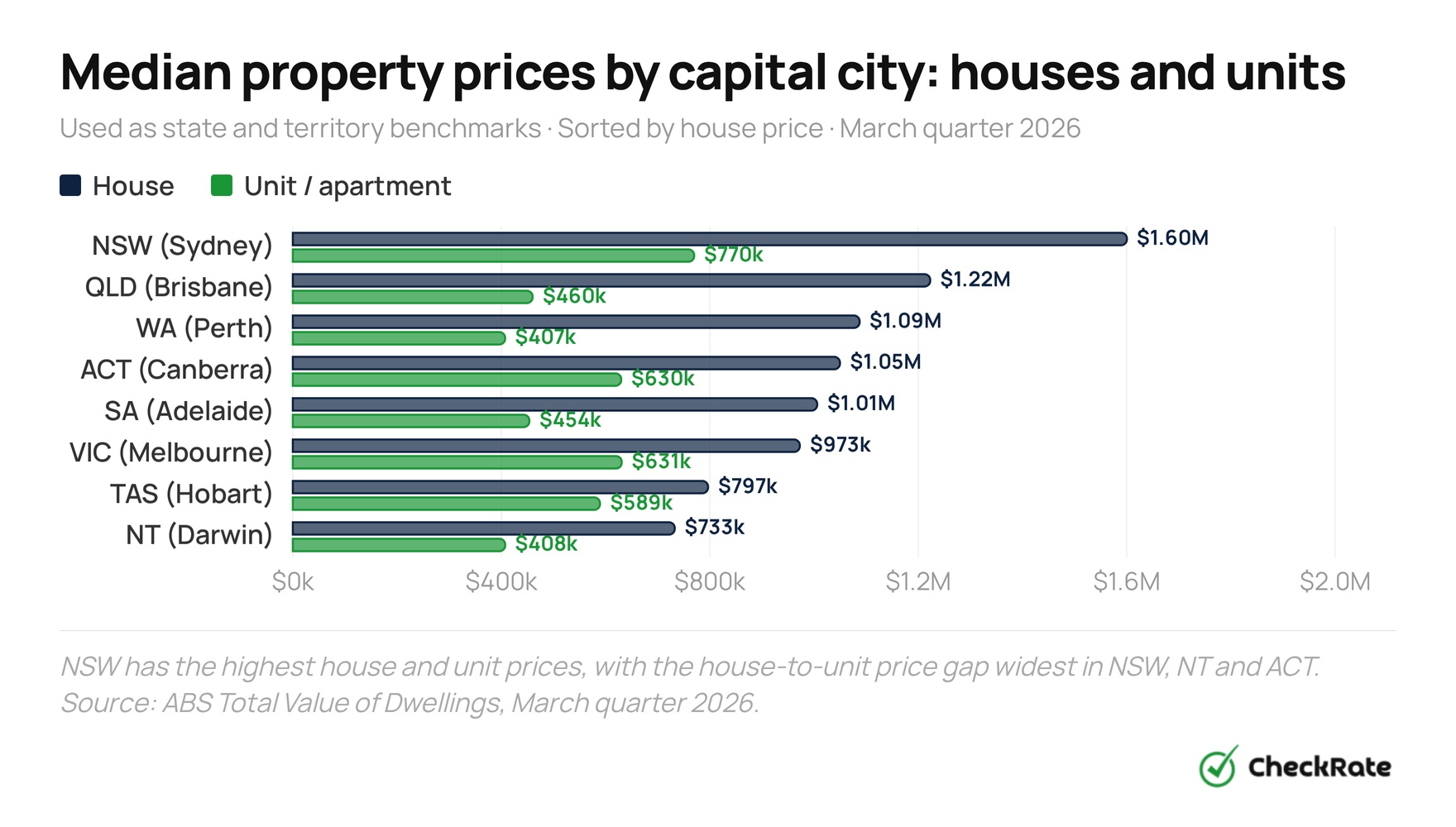
Before ongoing costs are added, the purchase-price benchmark needs to be clear. The ABS publishes median transfer prices by capital city and rest-of-state, rather than a single statewide figure. For this reason, the state and territory figures used throughout this article are capital-city medians, such as Sydney for NSW, Melbourne for Victoria and Brisbane for Queensland. On that basis, median house prices range from $740,000 in Hobart to $1,485,000 in Sydney, a difference of $745,000.
Units and apartments are cheaper than houses in every capital-city benchmark, although the size of the gap varies by market. New South Wales has both the largest dollar gap between houses and units, at $637,000, and the widest relative gap of any state benchmark. Sydney's median house price is around 1.75 times its median unit price.
The Northern Territory and the ACT are close behind, at roughly 1.74 and 1.71 times respectively. Tasmania has the narrowest relative gap, with Hobart's median unit price of $610,000 equal to around 82% of its median house price of $740,000. In Queensland, Brisbane's median unit price of $834,500 is around 73% of the median house price of $1,150,000.
A smaller purchase-price gap does not necessarily mean the same gap applies to ongoing ownership costs. Insurance, council rates, maintenance and strata levies can narrow or widen the difference between houses and units.
Median property prices by capital city: houses and units
Used as state and territory benchmarks · Sorted by house price · March quarter 2026
House
Unit / apartment
NSW has both the highest house and unit prices in this capital-city benchmark, and, together with the NT and the ACT, one of the widest relative gaps between houses and units. Houses cost around 1.7 to 1.75 times the median unit price in these markets. Queensland unit prices, at $834,500, are now close to NSW unit prices, at $848,000. Tasmania has the narrowest relative gap, with Hobart's median unit price around 82% of its median house price.
Source: ABS Total Value of Dwellings, March quarter 2026, median residential property transfer prices by capital city, including established house transfers and attached dwelling transfers. Released 9 June 2026. The ABS release includes median prices and counts of residential property transfers, and the next release, for June quarter 2026, is scheduled for 8 September 2026.
Section 02Monthly homeownership costs
What are the monthly costs of owning a home in Australia?
Most new buyers pay a mortgage, while all owners face recurring costs such as insurance, council rates and water bills. House owners also have separate maintenance costs, while unit owners usually pay strata levies instead. The six cost categories below apply from settlement and recur each year.
Mortgage
All owners
$4,369/month
National avg, March quarter 2026 · Range: $3,097–$5,112 by state
The largest monthly cost in the ownership model. This figure is the modelled repayment on the average new owner-occupier loan, using a 5.92% annual rate over a 30-year principal-and-interest term.
Insurance
All owners
$193/month
Rest-of-Australia avg, 2024–25 (ACCC) · Northern Australia significantly higher
Home and contents cover applies to houses. The rest-of-Australia average reached $2,310 per year in 2024–25. Northern Australia is much higher: the Northern Territory averaged $3,546 per year, while North Queensland averaged $3,117 per year. Unit owners typically need contents insurance rather than full building cover, because the owners corporation usually insures the building through strata. The exact cover depends on the strata policy.
Council rates
All owners
$208/month
Derived national average 2024–25 (ABS total rates revenue ÷ dwelling count) · Range: $164–$387/month by state
Council rates fund local services such as waste collection, roads, parks and community infrastructure. They are usually billed quarterly. In this derived estimate, the ACT is highest because territory-wide rates fund a broader service base. NSW is lowest as a share of property value despite having the highest property-price benchmark.
Water
All owners
$137/month
$1,641 per year, Bureau of Meteorology, 2024–25
Water costs include a fixed network access charge and variable usage charges. Some councils include water charges in rates notices. Larger households, larger gardens and properties with pools may have higher usage costs.
Maintenance
Houses only
$617–$1,238
Per month · Industry rule of thumb: 1% of property value annually · Estimate only, varies by property age and condition
A commonly used planning benchmark is 1% of a property's value per year for repairs and upkeep. The dollar amount varies by state and territory because house prices differ considerably across the country. This is an indicative long-term allowance, not a fixed annual bill.
Strata fees
Units only
$287–$565
Per month · Mid-range industry benchmark: 0.8% of unit value annually · Estimate only, varies by building and amenities
Strata levies cover building insurance, common-area maintenance, administration and capital works. Unit owners remain responsible for internal repairs, appliances and possible special levies.
House and unit costs are closer than purchase prices suggest
Unit owners avoid most exterior and common-property maintenance costs because these are usually covered through strata levies. However, they are still responsible for internal repairs, appliances and possible special levies. House owners carry higher upkeep costs and usually need full building insurance.
Section 03Mortgage repayments
Average mortgage repayments have more than doubled since 2019
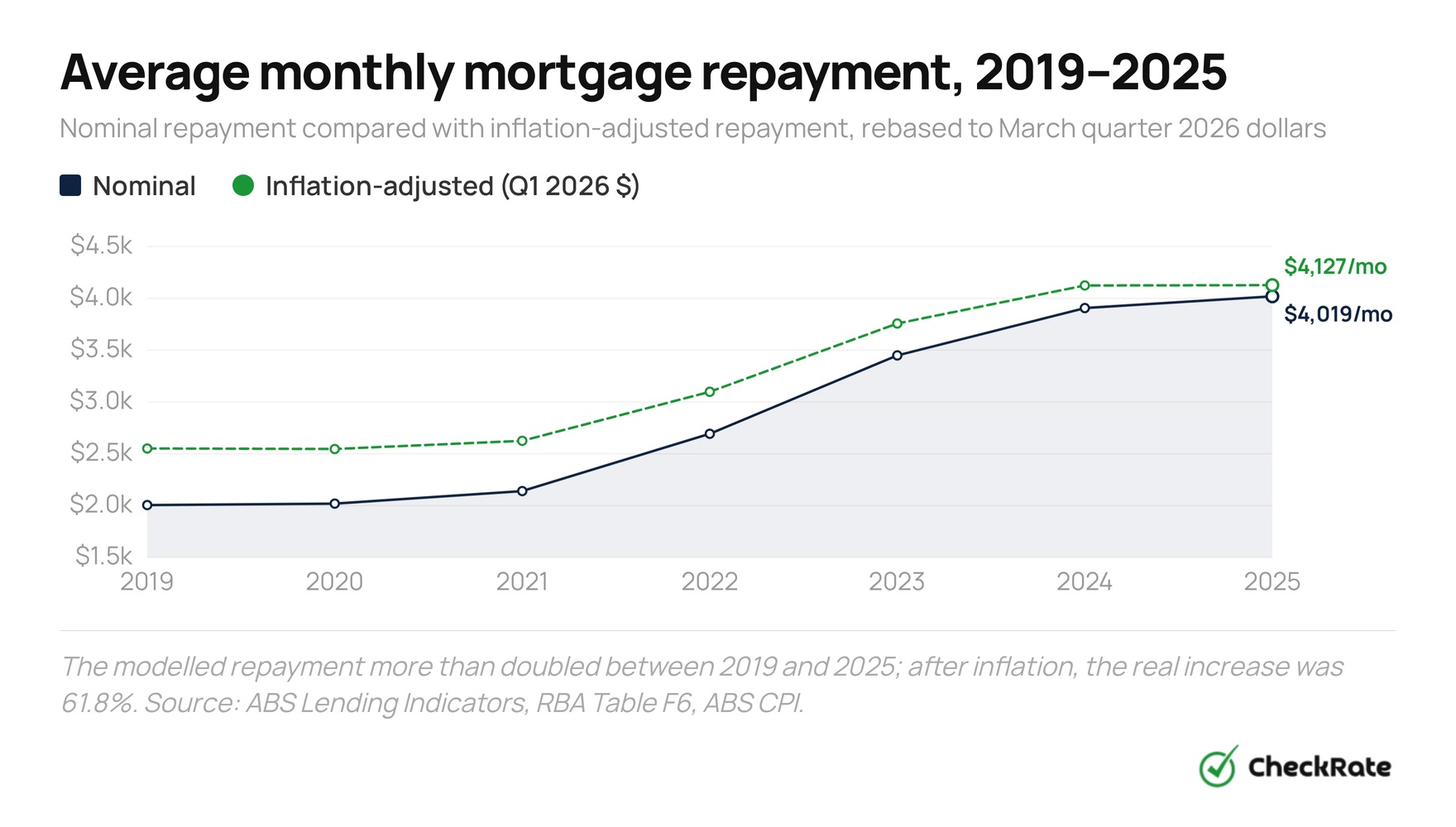
The mortgage is the largest single cost for most homeowners, and repayments on new owner-occupier loans have risen much faster than inflation since 2019. In 2019, the modelled repayment on the average new owner-occupier loan was about $2,005 per month. By 2025, that estimate had reached about $4,019, a nominal increase of just over 100%.
After inflation, the increase is smaller but still substantial. In March quarter 2026 dollars, the 2025 repayment of $4,019 is equivalent to $4,127. That means the real increase from 2019 was 61.8%. The sharpest single-year jump came between 2022 and 2023, when new-loan rates rose from 3.46% to 5.70% as the RBA lifted the cash rate.
Two factors drove the increase: interest rates rose from historic lows, and average loan sizes climbed. The national average new owner-occupier loan grew from $456,000 in 2019 to $693,000 in 2025, an increase of 52%, as property prices rose across most capital-city markets.
Average monthly mortgage repayment, 2019–2025
Nominal repayment compared with inflation-adjusted repayment, rebased to March quarter 2026 dollars
Nominal
Inflation-adjusted (Q1 2026 $)
The modelled monthly repayment more than doubled between 2019 and 2025. After inflation, the increase was 61.8%. The steepest rise came in 2022–23, when the average new-loan rate rose sharply.
Source: ABS Lending Indicators, new owner-occupier loan commitments, total value divided by number of commitments; RBA Statistical Table F6, average new-loan principal-and-interest rate; ABS Consumer Price Index, All Groups, rebased to March quarter 2026. Repayments assume a 30-year principal-and-interest loan. The ABS March quarter 2026 Lending Indicators release is current and reports new owner-occupier loan commitments by number and value.
$860k
Average new owner-occupier loan in NSW, March quarter 2026
That translates to a monthly repayment of $5,112, the highest of any state or territory. NSW borrowers are taking out loans roughly 65% larger than the Tasmania average of $521,000, which produces an estimated repayment of $3,097 per month.
Western Australia recorded the strongest annual loan growth in the March quarter of 2026, with the average new loan rising 18.4%. Queensland followed at 15.6%, while Tasmania recorded the slowest growth, at 7.0%.
Monthly mortgage repayment by state, average new owner-occupier loan
March quarter 2026 · 30-year P&I at 5.92% p.a.
NSW has the highest estimated repayment, at $5,112 per month. That is $2,015 more than Tasmania, where the estimated repayment is $3,097 per month. Western Australia had the fastest annual growth in average new loan size, rising 18.4% over the year.
Source: ABS Lending Indicators, March quarter 2026, seasonally unadjusted new owner-occupier loan commitments, total value divided by number of commitments. Repayments use the April 2026 RBA average new-loan principal-and-interest rate of 5.92% over a 30-year term. RBA lender interest-rate tables are published monthly.
Section 04Home insurance
Home insurance premiums are highest in northern Australia
Home and contents insurance is one of the fastest-rising costs in the ownership model. The ACCC's final Insurance Monitoring Report, published in June 2026, found that the average combined premium in the Northern Territory reached $3,546 per year in 2024–25, up 6% from $3,337 the previous year. In North Queensland, the average was $3,117, up 4%. In North Western Australia, it reached $4,966, up 8%.
The rest of Australia recorded the largest percentage increase of the four ACCC regions, rising 10% to $2,310. The ACCC linked premium growth across all regions to factors including cyclone and flood risk, higher sums insured, rising rebuilding costs and insurer repricing.
The location gap is large. Northern Australia carries the highest premiums in the country, reflecting greater exposure to cyclone and flood risk. The ACCC's SA3-level 2025 data shows that 22% of NT regions fall into the highest premium band, at $5,000 or more per year. These regions are Darwin City and East Arnhem. By comparison, only 1–2% of regions in NSW, Victoria and Queensland fall into this band, with none in the ACT, Tasmania or South Australia.
Tasmania has the largest share of regions in the lowest premium band, at 87%, followed by South Australia at 79%.
North Western Australia has the highest average home insurance premium
North Western Australia averaged $4,966 in 2024–25, the highest of the four ACCC regions. That was up 8% from $4,618 the previous year. The Northern Territory averaged $3,546, up 6%, while North Queensland averaged $3,117, up 4%. The ACCC also flagged affordability concerns across northern Australia, where households face higher premiums and more limited insurer choice.
Average annual home and contents insurance premium by region, 2023–24 and 2024–25
ACCC regional breakdown · Northern Australia vs rest of Australia · Source: ACCC Insurance Monitoring Report, June 2026
2023–24
2024–25
North Western Australia had the highest average premium in 2024–25, at $4,966 per year. The Northern Territory followed at $3,546, then North Queensland at $3,117. The rest of Australia had a lower average premium, at $2,310, but recorded the largest annual percentage increase, at 10%.
Source: ACCC Insurance Monitoring Report, June 2026, Table 6.1. Figures are mean retail premiums for combined home and contents insurance, inclusive of GST, stamp duty and applicable levies. The ACCC published its fifth report on 25 June 2026 under the insurance monitoring direction.
Share of SA3 regions with average home insurance premiums of $5,000 or more
Based on ACCC SA3-level premium-band data, 2025
NT
22%at $5,000+
WA
12%at $5,000+
NSW
2%at $5,000+
QLD
2%at $5,000+
VIC
1%at $5,000+
ACT
None
0%at $5,000+
TAS
None
0%at $5,000+
SA
None
0%at $5,000+
The NT has the highest concentration of high-premium regions, with 22% of its SA3 regions averaging $5,000 or more per year. WA follows at 12%, concentrated in the Pilbara, Kimberley and Gascoyne. NSW, Victoria and Queensland each have only 1–2% of regions in this band, while the ACT, Tasmania and South Australia have none. Tasmania has the highest share of regions in the lowest premium band, followed by South Australia and Western Australia.
Source: ACCC Insurance Monitoring Report, June 2026, Figure 6.1 supplementary data, SA3-level average combined home and contents premium bands, 2025. State shares are Check Rate calculations from the count of SA3 regions in each premium band. They are not published directly by the ACCC.
For unit owners, the insurance calculation is different. Building insurance is usually covered through the strata corporation, while individual owners are generally responsible for contents insurance. Strata insurance costs flow through to unit owners through levies.
The ACCC's final Insurance Monitoring Report found that strata insurance premiums were highest in North Western Australia, reaching $20,385 per year in 2024–25, up 13% from $18,009. The Northern Territory averaged $11,108, also up 13%, while North Queensland eased slightly to $9,154, down 1%. Outside northern Australia, the rest-of-Australia average was lower at $8,716 per year, up 8% from $8,040.
Section 05Council rates
Which states pay the highest council rates in Australia?
Council rates are levied each year to fund local services, including waste collection, roads, parks and community infrastructure. For many homeowners, rates are billed quarterly, but the annual total varies considerably by location.
The ACT is not directly comparable with state local councils because territory-wide general rates fund services that are split between state and local governments elsewhere. On this article's derived basis, the ACT has the highest indicative annual rates burden as a share of property value, at 0.43%. Tasmania and WA follow at 0.35% and 0.32% respectively.
NSW has the lowest derived rate relative to property value, at 0.13%. Despite having the highest property-price benchmark, NSW has the lowest derived annual council rates figure in the model, at around $1,970 per year.
These are indicative estimates, not observed average bills. The dwelling count used as the denominator comes from the 2021 Census and has not been updated for housing growth since then, so current averages may differ from the figures shown.
Average council rates by state, 2024–25
Derived monthly and annual rates, ranked by effective rate as a share of median house value
ACT
$387/mo$4,640/yr
TAS
$218/mo$2,610/yr
WA
$267/mo$3,200/yr
NT
$190/mo$2,280/yr
SA
$244/mo$2,930/yr
VIC
$204/mo$2,450/yr
QLD
$223/mo$2,680/yr
NSW
$164/mo$1,970/yr
The ACT ($387/month) stands apart due to its territory-wide rates structure. NSW has the lowest rate as a proportion of property value (0.13%) despite the highest property prices.
Source: ABS Taxation Revenue 2024–25, ABS Census 2021 and ABS Total Value of Dwellings, March quarter 2026. Rates are derived estimates and vary by council, property type and valuation method.
Council rates by state, 2024–25
Derived monthly and annual rates, ranked by effective rate as a share of median house value
State / territory
Monthly rates
Annual rates
Rate as % of value
ACT
$387
$4,640
0.43%
TAS
$218
$2,610
0.35%
WA
$267
$3,200
0.32%
NT
$190
$2,280
0.30%
SA
$244
$2,930
0.30%
VIC
$204
$2,450
0.29%
QLD
$223
$2,680
0.23%
NSW
$164
$1,970
0.13%
Source: ABS Taxation Revenue 2024–25, ABS Census 2021 and ABS Total Value of Dwellings, March quarter 2026. Rates are derived estimates and vary by council, property type and valuation method.
Section 06Repairs and maintenance
Estimated house maintenance costs by capital city
Maintenance costs do not arrive on a fixed schedule, but they build up over time. This article uses a 1% annual allowance as an indicative long-term benchmark for repairs, upkeep and gradual replacement of fixtures and fittings.
Some years require little spending. Others may include a hot water system replacement, roof repair, fence rebuild or appliance replacement. The 1% figure is a long-term estimate rather than a precise annual cost, and actual spending varies by property age, condition and location.
NSW estimate
$1,238/mo
$14,850/yr · Median house $1.485M
VIC estimate
$708/mo
$8,500/yr · Median house $850k
TAS estimate
$617/mo
$7,400/yr · Median house $740k
Estimated annual house maintenance costs by capital city
Indicative monthly and annual allowance using 1% of median house price, March quarter 2026
State / territory
Median house price
Monthly allowance
Annual total (1%)
NSW
$1,485,000
$1,238
$14,850
QLD
$1,150,000
$958
$11,500
ACT
$1,071,300
$893
$10,713
WA
$1,000,000
$833
$10,000
SA
$980,000
$817
$9,800
VIC
$850,000
$708
$8,500
NT
$750,000
$625
$7,500
TAS
$740,000
$617
$7,400
The 1% rule is an indicative long-term benchmark, not a precise annual bill. Some years may require little maintenance spending, while others may include major repairs or replacements. The estimate is higher in more expensive capital-city markets because it is applied to the median house price.
Source: ABS Total Value of Dwellings, March quarter 2026, median established house transfer prices by capital city. Maintenance estimate applies a 1% annual allowance to each capital-city median house price. This is an indicative industry benchmark, not an official ABS maintenance-cost measure. Actual annual spending varies by property age, condition, location and repair needs.
Owners of strata-titled properties, such as apartments and townhouses, do not usually budget for building-level maintenance in the same way as house owners. Their strata levies include contributions to a capital works fund managed by the owners corporation, which covers building repairs and common-area upkeep. As Australia's dwelling mix shifts away from detached houses, strata costs are becoming part of ownership for a growing share of buyers.
Section 07Strata fees
Estimated strata fees by capital city for median-priced units
For unit and apartment owners, the strata levy replaces some costs that house owners usually pay separately, including building-level maintenance and, in most cases, building insurance. The amount depends on the building's age, amenities, insurance costs, capital works fund and owners corporation decisions.
0.3–0.5%
Basic
Walk-up buildings with no lifts or pool, minimal gardens and shared areas.
0.6–0.8%
Mid-range
Standard modern apartments with a lift, communal gym, or shared outdoor facilities.
0.9–1.2%+
High-end
Luxury high-rises with multiple lifts, heated pool, concierge, and extensive facilities.
Using the mid-range benchmark of 0.8%, the table below shows estimated monthly levies based on median attached dwelling prices in each capital city, used as a benchmark for each state. An NSW unit owner at the Sydney median price of $848,000 can expect to pay around $565 per month ($6,784 per year) in levies. Queensland now has the second-highest unit median at $834,500, making its estimated levy of $556 per month among the highest in the country.
Estimated strata levies by capital city
Monthly levy and annual total · ABS median attached dwelling prices, March quarter 2026 · mid-range benchmark of 0.8% per year
State / territory
Median unit / apt price
Monthly levy (0.8%)
Annual equivalent
NSW
$848,000
$565
$6,784
QLD
$834,500
$556
$6,676
SA
$740,000
$493
$5,920
WA
$735,000
$490
$5,880
ACT
$625,000
$417
$5,000
VIC
$615,000
$410
$4,920
TAS
$610,000
$407
$4,880
NT
$430,000
$287
$3,440
These are mid-range estimates based on an industry benchmark, not observed average strata bills. Basic walk-up buildings without lifts may have lower levies, while high-amenity buildings with pools, lifts and concierge services may have higher levies. Actual levies are set by the owners corporation and depend on building age, insurance costs, maintenance needs and capital works requirements.
Source: ABS Total Value of Dwellings, March quarter 2026. Strata levies are estimated using 0.8% of median attached dwelling prices. Figures are indicative and vary by building, amenities, insurance costs and capital works needs.
Section 08Water rates
Water and wastewater bills add about $137 per month
Water and wastewater costs are typically one of the smaller recurring ownership expenses, but they still belong in the full ownership cost model. Most homeowners pay a fixed access charge for network maintenance and connection, plus variable usage charges based on consumption.
Monthly bill
$137/month
Typical residential bill (approx)
Annual bill
$1,641/year
Bureau of Meteorology, 2024–25
Source: Bureau of Meteorology, National Performance Report: Water and wastewater service providers, 2024–25. Figures are national median typical residential customer bills and vary by utility, household size, usage and billing arrangements.
In the Bureau of Meteorology's 2024–25 dataset, the median typical residential customer bill for drinking water supply and wastewater was about $1,641 per year, or $137 per month. Exact bills vary by utility, household size, usage, location and whether water and wastewater charges are billed separately or through council rates.
General information only
This article uses publicly available data from the ABS, RBA, ACCC and Bureau of Meteorology, together with clearly labelled assumptions for repayments, maintenance, strata levies, council rates, insurance and water costs. It is general information only and does not constitute financial, legal or tax advice.