


Published
 Is a retiree who moves overseas still an Australian tax resident?How the ATO's residency tests apply to retirees who move abroad.
 How is Australian super taxed for non-residents?Tax on super income streams and lump sums paid to members living overseas.
 How do a super pension and a lump sum compare before retiring overseas?How the choice between an income stream and a lump sum affects tax, the Age Pension and currency.
Section 01 · Tax residency
When does a retiree stop being an Australian resident for tax purposes?
A retiree who moves overseas stops being an Australian resident for tax purposes when they no longer reside in Australia and do not meet any of the three statutory tests, according to the Australian Taxation Office (ATO)1. The resides test is the primary test, and a person who resides in Australia is a resident without applying the other tests.
Factors used to decide whether a person resides in Australia include1:
- physical presence
- intention and purpose
- family
- business or employment ties
- where assets are kept and maintained
- social and living arrangements.
A person whose domicile is in Australia remains a resident under the domicile test unless the ATO is satisfied that their permanent place of abode is outside Australia1.
In the ATO's example, a taxpayer who moved overseas with their family on a three-year contract, set up a home there and rented out the Australian family home was a foreign resident under both the resides test and the domicile test1.
In a 2013 Administrative Appeals Tribunal decision, a person who did not cut their connection with Australia was treated as an Australian resident1.
In the income year of departure, a person whose status changes from resident to foreign resident is taxed at resident rates for that year and receives a pro-rata tax-free threshold1. The threshold is $13,464, plus $4,736 divided by 12 for each month of Australian residence, counting the month of departure2. In the ATO's example, a taxpayer who became a foreign resident on 22 December 2025 had six months of residence and a tax-free threshold of $15,832 for 2025-26.
When Australian tax residency ends, assets other than taxable Australian property, such as shares in listed companies, are taken to have been disposed of at market value on that day for capital gains tax (CGT) purposes3. Australian real estate is taxable Australian property, so it is not part of this deemed disposal.
An individual can instead choose to disregard all of these gains and losses. The assets are then treated as taxable Australian property until they are sold or the person becomes a resident again3. A person who was an Australian resident for the whole time they owned an asset can claim the full 50% CGT discount on its deemed disposal.
| Australia's tax residency tests for individuals | |
|---|---|
| Test | A person is an Australian resident for tax purposes if |
| Resides test | The person resides in Australia, judged on factors such as physical presence, intention, family, work ties, assets and living arrangements1 |
| Domicile test | The person's domicile is in Australia, unless the ATO is satisfied that their permanent place of abode is outside Australia1 |
| 183-day test | The person is in Australia for more than half the income year, unless their usual place of abode is outside Australia and they do not intend to take up residence1 |
| Commonwealth superannuation test | The person is an Australian Government employee at an overseas post who contributes to the Commonwealth Superannuation Scheme or the Public Sector Superannuation Scheme, or is that employee's spouse or child under 161 |
Source · ATO, Your tax residency.
How a deemed disposal fits with other capital gains tax events is covered in what triggers capital gains tax in Australia.
Section 02 · Australian income
How is Australian income taxed for foreign residents?
A foreign resident pays Australian tax on Australian-sourced income at foreign resident rates, which in 2025-26 were 30% on the first $135,000 of taxable income, 37% from $135,001 to $190,000 and 45% on taxable income of $190,001 or more5. Foreign residents have no tax-free threshold and do not pay the Medicare levy6.
A foreign resident declares Australian employment income, rental income, Australian pensions and annuities, and capital gains on taxable Australian property in an Australian tax return6. From the date a person stops being an Australian resident, foreign-source income is no longer declared in an Australian tax return1.
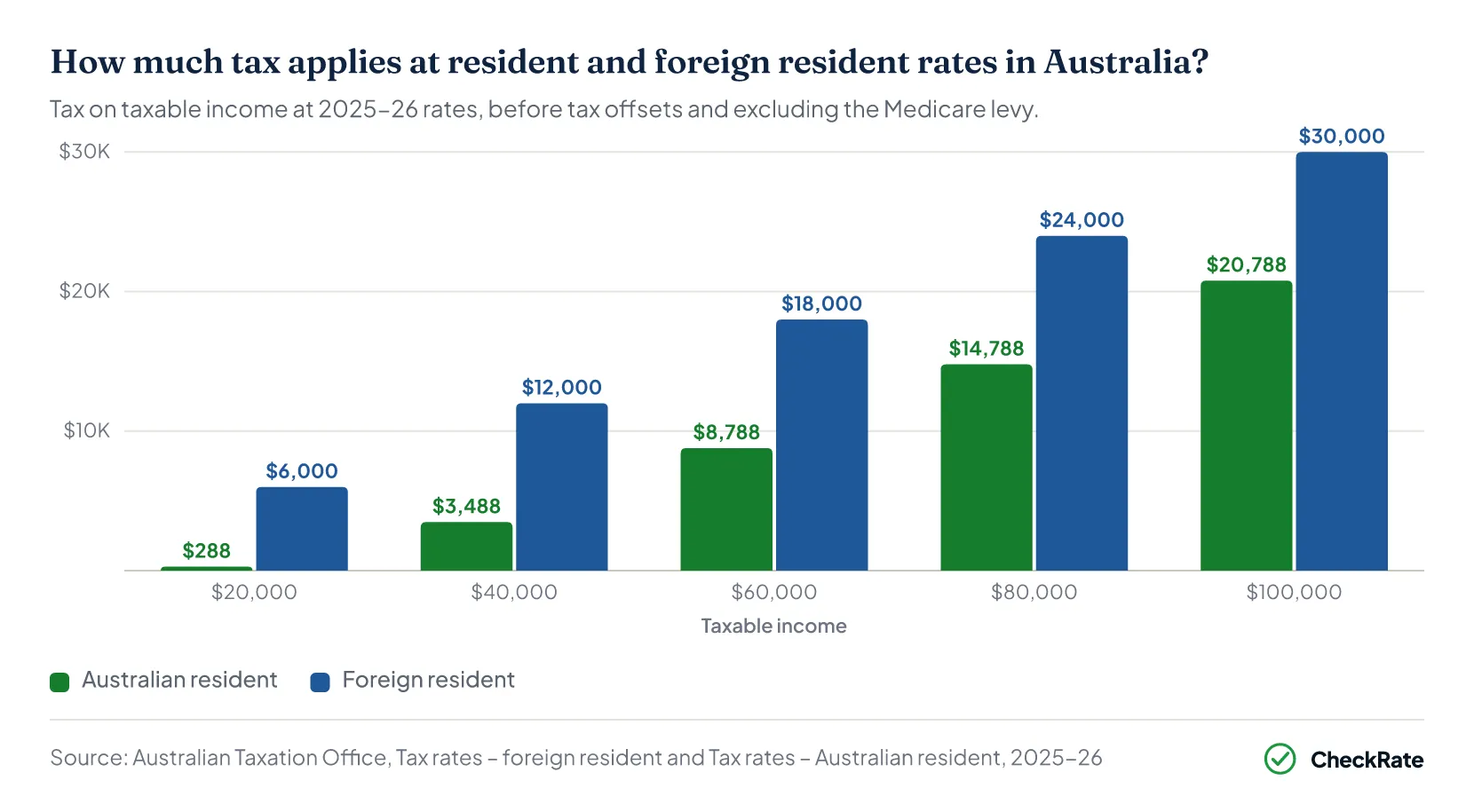
At $60,000 of taxable income, tax at 2025-26 foreign resident rates was $18,000, compared with $8,788 at resident rates57. This is an illustrative calculation of tax on taxable income before tax offsets and excluding the Medicare levy, based on the ATO's 2025-26 rate tables.
From $45,000 of taxable income upwards, a foreign resident paid $9,212 more tax in 2025-26 than a resident on the same income, on the same basis75. The whole gap arises on the first $45,000: a foreign resident pays 30% on the first $18,200, where a resident pays nothing, and 30% rather than 16% from $18,201 to $45,0007.
Australian interest, unfranked dividends and royalties paid to a foreign resident are taxed by withholding at the time of payment and, once tax has been withheld, are not declared in an Australian tax return8. Where no tax treaty applies, the rates are 10% on interest and 30% on unfranked dividends and royalties.
A payer that has not been given the investor's overseas address may withhold tax at 47%8.
| Australian withholding tax on investment income paid to foreign residents | ||
|---|---|---|
| Income | Rate where no tax treaty applies | Where a tax treaty applies |
| Interest | 10%8 | Some agreements exempt interest from withholding in certain circumstances |
| Unfranked dividends | 30%8 | Most agreements reduce the rate to 15%8 |
| Royalties | 30%8 | Most agreements reduce the rate to 10%8 |
Source · ATO, Interest, unfranked dividends and royalties.
How income tax, the Medicare levy and other taxes fit together is covered in how the Australian tax system works.
Section 03 · Tax treaties
How do Australia's double tax agreements apply to retirees overseas?
Under Australia's tax agreements with Thailand, Poland and Malaysia, pensions and annuities paid to a resident of one country are taxable only in that country91011. Thailand and Malaysia apply separate rules to government service pensions, while Poland includes government pensions in its general pension rule911.
The Treasury lists 47 countries and jurisdictions with income tax agreements with Australia, including Thailand, Poland and Malaysia12. One of the 47, the agreement with Greece, covers airline profits only.
A treaty sets which country may tax each type of income, and it can limit the tax charged by the country where the income arises on dividends, interest and royalties8.
Income from real property, such as rent from an Australian home, may be taxed in the country where the property is located under all three agreements91011. Australian tax on dividends paid to an individual is limited to 15% under the Poland and Malaysia agreements, while the Thailand agreement sets limits only for a company holding at least 25% of the paying company10119.
| Selected articles of Australia's tax agreements with Thailand, Poland and Malaysia | |||
|---|---|---|---|
| Article | Thailand | Poland | Malaysia |
| Signed and in force | Signed 31 August 1989, in force 27 December 198912 | Signed 7 May 1991, in force 4 March 199212 | Signed 20 August 1980, in force 26 June 1981, amended by protocols signed in 1999, 2002 and 201012 |
| Pensions and annuities | Taxable only in the country of residence, other than government service pensions9 | Taxable only in the country of residence, including government pensions10 | Taxable only in the country of residence, other than government service pensions11 |
| Income from Australian real property | May be taxed in Australia | May be taxed in Australia | May be taxed in Australia |
| Dividends | Limits of 15% and 20% apply only to a company holding at least 25% of the paying company9 | No more than 15%10 | No more than 15%, with franked dividends exempt for a company holding at least 10%11 |
| Interest | No more than 10% for financial institutions and 25% in other cases9 | No more than 10%10 | No more than 15%11 |
Source · ATO, synthesised texts of the agreements with Thailand, Poland and Malaysia; Treasury, Income tax treaties.
The three agreements are compared in more detail in double tax agreements for retirees in Thailand, Poland and Malaysia.
Section 04 · Superannuation
How is Australian super accessed and taxed after a move overseas?
For Australian citizens and permanent residents, moving overseas is not a condition of release, so their superannuation stays preserved, according to the ATO. The ATO lists leaving Australia as a ground for early access only for temporary residents13. Super can be withdrawn from age 65, or after reaching preservation age and meeting the retirement condition of release.
Preservation age is 60 for anyone born from 1 July 196413. Retirement means ceasing paid employment at age 60 or older, or ceasing employment before age 60 after reaching preservation age, where the fund must be satisfied that the member does not intend to work again.
From age 60, lump sums and account-based income stream payments from the tax-free component and the taxed element are not taxed in Australia14. Inside the fund, investment earnings are taxed at 15% in the accumulation phase and are tax-free in the retirement phase, subject to the transfer balance cap.
| Superannuation preservation age by date of birth | |
|---|---|
| Date of birth | Preservation age (years) |
| Before 1 July 196013 | 55 |
| 1 July 1960 to 30 June 1961 | 56 |
| 1 July 1961 to 30 June 1962 | 57 |
| 1 July 1962 to 30 June 1963 | 58 |
| 1 July 1963 to 30 June 1964 | 59 |
| From 1 July 1964 | 60 |
Source · ATO, When you can withdraw your super.
Access rules for members who live outside Australia are covered in accessing Australian super while living overseas.
Section 05 · Age Pension
Can the Age Pension be paid to retirees living overseas?
The Age Pension may continue to be paid to a pensioner who leaves Australia to live in another country, according to Services Australia1516. It is paid every four weeks at the rate for people outside Australia. For a pensioner who leaves Australia to live overseas, the Energy Supplement and the Pension Supplement stop and the Pensioner Concession Card is cancelled15.
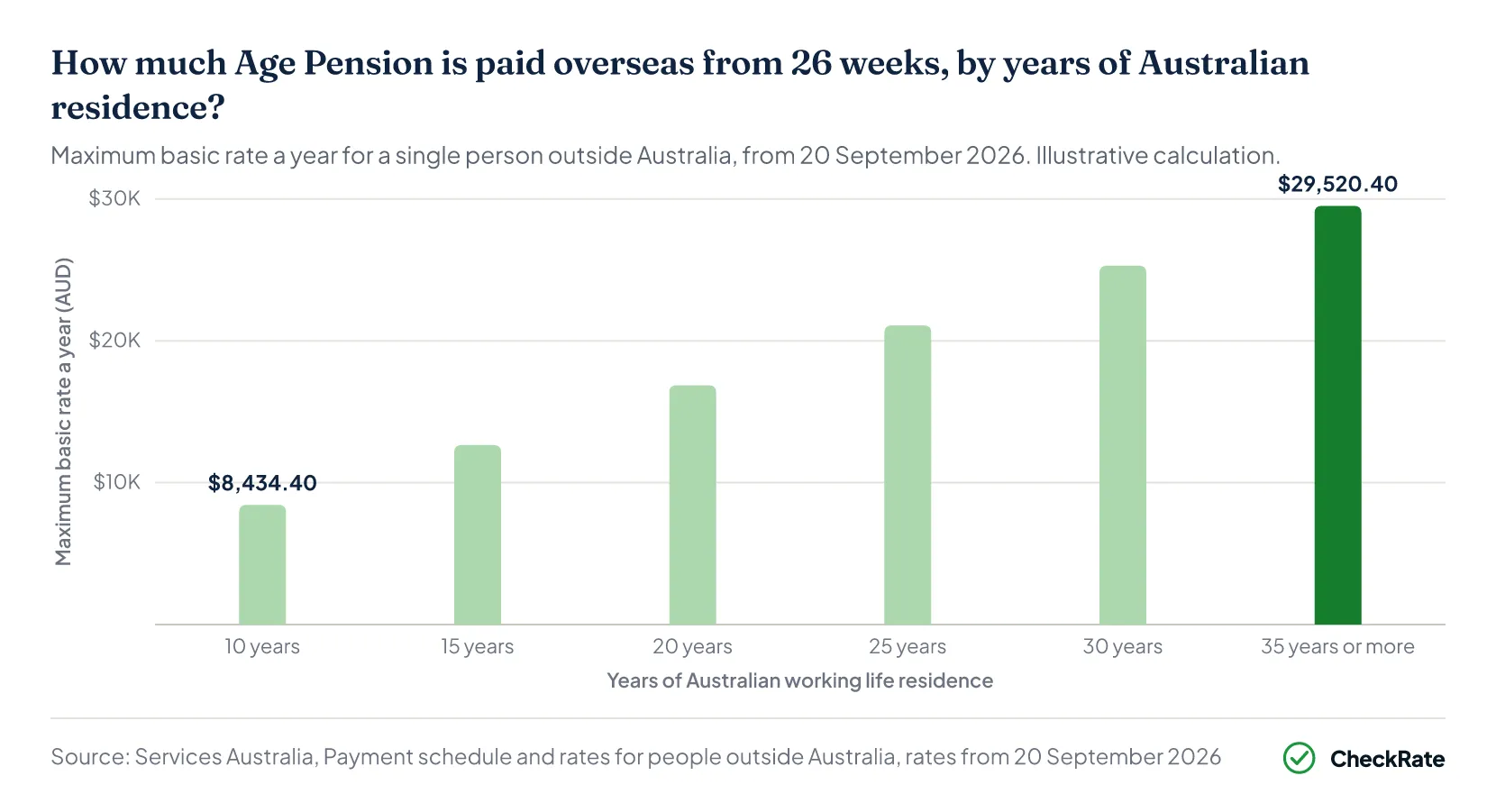
The maximum basic rate for a single person living outside Australia is $29,520.40 a year from 20 September 2026, equal to $1,135.40 a fortnight1617. In Australia, the maximum single rate from 20 September 2026 is $1,237.70 a fortnight, including the Pension Supplement and the Energy Supplement.
Once a pensioner has been outside Australia for 26 weeks, the rate depends on their years of Australian working life residence between age 16 and Age Pension age15. A pensioner with 35 years or more generally keeps the same rate, and a pensioner with less than 35 years generally receives a lower rate, such as 10/35ths of the usual rate after 10 years of residence.
A pensioner who was getting the Age Pension or another Australian social security payment while living outside Australia on 1 July 2014, had at least 25 years of Australian residence, and has not been in Australia for more than 26 weeks since then, while getting the Age Pension the whole time, generally keeps their rate15.
On a temporary trip, changes to the Age Pension occur at different points during the first 26 weeks15.
Less than 6 weeks outside Australia
The Age Pension rate generally stays the same.
6 weeks
The Energy Supplement stops and the Pensioner Concession Card is cancelled.
12 weeks
The Pension Supplement stops.
26 weeks
The rate depends on years of Australian working life residence between age 16 and Age Pension age, with 35 years or more generally leaving it unchanged.
Age Pension age is 67, and a claimant generally needs at least 10 years of Australian residence, including 5 years without a break184. On the day of the claim, the claimant must be living in Australia, physically in Australia and an Australian resident, with exceptions for claims under a social security agreement.
A claim can be made up to 13 weeks before Age Pension age, and a person who claims before leaving Australia must meet all qualification requirements on the day they reach Age Pension age19. A new claim can be lodged from overseas only in a country that has a social security agreement with Australia.
Australia has social security agreements with 32 countries, including Poland, but Thailand and Malaysia are not among them20. The agreement with the United Kingdom ended on 1 March 2001.
A person who returns to live in Australia and starts receiving the Age Pension after returning may have the payment stop if they travel outside Australia within two years, unless they travel to an agreement country15.
The six-, 12- and 26-week rules are set out in whether the Age Pension continues for pensioners living overseas.
Section 06 · The home
How is an Australian home taxed when the owner retires overseas?
A foreign resident who sells an Australian home cannot claim the main residence exemption, even for the years they lived in it as an Australian resident, unless they meet the life events test21. Rent from the home is declared in an Australian tax return and taxed at foreign resident rates, with no tax-free threshold6.
When can a foreign resident claim the main residence exemption on an Australian home?
Without the life events test, a foreign resident seller gets no partial exemption for the years the home was their main residence, and cannot use the rule that resets the cost of a home when it is first used to produce income21.
The life events test has two parts21:
- the seller was a foreign resident for a continuous period of six years or less
- during that period, the seller, their spouse or their child under 18 had a terminal medical condition, their spouse or child under 18 died, or the sale followed a formal agreement after the breakdown of a marriage or relationship.
Residency is tested at the time of disposal, which for a sale under a contract is the date the contract is signed, not the settlement date21. A seller who is an Australian resident on that date is not affected by the foreign resident rule, unless the home was inherited from a foreign resident.
A foreign resident who sells property bought after 8 May 2012 cannot claim the full 50% CGT discount, but can claim an apportioned discount for the period they were an Australian resident22.
For contracts signed from 1 January 2025, the buyer of any Australian property must withhold 15% of the price and pay it to the ATO23. No withholding applies if an Australian resident seller provides a clearance certificate. A reduced rate may apply if a foreign resident seller has an ATO variation notice24.
| Selling an Australian home, by the seller's tax residency on the contract date | ||
|---|---|---|
| Rule | Australian resident on the contract date | Foreign resident on the contract date |
| Main residence exemption21 | Available under the general rules | Not available unless the life events test is met |
| CGT discount on property bought after 8 May 201222 | Available under the general rules | Apportioned to the period of Australian residence |
| Withholding from the price23 | None with a clearance certificate | 15%, unless the ATO varies the rate23 |
Source · ATO, Main residence exemption for foreign residents; CGT discount for foreign residents; Foreign resident capital gains withholding overview.
Rental income and deductible expenses are covered in how rental property income and expenses are taxed in Australia.
Section 07 · Checklist
What rules apply when a retiree leaves Australia?
A retiree who leaves Australia may be affected by separate ATO and Services Australia rules covering the tax residency date, investments, other assets, the home, super, the Age Pension, concession cards and Medicare13211325. The part-year tax-free threshold and the deemed disposal of non-property assets both depend on the date tax residency ends.
| Rules that may apply when retiring overseas from Australia | ||
|---|---|---|
| Matter | What the rule says | Agency |
| Tax residency date | Residency ends when a person no longer resides in Australia and meets none of the three statutory tests, and the date sets the part-year tax-free threshold12 | ATO |
| Banks and investments | Payers withhold tax from interest and unfranked dividends paid to foreign residents, and may withhold 47% without an overseas address8 | ATO |
| Shares and other non-property assets | Treated as disposed of at market value on leaving, unless the choice to disregard the gains and losses is made3 | ATO |
| Sale of the home | The main residence exemption depends on residency on the contract date, and resident sellers need a clearance certificate2124 | ATO |
| Superannuation | Leaving Australia does not release super for citizens and permanent residents13 | ATO |
| Age Pension claim | A claim is made in Australia or from one of 32 agreement countries, up to 13 weeks before Age Pension age1920 | Services Australia |
| Payments and concession cards | Services Australia may need to be told about the departure, and the supplements and Pensioner Concession Card stop on leaving to live overseas2515 | Services Australia |
| Medicare | Medicare does not cover people overseas, and a person returning after more than 12 months overseas may need to re-enrol2519 | Services Australia |
Source · Australian Taxation Office; Services Australia; Department of Social Services.
Section 08
Retiring overseas: quick answers
Do Australians living overseas pay Australian tax?
A foreign resident pays Australian tax only on Australian-sourced income, such as rent from an Australian property, at 30% on the first $135,000 of taxable income in 2025-26, with no tax-free threshold. Australian interest and unfranked dividends are taxed through withholding instead, at 10% and 30% respectively where no tax treaty applies.
Can Australians keep their super after moving overseas?
Australian citizens and permanent residents keep their super in Australia after moving overseas, and it stays preserved until a condition of release is met, such as turning 65 or retiring on or after reaching preservation age, which is 60 for anyone born from 1 July 1964. From age 60, lump sums and account-based income stream payments from the tax-free component and the taxed element are not taxed in Australia.
Can a retiree living in Thailand get the Age Pension?
An Age Pension granted in Australia may continue to be paid to a pensioner who moves to Thailand, but a new claim cannot be lodged from Thailand because Thailand does not have a social security agreement with Australia. Once the pensioner has been outside Australia for 26 weeks, the rate depends on years of Australian working life residence between age 16 and Age Pension age, and 35 years or more generally leaves the rate unchanged.
Is capital gains tax payable on an Australian home sold after moving overseas?
A person who is a foreign resident when they sign the contract to sell an Australian home generally cannot claim the main residence exemption unless they meet the life events test, so the capital gain may be taxable in Australia. The buyer must also withhold 15% of the price and pay it to the Australian Taxation Office unless a variation applies.
References
- Australian Taxation Office, Your tax residency · ato.gov.au ↑ b c d e f g h i j k l m n
- ATO, Living overseas and becoming a foreign tax resident · ato.gov.au ↑ b
- ATO, How changing residency affects CGT (QC66059) · ato.gov.au ↑ b c d
- Services Australia, Residence rules for Age Pension · servicesaustralia.gov.au ↑ b
- ATO, Tax rates: foreign residents · ato.gov.au ↑ b c
- ATO, Foreign and temporary residents · ato.gov.au ↑ b c
- ATO, Tax rates – Australian resident (QC 73320) · ato.gov.au ↑ b c
- ATO, Interest, unfranked dividends and royalties (foreign resident investments) · ato.gov.au ↑ b c d e f g h i
- ATO, Synthesised text of the Multilateral Instrument and the Australia and Thailand tax treaty · ato.gov.au ↑ b c d e f g
- ATO, Synthesised text of the MLI and the Australia and Poland tax agreement · ato.gov.au ↑ b c d e f
- ATO, Synthesised text of the MLI and the Australia and Malaysia tax agreement · ato.gov.au ↑ b c d e f g
- Treasury, Income tax treaties · treasury.gov.au ↑ b c d
- Australian Taxation Office, Super withdrawal options · ato.gov.au ↑ b c d e
- Australian Taxation Office, Tax on super benefits · ato.gov.au ↑ b
- Services Australia, When you leave Australia if you get Age Pension · servicesaustralia.gov.au ↑ b c d e f g
- Services Australia, Payment schedule and rates for people outside Australia: Age Pension · servicesaustralia.gov.au ↑ b
- Services Australia, How much Age Pension you can get (rates from 20 September 2026) · servicesaustralia.gov.au ↑
- Services Australia, Who can get Age Pension · servicesaustralia.gov.au ↑
- Services Australia, Retiring overseas · servicesaustralia.gov.au ↑ b c
- Department of Social Services, International social security agreements · dss.gov.au ↑ b
- ATO, Main residence exemption for foreign residents · ato.gov.au ↑ b c d e f g h
- ATO, CGT discount for foreign residents · ato.gov.au ↑ b
- ATO, Foreign resident capital gains withholding overview · ato.gov.au ↑ b c
- ATO, Australian residents and clearance certificates · ato.gov.au ↑ b
- Services Australia, Before you leave Australia · servicesaustralia.gov.au ↑ b c