


Published
 Retiring overseas from Australia: tax residency, super and Age Pension rulesA retiree who moves overseas stops being an Australian resident for tax purposes when they no longer reside in Australia and do not meet any of the three statutory tests, according to the Australian T…
 Can a person live overseas and still get the Australian Age Pension?The Age Pension can generally continue to be paid for as long as a recipient is outside Australia, whether the absence is temporary or permanent, provided the person continues to qualify under the inc…
 How much super do Australians need to retire overseas?Moneysmart, the consumer website of the Australian Securities and Investments Commission (ASIC), gives a rule of thumb of around 70% of working-life income for retirement, and states that there is no…
Section 01 · Options
What options are there for taking super before retiring overseas?
Australian super can be taken as a lump sum, as a super income stream such as an account-based pension, or as a combination of both once a person meets a condition of release, according to the ATO1. The main conditions of release are turning 65, or reaching preservation age and retiring. Preservation age is 60 for people born from 1 July 19642.
Moving overseas is not itself a condition of release for Australian citizens and permanent residents. The departing Australia superannuation payment is available only to people who are neither Australian nor New Zealand citizens and are not permanent residents of Australia. New Zealand citizens leaving Australia permanently may be able to transfer their super to New Zealand3.
An account-based pension pays a regular income from super while the balance stays invested, so the balance changes with investment returns1. It continues until the balance runs out and does not guarantee an income for life, according to the Australian Securities and Investments Commission's (ASIC's) Moneysmart4.
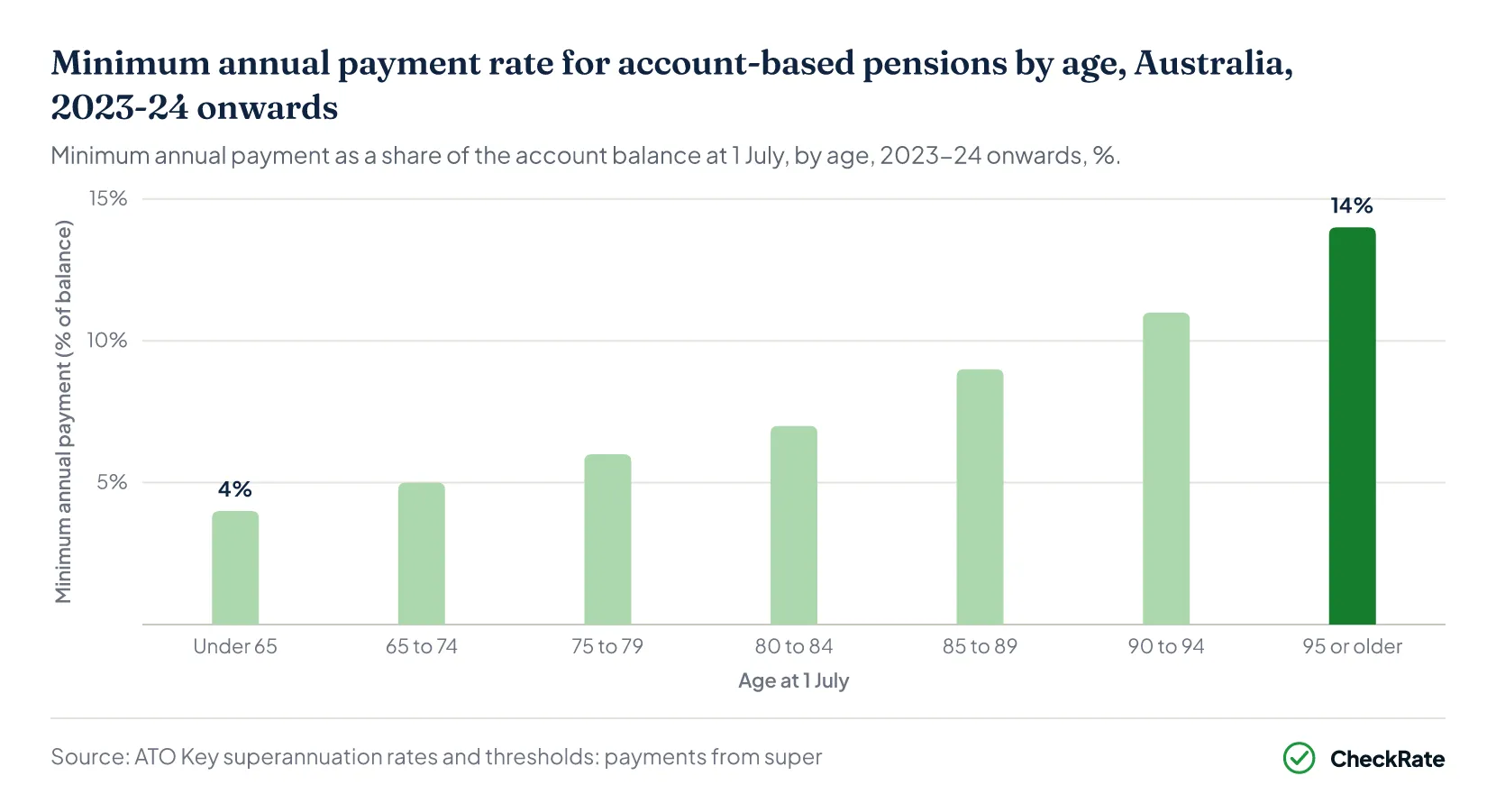
An account-based pension must pay at least 4% of the balance at 1 July each year for a person under 65, and the minimum rises with age to 14% at 95 or older5. There is no maximum, and lump sums can generally be taken from the pension at any time4.
This is an illustrative calculation based on the ATO's minimum payment rates. A person aged 67 with an account-based pension balance of $500,000 at 1 July would need to draw at least $25,000 that year, at the 5% rate for ages 65 to 745.
Savings balances by age group are compared in average savings by age.
Section 02 · Tax in Australia
How are super lump sums and account-based pensions taxed in Australia?
Super paid from a taxed fund to a person aged 60 or older is not taxed in Australia, whether it is taken as a lump sum or as an account-based pension5. The tax-free treatment applies to both the taxed element and the tax-free component of an account-based pension6.
Between preservation age and 60, the taxed element of a lump sum is tax-free up to the low rate cap of $260,000 in 2026-27 and taxed at no more than 15% above it, while the taxed element of an income stream is taxed at the person's marginal rate less a 15% tax offset56. The low rate cap is a lifetime amount, reduced by any amount already used5.
An untaxed element, most commonly paid from a public-sector fund, is taxed even after 60. A lump sum untaxed element paid to a person aged 60 or older is taxed at no more than 15% up to the untaxed plan cap of $1,935,000 in 2026-27, and at 45% above it56.
| Maximum Australian tax on super benefits from a taxed fund, by age and payment type, 2026-27 | ||
|---|---|---|
| Part of the benefit | Lump sum | Account-based pension |
| Tax-free component, any age after a condition of release | Nil | Nil |
| Taxed element, preservation age to 59 | Nil up to the $260,000 low rate cap, then 15%5 | Marginal rate less a 15% tax offset |
| Taxed element, 60 or older | Nil | Nil |
Source · ATO, Key superannuation rates and thresholds: payments from super; ATO, Tax on super benefits.
Section 03 · Age Pension
How does super count in the Age Pension assets and income tests?
From Age Pension age, which is 67, Services Australia counts super in the assets test whether it remains in the fund or is used to pay an account-based pension, and it also counts a lump sum withdrawn and kept in the bank89. Super is valued at the balance on the latest statement and is deemed to earn income under the income test.
Before Age Pension age, super that is not paying a pension is not counted in either test, while a super pension is assessed as an income stream9. An account-based pension started on or after 1 January 2015 is valued at its account balance and deemed under the income test10.
Withdrawing money from super does not itself change the Age Pension assessment, but how the money is held or used can9. Assets held outside Australia count in the assets test11.
From 20 September 2026, a single homeowner can have assets of up to $333,000 and receive the full Age Pension, and a homeowner couple can have up to $499,000 combined11. A part pension stops when a single homeowner's assets are more than $745,750, or $1,121,000 for a homeowner couple.
From 20 September 2026, deeming assumes a single person's first $66,800 of financial assets earns 1.75% a year and the rest earns 3.75%, whatever the assets actually earn12. For a couple with at least one partner on a pension, the lower rate applies to the first $110,600 of combined financial assets.
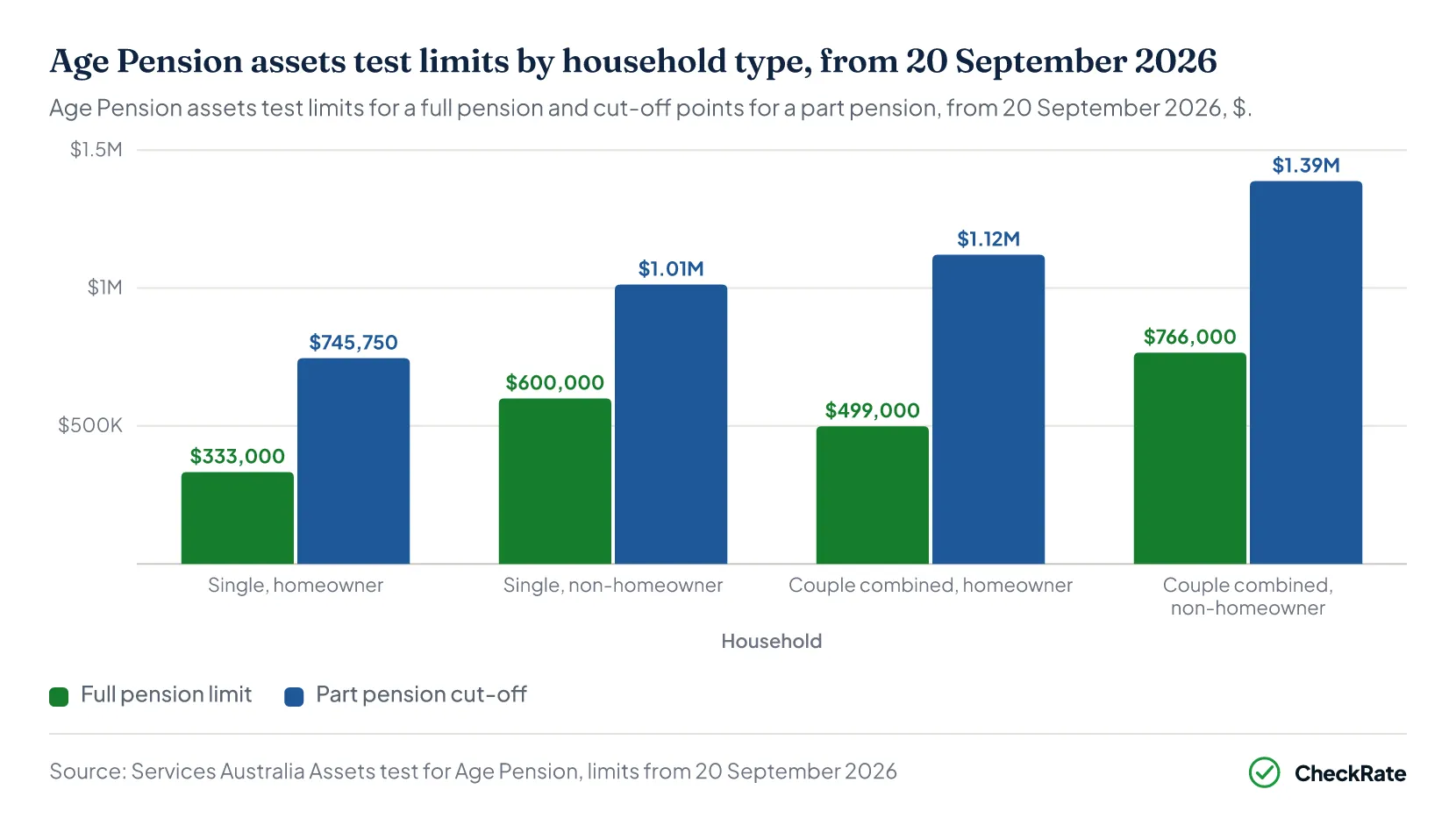
| Age Pension assets test limits by household type, from 20 September 2026 | ||
|---|---|---|
| Household | Full pension limit ($) | Part pension cut-off ($) |
| Single, homeowner | 333,00011 | 745,75011 |
| Single, non-homeowner | 600,00011 | 1,012,75011 |
| Couple combined, homeowner | 499,00011 | 1,121,00011 |
| Couple combined, non-homeowner | 766,00011 | 1,388,00011 |
Source · Services Australia, Assets test for Age Pension.
After 26 weeks outside Australia, the Age Pension rate depends on years of Australian residence between age 16 and Age Pension age, and a person with fewer than 35 years generally gets a lower rate13.
The overseas rate is set out in how much Age Pension is paid to Australians living overseas.
Section 04 · Earnings
How are investment earnings taxed inside and outside super?
Investment earnings in a retirement-phase super account are not taxed, while earnings on super in the accumulation phase are taxed at 15%, according to the ATO6. Once a lump sum is withdrawn, it is no longer super, so earnings on the money are not taxed as super and may need to be declared in a tax return1.
For a foreign resident, an Australian bank or company withholds tax from interest and unfranked dividends at the time of payment, and that income does not need to be declared in an Australian tax return14. The withholding rate is 10% on interest and 30% on unfranked dividends for residents of countries without a tax treaty with Australia, and most treaties reduce the dividend rate to 15%.
Other Australian income of a foreign resident is taxed from the first dollar, at 30% on taxable income up to $135,000 in 2025-267.
| Australian tax on investment earnings by where the money is held | |
|---|---|
| Where the money is held | Australian tax on earnings |
| Super, retirement-phase account | Nil, up to the transfer balance cap |
| Super, accumulation phase | 15%6 |
| Outside super, interest paid to a foreign resident | 10% withholding, with an exemption under some treaties14 |
| Outside super, unfranked dividends paid to a foreign resident | 30% withholding, reduced to 15% by most treaties14 |
| Outside super, other Australian income of a foreign resident | 30% up to $135,000 of taxable income in 2025-267 |
Source · ATO, Tax on super benefits; ATO, Interest, unfranked dividends and royalties; ATO, Tax rates: foreign residents.
Section 05 · Currency
How do exchange rates, prices and transfer costs change the value of super overseas?
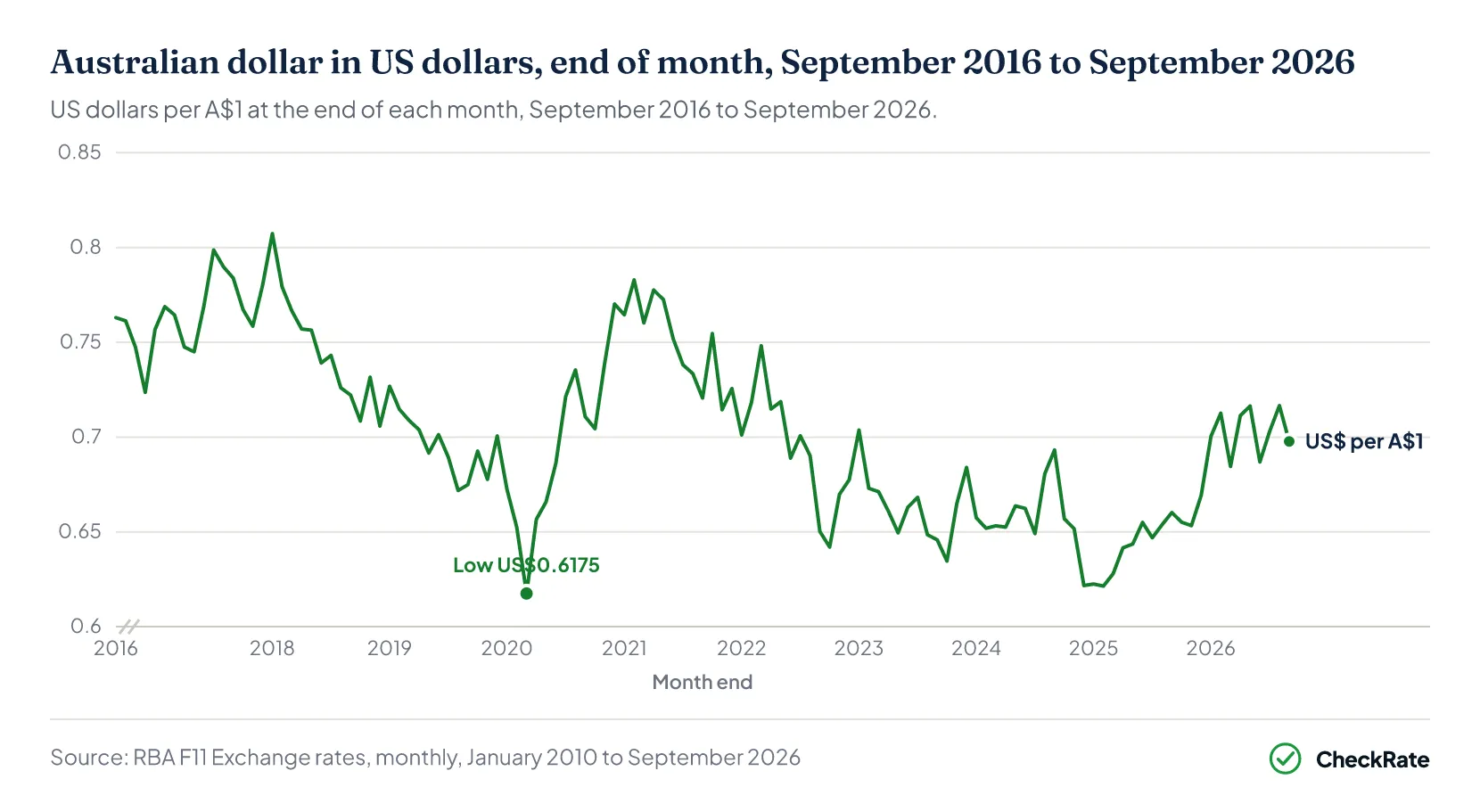
The Australian dollar fell 8.6% against the US dollar, from US$0.7630 at the end of September 2016 to US$0.6977 at the end of September 2026, according to Reserve Bank of Australia (RBA) exchange rate data16. From September 2016 to September 2026, the end-of-month rate ranged from US$0.8073 in January 2018 to US$0.6175 in March 2020.
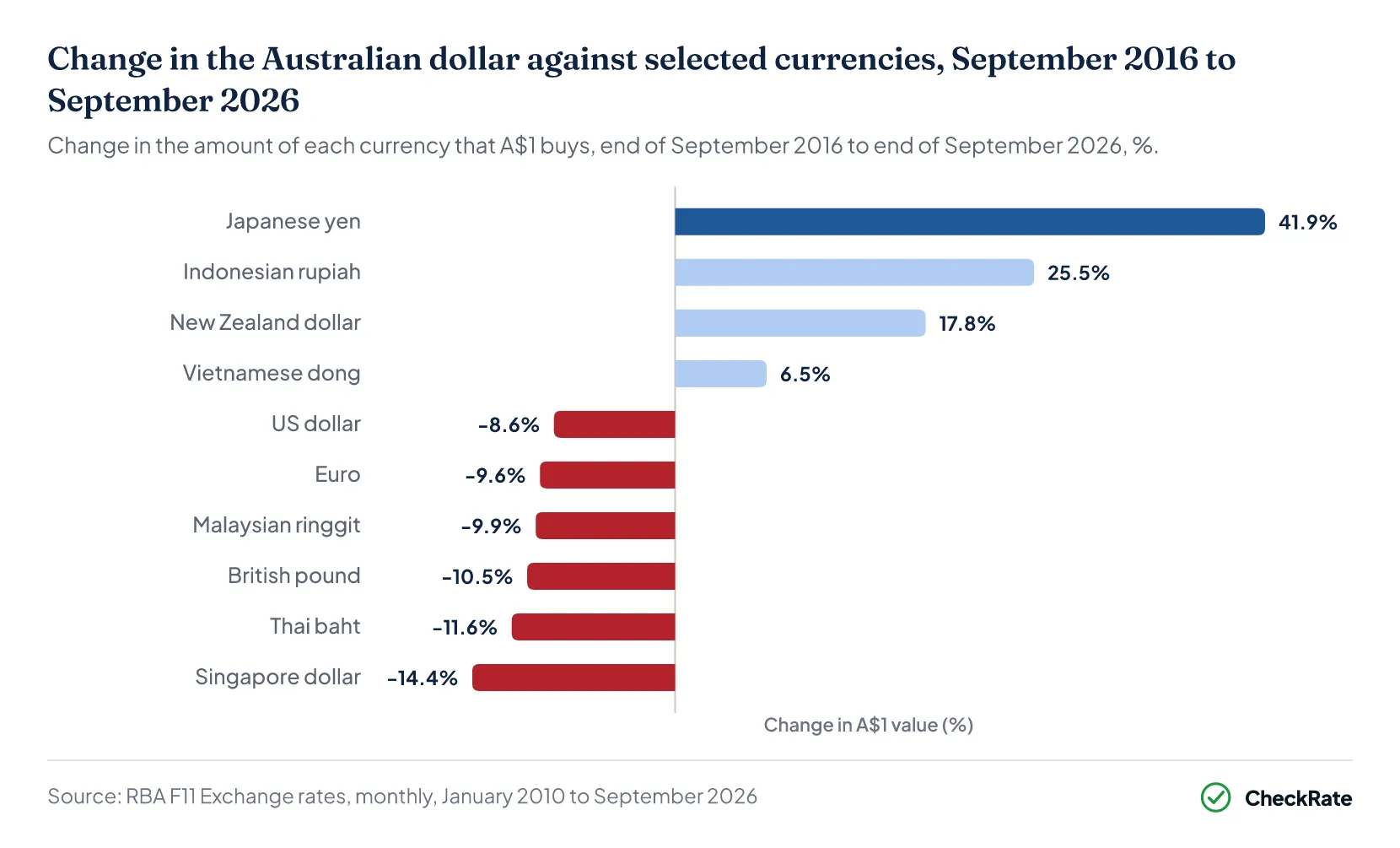
Among the 10 currencies compared, the Japanese yen recorded the largest increase in the amount A$1 buys from the end of September 2016 to the end of September 2026, at 41.9%, and the Singapore dollar recorded the largest fall, at 14.4%16.
Over the same period, A$1 bought 11.6% fewer Thai baht, 10.5% fewer British pounds and 25.5% more Indonesian rupiah16.
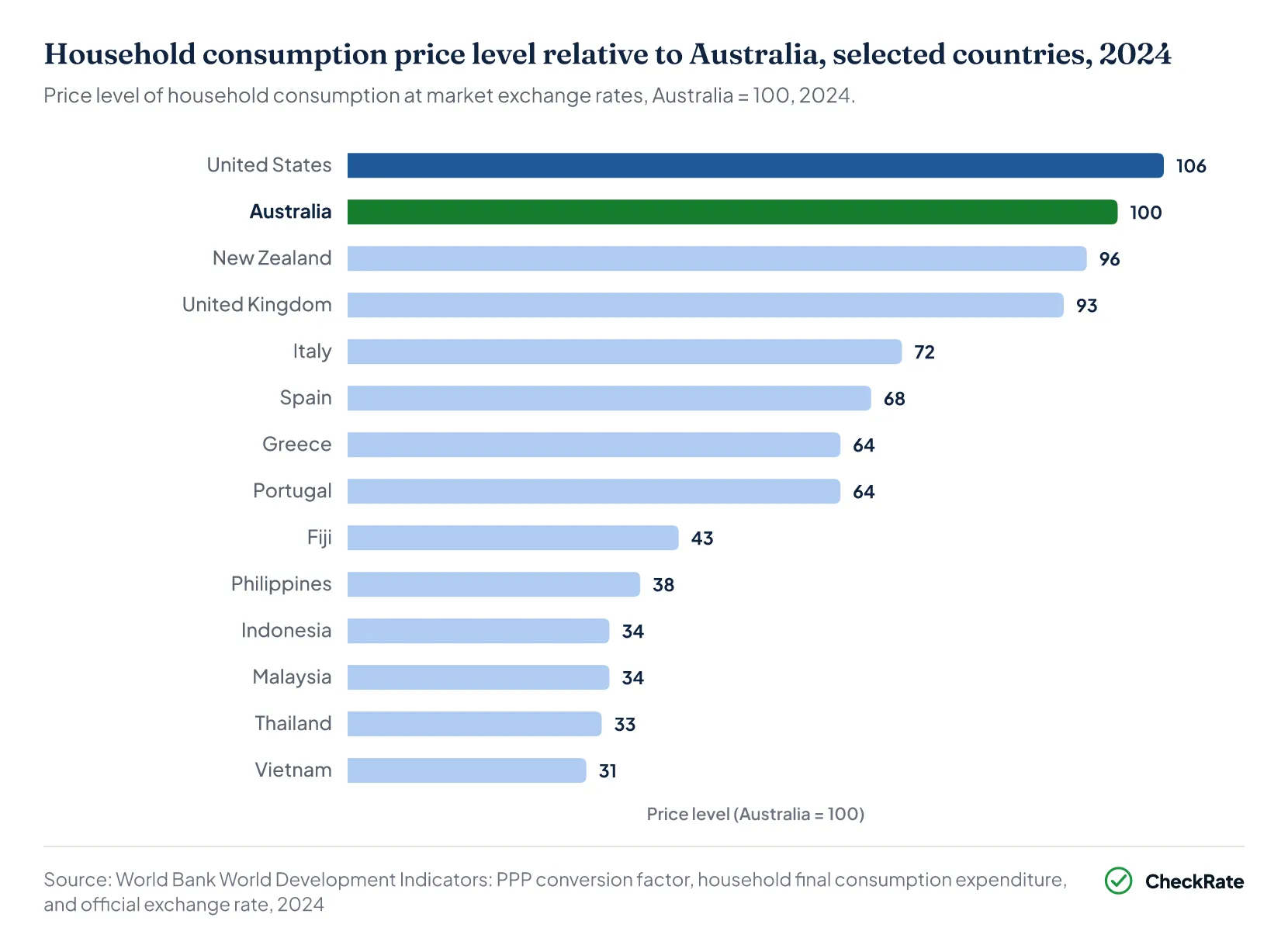
Household consumption prices in Thailand, Vietnam, Indonesia, Malaysia and the Philippines were between 31% and 38% of Australia's price level in 2024 at market exchange rates, according to World Bank purchasing power parity data1718. In 2024, prices in the United States were 6% higher than in Australia, and prices in the United Kingdom were 7% lower17.
The comparison covers average prices across all household spending at 2024 exchange rates. It does not measure the costs a particular retiree would face, and exchange rates have moved since 2024.
Banks and money transfer businesses set their own exchange rates and charge fees for overseas transfers. According to ASIC's Moneysmart, the cost depends on the amount sent, the destination and the transfer method19. Money transfer services in Australia must be registered with the Australian Transaction Reports and Analysis Centre (AUSTRAC).
Section 06 · Tax overseas
How is Australian super taxed in the new country of residence?
Australia's treaties with the United Kingdom and Thailand both provide that pensions and annuities paid to a resident of one country are taxable only in that country of residence2122. The rate of any tax charged by the new country is set by that country's law.
Australia had income tax treaties with 46 countries and jurisdictions as at 24 March 2026, according to Treasury, including Thailand, the Philippines, Malaysia, Indonesia, Vietnam, the United Kingdom, New Zealand and the United States23. Australia's only tax agreement with Greece covers airline profits, and Treasury lists no income tax treaty with Portugal.
Where Australian tax is withheld from investment income, an Australian payer can ask the ATO for a certificate of payment that a foreign resident can use to meet the tax requirements of their country of residence14.
| Australian income tax treaties with selected retirement destinations, March 2026 | |
|---|---|
| Country | Income tax treaty listed by Treasury |
| United Kingdom | Yes, in force 17 December 200323 |
| New Zealand | Yes, in force 19 March 201023 |
| United States | Yes23 |
| Thailand | Yes, in force 27 December 198923 |
| Philippines | Yes, in force 17 June 198023 |
| Indonesia | Yes, in force 14 December 199223 |
| Malaysia | Yes23 |
| Vietnam | Yes23 |
| Fiji | Yes, in force 28 December 199023 |
| Italy | Yes, in force 5 November 198523 |
| Spain | Yes, in force 10 December 199223 |
| Greece | No, airline profits agreement only23 |
| Portugal | No |
Source · Treasury, Income tax treaties.
The Australian tax position of a non-resident's super is covered in how super is taxed for non-residents.
Section 07 · Adviser questions
What questions does ASIC suggest asking a financial adviser?
ASIC's Moneysmart lists questions to ask a financial adviser at a first meeting. This includes the adviser's qualifications and areas of expertise, the fees and what they cover, and any commissions or incentives for recommending products24.
Moneysmart's list also covers:
- how the adviser will manage the money and consult on decisions
- how often meetings take place and what information is provided
- who looks after the account when the adviser is away
- how complaints are handled
- how to end the agreement, including any penalties or notice periods
Registered advisers can be searched by postcode on the Financial Advisers Register, and an adviser's Financial Services Guide sets out the services offered, fees and any links to financial products24.
Services Australia's Financial Information Service runs free webinars on super and the Age Pension9.
How these rules apply depends on personal circumstances, including tax residency, the taxed and untaxed parts of a super balance, the transfer balance cap, Age Pension residence requirements and the tax law of the new country of residence.
Section 08
Super and retiring overseas: quick answers
Can super be withdrawn when leaving Australia permanently?
Moving overseas does not by itself allow Australian and New Zealand citizens or permanent residents of Australia to withdraw their super, and they cannot claim the departing Australia superannuation payment, according to the ATO. Their super can generally be withdrawn from age 65, or from preservation age once they retire.
Is a super lump sum taxed after age 60 in Australia?
A super lump sum paid from a taxed fund to a person aged 60 or older is not taxed in Australia. The taxed element is non-assessable, non-exempt income, while the tax-free component is also not taxed. An untaxed element, most common in public-sector funds, is taxed at no more than 15% up to the untaxed plan cap of $1,935,000 in 2026-27, and at 45% above it.
Does super count in the Age Pension assets test?
Super counts in the Age Pension assets test from the Age Pension age of 67, at the balance on the latest statement, and it is deemed to earn income under the income test. Before Age Pension age, super is not counted unless the fund is paying a super pension.
How much must be withdrawn from an account-based pension each year?
The minimum yearly payment from an account-based pension is 4% of the 1 July balance for people under 65 and 5% for people aged 65 to 74, rising to 14% at age 95 or older. There is no maximum, and lump sums can generally be taken at any time.
Does Australia have a tax treaty with Thailand?
Australia has had an income tax treaty with Thailand since 27 December 1989, according to Treasury. Article 18 of the treaty provides that pensions and annuities paid to a resident of one country are taxable only in that country, subject to the government service article.
Is the Age Pension paid to Australians living overseas?
The Age Pension can continue overseas, but after 26 weeks outside Australia the rate depends on how long the person was an Australian resident between age 16 and Age Pension age, according to Services Australia. A person with fewer than 35 years of residence generally gets a lower rate, such as 10/35ths of the usual rate for a person with 10 years of residence.
References
- ATO, Retirement withdrawal – lump sum or income stream (QC73093) · ato.gov.au ↑ b c d
- Australian Taxation Office, Super withdrawal options · ato.gov.au ↑
- Australian Taxation Office, Departing Australia superannuation payment (DASP) · ato.gov.au ↑
- ASIC Moneysmart, Account-based pensions · moneysmart.gov.au ↑ b c
- ATO, Key superannuation rates and thresholds: Payments from super · ato.gov.au ↑ b c d e f g
- Australian Taxation Office, Tax on super benefits · ato.gov.au ↑ b c d e
- ATO, Tax rates: foreign residents · ato.gov.au ↑ b c
- Services Australia, Who can get Age Pension · servicesaustralia.gov.au ↑
- Services Australia, Superannuation (Age Pension) · servicesaustralia.gov.au ↑ b c d
- Services Australia, Income streams (Age Pension) · servicesaustralia.gov.au ↑
- Services Australia, Assets test for Age Pension · servicesaustralia.gov.au ↑ b c d e f g h i j
- Services Australia, Deeming (Age Pension) · servicesaustralia.gov.au ↑
- Services Australia, When you leave Australia if you get Age Pension · servicesaustralia.gov.au ↑
- ATO, Interest, unfranked dividends and royalties (foreign resident investments) · ato.gov.au ↑ b c d
- ATO, Key superannuation rates and thresholds: Transfer balance cap · ato.gov.au ↑
- Reserve Bank of Australia, F11 Exchange rates, monthly, January 2010 to September 2026 · Reserve Bank of Australia ↑ b c
- World Bank, World Development Indicators: PPP conversion factor, household final consumption (PA.NUS.PRVT.PP) · data.worldbank.org ↑ b
- World Bank, World Development Indicators: Official exchange rate (PA.NUS.FCRF) · data.worldbank.org ↑
- ASIC Moneysmart, Sending money overseas · moneysmart.gov.au ↑
- Services Australia, Income and assets from outside Australia can affect your Age Pension · servicesaustralia.gov.au ↑
- ATO, Synthesised text of the Multilateral Instrument and the Australia and United Kingdom tax treaty · ato.gov.au ↑
- ATO, Synthesised text of the Multilateral Instrument and the Australia and Thailand tax treaty · ato.gov.au ↑
- Treasury, Income tax treaties · treasury.gov.au ↑ b c d e f g h i j k l m
- ASIC Moneysmart, Choosing a financial adviser · moneysmart.gov.au ↑ b