


Published
 Retiring overseas from Australia: tax residency, super and Age Pension rulesA retiree who moves overseas stops being an Australian resident for tax purposes when they no longer reside in Australia and do not meet any of the three statutory tests, according to the Australian T…
 Double tax agreements: how Australia, Thailand, Poland and Malaysia tax a retiree's pension and investment incomeAccording to the Australian Taxation Office (ATO), a double tax agreement reduces or eliminates double taxation by setting out which country can tax different types of income, such as pensions, intere…
 Renting out an Australian home while overseas: tax rates, deductions and the 6-year ruleA foreign resident for tax purposes must declare rental income from an Australian property in an Australian tax return, along with other Australian income such as Australian pensions and capital gains…
Section 01 · The four tests
What are the four Australian tax residency tests?
Australian tax law sets four residency tests, and a person who meets any one of them is an Australian resident for tax purposes, according to the Australian Taxation Office (ATO)1. A person who meets none of the four tests is a foreign resident2.
The resides test is the primary test. A person who resides in Australia under this test is an Australian resident for tax purposes without needing to meet any of the other three tests1. The other three tests are the domicile test, the 183-day test and the Commonwealth superannuation fund test. Each can make a person an Australian resident even if they do not reside in Australia under the resides test.
Tax residency depends on a person's circumstances and connection to Australia2. A person can be an Australian resident for tax purposes without being an Australian citizen or permanent resident1. Citizenship counts only in a borderline case under the resides test, where the other facts are not conclusive3.
The ATO sets out its view of the tests in Taxation Ruling TR 2023/1, issued on 7 June 20232. It replaced earlier guidance, including IT 2650 on whether a person has a permanent place of abode outside Australia.
| The four Australian tax residency tests for individuals | |||
|---|---|---|---|
| Test | Generally relevant when | A person is a resident if | Unless |
| Resides test | The person is physically present in Australia | They reside in Australia in the ordinary meaning of the word | No exception; the other three tests still apply to a person who does not reside in Australia |
| Domicile test | The person has lived in Australia but is now overseas | Their domicile is in Australia | The ATO is satisfied their permanent place of abode is outside Australia |
| 183-day test | The person was not previously a resident and arrived during the income year | They are present in Australia for more than half the income year, continuously or with breaks | Their usual place of abode is outside Australia and they do not intend to take up residence in Australia |
| Commonwealth superannuation fund test | An Australian Government employee is posted overseas | They are a contributing member of the CSS or PSS, or the spouse or child under 16 of one | The test does not apply to PSSAP members or to people who are no longer contributing members |
Source · ATO, Your tax residency and the four residency test pages; ATO, Taxation Ruling TR 2023/1, paragraphs 11 to 14.
Residency decides which income Australia taxes, and the wider structure is covered in How does the Australian tax system work?
Section 02 · Resides test
How does the resides test apply to retirees living overseas?
A person who moves overseas for a lengthy period may no longer meet the resides test, depending on their continuing connections to Australia5. Income tax law does not define "resides", so the courts and the ATO use the word's ordinary meaning3.
Six factors are considered in deciding where a person resides:3
- the period of physical presence in Australia
- the intention or purpose of that presence
- behaviour while in Australia
- family and business or employment ties
- the maintenance and location of assets
- social and living arrangements.
No single factor is likely to be decisive, and many of the factors are interrelated3. Keeping a home in Australia does not by itself mean a person resides in Australia, because having a place available to live is not the same as actually residing there.
In the ATO's example, an Australian resident who accepts a three-year job overseas with an option to extend, moves with her husband and three children and rents out the family home is a foreign resident1. In a 2013 tribunal decision, a person who maintained significant connections with Australia was treated as a resident.
Section 03 · Domicile test
When does the domicile test apply to Australians who retire overseas?
An Australian who goes to live overseas remains an Australian resident under the domicile test while their domicile is in Australia, unless the ATO is satisfied that their permanent home is outside Australia5. A person who has always lived in Australia will keep an Australian domicile while overseas, unless they intend to make another country their permanent home.
To establish a new domicile in another country, a person generally needs to be lawfully living there and intend to make it their home indefinitely2. A visa to migrate to that country can support that intention. A plan to return to Australia on a clearly foreseen event can indicate that an Australian domicile has been retained, while only a vague possibility of returning is consistent with a new domicile overseas.
A permanent home overseas means a person has left Australia to live overseas on an ongoing basis. In this context, "permanent" is contrasted with temporary rather than meaning forever2.
The ATO considers three main factors: the length of the overseas stay, the nature of the accommodation and the strength of the person's connections with Australia and the overseas country2.
The ATO treats two years as a substantial period, so a person whose intended stay overseas is shorter than two years is unlikely to establish a permanent home overseas2. A stay of two years or more does not settle the question on its own, because residency depends on a person's overall circumstances.
A retiree who moves from country to country without living permanently in any of them is likely to remain an Australian resident under the domicile test while their domicile is in Australia, whether or not they keep a dwelling in Australia2. Hotels, campsites and similar temporary accommodation usually indicate that a stay overseas is not permanent.
Section 04 · 183-day test
How does the 183-day test count days spent in Australia?
The 183-day test makes a person an Australian resident if they are in Australia for more than half the income year, continuously or with breaks, unless their usual home is outside Australia and they have no intention to take up residence in Australia6. Every day of physical presence in the income year counts, including the days of arrival and departure. Part of a day in Australia counts as a whole day2.
The test applies to the income year from 1 July to 30 June, not the calendar year2. It is generally relevant to people who were not previously Australian residents and arrived during the income year.
The ATO gives an example of a person who spends more than 183 days in Australia on holiday but remains a foreign resident because they will return to their home overseas2. This shows that the test depends on more than the number of days spent in Australia6.
Section 05 · Foreign residents
What changes when an Australian becomes a foreign resident for tax purposes?
From the date a person becomes a foreign resident, Australia taxes only their Australian-sourced income and capital gains on taxable Australian property. Their foreign-source income is no longer included in an Australian tax return1. Foreign residents still declare Australian employment income, rental income, Australian pensions and annuities, and capital gains on taxable Australian property7.
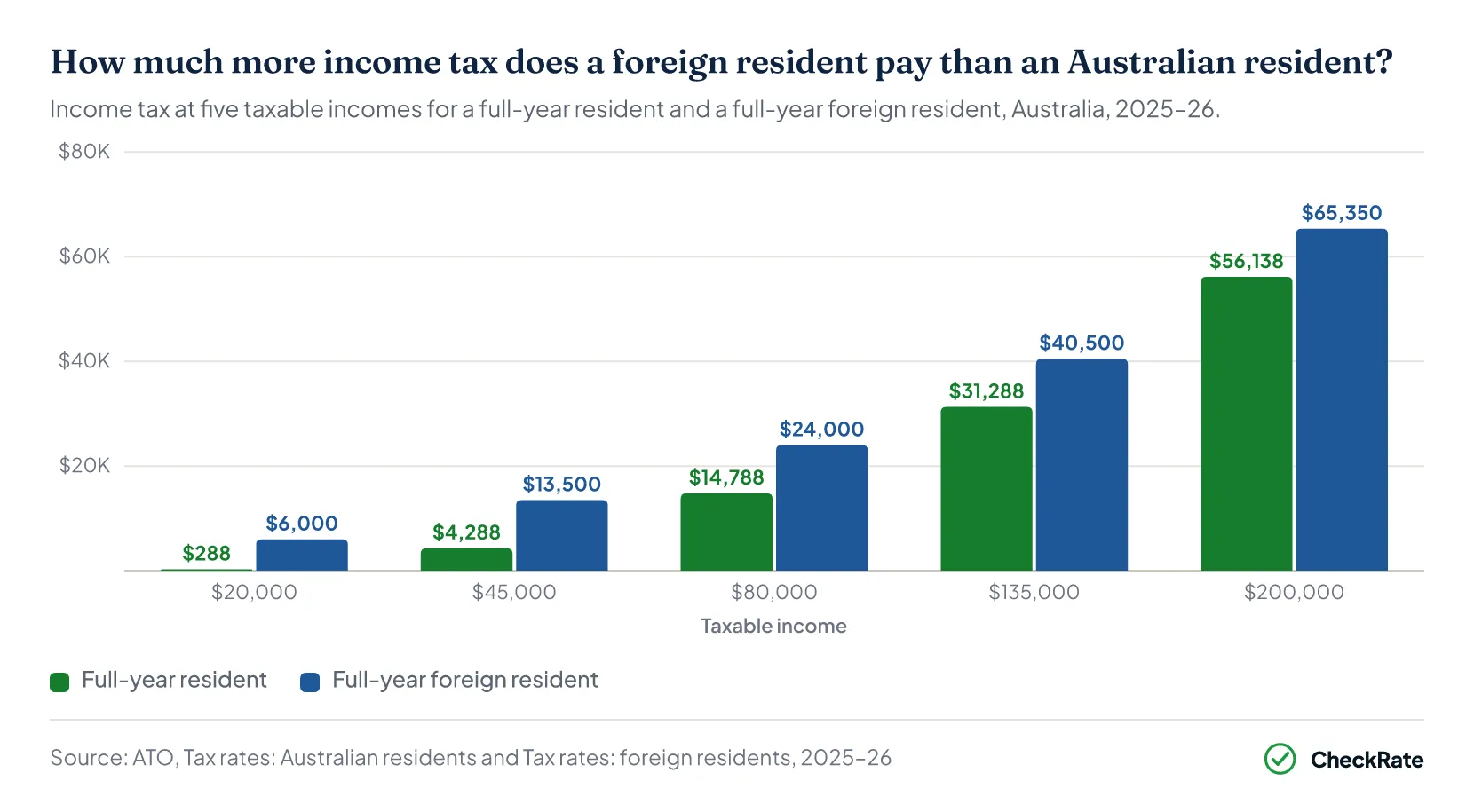
Foreign residents have no tax-free threshold and do not pay the Medicare levy7. In 2025–26, the foreign resident tax rate was 30% from the first dollar of taxable income up to $135,0008. A full-year resident paid no tax on the first $18,200 and 16% on income from $18,201 to $45,000 in the same year9.
For example, at taxable income of $80,000, the calculated tax was $14,788 for a full-year resident and $24,000 for a full-year foreign resident, before tax offsets and excluding the Medicare levy9. At every taxable income of $45,000 or more, the foreign resident figure was $9,212 higher, because both scales charge the same marginal rates above $45,0008.
The actual difference also depends on resident tax offsets, the 2% Medicare levy and any treaty relief9.
| Foreign resident income tax rates, Australia, 2025–26 | |
|---|---|
| Taxable income | Tax on this income |
| $0–$135,000 | 30c for each $18 |
| $135,001–$190,000 | $40,500 plus 37c for each $1 over $135,0008 |
| $190,001 and over | $60,850 plus 45c for each $1 over $190,0008 |
Source · ATO, Tax rates: foreign residents.
Australian interest, unfranked dividends and royalties paid to a foreign resident are subject to withholding tax and are not included in an Australian tax return1. The payer withholds 10% of interest. For residents of countries without a tax treaty, the withholding rates are 30% for unfranked dividends and 30% for royalties. Many tax treaties reduce these rates10. A payer that is not told the person's overseas address may withhold at 47%.
When residency ends, a person is treated as having disposed of assets other than taxable Australian property at market value on that date11. This can result in a capital gain. A home or rental property in Australia is taxable Australian property, so it is not part of this deemed disposal. A person can instead choose to disregard those gains and losses, in which case the assets are treated as taxable Australian property until they are sold or the person becomes an Australian resident again.
The full 50% capital gains tax (CGT) discount applies to the deemed disposal where the person held the asset for at least 12 months and was an Australian resident for the whole time they owned it11. For an asset acquired after 8 May 2012 and sold after the person became a foreign resident, the discount is limited to the period of Australian residency.
Foreign residents cannot claim the main residence exemption on property sold after 30 June 2020 unless they meet the life events test. A partial exemption is not available12.
The life events test has two parts:12
- the person was a foreign resident for a continuous period of six years or less
- during that period, the person, their spouse or their child under 18 had a terminal medical condition, their spouse or child under 18 died, or the sale followed a formal agreement after a marriage or relationship breakdown.
For contracts signed from 1 January 2025, a buyer generally withholds 15% of the sale price when purchasing Australian property from a foreign resident and pays it to the ATO13. A variation issued by the ATO can reduce the rate.
| Tax treatment of an Australian resident and a foreign resident, 2025–26 | ||
|---|---|---|
| Item | Australian resident | Foreign resident |
| Income taxed in Australia | Worldwide income | Australian-sourced income and capital gains on taxable Australian property |
| Tax-free threshold | $18,200 for a full year | None |
| Tax on taxable income of $45,000 | $4,2889 | $13,500 |
| Medicare levy | Generally 2% | Not payable |
| Australian interest, unfranked dividends and royalties | Declared in the tax return | Withholding as a final tax, not declared |
| Main residence exemption on an Australian home | Available, subject to the general rules | Not available for sales after 30 June 2020, unless the life events test is met12 |
| 50% CGT discount on assets acquired after 8 May 2012 | Available on assets held at least 12 months | Apportioned to periods of Australian residency only |
Source · ATO, Foreign and temporary residents; ATO, Tax rates: Australian residents and foreign residents; ATO, How changing residency affects CGT; ATO, Main residence exemption for foreign residents.
The events that create a capital gain in the first place are covered in What triggers capital gains tax in Australia?
Section 06 · Telling the ATO
How is a change of tax residency reported to the ATO?
A change of residency is reported in the individual tax return for the year it happens. The return records the date the person stopped being an Australian resident and the number of months they were a resident14. A person who changed from resident to foreign resident during the year answers "yes" to the return's question "Are you an Australian resident?"1. Resident tax rates apply to that year, with a reduced tax-free threshold.
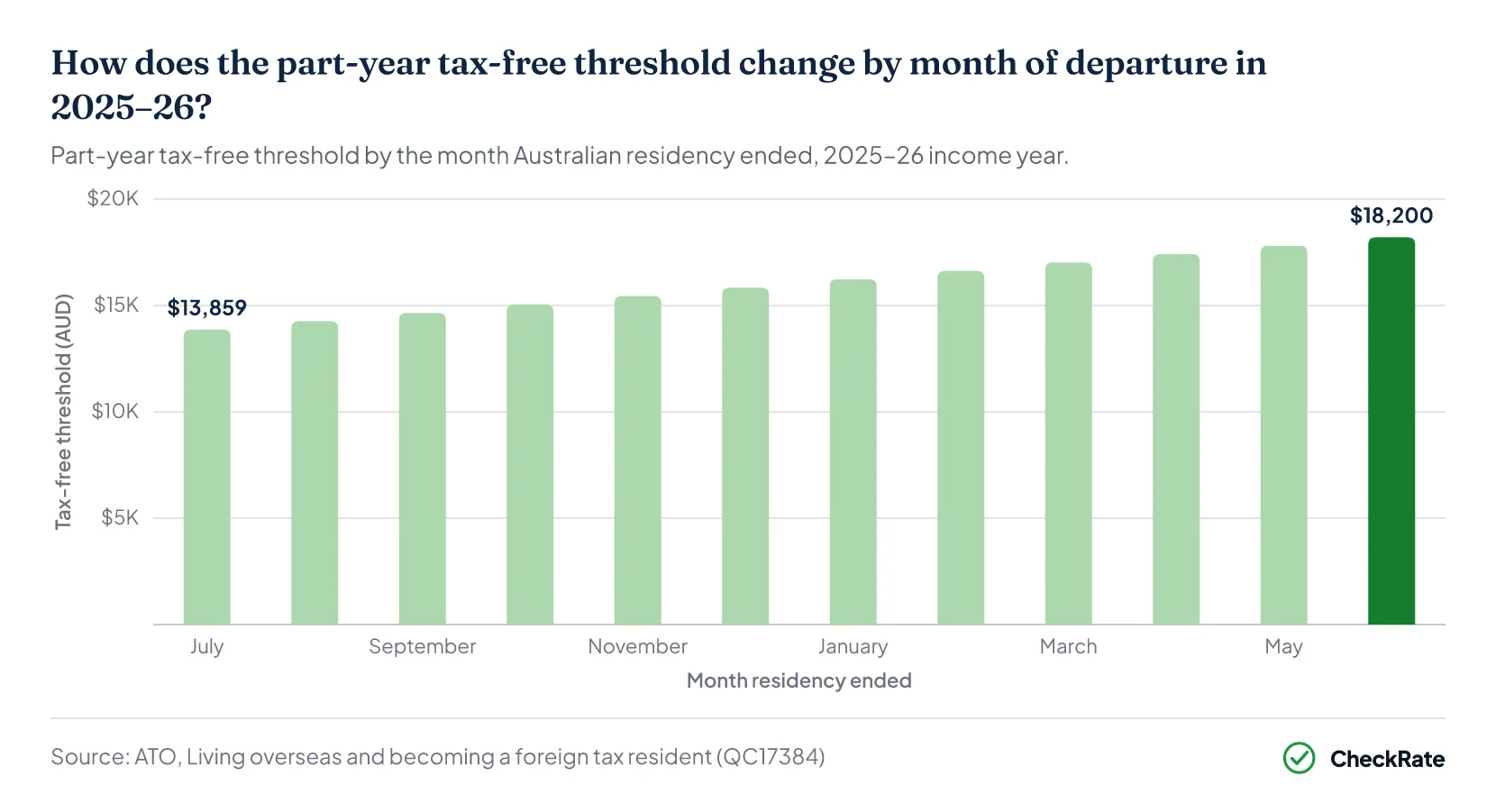
The tax-free threshold for that year is $13,464 plus $4,736 divided by 12 for each month of Australian residency, counting the month the person left15. In the ATO's example, a person who became a foreign resident on 22 December 2025 had six months of residency and a threshold of $15,832 for 2025–26.
The days after residency ends can be claimed as Medicare levy exempt days in the same return1.
A person leaving Australia permanently before 30 June can lodge that year's return early using a paper form if they will no longer receive Australian-sourced income other than interest, dividends and royalties16. Early returns take 50 business days to process, according to the ATO. The normal lodgment period applies if the person will continue to receive other Australian-sourced income, such as rent, or has a study or training loan.
A person with a Higher Education Loan Program (HELP) or other study or training loan must update their contact details in myGov before leaving Australia or within seven days of departure17. If they intend to remain overseas for 183 days or more, an overseas travel notification is also required within seven days of leaving. As a foreign resident, they then report their worldwide income for study-loan purposes or lodge a non-lodgment advice each year7.
How rental income and expenses are taxed is covered in How is rental property income taxed in Australia?
Section 07 · Split residency
How is tax residency decided when time is split between countries?
A person can be a tax resident of Australia and of another country at the same time3. If Australia has a tax treaty with that country, the treaty may determine which country the person is treated as a resident of for treaty purposes14. This does not necessarily end their Australian residency under domestic tax law2.
Splitting time between countries also affects the domicile test, because a person living between Australia and another country may be less likely to establish a permanent home overseas2.
Treasury's list of income tax treaties, as updated on 24 March 2026, covers 47 countries and jurisdictions, including Thailand, Poland and Malaysia18. The three agreements apply the same tie-breaker steps to an individual resident of both countries, in this order:19
- the country where a permanent home is available to the person
- if a permanent home is available in both countries or neither, the country where the person usually lives
- if the habitual abode is in both countries or neither, the country with which the person's personal and economic relations are closer.
The Thailand and Malaysia agreements can also consider citizenship at a later stage of the test, while the Poland agreement does not mention it20. All three agreements make pensions and annuities paid to a resident of one country taxable only in that country, although Thailand and Malaysia have separate rules for some government service pensions21.
A dual resident with income from a treaty country may be able to have withholding tax reduced or removed by providing the required tax-relief documentation or a certificate of residency14.
| Australia's income tax treaties with Thailand, Poland and Malaysia: residence, pensions and withholding | |||
|---|---|---|---|
| Provision | Thailand | Poland | Malaysia |
| Signed | 31 August 1989 | 7 May 1991 | 20 August 1980, amended by protocols signed in 1999, 2002 and 2010 |
| In force | 27 December 1989 | 4 March 1992 | 26 June 1981 |
| Tie-breaker for an individual resident of both countries | Permanent home, then habitual abode, then personal and economic relations | Permanent home, then habitual abode, then economic and personal relations | Permanent home, then habitual abode, then personal and economic relations |
| Citizenship in the final step | A factor | Not mentioned | May be considered |
| Pensions and annuities | Taxable only in the country of residence, except government service pensions (Article 18) | Taxable only in the country of residence, including government pensions (Article 18) | Taxable only in the country of residence, except government service pensions (Article 17) |
| Limit on tax in the source country on interest | 25%, or 10% for financial institutions | 10% | 15% |
| Limit on Australian tax on unfranked dividends | Limits apply only to company shareholders with at least 25% of the paying company | 15% | 15% |
Source · Treasury, Income tax treaties; ATO, synthesised texts of the Thailand, Poland and Malaysia agreements, Articles 4, 10, 11, 17 and 18; ATO, Interest, unfranked dividends and royalties.
Section 08
Tax residency overseas: quick answers
Do Australian citizens living overseas pay tax in Australia?
Australian citizens living overseas pay Australian tax on their worldwide income only while they remain Australian residents for tax purposes. Citizenship alone does not determine tax residency. A citizen who is a foreign resident pays Australian tax on Australian-sourced income and on capital gains on taxable Australian property.
How long can an Australian live overseas and remain a tax resident?
An Australian can live overseas and remain a tax resident for an indefinite period because there is no fixed time limit. The ATO treats an intended overseas stay of less than two years as unlikely to establish a permanent home overseas, but a longer stay does not end residency on its own.
Do foreign residents pay the Medicare levy?
Foreign residents do not pay the Medicare levy. A person who becomes a foreign resident part way through an income year can claim the days they were not an Australian resident as exempt days in their tax return.
Can a foreign resident claim the main residence exemption on an Australian home?
A foreign resident cannot claim the main residence exemption on an Australian home sold after 30 June 2020 unless they meet the life events test, and no partial exemption applies. The life events test requires foreign residency of six years or less and a terminal medical condition, the death of a spouse or child under 18, or a formal relationship breakdown agreement in that period.
What is the tax-free threshold in the year a person leaves Australia?
The tax-free threshold in the year a person becomes a foreign resident is $13,464 plus $4,736 divided by 12 for each month they were an Australian resident, counting the month they left. In the ATO's example, a person who became a foreign resident on 22 December 2025 had a threshold of $15,832.
References
- Australian Taxation Office, Your tax residency · ato.gov.au ↑ b c d e f g h
- ATO, Taxation Ruling TR 2023/1, Income tax: residency tests for individuals · ato.gov.au ↑ b c d e f g h i j k l m n o p
- ATO, Residency: the resides test (QC17137) · ato.gov.au ↑ b c d e
- ATO, Residency: the superannuation test (QC17140) · ato.gov.au ↑
- ATO, Residency: the domicile test (QC17138) · ato.gov.au ↑ b
- ATO, Residency: the 183-day test (QC17139) · ato.gov.au ↑ b
- ATO, Foreign and temporary residents · ato.gov.au ↑ b c d
- ATO, Tax rates: foreign residents · ato.gov.au ↑ b c d e
- ATO, Tax rates – Australian resident (QC 73320) · ato.gov.au ↑ b c d
- ATO, Interest, unfranked dividends and royalties (foreign resident investments) · ato.gov.au ↑
- ATO, How changing residency affects CGT (QC66059) · ato.gov.au ↑ b
- ATO, Main residence exemption for foreign residents · ato.gov.au ↑ b c
- ATO, Foreign resident capital gains withholding overview · ato.gov.au ↑
- ATO, Australian resident for tax purposes (QC65132) · ato.gov.au ↑ b c
- ATO, Living overseas and becoming a foreign tax resident · ato.gov.au ↑
- ATO, Lodge your tax return before leaving Australia (QC33230) · ato.gov.au ↑
- Australian Taxation Office, Living overseas and remaining an Australian tax-resident · ato.gov.au ↑
- Treasury, Income tax treaties · treasury.gov.au ↑
- ATO, Synthesised text of the Multilateral Instrument and the Australia and Thailand tax treaty · ato.gov.au ↑
- ATO, Synthesised text of the MLI and the Australia–Malaysia agreement · ato.gov.au ↑
- ATO, Synthesised text of the MLI and the Australia and Poland tax agreement · ato.gov.au ↑