


Published
 How much super do Australians need to retire overseas?Moneysmart, the consumer website of the Australian Securities and Investments Commission (ASIC), gives a rule of thumb of around 70% of working-life income for retirement, and states that there is no…
 How much Age Pension is paid to Australians living overseas?An Age Pension paid to a person who has been outside Australia for more than 26 weeks is generally paid without a residence-based reduction only if the person has 35 years of Australian working life r…
 Can a person live overseas and still get the Australian Age Pension?The Age Pension can generally continue to be paid for as long as a recipient is outside Australia, whether the absence is temporary or permanent, provided the person continues to qualify under the inc…
Section 01 · Moving overseas
Does moving overseas give early access to superannuation?
Moving overseas is not a condition of release for superannuation, so Australian citizens and permanent residents who leave Australia cannot withdraw their super until they meet a standard condition of release, such as retiring after reaching preservation age or turning 651.
The Australian Taxation Office (ATO) lists several circumstances in which super may be accessed early, including21:
- compassionate grounds, such as medical treatment or preventing the forced sale of a home
- a terminal medical condition, or temporary or permanent incapacity
- severe financial hardship
- a super balance of less than $200
- the First Home Super Saver scheme, for eligible voluntary contributions
- being a temporary resident who is leaving Australia.
Australian citizens, New Zealand citizens and permanent residents of Australia cannot claim a departing Australia superannuation payment (DASP), which allows eligible temporary residents to access their super after leaving Australia3.
Members who have permanently emigrated to New Zealand may transfer the whole balance of an Australian super account to a KiwiSaver scheme under the Trans-Tasman Retirement Savings Portability scheme. Both the Australian Prudential Regulation Authority (APRA)-regulated fund and the KiwiSaver provider must participate in the scheme4. The transfer is not taxed.
The Australian-sourced component cannot be accessed until the member is at least 60 and meets the Australian definition of retirement. It also cannot be transferred from KiwiSaver to a third country4.
| Superannuation on leaving Australia, by citizenship and visa status | ||
|---|---|---|
| Status of the member | Super released on leaving Australia? | Rule that applies |
| Australian citizen or permanent resident | No | Super stays preserved until a condition of release is met; a member who permanently emigrates to New Zealand may transfer the whole balance to a KiwiSaver scheme |
| New Zealand citizen | No | Not eligible for a DASP; Australian super, including ATO-held unclaimed super, may be transferred to a KiwiSaver scheme |
| Temporary visa holder (other than a working holiday maker) | Yes, as a DASP | Claimed after leaving Australia once the visa has expired or been cancelled; subclass 405 and 410 visas are excluded |
| Working holiday maker (subclass 417 or 462) | Yes, as a DASP | Same conditions, with tax withheld at the working holiday maker rate of 65% on the taxable component |
Source · Australian Taxation Office, Departing Australia superannuation payment (DASP) and Trans-Tasman retirement savings transfers
Section 02 · Conditions of release
What are the conditions of release for superannuation, including preservation age?
Superannuation can be withdrawn once a member turns 65, even while still working, or once they reach preservation age and retire1. A member who has reached preservation age and continues working may instead start a transition to retirement income stream.
A member under 65 with a transition to retirement income stream must withdraw at least 4% and no more than 10% of the account balance each financial year5. These limits no longer apply once the member meets a condition of release such as retiring after preservation age or turning 65.
Preservation age depends on date of birth, from 55 for people born before 1 July 1960 to 60 for people born from 1 July 19641. Anyone reaching preservation age now does so at age 60.
For super purposes, retirement has different rules depending on age. A member who stops paid employment at age 60 or older can meet the retirement condition of release. A member who retires after reaching preservation age but before age 60 must satisfy the fund that they do not intend to return to paid employment1.
Where the member lives does not affect these conditions of release.6
| Superannuation preservation age by date of birth, Australia | |
|---|---|
| Date of birth | Preservation age (years) |
| Before 1 July 1960 | 551 |
| 1 July 1960 to 30 June 1961 | 56 |
| 1 July 1961 to 30 June 1962 | 57 |
| 1 July 1962 to 30 June 1963 | 58 |
| 1 July 1963 to 30 June 1964 | 59 |
| From 1 July 1964 | 601 |
Source · Australian Taxation Office, Super withdrawal options
Section 03 · Access from overseas
How is superannuation accessed from overseas after a condition of release?
A member living overseas who has met a condition of release can take super as a lump sum or as an income stream, such as an account-based pension.5 The same withdrawal options apply to retirees living in Australia and overseas.6
Australian tax on a super lump sum depends on the member's age and the components of the payment7. For a member aged 60 or older, the taxed element of the taxable component is tax-free in Australia.
An untaxed element paid to a member aged 60 or older is taxed at a maximum of 15% up to the untaxed plan cap amount, which is $1,935,000 in 2026-27, and at 45% above it7.
Account-based pension payments are also free of Australian tax on the taxed element and the tax-free component once the member turns 608.
| Maximum Australian tax rates on super lump sum member benefits, by age at payment, 2026-27 | ||
|---|---|---|
| Age when paid | Taxed element | Untaxed element |
| Under preservation age | 20%7 | 30% up to the untaxed plan cap amount, 45% above it |
| Preservation age to 59 | Nil up to the low rate cap amount, 15% above it | 15% up to the low rate cap amount, 30% up to the untaxed plan cap amount, 45% above it |
| 60 or older | Nil (non-assessable, non-exempt income) | 15% up to the untaxed plan cap amount, 45% above it7 |
Source · Australian Taxation Office, Key superannuation rates and thresholds: payments from super
Section 04 · Departing payment
Who can claim a departing Australia superannuation payment?
A departing Australia superannuation payment (DASP) can be claimed by people who earned super while working in Australia on a temporary resident visa. They can claim it once they have left Australia and the visa has expired or been cancelled3. Investor Retirement (subclass 405) and Retirement (subclass 410) visas are excluded.
An application can be started before departure, but it can be submitted only once the member has left Australia and no longer holds an active Australian visa3.
Tax is withheld from a DASP as a final tax, and the payment is not included in an Australian tax return3. The taxed element of the taxable component is taxed at 35% and the untaxed element at 45%, while the tax-free component is not taxed.
Working holiday makers on subclass 417 or 462 visas pay 65% on both elements of the taxable component3. That rate applies to the whole payment if any part of it comes from contributions made while the member held a working holiday maker visa.
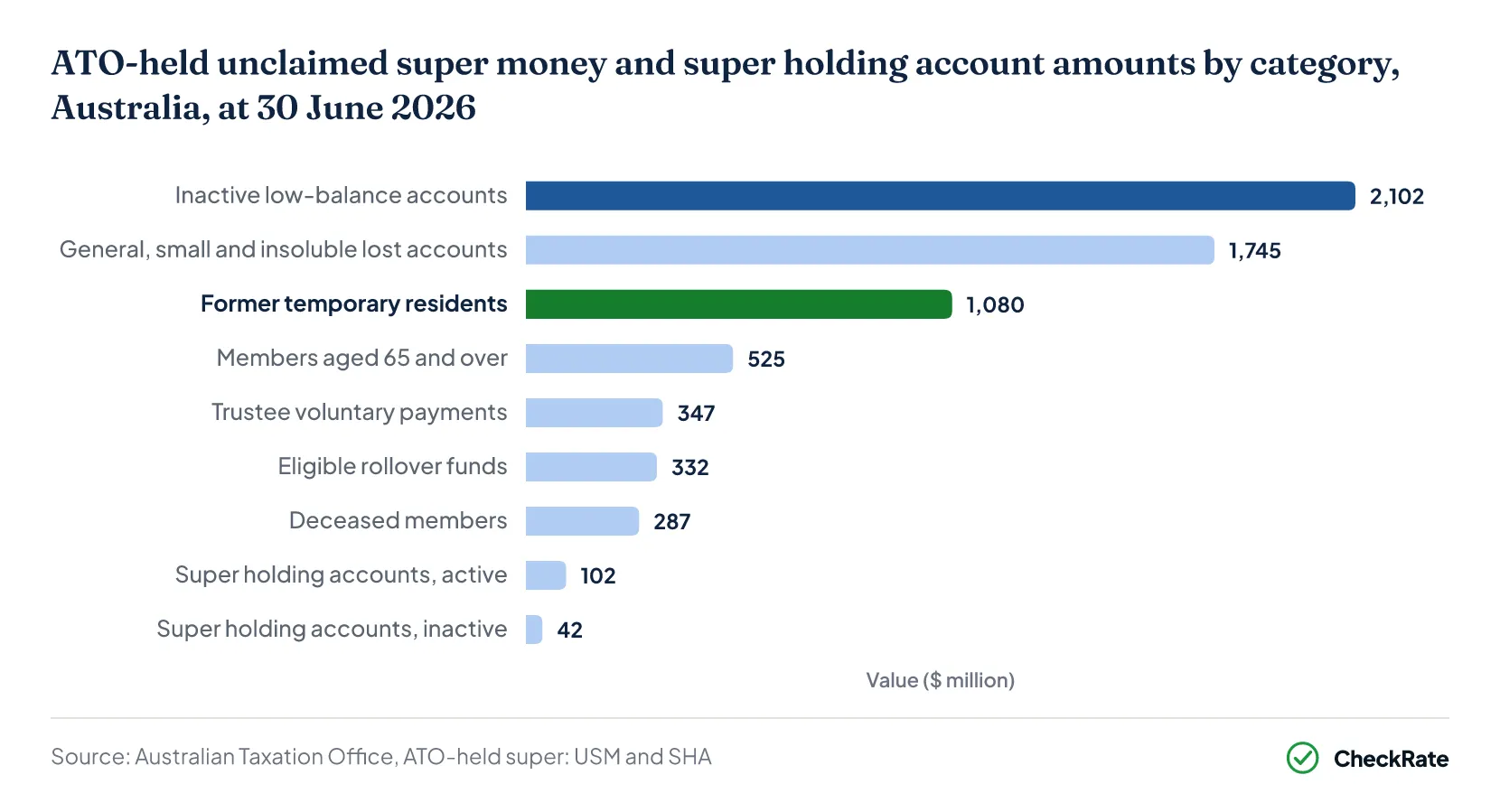
A fund transfers a former temporary resident's super to the ATO as unclaimed super money once six months have passed since the member left Australia and the visa has ceased3. At 30 June 2026, the ATO held $1,080 million in unclaimed super for former temporary residents across 1,004,000 accounts9. This accounted for 16.5% of the $6,560 million of unclaimed super money and super holding account amounts the ATO had at that date.
The value held for former temporary residents was largely unchanged over the three years, at $1,077 million at 30 June 2023 and $1,080 million at 30 June 20269.
| Departing Australia superannuation payment tax rates by component | ||
|---|---|---|
| Payment component | Ordinary DASP rate (%) | Working holiday maker rate (%) |
| Tax-free component | 0 | 0 |
| Taxable component, taxed element | 353 | 653 |
| Taxable component, untaxed element | 453 | 65 |
Source · Australian Taxation Office, Departing Australia superannuation payment (DASP)
Section 05 · Account-based pensions
How are account-based pensions paid to retirees living overseas?
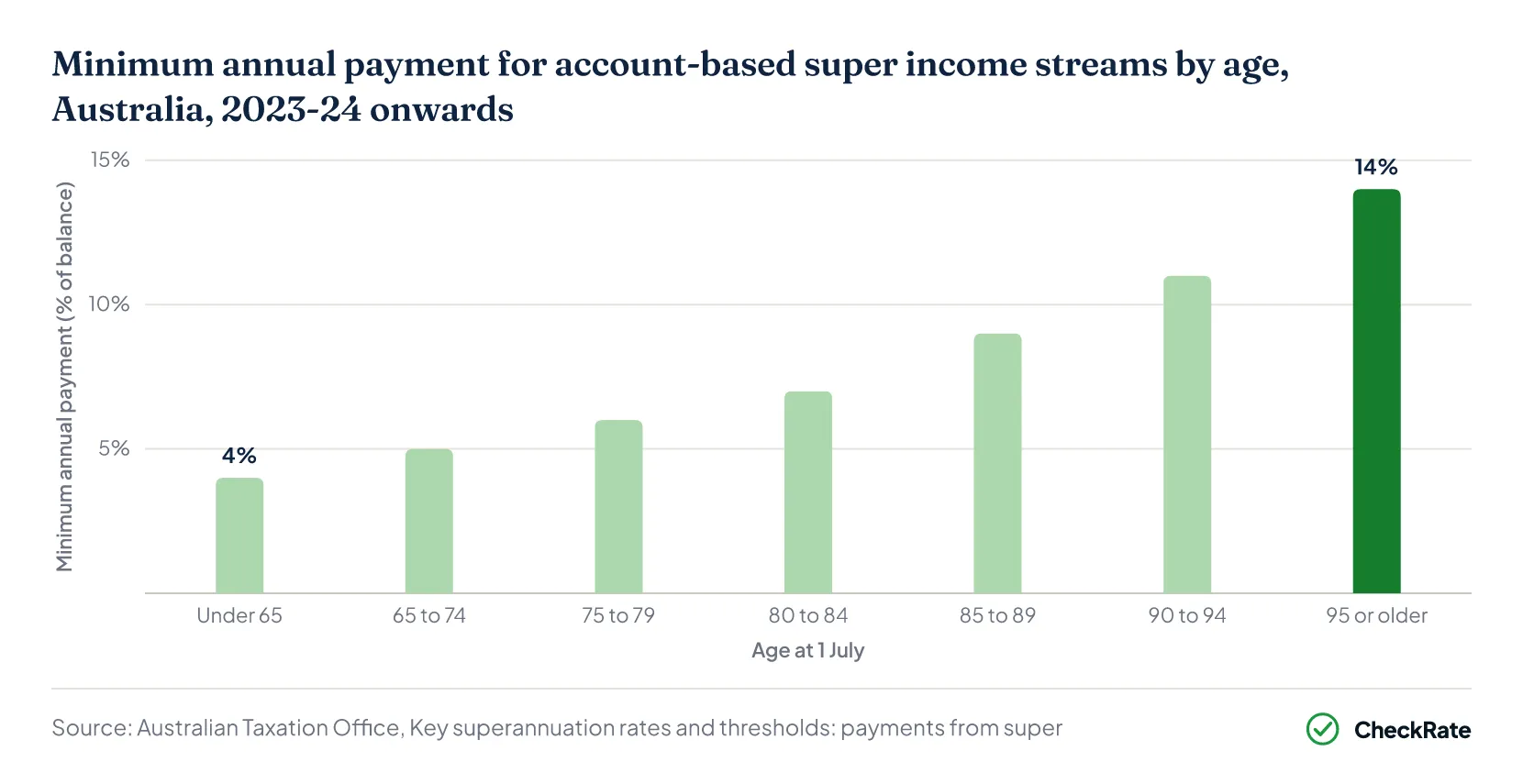
Retirees living overseas who draw an account-based pension must withdraw a minimum of 4% to 14% of the balance each financial year, depending on age at 1 July7. The minimum amount depends on the member's age and account balance at 1 July10.
An account-based pension pays a regular income from super until the balance runs out, and it does not guarantee an income for life, according to Moneysmart, the Australian Securities and Investments Commission's consumer website10. Payments may be made monthly, quarterly, half-yearly or yearly, depending on the options offered by the fund. Lump sums can also be taken at any time.
If the minimum annual payment is not made, the income stream is treated as having stopped at the start of that financial year for income tax purposes and is no longer in retirement phase5.
Worked example · $400,000 account-based pension at age 67
This is an example calculation based on the ATO's minimum annual payment percentages7. A retiree aged 67 at 1 July with a $400,000 account-based pension must withdraw at least $20,000 during that financial year. This equals 5% of the balance8.
Section 06 · Age Pension
Can the Age Pension be paid to retirees living overseas?
The Age Pension can be paid for the whole time a pensioner is outside Australia, including after leaving to live in another country11. The rate may be reduced based on how long the person was an Australian resident12.
The maximum basic rate for a single pensioner living outside Australia is $29,520.40 a year from 20 September 2026. For a couple who are both eligible, the combined maximum basic rate is $44,506.80 a year12.
A pensioner living outside Australia long term is paid every four weeks12. Payments made into an overseas bank account may be paid in local currency or US dollars.13 The Reserve Bank of Australia (RBA) arranges the conversion at the exchange rate at the time of payment.
Age Pension rates are adjusted every 20 March and 20 September14. Government pensions are indexed by whichever is higher: the increase in the Consumer Price Index (CPI) or the Pensioner and Beneficiary Living Cost Index over the previous six months, according to the Australian Bureau of Statistics (ABS)15.
Over the six months to the June quarter 2026, the Pensioner and Beneficiary Living Cost Index rose 3.2%, compared with 2.0% for the CPI15.
Section 07 · Prices and currencies
How do overseas price levels and exchange rates compare with Australia's?
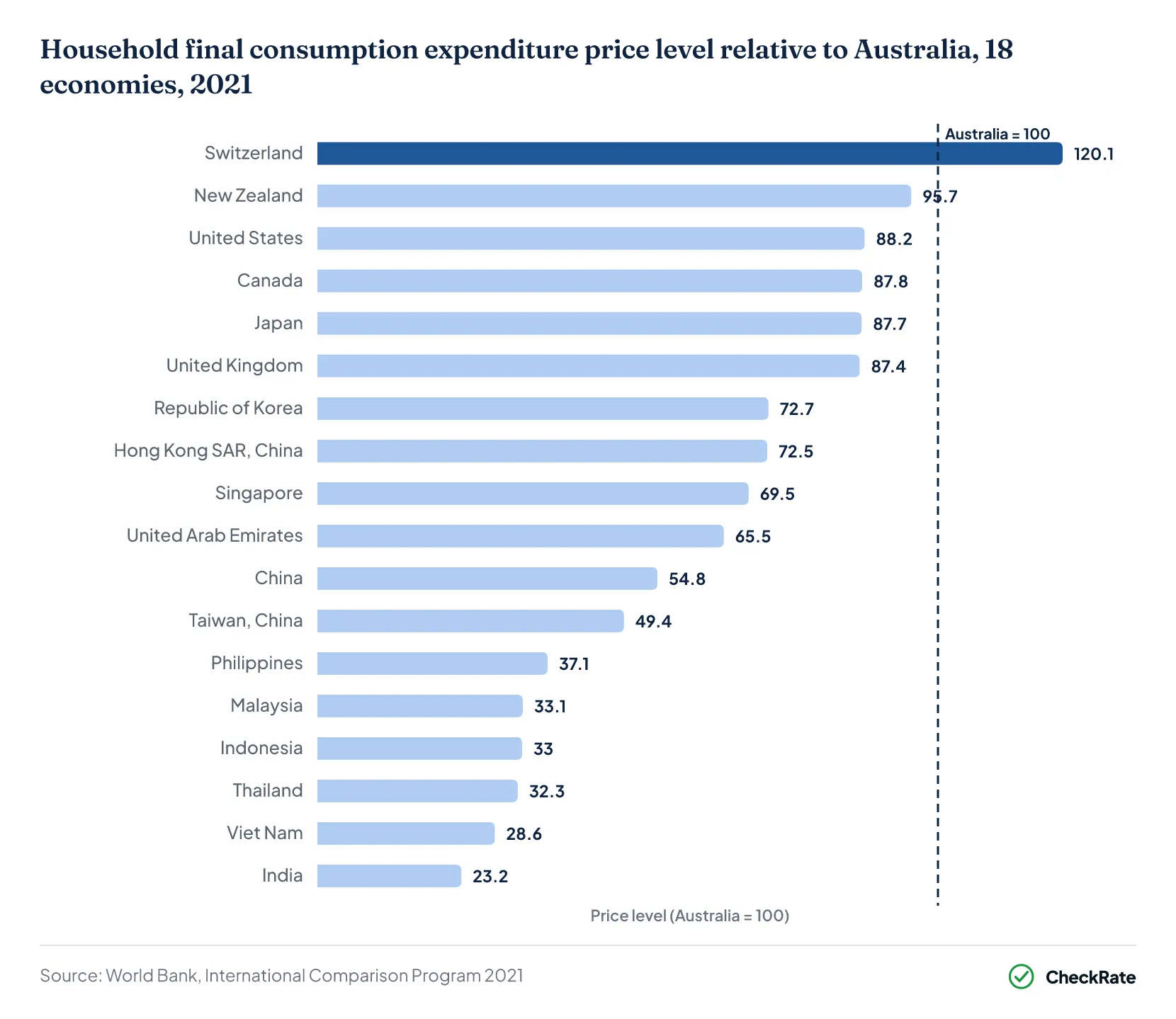
Household consumption prices were lower than in Australia in 17 of the 18 economies compared using 2021 World Bank data. The economies are those whose currencies the RBA publishes and that the World Bank's International Comparison Program (ICP) covers individually16. Switzerland was the only one with higher prices, at 120.1 where Australia equals 100.
India recorded the lowest household consumption price level among the 18 economies, at 23.2, followed by Vietnam at 28.6 and Thailand at 32.316. New Zealand, the United States and the United Kingdom recorded price levels of 95.7, 88.2 and 87.4, respectively.
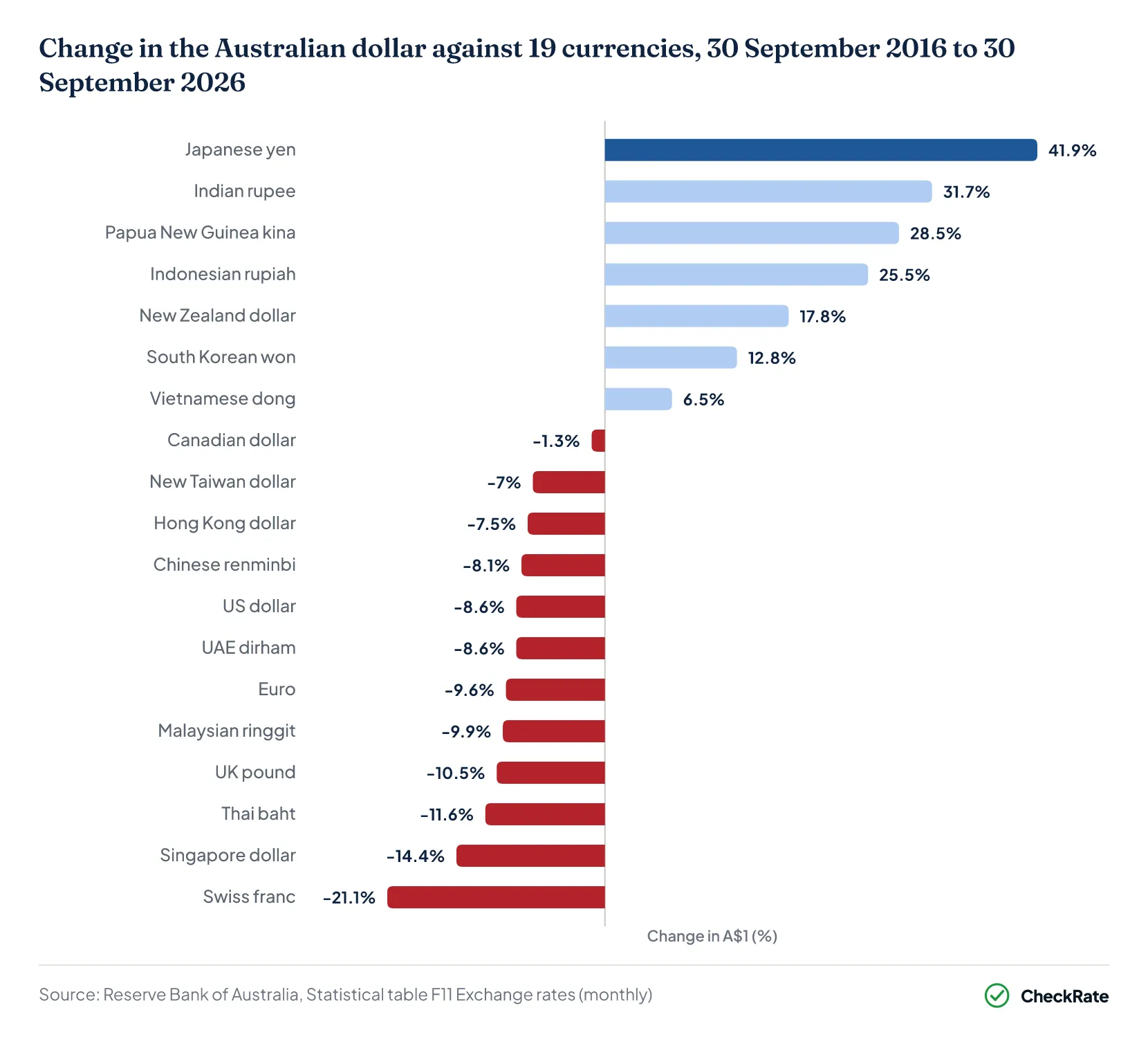
The Australian dollar was worth less against 12 of 19 currencies at 30 September 2026 than 10 years earlier, according to the RBA17. The Australian dollar fell 8.6% against the US dollar, from US$0.7630 at 30 September 2016 to US$0.6977 at 30 September 2026.
The Australian dollar recorded its largest fall among the 19 currencies against the Swiss franc, at 21.1%, and its largest rise against the Japanese yen, at 41.9%17.
For example, a $20,000 annual pension payment converts to US$13,954 at the 30 September 2026 rate, compared with US$15,260 at the 30 September 2016 rate.
Section 08 · Fund details
How can members living overseas find lost or unclaimed superannuation?
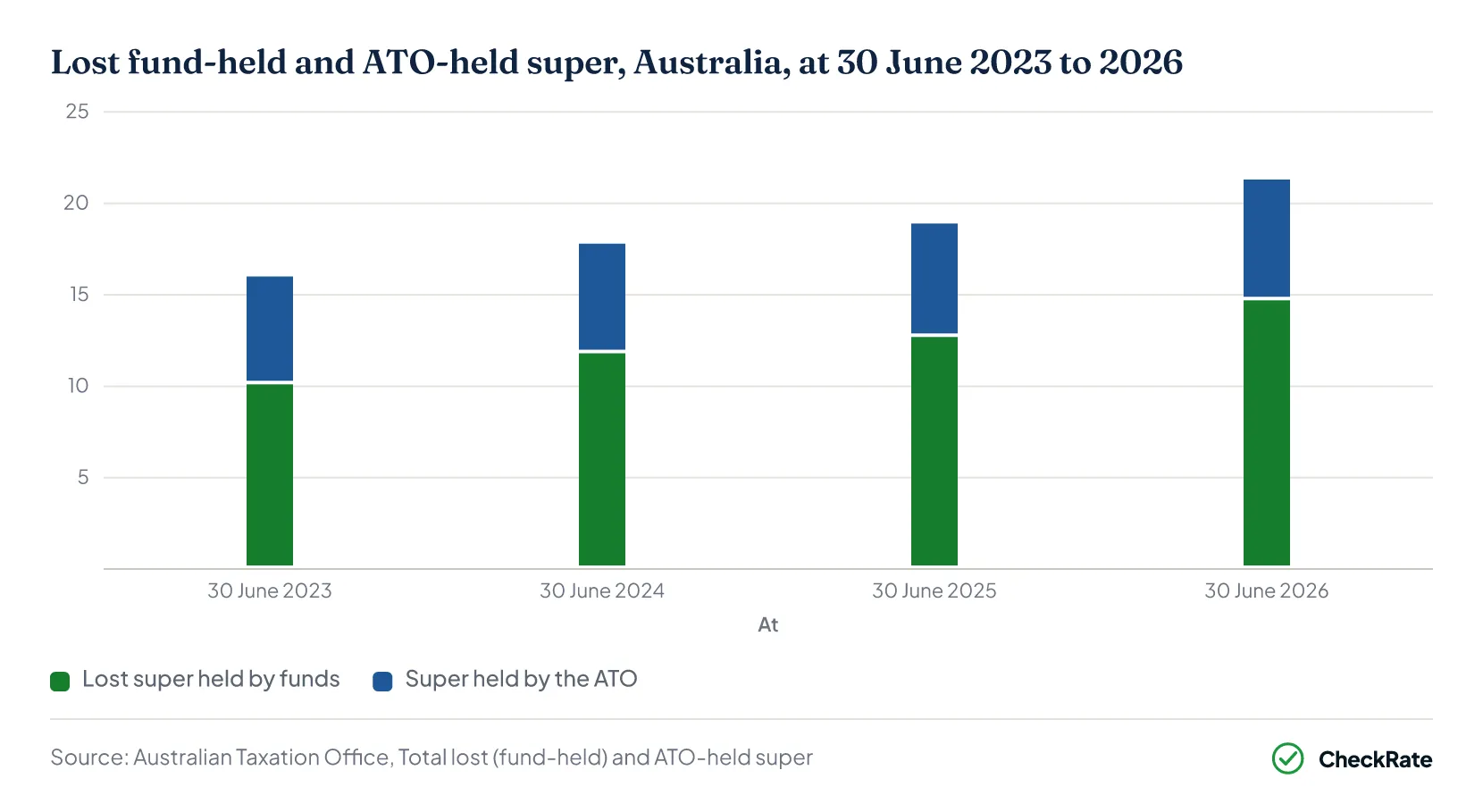
Lost super held by funds and super held by the ATO totalled $21.2 billion across about 7.5 million accounts at 30 June 2026, according to the ATO18. Lost super held by funds increased from $10.1 billion at 30 June 2023 to $14.7 billion at 30 June 2026. Over the same period, super held by the ATO increased from $5.9 billion to $6.6 billion.
Super funds must pay a member's super to the ATO as unclaimed super money in certain circumstances19. These include members aged 65 or older who have made no contribution for two years and whom the fund has not been able to contact for five years. They also include former temporary residents once six months have passed since they left Australia and their visa ceased3.
ATO online services linked to myGov and the ATO app allow members to check their balances, lost accounts and ATO-held super. ATO-held super can also be transferred to an Australian super fund through these services20.
The ATO can pay super it holds directly to a member aged 65 or older, provided it has the member's current financial institution details19. Current and previous addresses, employers and names can help the ATO match super that has not yet been linked to a person9.
How super balances compare across age groups is covered in average savings by age.
Section 09
Super while living overseas: quick answers
Can I access my super if I move overseas permanently?
Moving overseas permanently does not by itself allow an Australian citizen or permanent resident to withdraw super, because leaving Australia is a condition of release only for temporary visa holders, according to the ATO. The super stays in the fund until the member meets a condition of release, such as retiring after preservation age or turning 65.
Can New Zealand citizens take their Australian super home?
New Zealand citizens cannot claim a departing Australia superannuation payment, but those who move permanently to New Zealand can transfer Australian super, including unclaimed super held by the ATO, to a participating KiwiSaver scheme. The Australian-sourced component generally stays inaccessible until the member is 60 or older and has retired.
What is the preservation age for super in 2026?
The preservation age is 60 for anyone born on or after 1 July 1964, according to the ATO. People born earlier had preservation ages from 55 to 59 and had all reached their preservation age by 30 June 2023.
How much tax is taken from a departing Australia superannuation payment?
Tax is withheld from a departing Australia superannuation payment at 35% on the taxed element and 45% on the untaxed element of the taxable component, and the tax-free component is not taxed. Working holiday makers on subclass 417 or 462 visas pay 65% on the taxable component.
Is super taxed in Australia if I live overseas and am over 60?
Lump sums and account-based pension payments from the taxed element of a taxed fund carry no Australian tax once the member is 60 or older, according to the ATO. An untaxed element is taxed at a maximum of 15% up to the untaxed plan cap amount of $1,935,000 in 2026-27, with higher rates applying above that amount. These are Australian tax rates only.
Can I get the Age Pension if I live overseas?
The Age Pension can be paid while a pensioner lives outside Australia, although the rate may be reduced based on how long the person was an Australian resident, according to Services Australia. The maximum basic rate for a single pensioner living outside Australia is $29,520.40 a year from 20 September 2026.
References
- Australian Taxation Office, Super withdrawal options · ato.gov.au ↑ b c d e f g h
- Australian Taxation Office, When you can access your super early · ato.gov.au ↑ b
- Australian Taxation Office, Departing Australia superannuation payment (DASP) · ato.gov.au ↑ b c d e f g h i j k
- Australian Taxation Office, Trans-Tasman retirement savings transfers · ato.gov.au ↑ b
- ATO, Retirement withdrawal – lump sum or income stream (QC73093) · ato.gov.au ↑ b c
- Australian Taxation Office, Living overseas and remaining an Australian tax-resident · ato.gov.au ↑ b
- ATO, Key superannuation rates and thresholds: Payments from super · ato.gov.au ↑ b c d e f g
- Australian Taxation Office, Tax on super benefits · ato.gov.au ↑ b
- Australian Taxation Office, ATO-held super: USM and SHA · ato.gov.au ↑ b c d
- Moneysmart (ASIC), Account-based pensions · moneysmart.gov.au ↑ b
- Services Australia, Travel outside Australia rules for Age Pension · servicesaustralia.gov.au ↑
- Services Australia, Payment schedule and rates for people outside Australia: Age Pension · servicesaustralia.gov.au ↑ b c
- Services Australia, Payments while outside Australia (Age Pension) · servicesaustralia.gov.au ↑
- Services Australia, How much Age Pension you can get (rates from 20 September 2026) · servicesaustralia.gov.au ↑
- Australian Bureau of Statistics, Selected Living Cost Indexes, Australia, June 2026 · Australian Bureau of Statistics ↑ b
- World Bank, International Comparison Program (ICP) 2021 database · databank.worldbank.org ↑ b
- Reserve Bank of Australia, Exchange Rates: Statistical Table F11 (monthly) · Reserve Bank of Australia ↑ b
- Australian Taxation Office, Total lost (fund-held) and ATO-held super · ato.gov.au ↑
- Australian Taxation Office, ATO-held super · ato.gov.au ↑ b
- Australian Taxation Office, Keeping track of your super online · ato.gov.au ↑