


Published
 Can Australian super be accessed while living overseas?Moving overseas is not a condition of release for superannuation, so Australian citizens and permanent residents who leave Australia cannot withdraw their super until they meet a standard condition of…
 How much super do Australians need to retire overseas?Moneysmart, the consumer website of the Australian Securities and Investments Commission (ASIC), gives a rule of thumb of around 70% of working-life income for retirement, and states that there is no…
 How much Age Pension is paid to Australians living overseas?An Age Pension paid to a person who has been outside Australia for more than 26 weeks is generally paid without a residence-based reduction only if the person has 35 years of Australian working life r…
Section 01 · From age 60
How is super taxed for non-residents aged 60 or older?
A super lump sum paid to a person aged 60 or older carries no Australian tax on its tax-free component or its taxed element, which the ATO treats as non-assessable, non-exempt income1.
An account-based income stream paid after age 60 is also free of tax on its taxed element and tax-free component2.
The untaxed element is taxed at every age. From age 60 the untaxed element of a lump sum is taxed at a maximum of 15% up to the untaxed plan cap, which is $1,935,000 for 2026–27, and at 45% above that cap1.
The untaxed element of an income stream is taxed at marginal rates with a 10% tax offset3. The offset on the untaxed element is capped at $13,125 for 2026–274.
The maximum rates the ATO publishes exclude the Medicare levy of 2%1. Foreign residents for tax purposes do not pay the Medicare levy, so the maximum rates apply to them without it5.
Capped defined benefit income streams, such as lifetime pensions, follow a separate test. Where the tax-free component and taxed element paid in a year exceed the defined benefit income cap, 50% of the excess is assessed at marginal rates2. The defined benefit income cap is $131,250 for 2026–276.
| Tax on super payments to a person aged 60 or older, by component, Australia, 2026–27 | ||
|---|---|---|
| Component | Lump sum | Account-based income stream |
| Tax-free component | No tax | No tax |
| Taxable component, taxed element | No tax1 | No tax3 |
| Taxable component, untaxed element | Up to 15% to the untaxed plan cap of $1,935,000 per super plan; 45% above it1 | Marginal rates, less a 10% tax offset capped at $13,1254 |
Source · ATO, Payments from super; Super income stream tax tables; Tax on super benefits; Retirement withdrawal – lump sum or income stream; Transfer balance cap.
Savings balances at each age are compared in Average savings in Australia by age.
Section 02 · Before 60
How is super taxed for non-residents under 60?
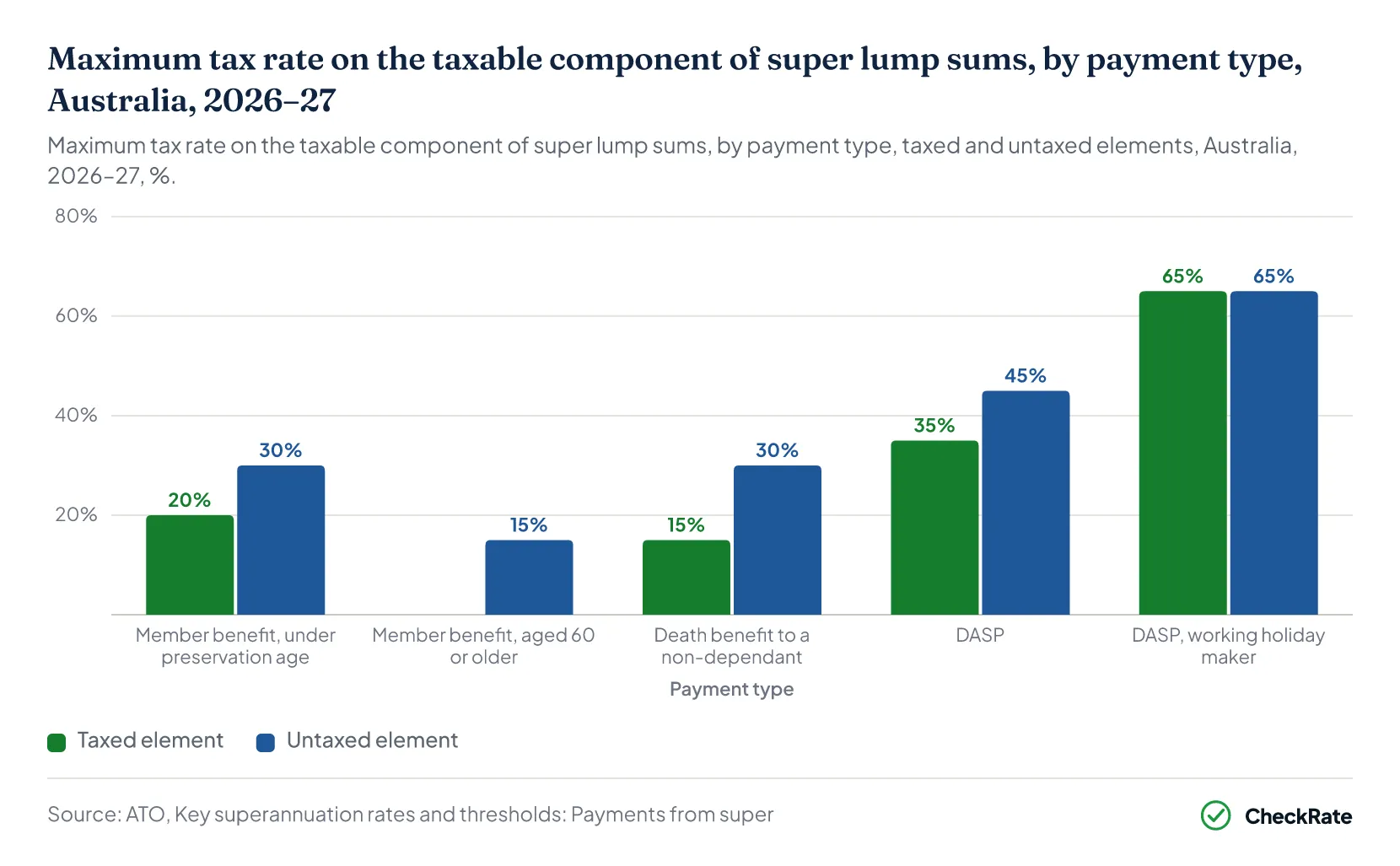
A super lump sum paid to a person under preservation age is taxed at a maximum of 20% on the taxed element and 30% on the untaxed element up to the untaxed plan cap1.
Preservation age is 60 for anyone born on or after 1 July 1964, so anyone under 60 in 2026–27 is below preservation age7.
The ATO's lower rates for people between preservation age and 60, including the $260,000 low rate cap from 1 July 2026, therefore do not apply to anyone under 60 in 2026–271.
A super income stream paid before preservation age is taxed at marginal rates with no tax offset3. A disability super benefit is the exception, with a 15% tax offset on the taxed element.
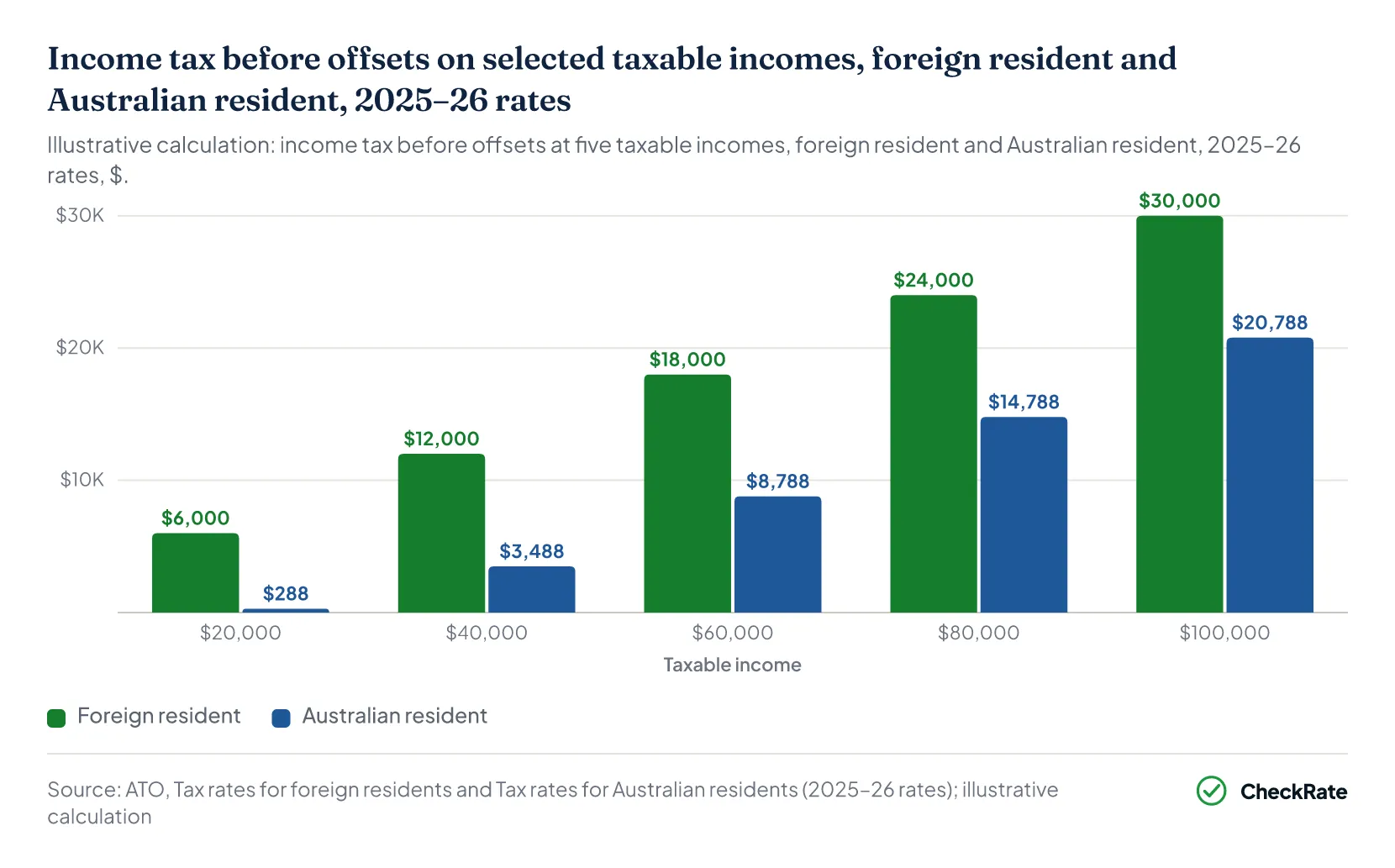
For a foreign resident, marginal rates start at 30% from the first dollar, because foreign residents have no tax-free threshold5. In 2025–26, foreign residents paid 30% on taxable income up to $135,000, 37% from $135,001 to $190,000 and 45% above $190,0008.
In an illustrative calculation at 2025–26 rates, a foreign resident with taxable income of $60,000 pays $18,000 of income tax before offsets and excluding the Medicare levy, compared with $8,788 for an Australian resident, a difference of $9,2129.
Section 03 · Taxed and untaxed
How do taxed and untaxed elements change the tax on super?
The untaxed element of a member's super lump sum is taxed at a higher maximum rate than the taxed element at every age. From age 60, the maximum rate is 15% on the untaxed element, compared with no tax on the taxed element1.
The taxed element is the part of the taxable component on which the fund has already paid tax, at 15%. The untaxed element is the part on which the fund has not paid tax and is most common in public sector funds2. The tax-free component generally comes from non-concessional (after-tax) contributions and is not taxed when withdrawn as a lump sum.
A fund calculates the components of each payment in proportion to the make-up of the account. This means a member cannot choose to withdraw only the tax-free component unless the whole account is tax-free2.
A departing Australia superannuation payment (DASP) is taxed at 35% on the taxed element and 45% on the untaxed element1. Working holiday makers pay 65% on both elements, and the tax-free component of a DASP is not taxed.
Death benefit lump sums paid to a non-dependant are taxed at a maximum of 15% on the taxed element and 30% on the untaxed element, regardless of the recipient's age1.
Section 04 · Tax treaties
How do Australia's tax treaties apply to super paid overseas?
Australia's treaties with New Zealand, the United Kingdom and Germany make pensions paid to residents of the other country taxable only in the country of residence, although exceptions apply11.
Australia has income tax treaties in force with 47 countries and jurisdictions, according to Treasury's list of income tax treaties as at March 202612. Each treaty sets out which country has the right to tax particular types of income.
Under the New Zealand treaty, a pension paid to a New Zealand resident is taxable only in New Zealand13. New Zealand does not tax the part of an Australian pension that Australia would not tax if the person were an Australian resident. Lump sums paid under a retirement benefit scheme are taxable only in the country where they arise.
The pensions articles of the United Kingdom and German treaties do not mention lump sums11. Both treaties have an other income article under which income not dealt with elsewhere in the treaty is taxable in the country of residence and, where it arises in the other country, may also be taxed there14.
Under the German treaty, a pension first paid after 31 December 2016 may also be taxed in the country where it arises if, for more than 15 years in that country, the contributions were tax-deductible or did not form part of taxable employment income14.
| Super pensions and lump sums in three of Australia's income tax treaties | ||
|---|---|---|
| Treaty | Pensions paid to a resident of the other country | Lump sums |
| New Zealand (2009), Article 18 | Taxable only in the country of residence, which does not tax the part the paying country would not tax for its own residents13 | From a retirement benefit scheme, taxable only in the country where the lump sum arises13 |
| United Kingdom (2003), Articles 17 and 20 | Pensions and annuities taxable only in the country of residence11 | Not mentioned in Article 17; Article 20 lets the source country also tax income the treaty does not otherwise deal with |
| Germany (2015), Articles 17 and 20 | Taxable only in the country of residence, except that the source country may also tax a pension first paid after 31 December 2016 where contributions received tax concessions there for more than 15 years14 | Not mentioned in Article 17; Article 20 lets the source country also tax income the treaty does not otherwise deal with |
Source · Australia–New Zealand Convention (2009); Australia–United Kingdom Convention (2003); Australia–Germany Agreement (2015).
Section 05 · Fund earnings
How are super fund earnings taxed when a member lives overseas?
Investment earnings inside an Australian super fund are taxed at 15% in the accumulation phase and are tax-free in the retirement phase, according to the ATO2.
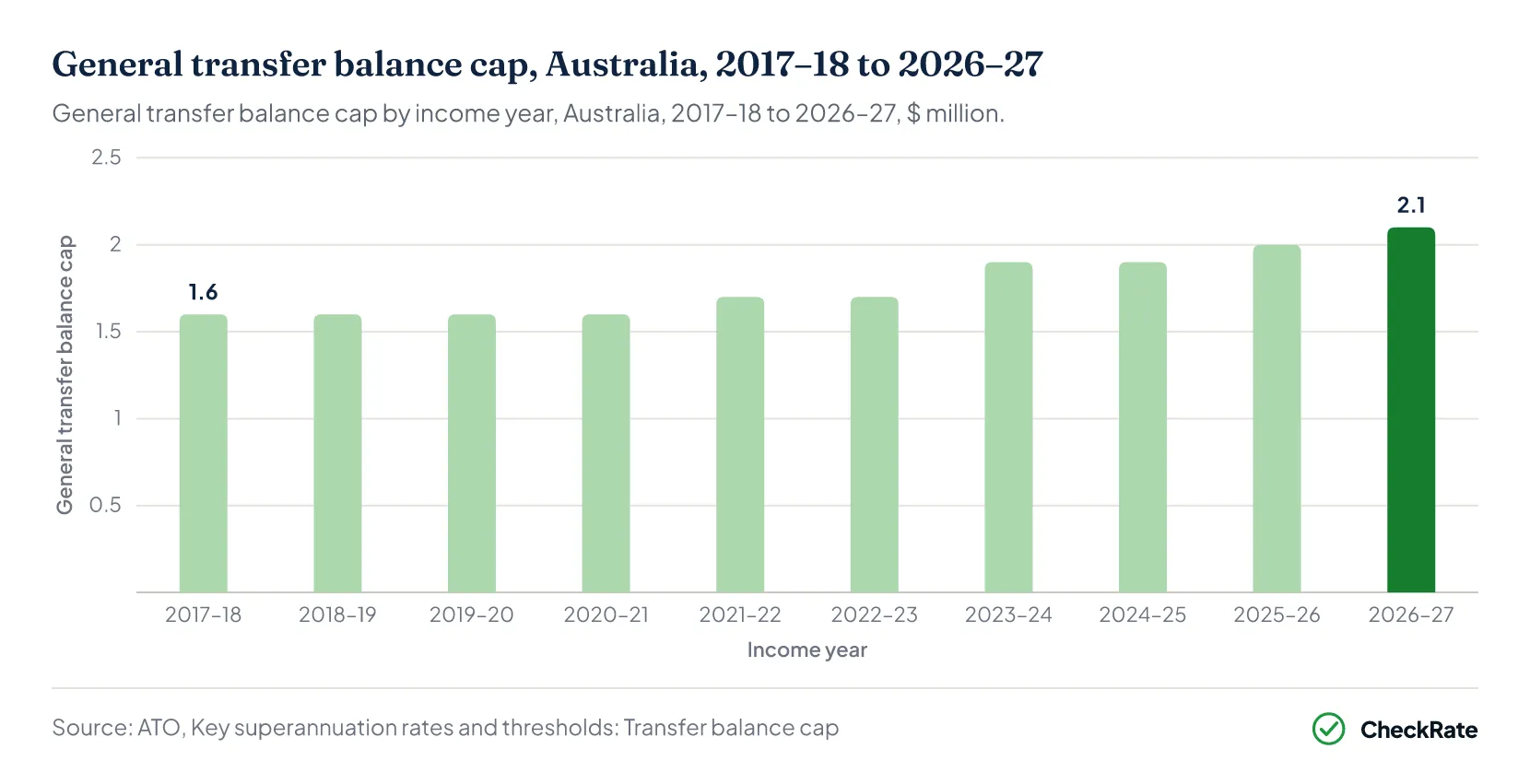
The tax-free treatment is limited by the transfer balance cap, which restricts the amount that can be transferred into the retirement phase4. The general transfer balance cap rose from $1.6 million in 2017–18, when the cap began, to $2.1 million in 2026–276.
From 1 July 2026, Division 296 tax reduces the tax concession on earnings for people with large super balances15. It applies an additional 15% to the share of a person's taxable super earnings that relates to a total super balance above the large super balance threshold of $3 million. An additional 10% applies to the share above the very large super balance threshold of $10 million. Both thresholds are indexed to the consumer price index.
Three residency conditions apply to a self-managed super fund (SMSF):
- The fund is established in Australia, or at least one of its assets is located in Australia.16
- Its central management and control is ordinarily in Australia, which the ATO generally accepts during a temporary absence of up to two years.16
- It has no active members, or Australian resident active members hold at least 50% of the interests held by active members.16
The conditions apply at all times during the financial year16. An SMSF that fails the residency test and is not wound up, or does not have its benefits rolled over to a regulated Australian fund, becomes non-complying. A non-complying fund's assessable income is taxed at the highest marginal rate, which is 45%17.
The budget cost of superannuation tax concessions is covered in How much do superannuation tax concessions cost in Australia?
Section 06 · Reporting overseas
How is Australian super reported in the country of residence?
The country of residence taxes and reports Australian super under its own law, and New Zealand's Inland Revenue states that lump sum withdrawals or transfers from Australian super are not taxed in New Zealand18. Most double tax agreements give New Zealand the right to tax pensions, so most people receiving a foreign pension pay New Zealand tax on it when they file a return.
However, foreign pensions can be treated differently. The double tax agreement between New Zealand and the country where the super is paid from can affect how it is taxed in New Zealand18.
In Australia, foreign residents declare Australian pensions and annuities on an Australian tax return, according to the ATO5. A person leaving Australia permanently can lodge a final return before leaving or lodge from outside Australia.
A super fund issues a payment summary showing the taxable and tax-free amounts paid and any tax withheld2. From age 60, the tax-free component and taxed element of a lump sum are not included in an Australian tax return.
Section 07
Super tax for non-residents: quick answers
Is super tax-free after 60 for someone living overseas?
Super paid to a person aged 60 or older carries no Australian tax on its tax-free component and taxed element, as a lump sum or an account-based income stream, although the country of residence can tax it under its own law. The untaxed element of a lump sum is still taxed in Australia, at up to 15% to the untaxed plan cap of $1,935,000 in 2026–27 and at 45% above it.
What tax rate applies to a departing Australia superannuation payment?
A departing Australia superannuation payment (DASP) is taxed at 35% on the taxed element and 45% on the untaxed element. The tax-free component is not taxed. Working holiday makers pay 65% on both elements.
Do non-residents pay the Medicare levy on super payments?
No. Foreign residents for tax purposes do not pay the Medicare levy, so the ATO's maximum super tax rates apply without it.
Can an Australian citizen living overseas withdraw super early?
An Australian citizen living overseas cannot withdraw super early because of the move, since leaving Australia is a condition of release only for former temporary visa holders. Australian citizens and permanent residents generally access super after retiring at or above preservation age, at 65, or on limited early-release grounds.
Does a tax treaty stop Australia taxing a super pension?
A tax treaty can stop Australia taxing a super pension, and the New Zealand, United Kingdom and German treaties make pensions paid to a resident of the other country taxable only in the country of residence, subject to exceptions. The treaty articles do not state how a particular super payment is classified, and the German treaty lets the source country also tax some pensions first paid after 31 December 2016.
Is Australian super taxed in New Zealand?
Lump sum withdrawals and transfers from Australian super are not taxed in New Zealand, according to New Zealand's Inland Revenue. Under the Australia–New Zealand treaty, a pension paid to a New Zealand resident is taxable only in New Zealand. New Zealand does not tax the part of the pension that Australia would not tax if the person were an Australian resident.
References
- ATO, Key superannuation rates and thresholds: Payments from super · ato.gov.au ↑ b c d e f g h i j
- Australian Taxation Office, Tax on super benefits · ato.gov.au ↑ b c d e f g
- ATO, Super income stream tax tables · ato.gov.au ↑ b c
- ATO, Retirement withdrawal – lump sum or income stream (QC73093) · ato.gov.au ↑ b c
- ATO, Foreign and temporary residents · ato.gov.au ↑ b c
- ATO, Key superannuation rates and thresholds: Transfer balance cap · ato.gov.au ↑ b
- Australian Taxation Office, Super withdrawal options · ato.gov.au ↑ b c
- ATO, Tax rates: foreign residents · ato.gov.au ↑
- ATO, Tax rates – Australian resident (QC 73320) · ato.gov.au ↑
- Australian Taxation Office, Departing Australia superannuation payment (DASP) · ato.gov.au ↑
- Convention between Australia and the United Kingdom for the Avoidance of Double Taxation (2003) · austlii.edu.au ↑ b c
- Treasury, Income tax treaties · treasury.gov.au ↑
- Convention between Australia and New Zealand for the Avoidance of Double Taxation (2009) · austlii.edu.au ↑ b c
- Agreement between Australia and the Federal Republic of Germany for the Elimination of Double Taxation (2015) · treasury.gov.au ↑ b c
- ATO, Key superannuation rates and thresholds: Division 296 tax thresholds and interest · ato.gov.au ↑
- ATO, Check your SMSF is an Australian super fund · ato.gov.au ↑ b c d e
- ATO, Our SMSF non-compliance actions · ato.gov.au ↑
- Inland Revenue (New Zealand), Foreign superannuation · ird.govt.nz ↑ b