

Published
 What triggers capital gains tax in Australia?When a person stops owning an asset, or certain rights over an asset are created or ended, tax law calls that a CGT event: the point at which a capital gain or loss is made.
 The RBA cash rate history: every change since 1990The Monetary Policy Board left the cash rate target unchanged at 4.35 per cent at its August 2026 meeting. The Board said financial conditions had tightened following three cash rate increases in 2026…
 Negative gearing in Australia: how many people use it and what it costsRental property ownership is measured in the ATO's annual Taxation statistics, and on the rental schedule basis, 2,335,540 people held an interest in a rental property in 2023–24. That was 14.1 per ce…
Section 01 · Income
What rental income must be declared?
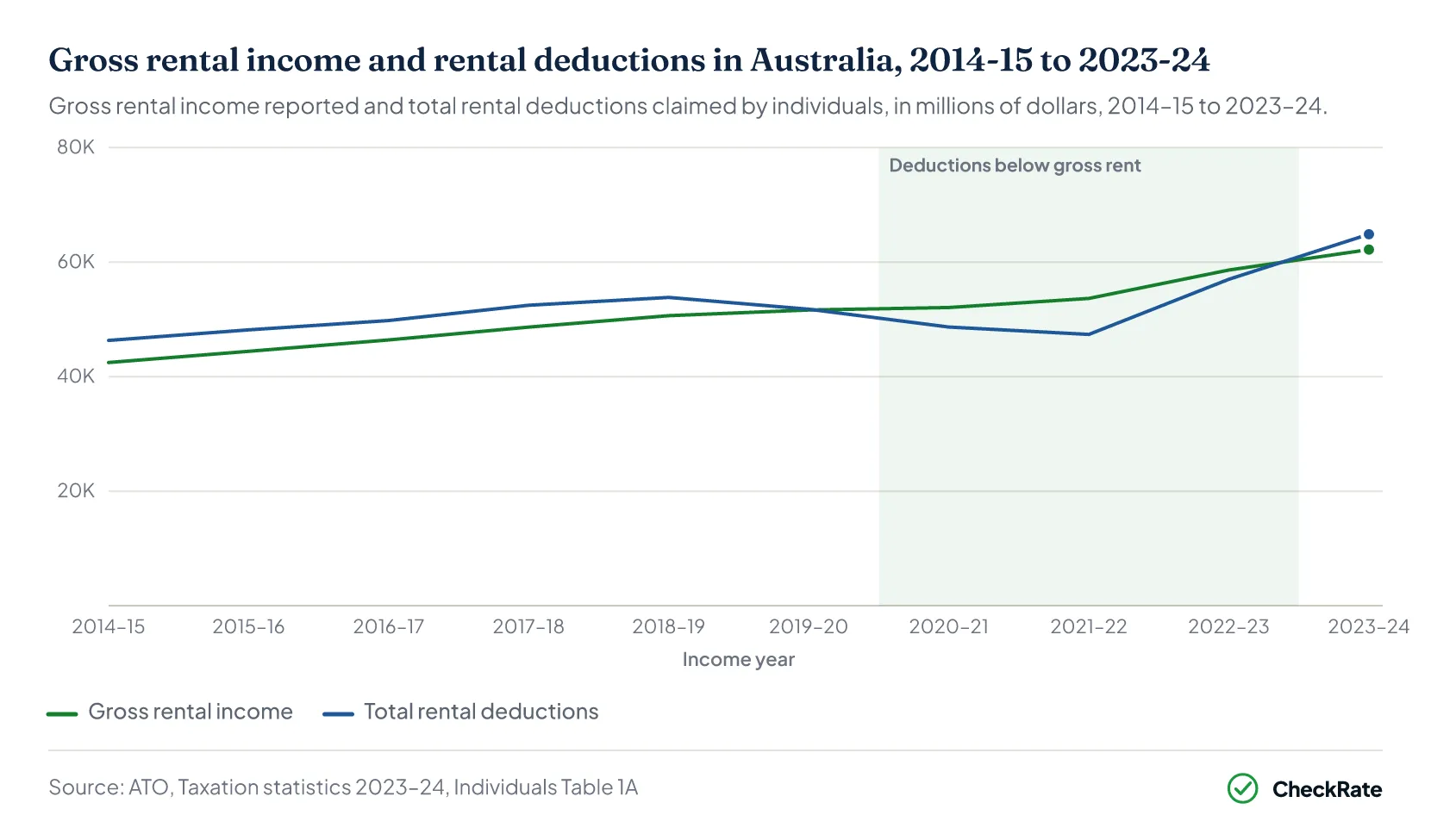
The ATO requires owners to declare rental income from Australian and overseas properties, short-term rentals, sharing platforms and part or all of the owner's own home1. Individuals reported $62.2 billion of gross rental income in 2023–24, the highest amount in the ATO's published series, which begins in 1978–79. Gross rental income increased from $58.6 billion in 2022–23 to $62.2 billion in 2023–24, a derived increase of 6.1 per cent2. A total of 2,335,540 individuals held an interest in a rental property that year, on the ATO's rental schedule basis3.
Related payments are also assessable. Bond money kept in place of rent, or kept because property damage required repairs, counts as income, as do letting and booking fees retained when a booking is cancelled1. Insurance payouts for lost rent are assessable, as is a payment from a tenant to cover the cost of repairing damage where the owner can claim the repair as a deduction. Payments can also be received as goods and services rather than cash. In these cases, the owner includes the monetary value.
Timing follows the tenant's payment, not the owner's receipt. Rental income is declared in the year the tenant pays it, even where an agent or property manager receives it first. In the ATO's example, bond money released to a property manager on 30 June 2026 is included in that year's return, although it did not reach the owners' bank account until 4 July 20261. Owners also report the gross rent before property management fees and expenses are taken out, not the net amount received from the agent.
The broader treatment of rental income within the individual tax system is covered in the overview of how the Australian tax system works.
Section 02 · Interest and borrowing
How are rental property interest and borrowing expenses treated?
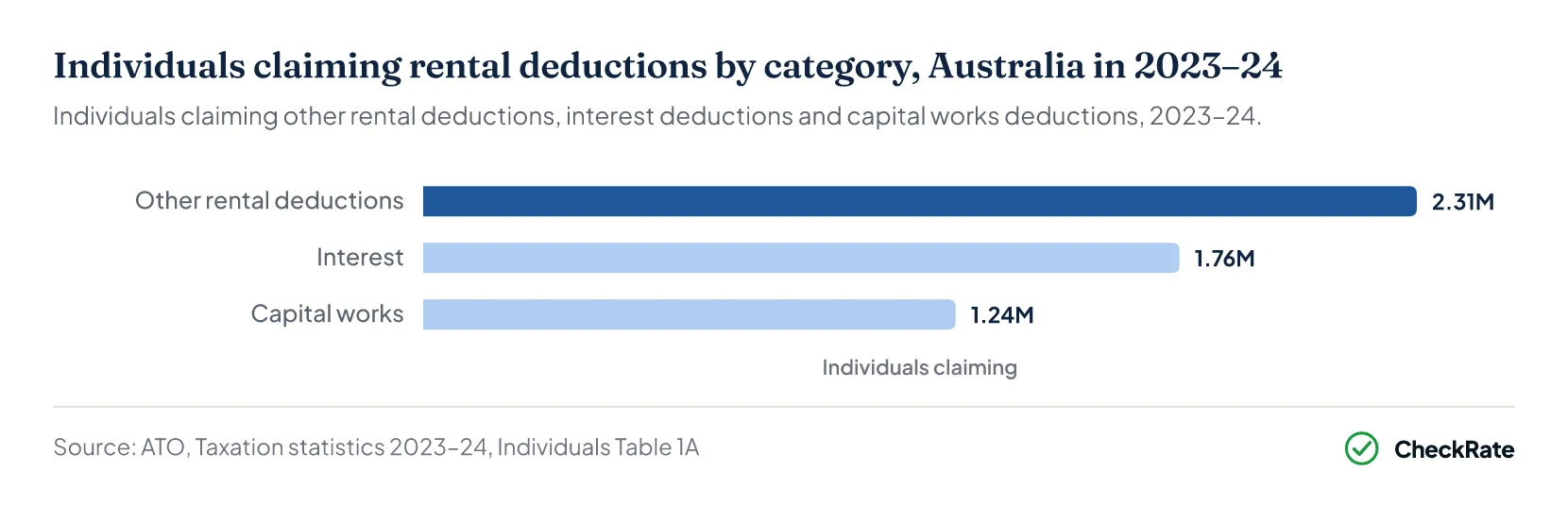
The interest deduction follows what the borrowed money was used for, not what secures the loan. Borrowing expenses are treated separately from interest. Interest was the largest of the three rental deduction categories the ATO publishes, at $32.2 billion of the $64.9 billion individuals claimed in 2023–24, a derived 49.7 per cent of total rental deductions2. A total of 1,761,903 individuals claimed interest deductions that year, a derived average of $18,302 per claimant.
Interest can be claimed on the part of a loan used to buy the rental property, to buy depreciating assets for it, to pay for deductible repairs or to finance renovations. It can generally be claimed in full where the property is rented or held to produce assessable income for the entire income year4. Interest cannot be claimed for periods the property is used privately, on the portion of a loan used for private purposes such as a car, or on a loan used to buy a new home that does not produce income, even where the rental property is the security for that loan. A loan account used for both rental and private purposes must be apportioned, and every repayment is split across both portions for the life of the loan. The owner cannot direct repayments solely to the private portion.
Worked example · interest on a loan that part-funded a car
In the ATO's example, an owner borrows $400,000 and uses $380,000 to buy a rental property and $20,000 to buy a car for private use. The property is rented for the whole year and the loan's total interest is $35,000. The deductible interest is $33,250, derived as $35,000 multiplied by $380,000 divided by $400,000. The 95 to 5 split between the deductible and private components then applies to every repayment for the life of the loan4.
Costs of setting up the loan, including establishment fees, lender's mortgage insurance, mortgage stamp duty, title search fees charged by the lender and valuation fees required for approval, are borrowing expenses5. Where they total more than $100, they are claimed over 5 years or the term of the loan, whichever is shorter. Where they total $100 or less, they are fully deductible in the year they are incurred. In the ATO's example, borrowing expenses of $1,600 on a 25-year loan taken out on 3 July produce a first-year deduction of $318.07, derived as $1,600 multiplied by the 363 days held divided by the 1,826 days in the 5-year period. Stamp duty on the transfer of the property itself is not a borrowing expense. It is a capital cost that can form part of the property's cost base for capital gains tax.
| Rental deductions claimed by individuals, by category, Australia, 2023–24 | |||
|---|---|---|---|
| Deduction category | Amount ($m) | Individuals claiming | Share of total deductions |
| Interest | 32,246 | 1,761,903 | 49.7% |
| Other rental deductions | 27,855 | 2,314,547 | 42.9% |
| Capital works | 4,770 | 1,240,455 | 7.4% |
| Total rental deductions | 64,871 | 2,321,954 | 100.0% |
Source · ATO, Taxation statistics 2023–24, Individuals Table 1A
Section 03 · Repairs
What is the difference between repairs, maintenance and improvements?
The dividing line is between restoring something and making it better. Repairs remedy defects, damage or deterioration that relate directly to renting the property out, such as replacing a cracked window pane, part of a gutter or part of a fence, and can be claimed in the year the cost is incurred6. Maintenance is work that prevents or fixes deterioration, such as repainting faded walls or oiling a deck, and is deductible in the same way. An owner who does the work personally can claim the materials but not the value of their own labour.
An improvement makes part of the property better, more valuable or more desirable, or changes the character of the item worked on, and is claimed as capital works rather than immediately6. In the ATO's example, an owner who replaced a damaged fibre cement wall with a brick feature wall did more than restore the wall's function, so the cost is capital works. Replacing the fibre cement with a modern equivalent such as plasterboard would have been a repair. Where repairs and improvements are carried out as part of the same job, the repair portion is deductible only if its cost can be separated, such as through an itemised invoice.
Two other types of expenditure are capital rather than immediately deductible. Initial repairs fix damage, defects or deterioration that existed when the property was bought. Depending on the expenditure, the cost may be claimed under the capital works or depreciating asset rules, or included in the property's capital gains tax cost base6. Replacing an entirety, meaning a separately identifiable item with its own function, is also not a repair. In the ATO's example, replacing a whole damaged toilet is claimed as a capital works deduction, not a repair.
Repair or maintenance
Deductible in the year the cost is incurred
Remedies wear, damage or deterioration from renting
Restores function without changing character
Materials claimable; the owner's own labour is not
Improvement
Claimed as capital works over a period of years
Makes the property better, more valuable or more desirable
Changes the character of the item worked on
Separable repair costs remain immediately deductible
Initial repair or full replacement
Not immediately deductible as a repair
Initial repairs relate to problems that existed at purchase
Replacing an entirety is not a repair
Claimed under the relevant capital rules
Source · ATO, repair and maintenance expenses; capital expenses
Section 04 · Capital works
How are capital works and depreciating assets claimed?
Construction and structural improvement costs are claimed as capital works, generally at 2.5 per cent a year over 40 years. Depreciating assets are claimed over their effective life, although some assets costing $300 or less can be claimed immediately if the ATO's eligibility conditions are met7. Second-hand assets in residential rental properties generally cannot be claimed where the property or asset was purchased after 7:30pm AEST on 9 May 20178.
Capital works deductions cover the cost of building the property and of structural improvements, alterations and extensions, including preliminary costs such as architect fees and building permits. The rate is generally 2.5 per cent or 4 per cent a year, spread over 40 or 25 years respectively, and the total claimed cannot exceed the construction expenses9. The deduction can be claimed once construction is fully completed, for properties built after 17 July 1985 that are rented or held to produce income. In the ATO's example, a $3,500 carport produces a capital works deduction of $87.50 a year from the year the work is completed, derived as 2.5 per cent of $3,500, for 40 years.
Depreciating assets are items of plant that are not part of the building's structure, such as carpets, curtains, furniture and appliances7. An asset costing $300 or less may be claimed in full if the eligibility conditions are met, including that it is not part of a set, or one of a number of identical or substantially identical assets, that together cost more than $300. For assets costing more than $300, the owner claims the decline in value over the asset's effective life. The diminishing value method generally produces larger deductions in the earlier years, while the prime cost method produces the same deduction each year. In the ATO's example, a new $1,500 outdoor table with a 5-year effective life produces a first-year deduction of $600 under the diminishing value method, derived as $1,500 multiplied by 200 per cent divided by 5. Under the prime cost method the deduction is $300 a year, derived as $1,500 multiplied by 100 per cent divided by 5.
Since 1 July 2017, deductions for second-hand depreciating assets in residential rental properties have generally not been available to individual investors. Assets that were already in a property when it was purchased, or that the owner previously used privately, generally cannot be depreciated. An exception applies where the property or asset was purchased before 7:30pm AEST on 9 May 2017. For an asset bought before that time, it must also have been installed at the property before 1 July 20178. The restriction does not apply to owners carrying on a business of letting rental properties, to certain entities such as corporate tax entities, or to properties rented for commercial purposes. A home turned into a rental property on or after 1 July 2017 is treated the same way. The depreciating assets already in the home cannot be claimed. Only new assets bought for the rental property can generally be depreciated.
Section 05 · Joint owners
How are jointly owned rental properties reported?
Co-owners who are not carrying on a business of letting rental properties must divide income and expenses according to their legal interest in the property. Joint tenants each hold an equal interest, while tenants in common may hold unequal interests, such as 20 per cent and 80 per cent10. The split follows legal ownership, not who pays the expenses. Oral or written agreements between the co-owners do not change that treatment for income tax. In the ATO's example, a joint tenant who earns much more than their co-owner and pays most of the property's bills must still include half of the total income and expenses. A written agreement allowing that owner to claim 80 per cent of the rental loss has no effect for income tax.
Borrowing arrangements follow the same legal-interest principle, although there is an important exception. A co-owner who borrows to acquire their own interest in the property can claim all of the interest on that borrowing, rather than dividing it between the co-owners10. Where a lender requires a co-borrower who is not an owner, the owner can still claim all the interest. In the ATO's example, a sole owner whose spouse was required to co-sign the loan declares 100 per cent of the rental income and claims 100 per cent of the interest. The example is supported by a written agreement and by bank statements showing the owner alone paid the repayments4.
The treatment differs where the co-owners genuinely carry on a business of letting rental properties in partnership. Partners in such a business divide the net rental income or loss according to the partnership agreement, even where legal interests differ, and equally if there is no agreement10. The ATO distinguishes this from simply owning and letting rental properties as an investment. In its example, an owner of 16 rental properties who personally collects rent and arranges repairs is still an investor, because the activities amount to letting properties rather than running a business11.
| How rental income and expenses are divided between co-owners, Australia, as at 23 August 2026 | ||
|---|---|---|
| Ownership arrangement | How income and expenses are divided | Can an agreement change the split? |
| Joint tenants | Equal shares, in line with each owner's equal legal interest | No, agreements have no effect for income tax |
| Tenants in common | By each owner's legal interest on the title, which may be unequal | No, agreements have no effect for income tax |
| Partnership carrying on a business of letting rental properties | By the partnership agreement, even where legal interests differ; equally if there is no agreement | Yes, the partnership agreement governs the split |
Source · ATO, Rental properties guide 2025 and rental property as investment or business guidance
Section 06 · Private use
What are the rules for vacant properties and private use?
Expenses are deductible only while the property produces assessable income or is genuinely held to produce it. Private use can require expenses to be apportioned, while holding costs for vacant land are generally not deductible. Expenses can still be claimed during a short unoccupied period if the property remains available for rent on commercial terms6. For a holiday home, the rules depend on how the property is used and made available for rent. Ownership and use expenses, including interest, council rates, water rates, body corporate fees, land tax and repairs, can be claimed only if the home is used or held mainly to produce rental income, meaning chiefly or for the most part12. The assessment considers how the home was actually used, how much time it was used to produce income, how much was private or reserved for private use, and how often the home was available during peak holiday periods. The owner's intention does not determine the outcome.
Where the property qualifies, expenses may still need to be apportioned. Costs must be split where the property produced income for only part of the year, where it was used privately for part of the year, where only part of it is rented, or where family or friends paid less than market rent12. Expenses that relate solely to renting, such as agent commissions, booking fees and advertising, are fully deductible without time apportionment, while expenses for private periods or private parts of the property cannot be claimed.
Worked example · a holiday home rented most of the year
In the ATO's example, a regional house is advertised year-round at market rates, has a high occupancy rate in the peak season, and is used by the owner for one week's holiday. Rent received was $35,432. Booking and commission fees of $3,543 and cleaning costs of $5,485 are deductible in full. The remaining $28,641 of expenses is apportioned for the private week, leaving $28,090 deductible for 51 of the 52 weeks. Total deductions are $37,118, derived as $3,543 plus $5,485 plus $28,090, producing a net rental loss of $1,68612.
What happens when a rental property is let below market rates?
Renting below market rates to family or friends can limit the deduction available. Where deductions would otherwise exceed the rent received from such an arrangement, the ATO accepts deductions limited to the amount of rent received, so the arrangement produces neither net rental income nor a loss1.
Land with no rentable dwelling is treated differently. Holding costs for vacant land incurred from 1 July 2019 are generally not deductible for individual investors. For these rules, land can remain vacant while a newly built or substantially renovated dwelling is not yet lawfully able to be occupied, or is not yet rented or available for rent13.
Section 07 · Records
What records must rental property owners keep?
Rental property owners need records that support their rental income, deductions and the property's eventual capital gain or loss. Records must generally be kept for five years, although when that period starts depends on what they relate to. The five years may run from the date the tax return is lodged, the date of the last claim for an asset's decline in value, the point at which it is certain no further capital gains tax event can occur for the property, or the date a dispute with the ATO is resolved14. Records supporting a tax loss or net capital loss must be kept until the loss is fully used and the relevant assessment can no longer be amended.
The ATO lists records that may be needed throughout the life of the property. Income records include agent statements, rent books or bank statements, and evidence of retained bond money. Expense records include loan documents, bank statements showing interest, land tax assessments, receipts for rates, agent fees and repairs, and before-and-after photos for capital works14. Purchase records include the contract, conveyancing documents and borrowing costs, and sale records include the contract of sale and the capital gain or loss calculation. Owners with more than one property, or with a duplex or subdivided property, keep separate records for each.
Records of private-use and main-residence periods affect both apportionment and the capital gains position when the property is sold. The events that can trigger capital gains tax when a property is sold are covered in what triggers capital gains tax in Australia.
Section 08 · FAQ
Rental property tax: quick answers
Is rental bond money taxable income?
Rental bond money is assessable income if the owner becomes entitled to retain it, for example because a tenant defaulted on the rent or because damage to the property required repairs. It is declared in the income year it is received by the owner or their agent, even if it reaches the owner's bank account later.
Can interest be claimed while a rental property is vacant?
Interest can generally continue to be claimed during a vacancy if the property remains genuinely available for rent on commercial terms. Interest cannot be claimed for periods the property is used privately, or on the portion of a loan used for private purposes.
What is the difference between a repair and an improvement on a rental property?
A repair remedies defects, damage or deterioration that relate directly to renting the property out, and is deductible in the year the cost is incurred. An improvement makes part of the property better, more valuable or more desirable, or changes its character, and is claimed as capital works over a period of years. Initial repairs, which fix problems that existed when the property was bought, are also capital rather than immediately deductible.
How is rental income divided between joint owners?
Co-owners who are not carrying on a business of letting rental properties divide rental income and expenses according to their legal interest in the property: equally for joint tenants, and by ownership share for tenants in common. An agreement to divide income or losses in other proportions has no effect for income tax. Different rules apply where co-owners genuinely carry on a business of letting rental properties, with the result divided according to the partnership agreement.
How long must rental property records be kept?
Rental property records must generally be kept for 5 years, although the starting point depends on the type of record. The 5 years may run from the date the tax return is lodged, the date of the last claim for an asset's decline in value, the point at which no further capital gains tax event can occur for the property, or the date a dispute with the ATO is resolved. Purchase, improvement and sale records are also needed to work out the capital gain or loss when the property is sold.
Do rental property losses reduce salary income?
A net rental loss can generally be deducted against salary and other income under the rules that apply for income years up to and including 2026–27. From 1 July 2027, negative gearing for newly purchased residential property will be limited to new builds. Losses on established residential investment properties purchased after 7:30pm AEST on 12 May 2026 will be deductible only against residential property income. Properties already held at that time retain the existing rules.
References
- ATO, Rental income you must declare · ato.gov.au ↑ b c d
- ATO, Taxation statistics 2023–24, Individuals Table 1: selected items by year (Tables 1A and 1B) · data.gov.au ↑ b
- ATO, Taxation statistics 2023–24, Individuals Table 27 (XLSX via data.gov.au) · data.gov.au ↑
- ATO, Interest expenses (rental properties) · ato.gov.au ↑ b c
- ATO, Borrowing expenses (rental properties) · ato.gov.au ↑
- ATO, Repair and maintenance expenses (rental properties) · ato.gov.au ↑ b c d
- ATO, Depreciating assets in rental properties · ato.gov.au ↑ b
- ATO, Second-hand depreciating assets · ato.gov.au ↑ b
- ATO, Capital expenses (rental properties) · ato.gov.au ↑
- ATO, Rental properties guide 2025: rental income and co-ownership · ato.gov.au ↑ b c
- ATO, Rental property as investment or business · ato.gov.au ↑
- ATO, Holiday homes · ato.gov.au ↑ b c
- ATO, Deductions for vacant land · ato.gov.au ↑
- ATO, Records for rental properties and holiday homes · ato.gov.au ↑ b
- ATO, Taxation statistics 2023–24 · ato.gov.au
- ATO, Tax reform – Boosting home ownership – Reforming negative gearing and capital gains tax (QC 107304) · ato.gov.au