

Published
 Capital gains tax in Australia: how much is paid, and who pays itIndividuals reported $40.6 billion in net capital gains in 2023–24. The ATO's Taxation statistics 2023–24 record a net capital gain label of $40,599,125,002 across 1,324,862 returns, up 2.5% from the…
 The 50% CGT discount vs indexation: the numbers behind the 2026 reformThe Treasury Laws Amendment (Tax Reform No. 1) Act 2026 and the Income Tax Rates Amendment (Tax Reform No. 1) Act 2026 introduce cost base indexation and a 30% minimum tax on eligible real gains from…
 How are rental property income and expenses taxed in Australia?The ATO requires owners to declare rental income from Australian and overseas properties, short-term rentals, sharing platforms and part or all of the owner's own home. Individuals reported $62.2 bill…
Section 01 · The trigger
What is a capital gains tax event?
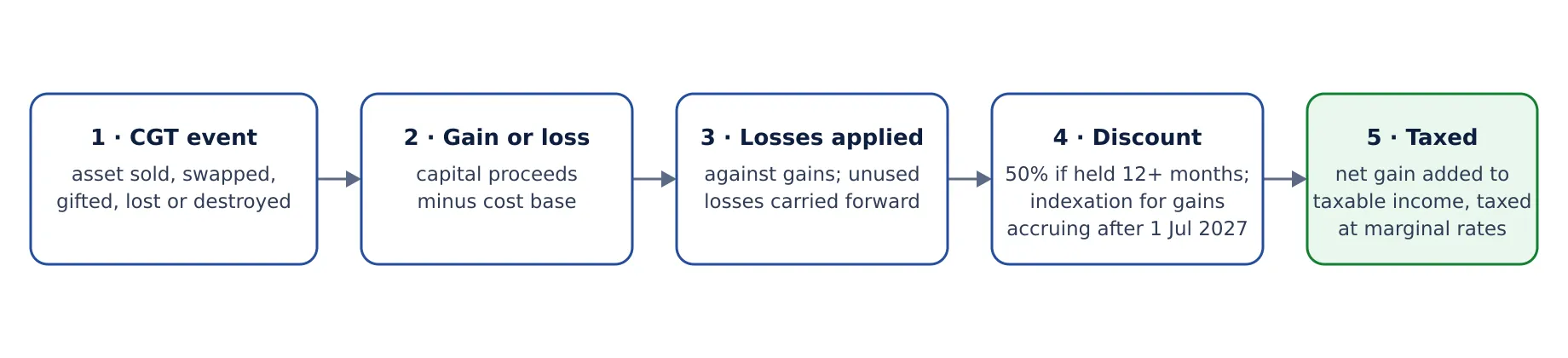
When a person stops owning an asset, or certain rights over an asset are created or ended, tax law calls that a CGT event: the point at which a capital gain or loss is made.
The ATO's guidance lists 54 event types under Division 104 of the Income Tax Assessment Act 1997, from A1, the ordinary disposal, to L8, a consolidation adjustment; most people encounter only a handful1.
CGT then forms part of the income tax calculation. CGT is not a separate tax, as a net capital gain is added to taxable income, so the tax on the same gain differs from person to person depending on their marginal rate, other income and concessions2. In 2023–24, 1,324,862 people reported a net capital gain, 8.0% of the 16.58 million individuals who lodged a tax return3. Who they were, and how much tax followed, is in the CGT statistics article.
Where an asset is sold under a contract, the CGT event happens when the contract is entered into, not when it settles. Without a contract, it is generally when ownership stops. In the ATO's example, a taxpayer signed a contract to sell land in June 2025 and settled in October 2025. The capital gain was therefore made in 2024–25, the year the contract was signed1. A lost or destroyed asset has its own timing rule: the event happens when compensation is first received or, failing that, when the loss is discovered or the destruction occurred.
| Common CGT events and when they happen | ||
|---|---|---|
| Trigger | Event | Time of the event |
| Sale or disposal of an asset | A1 | When the disposal contract is entered into or, if none, when ownership stops |
| Loss or destruction of an asset | C1 | When compensation is first received or, if none, when the loss is discovered or destruction occurred |
| Cancellation, surrender or ending of an asset | C2 | When the contract ending the asset is entered into or, if none, when the asset ends |
| Creating contractual or other rights | D1 | When the contract is entered into or the right is created |
| Granting a lease | F1 | When the lease contract is entered into or at the start of the lease |
| Shares declared worthless by a liquidator or administrator | G3 | When the declaration was made |
| Stopping being an Australian resident | I1 | When the individual or company stops being an Australian resident |
| An asset passing to a charity or super fund on death | K3 | When the individual dies |
Source · ATO, CGT events (QC66016, last updated 22 June 2026), read via a Wayback Machine snapshot of 22 June 2026. Event letters follow the ATO's Division 104 list; 8 of the 54 listed events are shown.
Section 02 · Shares and funds
When do shares, exchange-traded funds and managed investments trigger CGT?
Selling shares or units is the most common CGT event and generally occurs on the date of sale. Fund switches, buy-backs, mergers and certain fund distributions can also trigger CGT; dividends do not.
Selling is the ordinary trigger, and for shares the CGT event happens on the date of sale, when the seller stops being the owner4. In 2023–24, 301,970 individuals reported current-year gains on Australian exchange-listed shares5.
Other share and fund transactions can also trigger CGT. The ATO lists redeeming units to switch between managed funds, in specie transfers, share buy-backs, distributions other than dividends from a unit trust or managed fund, takeovers and mergers, and a liquidator's declaration that shares are worthless, which produces a capital loss4. ETF units work the same way on disposal, including units acquired through a distribution reinvestment plan, and managed investment trust distributions can include capital gains6.
Dividends are taxed as ordinary income, and the profits from a share-trading business are treated as ordinary business income rather than capital gains. Shares held for at least 12 months currently qualify for the 50% discount; under legislation passed in June 2026, gains accruing after 1 July 2027 will instead have cost bases indexed to CPI, with a 30% minimum tax rate7.
| Share and fund transactions · what triggers CGT | |
|---|---|
| Transaction | Treatment |
| Selling shares or units | CGT event on the date of sale |
| Switching or redeeming units between managed funds | Disposal of the units; a CGT event |
| Accepting a share buy-back offer | CGT event |
| Takeover or merger of a company whose shares are held | A CGT event may happen; the ATO often publishes a class ruling on the treatment |
| Distribution other than a dividend from a unit trust or managed fund | Can be a CGT event |
| Selling ETF units, including units from a distribution reinvestment plan | Subject to CGT on disposal |
| Shares declared worthless by a liquidator or administrator | Capital loss event (G3) |
| Receiving dividends | Not CGT; taxed as ordinary income |
| Profits of a share-trading business | Not CGT; ordinary business income |
Source · ATO, When CGT applies to shares and units (QC66045) and List of CGT assets and exemptions (QC66014), read via Wayback Machine snapshots of 16 December 2025 and 23 April 2026.
Section 03 · Property
When does selling an investment property trigger CGT?
For property, the contract date is the trigger. The ATO's rental property guidance states that the CGT event occurs when the contract is entered into, rather than when the sale settles, which can place a gain in the earlier tax year8. Most real estate is in scope: the ATO lists vacant land, business premises, rental properties, holiday houses and hobby farms, with the main residence generally exempt6. Individuals reported $38.6 billion in current-year gains from real estate in 2023–24, more than any other asset type5.
The capital gain is generally the difference between the sale proceeds and the property's cost base, which can include the purchase price and certain acquisition, ownership and disposal costs. In the ATO's worked example, a rental property had a $756,000 cost base, comprising a $750,000 purchase price, $30,000 in purchase costs, a $6,000 fence and $10,000 sale costs, less $35,000 of capital works and $5,000 of decline-in-value deductions. A $900,000 sale price produced a $144,000 capital gain. After the 50% CGT discount, the taxable gain was $72,000, or $36,000 for each of the two owners. The gain was reported in 2025–26, the year the sale contract was entered into8. What each owner then paid depended on their marginal rate and other income; the rates by range are in the income tax brackets article.
The 2027 reform also applies to property gains accruing after 1 July 2027. For a property held across that date, the discount still applies to the gain accrued to that date, using the asset's value at 1 July 2027; indexation and the 30% minimum tax apply to gains accruing after it. Investors who buy new builds will be able to choose either treatment when they sell7.
Section 04 · Crypto
When do cryptocurrency sales, swaps and spending trigger CGT?
For crypto held as an investment, selling, swapping, converting to currency, spending and gifting can each trigger CGT.
Transactions that do not involve a cash sale can still be treated as disposals for CGT purposes. For crypto held as an investment, the ATO lists five: selling, gifting, trading, exchanging or swapping one crypto asset for another, converting to Australian or foreign currency, and buying goods or services9. A token-for-token swap is a disposal of the first token even though no cash changes hands, as is paying for goods and services with crypto.
Three further rules apply:
- Each crypto asset is a separate CGT asset, so records are kept for each asset.
- Values are worked out in Australian dollars, and crypto held as an investment is not exempt as a personal use asset.
- Crypto held for at least 12 months can currently qualify for the CGT discount, and the ATO data-matches reported amounts against transaction data from designated service providers9.
| Crypto transactions that are CGT disposals · investment holdings | |
|---|---|
| Transaction | Why it triggers CGT |
| Selling a crypto asset | Ordinary disposal for money |
| Trading, exchanging or swapping one crypto asset for another | Disposal of the first asset, even with no cash involved |
| Converting a crypto asset to Australian or foreign currency | Disposal of the crypto asset converted |
| Buying goods or services with a crypto asset | Disposal of the coins used as payment |
| Gifting a crypto asset | Disposal even though no payment is received |
Source · ATO, How to work out and report CGT on crypto (QC69952, last updated 22 June 2026), read via a Wayback Machine snapshot of 19 July 2026. Applies to crypto held as an investment; each crypto asset is a separate CGT asset and values are worked out in Australian dollars.
Section 05 · Gifts and transfers
Do gifts and property transfers trigger capital gains tax?
Giving an asset away does not necessarily avoid CGT. Under the market value substitution rule for property, selling, transferring or gifting property for less than it is worth, where the parties are not dealing at arm's length, is treated as if the market value had been received.
In the ATO's example, a taxpayer sold a rental property to his son for the $120,000 remaining on the mortgage. A professional valuation put the property at $450,000, so the capital proceeds for CGT purposes were $450,000. Two exceptions exist: transfers to a former spouse on a relationship breakdown, where the rule may not apply, and transfers to the trustee of a special disability trust for no payment, where the gain or loss is disregarded10.
Death is treated under different CGT rules. Assets passing to a beneficiary under a will, intestacy or a deed of arrangement generally do not trigger CGT at that point: the estate's legal personal representative disregards the gain, and CGT generally arises when the beneficiary disposes of the asset. Different treatment can apply where an asset passes to a foreign resident under conditions the ATO sets out, or to a tax-advantaged entity such as a charity or complying super fund. In those cases, the gain or loss is worked out at the date of death and reported in the deceased person's final tax return11.
Section 06 · Losses
How are capital losses used to reduce capital gains?
A CGT event can produce either a capital gain or a capital loss. Capital losses are used to reduce capital gains. Current-year losses offset current-year gains, and the taxpayer chooses which gains to offset. The ATO notes that subtracting losses first from non-discount gains can result in lower CGT payable. There is no spillover: capital losses cannot be deducted from other assessable income. Any remaining net capital loss can be carried forward with no time limit and applied in the order the losses were made12.
Some losses are disregarded or treated separately. Losses on personal use assets such as boats and furniture are disregarded, as are losses on exempt assets such as cars, on collectables acquired for $500 or less, on most leases and on personal-services-income arrangements. A loss on a collectable can only be deducted from capital gains on collectables. If there are no eligible gains, the loss can be carried forward. Trust capital losses cannot be distributed to beneficiaries, and a company can only carry losses forward while substantially under the same ownership and control or in the same line of business12. One loss trigger does not require a sale: a liquidator's declaration that shares are worthless is itself the CGT event.
| How different capital losses can be used | |
|---|---|
| Capital loss | How it can be used |
| Current-year capital losses | Offset against capital gains made in the same year; the taxpayer chooses which gains |
| Net capital losses carried forward | Deducted from future capital gains, subject to the applicable rules; no time limit |
| Losses from collectables | Only against capital gains from collectables; otherwise carried forward |
| Losses on personal use assets | Disregarded entirely |
| Losses on exempt assets such as cars | Disregarded entirely |
| Any capital loss against salary or other income | Never deductible |
Source · ATO, Using capital losses to reduce capital gains (QC66025, last updated 23 June 2025), read via a Wayback Machine snapshot of 29 November 2025.
Section 07 · Exemptions
Which assets and transactions are exempt from CGT?
The largest exemption covers the family home. A main residence is generally exempt from CGT, though the exemption narrows if part of the home is rented out, the home is used for business, the property exceeds 2 hectares, or the owner is a foreign resident who fails the life events test at the CGT event6. A former home can also continue to be treated as a main residence for CGT purposes after the owner moves out. A former home used to produce income can be treated as the main residence for up to 6 years after moving out, or indefinitely if it does not produce income, while no other property is treated as the main residence13. Under the 2026 reform legislation, the main residence exemption and the four small business CGT concessions are unchanged.
Assets acquired before 20 September 1985 are generally treated as pre-CGT assets. Capital improvements made after that date may themselves be taxed. The 2026 Act's transitional rules cap the exemption's growth. Gains on pre-1985 assets accrued before 1 July 2027 continue to be exempt, while gains accruing after that date fall under the new indexation arrangements, which the factsheet applies to legacy assets bought before 19857.
Other exemptions depend on the type and value of the assets. Cars and motorcycles are exempt outright, with the car exemption applying to vehicles that carry less than 1 tonne and fewer than 9 passengers. Personal use assets such as boats and furniture are taxed only where the asset cost more than $10,000 to acquire. Collectables such as artwork, jewellery and antiques are exempt where they were acquired for $500 or less, with rules preventing assets from being split into separate items to fall below the thresholds. Depreciating assets used solely for taxable purposes sit outside CGT, eligible granny flat arrangements carry no CGT when created, varied or ended, and gambling winnings, unpurchased valour decorations and several classes of compensation and insurance payouts are also exempt6.
| Main CGT exemptions and their limits | |
|---|---|
| Asset or transaction | CGT treatment |
| Main residence | Generally exempt; CGT may apply if part is rented out, it is used for business, it sits on more than 2 hectares, or foreign-resident rules are not met |
| Assets acquired before 20 September 1985 | Pre-CGT and exempt; later capital improvements may be taxed, and gains accruing after 1 July 2027 fall under the new arrangements |
| Cars and motorcycles | Exempt; a car carries under 1 tonne and fewer than 9 passengers |
| Personal use assets (boats, furniture, household items) | Gain taxed only if the asset cost more than $10,000 to acquire; losses disregarded |
| Collectables (artwork, jewellery, antiques, stamps) | Exempt if acquired for $500 or less; losses only offset collectable gains |
| Eligible granny flat arrangements | No CGT when created, varied or ended |
| Depreciating assets used solely for taxable purposes | Outside CGT; balancing adjustments are income or deductions instead |
| Gambling winnings, valour decorations, listed compensation and insurance payouts | Exempt |
Source · ATO, List of CGT assets and exemptions (QC66014, last updated 23 June 2025), read via a Wayback Machine snapshot of 23 April 2026; pre-1985 transitional treatment per the Budget 2026–27 factsheet.
Capital gains tax timeline: 1985 to 2027
20 September 1985
Capital gains tax began. Assets acquired from this date are within the regime; assets acquired earlier are pre-CGT.
1985 to 1999
Cost bases were indexed to CPI, so tax applied to gains above inflation.
1999
The 50% CGT discount was introduced, replacing indexation for individuals and trusts.
26 June 2026
The Treasury Laws Amendment (Tax Reform No. 1) Act 2026 received Royal Assent.
1 July 2027
For gains accruing after this date, CPI indexation replaces the discount for individuals, trusts and partnerships, with a 30% minimum tax rate. Gains accrued earlier keep the discount.
Source · ATO, List of CGT assets and exemptions (QC66014); Budget 2026–27 factsheet; Federal Register of Legislation, C2026A00049 (queried 18 August 2026).
Section 08 · FAQ
Capital gains tax triggers: quick answers
Is capital gains tax a separate tax in Australia?
No. The ATO describes capital gains tax as part of income tax, not a separate tax. A net capital gain is added to taxable income and taxed at the person's income tax rates, so the tax on any gain depends on the person's marginal rate, other income in that year and eligibility for concessions such as the CGT discount.
When does a CGT event happen on a property sale?
When the contract of sale is entered into, not when the sale settles. In the ATO's example, a contract signed in June 2025 and settled in October 2025 produced a gain in the 2024–25 income year, the contract year. Without a contract, the event is generally when ownership stops.
Does swapping one cryptocurrency for another trigger capital gains tax?
Yes, for crypto held as an investment. The ATO lists swaps as disposals, alongside selling, converting to Australian or foreign currency, spending on goods or services, and gifting. Each crypto asset is a separate CGT asset, and values are worked out in Australian dollars.
Is there capital gains tax on gifts?
Generally yes, for the giver. Under the market value substitution rule, transferring property to family or friends for less than it is worth, outside an arm's length deal, is taxed as if the market value had been received. Exceptions cover transfers to a former spouse on a relationship breakdown and to the trustee of a special disability trust. Death works differently: assets passing to a beneficiary generally do not trigger CGT at that point, with CGT usually arising when the beneficiary later disposes of them.
Can capital losses be deducted from salary or wages?
No. The ATO states that capital losses cannot be deducted from other assessable income. They only offset capital gains, either in the current year or after being carried forward. Unused net capital losses can be carried forward with no time limit. Collectable losses only offset collectable gains, and personal use asset losses are disregarded.
Is the 50% CGT discount ending?
For future gains, yes. The Treasury Laws Amendment (Tax Reform No. 1) Act 2026 received assent on 26 June 2026 and is in force. For gains accruing after 1 July 2027 the new rules replace the 50% discount for individuals, trusts and partnerships with CPI cost base indexation and a 30% minimum tax rate on capital gains. Gains accrued before 1 July 2027 keep the discount under transitional rules, and the main residence exemption is unchanged.
References
- ATO, CGT events (QC66016) · ato.gov.au ↑ b
- ATO, What is capital gains tax? (QC69844) · ato.gov.au ↑
- ATO, Taxation statistics 2023–24, Individuals Table 1: selected items by year (Tables 1A and 1B) · data.gov.au ↑
- ATO, When CGT applies to shares and units (QC66045) · ato.gov.au ↑ b
- ATO, Taxation statistics 2023–24: CGT Table 1 · data.gov.au ↑ b
- ATO, List of CGT assets and exemptions (QC66014) · ato.gov.au ↑ b c d
- Australian Government, Budget 2026–27 factsheet: Negative Gearing and Capital Gains Tax Reform · budget.gov.au ↑ b c
- ATO, CGT when selling your rental property (QC66039) · ato.gov.au ↑ b
- ATO, How to work out and report CGT on crypto (QC69952) · ato.gov.au ↑ b
- ATO, Transferring property to family or friends (QC66041) · ato.gov.au ↑
- ATO, How CGT applies to inherited assets (QC69713) · ato.gov.au ↑
- ATO, Using capital losses to reduce capital gains (QC66025) · ato.gov.au ↑ b
- ATO, Treating former home as main residence (QC66030) · ato.gov.au ↑
- Income Tax Assessment Act 1997 (Cth) · legislation.gov.au
- Treasury Laws Amendment (Tax Reform No. 1) Act 2026 (Cth), No. 49 of 2026 · legislation.gov.au