

Updated
 Childcare costs in Australia: average daily fees and out-of-pocket costs after the subsidyThe average daily fee for centre-based day care in Australia was $146.00 for a 10-hour session in the June quarter 2026, before the Child Care Subsidy. This is based on the Department of Education's…
 How much does it cost to raise a child in Australia in 2026?The estimated cost of one child aged 0 to 12 is $14,902 a year for parents with a combined child support income of $93,137, according to 2026 child support cost estimates from the Department of Social…
 Family finances in Australia: income, spending and debt for households with childrenCouple families with dependent children had a median disposable household income of $2,285 a week in 2019-20, according to Australian Bureau of Statistics (ABS) Survey of Income and Housing data. For…
Section 01 · Child Care Subsidy
What does the Child Care Subsidy pay, and to how many families?
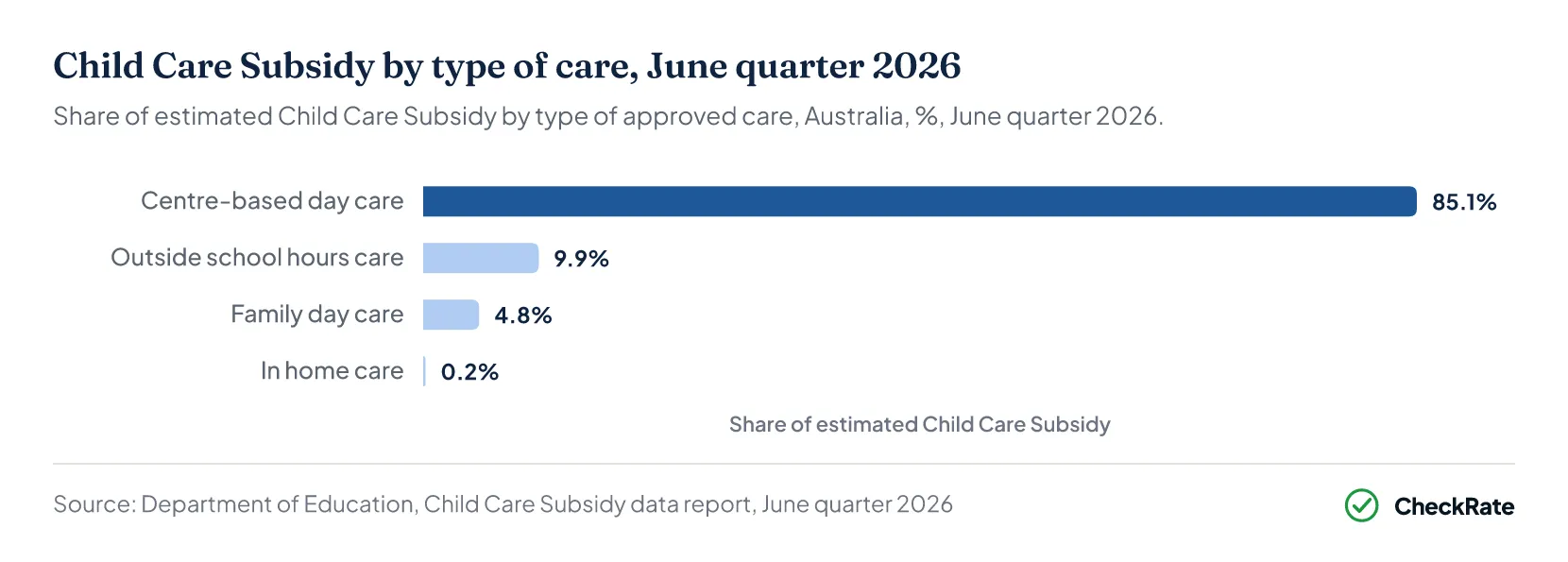
The Child Care Subsidy and Additional Child Care Subsidy had estimated Australian Government expenditure of $3.88 billion in the June quarter 2026, when 989,100 families used approved child care, according to the Department of Education1. Estimated expenditure was up 0.7% from the June quarter 2025, while the number of families using approved care was down 1.7%.
The subsidy covers up to 90% of the hourly fee, or the hourly rate cap if that is lower, for families with a combined adjusted taxable income of $88,520 or less in 2026-274. The percentage falls by 1 percentage point for each additional $5,000 of family income above $88,520, and is 0% for family income of $538,520 or more. In 2026-27, a family with more than one child aged 5 or under can receive a higher subsidy of up to 95% for the second and younger children.
From 6 July 2026, the hourly rate cap for a child below school age is $15.19 in centre-based day care and outside school hours care, and $14.08 in family day care5.
The average hourly fee across approved care was $13.90 in the June quarter 20261. Centre-based day care recorded the highest average hourly fee of the three main care types, at $14.60, compared with a 2025-26 hourly rate cap of $14.63 for children below school age.
Since January 2026, families eligible for the Child Care Subsidy can receive three days of subsidised child care a week, regardless of activity levels, under the 3-Day Guarantee6.
| Child Care Subsidy hourly rate caps by care type, Australia, $ an hour, 2026-27 | ||
|---|---|---|
| Care type | Child below school age ($) | School-aged child ($) |
| Centre-based day care | 15.195 | 13.305 |
| Outside school hours care | 15.195 | 13.305 |
| Family day care | 14.085 | 14.085 |
| In home care (per family) | 41.315 | 41.315 |
Source · Department of Social Services, Family Assistance Guide 3.5.3
Fees and out-of-pocket costs by type of care are covered on the childcare costs page.
Section 02 · Parental Leave Pay
How much is Parental Leave Pay, and how many people receive the payment?
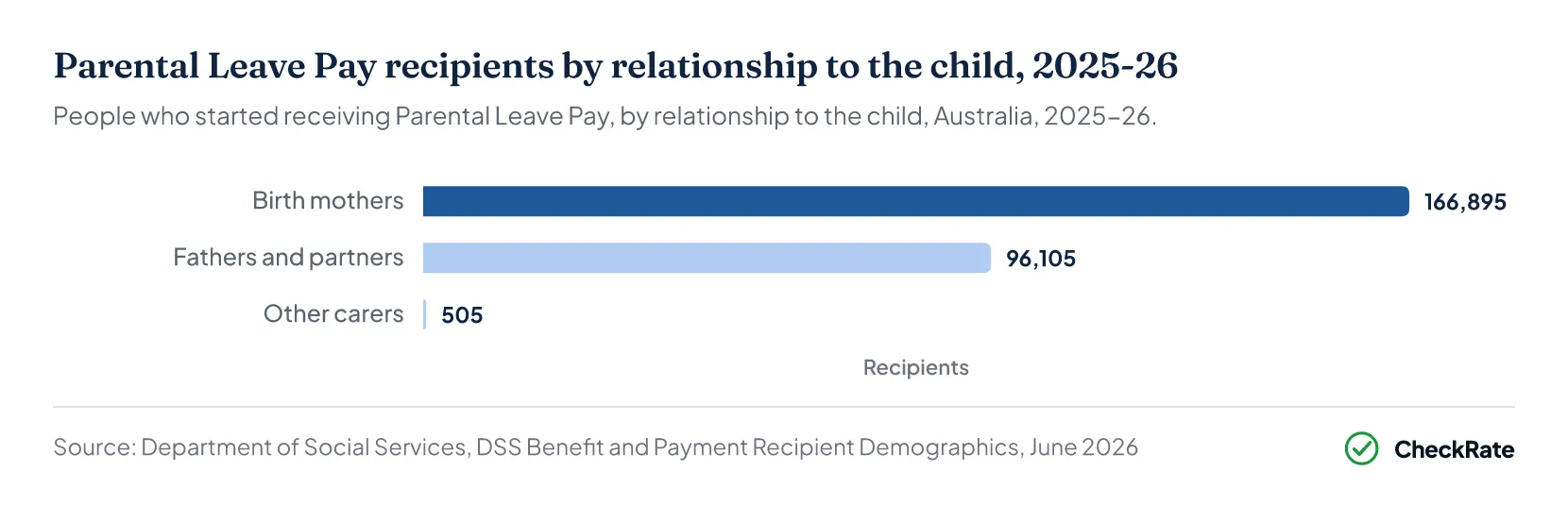
Parental Leave Pay is $200.94 a day before tax from 1 July 2026, equal to $1,004.70 for a five-day week7. In 2025-26, 263,505 people started receiving Parental Leave Pay, according to the Department of Social Services (DSS)2.
The daily Parental Leave Pay rate is based on the national minimum wage and usually changes on 1 July each year7. The daily rate was $189.62 in 2025-26.
A family with a child born or adopted from 1 July 2026 can receive up to 130 days of Parental Leave Pay, or 26 five-day weeks7. The limit increased from 110 days for a child born or adopted from 1 July 2024 to 120 days from 1 July 2025. For partnered parents, 20 of the 130 days are reserved for the partner.
At the 2026-27 daily rate, 130 days of Parental Leave Pay amount to $26,122.20 before tax7. This calculation assumes all 130 days are paid at the 2026-27 rate.
The number of Parental Leave Pay recipients increased from 252,340 in 2024-25 to 263,505 in 2025-26, an increase of 11,165, or 4.4%23. The 2024-25 figure counts people paid for claims during the year, while the 2025-26 figure counts people who started receiving the payment, so the change is a guide only. Parental Leave Pay was paid in relation to 204,075 children in 2025-262.
For a child born or adopted from 1 July 2025, the Australian Taxation Office pays a superannuation contribution on Parental Leave Pay after the end of the financial year, based on the superannuation guarantee rate7.
| Parental Leave Pay days by child's date of birth or adoption, Australia | |||
|---|---|---|---|
| Child born or adopted from | Days a family can get | Weeks (five-day week) | Days reserved for a partner |
| 1 July 2024 | 1107 | 227 | 107 |
| 1 July 2025 | 1207 | 247 | 157 |
| 1 July 2026 | 1307 | 267 | 207 |
Source · Services Australia, How much Parental Leave Pay you can get
Section 03 · Family Tax Benefit
What does Family Tax Benefit pay, and to how many families?
Family Tax Benefit Part A and Part B were paid by fortnightly instalment to 1,242,195 and 984,020 families respectively in June 2026, according to the Department of Social Services2. A total of 1,250,905 families received at least one of the two payments by instalment in June 2026.
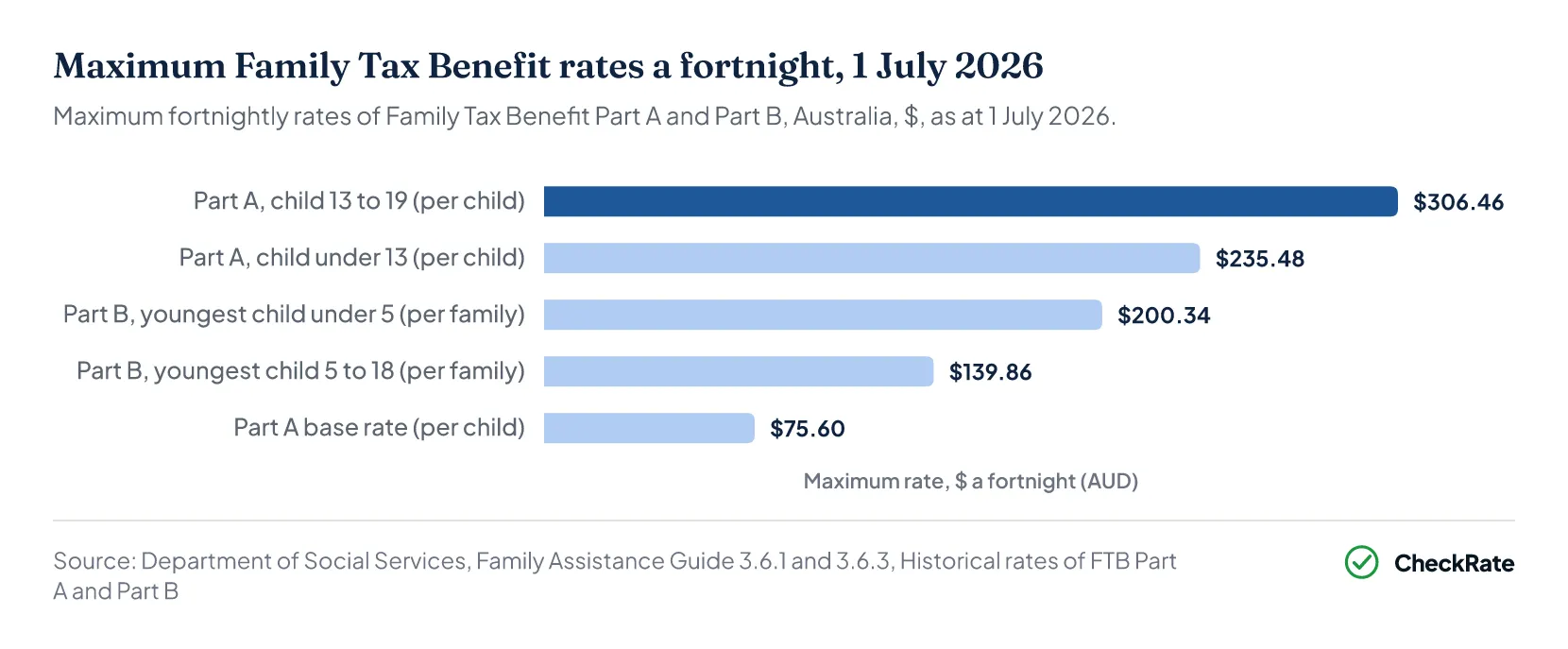
As at 1 July 2026, the maximum Part A rate is $235.48 a fortnight for each child under 13 and $306.46 for each child aged 13 to 15, or aged 16 to 19 and in secondary school8. The Part A base rate is $75.60 a fortnight for each child. Part A also includes an annual supplement of $970.90 per child, paid after the end of the financial year where the family's combined adjusted taxable income is $80,000 or less.
As at 1 July 2026, the maximum Part B rate is $200.34 a fortnight for a family whose youngest child is under 5, and $139.86 where the youngest child is aged 5 to 15, or 16 to 18 and in secondary school9. Part B also includes an annual supplement of $478.15 per family.
The number of families paid Family Tax Benefit by instalment fell from 1,295,425 in June 2025 to 1,250,905 in June 2026, a decrease of 44,520 families, or 3.4%3.
In June 2026, 600,915 of the families paid Family Tax Benefit by instalment also received an income support payment, equivalent to 48.0%2. Of the families paid Family Tax Benefit by instalment, 318,430 received Parenting Payment Single, equivalent to 25.5% of the total.
The counts cover families paid by fortnightly instalment and exclude families who claim Family Tax Benefit as a lump sum after the end of the financial year2.
| Families paid Family Tax Benefit by instalment, by state and territory, June 2026 | ||
|---|---|---|
| State or territory | Family Tax Benefit Part A | Family Tax Benefit Part B |
| New South Wales | 367,9602 | 291,0702 |
| Victoria | 312,7502 | 242,3402 |
| Queensland | 287,7652 | 230,0202 |
| Western Australia | 122,8052 | 100,6202 |
| South Australia | 90,3102 | 70,4352 |
| Tasmania | 31,3352 | 25,0252 |
| Northern Territory | 15,9702 | 13,6952 |
| Australian Capital Territory | 12,8902 | 10,5252 |
| Unknown | 4052 | 2902 |
| Australia | 1,242,1952 | 984,0202 |
Source · Department of Social Services, DSS Benefit and Payment Recipient Demographics, June 2026
Estimates of what it costs to raise a child in Australia are on the cost of raising a child page.
Section 04 · Average payments
What is the average family payment in Australia, per family and per child?
Family Tax Benefit Part A and Part B averaged about $11,180 and $4,060 a year respectively in 2025-26, based on estimated expenses divided by the number of families paid by instalment in June 2026210. Parental Leave Pay averaged about $20,300 per child whose payment started in 2025-26210.
The Child Care Subsidy and Additional Child Care Subsidy amounted to about $3,930 per family on average in the June quarter 2026, calculated by dividing estimated expenditure by the 989,100 families using approved child care1.
These averages were calculated for this article by dividing estimated expenses by recipient counts. They are not published average payment amounts.
The spending totals and the recipient counts do not cover exactly the same families. Family Tax Benefit expenses include lump-sum claims and end-of-year supplements, while the family counts cover only families paid by instalment in June 2026. The calculated averages therefore do not represent the actual average amount received by these families.
| Average payment per family or child, Australia, 2025-26 and June quarter 2026 | |||||
|---|---|---|---|---|---|
| Payment | Spending ($ million) | Spending period | Count | What is counted | Average ($) |
| Family Tax Benefit Part A | 13,885.710 | 2025-26, estimated actual | 1,242,1952 | Families paid by instalment, June 2026 | 11,178 a year |
| Family Tax Benefit Part B | 3,996.910 | 2025-26, estimated actual | 984,0202 | Families paid by instalment, June 2026 | 4,062 a year |
| Parental Leave Pay | 4,141.810 | 2025-26, estimated actual | 204,0752 | Children for whom payment started in 2025-26 | 20,296 per child |
| Child Care Subsidy and Additional Child Care Subsidy | 3,883.11 | June quarter 2026, estimated | 989,1001 | Families using approved care, June quarter 2026 | 3,926 a quarter |
Source · Department of Social Services, Portfolio Budget Statements 2026-27 and DSS Benefit and Payment Recipient Demographics, June 2026; Department of Education, Child Care Subsidy data report, June quarter 2026
Section 05 · Indexation
How do family payment rates and income thresholds change with indexation?
The main Family Tax Benefit rates and income thresholds increased by between 3.5% and 3.6% on 1 July 2026, when the maximum Part A rate for a child under 13 rose from $227.36 to $235.48 a fortnight8.
Family Tax Benefit rates, supplements and income thresholds are generally adjusted for inflation using the Consumer Price Index (CPI) on 1 July each year, where indexation has not been paused11. Child Care Subsidy hourly rate caps are also adjusted using the CPI at the start of each financial year, and the 2026-27 caps took effect on 6 July 20265.
The cap for a child below school age in centre-based day care rose from $14.63 in 2025-26 to $15.19 in 2026-27, an increase of 3.8%51. The lower income threshold for the Child Care Subsidy is also indexed using the CPI each financial year4.
Parental Leave Pay changes with the national minimum wage rather than the CPI7. The weekly Parental Leave Pay rate increased by 6.0%, from $948.10 in 2025-26 to $1,004.70 in 2026-2712.
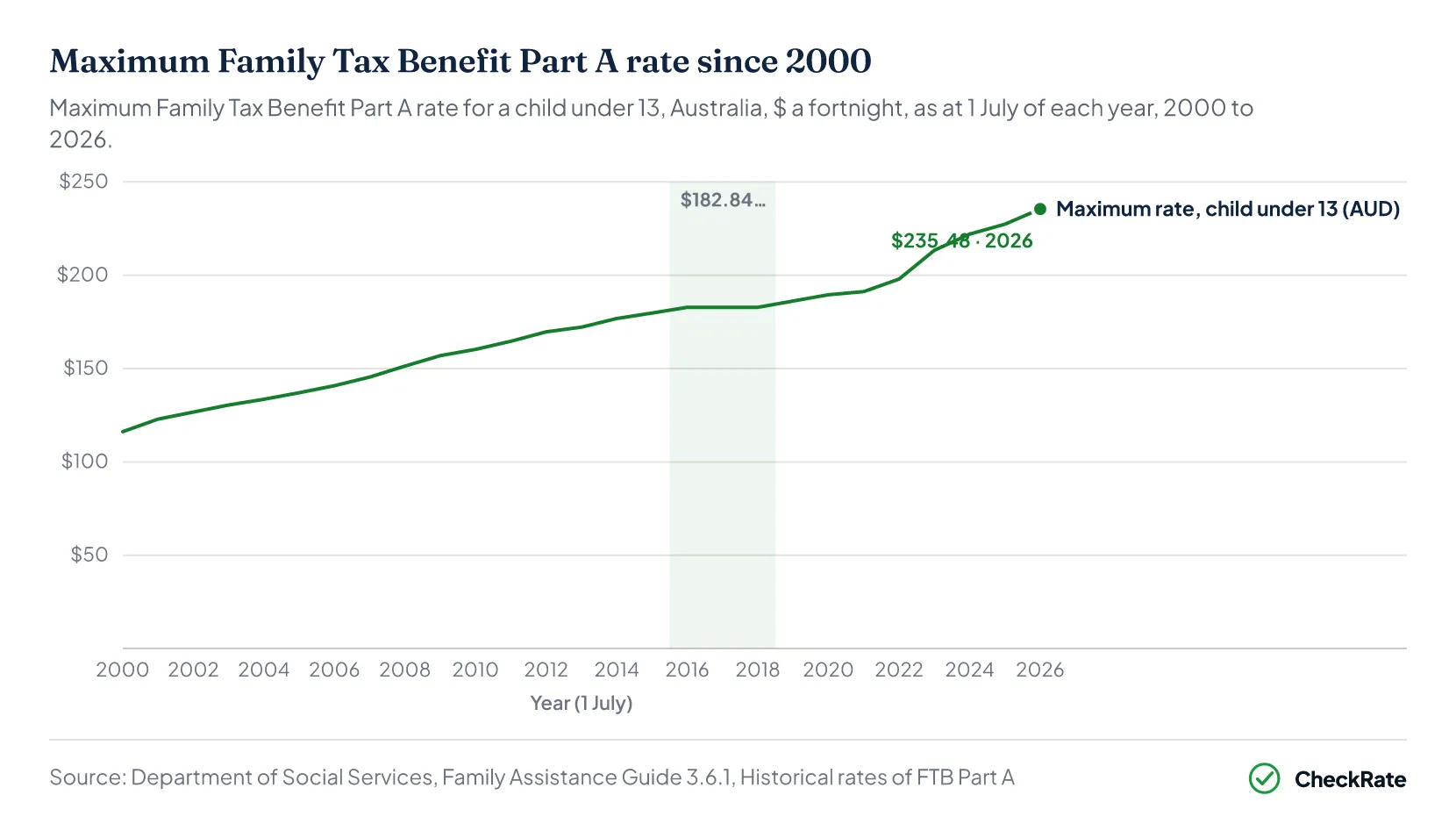
The maximum Part A rate for a child under 13 was $116.20 a fortnight as at 1 July 2000 and $235.48 as at 1 July 20268. The 2026 rate was 2.03 times the 2000 rate in dollar terms, without adjusting for inflation.
The maximum Part A rate for a child under 13 stayed at $182.84 from 1 July 2016 until it increased to $186.20 on 1 July 2019, after legislation temporarily froze Part A and Part B rates until 30 June 20198.
| Family payment rates and thresholds, Australia, 1 July 2025 and 1 July 2026 | ||||
|---|---|---|---|---|
| Rate or threshold | Unit | 2025-26 ($) | 2026-27 ($) | Change (%) |
| Family Tax Benefit Part A maximum rate, child under 13 | $ a fortnight | 227.368 | 235.488 | 3.6 |
| Family Tax Benefit Part A maximum rate, child 13 to 15, or 16 to 19 in secondary school | $ a fortnight | 295.828 | 306.468 | 3.6 |
| Family Tax Benefit Part A base rate, per child | $ a fortnight | 72.948 | 75.608 | 3.6 |
| Family Tax Benefit Part A supplement, per child | $ a year | 938.058 | 970.908 | 3.5 |
| Family Tax Benefit Part B maximum rate, youngest child under 5 | $ a fortnight | 193.349 | 200.349 | 3.6 |
| Family Tax Benefit Part B maximum rate, youngest child 5 to 15, or 16 to 18 in secondary school | $ a fortnight | 134.969 | 139.869 | 3.6 |
| Family Tax Benefit Part A lower income free area | $ a year | 66,7228 | 69,1318 | 3.6 |
| Family Tax Benefit Part A higher income free area | $ a year | 118,7718 | 123,0788 | 3.6 |
| Family Tax Benefit Part B primary earner income limit | $ a year | 120,0079 | 124,3279 | 3.6 |
| Child Care Subsidy hourly rate cap, centre-based day care, below school age | $ an hour | 14.631 | 15.195 | 3.8 |
| Parental Leave Pay, five-day week | $ a week | 948.1012 | 1,004.7012 | 6.0 |
Source · Department of Social Services, Family Assistance Guide 3.5.3, 3.6.1 and 3.6.3, and Paid Parental Leave Guide 3.2; Department of Education, Child Care Subsidy data report, June quarter 2026
Section 06 · Program cost
How much do family payments and child care subsidies cost the Australian Government?
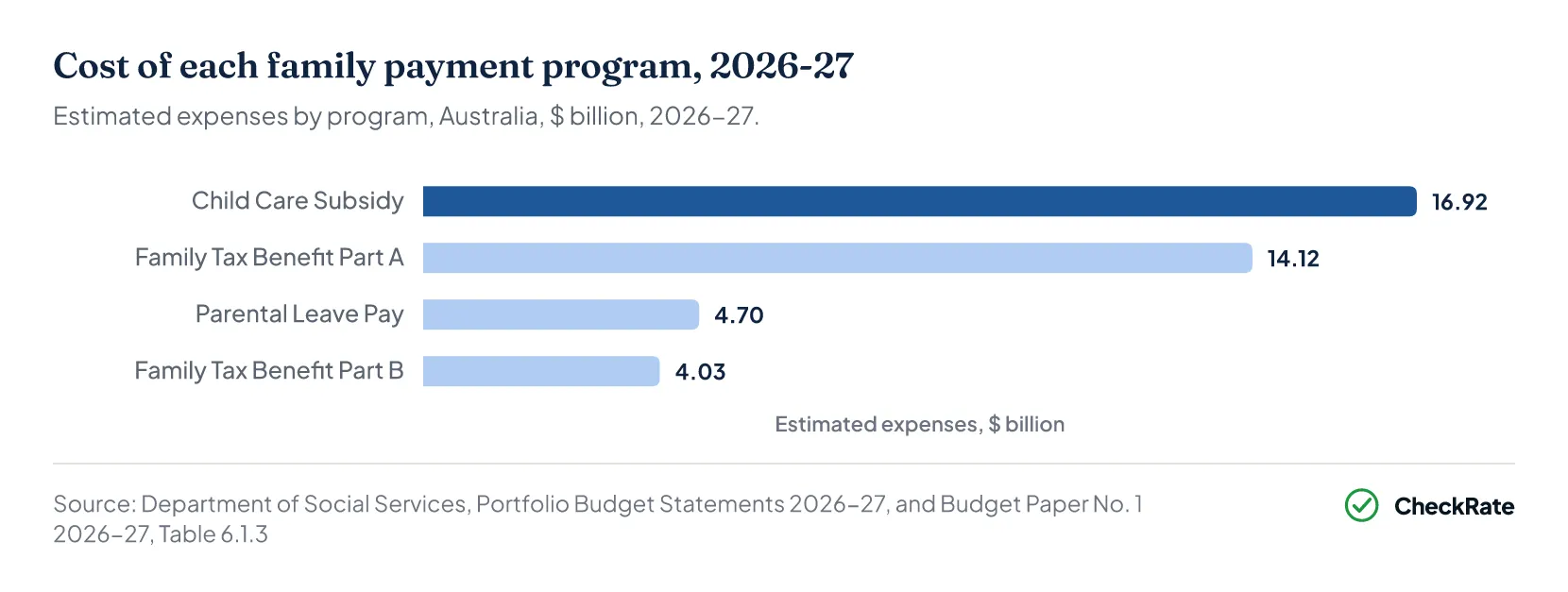
The Child Care Subsidy, Family Tax Benefit and Parental Leave Pay have combined estimated expenses of $39.8 billion in 2026-27, according to the 2026-27 Budget106.
Family Tax Benefit has the largest estimated expenses of the three payments in 2026-27, at $18.1 billion across Part A and Part B10. Estimated expenses in 2026-27 are $16.9 billion for the Child Care Subsidy and $4.7 billion for Parental Leave Pay6. When Part A and Part B are counted separately, the Child Care Subsidy is the largest of the four Budget programs106.
Estimated expenses on the three payments were $37.6 billion in 2025-26, and are estimated at $39.8 billion in 2026-27 and $45.7 billion in 2029-30610.
Child Care Subsidy payments are expected to grow by an average of 5.4% a year before adjusting for inflation from 2026-27 to 2036-37, according to the 2026-27 Budget6.
Assistance to families with children also includes parenting payments and child support6.
| Estimated expenses on family payments by program, Australia, $ million, 2025-26 to 2029-30 | |||||
|---|---|---|---|---|---|
| Program | 2025-26 | 2026-27 | 2027-28 | 2028-29 | 2029-30 |
| Child Care Subsidy | 15,6186 | 16,9176 | 18,5756 | 19,8606 | 21,0906 |
| Family Tax Benefit Part A | 13,885.710 | 14,118.810 | 14,547.310 | 14,750.110 | 15,010.010 |
| Parental Leave Pay | 4,141.810 | 4,700.210 | 4,952.810 | 5,189.710 | 5,380.610 |
| Family Tax Benefit Part B | 3,996.910 | 4,031.210 | 4,113.710 | 4,126.710 | 4,189.610 |
| Total, three payments | 37,642.5 | 39,767.1 | 42,188.8 | 43,926.5 | 45,670.1 |
Source · Department of Social Services, Portfolio Budget Statements 2026-27, Table 2.1.2; Budget Paper No. 1 2026-27, Table 6.1.3
Costs that families meet for schooling are covered on the school costs page.
Section 07 · Spending over time
How has government spending on families with children changed since 2019-20?
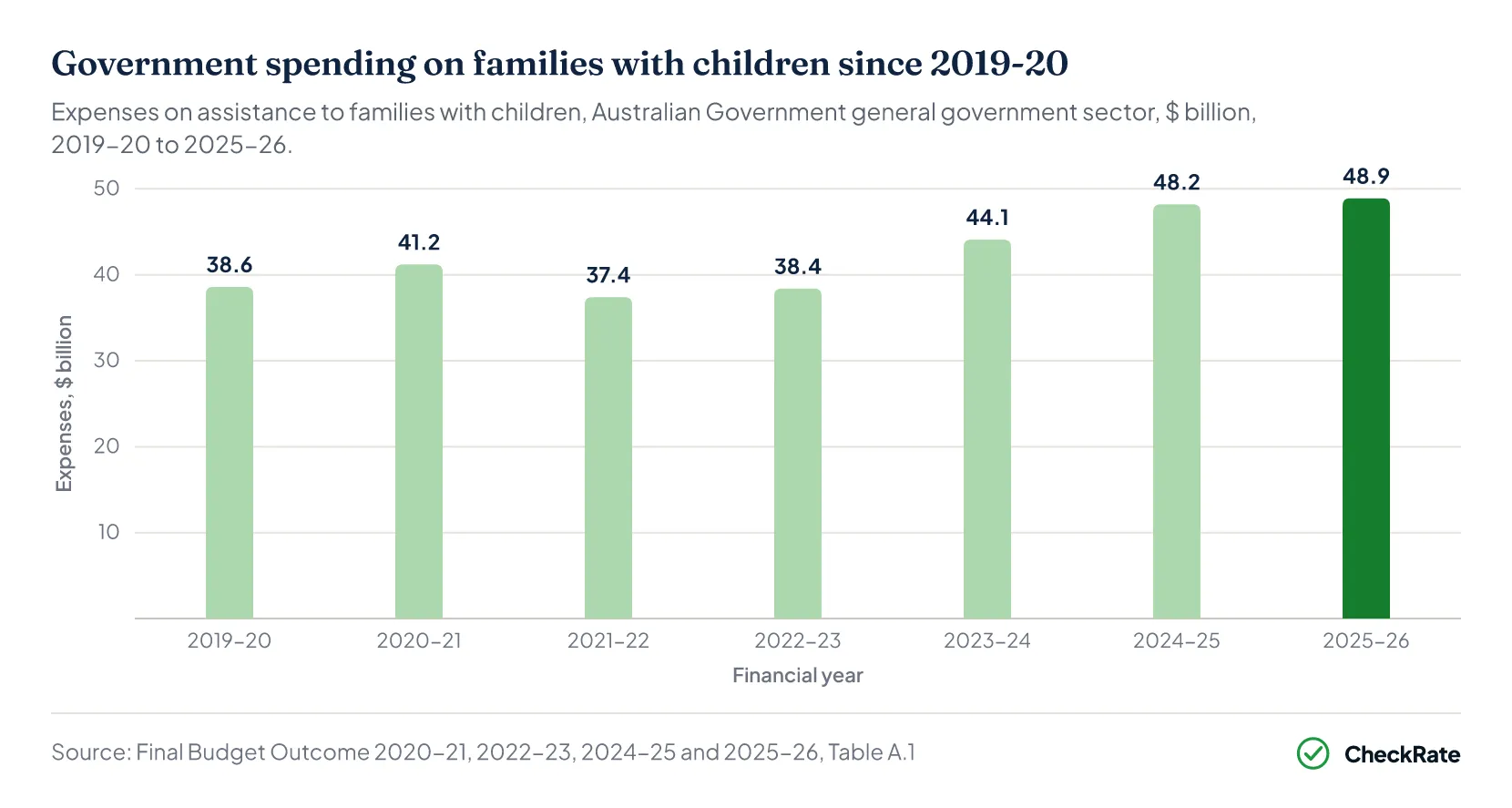
Australian Government expenses on assistance to families with children increased from $38.6 billion in 2019-20 to $48.9 billion in 2025-26, according to the Final Budget Outcome1314. The increase was $10.3 billion, or 26.6%, before adjusting for inflation1314.
Assistance to families with children includes parenting payments and child support as well as the Child Care Subsidy, Family Tax Benefit and Parental Leave Pay6.
Expenses fell from $41.2 billion in 2020-21 to $37.4 billion in 2021-22 and then increased in each year to 2025-261415. The largest annual increase during this period was in 2023-24, when expenses rose by $5.7 billion, from $38.4 billion in 2022-23 to $44.1 billion16.
Expenses increased from $48.2 billion in 2024-25 to $48.9 billion in 2025-26, an increase of $0.7 billion, or 1.4%13.
The 2025-26 actual expenses were $2.9 billion lower than the $51.8 billion estimated in the 2026-27 Budget13. Expenses on assistance to families with children are estimated at $53.9 billion in 2026-27 and $58.8 billion in 2029-306.
| Expenses on assistance to families with children, Australia, $ million, 2019-20 to 2025-26 | |||
|---|---|---|---|
| Financial year | Expenses ($ million) | Change on previous year ($ million) | Final Budget Outcome edition |
| 2019-20 | 38,60414 | n/a | FBO 2020-21 |
| 2020-21 | 41,24514 | +2,641 | FBO 2020-21 |
| 2021-22 | 37,37515 | -3,870 | FBO 2022-23 |
| 2022-23 | 38,39915 | +1,024 | FBO 2022-23 |
| 2023-24 | 44,10716 | +5,708 | FBO 2024-25 |
| 2024-25 | 48,19316 | +4,086 | FBO 2024-25 and 2025-26 |
| 2025-26 | 48,86113 | +668 | FBO 2025-26 |
Source · Final Budget Outcome 2020-21, 2022-23, 2024-25 and 2025-26, Table A.1
Section 08 · Common questions
Family payments in Australia: quick answers
How much is Parental Leave Pay a week in 2026-27?
Parental Leave Pay is $1,004.70 for a five-day week before tax from 1 July 2026, or $200.94 a day7. The rate is based on the national minimum wage.
How many families are paid Family Tax Benefit in Australia?
Family Tax Benefit was paid by fortnightly instalment to 1,250,905 families in June 2026, including 1,242,195 families who received Part A and 984,020 who received Part B2. The counts exclude families who claim Family Tax Benefit as a lump sum after the end of the financial year.
What is the maximum Child Care Subsidy percentage?
The maximum Child Care Subsidy percentage is 95%, available in 2026-27 for the second and younger children aged 5 or under in a family with more than one such child4. The maximum standard percentage is 90% of the hourly fee or the hourly rate cap, whichever is lower, for families with a combined adjusted taxable income of $88,520 or less in 2026-27.
How much Family Tax Benefit Part A is paid per child?
As at 1 July 2026, the maximum Family Tax Benefit Part A rate is $235.48 a fortnight for a child under 13 and $306.46 for a child aged 13 to 15, or aged 16 to 19 and in secondary school8. The base rate is $75.60 a fortnight for each child.
When are family payment rates indexed?
Family Tax Benefit rates and income thresholds are generally adjusted using the Consumer Price Index on 1 July each year unless indexation has been paused11, and Child Care Subsidy hourly rate caps are also adjusted using the CPI at the start of each financial year5. Parental Leave Pay is based on the national minimum wage and usually changes on 1 July7.
References
- Department of Education, Child Care Subsidy data report, June quarter 2026 · education.gov.au ↑ b c d e f g h i j
- DSS Benefit and Payment Recipient Demographics, June 2026 · data.gov.au ↑ b c d e f g h i j k l m n o p q r s t u v w x y z a2 b2 c2 d2 e2 f2 g2 h2 i2 j2
- Department of Social Services, DSS Benefit and Payment Recipient Demographics, June 2025 · data.gov.au ↑ b c d
- Department of Social Services, Family Assistance Guide 3.5.1, CCS combined annual ATI · guides.dss.gov.au ↑ b c
- Department of Social Services, Family Assistance Guide 3.5.3, CCS hourly rate caps · guides.dss.gov.au ↑ b c d e f g h i j k l m n
- Budget Strategy and Outlook, Budget Paper No. 1, 2026–27 · budget.gov.au ↑ b c d e f g h i j k l m n o p
- Services Australia, How much Parental Leave Pay you can get · servicesaustralia.gov.au ↑ b c d e f g h i j k l m n o p q
- Department of Social Services, Family Assistance Guide 3.6.1, Historical rates of FTB Part A · guides.dss.gov.au ↑ b c d e f g h i j k l m n o p q
- Department of Social Services, Family Assistance Guide 3.6.3, Historical rates of FTB Part B · guides.dss.gov.au ↑ b c d e f g
- Department of Social Services, Portfolio Budget Statements 2026-27 · dss.gov.au ↑ b c d e f g h i j k l m n o p q r s t u v w x y
- Department of Social Services, Family Assistance Guide 3.1.1.60, Indexation of FTB · guides.dss.gov.au ↑ b
- Department of Social Services, Paid Parental Leave Guide 3.2, Historical rates of PLP · guides.dss.gov.au ↑ b c
- Final Budget Outcome 2025-26 · archive.budget.gov.au ↑ b c d e
- Final Budget Outcome 2020-21 · archive.budget.gov.au ↑ b c d e
- Australian Government, Final Budget Outcome 2022-23 · archive.budget.gov.au ↑ b c
- Final Budget Outcome 2024-25 · archive.budget.gov.au ↑ b c