

Updated
- Average hourly childcare fee
- $14.601
- Centre-based day care, June quarter 2026, before the Child Care Subsidy
- Average daily childcare fee
- $146
- Centre-based day care hourly fee multiplied by a 10-hour session, June quarter 2026
- Annual childcare fee increase
- 3.8%1
- All approved care types, year to the June quarter 2026, before the Child Care Subsidy
- Out-of-pocket share of income
- 3.2%2
- One child, 30 hours a week, $95,000 family income, March quarter 2025
 How much does it cost to raise a child in Australia in 2026?The estimated cost of one child aged 0 to 12 is $14,902 a year for parents with a combined child support income of $93,137, according to 2026 child support cost estimates from the Department of Social…
 Family payments in Australia: Child Care Subsidy, Parental Leave Pay and Family Tax BenefitThe Child Care Subsidy and Additional Child Care Subsidy had estimated Australian Government expenditure of $3.88 billion in the June quarter 2026, when 989,100 families used approved child care…
 How much does school cost in Australia? Fees, charges and parent contributionsIndependent schools in Australia received $13,341 per student from fees, charges and parent contributions in 2024, according to Australian Curriculum, Assessment and Reporting Authority (ACARA) My…
Section 01 · Daily fee
How much does childcare cost per day in Australia?
The average daily fee for centre-based day care in Australia was $146.00 for a 10-hour session in the June quarter 2026, before the Child Care Subsidy. This is based on the Department of Education's average hourly fee of $14.601.
The department publishes fees per hour, not per day3.
According to the Australian Competition and Consumer Commission (ACCC), childcare sessions were commonly 10 hours long in December 2023, rather than 11 or 12 hours4. At the June quarter 2026 average hourly fee, an 11-hour session would cost $160.60 and a 12-hour session would cost $175.201. The ACCC found that shorter sessions carry a higher hourly rate, so a longer session usually works out cheaper per hour and these figures may overstate its cost4.
Children in centre-based day care were charged for an average of 34.4 hours a week in the June quarter 20261.
The Productivity Commission reported a median weekly cost of $711 for 50 hours of centre-based day care in the March quarter 2025, before the subsidy and in 2024-25 dollars2.
Within Australia, Sydney's Eastern Suburbs – North had the highest average hourly fee for centre-based day care, at $19.01, in the June quarter 2026. Katherine in the Northern Territory had the lowest, at $6.78. The comparison covers 281 local areas with at least 10 childcare services5.
| Fee for a daily session of centre-based day care by session length, Australia, June quarter 2026 | ||
|---|---|---|
| Session length | Average hourly fee ($) | Fee for the session ($) |
| 10 hours | 14.605 | 146.00 |
| 11 hours | 14.605 | 160.60 |
| 12 hours | 14.605 | 175.20 |
Source · Department of Education, Child Care Subsidy data report, June quarter 2026, Table 5.2.
Childcare is one part of the cost of raising a child in Australia.
Section 02 · After subsidy
How much does a day of childcare cost after the Child Care Subsidy?
A family receiving the maximum standard Child Care Subsidy (CCS) rate of 90% would pay $14.60 out of pocket for a 10-hour day of centre-based day care, based on the June quarter 2026 national average fee of $1461.
The Department of Education does not publish an average out-of-pocket cost per day.
The subsidy applies to either the hourly childcare fee or the government's hourly rate cap, whichever is lower, according to Services Australia6. The hourly rate cap for children below school age in centre-based day care was $14.63 in the June quarter 2026, and 56.7% of centre-based day care services had an average hourly fee at or below the cap1. The cap increased to $15.19 for 2026-276.
In 2026-27, families with an income of $88,520 or less can receive the maximum standard CCS rate of 90%7. The rate decreases by one percentage point for every additional $5,000 of family income, reaching 0% at $538,520. Families with more than one child aged 5 or under may receive a higher rate for one or more of those children.
At a 70% rate, which applies at a family income of $188,520 in 2026-27, the out-of-pocket cost of the same 10-hour day is $43.80, and at a 50% rate it is $73.007.
When childcare fees exceed the hourly rate cap, families pay the difference without a subsidy. In the Australian Capital Territory, where centre-based day care averaged $16.50 an hour in the June quarter 2026, a family receiving the 90% subsidy would pay $33.33 for a 10-hour day, based on the 2025-26 hourly cap of $14.63 that applied in that quarter1. At the 2026-27 cap of $15.19, the same $16.50 fee would leave $28.29 to pay for the day6.
Services Australia withholds 5% of the subsidy each fortnight to reduce the chance of an overpayment7. The withheld amount is reconciled after the financial year when the family's actual income is confirmed.
| Illustrative out-of-pocket cost of a 10-hour day of centre-based day care by subsidy rate, Australia, June quarter 2026 fee | |||
|---|---|---|---|
| CCS percentage | Family income for one child, 2026-27 | Subsidy for the day ($) | Out-of-pocket cost for the day ($) |
| 90%7 | Up to $88,5207 | 131.40 | 14.60 |
| 80% | $138,520 | 116.80 | 29.20 |
| 70% | $188,520 | 102.20 | 43.80 |
| 50% | $288,520 | 73.00 | 73.00 |
| 30% | $388,520 | 43.80 | 102.20 |
| 0%7 | $538,520 or more7 | 0.00 | 146.00 |
Source · Department of Education, Child Care Subsidy data report, June quarter 2026; Services Australia, Child Care Subsidy rates.
The Child Care Subsidy is one of several government payments for families.
Section 03 · By state
Which states and territories have the highest childcare fees?
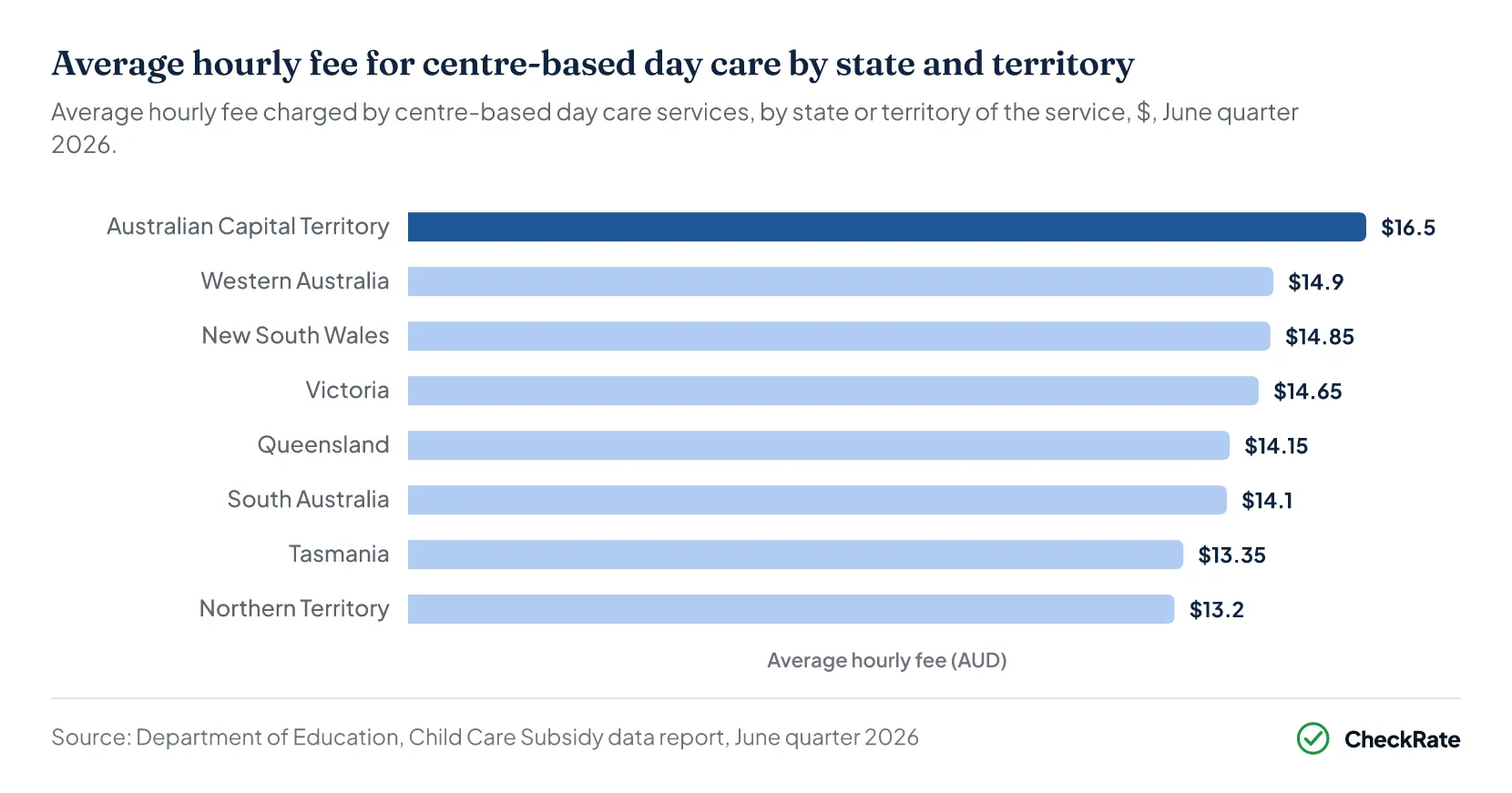
The Australian Capital Territory had the highest average hourly fee for centre-based day care in Australia, at $16.50, in the June quarter 2026. This was equivalent to $165.00 for a 10-hour day1.
Western Australia had the second-highest average hourly fee, at $14.90, followed by New South Wales, at $14.85, and Victoria, at $14.651. All four were above the $14.63 hourly rate cap for children below school age.
The Northern Territory had the lowest average hourly fee for centre-based day care of any state or territory, at $13.20, equal to $132.00 for a 10-hour day. Tasmania had the second-lowest fee, at $13.351. The gap between the Australian Capital Territory and the Northern Territory was $3.30 an hour, or $33.00 over a 10-hour day.
Average hourly fees for centre-based day care increased in every state and territory over the year to the June quarter 2026. Victoria recorded the smallest increase, at 3.5%, from $14.15 to $14.65, while the Australian Capital Territory had the largest, at 5.1%, from $15.70 to $16.508.
The Productivity Commission also found that the Australian Capital Territory had the highest median weekly cost for 50 hours of centre-based day care in March 2025, at $805 before the subsidy. Tasmania had the lowest, at $660. Both figures are in 2024-25 dollars2.
| Average hourly fee by care type and state or territory, Australia, June quarter 2026 | |||||
|---|---|---|---|---|---|
| State or territory | Centre-based ($/hr) | Family day care ($/hr) | OSHC ($/hr) | All types ($/hr) | Centre-based 10-hour day ($) |
| New South Wales | 14.855 | 14.305 | 9.705 | 14.055 | 148.50 |
| Victoria | 14.655 | 13.605 | 10.855 | 14.205 | 146.50 |
| Queensland | 14.155 | 14.005 | 9.205 | 13.305 | 141.50 |
| South Australia | 14.105 | 14.605 | 8.655 | 13.005 | 141.00 |
| Western Australia | 14.905 | 13.655 | 12.655 | 14.455 | 149.00 |
| Tasmania | 13.355 | 15.205 | 12.105 | 13.255 | 133.50 |
| Northern Territory | 13.205 | 14.755 | 10.005 | 12.655 | 132.00 |
| Australian Capital Territory | 16.505 | 14.605 | 13.305 | 15.905 | 165.00 |
| Australia | 14.605 | 13.955 | 10.055 | 13.905 | 146.00 |
Source · Department of Education, Child Care Subsidy data report, June quarter 2026, Table 5.2.
Section 04 · By care type
How much do long day care, family day care and outside school hours care cost?
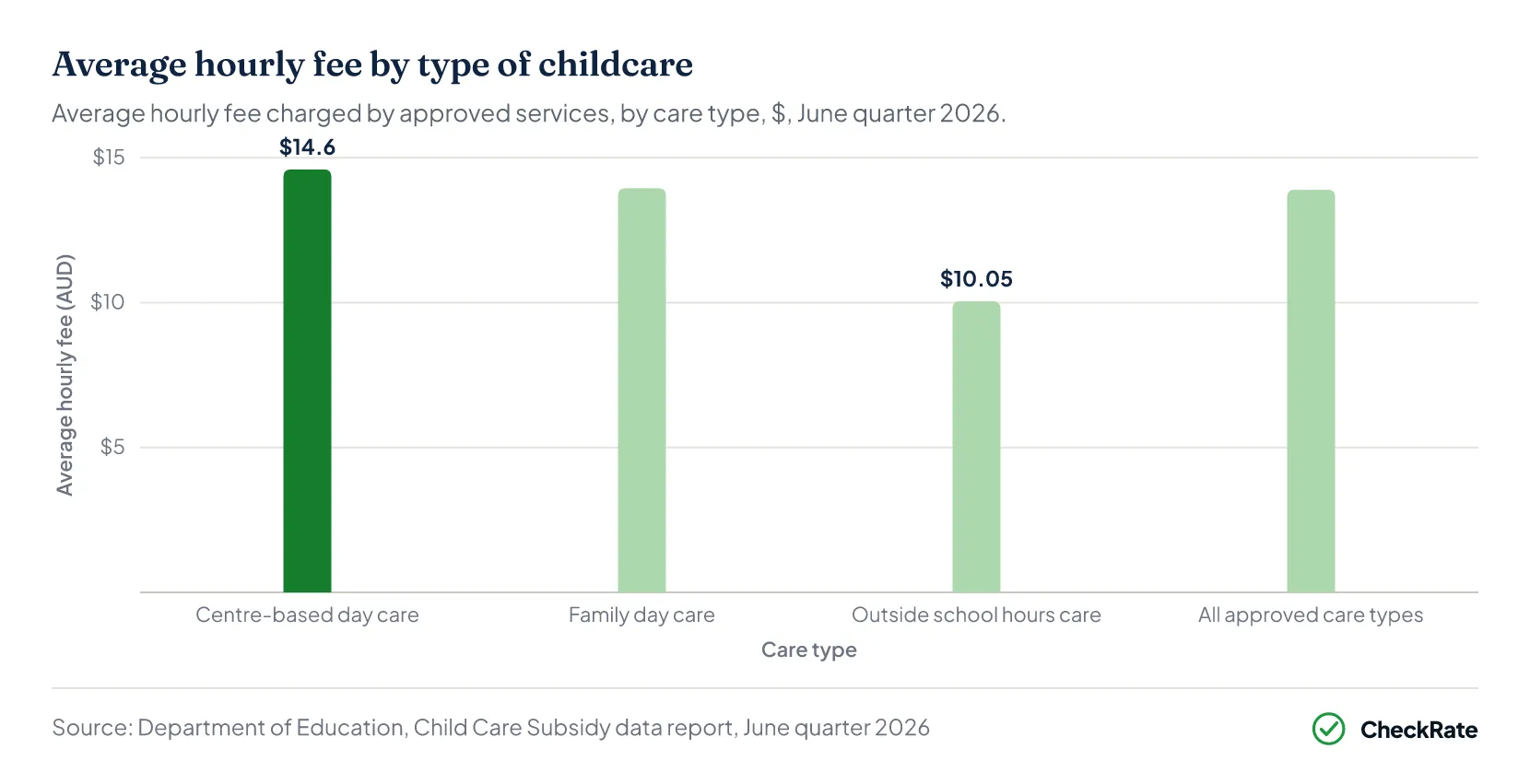
Centre-based day care, which includes long day care, had the highest average hourly fee of the three care types in the June quarter 2026, at $14.60. This compared with $13.95 for family day care and $10.05 for outside school hours care (OSHC)1. The average across all approved care types, excluding In Home Care, was $13.90.
Children were charged for an average of 34.4 hours a week in centre-based day care, 26.5 hours in family day care and 11.6 hours in OSHC in the June quarter 20265.
Centre-based day care was attended by 783,860 children in the June quarter 2026, accounting for 56.2% of children in approved care1. Outside school hours care was attended by 571,580 children, or 41.0%, and family day care by 62,820 children, or 4.5%. Children who use more than one care type are counted in each category, so the percentages total more than 100%3.
Over the year to the June quarter 2026, average hourly fees increased by 4.3% for centre-based day care, from $14.00 to $14.60. Family day care fees rose by 3.7%, from $13.45 to $13.95, while OSHC fees increased by 3.6%, from $9.70 to $10.058.
In the June quarter 2026, the hourly subsidy cap was $13.56 for family day care and $12.81 for OSHC for school-age children. Around 45.2% of family day care services had average hourly fees at or below their respective caps1.
Section 05 · Fees and inflation
How have childcare fees in Australia risen compared with inflation?
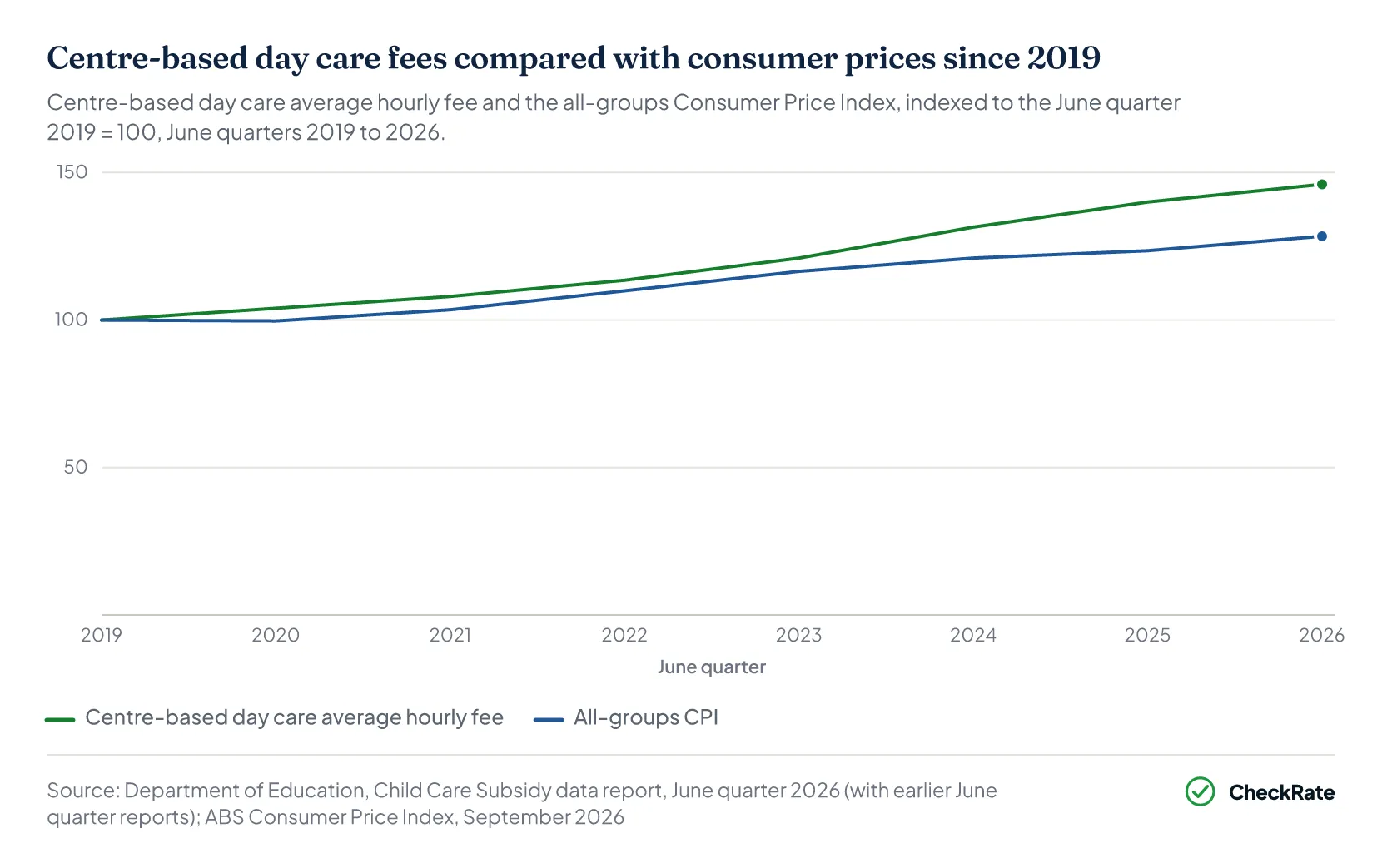
The average hourly fee for centre-based day care increased 46.0% between the June quarter 2019 and the June quarter 2026, from $10.00 to $14.609. Over the same period, the Consumer Price Index (CPI) rose 28.4%10.
This was equivalent to average annual growth of 5.6% for centre-based day care fees, compared with 3.6% for consumer prices10.
Over the year to the June quarter 2026, the average hourly fee across all approved care types increased 3.8%, compared with 3.9% for the overall quarterly CPI1. The department calculates the 3.8% from unrounded fees3. Centre-based day care fees rose 4.3% over the same period8.
The ABS childcare price index measures costs paid by families after the subsidy, rather than the fees charged by childcare services11. The index rose 20.1% between the June quarter 2019 and the June quarter 2026, compared with 46.0% for the average centre-based day care fee12. In the year to the June quarter 2026, the childcare index rose 7.8%.
More recent monthly ABS figures show that childcare costs rose 4.4% in the year to September 2026, compared with a 4.3% increase in overall consumer prices13.
| Average hourly fee and consumer prices, Australia, June quarters 2019 to 2026 | ||||
|---|---|---|---|---|
| June quarter | Centre-based fee ($/hr) | All types fee ($/hr) | All-groups CPI (2019 = 100) | Child care index (2019 = 100) |
| 2019 | 10.009 | 9.709 | 100.0 | 100.0 |
| 2020 | n/a | n/a | 99.7 | 5.3 |
| 2021 | 10.8014 | 10.4014 | 103.5 | 110.2 |
| 2022 | 11.3515 | 10.9015 | 109.9 | 105.2 |
| 2023 | 12.1016 | 11.5516 | 116.5 | 115.2 |
| 2024 | 13.1517 | 12.5517 | 121.0 | 108.6 |
| 2025 | 14.008 | 13.408 | 123.5 | 111.4 |
| 2026 | 14.605 | 13.905 | 128.4 | 120.1 |
Source · Department of Education, Child Care Subsidy data reports, June quarters 2019 to 2026; ABS, Consumer Price Index, Australia, September 2026, Tables 17 and 18.
Section 06 · Share of income
What share of family income do out-of-pocket childcare costs take?
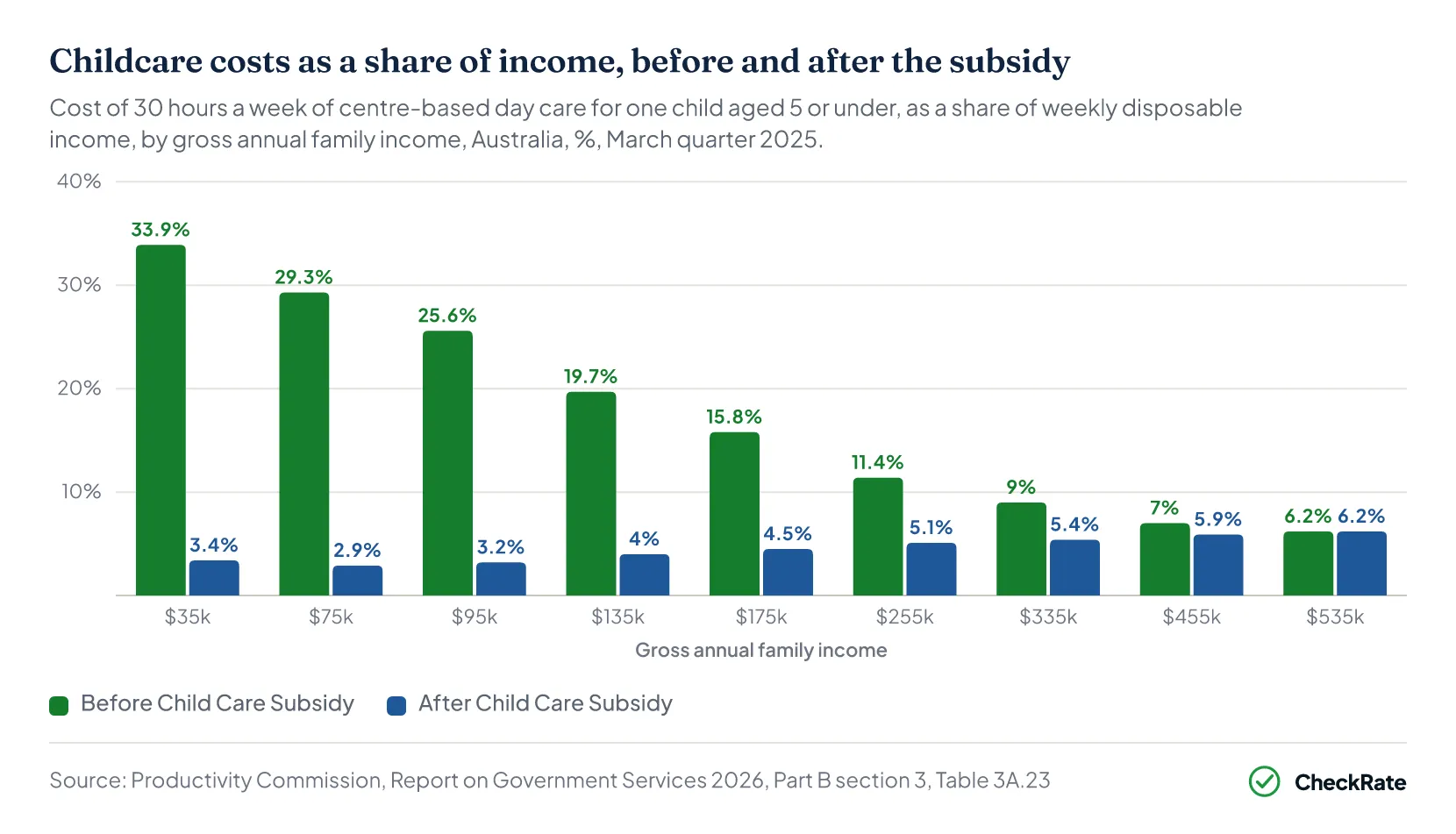
For a family earning $95,000 a year, out-of-pocket costs for one child attending 30 hours of centre-based day care a week were equivalent to 3.2% of weekly disposable income in March 2025, after the Child Care Subsidy, according to the Productivity Commission's Report on Government Services2.
Before the subsidy, the same childcare costs represented 25.6% of the same family's weekly disposable income2.
Among the income levels modelled by the Productivity Commission, families earning $75,000 had the lowest after-subsidy share, at 2.9%, while those earning $535,000 had the highest, at 6.2%2. At $535,000 and $555,000, both above the 2024-25 income limit for the subsidy, families received no subsidy, so the before-subsidy and after-subsidy shares were the same, at 6.2% and 6.0%.
For families with two children aged 5 or under attending 30 hours of centre-based day care a week, out-of-pocket costs represented 4.3% of disposable income at $95,000 and 7.0% at $175,0002. Before the subsidy, the corresponding shares were 49.1% and 31.6%, respectively.
The Productivity Commission uses 30 hours of care a week to reflect average use. In March 2025, children in centre-based day care attended an average of 34.1 hours a week nationally2.
The Household, Income and Labour Dynamics in Australia (HILDA) Survey shows what families reported paying. In the Melbourne Institute's HILDA Statistical Report 2026, among families paying for child care for children not yet at school, including informal paid care such as nannies, the median share of household disposable income spent on child care was 6.5% in 2024, and the median cost was $190 a week after subsidies, in December 2024 prices18. These figures reflect the hours of care each family actually used, and the share uses income adjusted for household size, so they are not comparable with the Productivity Commission's modelled example.
Section 07 · Since 2024
How have childcare fees changed since the 2024 worker retention payment?
The average hourly fee for centre-based day care rose 4.3% in the year to June 2026, compared with 6.5% in 2025 and 8.7% in 202417.
The data do not show whether the worker retention payment contributed to the slower growth in fees.
The worker retention payment is a Department of Education grant that funds higher wages for early childhood workers. It does not change childcare subsidy rates. From 8 August 2024, participating services were required to limit fee increases to 4.4% over 12 months20.
The payment funded wage increases of 10% above award rates from December 2024 and 15% from December 202521. In the Department of Education's example, the maximum fee increase for an established service was 4.2% between August 2025 and August 202622. The payment was extended in June 2026 until June 2028, and services already getting it must not increase fees by more than 5.8% between 8 August 2026 and 7 August 20272321.
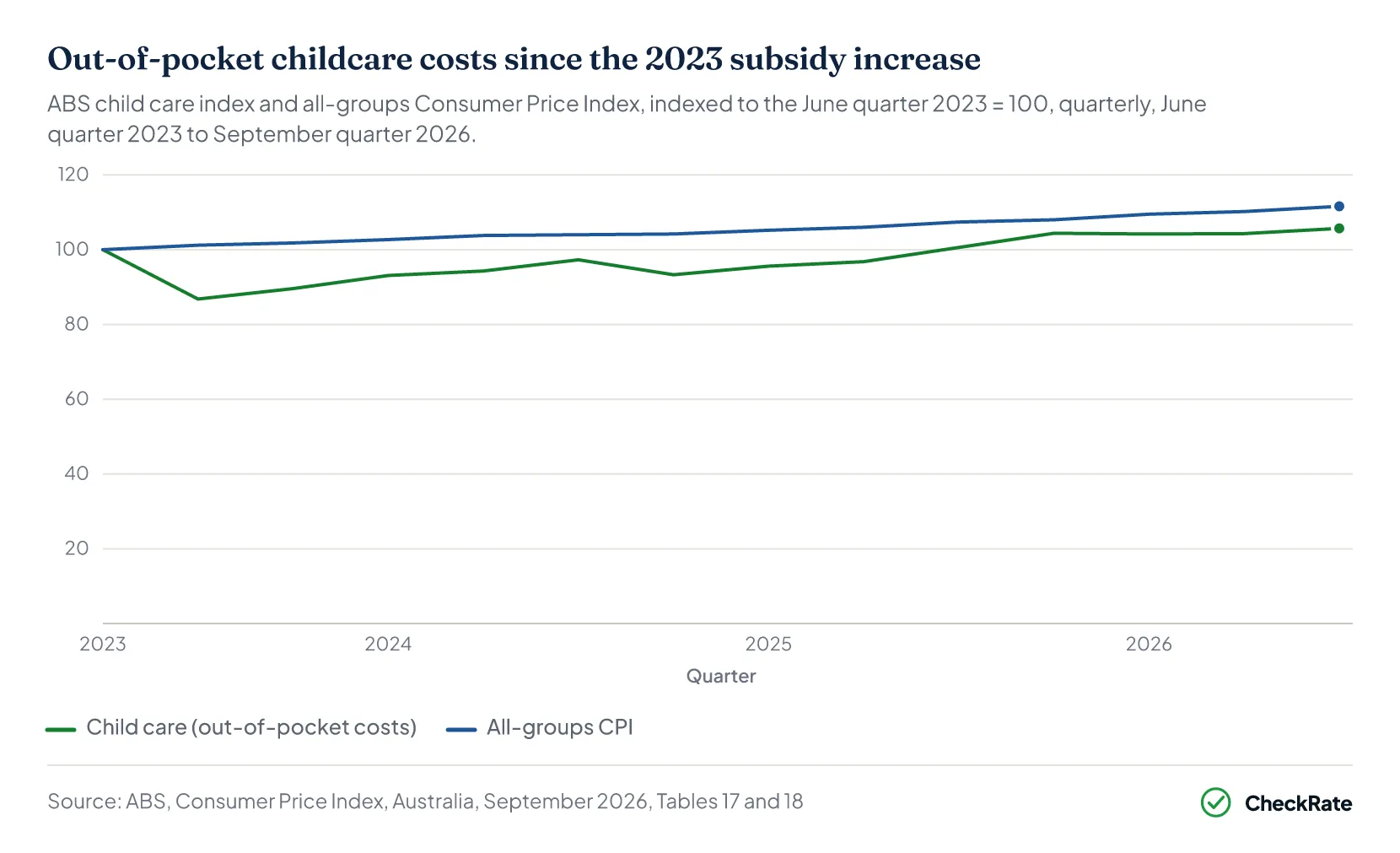
Earlier changes to the Child Care Subsidy also affected what families paid. From 10 July 2023, the maximum standard CCS rate increased from 85% to 90%, and the family income limit rose to $530,0002. For a family earning $95,000 with one child attending 30 hours of centre-based day care a week, out-of-pocket costs fell from 5.1% of disposable income in March 2023 to 3.2% in March 2024.
From 5 January 2026, the 3 Day Guarantee replaced the activity test, giving eligible families at least 72 hours of subsidised care a fortnight24. Families can receive up to 100 hours a fortnight if they meet additional conditions, including more than 48 hours of recognised participation or caring for an Aboriginal or Torres Strait Islander child.
The ABS reported a 1.6% fall in its monthly childcare price index in February 2026, partly reflecting lower out-of-pocket costs for some families following this change25.
Between June 2023 and June 2026, the average hourly fee for centre-based day care increased 20.7%, from $12.10 to $14.60.16 Over the same period, the ABS childcare price index rose 4.3%, compared with a 10.2% increase in overall consumer prices12.
| Childcare subsidy and fee changes, Australia, July 2023 to June 2026 | |
|---|---|
| Date | Change |
| 10 July 2023 | Maximum standard CCS rate increased from 85% to 90%, and the subsidy's family income limit increased to $530,0002 |
| 8 August 2024 | Worker retention payment announced, with participating services to limit fee growth to no more than 4.4% over the following 12 months20 |
| 2 December 2024 | Worker retention payment starts, funding a wage increase of 10% above the award rate21 |
| 8 August 2025 | Fee growth cap period to 7 August 2026 begins, with a 4.2% cap in the department's example22 |
| 1 December 2025 | Second year of the payment, funding a wage increase of 15% above the award rate21 |
| 5 January 2026 | 3 Day Guarantee replaces the activity test, with at least 72 hours of subsidised care a fortnight24 |
| 17 June 2026 | Worker retention payment extended to 30 June 2028 and expanded to In Home Care and family day care, with a 5.8% fee growth cap to 7 August 202723 |
Source · Productivity Commission, Report on Government Services 2026, Table 3A.23 note; Department of Education.
Section 08 · Common questions
Childcare costs: quick answers
How much does childcare cost per day in Australia?
A 10-hour session of centre-based day care, which includes long day care, cost $146.00 before the Child Care Subsidy in the June quarter 2026, based on the Department of Education's national average hourly fee of $14.601. This is an estimate, as the department reports hourly rather than daily fees.
How much does childcare cost after the Child Care Subsidy?
At the June 2026 national average fee, a 10-hour day would cost $14.60 after the maximum standard Child Care Subsidy of 90%7, or $73 with a 50% subsidy. These are illustrative costs, not national averages.
Which state or territory has the most expensive childcare in Australia?
The Australian Capital Territory recorded the highest average hourly fee for centre-based day care of any state or territory in the June quarter 2026, at $16.50, according to the Department of Education1. The Northern Territory recorded the lowest average hourly fee, at $13.20.
Have childcare fees risen faster than inflation?
The average hourly fee for centre-based day care increased 46.0% between the June quarter 2019 and the June quarter 2026, compared with 28.4% for the overall Consumer Price Index (CPI). In the year to June 2026, average fees across all approved care types rose 3.8%1, slightly below the 3.9% increase in the quarterly Consumer Price Index.
What is the 3 Day Guarantee for childcare?
The 3 Day Guarantee has given families eligible for the Child Care Subsidy at least 72 hours of subsidised care a fortnight since 5 January 2026, replacing the activity test24. Families with more than 48 hours of recognised participation a fortnight can get 100 hours a fortnight.
References
- Department of Education, Child Care Subsidy data report, June quarter 2026 · education.gov.au ↑ b c d e f g h i j k l m n o p q r s
- Productivity Commission, Report on Government Services 2026, Part B section 3 Early childhood education and care, data tables · assets.pc.gov.au ↑ b c d e f g h i j k l
- Department of Education, About Child Care Subsidy data · education.gov.au ↑ b c
- Australian Competition and Consumer Commission (ACCC), Childcare inquiry final report, December 2023 · accc.gov.au ↑ b c
- Department of Education, Child Care Subsidy data report, June quarter 2026, data tables · education.gov.au ↑ b c d e f g h i j k l m n o p q r s t u v w x y z a2 b2 c2 d2 e2 f2 g2 h2 i2 j2 k2 l2 m2 n2 o2 p2 q2
- Services Australia, Child Care Subsidy: the type of child care you use affects it · servicesaustralia.gov.au ↑ b c d
- Services Australia, Child Care Subsidy: your income can affect it · servicesaustralia.gov.au ↑ b c d e f g h i j
- Department of Education, Child Care Subsidy data report, June quarter 2025, data tables · education.gov.au ↑ b c d e
- Department of Education, Child care data, June quarter 2019, data tables · education.gov.au ↑ b c
- ABS, Consumer Price Index, Australia, August 2026, Table 17 (6401017.xlsx) · Australian Bureau of Statistics ↑ b
- ABS, Consumer Price Index, Australia, August 2026 · Australian Bureau of Statistics ↑ b
- ABS, Consumer Price Index, Australia, September 2026, Table 18 (6401018.xlsx) · Australian Bureau of Statistics ↑ b c d
- ABS, Consumer Price Index, Australia, September 2026 · Australian Bureau of Statistics ↑
- Department of Education, Child Care Subsidy data report, June quarter 2021, data tables · education.gov.au ↑ b
- Department of Education, Child Care Subsidy data report, June quarter 2022 · education.gov.au ↑ b
- Department of Education, Child Care Subsidy data report, June quarter 2023 · education.gov.au ↑ b c
- Department of Education, Child Care Subsidy data report, June quarter 2024, data tables · education.gov.au ↑ b c
- Melbourne Institute, University of Melbourne: HILDA Statistical Report 2026 (Selected Findings from Waves 1 to 24) · melbourneinstitute.unimelb.edu.au ↑
- Productivity Commission, Report on Government Services 2026, Early childhood education and care · pc.gov.au ↑
- Department of Education, Wage increase for the early childhood workforce · education.gov.au ↑ b
- Department of Education, Worker retention payment · education.gov.au ↑ b c d
- Department of Education, Worker retention payment: eligibility and conditions · education.gov.au ↑ b c
- Department of Education, Worker retention payment extended to 30 June 2028 (17 June 2026) · education.gov.au ↑ b
- Department of Education, 3 Day Guarantee · education.gov.au ↑ b c
- ABS Consumer Price Index, Australia, February 2026 · Australian Bureau of Statistics ↑