


Published
 Can a person live overseas and still get the Australian Age Pension?The Age Pension can generally continue to be paid for as long as a recipient is outside Australia, whether the absence is temporary or permanent, provided the person continues to qualify under the inc…
 How do exchange rates change the value of the Age Pension overseas?The Age Pension for a single person living outside Australia is set in Australian dollars, with a maximum basic rate of A$29,520.40 a year from 20 September 2026, according to Services Australia. The…
 The cheapest countries to retire on the Australian Age PensionThe maximum Age Pension for a single person living outside Australia is A$29,520.40 a year from 20 September 2026, according to Services Australia. A couple who are both eligible can receive up to A$4…
Section 01 · Working life residence
How does Australian working life residence affect the Age Pension overseas?
An Age Pension paid to a person who has been outside Australia for more than 26 weeks is generally paid without a residence-based reduction only if the person has 35 years of Australian working life residence, according to Services Australia1. A person with less than 35 years generally receives a lower, proportional rate after that point.
Australian working life residence is the total time a person was an Australian resident between age 16 and Age Pension age2. It does not depend on whether the person worked or paid tax during that time. Age Pension age is 67 years3.
Separate periods of residence are added together, with excess days converted to months at 30 days a month4. After the final addition, any remaining 0 to 29 days are rounded up to one month, so even an exact number of years gains a month and the count used in the rate calculation is the whole months of residence plus one month2.
What else changes for the Age Pension during an absence from Australia?
The Energy Supplement stops and the Pensioner Concession Card is cancelled once a person has been outside Australia for 6 weeks, and the Pension Supplement stops at 12 weeks1. For a person who leaves to live in another country, all three stop from the date of departure and the pension is paid at the outside Australia rate.
| What changes for an Age Pension recipient outside Australia, by length of absence | |
|---|---|
| Length of absence | What changes |
| Less than 6 weeks | The Age Pension rate does not change in most cases |
| 6 weeks or more | The Energy Supplement stops and the Pensioner Concession Card is cancelled1 |
| 12 weeks or more | The Pension Supplement stops1 |
| More than 26 weeks | Unchanged in most cases with 35 years or more of Australian working life residence, and lower in most cases with less than 35 years |
| Leaving to live in another country | From the date of departure, the outside Australia rate applies and the Energy Supplement, Pension Supplement and Pensioner Concession Card stop1 |
Source · Services Australia, When you leave Australia if you get Age Pension
Since 1 July 2021, a recipient who is temporarily overseas and cannot return within 26 weeks for certain specified reasons can apply to have the 26-week period extended, and the rate is not reduced based on working life residence while the extension applies5. Services Australia lists serious illness, a public health crisis and a natural disaster as examples1.
A person who returns to Australia to live and then starts receiving the Age Pension after returning can have the payment stop if they travel outside Australia within the following two years1. The payment may continue where the travel is to a country with a social security agreement.
Whether the Age Pension can be paid at all after a move overseas is covered in the article on living overseas and the Age Pension.
Section 02 · The formula
How is the Age Pension rate calculated for people living overseas?
The Age Pension rate paid overseas is based on the yearly rate a person would receive in Australia after the income and assets tests. That amount is multiplied by their months of Australian working life residence, plus one month, and divided by 420, according to the Department of Social Services (DSS) Social Security Guide5. This calculation applies when a recipient with unlimited portability has been overseas for more than 26 weeks and has less than 420 months, or 35 years, of working life residence.
Three terms make up the formula, overseas rate = (P × Q) ÷ 420:
- P is the yearly rate that would be payable in Australia after the income and assets tests (the notional domestic rate).
- Q is the number of months of working life residence plus one month, up to a maximum of 420.
- 420 is 35 years expressed in months5.
In the DSS Social Security Guide, a recipient with a yearly income-tested and assets-tested rate of $3,500 and 18 years of working life residence receives $1,808.30 a year. The calculation uses $3,500 multiplied by 217 months and divided by 4205.
The formula gives $1,808.33, which the DSS Social Security Guide shows as $1,808.305.
Services Australia's example gives 10/35ths of the usual rate for a person who was a resident for 10 years1. Because the Guide's count adds one month, exactly 10 years counts as 121 months, or 28.81% of the full 420-month period, compared with 28.57% using 10/35ths2.
A recipient with 420 months or more of working life residence does not have their rate reduced based on their years of residence and is paid the normal income-tested and assets-tested rate overseas5. Each member of a couple has the rate calculated using their own working life residence.
Section 03 · Worked examples
Age Pension examples for 10, 20 and 35 years of residence
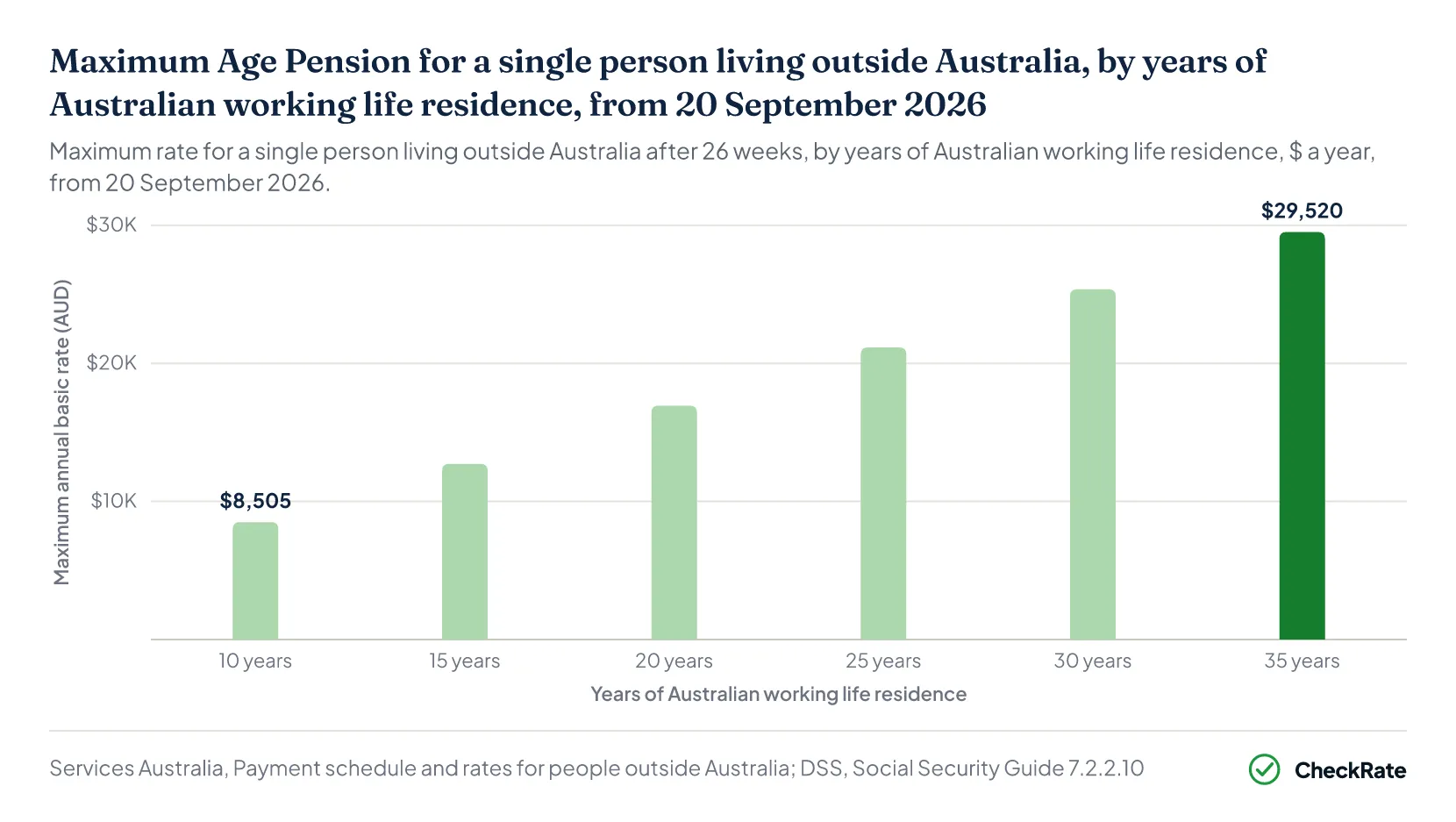
A single person on the maximum basic rate with exactly 10 years of Australian working life residence would receive about $8,505 a year outside Australia from 20 September 2026, compared with about $16,939 with 20 years and the full $29,520.40 with 35 years6. These are illustrative calculations based on the maximum basic rate for people living outside Australia and the working life residence calculation in the Social Security Guide5.
The examples assume the pensioner has been outside Australia for more than 26 weeks and that income and assets are low enough for the maximum basic rate to apply before the working life residence calculation. The outside Australia rate is the maximum basic rate only, and the supplements stop when a person leaves to live in another country6.
Worked example · 10 years of residence
Ten years of residence is 120 months, counted as 1212. Using 121/420 of the $29,520.40 single maximum gives about $8,505 a year6. For each member of a couple, 121/420 of the $22,253.40 partnered maximum is about $6,411 a year.
Ten years is also the minimum total residence for most Age Pension claims, and at least 5 of those years must be without a break7.
Worked example · 20 years of residence
Twenty years is 240 months, counted as 2412. Using 241/420, or 57.38%, of the single maximum gives about $16,939 a year and about $12,769 a year for each member of a couple5.
Worked example · 35 years of residence
Thirty-five years is 420 months, the cap in the formula, so the extra month adds nothing5. A single person receives the full $29,520.40 a year and each member of a couple $22,253.40, or $44,506.80 combined, subject to the income and assets tests6.
| Proportional Age Pension outside Australia at 10, 20 and 35 years of residence, from 20 September 2026 | ||||
|---|---|---|---|---|
| Australian working life residence | Months counted | Share of the unreduced rate | Single ($ a year) | Each member of a couple ($ a year) |
| 10 years | 121 | 28.81% | 8,505 | 6,411 |
| 20 years | 241 | 57.38% | 16,939 | 12,769 |
| 35 years | 420 | 100.00% | 29,520 | 22,253 |
Source · Services Australia, Payment schedule and rates for people outside Australia; DSS, Social Security Guide 7.2.2.10 and 1.1.A.340
Section 04 · Income and assets
How do the income and assets tests apply to an Age Pension paid overseas?
The income and assets tests apply to a pensioner living outside Australia, and Services Australia pays the rate from whichever test gives the lower amount6. For a single person living outside Australia, the maximum basic rate is paid with annual income up to $5,876, and a part pension is payable with annual income less than $64,916.80, from 20 September 2026.
The income free area is $226 a fortnight for a single person, and the pension reduces by 50 cents for each dollar of income above it8. A single homeowner living outside Australia can have assets up to $333,000 for the maximum rate and less than $711,500 for a part pension6.
| Income and assets limits for the Age Pension outside Australia, from 20 September 2026 | ||||
|---|---|---|---|---|
| Test | Single, full | Single, part | Couple, full | Couple, part |
| Annual income | Up to $5,876 | Less than $64,916.806 | Up to $10,296 | Less than $99,309.606 |
| Assets, homeowner | Up to $333,000 | Less than $711,5006 | Up to $499,000 | Less than $1,070,000 |
| Assets, non-homeowner | Up to $600,000 | Less than $978,5006 | Up to $766,000 | Less than $1,337,000 |
Source · Services Australia, Payment schedule and rates for people outside Australia
The part-pension limits for people living outside Australia are lower than the limits in Australia, where a single homeowner's part pension stops when assets exceed $745,7509. The Pension Supplement and the Energy Supplement, which form part of the maximum rate in Australia, are not paid to a person who leaves to live in another country10111.
Financial assets are assumed to earn income at set rates of 1.75% on the first $66,800 for a single person and 3.75% on the amount above it, under the outside Australia rates from 20 September 20266. Income and assets held in other countries count in both tests and are converted to Australian dollars at exchange rates12.
Worked example · 20 years of residence and $15,876 of income
This is an example calculation based on the outside Australia rates from 20 September 2026. A single homeowner with assets under the full-pension limit and annual assessable income of $15,876 has $10,000 above the $5,876 free area, which reduces the $29,520.40 maximum basic rate by $5,000 to $24,520.408.
With 20 years of residence, 241/420 of $24,520.40 gives about $14,070 a year5.
Section 05 · Agreements
How do social security agreements affect the Age Pension overseas?
Australia has social security agreements with 32 countries13. These agreements can allow people to combine periods of Australian residence with periods of contributions in another country to meet minimum qualifying periods. A person usually receives a part pension from each agreement country they lived in, with the amount depending on where they live and how long they lived or worked in each country14.
For most agreements, an Australian agreement pension paid outside Australia is calculated on the same working life residence basis, with a maximum of 420 months15. In the Guide's example, a person with 180 months of residence may receive 180/420ths of the rate payable with 420 months.
A person who is not an Australian resident usually needs at least 12 months of Australian working life residence, including at least six continuous months, before using an agreement to add periods together16. A person living in an agreement country can claim the Age Pension from there, while a person living in a country without an agreement cannot be granted it while living there17.
Since 1 July 2014, an agreement Age Pension has been calculated on the person's own working life residence rather than a partner's or former partner's period, which may be longer15. Since 1 August 2000, an Australian pension paid outside Australia, including under an agreement, cannot exceed the rate the person would receive living in Australia18.
Some agreements also allow a foreign pension covered by the agreement to be reduced before it is counted in the Australian income test where the Australian pension has also been reduced based on working life residence5.
Pensioners paid under the agreements with Greece and New Zealand have a different working life residence period for the full basic means-tested rate, as specified in each agreement19. Under the New Zealand agreement, payments can change from the date of arrival for a person who moves to New Zealand to live or plans to stay longer than 12 months, and otherwise after 26 weeks there1.
Australia's agreement with the United Kingdom ended on 1 March 2001 after the United Kingdom declined to change its policy of not indexing UK pensions paid in Australia, according to DSS13.
| Countries with a social security agreement with Australia, by region | ||
|---|---|---|
| Region | Number of countries | Countries |
| Asia | 3 | India, Japan, Korea |
| Australasia | 1 | New Zealand |
| Europe | 25 | Austria, Belgium, Croatia, Cyprus, Czech Republic, Denmark, Estonia, Finland, Germany, Greece, Hungary, Ireland, Italy, Latvia, Malta, Netherlands, North Macedonia, Norway, Poland, Portugal, Serbia, Slovak Republic, Slovenia, Spain, Switzerland |
| North America | 2 | Canada, United States of America |
| South America | 1 | Chile |
| Total | 3213 | |
Source · Department of Social Services, International social security agreements
Section 06 · Before July 2014
Which pensioners overseas are covered by the earlier 25-year rule?
Pensioners who were living outside Australia before 1 July 2014 generally continue to be paid under the earlier 25-year rule, where 300 months of working life residence gives the full Age Pension rate before any reduction based on working life residence20. From 1 July 2014, the period needed for a full rate after 26 weeks overseas increased from 25 years, or 300 months, to 35 years, or 420 months.
The change applied to Age Pension recipients with unlimited portability and to pensioners paid under social security agreements outside Australia, except under the agreements with Greece and New Zealand20.
Services Australia lists three conditions under which the rate generally does not change at 26 weeks for these pensioners1:
- The person was receiving the Age Pension or another Australian social security payment while living outside Australia on 1 July 2014.
- The person was an Australian resident for 25 years or more.
- The person has not been in Australia for more than 26 weeks since 1 July 2014 and has received the Age Pension the whole time.
A pensioner covered by the earlier rule who returns to Australia for longer than 26 weeks and then leaves again is assessed under the 35-year rule20. The 25-year period also covers pensioners not paid under an agreement who move to an agreement pension after the normal overseas payment period ends.
The working life residence calculation for overseas pensions dates from 1 July 1986, when it was introduced for pensions granted after that date, with earlier pensioners covered by transitional arrangements20.
Under the 25-year rule, 25 years of residence gives the full $29,520.40 single maximum basic rate from 20 September 2026, compared with about $21,156 a year under the 35-year rule, in an illustrative calculation5.
Section 07 · Indexation
Does the Age Pension rise with indexation when paid overseas?
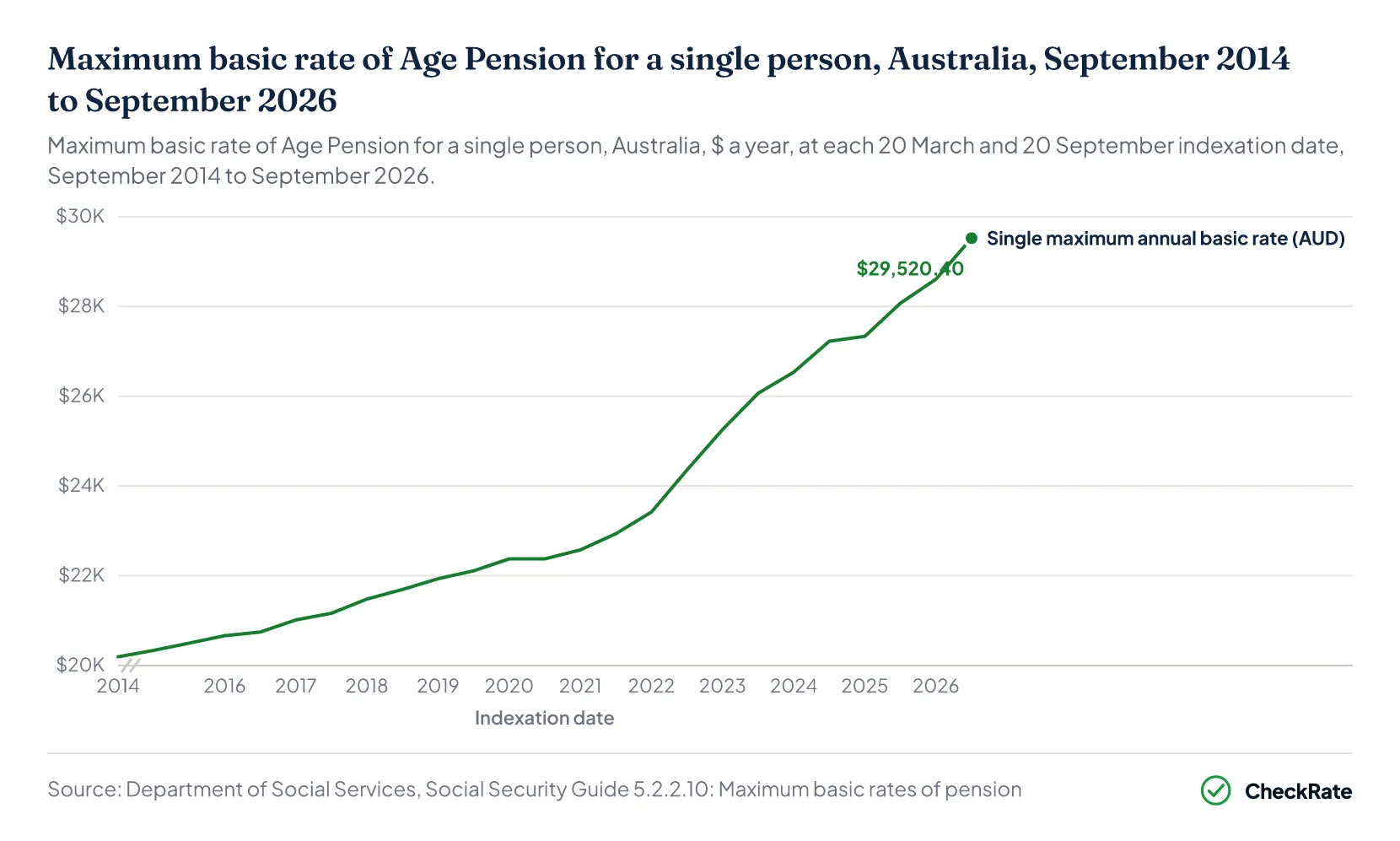
The maximum basic rate for a single person living outside Australia is $29,520.40 a year from 20 September 2026, equal to 26 fortnights at the Australian maximum basic rate of $1,135.40610. The Department of Social Services adjusts the Age Pension rates every 20 March and 20 September.
The single maximum basic rate increased from $28,607.80 a year on 20 March 2026 to $29,520.40 on 20 September 2026, an increase of $912.60, or 3.2%21. The single maximum basic rate increased from $20,194.20 on 20 September 2014, the first indexation date after the 35-year rule commenced, to $29,520.40 on 20 September 2026, an increase of 46.2%.
In an example calculation for a single person with 10 years of residence (121 of 420 months), the $912.60 increase in the single maximum basic rate on 20 September 2026 adds about $263 a year to the overseas rate5.
Section 08
Age Pension outside Australia: quick answers
How is the Age Pension calculated for someone living overseas?
A pensioner who has been outside Australia for more than 26 weeks generally receives a share of their income-tested and assets-tested rate based on their Australian working life residence, plus one month, divided by 420. From 20 September 2026, the maximum basic rate for a single person living outside Australia is $29,520.40 a year, with no reduction for residence at 35 years or more.
What is Australian working life residence?
Australian working life residence is the total time a person was an Australian resident between age 16 and Age Pension age, which is 67. A person does not need to have worked or paid tax during that time for it to count.
How much Age Pension is paid overseas with 10 years of residence?
Services Australia describes the rate after 26 weeks overseas with 10 years of residence as 10/35ths of the usual rate. Under the Social Security Guide's formula, which counts exactly 10 years as 121 months, a single person on the maximum basic rate would receive about $8,505 a year from 20 September 2026.
What income and assets limits apply to the Age Pension outside Australia?
The income and assets tests apply to a pensioner living outside Australia, and the test giving the lower rate is used. From 20 September 2026, a single person living outside Australia can receive a part pension with annual income less than $64,916.80 and, for a homeowner, assets less than $711,500.
How often is the Age Pension paid overseas adjusted?
The maximum basic rate for people living outside Australia is based on 26 fortnights of the Australian maximum basic rate, which the Department of Social Services adjusts every 20 March and 20 September. The single rate increased from $28,607.80 a year on 20 March 2026 to $29,520.40 on 20 September 2026.
Which pensioners overseas are paid under the 25-year rule?
Pensioners who were living outside Australia immediately before 1 July 2014 generally continue to be paid under the 25-year rule, where 300 months of working life residence gives the full rate. A pensioner who returns to Australia for longer than 26 weeks and then leaves again is assessed under the 35-year rule.
References
- Services Australia, When you leave Australia if you get Age Pension · servicesaustralia.gov.au ↑ b c d e f g h i j k
- Department of Social Services, Social Security Guide 1.1.A.340, Australian working life residence (AWLR) · guides.dss.gov.au ↑ b c d e f
- Services Australia, Who can get Age Pension · servicesaustralia.gov.au ↑
- Department of Social Services, Social Security Guide 7.2.2.40: Australian working life residence · guides.dss.gov.au ↑ b
- Department of Social Services, Social Security Guide 7.2.2.10: Calculating proportional portability for non-agreement pensions · guides.dss.gov.au ↑ b c d e f g h i j k l m n o
- Services Australia, Payment schedule and rates for people outside Australia: Age Pension · servicesaustralia.gov.au ↑ b c d e f g h i j k l m n
- Services Australia, Residence rules for Age Pension · servicesaustralia.gov.au ↑
- Services Australia, Income test for Age Pension · servicesaustralia.gov.au ↑ b
- Services Australia, Assets test for Age Pension · servicesaustralia.gov.au ↑ b
- Services Australia, How much Age Pension you can get (rates from 20 September 2026) · servicesaustralia.gov.au ↑ b c
- Services Australia, Travel outside Australia rules for Pension Supplement · servicesaustralia.gov.au ↑
- Services Australia, Income and assets from outside Australia can affect your Age Pension · servicesaustralia.gov.au ↑
- Department of Social Services, International social security agreements · dss.gov.au ↑ b c d
- Services Australia, How much you can get under a social security agreement · servicesaustralia.gov.au ↑
- Department of Social Services, Social Security Guide 10.1.9.30: Working life residence for agreement payments · guides.dss.gov.au ↑ b
- Department of Social Services, Social Security Guide 10.1.5.50: Minimum periods for non-Australian residents · guides.dss.gov.au ↑
- Services Australia, Retiring overseas · servicesaustralia.gov.au ↑
- Department of Social Services, Social Security Guide 10.1.9.20: Outside Australia rate for agreement payments · guides.dss.gov.au ↑
- Department of Social Services, Social Security Guide 7.2.2.60: Post departure reviews of portable payments · guides.dss.gov.au ↑
- Department of Social Services, Social Security Guide 7.1.1.10: Overview of portability legislation · guides.dss.gov.au ↑ b c d
- Department of Social Services, Social Security Guide 5.2.2.10: Maximum basic rates of pension, July 1909 to present date · guides.dss.gov.au ↑