


Published
Section 01 · Contributions
How concessional and non-concessional contributions are taxed
Money can enter superannuation in two ways, and the tax treatment differs between them. Concessional contributions are made from before-tax income. They include compulsory employer contributions. The super guarantee rate has been 12 per cent since 1 July 20251. From 1 July 2026, it is calculated on an employee's qualifying earnings. They also include salary-sacrificed amounts and personal contributions claimed as a deduction. These contributions are included in the fund's assessable income and generally taxed at 15 per cent, rather than at the member's marginal income tax rate2. The concessional contributions cap is now $32,500 from 1 July 2026. It was $30,000 from 1 July 2024 to 30 June 2026, and it increases in increments of $2,500 in line with average weekly ordinary time earnings3.
Non-concessional contributions are made from after-tax income and are not taxed again in the fund, provided they stay within the non-concessional contributions cap of $130,000 from 1 July 2026. A person whose total super balance at the end of the previous financial year is at or above the general transfer balance cap, which is $2.1 million for 2026–27, has a non-concessional cap of nil4. For low-income earners, the low-income superannuation tax offset is intended to effectively return the 15 per cent tax on their concessional contributions. A legislated change will increase the payment by $310 to $810 and lift the eligibility threshold from $37,000 to $45,000 from 1 July 20272.
| Superannuation contribution caps and tax treatment, Australia, 2026–27 | ||
|---|---|---|
| Contribution type | Annual cap | Tax in the fund |
| Concessional (before tax): employer, salary sacrifice, deducted personal | $32,500 | Generally 15%; an additional 15% Division 293 tax generally applies to contributions above the $250,000 combined income threshold |
| Non-concessional (after tax) | $130,000 | Not taxed within the cap; the cap is nil where the total super balance is $2.1 million or more |
Source · ATO guidance (QC19749, QC73087).
How Australia's reliance on compulsory private retirement saving shapes its overall tax mix is covered in the comparison of Australian and OECD tax levels.
Section 02 · Earnings
How superannuation investment earnings are taxed during accumulation
While money stays in a superannuation fund, the fund pays tax on the investment income it earns. For a complying superannuation entity, which has elected to be regulated and meets prudential requirements under the Superannuation Industry (Supervision) Act 1993, the tax rate on earnings in the accumulation phase is generally 15 per cent. Treasury's benchmark would instead tax those earnings at each member's marginal income tax rate, and the difference between the two is what the earnings concession estimates measure2.
Capital gains receive a further reduction. Where a fund has held an asset for at least 12 months, one third of the nominal gain is excluded from assessable income, so the gain is effectively taxed at 10 per cent rather than 15 per cent. Treasury estimated the revenue forgone from this discount at $2,550 million for 2025–26, as a separate item from the main earnings concession2. Some fund income is excluded from the concessional rates. Non-arm's length income of self-managed superannuation funds is taxed at 45 per cent5, and contributions income for members who have not provided a tax file number is taxed at 47 per cent, according to Treasury's description.
Section 03 · Withdrawals
How withdrawals and retirement-phase earnings are treated
Superannuation benefits paid from a taxed fund are generally tax free for people aged 60 and over. That treatment covers both income stream payments from a taxed source and the taxable component of lump sums paid from a taxed fund. For a person below preservation age, a maximum rate of 20 per cent applies to the taxable component of a lump sum2. Investment earnings on assets that support a retirement-phase income stream are taxed at zero per cent in the fund.6 The amount that can be moved into these accounts is limited by the transfer balance cap, which limits transfers into tax-free retirement-phase accounts and has applied since 1 July 2017.
Treasury's tax expenditure benchmark treats superannuation benefits as generally tax free. Tax that is still collected on some withdrawals is therefore treated as a negative tax expenditure, meaning it increases revenue relative to the benchmark. Treasury estimated the tax on funded superannuation lump sums at negative $1,050 million for 2025–26, and the tax on funded superannuation income streams at negative $120 million2.
Section 04 · Division 293
How Division 293 applies to higher-income earners
Division 293 tax is an additional tax on concessional contributions for people whose combined income and concessional contributions for Division 293 purposes exceed $250,000 in a year. It is charged at 15 per cent of the excess over the threshold or the person's taxable super contributions, whichever is less. This brings the effective rate on the affected contributions to 30 per cent7.
The ATO assesses Division 293 tax after it receives both the person's income tax return and contribution information from their super fund, and issues a separate notice of assessment.7 The liability can be paid directly or an amount can be released from the person's super fund to pay it. According to the ATO, Division 293 reduces the tax concession on the affected contributions rather than removing it entirely.
Section 05 · Large balances
How tax settings for large superannuation balances work
From 1 July 2026, the Division 296 tax reduces the concessions available on large balances. It applies at 15 per cent to taxable superannuation earnings attributable to the portion of a person's total superannuation balance above the $3 million threshold. A further 10 per cent applies to earnings attributable to the portion of the balance above the $10 million threshold. For 2026–27, the tax applies where the total balance at the end of that income year exceeds $3 million. Both thresholds are indexed to the consumer price index, with the $3 million threshold increasing in $150,000 increments and the $10 million threshold in $500,000 increments8.
According to Treasury, the measure applies to realised earnings rather than unrealised gains. The effective tax rate on affected earnings is 30 per cent for the portion attributable to balances above $3 million and up to $10 million, and 40 per cent for the portion attributable to balances above $10 million2.
The measure was announced in the 2025–26 Mid-Year Economic and Fiscal Outlook and is now law. The Treasury Laws Amendment (Building a Stronger and Fairer Super System) Act 2026 and the Superannuation (Building a Stronger and Fairer Super System) Imposition Act 2026 both received royal assent on 13 March 20269. The Imposition Act sets an additional rate of 15 per cent on taxable superannuation earnings and a further 10 per cent on the very large balance earnings component10. Division 296 tax is generally due 84 days after the notice of assessment8, and a person can elect to have the amount released from their super fund.
Section 06 · The cost
How much superannuation tax concessions are estimated to cost
The concessional taxation of employer superannuation contributions was estimated to cost $29,450 million of revenue forgone in 2025–26, the largest superannuation item in Treasury's statement. Among all the tax expenditures in Treasury's large-expenditures table for 2025–26, only the discount component of the capital gains tax main residence exemption, at an estimated $32,000 million, was larger2. The earnings concession was estimated at $25,950 million, the fourth-largest tax expenditure in the same table. Treasury also published combined estimates for the two categories: $32,200 million for contributions concessions and $28,500 million for earnings concessions in 2025–26.
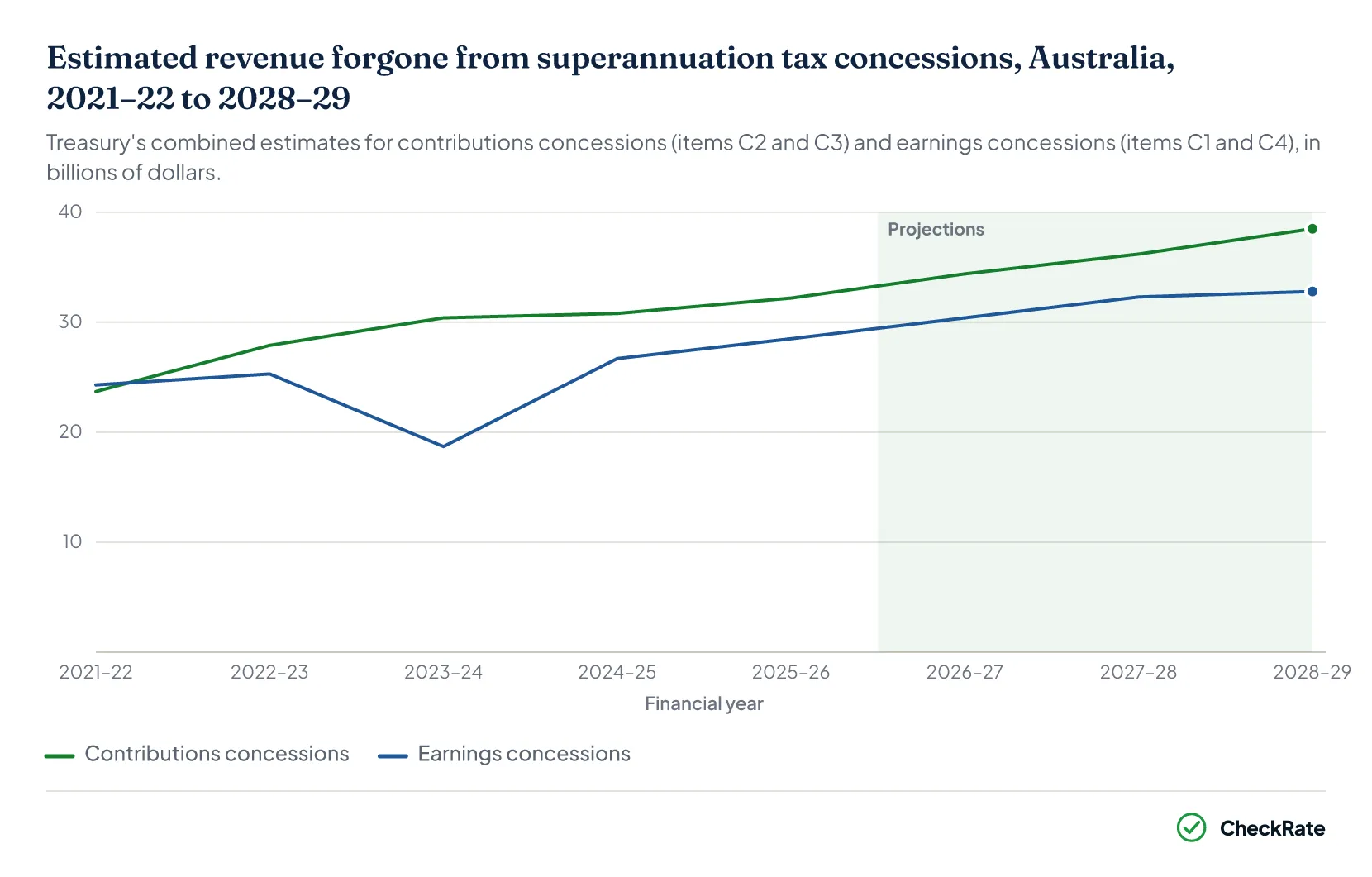
Overall, both combined estimates were higher in 2025–26 than in 2021–22 and are projected to keep growing. The contributions estimate increased from $23,700 million in 2021–22 to the $32,200 million estimated for 2025–26, and is projected to reach $38,450 million by 2028–29. The earnings estimate fluctuated more, from $24,300 million in 2021–22 to $18,650 million in 2023–24 before rising to $28,500 million in 2025–26. It is projected to reach $32,750 million by 2028–29. Treasury notes that estimates can change substantially from year to year with economic conditions and other parameters2.
| Estimated revenue forgone by superannuation tax expenditure item, Australia, 2025–26 | ||
|---|---|---|
| Item | Estimated revenue forgone ($m) | Estimate reliability |
| Concessional taxation of employer contributions (C2) | 29,450 | Medium |
| Concessional taxation of superannuation earnings (C4) | 25,950 | Low |
| Concessional taxation of personal contributions (C3) | 2,750 | Medium |
| Concessional taxation of capital gains for super funds (C1) | 2,550 | Low |
| Deductibility of life and TPD insurance premiums inside super (C6) | 2,450 | Medium |
| Exemption for small business assets held more than 15 years (C12) | 1,190 | Medium |
| Concessional taxation of unfunded superannuation (C5) | 870 | Medium |
| Small business capital gains retirement exemption (C7) | 830 | Medium to low |
| Tax on funded superannuation income streams (C10) | −120 | Medium |
| Tax on funded superannuation lump sums (C11) | −1,050 | Low |
Source · Treasury, 2025–26 Tax Expenditures and Insights Statement, published 17 December 2025, retrieved 21 August 2026
Where superannuation taxation sits within the wider Australian tax system is covered in the tax system overview article.
Section 07 · Who benefits
Who receives the largest share of superannuation tax concessions
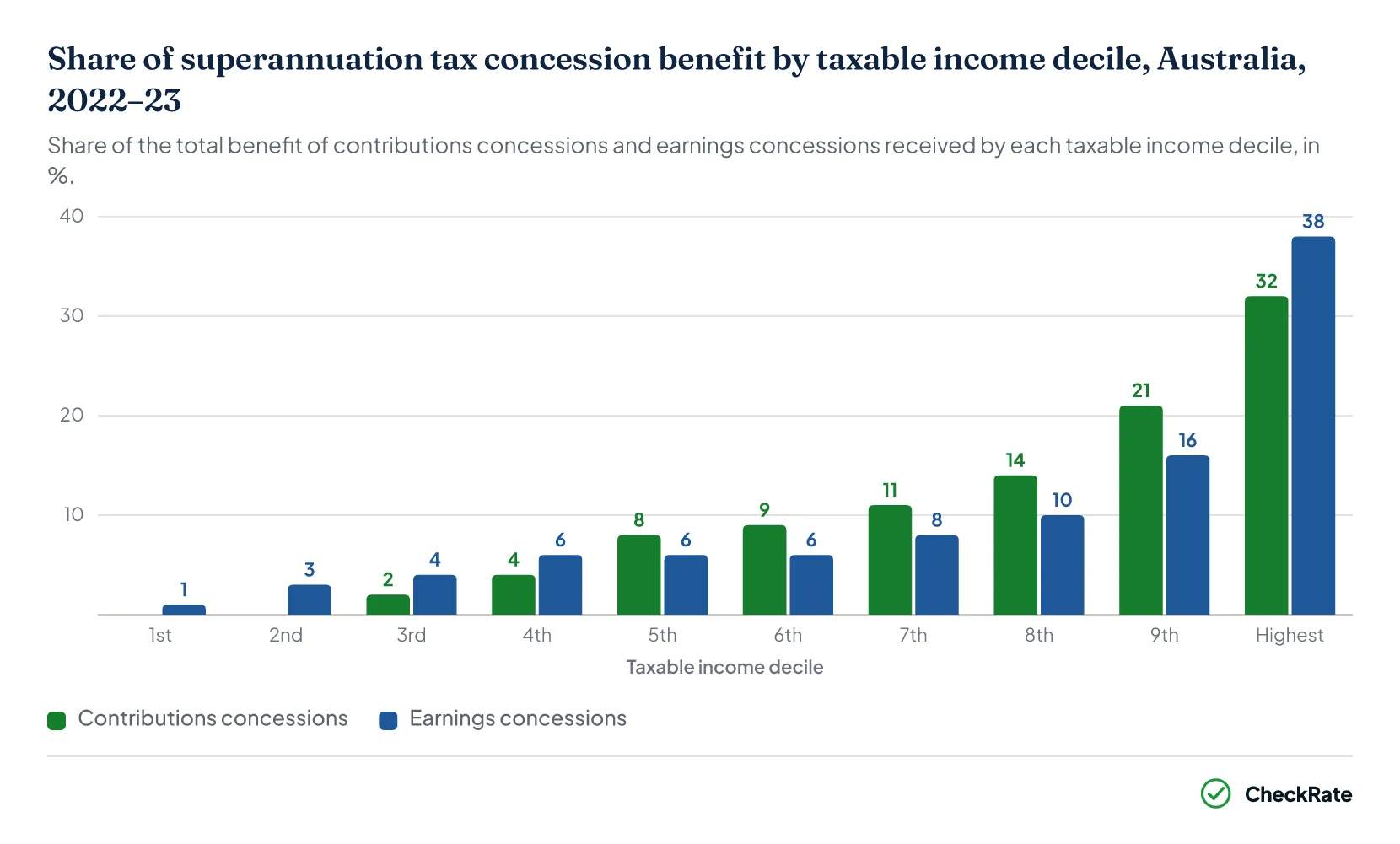
The benefits of both concessions were concentrated among people with higher taxable incomes. In 2022–23, people with above-median taxable income received 87 per cent of the contributions concession benefit, and the top taxable income decile alone received 32 per cent. For the earnings concessions, people with above-median income received 79 per cent of the benefit, and the top decile received 38 per cent2. Treasury explains that people in higher income deciles tend to make larger contributions and hold larger superannuation balances. They also face higher marginal income tax rates, making the flat 15 per cent rate more concessional for them. About 13 million people were affected by the contributions concessions in 2022–23 and about 18 million by the earnings concessions.
At the bottom of the income distribution the benefit can be nil or negative, because a 15 per cent contributions rate can exceed the marginal income tax rate a low-income earner would otherwise pay. Treasury notes this effect may be offset by the low-income superannuation tax offset, which its analysis excludes because the offset is a direct government payment. The distribution also differs by gender and age. Men received 61 per cent of the contributions concession benefit in 2022–23, with an average benefit of $2,490 compared with $1,610 for women. Men also received 60 per cent of the earnings concession benefit, while people aged 60 or older received 51 per cent2.
Contributions concessions, 2022–23
About 13 million people affected
87% of the benefit to above-median incomes
32% of the benefit to the top decile
Average benefit $2,490 for men, $1,610 for women
Earnings concessions, 2022–23
About 18 million people affected
79% of the benefit to above-median incomes
38% of the benefit to the top decile
51% of the benefit to people aged 60 or older
Source · Treasury, 2025–26 TEIS, sections 2.3 and 2.4, Tables 2.3 and 2.5.
Section 08 · Estimates vs collections
How concession estimates differ from tax revenue collected
A tax expenditure estimate measures a difference against a benchmark, not an amount collected. Treasury's revenue forgone approach measures the difference in revenue between the existing tax treatment and a benchmark treatment, assuming taxpayer behaviour stays the same and the existing treatment is removed entirely. Treasury states that these figures are not estimates of the revenue impact if a concession were removed, because taxpayers would be expected to change their behaviour. A removed concession would often be replaced with an alternative policy that reduces the net impact2. Treasury also advises care when adding separate tax expenditure estimates together, or comparing them with direct government spending.
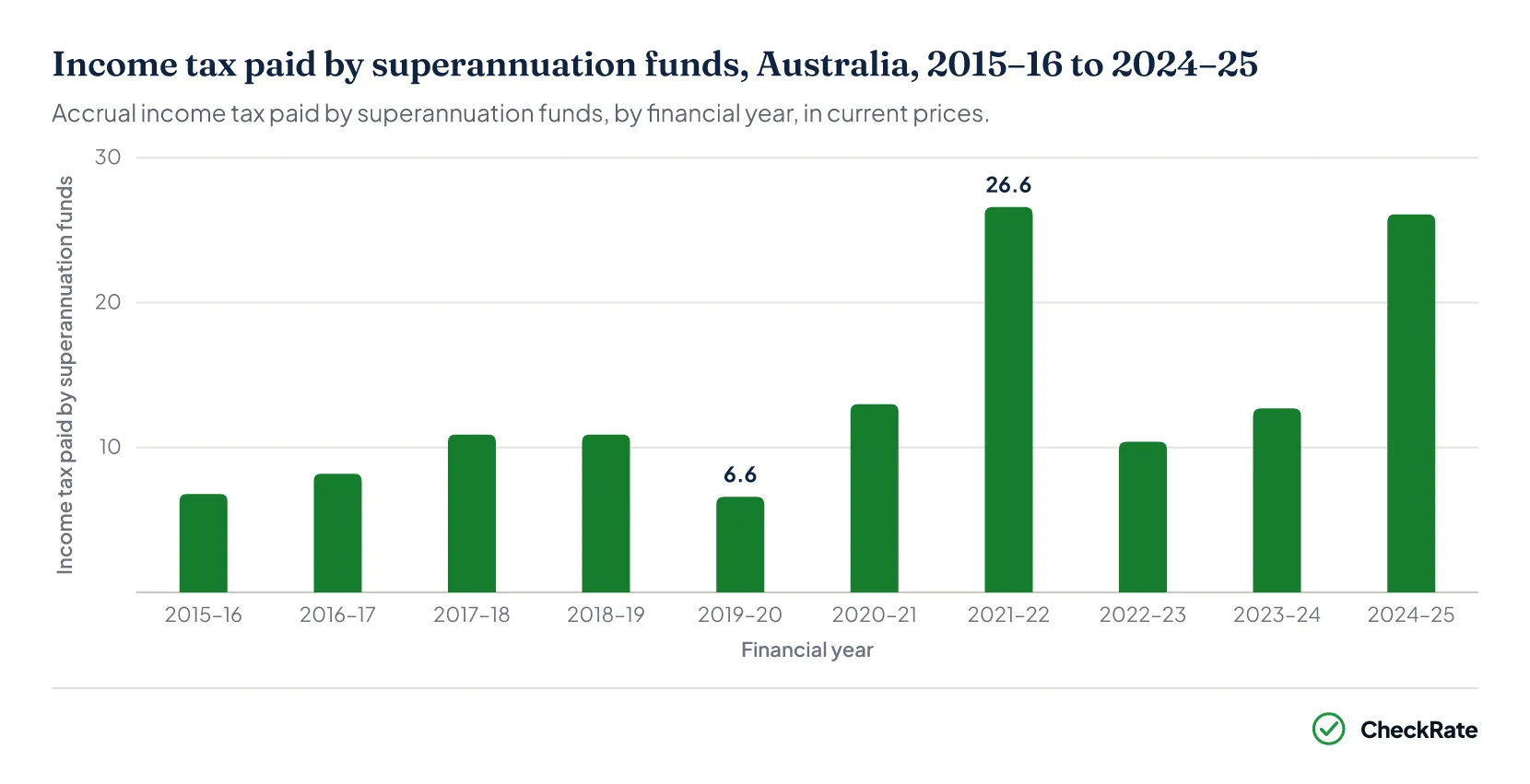
Income tax paid by superannuation funds is a separate measure. On the ABS accrual measure, superannuation funds paid $26,052 million in income tax in 2024–25, which was 3.9 per cent of the Commonwealth's $675.2 billion of taxation revenue. The amount varied sharply between years, from $6.6 billion in 2019–20 to $26.6 billion in 2021–22, then $10.4 billion in 2022–23 and $12.7 billion in 2023–2411. The data does not identify the cause of each swing. The collections figure and concession estimates are also measured on different bases. The concession estimate is a modelled gap against a benchmark, while the ABS figure records tax revenue in government finance statistics.
Total superannuation assets were $4,437.9 billion at March 2026, on APRA's quarterly statistics, an increase of 7.9 per cent on a year earlier.12 Funds with more than six members received $226.1 billion of contributions and paid $143.5 billion of benefits over the year to March 2026.
Section 09 · FAQ
Superannuation tax concessions: quick answers
How much do superannuation tax concessions cost the government?
Treasury estimated the revenue forgone from the concessional taxation of superannuation contributions at $32.2 billion for 2025–26, and the revenue forgone from the concessional taxation of superannuation earnings at $28.5 billion. Treasury publishes the two as separate estimates and cautions that tax expenditure estimates should not simply be added, because removing one concession would change the use of others.
What is the tax rate on superannuation contributions?
Employer and other before-tax contributions to a complying superannuation fund are generally taxed at 15 per cent in the fund, up to the concessional contributions cap of $32,500 for 2026–27. People whose combined income and concessional contributions exceed $250,000 generally pay an additional 15 per cent Division 293 tax, bringing the effective rate on the affected contributions to 30 per cent. After-tax contributions are not taxed in the fund within the $130,000 non-concessional cap.
Is superannuation tax free after 60?
Superannuation benefits paid from a taxed fund, whether as an income stream or a lump sum, are generally tax free for people aged 60 and over, and investment earnings on assets in a retirement-phase account are not taxed. The amount that can be transferred into retirement-phase accounts is limited by the transfer balance cap, which is $2.1 million for 2026–27, and from 1 July 2026 the Division 296 tax reduces the concessions on total superannuation balances above $3 million.
What is the Division 296 tax on super balances above $3 million?
Division 296 tax applies from 1 July 2026 at 15 per cent of a person's taxable superannuation earnings, broadly the portion of earnings corresponding to the part of their total superannuation balance above the $3 million threshold. A further 10 per cent applies to the portion above the $10 million threshold. It applies to realised earnings, both thresholds are indexed, and the law received royal assent on 13 March 2026.
Who benefits most from superannuation tax concessions?
In 2022–23, people in the top taxable income decile received 32 per cent of the benefit of superannuation contributions tax concessions and 38 per cent of the benefit of earnings tax concessions, on Treasury's distributional analysis. People with above-median income received 87 per cent of the contributions concession benefit and 79 per cent of the earnings concession benefit. Men received 61 per cent of the contributions benefit and 60 per cent of the earnings benefit.
Are superannuation tax concession estimates the same as money the government spends?
No. Treasury's revenue forgone estimates measure the difference between tax paid under the existing rules and tax that would be paid under a benchmark treatment, assuming taxpayer behaviour did not change. Treasury states that they are not estimates of the revenue impact if a concession were removed, and advises care when comparing tax expenditure estimates with direct spending. Superannuation funds paid $26.1 billion of income tax in 2024–25 on the ABS measure.
References
- ATO, Super guarantee (QC18123) · ato.gov.au ↑
- Treasury, 2025–26 Tax Expenditures and Insights Statement · treasury.gov.au ↑ b c d e f g h i j k l
- ATO, Concessional contributions cap (QC19749) · ato.gov.au ↑
- ATO, Non-concessional contributions cap (QC73087) · ato.gov.au ↑
- How SMSFs are taxed · ato.gov.au ↑
- ATO, Retirement withdrawal – lump sum or income stream (QC73093) · ato.gov.au ↑
- ATO, Division 293 tax on concessional contributions by high-income earners (QC36272) · ato.gov.au ↑ b
- ATO, Division 296 tax on large super balances (QC107622) · ato.gov.au ↑ b
- Treasury Laws Amendment (Building a Stronger and Fairer Super System) Act 2026 (No. 8, 2026) · legislation.gov.au ↑
- Superannuation (Building a Stronger and Fairer Super System) Imposition Act 2026 (No. 9, 2026) · legislation.gov.au ↑
- ABS, Taxation Revenue, Australia, 2024–25, Table 1 · Australian Bureau of Statistics ↑
- APRA, Quarterly superannuation performance statistics highlights, March 2026 · apra.gov.au ↑