


Published
 How is Australian super taxed for non-residents?A super lump sum paid to a person aged 60 or older carries no Australian tax on its tax-free component or its taxed element, which the ATO treats as non-assessable, non-exempt income.
 Can Australian super be accessed while living overseas?Moving overseas is not a condition of release for superannuation, so Australian citizens and permanent residents who leave Australia cannot withdraw their super until they meet a standard condition of…
 How much Age Pension is paid to Australians living overseas?An Age Pension paid to a person who has been outside Australia for more than 26 weeks is generally paid without a residence-based reduction only if the person has 35 years of Australian working life r…
Section 01 · Retirement costs
How much does retirement cost in Australia?
Moneysmart, the consumer website of the Australian Securities and Investments Commission (ASIC), gives a rule of thumb of around 70% of working-life income for retirement, and states that there is no single amount that suits everyone1.
The amount depends on spending habits, housing costs and retirement lifestyle. The retirement cost estimates Moneysmart lists assume the retiree owns a home, and renters are likely to have higher living costs in retirement1.
Moneysmart also lists two non-government estimates, the Association of Superannuation Funds of Australia (ASFA) Retirement Standard and Super Consumers Australia's Retirement Savings Targets. ASFA is an industry association of superannuation funds1.
The Age Pension paid in Australia was up to A$1,237.70 a fortnight for a single person from 20 September 2026, including the Pension Supplement and Energy Supplement, equal to A$32,180.20 a year2. A couple could receive up to A$1,866.00 a fortnight combined, or A$48,516.00 a year.
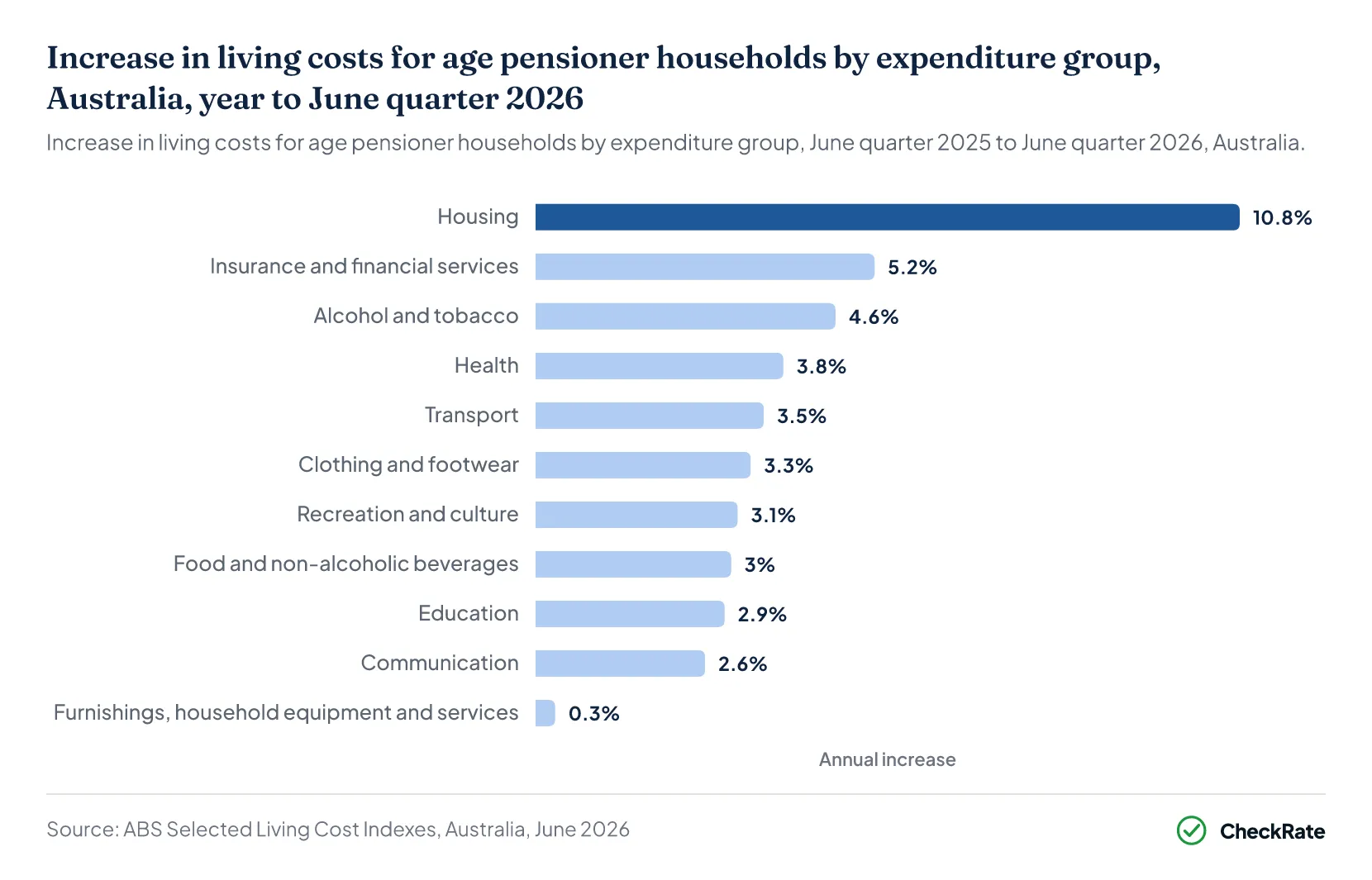
Living costs for age pensioner households rose 4.7% over the year to the June quarter 2026, compared with 3.8% for self-funded retiree households, according to Australian Bureau of Statistics (ABS) living cost data3. Housing recorded the largest increase among the 11 expenditure groups for age pensioner households, at 10.8%.
The Age Pension is indexed on 20 March and 20 September using the higher of movements in the Pensioner and Beneficiary Living Cost Index and the Consumer Price Index over six months3. Over the six months to the June quarter 2026, the Pensioner and Beneficiary Living Cost Index rose 3.2% and the Consumer Price Index rose 2.0%.
| Maximum Age Pension rates in Australia, from 20 September 2026 | |||
|---|---|---|---|
| Payment (A$ a fortnight) | Single | Couple, each | Couple, combined |
| Maximum basic rate | 1,135.402 | 855.90 | 1,711.80 |
| Pension Supplement | 88.20 | 66.50 | 133.00 |
| Energy Supplement | 14.10 | 10.60 | 21.20 |
| Total | 1,237.70 | 933.00 | 1,866.00 |
| Total a year | 32,180.20 | 24,258.00 | 48,516.00 |
Source · Services Australia, How much Age Pension you can get.
Savings outside super are covered in the average savings by age article.
Section 02 · Overseas prices
How do living costs in other countries compare with Australia's?
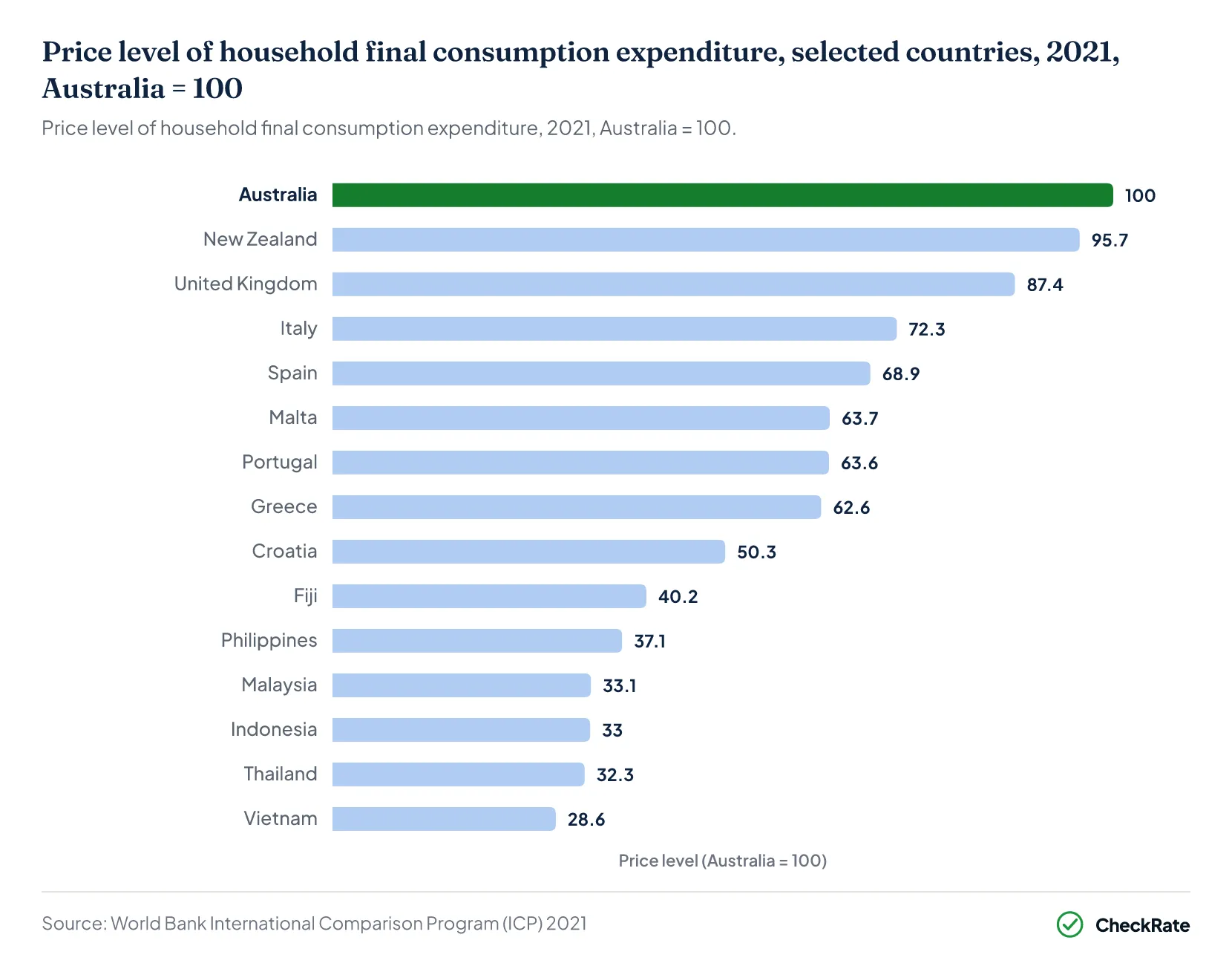
Household consumption prices in 2021 ranged from 28.6% of Australia's level in Vietnam to 95.7% in New Zealand among 14 selected countries, according to the World Bank International Comparison Program (ICP)4.
A price level compares what a common basket of goods and services costs in each country, converted at market exchange rates. Thailand's price level of 32.3 means a basket that cost A$100 in Australia cost the equivalent of A$32.30 in Thailand in 202145.
The six selected countries in Southeast Asia and the Pacific had price levels between 28.6 and 40.2, while the seven European countries ranged from 50.3 in Croatia to 87.4 in the United Kingdom4. Malaysia, Indonesia and Thailand had price levels of 33.1, 33.0 and 32.3 respectively. Because these values are close, the World Bank advises against ranking them strictly5.
Housing and utility price levels ranged from 10.1 in Thailand to 113.2 in New Zealand in 2021, a wider range than food price levels, which ran from 53.1 in Vietnam to 94.5 in New Zealand4.
As an illustrative example, household goods and services that cost A$40,000 a year in Australia would have cost about A$12,900 in Thailand in 2021, based on Thailand's price level of 32.3 (A$40,000 × 0.323). The calculation does not allow for changes in prices or exchange rates since 2021.
The Moneysmart rule of thumb is expressed as a share of working-life income, not as a price level1.
| Price levels by expenditure group, selected countries, 2021 (Australia = 100) | |||||
|---|---|---|---|---|---|
| Country | Agreement | Household consumption | Food | Housing | Restaurants |
| New Zealand | Yes | 95.74 | 94.5 | 113.2 | 92.5 |
| United Kingdom | No | 87.4 | 74.7 | 93.4 | 70.1 |
| Italy | Yes | 72.3 | 83.5 | 55.4 | 78.1 |
| Spain | Yes | 68.9 | 77.2 | 57.7 | 59.3 |
| Malta | Yes | 63.7 | 92.4 | 34.0 | 66.5 |
| Portugal | Yes | 63.6 | 80.0 | 45.3 | 50.1 |
| Greece | Yes | 62.6 | 84.0 | 39.4 | 62.3 |
| Croatia | Yes | 50.3 | 76.9 | 25.0 | 56.0 |
| Fiji | No | 40.2 | 63.7 | 16.9 | 46.7 |
| Philippines | No | 37.1 | 62.2 | 22.5 | 25.6 |
| Malaysia | No | 33.1 | 55.5 | 13.4 | 16.2 |
| Indonesia | No | 33.0 | 60.1 | 14.5 | 23.9 |
| Thailand | No | 32.3 | 57.3 | 10.1 | 22.2 |
| Vietnam | No | 28.64 | 53.1 | 14.6 | 19.2 |
Source · World Bank, International Comparison Program 2021; Department of Social Services, International social security agreements.
Section 03 · Age Pension
How does a part Age Pension combine with super overseas?
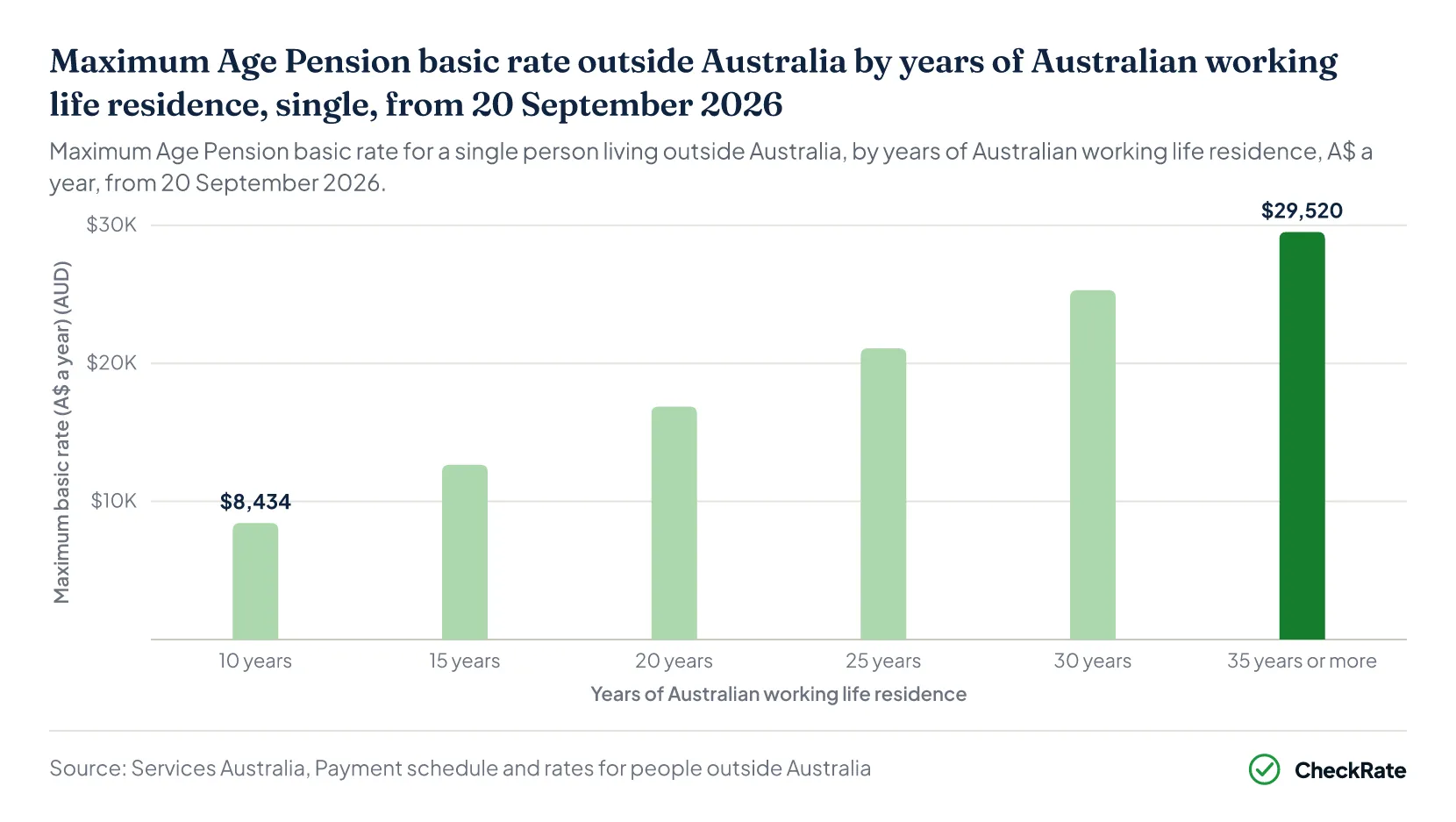
A single person living outside Australia can receive an Age Pension basic rate of up to A$29,520.40 a year6. A couple who are both eligible can receive up to A$44,506.80 combined, according to Services Australia.
Leaving Australia to live in another country stops the Pension Supplement and Energy Supplement and cancels the Pensioner Concession Card from the date of departure7.
After 26 weeks outside Australia, the Age Pension rate depends on a pensioner's Australian working life residence7. Australian working life residence is the time a person was an Australian resident between age 16 and Age Pension age, which is 678. A pensioner with 35 years or more generally keeps the full rate, while a pensioner with 10 years receives 10/35ths of the usual rate7.
Worked example · 25 years of Australian working life residence
This is an illustrative calculation based on the maximum basic rate for a single pensioner living outside Australia. A single pensioner with 25 years of Australian working life residence would receive up to 25/35ths of A$29,520.40, or A$21,086.00 a year, if the income and assets tests allowed the full rate6.
Super can reduce the pension once a person reaches Age Pension age, because super balances and some super payments may count under the income and assets tests9. A single homeowner living outside Australia can have assets of up to A$333,000 for the full pension, and the part pension is paid only when assets are below A$711,500, compared with A$745,750 for a single homeowner in Australia610.
Financial assets are deemed to earn 1.75% a year on the first A$66,800 for a single pensioner living overseas and 3.75% on amounts above that threshold6.
Australia has social security agreements with 32 countries, and a person living in one of them can claim the Age Pension from there11. A person living in a country without an agreement cannot claim the Age Pension from that country, and Services Australia states that a claim generally needs to be made before leaving Australia12.
Pensioners living outside Australia long term are paid every four weeks, in local currency or US dollars when the payment goes to a bank account outside Australia6.
| Age Pension rates and limits for pensioners living outside Australia, from 20 September 2026 | ||
|---|---|---|
| Rate or limit (A$) | Single | Couple, both eligible |
| Maximum basic rate | 29,520.406 | 44,506.80 |
| Full pension: income up to | 5,876.00 | 10,296.00 |
| Part pension: income less than | 64,916.80 | 99,309.60 |
| Full pension: assets up to, homeowner | 333,000 | 499,000 |
| Part pension: assets less than, homeowner | 711,500 | 1,070,000 |
| Full pension: assets up to, non-homeowner | 600,000 | 766,000 |
| Part pension: assets less than, non-homeowner | 978,500 | 1,337,000 |
| Deeming threshold | 66,800 | 110,600 |
Source · Services Australia, Payment schedule and rates for people outside Australia.
Section 04 · Drawing down
Can Australians access their super while living overseas?
Australians living overseas can access their super once they meet a condition of release, such as turning 65 or retiring after reaching preservation age, which is 60 for anyone born from 1 July 196413. Retiring overseas does not change these access conditions for Australian citizens and permanent residents.
The Australian Taxation Office (ATO) lists leaving Australia as an early-access ground only for temporary residents, through the departing Australia superannuation payment, and New Zealand citizens are not eligible for that payment1314.
Super paid from a taxed fund to a person aged 60 or older is not taxed in Australia, whether taken as a lump sum or an income stream, unless it includes an untaxed element15. Investment earnings on super in the retirement phase are also tax-free, up to the transfer balance cap of A$2.1 million from 1 July 202616.
The Age Pension, by contrast, is a taxable payment2.
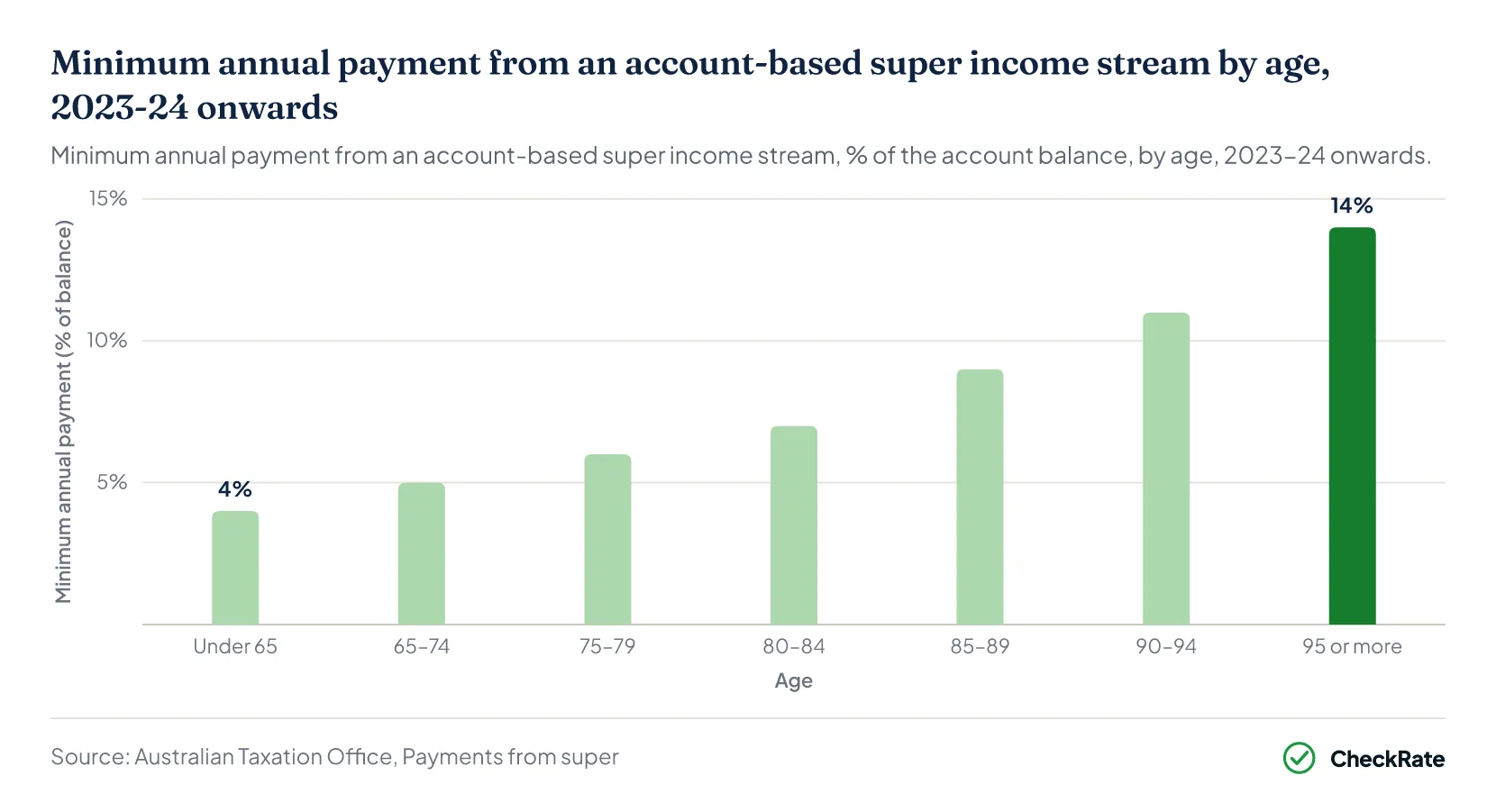
An account-based pension must pay out at least a minimum share of its balance each year, from 4% for people under 65 to 14% for people aged 95 or older17. The minimum resets each year based on the account balance at 1 July.
Worked example · A$400,000 account-based pension at age 67
This is an illustrative calculation based on the ATO minimum payment rates. A 67-year-old with a balance of A$400,000 at 1 July would need to draw at least 5% of it, or A$20,000, during that year, regardless of where they live17.
The cost of tax concessions on super is covered in the super tax concessions article.
Section 05 · Healthcare
What health care cover is available to Australians retiring overseas?
Medicare does not cover medical care outside Australia, but Australia has reciprocal health care agreements with 11 countries that can cover some medically necessary care for visitors18. The agreement countries are Belgium, Finland, Ireland, Italy, Malta, the Netherlands, New Zealand, Norway, Slovenia, Sweden and the United Kingdom19.
The agreement with Italy covers essential care that cannot wait until the person returns home, through the national health service, for up to six months after arrival20.
Health prices in 2021 ranged from 15.3% of Australia's level in Vietnam to 83.5% in the United Kingdom among the 14 selected countries4. The price levels include government-provided health care and do not measure access to care or its quality.
In Australia, health costs for age pensioner households rose 3.8% over the year to the June quarter 20263.
This article does not cover private health insurance premiums for Australians living abroad.

Section 06 · Currency
How does currency risk affect Australian retirement income overseas?
The Australian dollar bought between 0.5586 and 0.8578 euros at the end of each month from January 2010 to September 2026, according to the Reserve Bank of Australia (RBA)21. The lowest value was in June 2025 and the highest in July 2012.
The Australian dollar bought between US$0.6175 in March 2020 and US$1.0954 in July 2011, and bought US$0.6977 at the end of September 202621. Against the Thai baht, the value of A$1 ranged from 33.22 baht in July 2012 to 20.16 baht in March 2020.
Over the year to September 2026, the Australian dollar rose 9.3% against the euro, from 0.5626 to 0.6150, and 9.6% against the Thai baht, from 21.35 to 23.4121.
The Age Pension rates for people outside Australia are set in Australian dollars. Services Australia pays the pension in Australian dollars into an Australian bank account, or in local currency or US dollars into a bank account outside Australia, so its value in a destination's currency changes with exchange rates6. This is an example calculation using RBA month-end rates. The A$29,520.40 maximum overseas basic rate was equal to about €16,608 at the end of September 2025, compared with €18,155 at the end of September 202621.
Money transfer providers choose the exchange rate they use and charge fees. According to Moneysmart, the cost can vary by the amount transferred, destination and transfer method22.
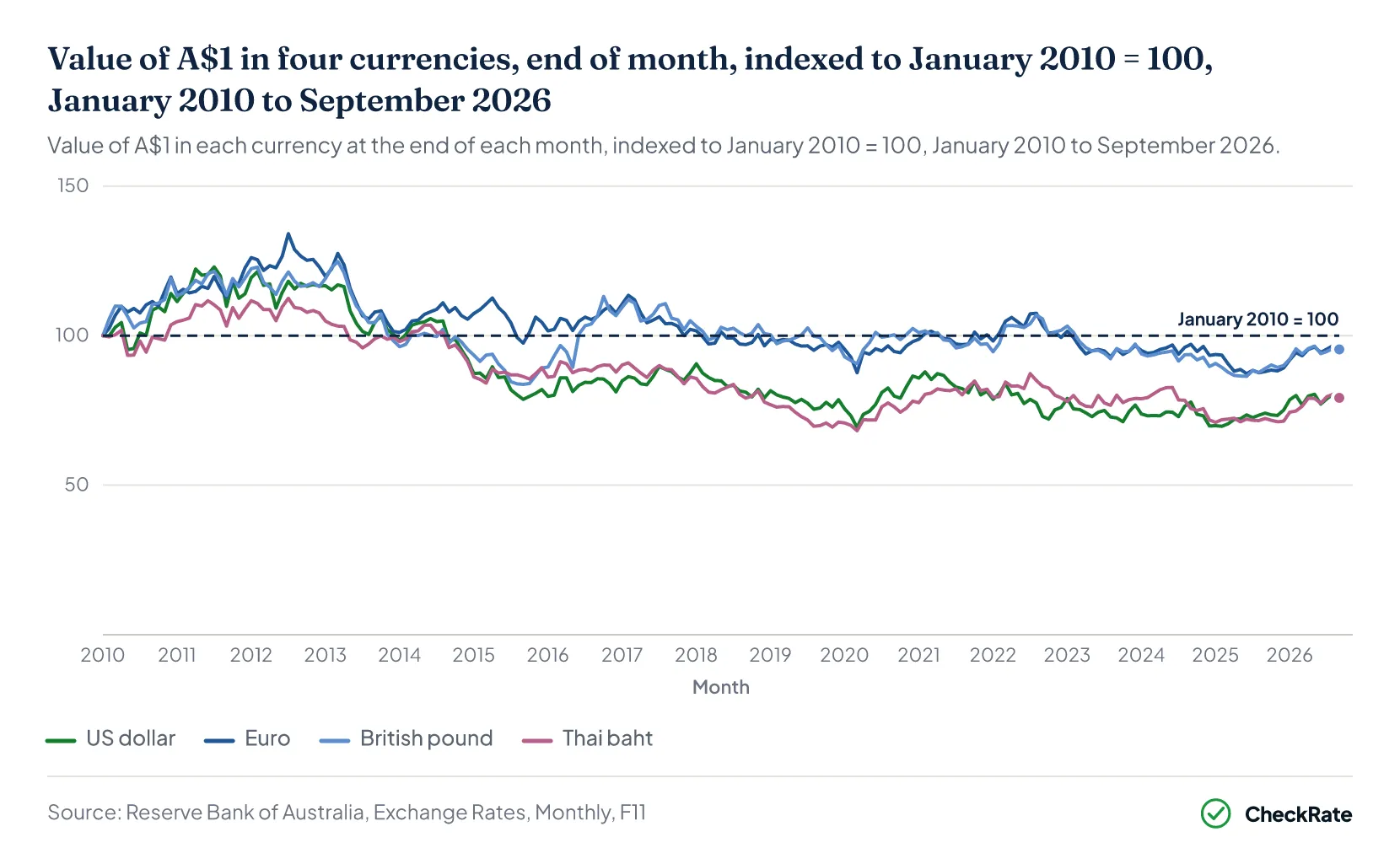
| Value of A$1 in selected currencies, end of month, January 2010 to September 2026 | |||||
|---|---|---|---|---|---|
| Currency | Lowest | Highest | September 2025 | September 2026 | Change (%) |
| US dollar | 0.6175 (March 2020) | 1.0954 (July 2011) | 0.6602 | 0.6977 | +5.7 |
| Euro | 0.5586 (June 2025) | 0.8578 (July 2012) | 0.5626 | 0.615021 | +9.3 |
| British pound | 0.4623 (September 2015) | 0.6890 (March 2013) | 0.4915 | 0.5267 | +7.2 |
| New Zealand dollar | 1.0195 (March 2015) | 1.3598 (April 2011) | 1.1410 | 1.2351 | +8.2 |
| Thai baht | 20.16 (March 2020) | 33.22 (July 2012) | 21.35 | 23.41 | +9.6 |
| Malaysian ringgit | 2.6525 (March 2020) | 3.4172 (July 2017) | 2.7834 | 2.8477 | +2.3 |
| Indonesian rupiah | 7,735 (June 2010) | 12,814 (May 2026) | 11,022 | 12,450 | +13.0 |
| Vietnamese dong | 14,583 (March 2020) | 22,560 (July 2011) | 17,445 | 18,119 | +3.9 |
Source · Reserve Bank of Australia, Exchange Rates, Monthly, F11.
Section 07 · Moneysmart planner
How does the Moneysmart retirement planner estimate retirement income?
The Moneysmart retirement planner starts from a retirement income target of A$2,917 a month for its default salary of A$50,000 a year, equal to 70% of that salary, and a default retirement age of 6723.
The planner works in three steps, covering a person's current position, the income needed and the options available23.
The assumed investment returns in the Moneysmart account-based pension calculator range from 4.3% a year for cash to 7.2% a year for high growth16. These are modelling assumptions, not forecasts. The return assumptions use the Willis Towers Watson Global Asset Model outlook at June 2026. The calculator assumes inflation of 2.5% a year, shows results in today's dollars and excludes the Age Pension.
The calculator's results are estimates based on assumptions, not predictions16.
An Age Pension paid overseas can be lower than an estimate for a pensioner living in Australia. Supplements stop when a pensioner moves abroad. After 26 weeks outside Australia, the rate is proportional for pensioners with fewer than 35 years of Australian working life residence7.
| Default assumptions in the Moneysmart account-based pension calculator, 2026 | |
|---|---|
| Investment option | Return (% a year) |
| Cash | 4.316 |
| Conservative | 5.616 |
| Moderate | 6.316 |
| Balanced | 6.716 |
| Growth | 6.916 |
| High growth | 7.216 |
Source · Moneysmart, Account-based pension calculator.
Section 08
Retiring overseas: quick answers
Can you get the Age Pension if you retire overseas?
The Age Pension can continue to be paid to a pensioner who moves to another country, and a person living in one of the 32 countries with a social security agreement with Australia can claim it from there11. A person living in a country without an agreement generally needs to claim before leaving Australia12.
How much Age Pension do you get if you live overseas?
The maximum Age Pension basic rate for a single person living outside Australia is A$29,520.40 a year from 20 September 2026, or A$44,506.80 combined for a couple who are both eligible6. After 26 weeks overseas, the rate is proportional for pensioners with fewer than 35 years of Australian working life residence, so a pensioner with 25 years of residence receives up to 25/35ths of the full rate7.
Can you access your super early if you move overseas permanently?
Moving overseas permanently does not give Australian citizens and permanent residents early access to super. Super generally remains subject to the usual conditions of release, such as retiring after reaching a preservation age of 60 for anyone born from 1 July 196413. The Australian Taxation Office allows early access on leaving Australia only for temporary residents, through the departing Australia superannuation payment.
Is super tax-free if you retire overseas?
Super paid from a taxed fund to a person aged 60 or older is not taxed in Australia, whether taken as a lump sum or an income stream, unless it includes an untaxed element15. Tax rules in the country where the person lives may differ and are not covered by these Australian rules.
Does Medicare cover Australians living overseas?
Medicare does not cover medical care outside Australia, and Services Australia advises travel insurance even for visits to the 11 countries with a reciprocal health care agreement18. Those agreements cover limited care for visitors. The level and duration of cover vary by country. For example, the agreement with Italy covers essential care through its national health service for up to six months after arrival20.
References
- Moneysmart (ASIC), Work out how much you need to retire · moneysmart.gov.au ↑ b c d
- Services Australia, How much Age Pension you can get (rates from 20 September 2026) · servicesaustralia.gov.au ↑ b c
- Australian Bureau of Statistics, Selected Living Cost Indexes, Australia, June 2026 · Australian Bureau of Statistics ↑ b c
- World Bank, International Comparison Program (ICP) 2021 database · databank.worldbank.org ↑ b c d e f g
- World Bank, ICP 2021 Frequently asked questions · thedocs.worldbank.org ↑ b c
- Services Australia, Payment schedule and rates for people outside Australia: Age Pension · servicesaustralia.gov.au ↑ b c d e f g h
- Services Australia, When you leave Australia if you get Age Pension · servicesaustralia.gov.au ↑ b c d e
- Services Australia, Who can get Age Pension · servicesaustralia.gov.au ↑
- Moneysmart (ASIC), Super and the Age Pension · moneysmart.gov.au ↑
- Services Australia, Assets test for Age Pension · servicesaustralia.gov.au ↑
- Department of Social Services, International social security agreements · dss.gov.au ↑ b c
- Services Australia, Retiring overseas · servicesaustralia.gov.au ↑ b
- Australian Taxation Office, Super withdrawal options · ato.gov.au ↑ b c
- Australian Taxation Office, How superannuation applies to temporary residents · ato.gov.au ↑
- Australian Taxation Office, Tax on super benefits · ato.gov.au ↑ b
- Moneysmart (ASIC), Account-based pension calculator · moneysmart.gov.au ↑ b c d e f g h i j k
- ATO, Key superannuation rates and thresholds: Payments from super · ato.gov.au ↑ b
- Services Australia, Health care planning when going overseas · servicesaustralia.gov.au ↑ b c
- Services Australia, Reciprocal Health Care Agreements: medical care when you travel to another country · servicesaustralia.gov.au ↑
- Services Australia, Reciprocal Health Care Agreement: visiting Italy · servicesaustralia.gov.au ↑ b c
- Reserve Bank of Australia, Exchange Rates: Statistical Table F11 (monthly) · Reserve Bank of Australia ↑ b c d e
- ASIC Moneysmart, Sending money overseas · moneysmart.gov.au ↑
- Moneysmart (ASIC), Retirement planner · moneysmart.gov.au ↑ b