


Published
 How overseas income and assets count in the Age Pension means testsAge Pension recipients have 14 days to report changes to their own or their partner's income or assets, including those held outside Australia. Changes can be reported online through a Centrelink onli…
 Selling an Australian home to buy overseas: how it affects the Age PensionProceeds from selling a principal home can be exempt from the Age Pension assets test for up to 24 months from settlement, provided they are intended to buy, build, rebuild, repair or renovate a new p…
 Keeping an Australian home after moving overseas: what happens to the Age PensionA principal home stops being exempt from the Age Pension assets test when its owner states they definitely do not intend to return. It also stops being exempt when a temporary absence for a reason oth…
Section 01 · Foreign residents
Can a foreign resident claim the main residence exemption after moving overseas?
A foreign resident for tax purposes who sells an Australian home after 30 June 2020 cannot claim the capital gains tax (CGT) main residence exemption, unless the life events test is met, according to the Australian Taxation Office (ATO)1. The exclusion applies even if the seller lived in the home as an Australian resident for part of the time they owned it.
Without the life events test, a foreign resident seller is also not entitled to a partial main residence exemption1. The rule that resets a home's cost base to its market value when it is first rented out also does not apply to a foreign resident seller who does not meet the life events test.
For an Australian resident seller, a home is fully exempt when three conditions are met2. The dwelling must have:
- been the home of the owner, their partner and other dependants for the whole period it was owned
- not been used to produce income, such as from rent or a business
- stood on land of 2 hectares or less.
A foreign resident seller's 50% CGT discount is reduced for periods of foreign residency3. For property acquired after 8 May 2012, a seller who was an Australian resident for only part of the ownership period can claim the discount only for the resident period.
Section 02 · Life events test
What is the life events test for the main residence exemption?
The life events test lets a foreign resident claim the main residence exemption only if they were a foreign resident for a continuous period of six years or less and experienced one of three specified life events during that period, according to the ATO1. The seller must also meet the general conditions for the exemption.
The three qualifying life events are:1
- the seller, their spouse or their child under 18 had a terminal medical condition
- the seller's spouse or child under 18 died
- the sale happened because of a formal agreement following the breakdown of the seller's marriage or relationship.
Retirement overseas is not a qualifying life event. A foreign resident retiring overseas can therefore meet the test only if one of these three events occurred during a continuous period of foreign residency of six years or less1.
A seller who meets the test can also use the exemption as a reason to apply for a variation of the foreign resident capital gains withholding on the sale1.
A transitional rule for homes acquired before 7:30 pm Canberra time on 9 May 2017 allowed foreign residents to claim the exemption without the life events test, but only for homes disposed of by 30 June 20201.
Section 03 · Timing
Which date decides whether a home sale is exempt from capital gains tax?
The seller's tax residency on the date the sale contract is signed decides whether the main residence exemption can apply. The ATO treats a home sold under a contract as disposed of when the contract is signed1. Where there is no contract, the disposal time is settlement.
A home sold under a contract signed while the owner is still an Australian resident can qualify for the exemption1. The same home sold under a contract signed after the owner becomes a foreign resident cannot, unless the life events test is met.
When a person stops being an Australian resident, assets that are not taxable Australian property are treated as sold at market value on that date for CGT purposes5. Australian real estate is taxable Australian property, so the CGT event for the home occurs only when it is sold.
Under the ATO's residency guidance, an individual who goes overseas temporarily and does not set up a permanent home in another country is still an Australian resident for tax purposes6.
For contracts signed from 1 January 2025, the buyer must withhold 15% of the price of Australian property and pay it to the ATO, unless the seller provides a clearance certificate or a variation notice6. From 1 July 2017 to 31 December 2024, the rate was 12.5% and applied only to property valued at $750,000 or more.
| Main residence exemption and withholding by the seller's tax residency at the contract date, Australia | ||
|---|---|---|
| Seller's tax residency when the contract is signed | Main residence exemption | Withholding at settlement |
| Australian resident | Available, in full or in part, if the conditions are met | None if a clearance certificate is given to the buyer, otherwise 15% |
| Foreign resident, life events test met | Available if the general conditions are also met | 15%, unless a variation notice sets a lower rate6 |
| Foreign resident, life events test not met | Not available, including any partial exemption1 | 15%, unless a variation notice sets a lower rate |
Source · ATO, Main residence exemption for foreign residents; ATO, Foreign resident capital gains withholding overview.
Section 04 · Assets test
How do the Age Pension assets test limits differ for homeowners and non-homeowners?
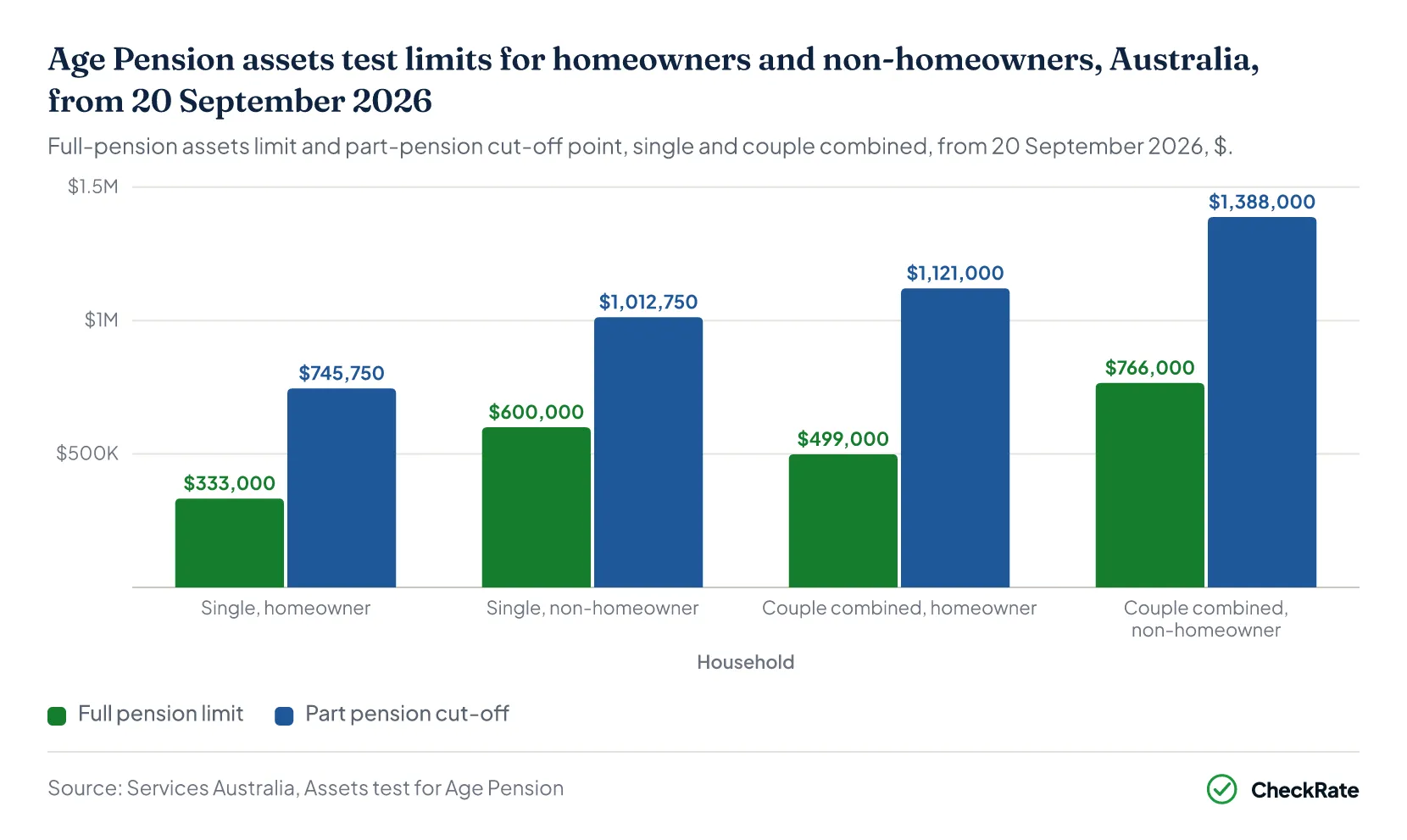
A single non-homeowner can have up to $600,000 of assessable assets and still receive the full Age Pension from 20 September 2026, compared with $333,000 for a single homeowner, according to Services Australia7.
For a couple, the combined full-pension limits are $499,000 for homeowners and $766,000 for non-homeowners7. A part Age Pension stops once assets reach $745,750 for a single homeowner or $1,012,750 for a single non-homeowner. For couples, the combined cut-off points are $1,121,000 for homeowners and $1,388,000 for non-homeowners. Each non-homeowner amount is $267,000 higher than the matching homeowner amount.
The principal home, and up to 2 hectares of its land, is not counted in the assets test8. People who are not homeowners can have a higher value of assets before their pension is reduced or cancelled9.
A pensioner who sells the home without intending to use the proceeds to buy, build, rebuild, repair or renovate a new principal home becomes a non-homeowner, and the sale proceeds are counted as assets9.
For homes sold from 1 January 2023, proceeds intended for a new principal home can instead be excluded from the assets test for up to 24 months after settlement10. The seller continues to be treated as a homeowner during this period. The exemption can run to 36 months where delays beyond the seller's control meet the extension criteria.
The pension falls by $3 a fortnight for each $1,000 of assets above the full-pension limit11. The pension paid is the lower of the rates under the assets test and the income test.
The assets test also counts assets held outside Australia7.
How many Australians own their home is covered in Australian home ownership statistics.
Section 05 · Deeming
How are home sale proceeds treated under the Age Pension deeming rules?
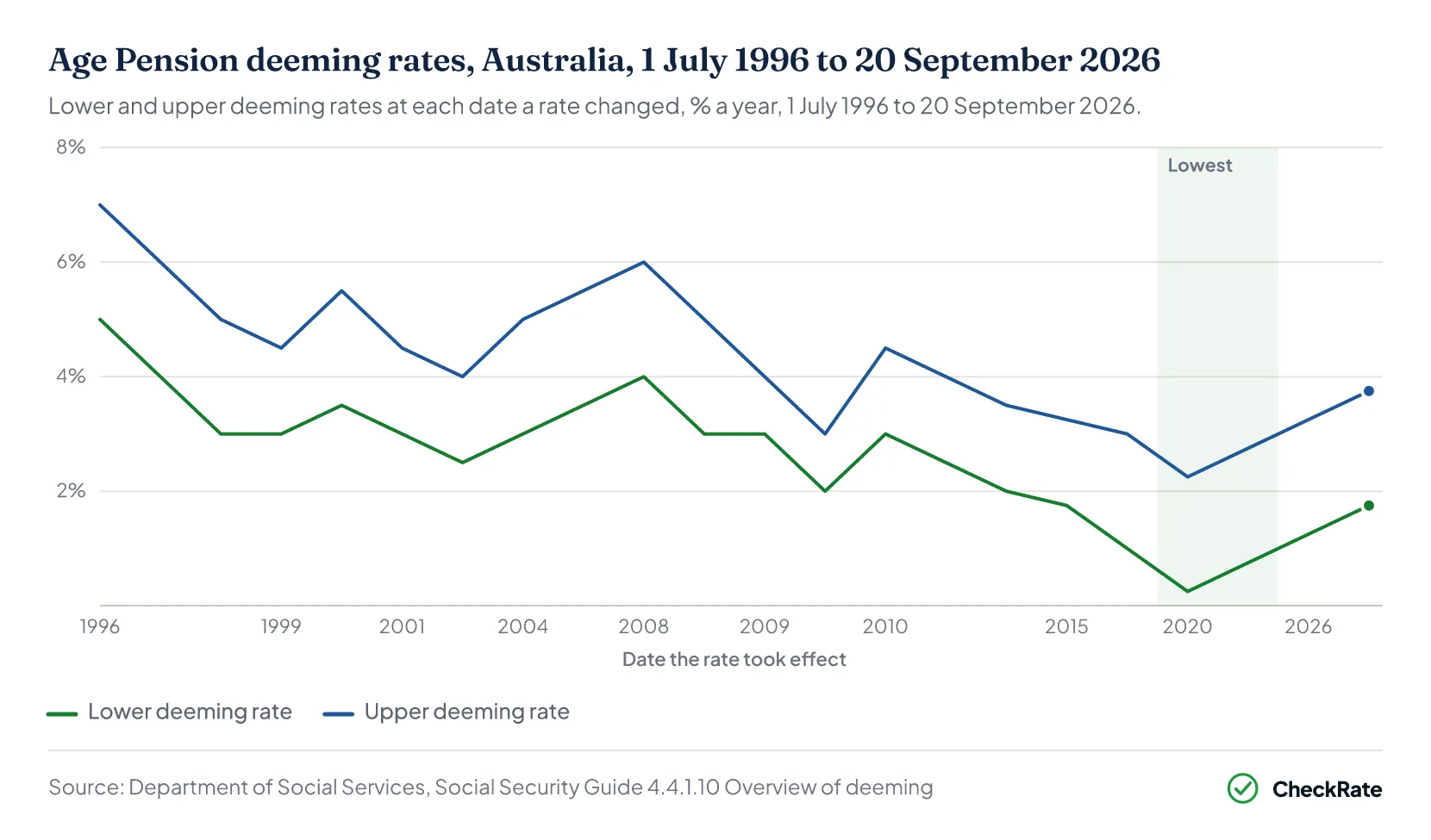
Home sale proceeds kept in a bank account or other financial investment are treated as earning income under the Age Pension deeming rules, regardless of the income they actually earn10. From 20 September 2026, a single pensioner's financial assets are deemed to earn 1.75% a year on the first $66,800 and 3.75% on the amount above it, according to Services Australia12.
For a couple where at least one member receives a pension, the 1.75% rate applies to the first $110,600 of combined financial assets12.
For homes sold from 1 January 2023, proceeds intended for a new principal home are deemed at the lower rate only while they are exempt from the assets test1012. The lower rate is 1.75% from 20 September 202613. Any other proceeds held in a financial asset are deemed at the regular rates12.
This deemed income is then added to any other income under the Age Pension income test. A single pensioner's fortnightly rate falls by 50 cents for each dollar of income above $226 a fortnight, and for a couple, each member's rate falls by 25 cents for each dollar of combined income above $396 a fortnight14. Services Australia notes that the income cut-off point may be lower for a person who does not live in Australia.
The period from 1 May 2020 to 19 September 2025 had the lowest deeming rates shown in the Department of Social Services data dating back to 1 July 1996, at 0.25% and 2.25%13. Both rates rose by 1.5 percentage points over three increases from 20 September 2025 to 20 September 2026, reaching 1.75% and 3.75%.
| Age Pension deeming thresholds and rates, Australia, from 20 September 2026 | |||
|---|---|---|---|
| Situation | Threshold | Rate up to the threshold | Rate above the threshold |
| Single pensioner | $66,80012 | 1.75% | 3.75% |
| Couple, at least one receiving a pension (combined) | $110,60012 | 1.75% | 3.75% |
| Member of a couple, neither receiving a pension (each) | $55,30012 | 1.75% | 3.75% |
Source · Services Australia, Deeming.
Section 06 · Worked example
How much can selling the home change a single person's Age Pension?
In an illustrative calculation, selling a $600,000 home without intending to use the proceeds for a new principal home reduces a single pensioner's Age Pension from $1,232.16 to $637.70 a fortnight under the rates from 20 September 202611. This is a reduction of $594.46 a fortnight, with the assets test producing the lower pension rate after the sale.
Worked example · $600,000 home sale by a single pensioner
This example uses Age Pension rates, assets limits and deeming rates from 20 September 2026. It assumes a single person living in Australia, on the standard rules, with $200,000 of financial assets as well as the home, who sells the home for $600,000 and does not intend to use the proceeds for a new principal home. Selling costs, the Work Bonus, Rent Assistance and any pension from another country are not included.
Before the home is sold, the $200,000 of financial assets is below the $333,000 homeowner limit, so the assets test does not reduce the pension7. Deemed income is $6,164 a year, or $237.08 a fortnight12. This is $11.08 above the $226 fortnightly income-free area, reducing the pension by $5.54 to $1,232.16 a fortnight14.
After the home is sold, the person is a non-homeowner with $800,000 of financial assets. This is $200,000 above the $600,000 full-pension assets limit for a single non-homeowner7. The assets test therefore reduces the maximum fortnightly pension of $1,237.7015 by $600, leaving $637.70 a fortnight11.
Deemed income rises to $28,664 a year, or $1,102.46 a fortnight12. Under the income test, this would reduce the pension to $799.47 a fortnight1412.
The lower result from the two tests applies, so the pension in this example is $637.70 a fortnight11.
| Illustrative Age Pension for a single pensioner before and after a $600,000 home sale, from 20 September 2026 | ||
|---|---|---|
| Step | Before the sale | After the sale |
| Homeowner status | Homeowner | Non-homeowner |
| Assessable financial assets | $200,000 | $800,000 |
| Full-pension assets limit | $333,0007 | $600,0007 |
| Fortnightly rate under the assets test | $1,237.7015 | $637.70 |
| Deemed income a year | $6,164.00 | $28,664.00 |
| Deemed income a fortnight | $237.08 | $1,102.46 |
| Fortnightly rate under the income test | $1,232.16 | $799.47 |
| Fortnightly pension paid, the lower of the two rates | $1,232.16 | $637.70 |
Source · Services Australia; Department of Social Services, Social Security Guide 4.2.3.
How net worth and assets are spread across Australian households is covered in Australian wealth statistics.
Section 07 · Renting it out
What happens to tax and the Age Pension if the home is rented out?
A home kept and rented out can remain the principal home for the Age Pension assets test for up to 12 months after the owner moves out16. During that time, the owner is still treated as a homeowner, even if the absence is expected to last longer.
After 12 months, the home is no longer the principal home and its market value is counted as an asset16.
The 12 months can be extended for a person overseas who is unable to return because of circumstances beyond their control16.
Services Australia counts rent from a former principal home as income8.
Services Australia values real estate at current market value, which can differ from state and local government valuations8.
A foreign resident's taxable income, including net rent, is taxed at foreign resident rates. For 2025–26, the latest year listed in the ATO data, the rate was 30% on taxable income up to $135,000, with no tax-free threshold17. Foreign residents do not pay the Medicare levy.
A rented-out home is still subject to the foreign resident main residence exemption rules when it is later sold. The 6-year rule can let an owner treat a rented-out former home as their main residence for up to six years after moving out18. However, a foreign resident seller generally cannot use the main residence exemption unless the life events test is met1.
An owner who returns to Australia and becomes a resident again before signing a sale contract is not affected by the foreign resident exclusion1. The 6-year rule can then apply to the period the home was rented out if its conditions are met18.
| Selling before leaving Australia compared with keeping and renting the home, by rule | ||
|---|---|---|
| Rule | Home sold while an Australian resident | Home kept and rented out |
| Capital gains tax on the home | Main residence exemption can apply | No exemption on a later sale as a foreign resident, unless the life events test is met |
| Withholding at settlement | None with a clearance certificate | 15% on a later sale as a foreign resident, unless a variation notice applies6 |
| Age Pension assets test | Proceeds counted, with non-homeowner limits, unless intended for a new home | Home exempt for up to 12 months of absence, then counted at market value16 |
| Age Pension income test | Proceeds deemed at 1.75% and 3.75%, or at 1.75% only while exempt as intended for a new home12 | Rent counted as income |
Source · ATO; Services Australia; Department of Social Services, Social Security Guide 4.6.3.60.
Tax rates, deductions and the 6-year rule for a rented home are covered in Renting out an Australian home while living overseas.
Section 08
Selling a home to move overseas: quick answers
Do foreign residents pay capital gains tax on their former home in Australia?
A seller who is a foreign resident for tax purposes when the sale contract is signed generally cannot claim the main residence exemption on an Australian home unless the life events test is met, according to the Australian Taxation Office. A partial exemption for the years the home was lived in as an Australian resident is not available either.
Does selling the family home affect the Age Pension?
Selling the home can reduce the Age Pension, because proceeds not intended for a new principal home are generally counted as assets and deemed to earn income. From 20 September 2026, the full-pension assets limit for a single non-homeowner is $600,000, compared with $333,000 for a single homeowner7.
How long are home sale proceeds exempt from the Age Pension assets test?
For homes sold from 1 January 2023, proceeds a pensioner intends to use for a new principal home can be exempt from the assets test for up to 24 months from settlement, and for up to 36 months if the extension criteria for delays beyond their control are met. The exempt proceeds are still deemed under the income test, at the lower deeming rate only.
What are the Age Pension deeming rates?
From 20 September 2026, a single pensioner's financial assets are deemed to earn 1.75% a year on the first $66,800 and 3.75% on the amount above it12. For a couple where at least one member receives a pension, the 1.75% rate applies to the first $110,600 of combined financial assets.
Is tax withheld when a foreign resident sells an Australian home?
For contracts signed from 1 January 2025, the buyer generally withholds 15% of the sale price when a foreign resident sells Australian property and pays it to the Australian Taxation Office at settlement6. A variation notice can set a lower rate, and the 15% rate applies to property of any value.
Does the 6-year rule apply to a home sold while living overseas?
The 6-year rule generally does not help a seller who is a foreign resident for tax purposes when the sale contract is signed, because the main residence exemption is generally unavailable unless the life events test is met. A seller who becomes an Australian resident again at the contract date can use the 6-year rule if its conditions are met.
References
- ATO, Main residence exemption for foreign residents · ato.gov.au ↑ b c d e f g h i j k l m n
- ATO, Eligibility for main residence exemption · ato.gov.au ↑
- ATO, CGT discount for foreign residents · ato.gov.au ↑
- ATO, Australian residents and clearance certificates · ato.gov.au ↑ b
- ATO, How changing residency affects CGT (QC66059) · ato.gov.au ↑
- ATO, Foreign resident capital gains withholding overview · ato.gov.au ↑ b c d e f
- Services Australia, Assets test for Age Pension · servicesaustralia.gov.au ↑ b c d e f g h
- Services Australia, Real estate assets · servicesaustralia.gov.au ↑ b c
- Department of Social Services, Social Security Guide 4.6.3.20 Determining homeowners and non-homeowners · guides.dss.gov.au ↑ b
- Department of Social Services, Social Security Guide 4.6.3.90 Exempting the principal home: sale proceeds · guides.dss.gov.au ↑ b c d
- Department of Social Services, Social Security Guide 4.2.3 Pensions and benefits assets tests · guides.dss.gov.au ↑ b c d
- Services Australia, Deeming (Age Pension) · servicesaustralia.gov.au ↑ b c d e f g h i j k l
- Department of Social Services, Social Security Guide 4.4.1.10 Overview of deeming · guides.dss.gov.au ↑ b
- Services Australia, Income test for Age Pension · servicesaustralia.gov.au ↑ b c
- Services Australia, How much Age Pension you can get (rates from 20 September 2026) · servicesaustralia.gov.au ↑ b
- Department of Social Services, Social Security Guide 4.6.3.60 Exempting the principal home - temporary vacation of property · guides.dss.gov.au ↑ b c d e
- ATO, Tax rates: foreign residents · ato.gov.au ↑
- ATO, Treating former home as main residence (QC66030) · ato.gov.au ↑ b