

Published
 Selling a home to retire overseas: capital gains tax and the Age PensionA foreign resident for tax purposes who sells an Australian home after 30 June 2020 cannot claim the capital gains tax (CGT) main residence exemption, unless the life events test is met, according to…
 Keeping an Australian home after moving overseas: what happens to the Age PensionA principal home stops being exempt from the Age Pension assets test when its owner states they definitely do not intend to return. It also stops being exempt when a temporary absence for a reason oth…
 Married to a non-Australian: how a partner's income and assets affect the Age PensionA person is assessed as a member of a couple for the Age Pension if they are legally married, in a registered relationship or in a de facto relationship, providing they have not permanently separated,…
Section 01 · Sale proceeds exemption
How long are home sale proceeds exempt from the Age Pension assets test?
Proceeds from selling a principal home can be exempt from the Age Pension assets test for up to 24 months from settlement, provided they are intended to buy, build, rebuild, repair or renovate a new principal home. This applies to homes sold on or after 1 January 2023, according to the Department of Social Services (DSS) Social Security Guide1.
The exemption can be extended to a maximum of 36 months where the extension criteria are met1.
The seller continues to be assessed as a homeowner during the exemption period1.
The exemption ends when the new home is bought, or its building or renovation is complete, or the seller no longer intends to use the proceeds for a new home, whichever happens first1.
Three conditions must be met for an extension beyond 24 months:
- The seller must have made reasonable attempts to buy, build, rebuild, repair or renovate the new home, supported by documents such as a signed contract of sale, a building contract or an accepted quotation1
- These attempts must have started within 12 months from the date of sale1
- The delays must be beyond the seller's control, such as delays in the building industry1.
All three conditions must be met for the extension to apply1.
| Age Pension sale proceeds exemption timeline, homes sold on or after 1 January 2023 | |
|---|---|
| Step | Timing |
| Exemption and homeowner status start | At settlement |
| First attempts to buy, build or renovate, for any extension | Within 12 months of the date of sale |
| Standard exemption period | Up to 24 months |
| Maximum period with an extension | 36 months1 |
| Lower deeming rate on proceeds intended for the new home | While the exemption applies |
Source · DSS, Social Security Guide 4.6.3.90
Section 02 · Deeming
How are home sale proceeds deemed under the Age Pension income test?
Home sale proceeds that are exempt from the Age Pension assets test are still assessed under the income test using deeming rates1. For homes sold on or after 1 January 2023, only the lower deeming rate applies to those proceeds during the exemption period. Services Australia lists the lower deeming rate as 1.75%2.
Proceeds not intended for the new home and held in a financial asset are assessed using the standard deeming rates3.
Deemed income is added to other income under the Age Pension income test2. For a single pensioner, income above the income-free area reduces the pension by 50 cents for every dollar above that limit4. For a couple, each partner's pension is reduced by 25 cents for every dollar above the combined income-free area.
Worked example · $500,000 of sale proceeds, single pensioner
This example assumes a single pensioner has no other financial assets and holds $500,000 in a bank account from the sale of their home. All the proceeds are intended to buy a new principal home. At the lower deeming rate of 1.75%, the $500,000 would produce deemed income of $8,750 a year2.
If the same $500,000 were deemed at the regular rates, deemed income would be $17,414 a year, made up of $1,169 on the first $66,800 and $16,245 on the remaining $433,2002. How much either amount changes the pension depends on the pensioner's other income and the income-free area4.
| Age Pension deeming rates and thresholds for financial assets | |||
|---|---|---|---|
| Situation | Lower rate applies to the first | Lower rate | Upper rate |
| Single | $66,8002 | 1.75% | 3.75%2 |
| Couple, at least one partner receives a pension (combined) | $110,6002 | 1.75% | 3.75% |
| Couple, neither partner receives a pension (each) | $55,3002 | 1.75% | 3.75% |
Source · Services Australia, Deeming (Age Pension)
Section 03 · Principal home
What counts as a principal home for the Age Pension assets test?
The principal home is generally the home where a person or a couple lives for most of the time each year5. Services Australia describes it as the home a person lives in and the first two hectares of land it is on, provided the land is held under a single title3.
For a person who owns more than one home, the principal home is the one where the person spends the most time, or the most expensive home if they spend equal time in each5. The other home is assessed as an asset even if the person lives there for part of the year.
A home generally remains exempt from the assets test during a temporary absence of up to 12 months, even if the person expects to be away for longer6. This period may be extended if the person is overseas and cannot return because of circumstances beyond their control.
An absence is generally considered temporary unless the person has a definite intention not to return6. A home that the person does not intend to return to is counted as an asset, and the person is assessed under the higher non-homeowner assets test limits.
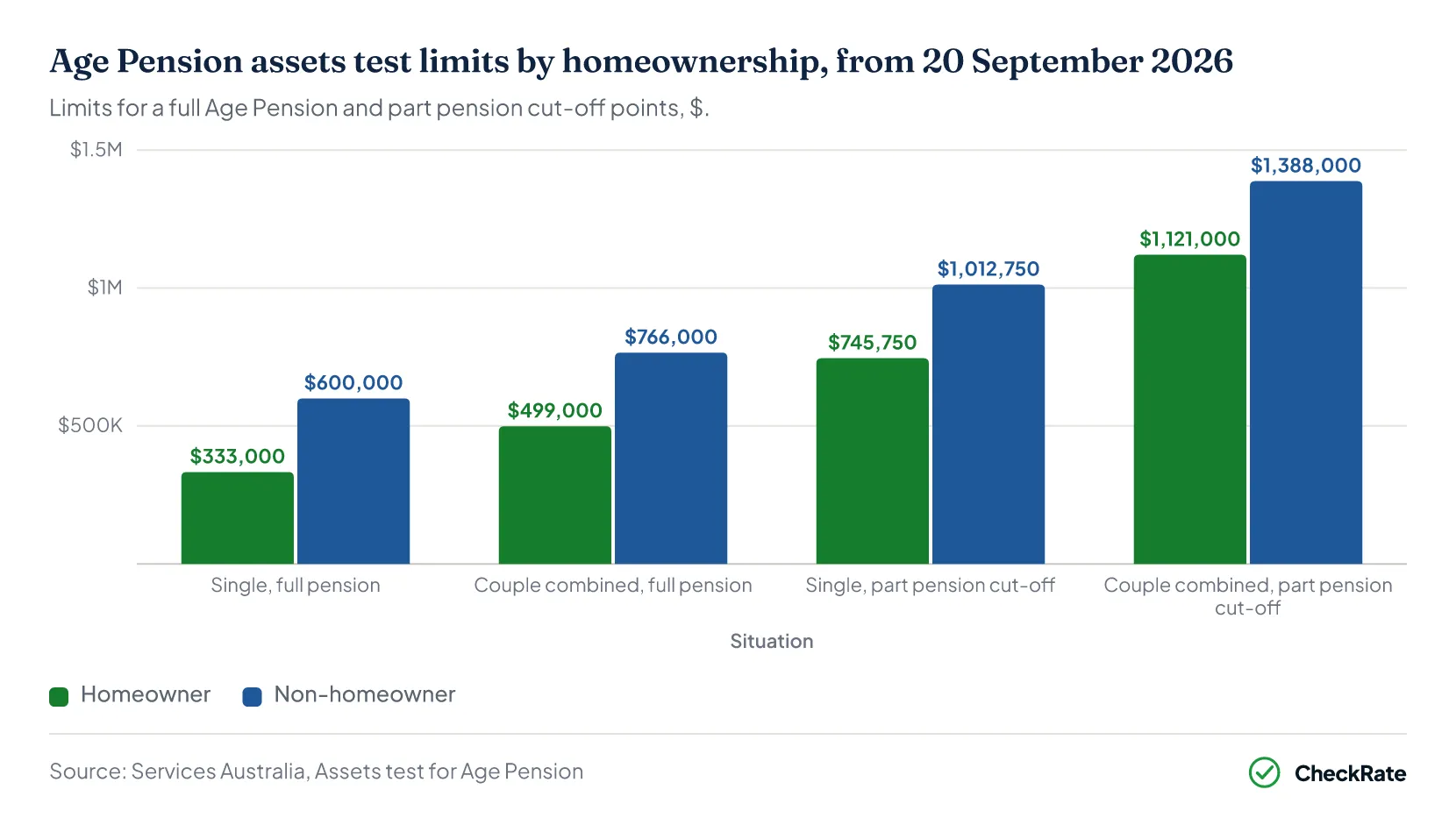
From 20 September 2026, the Age Pension assets test limits for non-homeowners are $267,000 higher than the corresponding homeowner limits7. A single homeowner can have assets of up to $333,000 for a full Age Pension, compared with $600,000 for a single non-homeowner.
Home ownership rates across Australia are covered in Australian home ownership statistics.
Section 04 · Overseas assets
How do overseas assets count in the Age Pension assets test?
Assets held outside Australia are included in the Age Pension assets test7. This includes overseas financial investments and shares8.
Services Australia excludes a person's principal home from the assets test but counts other property they own, including property that is rented out, left vacant or used as another residence3.
Assets and income in another country are converted to Australian dollars using the Commonwealth Bank buying rate for most currencies9.
Financial investments held outside Australia are deemed using their gross value after conversion to Australian dollars10. Income from outside Australia, including foreign pensions, employment, business and rental income, is generally assessed before tax. However, an international social security agreement may change how certain income is treated11.
For Age Pension purposes, a couple generally includes people who are married, in a registered relationship or in a de facto relationship, provided they are not permanently separated12.
For a couple, the Age Pension assets test limit applies to both partners' combined assets, including assets held outside Australia7.
Household assets and net worth across Australia are covered in Australian wealth statistics.
Section 05 · The overseas question
Does the Age Pension sale proceeds exemption apply to a home bought outside Australia?
The published guidance from the Department of Social Services (DSS) and Services Australia does not confirm whether the Age Pension sale proceeds exemption applies when a person buys a home overseas1.
The DSS definition of a principal home does not specify that the home must be in Australia. However, this does not establish whether a home bought overseas qualifies for the exemption5.
If the exemption does not apply, sale proceeds held in a bank account or other financial asset are included in the assets test and assessed using the standard deeming rates3.
A seller who does not intend to use the proceeds to buy a new principal home is assessed as a non-homeowner13.
Section 06 · Questions to ask
What contact and review options does Services Australia list for a move overseas?
Written enquiries about the Age Pension and a move outside Australia can be sent to Centrelink International Services by post to PO Box 7809, Canberra BC ACT 2610, or by fax on +61 2 6124 881314. The service can also be called on 131 673 from within Australia, and it lists country-specific numbers for callers outside Australia15.
Services Australia requires Age Pension recipients to report the sale of a home within 14 days2.
Services Australia can be asked to explain a decision about Centrelink payments, and a decision can be formally reviewed16.
How the published rules apply to six common questions about buying a home overseas:
Can a home bought outside Australia be the new principal home for the sale proceeds exemption?
The published rules describe a new principal home without stating where it must be.
Will the proceeds be deemed at the lower rate while an overseas purchase is under way?
The lower rate applies only while the assets test exemption applies.
Which overseas documents count as reasonable attempts for an extension beyond 24 months?
The DSS Social Security Guide lists contracts of sale, building contracts and accepted quotations, with documentary evidence.
Will homeowner status continue during the exemption while living outside Australia?
A seller using the exemption is assessed as a homeowner, so the lower homeowner limit applies.
How will an overseas home and other overseas assets be valued and converted to Australian dollars?
Services Australia converts foreign assets to Australian dollars using the Commonwealth Bank buying rate for most currencies.
How will moving outside Australia affect the Age Pension payment itself?
Travel or a move outside Australia can affect Centrelink payments separately from the assets test15.
Section 07 · Selling after leaving
How do clearance certificates and foreign resident capital gains withholding work after leaving Australia?
For contracts signed from 1 January 2025, buyers of Australian property, including homes, must generally withhold 15% of the purchase price unless the seller provides an Australian Taxation Office (ATO) clearance certificate at or before settlement, or an ATO variation notice reduces the withholding rate17.
A clearance certificate confirms the seller's Australian residency for tax purposes17. Applications are free and can take up to 28 days to process. A certificate is valid for 12 months from its date of issue as long as the seller's residency status does not change.
A seller who has become a foreign resident for tax purposes is subject to the 15% withholding rate unless the ATO approves a lower rate through a variation notice18.
Residency for tax purposes is assessed differently from residency for social security purposes17.
| Foreign resident capital gains withholding rates, by date the property contract was signed | ||
|---|---|---|
| Contract signed | Withholding rate | Property it applies to |
| On or after 1 January 2025 | 15%19 | All property |
| 1 July 2017 to 31 December 2024 | 12.5%19 | Property valued at $750,000 or more |
| 1 July 2016 to 30 June 2017 | 10%19 | Real property valued at $2 million or more |
Source · ATO, Foreign resident capital gains withholding overview
Section 08 · CGT timing
How does sale timing affect capital gains tax on a home when leaving Australia?
A seller who is a foreign resident for tax purposes when the sale contract is signed cannot claim the capital gains tax (CGT) main residence exemption on an Australian home sold under a contract signed after 30 June 2020, according to the ATO20.
The exemption is unavailable even if the seller was an Australian resident for part of the time the home was owned. A partial exemption for those years is also unavailable under this rule20.
For a sale under a contract, the ATO uses the date the contract is signed, rather than the settlement date, to determine when the property is sold for CGT purposes.20 The seller's tax residency on that date therefore affects eligibility for the main residence exemption. The Age Pension sale proceeds exemption uses a different date and begins at settlement1.
An Australian resident's home is generally exempt from CGT where it has been the home for the whole ownership period, has not been used to produce income and is on land of two hectares or less21.
A foreign resident can claim the exemption under the life events test where both conditions are met:
- the seller was a foreign resident for tax purposes for a continuous period of six years or less20
- during that period, the seller, their spouse or their child under 18 had a terminal medical condition, the spouse or child under 18 died, or the sale followed a formal agreement after a marriage or relationship breakdown20.
When a person ceases to be an Australian resident for tax purposes, certain assets are treated as though they have been sold at market value. However, this generally does not apply to Australian real estate22.
Leaving Australia does not trigger a CGT event for a home in Australia, because the home is taxable Australian property23. A CGT event happens when the home is sold2223. The full 50% CGT discount is not available on an asset acquired after 8 May 2012 and sold after the owner became a foreign resident, though a partial discount may apply22.
| The date each rule uses when an Australian home is sold | ||
|---|---|---|
| Rule | Date that counts | Agency |
| CGT main residence exemption: residency of the seller | Date the contract is entered into | ATO |
| Foreign resident capital gains withholding rate | Date the contract is signed | ATO |
| Clearance certificate given to the buyer | At or before settlement, within 12 months of issue | ATO |
| Age Pension sale proceeds exemption start | Settlement | Services Australia |
| Extension test: first attempts to buy or build | Within 12 months of the date of sale | Services Australia |
| Reporting the sale | Within 14 days of the sale | Services Australia |
Source · ATO, Main residence exemption for foreign residents; ATO, Foreign resident capital gains withholding overview; ATO, Australian residents and clearance certificates; DSS, Social Security Guide 4.6.3.90; Services Australia, Deeming (Age Pension)
Section 09
Selling a home to buy overseas: quick answers
Are proceeds from selling a home exempt from the Age Pension assets test?
Proceeds from selling a principal home can be exempt from the Age Pension assets test for up to 24 months from settlement, or up to 36 months with an extension, for homes sold on or after 1 January 2023. Only the part of the proceeds intended for a new principal home is exempt.
Is a home outside Australia covered by the Age Pension sale proceeds exemption?
The Department of Social Services and Services Australia guidance on the Age Pension sale proceeds exemption does not state whether a home bought outside Australia can be treated as the new principal home. The published rules neither confirm nor rule out the exemption for an overseas purchase.
What deeming rate applies to home sale proceeds?
Proceeds intended for a new principal home are deemed at the lower deeming rate, listed by Services Australia as 1.75%, during the assets test exemption for homes sold on or after 1 January 2023. Proceeds not intended for the new home are deemed at the regular rates.
Can a foreign resident claim the CGT main residence exemption on an Australian home?
A foreign resident for tax purposes generally cannot claim the main residence exemption for property sold after 30 June 2020 unless the life events test is met. For a sale under a contract, the Australian Taxation Office treats the contract date as the time of disposal.
Is a clearance certificate needed to sell a home in Australia?
An Australian resident for tax purposes needs a clearance certificate from the Australian Taxation Office, given to the buyer at or before settlement, to avoid 15% of the sale price being withheld for contracts signed from 1 January 2025. Applications are free and can take up to 28 days to process.
References
- Department of Social Services, Social Security Guide 4.6.3.90 Exempting the principal home: sale proceeds · guides.dss.gov.au ↑ b c d e f g h i j k l m
- Services Australia, Deeming (Age Pension) · servicesaustralia.gov.au ↑ b c d e f g h i
- Services Australia, Real estate assets · servicesaustralia.gov.au ↑ b c d e
- DSS, Social Security Guide 4.2.1.10 Pensions income test · guides.dss.gov.au ↑ b
- DSS, Social Security Guide 4.6.3.30 Defining the principal home · guides.dss.gov.au ↑ b c
- Department of Social Services, Social Security Guide 4.6.3.60 Exempting the principal home - temporary vacation of property · guides.dss.gov.au ↑ b
- Services Australia, Assets test for Age Pension · servicesaustralia.gov.au ↑ b c
- Services Australia, Asset types (Age Pension) · servicesaustralia.gov.au ↑
- Services Australia, What are the exchange rates (International Services) · servicesaustralia.gov.au ↑
- Services Australia, Income from outside Australia (Age Pension) · servicesaustralia.gov.au ↑
- DSS, Social Security Guide 4.3.6.10 Income from overseas payments · guides.dss.gov.au ↑
- DSS, Social Security Guide 1.1.M.120 Member of a couple · guides.dss.gov.au ↑
- Department of Social Services, Social Security Guide 4.6.3.20 Determining homeowners and non-homeowners · guides.dss.gov.au ↑
- Services Australia, Write to us · servicesaustralia.gov.au ↑
- Services Australia, How we can help with International Services · servicesaustralia.gov.au ↑ b
- Services Australia, Explanations and formal reviews · servicesaustralia.gov.au ↑
- ATO, Australian residents and clearance certificates · ato.gov.au ↑ b c d
- ATO, Foreign residents and capital gains withholding variations · ato.gov.au ↑
- ATO, Foreign resident capital gains withholding overview · ato.gov.au ↑ b c
- ATO, Main residence exemption for foreign residents · ato.gov.au ↑ b c d e
- ATO, Eligibility for main residence exemption · ato.gov.au ↑
- ATO, How changing residency affects CGT (QC66059) · ato.gov.au ↑ b c
- ATO, Taxable Australian property · ato.gov.au ↑ b