


Published
 Can a person live overseas and still get the Australian Age Pension?The Age Pension can generally continue to be paid for as long as a recipient is outside Australia, whether the absence is temporary or permanent, provided the person continues to qualify under the inc…
 How do exchange rates change the value of the Age Pension overseas?The Age Pension for a single person living outside Australia is set in Australian dollars, with a maximum basic rate of A$29,520.40 a year from 20 September 2026, according to Services Australia. The…
 Retiring overseas from Australia: tax residency, super and Age Pension rulesA retiree who moves overseas stops being an Australian resident for tax purposes when they no longer reside in Australia and do not meet any of the three statutory tests, according to the Australian T…
Section 01 · Reporting
How is overseas income reported to Services Australia for the Age Pension?
Age Pension recipients have 14 days to report changes to their own or their partner's income or assets, including those held outside Australia1. Changes can be reported online through a Centrelink online account linked to myGov, the Express Plus Centrelink mobile app or Centrelink phone self service, or by calling the Older Australians line.
The same 14-day reporting period applies to selling the principal home and to leaving Australia, whether temporarily or to live in another country1.
Services Australia includes reported overseas income and assets when calculating the Age Pension, using the same income and assets tests that apply in Australia2. Income from outside Australia that can count includes money from investments, pensions, employment, self-employment, business and real estate, whether it is paid from overseas or through an Australian agent3.
For a member of a couple, the partner's income and assets from outside Australia count as well, because the income test and the assets test assess a couple's income and assets together4.
A person is a member of a couple if they are married, in a registered relationship or in a de facto relationship, and have not separated from their partner permanently or indefinitely5.
| How income and assets outside Australia count in the Age Pension means tests | ||
|---|---|---|
| Income or asset outside Australia | Income test | Assets test |
| Foreign government pension | Gross amount counts as income, unless a social security agreement changes the treatment6 | Not counted while the person cannot access the money because they do not yet meet the payment's qualifying criteria6 |
| Private pension, annuity or overseas income stream | Gross amount counts as income6 | Assessed under the income stream rules |
| Overseas lump sum that is not arrears of a pension | Counts as income for 12 months from the date received6 | Any amount kept counts as an asset |
| Bank account, term deposit, shares or managed investment | Deemed income at the deeming rates3 | Counts at its value in Australian dollars |
| Real estate that is not the principal home | Rent counts as gross rent minus allowable costs3 | Counts at market value, less the amount owed on it7 |
| Employment, self-employment or business income | Counts as income | Business assets count |
Source · Services Australia, Income from outside Australia; Services Australia, Assets test for Age Pension; Department of Social Services, Social Security Guide 4.3.6.10 and 4.4.2
Section 02 · Foreign pensions
How are foreign pensions counted in the Age Pension income test?
Foreign pensions count as income in the Age Pension income test at their gross current rate, before deductions for foreign tax, bank charges or other amounts taken from the payment6. This also applies to overseas war pensions, public service pensions, private annuities and other private overseas income streams.
Australia's social security agreements with other countries can change how a foreign pension is assessed6. Under an agreement, a payment can instead be deducted directly from the Australian pension, be exempt from the income test, or be only partly assessed.
For a person in Australia, New Zealand superannuation is always deducted directly from the Australian payment under the New Zealand agreement6.
Some overseas payments are exempt from the income test, and others are not assessed for a set period. Certain restitution payments, including some compensation for victims of National Socialist persecution, are exempt from the income test6. A survivor's or widow's pension, or an increase in a pensioner's own foreign payment after a partner's death, is not assessed for 14 weeks3.
Arrears of a foreign social security pension paid as a lump sum are assessed over the period the payment relates to rather than only when it is received6. Any Age Pension paid above the reassessed rate for that period can be a recoverable debt. Other overseas lump sums, such as a refund of contributions, count as income for 12 months from the date received.
Once converted to Australian dollars, foreign pension income is added to the pensioner's other assessable income.
Under the standard income test rules from 1 July 2026, the income free area for a single pensioner is $226 a fortnight, and each dollar of assessable income above it reduces the pension by 50 cents4. A couple can have combined income of up to $396 a fortnight, with each partner's pension reducing by 25 cents for each dollar above it.
| Age Pension income test, standard rules, dollars a fortnight, 2026 | |||
|---|---|---|---|
| Situation | Free area | Reduction above it | Cut-off point |
| Single | $226 | 50 cents in the dollar | $2,701.404 |
| Couple living together, combined | $396 | 25 cents in the dollar, each partner | $4,128.004 |
| Couple living apart due to ill health, combined | $396 | 25 cents in the dollar, each partner | $5,346.80 |
Source · Services Australia, Income test for Age Pension
Section 03 · Deeming
How does deeming apply to overseas bank accounts and shares?
Money in overseas bank accounts and other financial investments outside Australia is assessed under the deeming rules3. These rules assume the investments earn a set rate of income regardless of what they actually earn8. Services Australia applies the deeming rates to the value of the investments after they are converted to Australian dollars3.
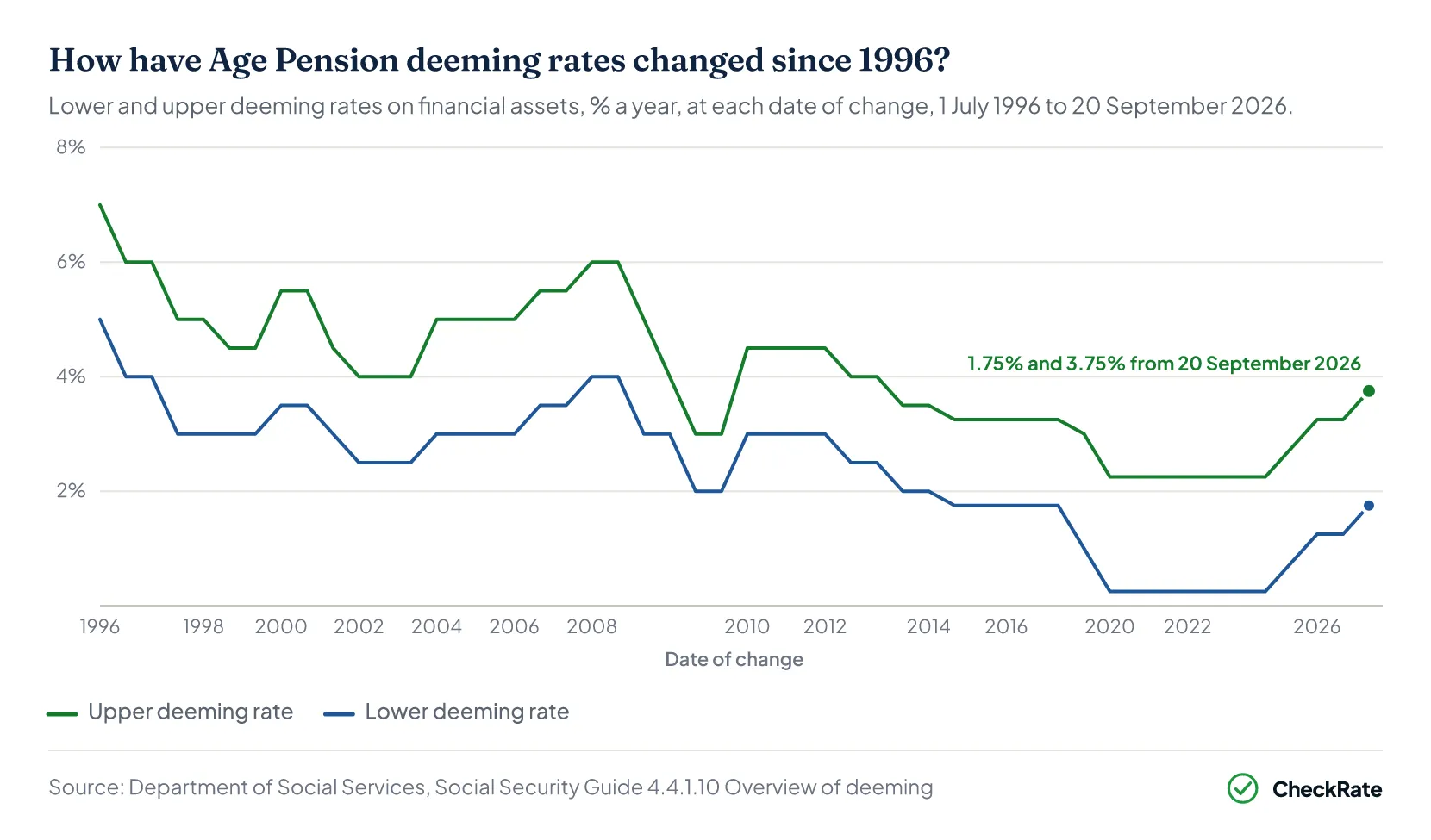
From 20 September 2026, the first $66,800 of a single pensioner's financial assets is deemed to earn 1.75% a year, and any amount above that is deemed to earn 3.75%9. For a couple where at least one partner gets a pension, the threshold is $110,600 of combined financial assets8.
Financial assets include savings accounts, term deposits, managed investments, loans, debentures, and listed shares and securities8. Overseas listed shares and managed investments are included in the same way as Australian financial assets10.
The actual amount an investment earns does not change the deemed income. An overseas account that earns less than the deeming rates is still assessed at that rate, while earnings above the deeming rate are not counted as additional income9. The same accounts and investments also count in the assets test11.
Deeming rates were 0.25% and 2.25% from 1 May 2020 to 19 September 20259. The lower and upper rates then increased in three stages, to 0.75% and 2.75% from 20 September 2025, then to 1.25% and 3.25% from 20 March 2026, and to 1.75% and 3.75% from 20 September 2026.
| Age Pension deeming thresholds and rates, from 20 September 2026 | |||
|---|---|---|---|
| Situation | Threshold | Rate up to the threshold | Rate above the threshold |
| Single | $66,800 | 1.75% | 3.75% |
| Couple, at least one partner gets a pension, combined | $110,6008 | 1.75% | 3.75% |
| Couple, neither partner gets a pension, each partner | $55,3008 | 1.75% | 3.75% |
Source · Services Australia, Deeming; Department of Social Services, Social Security Guide 4.4.1.10
Worked example · $100,000 in overseas bank accounts
This illustrative example uses the deeming rates that apply from 20 September 2026, and assumes a single pensioner whose only financial assets are overseas bank accounts worth $100,000 after conversion to Australian dollars.
The first $66,800 is deemed to earn $1,169 a year at 1.75%, and the remaining $33,200 is deemed to earn $1,245 a year at 3.75%8.
Together, this gives deemed income of $2,414 a year, or $92.85 a fortnight. That amount is added to the pensioner's other assessable income under the income test.
How financial assets sit within the wealth of Australian households is covered in the Australian wealth statistics article.
Section 04 · Property
How is property overseas counted in the Age Pension assets test?
Real estate outside Australia counts in the Age Pension assets test at its current market value, unless it is the pensioner's principal home7. This includes property that is rented out, left vacant, occupied by someone else for free or used as another home.
The principal home is the home where the pensioner, or the couple, lives for most of the year12. A pensioner who owns more than one home can have only one principal home for the assets test. Any other property is assessed as an asset, even while the pensioner is living in it.
Only the pensioner's share of a property counts, less the amount owed on a loan for the property7.
Rent from a property outside Australia counts in the income test as the gross rent minus allowable costs associated with earning that rent3.
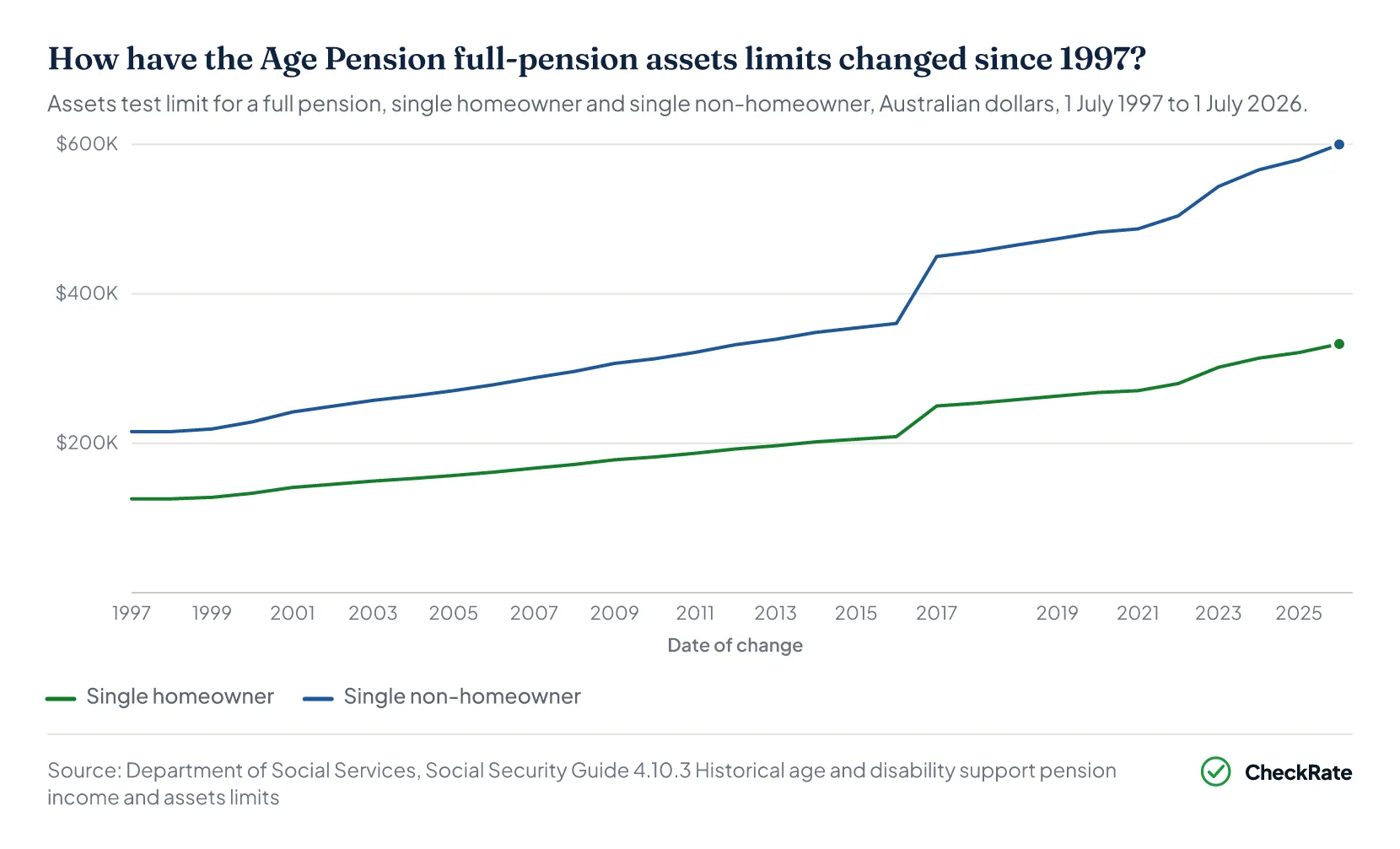
From 1 July 2026, a single homeowner can have assets of up to $333,000 and receive the full pension, compared with $600,000 for a single non-homeowner11. For a couple, the full-pension limits are $499,000 for homeowners and $766,000 for non-homeowners, combined. Under the standard rules, each $1,000 of assets above the limit reduces a single pension, or a couple's combined pension, by $3 a fortnight13.
From 20 September 2026, a part pension stops when a single homeowner's assets are more than $745,750. For a single non-homeowner, the cut-off is $1,012,75011. For singles and couples, the non-homeowner full-pension limit and part-pension cut-off point are each $267,000 higher than the homeowner amounts.
The full-pension assets limit for a single homeowner increased from $125,750 on 1 July 1997 to $333,000 on 1 July 2026. This included a one-off increase from $209,000 to $250,000 on 1 January 201714.
| Age Pension assets test limits, full pension from 1 July 2026 and part pension from 20 September 2026 | ||
|---|---|---|
| Situation | Full pension limit | Part pension cut-off point |
| Homeowner, single | $333,000 | $745,750 |
| Homeowner, couple, combined | $499,000 | $1,121,00011 |
| Homeowner, couple separated due to illness, combined | $499,000 | $1,324,500 |
| Homeowner, couple, one partner eligible, combined | $499,000 | $1,121,000 |
| Non-homeowner, single | $600,000 | $1,012,750 |
| Non-homeowner, couple, combined | $766,000 | $1,388,00011 |
| Non-homeowner, couple separated due to illness, combined | $766,000 | $1,591,500 |
| Non-homeowner, couple, one partner eligible, combined | $766,000 | $1,388,000 |
Source · Services Australia, Assets test for Age Pension
What happens to the Australian home when a pensioner moves overseas?
A pensioner who is temporarily away from their Australian home, including overseas, remains a homeowner, and the home stays exempt for up to 12 months15. After 12 months, the home stops being treated as the principal home. The period can be extended for a person overseas who cannot return because of circumstances beyond their control.
If a pensioner does not intend to return, the home generally becomes an assessable asset from that point, and the higher non-homeowner limit applies15. For a principal home sold from 1 January 2023, the part of the sale proceeds the pensioner intends to use for a new principal home can be exempt from the assets test for up to 24 months, or up to 36 months in some circumstances167. During that period, those proceeds are deemed only at the lower deeming rate8.
How many Australians own their home outright or with a mortgage is covered in the Australian home ownership statistics article.
Section 05 · Exchange rates
How is foreign income converted to Australian dollars for the Age Pension?
Services Australia converts foreign income and assets to Australian dollars at exchange rates that are updated each month18.
For each month, it uses a Commonwealth Bank exchange rate set shortly before the start of that month. The same rate then applies to each payday during that calendar month18.
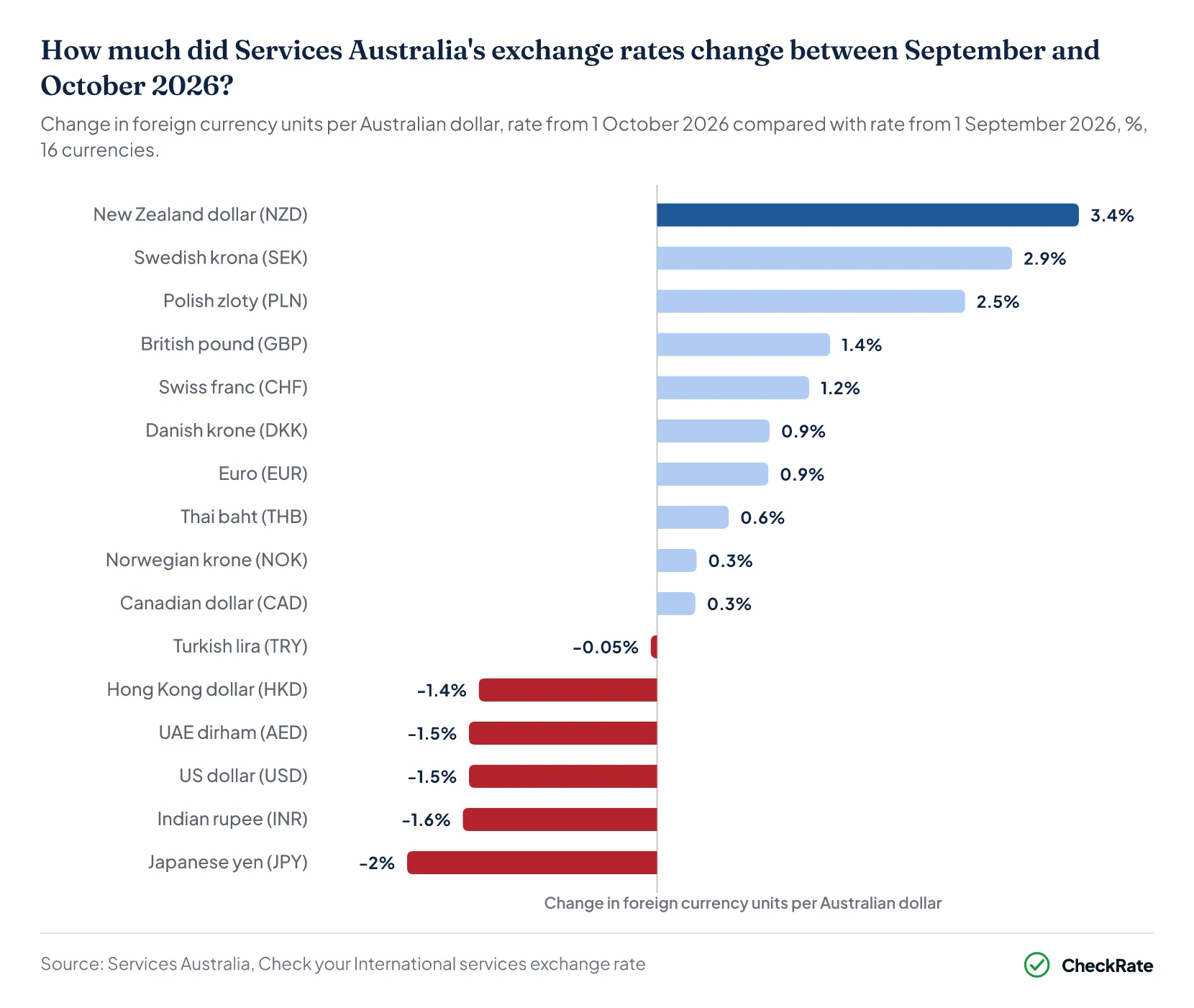
From 1 September to 1 October 2026, Services Australia's rate for each Australian dollar moved from US$0.7381 to US$0.7269, from £0.5414 to £0.5490, from €0.6328 to €0.6385 and from NZ$1.2382 to NZ$1.280419.
A higher rate means each Australian dollar buys more of the foreign currency, so the same foreign income converts to fewer Australian dollars. Between the September and October 2026 rates, the rate for the New Zealand dollar rose the most among the 16 currencies Services Australia lists, by 3.41%, and the rate for the Japanese yen fell the most, by 2.02%19.
A pensioner can ask Services Australia to review an exchange rate if the rate actually received from a bank or other organisation differs from the Services Australia rate by more than 5%. Proof of the rate received is required19.
Pensioners whose pension rate is reduced because of foreign income or assets receive a letter each February listing the exchange rates used over the previous 12 months19.
A foreign lump sum assessed over 12 months is converted at the exchange rate that applies on the day it is received. That rate applies for the full 12 months6.
Worked example · an overseas pension of £8,000 a year
This illustrative example uses Services Australia's rate of £0.5490 from 1 October 2026, for a single pensioner whose only income is an overseas pension of £8,000 a year before tax.
Converted at that rate, the pension is A$14,571.95 a year, or $560.46 a fortnight19.
That fortnightly amount is $334.46 above the $226 income free area. Under the standard income test, this reduces the Age Pension by $167.23 a fortnight4.
At the September 2026 rate of £0.5414, the same pension would have converted to $568.33 a fortnight and reduced the pension by $171.16 a fortnight.
| Services Australia exchange rates, foreign currency units per Australian dollar, September and October 2026 | |||
|---|---|---|---|
| Country | Currency | From 1 September 2026 | From 1 October 2026 |
| Canada | CAD | 1.0313 | 1.0345 |
| Denmark | DKK | 4.7927 | 4.8362 |
| European Union | EUR | 0.6328 | 0.6385 |
| Hong Kong | HKD | 5.8380 | 5.7537 |
| India | INR | 69.4470 | 68.3534 |
| Japan | JPY | 118.9600 | 116.5600 |
| New Zealand | NZD | 1.2382 | 1.2804 |
| Norway | NOK | 6.9643 | 6.9863 |
| Poland | PLN | 2.7648 | 2.8336 |
| Sweden | SEK | 7.1033 | 7.3069 |
| Switzerland | CHF | 0.6000 | 0.6074 |
| Thailand | THB | 24.1000 | 24.2400 |
| Turkey | TRY | 36.2985 | 36.2787 |
| United Arab Emirates | AED | 2.7469 | 2.7051 |
| United Kingdom | GBP | 0.5414 | 0.549019 |
| United States | USD | 0.7381 | 0.726919 |
Source · Services Australia, Check your International services exchange rate
How exchange rate movements change the value of an Age Pension paid outside Australia is covered in the article on exchange rates and the Age Pension overseas.
Section 06 · Not reporting
What happens if overseas income or assets are not reported to Services Australia?
An Age Pension recipient who does not report a change in overseas income or assets within 14 days may be paid too much and may have to repay the overpayment1. Deliberately not reporting a change can lead to a fraud charge.
When a debt is raised, Services Australia sends a letter showing the amount overpaid, why it is owed and a due date, which is usually 28 days after the letter20. For a person still getting a Centrelink payment, repayments are generally deducted from that payment.
A former recipient who has not repaid the debt or set up a repayment arrangement by the due date can be charged interest from the 29th day after the date of the debt notice21. The interest charge is the 90-day Bank Accepted Bill rate plus 7%, compounded daily. People who are still receiving a social security payment are exempt from this interest charge.
The 10% recovery fee on debts from undeclared income from personal exertion does not apply to the Age Pension. The fee applies to working-age benefits, the Disability Support Pension, Parenting Payment and some closed payments22.
Services Australia checks land title records against the real estate reported by pensioners and adjusts the value of assessable residential real estate each year7. If those checks show property is worth more than reported, payments can reduce or stop and money may have to be repaid.
A debt can be waived in part or in full under the special circumstances waiver, including in some cases of hardship20.
Section 07
Overseas income, assets and the Age Pension: quick answers
Does overseas income affect the Age Pension?
Overseas income can reduce the Age Pension, because Services Australia counts income from outside Australia in the income test, including foreign pensions before tax, deemed income on financial investments and rent after allowable costs are deducted. Under the standard rules from 1 July 2026, a single pensioner’s pension reduces by 50 cents for each dollar of income above $226 a fortnight4.
Is a foreign pension counted as income for the Age Pension?
A foreign pension is counted as income for the Age Pension at its gross amount, with no deduction for foreign tax or bank charges6. A social security agreement with the paying country can instead make the payment exempt, partly assessable or deducted directly from the Australian pension.
Do overseas bank accounts count for the Age Pension?
Overseas bank accounts count as financial assets in the assets test and are deemed to earn income in the income test, after conversion to Australian dollars. From 20 September 2026, a single pensioner’s first $66,800 of financial assets is deemed to earn 1.75% a year and the rest 3.75%8.
Does property overseas count in the Age Pension assets test?
Property overseas counts in the Age Pension assets test at its market value, less the amount owed on it, unless it is the pensioner’s principal home7. The principal home is the home where a pensioner lives for the greatest amount of time each year.
What exchange rate does Centrelink use for foreign income?
Centrelink, part of Services Australia, converts foreign income using the Commonwealth Bank’s on-demand airmail buying rate set before the start of each month, and applies that rate to every payday in the month18. A pensioner can ask for a review if the rate actually received differs from that rate by more than 5%.
Does a partner’s overseas income count for the Age Pension?
A partner’s overseas income counts for the Age Pension, because Services Australia assesses a couple’s income and assets together, including income and assets in another country. Under the standard rules, a couple can have combined income of up to $396 a fortnight before each partner’s pension reduces4.
References
- Services Australia, Change of circumstances when you get Age Pension · servicesaustralia.gov.au ↑ b c
- Services Australia, Income and assets from outside Australia can affect your Age Pension · servicesaustralia.gov.au ↑
- Services Australia, Income from outside Australia (Age Pension) · servicesaustralia.gov.au ↑ b c d e f g
- Services Australia, Income test for Age Pension · servicesaustralia.gov.au ↑ b c d e f g
- DSS, Social Security Guide 1.1.M.120 Member of a couple · guides.dss.gov.au ↑
- DSS, Social Security Guide 4.3.6.10 Income from overseas payments · guides.dss.gov.au ↑ b c d e f g h i j k l
- Services Australia, Real estate assets · servicesaustralia.gov.au ↑ b c d e f
- Services Australia, Deeming (Age Pension) · servicesaustralia.gov.au ↑ b c d e f g h
- Department of Social Services, Social Security Guide 4.4.1.10 Overview of deeming · guides.dss.gov.au ↑ b c
- Department of Social Services, Social Security Guide 4.4.2: Deeming of financial investments · guides.dss.gov.au ↑
- Services Australia, Assets test for Age Pension · servicesaustralia.gov.au ↑ b c d e
- DSS, Social Security Guide 4.6.3.30 Defining the principal home · guides.dss.gov.au ↑
- Department of Social Services, Social Security Guide 4.2.3 Pensions and benefits assets tests · guides.dss.gov.au ↑
- Department of Social Services, Social Security Guide 4.10.3: Historical age and disability support pension income and assets limits · guides.dss.gov.au ↑
- Department of Social Services, Social Security Guide 4.6.3.60 Exempting the principal home - temporary vacation of property · guides.dss.gov.au ↑ b
- Department of Social Services, Social Security Guide 4.6.3.90 Exempting the principal home: sale proceeds · guides.dss.gov.au ↑
- ATO, Main residence exemption for foreign residents · ato.gov.au ↑
- Department of Social Services, Social Security Guide 4.3.6.50: Arrears, embargoes and exchange rates for overseas income · guides.dss.gov.au ↑ b c
- Services Australia, Check your International services exchange rate · servicesaustralia.gov.au ↑ b c d e f g
- Services Australia, What happens when you’re overpaid by Centrelink · servicesaustralia.gov.au ↑ b c
- Department of Social Services, Social Security Guide 6.7.1.40: Interest charge on debts · guides.dss.gov.au ↑
- Department of Social Services, Social Security Guide 6.7.1.45: 10% recovery fee on debts from false or non-declaration of income from personal exertion · guides.dss.gov.au ↑