

Published
 Does retiring overseas end Australian tax residency?Australian tax law sets four residency tests, and a person who meets any one of them is an Australian resident for tax purposes, according to the Australian Taxation Office (ATO). A person who meets n…
 Double tax agreements: how Australia, Thailand, Poland and Malaysia tax a retiree's pension and investment incomeAccording to the Australian Taxation Office (ATO), a double tax agreement reduces or eliminates double taxation by setting out which country can tax different types of income, such as pensions, intere…
 Selling a home to retire overseas: capital gains tax and the Age PensionA foreign resident for tax purposes who sells an Australian home after 30 June 2020 cannot claim the capital gains tax (CGT) main residence exemption, unless the life events test is met, according to…
Section 01 · Rental income
How do foreign residents declare rental income from an Australian home?
A foreign resident for tax purposes must declare rental income from an Australian property in an Australian tax return, along with other Australian income such as Australian pensions and capital gains on taxable Australian property, according to the Australian Taxation Office (ATO)1.
Rental income is declared in the income year the tenant pays it. This includes rent paid to a property manager that has not yet been transferred to the owner2. Co-owners each declare their share of the rent according to their legal ownership of the property.
Tax residency is determined by Australian residency tests, not by citizenship or visa status. The main test is whether a person resides in Australia. A person who does not reside in Australia can still be a resident under the domicile test, unless their permanent place of abode is outside Australia3.
In the ATO's example, an employee who moved overseas with her family for a three-year contract, set up a home there and rented out the family home in Australia was treated as a foreign resident, even though the family intended to return3.
Interest, dividends and royalties are taxed differently from rental income. Interest, unfranked dividends and royalties paid to a foreign resident generally have tax withheld, and income does not need to be declared in an Australian tax return where the required tax has been withheld1.
For residents of countries without a tax treaty, the withholding rate is 10% on interest and 30% on unfranked dividends and royalties4. Most treaties reduce the dividend rate to 15% and the royalty rate to 10%.
Treasury lists Australia's tax treaties with Thailand, Poland and Malaysia as in force5. Each of the three treaties allows income from Australian property to be taxed in Australia678.
| How Australian income of a foreign resident is taxed, by income type | ||
|---|---|---|
| Income type | How it is taxed | Declared in an Australian tax return |
| Rental income from Australian property | Foreign resident tax rates, with no tax-free threshold | Yes |
| Australian pensions and annuities | Foreign resident tax rates, with no tax-free threshold | Yes |
| Capital gains on taxable Australian property | Foreign resident tax rates, with no tax-free threshold | Yes |
| Interest | 10% withholding, with an exemption in certain circumstances under some treaties | No, where tax has been withheld |
| Unfranked dividends | 30% withholding, reduced to 15% under most treaties4 | No, where tax has been withheld |
| Royalties | 30% withholding, reduced to 10% under most treaties | No, where tax has been withheld |
Source · ATO, Foreign and temporary residents; ATO, Interest, unfranked dividends and royalties.
Section 02 · Tax rates
What are the non-resident tax rates in Australia?
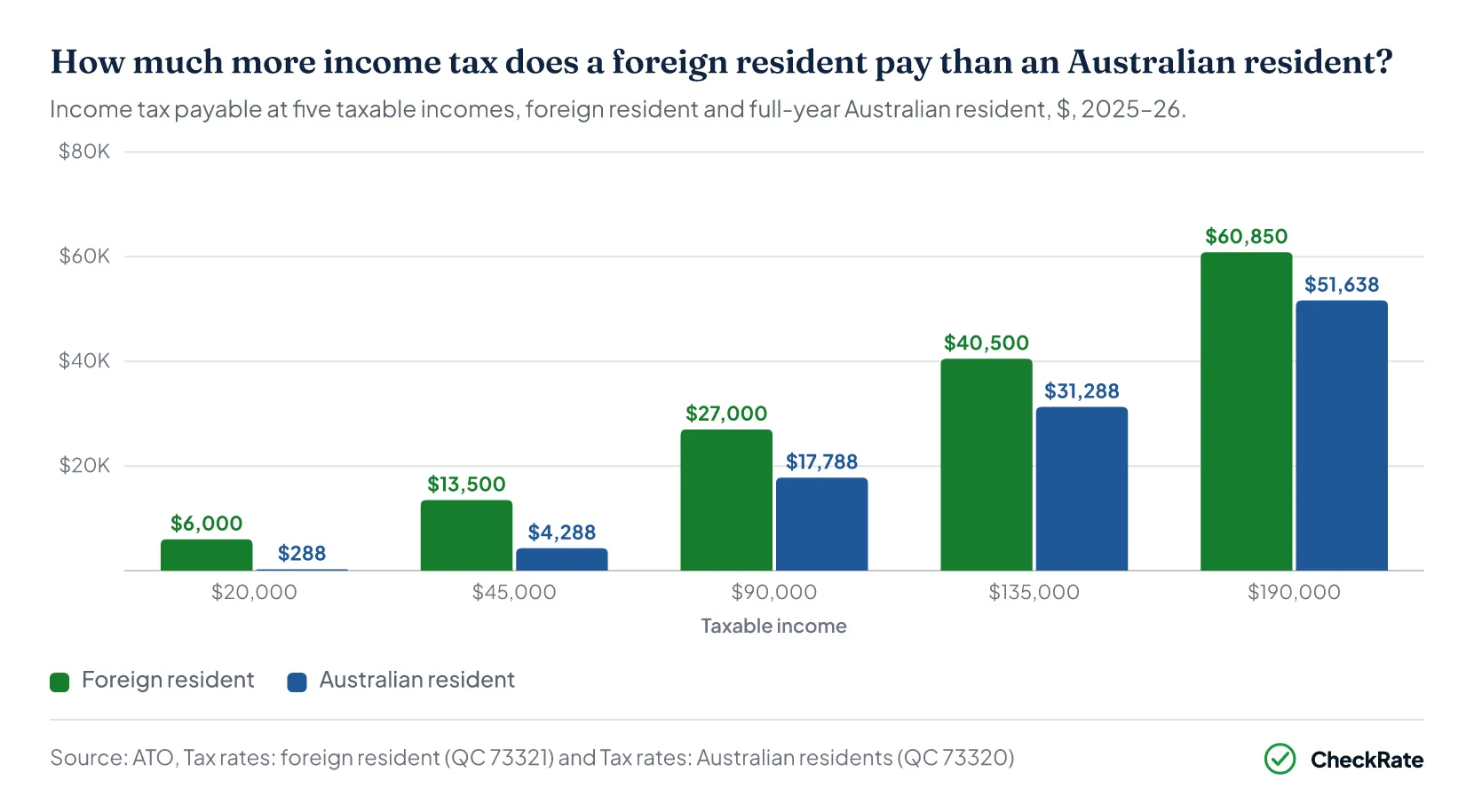
For 2025–26, full-year foreign residents paid 30% on taxable income up to $135,000, $40,500 plus 37% of income from $135,001 to $190,000, and $60,850 plus 45% of income above $190,000, according to the ATO9. The same rates applied in 2024–25.
Foreign residents have no tax-free threshold and do not pay the Medicare levy1. Australian residents paid no tax on the first $18,200 of taxable income in 2025–26 and 16% on income from $18,201 to $45,00010. Above $45,000, the Australian resident and foreign resident marginal tax rates were the same. For 2026–27, the Australian resident rate on income from $18,201 to $45,000 is 15%.
Based on the 2025–26 rate scales, a full-year foreign resident with taxable income of $45,000 or more paid $9,212 more income tax than a full-year Australian resident with the same taxable income. The comparison is before tax offsets and excludes the Medicare levy, and it is an illustrative calculation910.
The difference arises on the first $45,000 of taxable income, where tax was $13,500 for a foreign resident compared with $4,288 for an Australian resident109. Above $45,000, both scales charge the same marginal rates. Australian residents also pay the 2% Medicare levy10, so the overall difference is smaller at higher incomes. At $90,000 of taxable income, for example, the resident's $1,800 Medicare levy narrows the gap to $7,412.
| Marginal income tax rates for foreign residents and Australian residents, 2025–26 and 2026–27 | |||
|---|---|---|---|
| Taxable income | Foreign resident, 2025–26 | Australian resident, 2025–26 | Australian resident, 2026–27 |
| $0–$18,200 | 30%9 | Nil | Nil |
| $18,201–$45,000 | 30% | 16% | 15%10 |
| $45,001–$135,000 | 30% | 30% | 30% |
| $135,001–$190,000 | 37% | 37% | 37% |
| $190,001 and over | 45% | 45% | 45% |
| Medicare levy | Nil9 | 2% | 2% |
Source · ATO, Tax rates: foreign resident; ATO, Tax rates: Australian residents; ATO, Foreign and temporary residents.
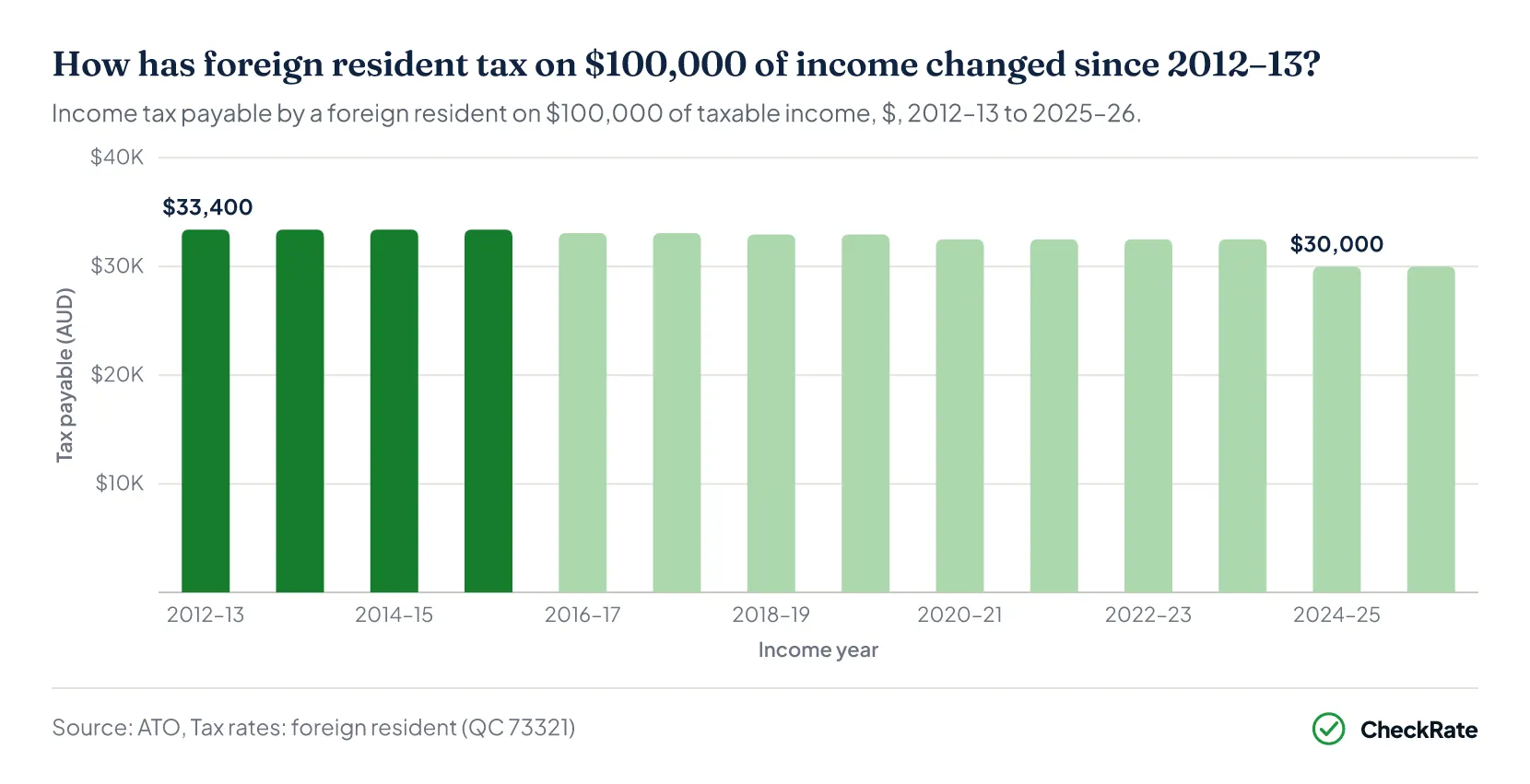
Foreign resident tax on $100,000 of taxable income was $33,400 in 2012–13, the first year in which the 32.5% rate applied from the first dollar of income9. Tax on $100,000 was $32,500 in 2023–24 and $30,000 in 2024–25. In 2024–25, the rate on the lowest bracket fell from 32.5% to 30% and the upper limit of that bracket rose from $120,000 to $135,000.
The foreign resident rates apply to an individual who was a foreign resident for the full income year9. In the year a person stops being an Australian resident, the resident tax rates apply, but the tax-free threshold is reduced. The tax-free threshold for that year is $13,464 plus $4,736 divided by 12 for each month of residency, including the month of departure113.
How does the Australian tax system work? explains how personal income tax fits with the other taxes collected in Australia.
Section 03 · Deductions
Which rental property deductions can foreign residents claim?
A foreign resident who declares Australian rent generally claims rental expenses under the same ATO rules as other individual owners. There are no separate deduction rules for foreign residents12. Rental expenses fall into three categories: expenses claimed in the year they are incurred, expenses claimed over several years and expenses that cannot be claimed.
| Rental expense categories for a residential rental property, individual owners | |
|---|---|
| Category | Examples |
| Claimed in the year incurred | Interest on loans, council rates, repairs and maintenance, depreciating assets costing $300 or less, advertising for tenants, real estate commission |
| Claimed over several years | Capital works, borrowing expenses, decline in value of depreciating assets costing more than $300 |
| Cannot be claimed | Personal expenses, purchase and sale costs, expenses paid by tenants, decline in value of second-hand depreciating assets in most cases, travel to a residential rental property unless the owner is in the business of letting rental properties |
Source · ATO, How to claim rental expenses; ATO, Rental properties and travel expenses.
Travel to a residential rental property has generally not been deductible for individual owners since 1 July 2017, unless the owner is in the business of letting rental properties13. The rule covers airfares, accommodation, meals and car costs for travel to inspect, maintain or collect rent for the property. In most cases, the decline in value of second-hand depreciating assets has also not been deductible since 1 July 201714.
Expenses are generally apportioned when a home becomes a rental during the year. The calculation is based on the number of days the property was rented or available for rent on commercial terms compared with the number of days it was owned during that income year12. Advertising for tenants and real estate commission relate only to renting and are not apportioned.
Where deductions are larger than the rent, the property is negatively geared. The loss can be claimed against other Australian income in the tax return, such as Australian salary, wages or business income12. A loss that cannot be fully offset against other income can be carried forward to the next income year.
How are rental property income and expenses taxed in Australia? covers each rental expense category in more detail.
Section 04 · The 6-year rule
How does the CGT 6-year rule apply to a rented-out former home?
A former home that is rented out can generally be treated as a main residence, and can remain exempt from capital gains tax (CGT), for up to six years after the owner moves out16. A former home that is not used to produce income, such as one left vacant, can be treated as a main residence for an unlimited period. However, an owner who is a foreign resident when the sale contract is signed cannot claim the exemption unless the life events test is met17.
While an owner treats a former home as their main residence under the six-year rule, no other property can generally be treated as their main residence, except for up to six months when moving house16. The six-year period applies separately to each absence. An absence ends when the owner stops renting the home and either moves back in or leaves it vacant.
In the ATO's example, a house was rented out for three years, left vacant for two, rented again for three and left vacant for two more16. The property was rented for a total of six years during the 10-year absence, so the entire period was covered by the main residence exemption.
A former home rented out for more than six years in one absence is generally subject to CGT for the period after the 6-year limit16. In some cases, the property's cost base can become its market value when it was first rented out, plus allowable costs incurred after that date.
Worked example: former home rented out for 25 years
In the ATO's example, an apartment was first rented out on 29 September 1999, when its market value was $220,000, and sold under a contract that settled on 29 September 2024 for $555,000, with $15,000 of agent's and solicitor's fees16. The capital gain was $320,000. Of this, $243,162 related to the 6,940 days after the six-year exemption ended, out of 9,133 days from when the apartment was first rented until it was sold. After the 50% CGT discount, the net capital gain was $121,581.
| Worked example: capital gain on a former home rented out from 1999 to 2024 | |
|---|---|
| Step | Amount |
| Sale price | $555,000 |
| Cost base: market value when first rented out, plus selling costs | $235,000 |
| Capital gain | $320,000 |
| Days after the 6-year limit | 6,940 |
| Days from first renting to sale | 9,133 |
| Assessable capital gain | $243,16216 |
| Net capital gain after the 50% CGT discount | $121,581 |
Source · ATO, Treating former home as main residence.
The owner in the ATO's example was an Australian resident when the sale contract was signed. An owner who sells as a foreign resident generally cannot use the 6-year rule, the partial exemption or the market-value cost base for the former home, unless the life events test is met17.
Section 05 · Selling from overseas
Can foreign residents claim the main residence exemption when selling?
Foreign residents cannot claim the main residence exemption for property sold after 30 June 2020 unless they meet the life events test17. The rule applies even where the owner lived in the home as an Australian resident for part of the ownership period. A former home sold by an owner who is a foreign resident when the sale contract is signed is subject to CGT on the whole capital gain.
The life events test has two conditions:
- the owner was a foreign resident for tax purposes for a continuous period of six years or less
- one of three events occurred during that period:
- the owner, their spouse or their child under 18 had a terminal medical condition
- the owner's spouse or child under 18 died
- the sale followed a formal agreement after the breakdown of a marriage or relationship17.
Foreign residents are also not entitled to the full 50% CGT discount on property acquired after 8 May 201218. An owner who was an Australian resident for part of the ownership period can claim a discount for the eligible resident period, while an owner who was a foreign resident for the whole period is not entitled to any CGT discount.
From 1 July 2027, the 50% CGT discount for individuals will be replaced by cost base indexation and a 30% minimum tax rate on capital gains, but only for gains that accrue from that date15.
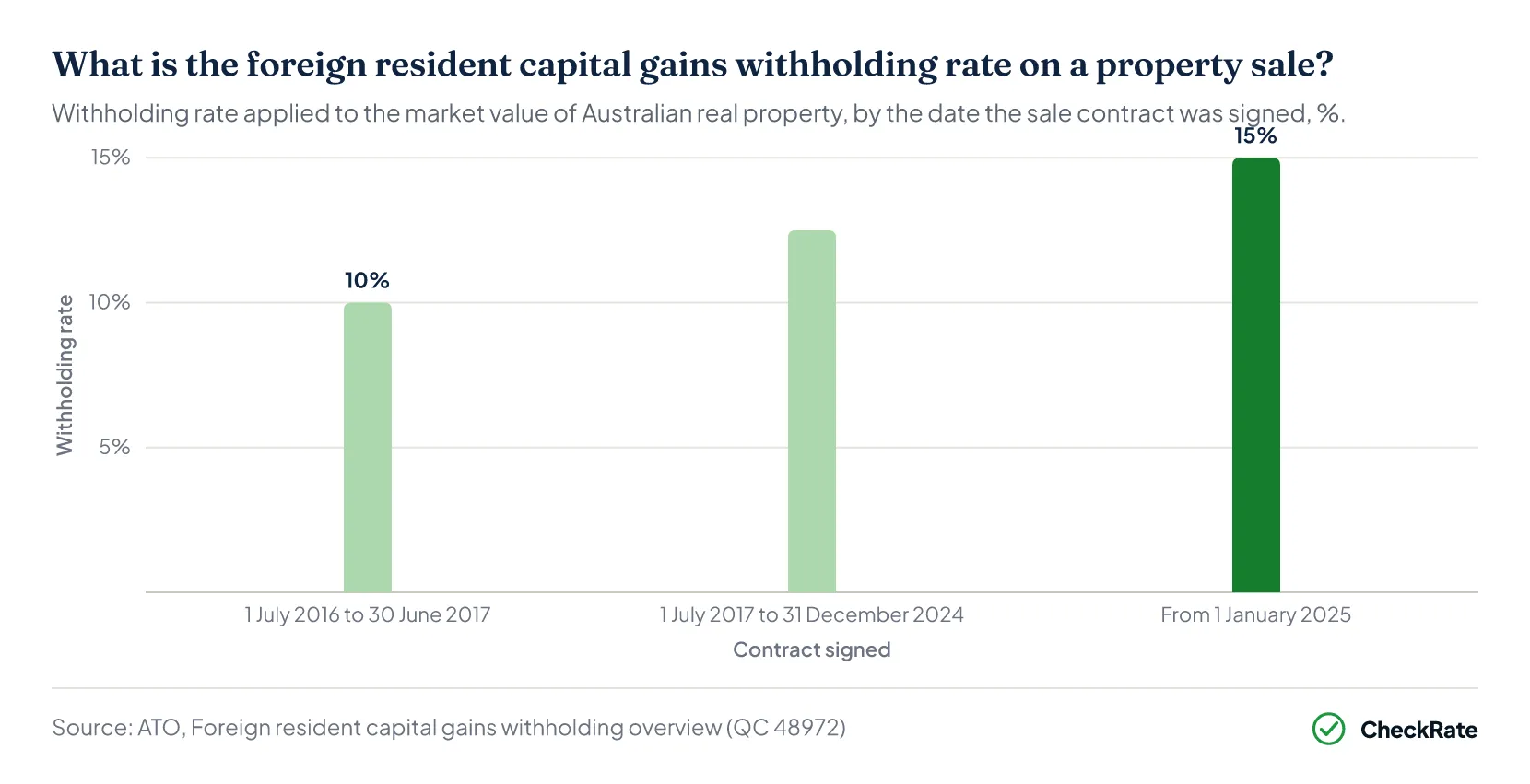
For Australian property sold under a contract signed from 1 January 2025, the buyer must withhold 15% of the property's market value, which is usually the sale price, and pay it to the ATO19. Withholding does not apply where the seller is an Australian resident with a clearance certificate, and a foreign resident seller can apply for a variation notice that reduces the rate.
Foreign resident capital gains withholding began on 1 July 2016 at 10% on property valued at $2 million or more19. From 1 July 2017 to 31 December 2024, the rate was 12.5% on property valued at $750,000 or more.
In the ATO's example, a buyer of a $1.2 million apartment from a foreign resident withholds $180,000 under the 15% rate for contracts signed from 1 January 202519. The seller can claim the amount withheld as a credit when lodging the tax return for the income year in which the contract was signed20.
What triggers capital gains tax in Australia? sets out the events that create a capital gain and the main exemptions.
Section 06 · Land tax and rates
Do owners living overseas pay land tax surcharges?
Australian citizens living overseas are not charged the foreign owner or absentee land tax surcharges in New South Wales, Victoria and Queensland, according to Revenue NSW, the State Revenue Office Victoria and the Queensland Revenue Office212223.
In New South Wales, surcharge land tax on residential land owned by foreign persons is 5% of land value from the 2025 land tax year21. In Victoria, the absentee owner surcharge is 4% from the 2024 land tax year22.
In Queensland, Australian citizens and permanent visa holders living overseas are assessed at the individual land tax rates, with a threshold of $600,000 of taxable land value24. Queensland absentees are liable for land tax from $350,000 of taxable land value, with a 3% absentee surcharge on the value above $350,00023. Absentees cannot claim the home exemption.
Australian citizens and permanent visa holders are not absentees, so they can still claim the Queensland home exemption if they meet its usual conditions24.
In New South Wales, an owner who moves out can generally keep the principal place of residence exemption for up to six years25. The owner must have lived in the home continuously for at least six months before moving out and must not own another principal place of residence. The home must also either earn only enough income to cover basic property expenses, such as rates and water, or be leased for no more than six months in a calendar year.
Council rates on a rental property can be claimed as a deduction in the income year they are incurred12.
| Foreign owner and absentee land tax surcharges for owners living overseas, New South Wales, Victoria and Queensland | |||
|---|---|---|---|
| State | Surcharge | Australian citizens living overseas | Permanent residents living overseas |
| New South Wales | 5% of residential land value, from the 2025 land tax year21 | Not a foreign person | A foreign person if they spend 165 days or more overseas in a calendar year |
| Victoria | 4% absentee owner surcharge, from the 2024 land tax year22 | Not an absentee | Not an absentee |
| Queensland | 3% absentee surcharge on taxable land value above $350,00023 | Not an absentee | Not an absentee, if they hold a permanent visa |
Source · Revenue NSW, What is surcharge land tax?; State Revenue Office Victoria, Understanding the absentee owner surcharge; Queensland Revenue Office, Land tax for absentees.
A permanent resident who lives overseas for 165 days or more in a calendar year is treated as a foreign person for surcharge land tax in New South Wales21.
Land tax in Australia by state compares thresholds, rates and surcharges in every state and territory.
Section 07
Renting out a home from overseas: quick answers
Is Australian rental income taxed when the owner lives overseas?
Rental income from an Australian property is taxed in Australia when the owner lives overseas, and an owner who is a foreign resident for tax purposes declares it in an Australian tax return. For a full year as a foreign resident in 2025–26, the rate was 30% on taxable income up to $135,000, with no tax-free threshold and no Medicare levy.
Do foreign residents get a tax-free threshold in Australia?
Foreign residents do not get a tax-free threshold, so foreign resident tax applies from the first dollar of taxable income, at 30% up to $135,000 in 2025–26. Australian residents paid no tax on the first $18,200 of taxable income for the same income year.
Can rental deductions be claimed while living overseas?
Rental deductions such as loan interest, council rates and repairs can be claimed against Australian rental income by an owner living overseas, under the same ATO rules that apply to other individual owners. Travel to a residential rental property has generally not been deductible for individual owners since 1 July 2017, unless they are in the business of letting rental properties.
Does the 6-year rule apply when living overseas?
The 6-year rule can apply to a former home rented out while the owner lives overseas, for up to six years during each absence, where the owner is an Australian resident when the sale contract is signed. An owner who is a foreign resident on that date generally cannot claim the main residence exemption, including under the six-year rule, unless the life events test is met.
How much tax is withheld when a foreign resident sells Australian property?
A buyer of Australian property from a foreign resident must withhold 15% of its market value and pay it to the ATO for contracts signed from 1 January 2025, unless the seller has a variation notice that reduces the rate. The seller can claim the amount withheld as a credit in the tax return for the income year in which the contract was signed.
Do Australians living overseas pay foreign owner land tax surcharges?
Australian citizens living overseas are not treated as foreign persons or absentees for the land tax surcharges in New South Wales, Victoria and Queensland. Land tax can still apply to a rented former home, because the home exemptions in those states generally depend on the owner meeting the relevant eligibility requirements.
References
- ATO, Foreign and temporary residents · ato.gov.au ↑ b c
- ATO, Rental income you must declare · ato.gov.au ↑
- Australian Taxation Office, Your tax residency · ato.gov.au ↑ b c
- ATO, Interest, unfranked dividends and royalties (foreign resident investments) · ato.gov.au ↑ b c
- Treasury, Income tax treaties · treasury.gov.au ↑
- ATO, Synthesised text of the Multilateral Instrument and the Australia and Thailand tax treaty · ato.gov.au ↑ b
- ATO, Synthesised text of the MLI and the Australia and Poland tax agreement · ato.gov.au ↑ b
- ATO, Synthesised text of the MLI and the Australia and Malaysia tax agreement · ato.gov.au ↑ b
- ATO, Tax rates: foreign residents · ato.gov.au ↑ b c d e f g
- ATO, Tax rates – Australian resident (QC 73320) · ato.gov.au ↑ b c d e
- ATO, Living overseas and becoming a foreign tax resident · ato.gov.au ↑
- ATO, How to claim rental expenses · ato.gov.au ↑ b c d
- ATO, Rental properties and travel expenses · ato.gov.au ↑
- ATO, Depreciating assets in rental properties · ato.gov.au ↑
- ATO, Tax reform – Boosting home ownership – Reforming negative gearing and capital gains tax (QC 107304) · ato.gov.au ↑ b
- ATO, Treating former home as main residence (QC66030) · ato.gov.au ↑ b c d e f g
- ATO, Main residence exemption for foreign residents · ato.gov.au ↑ b c d e
- ATO, CGT discount for foreign residents · ato.gov.au ↑
- ATO, Foreign resident capital gains withholding overview · ato.gov.au ↑ b c
- ATO, Australian residents and clearance certificates · ato.gov.au ↑
- Revenue NSW, What is surcharge land tax? · revenue.nsw.gov.au ↑ b c d
- State Revenue Office Victoria, Understanding the absentee owner surcharge · sro.vic.gov.au ↑ b c
- Queensland Revenue Office, Land tax rates for absentees · qro.qld.gov.au ↑ b c
- Queensland Revenue Office, Land tax rates for individuals · qro.qld.gov.au ↑ b
- Revenue NSW, Principal place of residence exemption · revenue.nsw.gov.au ↑