

Published
Section 01 · Basics
How does land tax work in Australia?
Every Australian state, as well as the ACT, levies an annual tax on landholdings. The Northern Territory is the exception. Its government states that there is no land tax in the NT and that there is land tax in all other Australian states or territories1. The tax is calculated on the value of the land itself, not the buildings on it. Victoria and South Australia name this the site value, New South Wales the land value, and Queensland uses the statutory land value or a three-year averaged value, whichever is lower2.
In most states, taxable land held by the same owner is aggregated before the rate scale is applied, although assessment methods vary by jurisdiction. An owner of several smaller properties can exceed a threshold that no single property would. New South Wales and Victoria assess the land an owner holds at midnight on 31 December each year, for the calendar-year land tax year that follows3. Queensland, South Australia and Western Australia assess ownership at midnight on 30 June, and Tasmania on 1 July, for the financial year that follows4.
The Australian Capital Territory's land tax applies only to residential properties that are not the owner's principal place of residence, such as rented or vacant homes. It is charged quarterly and has no tax-free threshold5.
Where land tax sits among Australia's taxes overall is covered in the overview of how the Australian tax system works.
Section 02 · Thresholds
What is the land tax threshold in each state and territory?
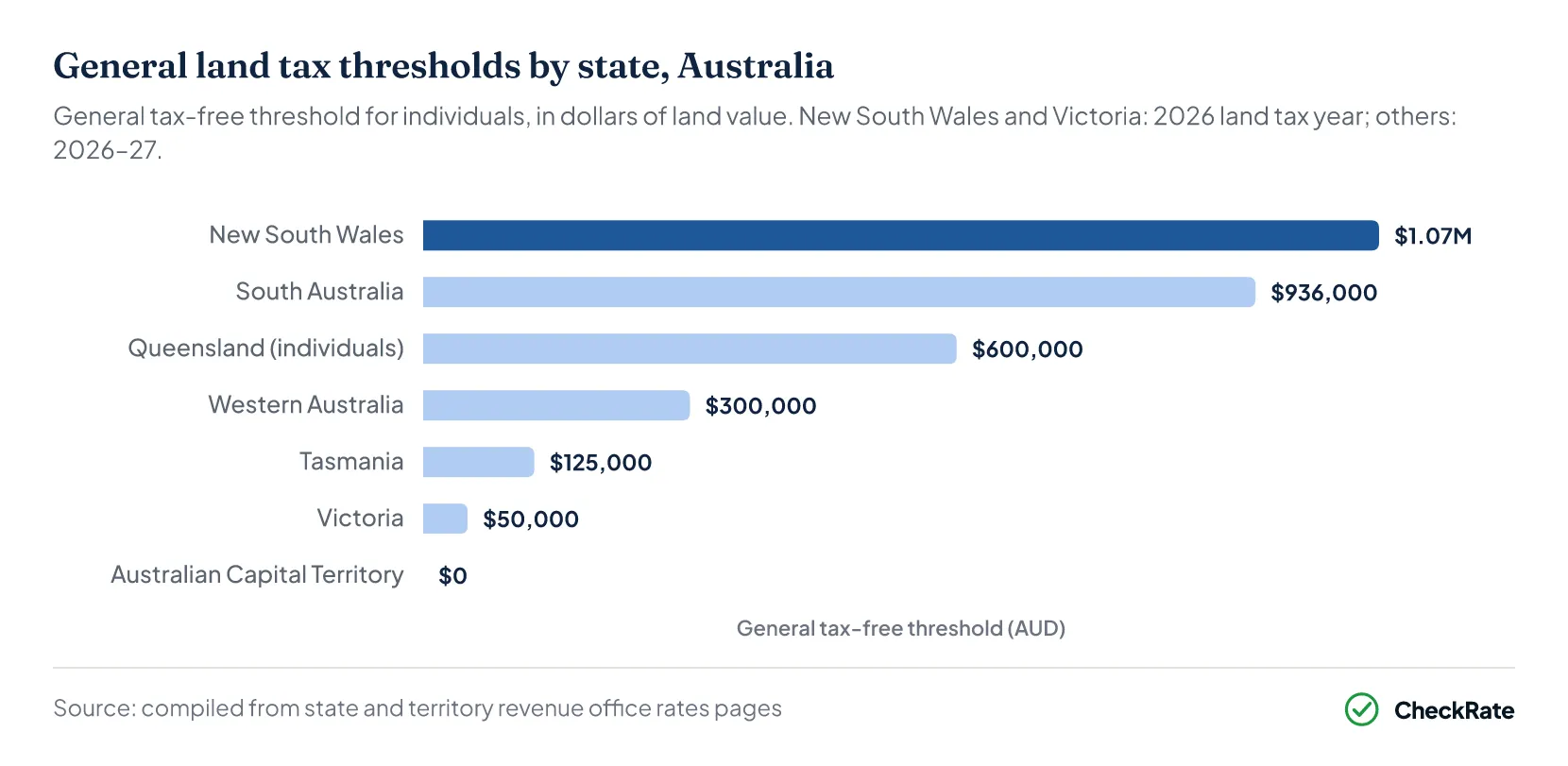
New South Wales has the highest general threshold of the six jurisdictions that publish one, at $1,075,000 of land value for the 2026 land tax year, with a premium threshold at $6,571,0006. South Australia's general threshold increased from $833,000 in 2025–26 to $936,000 for 2026–27. RevenueSA adjusts its thresholds each year based on changes in property site values determined by the Valuer-General, who assessed the average change for 2026–27 at 12.44%7. The new thresholds were published in the South Australian Government Gazette on 4 June 20268.
Queensland's threshold depends on the owner. An individual is liable if the total taxable value of their freehold land at 30 June is $600,000 or more; for companies, trustees and absentees the figure is $350,000 or more9. Western Australia's threshold is $300,000, and Tasmania's is $125,000, the next two lowest state thresholds after Victoria's10. Victoria's general threshold was $300,000 for the 2023 land tax year and is $50,000 under the scale applying from 2024 to 2033, with land held on trust taxed from $25,00011. The Australian Capital Territory has no tax-free threshold. Its marginal rates start from the first dollar of average unimproved value, alongside a fixed charge12.
Section 03 · Rates
What are the land tax rates in each state and territory?
Most state scales apply no tax below a threshold, then increase through fixed amounts and marginal rates as land value rises. The ACT is different because it has no tax-free threshold and combines a fixed charge with marginal rates. New South Wales charges $100 plus 1.6% of the land value above the general threshold, and $88,036 plus 2% above the premium threshold6. Victoria charges flat amounts at the bottom of its scale, $500 for holdings from $50,000 to less than $100,000 and $975 from $100,000 to less than $300,000, then marginal rates that reach 2.65% of the amount above $3 million13. Western Australia's general scale reaches 2.67% above $11 million, while Queensland's separate company and trustee scale reaches 2.75% for holdings of $10 million or more14.
Western Australia also charges a metropolitan region improvement tax of 0.14% on the taxable value above $300,000 for property in the Perth metropolitan region10. The ACT combines a fixed charge, $1,778 from 1 July 2026, with marginal rates on average unimproved value that run from 0.54% to 1.26% above $2 million12. The general scales for individuals differ from the separate trust scales and foreign and absentee-owner surcharges.
| Land tax thresholds and rates by state and territory, Australia. | ||||
|---|---|---|---|---|
| Jurisdiction | Tax-free threshold | Tax at the bottom of the scale | Top marginal rate | Assessment date |
| New South Wales | $1,075,000 | $100 plus 1.6% of land value above the threshold | 2% above $6,571,000 (premium) | Midnight 31 December |
| Victoria | $50,000 | $500 flat from $50,000 to less than $100,000 | 2.65% above $3,000,000 | Midnight 31 December |
| Queensland | $600,000 | $500 plus 1 cent per $1 above $600,000 (individuals) | 2.25% individuals, $10,000,000 or more | Midnight 30 June |
| South Australia | $936,000 | $0.50 per $100 above $936,000 | 2.4% above $3,504,000 | Midnight 30 June |
| Western Australia | $300,000 | $300 flat from $300,001 to $420,000 | 2.67% above $11,000,000 | Midnight 30 June |
| Tasmania | $125,000 | $50 plus 0.45% of value above $125,000 | 1.5% above $500,000 | 1 July |
| Australian Capital Territory | None | $1,778 fixed charge plus 0.54% of average unimproved value (AUV) | 1.26% above $2,000,000 AUV, plus the fixed charge | Quarterly |
| Northern Territory | No land tax | No land tax | No land tax | No land tax |
Source · State and territory revenue office rates pages
Worked example · $680,000 of taxable land in Queensland
In the Queensland Revenue Office's example, an individual whose land has a total taxable value of $680,000 pays $1,300 for the year, derived as $500 plus 1 cent for each $1 of the $80,000 above the $600,000 threshold9. For comparison, using the published general scales and assuming no surcharge or exemption, an owner of investment land valued at $1,500,000 in New South Wales would pay $6,900, derived as $100 plus 1.6% of the $425,000 above the $1,075,000 threshold. The same $1,500,000 of land would attract no tax in the Northern Territory and $9,150 in Victoria, derived as $4,650 plus 0.9% of the $500,000 above $1,000,000 under the 2024 to 2033 scale13.
Section 04 · Exemptions
Which land is exempt from land tax?
Every state that levies land tax exempts the owner's home. Revenue NSW describes it as your home, known as the principal place of residence exemption, and pairs it with an exemption for land used for primary production (primary production land exemption)3. Victoria's land tax is described as applying to taxable land excluding exempt properties like your home, with a primary production land exemption also available15. Queensland offers a home exemption for the home the owner lives in and an exemption for land used for the business of primary production; each joint owner claiming an exemption applies separately16.
The same two categories appear across the other states' published exemption rules. South Australia's published exemption categories cover the principal place of residence and primary production land, and extend to not-for-profit institutions, retirement villages, aged care and relocatable home parks for retired people17. Western Australia exempts land used as the owner's principal place of residence10. Tasmania classifies the home as Principal Residence Land, which is not subject to land tax or the foreign investor land tax surcharge, and applies land tax to vacant land, commercial properties, rental properties and shacks18.
Section 05 · Surcharges
What surcharges apply to foreign owners, absentee owners and trusts?
New South Wales charges foreign persons surcharge land tax on residential land, and the rate has increased twice: it was 2% for the 2018 to 2022 land tax years, 4% for 2023 and 2024, and increased to 5% of land value from the 2025 land tax year. No tax-free threshold applies, and the surcharge applies even if the property is exempt from regular land tax19. Victoria's absentee owner surcharge rose from 2% for the 2020 to 2023 land tax years to 4% from the 2024 land tax year, applied on top of the general and trust surcharge rates20.
Queensland applies a 3% surcharge to absentees and to foreign companies and trustees of foreign trusts, on the value of taxable land above $350,000. In the Queensland Revenue Office's example, an absentee with $400,000 of taxable land pays $3,800: $2,300 under the absentee scale plus a $1,500 surcharge21. Tasmania charges a 2% foreign investor land tax surcharge on the foreign-owned portion of residential-capable general land acquired on or after 1 July 2022. The ACT charges foreign owners 0.75% of average unimproved value a year, a rate unchanged since it began on 1 July 201822. No equivalent foreign owner land tax surcharge is shown in the published land tax rate scales of South Australia or Western Australia10.
Trusts are treated separately from foreign and absentee-owner surcharges. In New South Wales, special trusts do not receive the land tax threshold and are taxed at a flat rate of 1.6% for amounts up to the premium land tax threshold, then at 2%, while a fixed trust is eligible for the threshold23. Victoria taxes land held on trust from a $25,000 threshold under a higher scale, $82 plus 0.375% of the amount above $25,000 in its first band, which converges with the general scale at $3 million13. Queensland assesses trustees with the $350,000 company threshold and scale, and South Australia's trust rates start at $125 plus $0.50 per $100 above a $25,000 threshold7.
| Foreign and absentee surcharges and trust treatment by jurisdiction, Australia | ||
|---|---|---|
| Jurisdiction | Foreign or absentee surcharge | Trust treatment |
| New South Wales | 5% of residential land value, foreign persons, from the 2025 land tax year; no threshold | Special trusts: flat 1.6% with no threshold, 2% above the premium threshold; fixed trusts keep the threshold |
| Victoria | 4% absentee owner surcharge from the 2024 land tax year, on top of general and trust rates | Trust scale from $25,000; about 0.375 percentage points above general rates until the scales converge at $3,000,000 |
| Queensland | 3% for absentees and foreign companies and trusts, on taxable land of $350,000 or more | Trustees assessed from $350,000 at the company scale |
| South Australia | No equivalent surcharge shown in the published land tax scales | Trust rates from $25,000: $125 plus $0.50 per $100 above the threshold |
| Western Australia | No equivalent surcharge shown in the published land tax scales | No separate trust scale published |
| Tasmania | 2% on the foreign-owned portion of general land acquired on or after 1 July 2022 | No separate trust scale published |
| Australian Capital Territory | 0.75% of average unimproved value per year, from 1 July 2018 | No separate trust scale published |
| Northern Territory | No land tax | No land tax |
Source · State and territory revenue office rates and surcharge pages
Section 06 · Joint owners
How is jointly owned land assessed for land tax?
Joint ownership is assessed in one of two ways across New South Wales, Victoria, Queensland and South Australia. In NSW, joint owners of land are treated as a single entity called the primary taxpayer and can claim only one threshold for the land they own together. Each joint owner is then also assessed separately as a secondary taxpayer, with their share of the joint land added to any land they own individually. A secondary deduction applies so the same land is not taxed twice24.
Victoria applies the same two-stage design: each unique joint ownership is assessed together as if it were a single owner, each owner's individual assessment then includes their share, and a formula-based deduction applies where land is assessed in both25.
Queensland does not issue a joint assessment. When determining the land a person owns, the Queensland Revenue Office includes all land owned solely and any interest (or share) in land owned with others, so each co-owner's share is added to their own total taxable value. In the office's example, a 20% interest in an investment unit valued at $1,900,000 counts as $380,000 towards that owner's total2.
South Australia also uses joint and individual assessments. All land held by the same registered owner or owners is one ownership. Each joint ownership is assessed first, as if it were a single owner; each joint owner is then also assessed individually on their share of that land, together with any other taxable land they own. A deduction may apply for the owner's share of land tax already assessed to the joint ownership, preventing the same land from being taxed twice. Tenants in common are assessed on the share recorded on the certificate of title; joint tenants are taken to hold equal shares4.
Joint first, then individual
New South Wales, Victoria and South Australia
Joint owners assessed together as one owner, one threshold
Each owner assessed again individually on their share
A secondary deduction prevents double taxation
Each owner on their share
Queensland
No joint assessment is issued
A co-owner's share joins their own total taxable value
Threshold applied to each owner's total
Source · Revenue NSW joint owners page; SRO Victoria joint ownership assessments; QRO, taxable value of land explained; RevenueSA, how land tax is assessed.
Section 07 · Revenue
How much revenue does land tax raise in each state and territory?
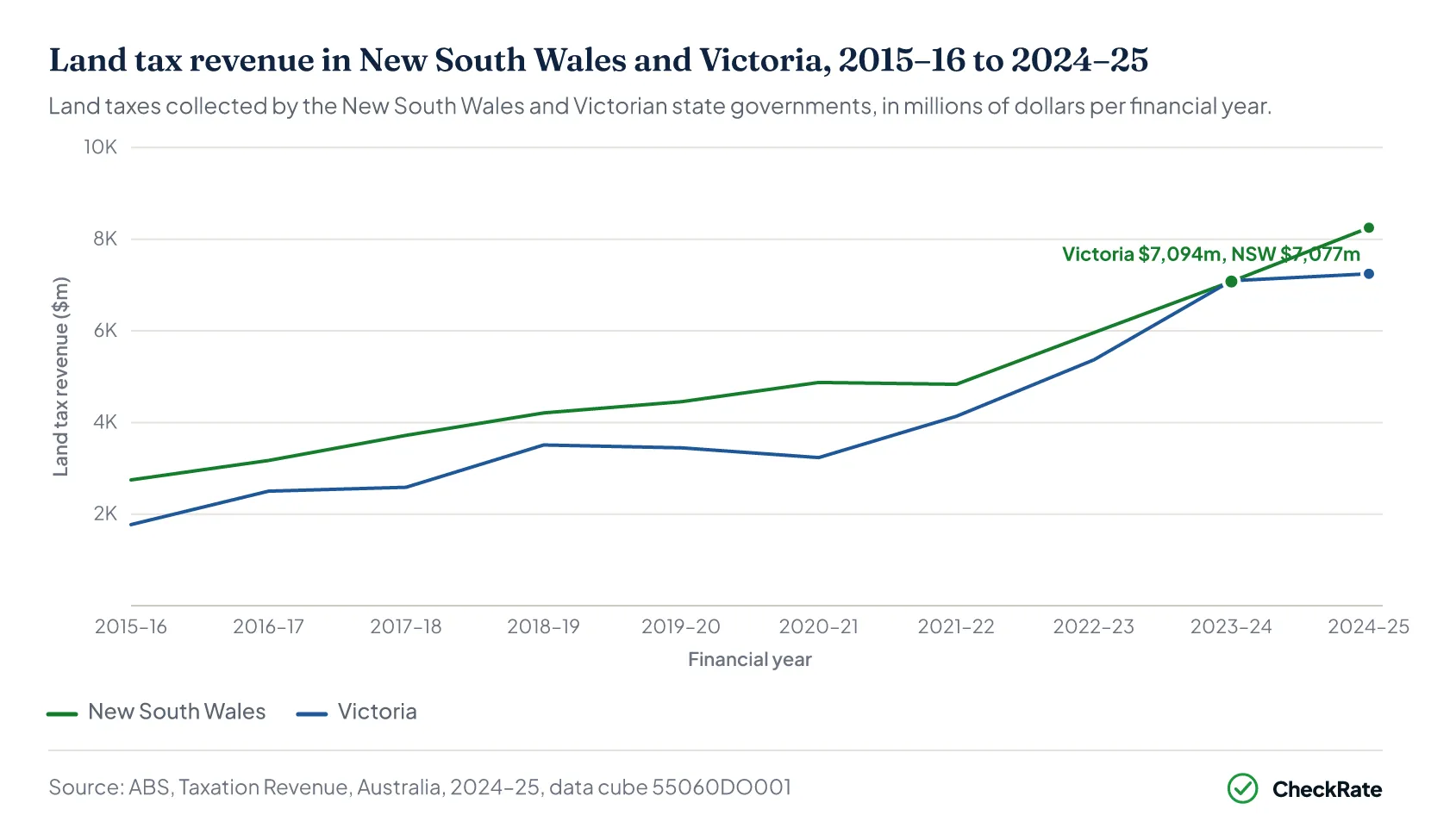
New South Wales collected the most land tax of any jurisdiction in 2024–25, at $8,251 million, ahead of Victoria's $7,246 million and Queensland's $2,353 million26. Victoria, however, had the highest land tax share of taxation revenue of any state or territory, at a derived 18.3% compared with 17.0% in New South Wales, 11.4% in South Australia and 6.1% in Western Australia. Across all states and territories, land tax accounted for a derived 14.2% of taxation revenue27.
Across all states and territories, land tax revenue rose from $7,237 million in 2015–16 to $20,002 million in 2024–25, a derived increase of 176%. In the latest year, revenue rose by a derived 10.1%, from $18,171 million in 2023–2426.
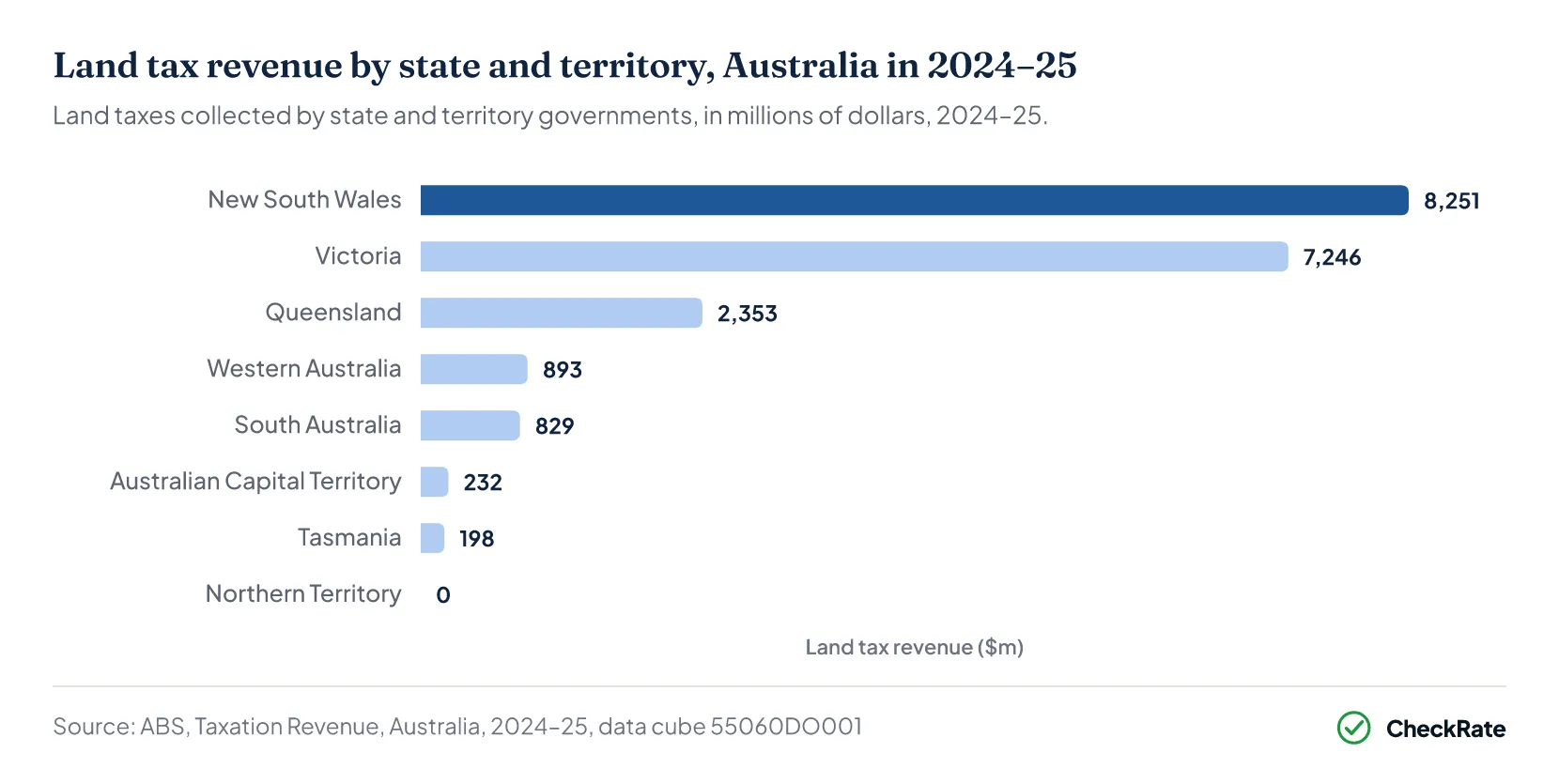
New South Wales collections more than tripled over the nine years, from $2,747 million in 2015–16 to $8,251 million in 2024–25, while Victoria's more than quadrupled, from $1,771 million to $7,246 million26. Victoria collected more land tax than New South Wales in 2023–24, $7,094 million against $7,077 million, the only year in the ten-year series in which Victoria collected more; in 2024–25 New South Wales collections rose by a derived 16.6% while Victoria's rose by 2.1%.
Western Australia was the only state whose collections in 2024–25 remained below their 2015–16 level. Its $893 million in 2024–25 was a derived 5.1% below the $941 million collected in 2015–1626.
| Land tax revenue by state and territory, Australia, 2015–16 to 2024–25 | ||||||
|---|---|---|---|---|---|---|
| Jurisdiction | 2015–16 ($m) | 2019–20 ($m) | 2022–23 ($m) | 2023–24 ($m) | 2024–25 ($m) | Share of state and territory taxes, 2024–25 |
| New South Wales | 2,747 | 4,453 | 5,961 | 7,077 | 8,251 | 17.0% |
| Victoria | 1,771 | 3,447 | 5,367 | 7,094 | 7,246 | 18.3% |
| Queensland | 1,010 | 1,406 | 1,732 | 2,026 | 2,353 | 9.3% |
| Western Australia | 941 | 784 | 779 | 837 | 893 | 6.1% |
| South Australia | 570 | 640 | 575 | 746 | 829 | 11.4% |
| Tasmania | 97 | 125 | 155 | 186 | 198 | 10.7% |
| Australian Capital Territory | 101 | 143 | 184 | 206 | 232 | 8.4% |
| Northern Territory | 0 | 0 | 0 | 0 | 0 | 0% |
| All states and territories | 7,237 | 10,999 | 14,754 | 18,171 | 20,002 | 14.2% |
Source · ABS, Taxation Revenue, Australia, 2024–25, data cube 55060DO001 and the release's jurisdiction table
Land tax applies to investment property held by individuals as well as companies and trusts. The federal tax position of rental property investors is covered in the negative gearing statistics.
Section 08 · FAQ
Land tax by state: quick answers
Which state has the highest land tax threshold?
New South Wales has the highest general land tax threshold of the six jurisdictions that publish one, at $1,075,000 for the 2026 land tax year, frozen at its 2024 level. South Australia is next at $936,000 for 2026–27. Victoria's $50,000 is the lowest. The ACT has no tax-free threshold, while the Northern Territory levies no land tax.
Is there land tax in the Northern Territory?
No. The Northern Territory Government states that there is no land tax in the NT, and that all other Australian states or territories levy it. The ABS series records no NT land tax revenue from 2015–16 to 2024–25.
Is the family home exempt from land tax?
The family home is generally exempt from land tax in every state that levies it, through a principal place of residence exemption whose conditions vary by jurisdiction. In the Australian Capital Territory the tax itself applies only to residential properties that are not the owner's principal place of residence, such as rented or vacant homes.
How much land tax do state and territory governments collect?
State and territory governments collected $20.0 billion in land tax in 2024–25, according to the Australian Bureau of Statistics. New South Wales collected $8,251 million, Victoria $7,246 million and Queensland $2,353 million, while each of the other five jurisdictions collected less than $1 billion. Land tax accounted for a derived 14.2% of all state and territory taxation revenue.
Do foreign owners pay a land tax surcharge?
Foreign or absentee owners can face a land tax surcharge in five jurisdictions: 5% in New South Wales, 4% in Victoria, 3% in Queensland, 2% in Tasmania and 0.75% in the ACT. The published land tax scales reviewed for South Australia and Western Australia do not show an equivalent foreign-owner surcharge.
When is land tax assessed in each state and territory?
New South Wales and Victoria assess land tax on the land an owner holds at midnight on 31 December, for the calendar-year land tax year that follows. Queensland, South Australia and Western Australia assess ownership at midnight on 30 June, and Tasmania on 1 July, for the following financial year. The ACT assesses land tax quarterly. The NT does not levy land tax.
References
- Northern Territory Government, Property taxes · nt.gov.au ↑
- Queensland Revenue Office, Taxable value of land explained · qro.qld.gov.au ↑ b
- Revenue NSW, What is land tax? · revenue.nsw.gov.au ↑ b
- RevenueSA, How land tax is assessed · revenuesa.sa.gov.au ↑ b
- ACT Revenue Office, Land tax · revenue.act.gov.au ↑
- Revenue NSW, Land tax thresholds and rates · revenue.nsw.gov.au ↑ b
- RevenueSA, Land tax rates and thresholds · revenuesa.sa.gov.au ↑ b
- RevenueSA, 2026–27 land tax rates and thresholds · revenuesa.sa.gov.au ↑
- Queensland Revenue Office, Land tax rates for individuals · qro.qld.gov.au ↑ b
- Government of Western Australia, Land tax assessment · wa.gov.au ↑ b c d
- State Revenue Office Victoria, Land tax historical rates · sro.vic.gov.au ↑
- ACT Revenue Office, How land tax is calculated · revenue.act.gov.au ↑ b
- State Revenue Office Victoria, Land tax current rates · sro.vic.gov.au ↑ b c
- Queensland Revenue Office, Land tax rates for companies and trusts · qro.qld.gov.au ↑
- State Revenue Office Victoria, Land tax · sro.vic.gov.au ↑
- Queensland Revenue Office, Land tax exemptions and relief · qro.qld.gov.au ↑
- RevenueSA, Exemptions, waiver or relief · revenuesa.sa.gov.au ↑
- State Revenue Office Tasmania, Land tax · sro.tas.gov.au ↑
- Revenue NSW, What is surcharge land tax? · revenue.nsw.gov.au ↑
- State Revenue Office Victoria, Understanding the absentee owner surcharge · sro.vic.gov.au ↑
- Queensland Revenue Office, Land tax rates for absentees · qro.qld.gov.au ↑
- State Revenue Office Tasmania, Foreign investor land tax surcharge: rate of surcharge · sro.tas.gov.au ↑
- Revenue NSW, How trusts are assessed for land tax · revenue.nsw.gov.au ↑
- Revenue NSW, How individuals and joint owners are assessed for land tax · revenue.nsw.gov.au ↑
- State Revenue Office Victoria, Joint ownership assessments · sro.vic.gov.au ↑
- ABS, Taxation Revenue, Australia, 2024–25, data cube 55060DO001 · Australian Bureau of Statistics ↑ b c d
- ABS, Taxation Revenue, Australia, 2024–25, Table 1 · Australian Bureau of Statistics ↑
- State Revenue Office Tasmania, Rates of land tax · sro.tas.gov.au
- ACT Revenue Office, Foreign ownership surcharge for land tax · revenue.act.gov.au