


Published
 Retirement visas compared: Thailand, Malaysia and PolandThailand's Non-Immigrant O-A (long stay) visa is open to applicants aged 50 and over. According to the Thai Ministry of Foreign Affairs, applicants must have a bank deposit of at least 800,000 baht, a…
 Selling an Australian home to buy overseas: how it affects the Age PensionProceeds from selling a principal home can be exempt from the Age Pension assets test for up to 24 months from settlement, provided they are intended to buy, build, rebuild, repair or renovate a new p…
 Keeping an Australian home after moving overseas: what happens to the Age PensionA principal home stops being exempt from the Age Pension assets test when its owner states they definitely do not intend to return. It also stops being exempt when a temporary absence for a reason oth…
Section 01 · Couple definition
Who counts as a partner for the Age Pension?
A person is assessed as a member of a couple for the Age Pension if they are legally married, in a registered relationship or in a de facto relationship, providing they have not permanently separated, according to the Department of Social Services (DSS) Social Security Guide1. A partner's citizenship, visa status or country of residence does not determine whether someone is part of a couple.
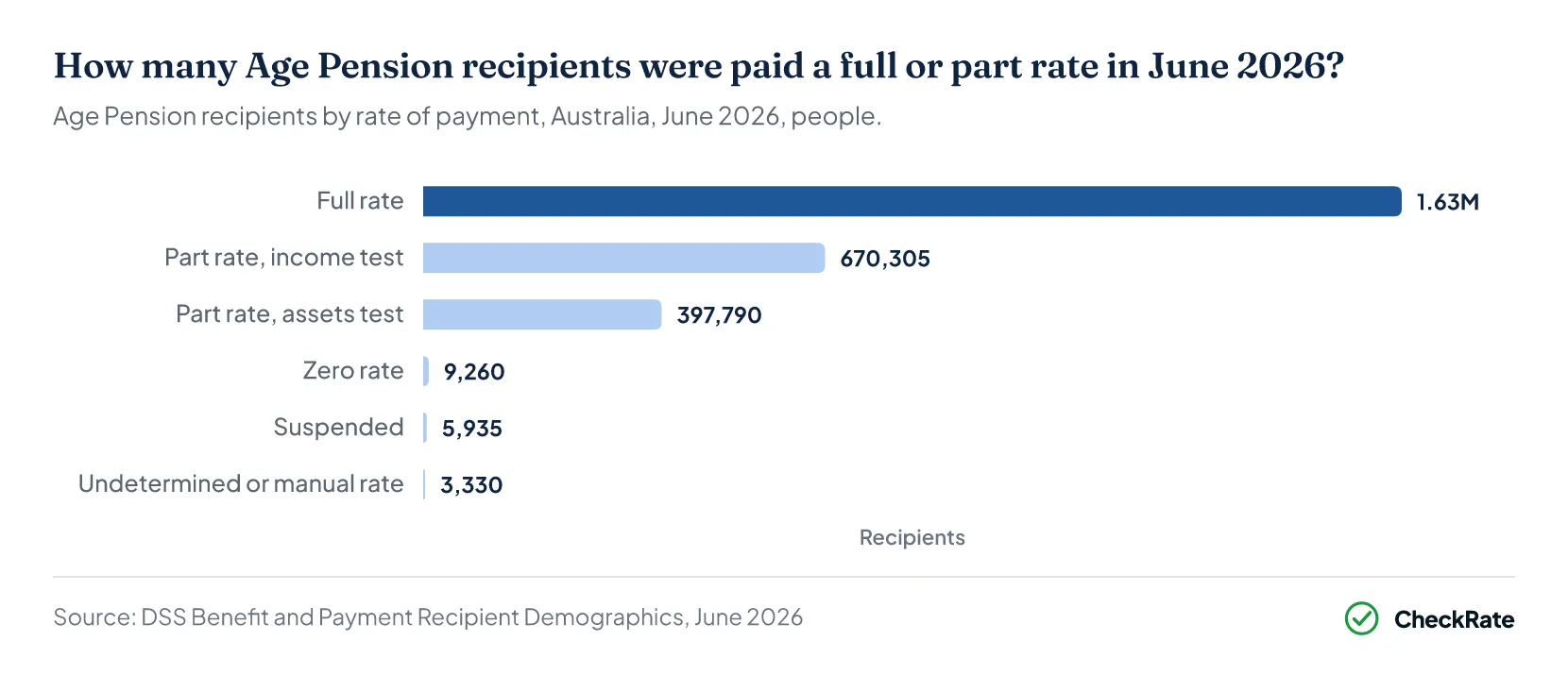
Partnered recipients accounted for 50.6% of Age Pension recipients in June 2026, at 1,376,765 of 2,718,425 people, according to DSS Benefit and Payment Recipient Demographics data2. Recipients who are married, in a de facto relationship or in a registered relationship are counted as partnered.
Only relationships registered under recognised Australian state or territory law count as registered relationships3. A relationship registered overseas does not automatically qualify as a registered relationship under Australian social security law, although it may still help establish a de facto relationship.
There is no minimum time a couple must be together before their relationship can be considered de facto for the Age Pension3. Social security law recognises only one couple relationship for a person at a time, including where a relationship was formed overseas.
Five factors are considered when determining whether two people are in a couple relationship:1
- the financial aspects of the relationship
- the nature of the household
- the social aspects of the relationship
- any sexual relationship between the two people
- the nature of their commitment to each other.
A temporary separation, such as for work, holidays or an attempt to reconcile, does not end a couple relationship4. A couple is considered permanently separated when their relationship has broken down and at least one partner has no intention of reconciling.
Section 02 · Couple rates
How do Age Pension couple rates compare with single rates?
The maximum Age Pension rate from 20 September 2026 is $933.00 a fortnight for each member of a couple, or $1,866.00 for the couple combined, compared with $1,237.70 for a single person, according to the DSS Social Security Guide5. Each partner's maximum rate is equal to 75.4% of the single rate, and the combined couple rate is equal to 150.8% of it.
The maximum rate has three parts6: the basic pension, the Pension Supplement and the Energy Supplement. For each member of a couple, these are $855.90, $66.50 and $10.60 a fortnight respectively, compared with $1,135.40, $88.20 and $14.10 for a single person. The rates are adjusted every 20 March and 20 September.
A partnered pensioner is paid the single rate in three cases:5
- The couple lives apart because of illness or disability affecting one or both partners.
- The couple is separated because one partner is receiving respite care.
- The pensioner's partner is in prison.
In each of these cases, the couple's combined income and assets are still assessed5. A partner living overseas, or a partner who does not qualify for a pension, does not automatically entitle the pensioner to the single rate.
A pensioner residing in Australia keeps the Energy Supplement for up to six weeks while temporarily overseas and the Pension Supplement for up to 12 weeks5. After 12 weeks away, or for a pensioner not residing in Australia, the maximum rate is the basic rate alone, at $855.90 a fortnight for each member of a couple and $1,135.40 for a single person.
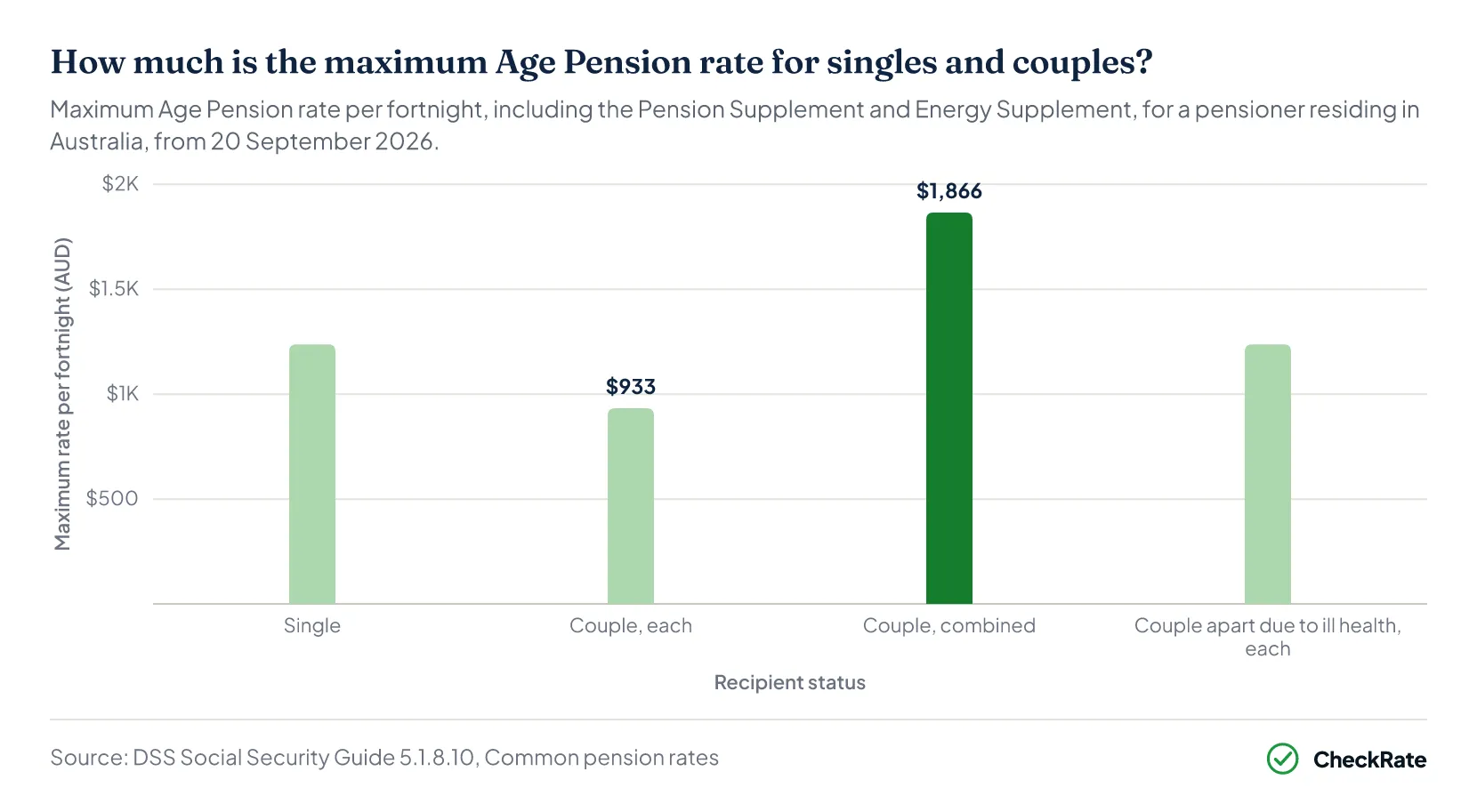
| Maximum Age Pension rates per fortnight by part, Australia, from 20 September 2026 | ||||
|---|---|---|---|---|
| Part of the rate | Single | Couple, each | Couple, combined | Ill-health apart, each |
| Maximum basic rate | $1,135.40 | $855.90 | $1,711.80 | $1,135.40 |
| Maximum Pension Supplement | $88.20 | $66.50 | $133.00 | $88.20 |
| Energy Supplement | $14.10 | $10.60 | $21.20 | $14.10 |
| Total | $1,237.706 | $933.006 | $1,866.006 | $1,237.70 |
Source · Services Australia, How much Age Pension you can get; DSS Social Security Guide 5.1.8.10
Section 03 · Partner income
How is a partner's income counted for the Age Pension, including foreign pensions?
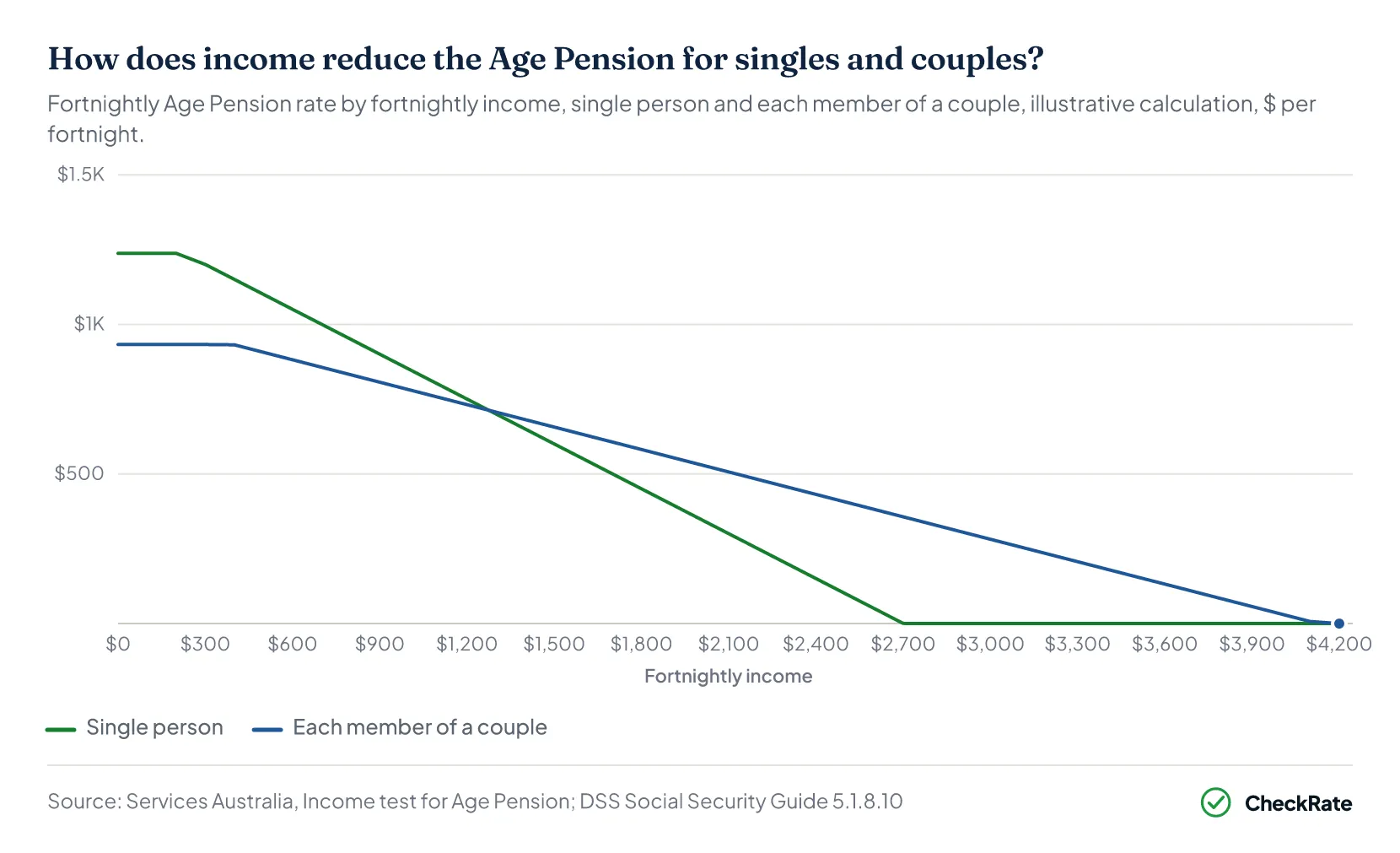
Each member of a couple has their Age Pension reduced by 25 cents for each dollar of the couple's combined income above $396 a fortnight, from 1 July 2026, according to Services Australia7. A single person's pension is reduced by 50 cents for each dollar above $226 a fortnight.
For couples, the combined income is divided equally between the partners. The pension is then reduced by 50 cents for each dollar above each partner's share of the income free area. This means a reduction of 25 cents for each dollar of combined income above $396 for each eligible pensioner8. Income free areas are adjusted to the consumer price index on 1 July each year.
Income from all sources counts for both the pensioner and the partner, including deemed income from financial assets such as savings, shares and superannuation7. That includes any income the partner has in another country9.
A couple living together receives no pension in a fortnight when combined income exceeds $4,128.00, compared with $2,701.40 for a single person7. The cut-off point can be lower for a pensioner who does not live in Australia.
How do foreign pensions count in the Age Pension income test?
A pension from another country counts as income before tax and other deductions, whether it is paid from overseas or through an Australian agent10.
Foreign tax, bank charges and foreign debts are not deducted when calculating the pension's value10. Each payment is converted to Australian dollars, and the exchange rate used changes each month11.
The same rules apply to other overseas payments, including war pensions, public service pensions, private annuities and other private overseas income streams10. Some restitution payments and blocked pensions are exempt, as are some pensions or parts of pensions affected by an international social security agreement11.
A foreign pension may be excluded from the income test if there is little or no realistic prospect of the recipient ever receiving it10. However, a pension is not considered blocked simply because the paying country restricts payments to its residents or people physically present there. In Rose v Secretary, Department of Social Security (1990), the Federal Court decided that the definition of income has no territorial limit.
A lump sum from overseas that is not arrears of a foreign pension is assessed as income for 12 months from the date it is received10. Overseas financial investments are assessed using their value in Australian dollars, while overseas rental and business income are assessed after allowable deductions11.
Worked example · a partner's foreign pension of $800 a fortnight
This is an example calculation based on the couple rate from 20 September 2026 and the income test from 1 July 2026. A pensioner with no income of their own has a partner who receives no Australian payment and a foreign pension worth $800 a fortnight after conversion to Australian dollars.
The couple's combined income of $800 is $404 above the $396 free area. The pensioner's rate is reduced by 25 cents for each dollar above the free area, or $101.00, from $933.00 to $832.00 a fortnight7.
The calculation covers the income test only. It assumes the couple's assets are below the full-pension assets limit.
How net worth and financial assets are distributed across Australian households is covered in the Australian wealth statistics article.
Section 04 · Partner assets
How are a partner's assets counted for the Age Pension, including overseas property?
From 20 September 2026, a homeowner couple can have combined assessable assets of up to $499,000 before the Age Pension is reduced, compared with $766,000 for a non-homeowner couple, according to Services Australia12. A couple's assets are assessed together, and the part pension stops when combined assets exceed $1,121,000 for a homeowner couple and $1,388,000 for a non-homeowner couple.
The same couple limits apply even where only one partner is eligible for the Age Pension, at $499,000 and $766,000 for a full pension12. For a single person, the full-pension limits are $333,000 for a homeowner and $600,000 for a non-homeowner.
Assets include property and possessions that a person owns, either fully or partly, including those held overseas12. Overseas assets are converted to Australian dollars9.
Real estate other than the principal home counts in the assets test, including property that is rented out, left vacant, or occupied by someone without paying rent13. Real estate is assessed at current market value, minus any mortgage debt secured against the owner's share of the property.
Which home is exempt when a couple has homes in two countries?
Only one home can be treated as a couple's principal home and excluded from the Age Pension assets test. The principal home, including adjacent land, is exempt from the assets test regardless of its value14.
Where a couple has more than one home, the principal home is generally the one in which they spend the most time, or the more expensive home if they spend the same time in each15. The other home is assessed as an asset even while the couple are living in it.
A person is considered a homeowner if they or their partner have a legal right or interest in the property that gives them reasonable security of tenure16. Homeowners are assessed against the lower homeowner assets limits12.
A principal home that is temporarily left vacant for reasons other than care or damage can remain exempt for up to 12 months, even when the absence is expected to last longer17. The period can be extended for a person who is overseas and unable to return because of circumstances beyond their control.
If the owner no longer intends to return, the home is counted as an asset and the higher non-homeowner limit applies17.
For a principal home sold on or after 1 January 2023, the part of the sale proceeds intended for a new principal home is exempt for up to 24 months, and the exemption can be extended to a maximum of 36 months18. Only the amount intended for the new home is exempt.
For capital gains tax, foreign residents for tax purposes cannot claim the main residence exemption on property sold from 1 July 2020 unless they satisfy the life events test, according to the Australian Taxation Office (ATO)19.
In June 2026, 1,969,100 of 2,718,425 Age Pension recipients were recorded as homeowners, equivalent to 72.4%, according to DSS data2. A recipient counted as a homeowner may not be living in the home they own.
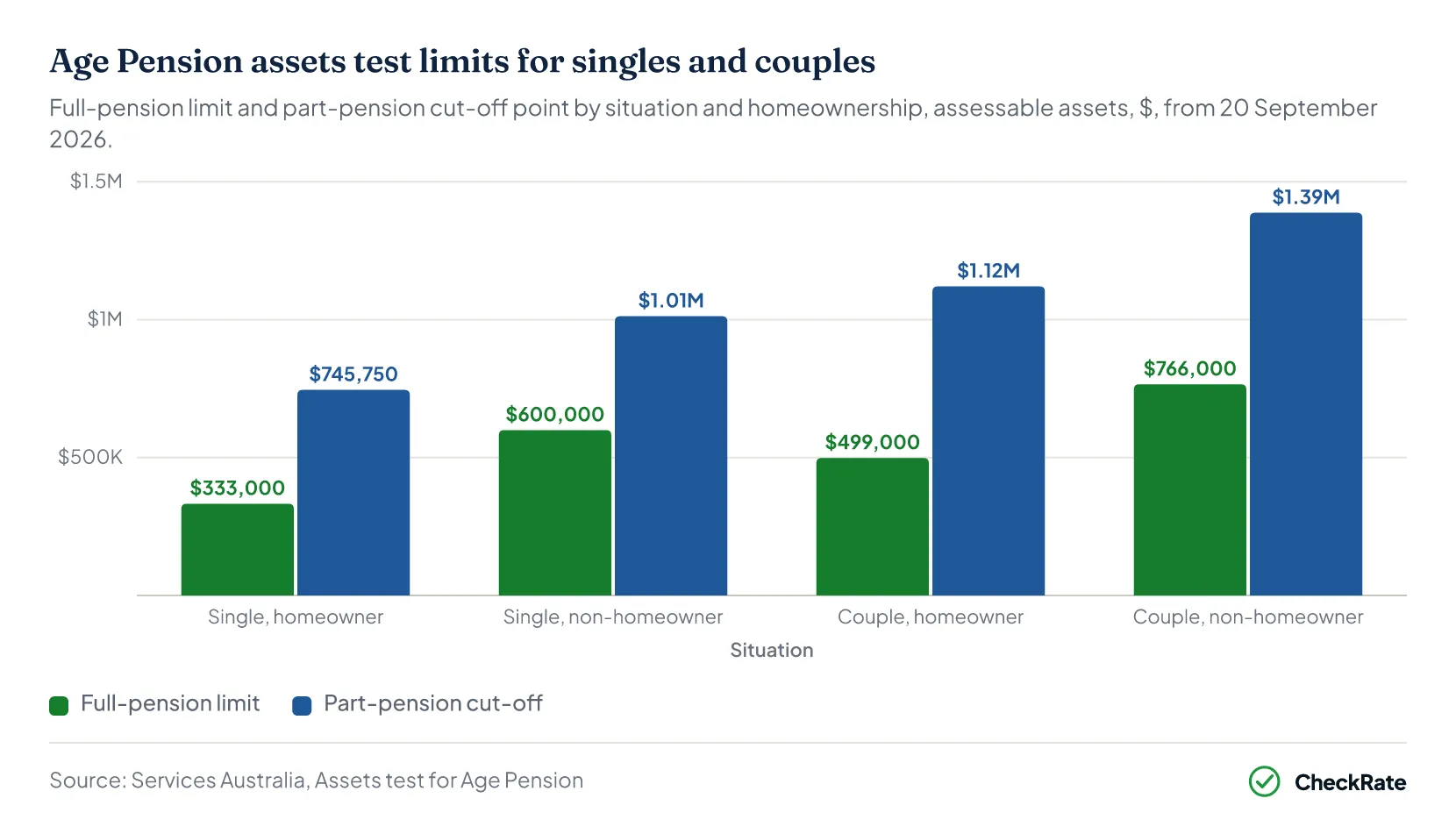
| Age Pension assets test limits by situation, Australia, from 20 September 2026 | ||||
|---|---|---|---|---|
| Situation | Full pension, homeowner | Full pension, non-homeowner | Part-pension cut-off, homeowner | Part-pension cut-off, non-homeowner |
| Single | $333,000 | $600,000 | $745,75012 | $1,012,75012 |
| Couple, combined | $499,000 | $766,000 | $1,121,000 | $1,388,000 |
| Couple, one partner eligible, combined | $499,000 | $766,000 | $1,121,000 | $1,388,000 |
| Couple separated due to illness, combined | $499,000 | $766,000 | $1,324,50012 | $1,591,500 |
Source · Services Australia, Assets test for Age Pension
Home ownership across the Australian population is covered in the Australian home ownership statistics article.
Section 05 · Partner eligibility
Can a non-Australian partner get the Age Pension?
A partner can get the Age Pension in their own right only if they meet the eligibility requirements, including being at least 67 years old and meeting the Australian residence rules20.
Unless they qualify under an international social security agreement, a person must meet three conditions when claiming the Age Pension:21
- living in Australia
- physically present in Australia
- an Australian resident, meaning a person living long-term in Australia who is an Australian citizen, a permanent visa holder or a protected Special Category visa holder from New Zealand.
A claimant needs at least 10 years of Australian residence in total, including at least five consecutive years21. Refugees and former refugees are exempt from the 10-year rule, and a woman whose partner has died can qualify with two years of continuous Australian residence immediately before claiming, if both partners were Australian residents when the partner died22.
People who qualify under an international social security agreement may be able to claim without meeting the usual Australian residence requirement22. Australia has no social security agreement with Thailand or the Philippines23.
A partner who does not qualify still counts in the means tests. The couple assets limits apply even when only one partner is eligible. A partnered pensioner is paid the single rate only when the couple is separated due to illness, one partner is in respite care or the other partner is in prison5.
A person of Age Pension age who does not meet all the rules may be eligible for a Commonwealth Seniors Health Card20.
A pensioner who is overseas for more than 26 weeks, or indefinitely, is generally paid a proportional rate based on their Australian working-life residence between age 16 and Age Pension age, up to a maximum of 35 years5.
A person with no Australian working-life residence, such as someone who first arrived after Age Pension age, receives no Age Pension while overseas even though they remain qualified5.
| Ways to meet the Age Pension residence rules, Australia | |
|---|---|
| Route | Residence requirement |
| General rule | At least 10 years of Australian residence in total, with at least 5 of those years without a break21 |
| Refugee or former refugee | Exempt from the 10-year rule |
| Woman whose partner has died | Australian resident for the 2 years before the claim, and both partners Australian residents when the partner died |
| Lived or worked in an agreement country | May qualify under a social security agreement, and the Australian residence requirement does not apply to a claimant relying on an agreement |
Source · Services Australia, Residence rules for Age Pension; DSS Social Security Guide 3.4.1.10
The proportional rate for pensioners who move overseas is explained in the article on how much Age Pension is paid to Australians living overseas.
Section 06 · Reporting
When must Age Pension recipients tell Services Australia about a partner?
Age Pension recipients must notify Services Australia within 14 days if they marry, separate or divorce24. The same 14-day period applies when the recipient or their partner starts receiving a pension from overseas, receives a lump sum, starts or changes employment, or buys or sells shares.
Changes to real estate must also be reported within 14 days13. Employment income must be reported for both partners, even if the amount is below the income cut-off point6.
Services Australia may ask a couple to confirm their relationship status25.
Overseas payments are reviewed annually to update their rates10. Where a recipient or partner may be entitled to a foreign pension and has not applied for it, the Secretary of the department can require them to take reasonable steps to claim it24.
If a foreign pension includes a lump-sum payment for earlier periods, the amount is assessed against those periods. Any reduction that would have applied to the pension of the recipient or their partner may result in a debt that must be repaid10.
| Changes Age Pension recipients report within 14 days, Australia | |
|---|---|
| Change | Whose change |
| Marriage, separation or divorce | Recipient |
| An overseas pension starts | Recipient or partner |
| A lump sum or one-off payment is received | Recipient or partner |
| Employment, including self-employment, starts or changes | Recipient or partner |
| Shares or managed investments are bought or sold, or new accounts are opened | Recipient or partner |
| More than $2,000 of assets is gifted in an income year, or assets are sold for less than their value24 | Recipient or partner |
| Real estate changes in value, ownership share or mortgage balance beyond the usual repayment, or is bought or sold | Recipient |
| Overseas travel that may affect the payment after an absence of more than 6 weeks24 | Recipient |
Source · DSS Social Security Guide 3.4.1.50; Services Australia, Real estate assets
Section 07
Age Pension with a non-Australian partner: quick answers
Does a partner's income affect the Age Pension?
Yes. A partner's income affects the Age Pension because both partners' incomes are assessed together. Each partner's pension is reduced by 25 cents for each dollar of combined income above $396 a fortnight from 1 July 20267. The income of a partner who is not an Australian citizen or resident counts in the same way, including a foreign pension.
Does a foreign pension count as income for the Age Pension?
A foreign pension counts as income at its gross amount, converted to Australian dollars, with no deduction for foreign tax, bank charges or foreign debts. Some foreign pensions are treated differently under Australia's social security agreements, such as New Zealand superannuation and the Italian supplement.
Does property overseas count in the Age Pension assets test?
Property overseas counts in the Age Pension assets test unless it is the couple's principal home, which is generally the home where they spend the most time each year. A second home is assessed at its market value even while the couple are staying in it.
What is the couple rate of Age Pension?
The maximum couple rate of Age Pension is $933.00 a fortnight for each partner, or $1,866.00 combined, from 20 September 20266. The maximum single rate is $1,237.70 a fortnight.
Can a foreign spouse get the Age Pension in Australia?
A foreign spouse can get the Age Pension if they meet the eligibility requirements, including being at least 67 years old20, meeting the Australian residence rules when claiming and generally having lived in Australia for at least 10 years21. Exemptions apply to refugees, some women whose partner has died and people covered by a social security agreement.
Is the single rate of Age Pension paid when a partner lives overseas?
A pensioner whose partner lives overseas is generally paid the couple rate. The single rate applies only in certain circumstances, including separation due to illness, respite care or imprisonment of a partner. A couple living in different countries remains a couple for the Age Pension unless the relationship has broken down.
References
- DSS, Social Security Guide 1.1.M.120 Member of a couple · guides.dss.gov.au ↑ b c
- DSS Benefit and Payment Recipient Demographics, June 2026 · data.gov.au ↑ b c d e
- DSS, Social Security Guide 2.2.5.10 Types of member of a couple relationships · guides.dss.gov.au ↑ b
- DSS, Social Security Guide 2.2.5.30 Determining member of a couple relationships · guides.dss.gov.au ↑
- DSS, Social Security Guide 5.1.8.10 Common pension rates · guides.dss.gov.au ↑ b c d e f g
- Services Australia, How much Age Pension you can get (rates from 20 September 2026) · servicesaustralia.gov.au ↑ b c d e f
- Services Australia, Income test for Age Pension · servicesaustralia.gov.au ↑ b c d e f
- DSS, Social Security Guide 4.2.1.10 Pensions income test · guides.dss.gov.au ↑
- Services Australia, Income and assets from outside Australia can affect your Age Pension · servicesaustralia.gov.au ↑ b
- DSS, Social Security Guide 4.3.6.10 Income from overseas payments · guides.dss.gov.au ↑ b c d e f g h
- Services Australia, Income from outside Australia (Age Pension) · servicesaustralia.gov.au ↑ b c
- Services Australia, Assets test for Age Pension · servicesaustralia.gov.au ↑ b c d e f g
- Services Australia, Real estate assets · servicesaustralia.gov.au ↑ b
- DSS, Social Security Guide 4.6.3.10 General provisions for assessing the principal home · guides.dss.gov.au ↑
- DSS, Social Security Guide 4.6.3.30 Defining the principal home · guides.dss.gov.au ↑
- Department of Social Services, Social Security Guide 4.6.3.20 Determining homeowners and non-homeowners · guides.dss.gov.au ↑
- Department of Social Services, Social Security Guide 4.6.3.60 Exempting the principal home - temporary vacation of property · guides.dss.gov.au ↑ b
- Department of Social Services, Social Security Guide 4.6.3.90 Exempting the principal home: sale proceeds · guides.dss.gov.au ↑
- ATO, Main residence exemption for foreign residents · ato.gov.au ↑
- Services Australia, Who can get Age Pension · servicesaustralia.gov.au ↑ b c
- Services Australia, Residence rules for Age Pension · servicesaustralia.gov.au ↑ b c d
- DSS, Social Security Guide 3.4.1.10 Qualification for Age · guides.dss.gov.au ↑ b
- DSS, Social Security Guide Part 10 Australian Social Security Agreements · guides.dss.gov.au ↑
- DSS, Social Security Guide 3.4.1.50 Notification and recipient obligations for Age · guides.dss.gov.au ↑ b c d e
- Services Australia, Relationship changes · servicesaustralia.gov.au ↑