

Updated
 Business loan interest rates in Australia: what small, medium and large businesses payThe average interest rate on outstanding small-business loans was 7.46% in July 2026, compared with 6.21% for medium businesses and 5.74% for large businesses. New loans funded in July 2026 averaged 7…
 How many businesses are there in Australia? Entries, exits and survival ratesAustralia had 2,814,778 actively trading businesses at 30 June 2026, according to the Australian Bureau of Statistics (ABS) Counts of Australian Businesses data. The number grew from 2,729,648 at 30 J…
 SME lending statistics: how much small and medium businesses borrow in AustraliaLending outstanding to small businesses was $208.0 billion at 30 June 2026, while medium businesses had $584.9 billion outstanding, bringing combined SME lending to $792.8 billion, according to the Re…
Section 01 · From 1 October 2026
What changed for card surcharges and merchant fees on 1 October 2026?
The RBA lifted its prohibition on no-surcharge rules for the designated eftpos, Mastercard and Visa card networks on 1 October 2026, covering debit, prepaid and credit cards12. Its Payments System Board published the final decisions on 31 March 20263. The RBA stated that surcharging on debit and credit cards should end from that date4. eftpos, Mastercard and Visa each introduced no-surcharge rules from 1 October 2026, so merchants can no longer add a card surcharge on those networks unless an exception applies1. If surcharging continues after the change, the government could legislate a ban on surcharging cards of the designated networks5.
The cap on interchange fees for debit and prepaid cards issued in Australia fell from 10 cents, or 0.2% for fees charged as a share of value, to 8 cents, or 0.16%, on 1 October 20266. The cap for consumer credit cards issued in Australia also fell from 0.8% to 0.3% of the transaction value, while the 0.8% cap for commercial credit cards was retained. A cap of 1.0% of the transaction value on interchange fees for cards issued overseas will apply from 1 April 2027.
The interchange changes are estimated to save merchants around $910 million per year4. Card issuers' interchange revenue is expected to fall by an estimated $660 million per year2. Payment service providers were expected to spend around $25 million across the industry to implement the removal of surcharging.
eftpos, Mastercard, Visa and large acquirers must publish the fees they charge, with the first quarterly publications due by 30 October 2026 for the September quarter 20262. Acquirers must publish how much of the interchange reduction they pass through by 30 January 2027, and merchant statements must carry additional information from 1 April 2027.
| Payments System Board decisions on surcharging, interchange caps and fee transparency, Australia, settings before and after the change, 2026 to 2027 | |||
|---|---|---|---|
| Policy | Setting before the change | Setting after the change | Start date |
| Surcharging on eftpos, Mastercard and Visa debit, prepaid and credit cards | RBA prohibits no-surcharge rules, so merchants may surcharge | RBA lifted its prohibition on no-surcharge rules; eftpos, Mastercard and Visa introduced no-surcharge rules1 | 1 October 2026 |
| Interchange cap, debit and prepaid cards issued in Australia | 10 cents or 0.2% of value; benchmark 8 cents | 8 cents or 0.16% of value; benchmark 8 cents | 1 October 2026 |
| Interchange cap, consumer credit cards issued in Australia | 0.8% of value; benchmark 0.5% | 0.3% of value; benchmark abolished | 1 October 2026 |
| Interchange cap, commercial credit cards issued in Australia | 0.8% of value; benchmark 0.5% | 0.8% of value; benchmark abolished | 1 October 2026 |
| Interchange cap, cards issued overseas | No cap | 1.0% of value | 1 April 2027 |
| Publication of fees by eftpos, Mastercard, Visa and large acquirers | Not required | Quarterly publication | First publication by 30 October 2026, for 1 July to 30 September 2026 |
| Publication of interchange pass-through by acquirers | Not required | First publication by 30 January 2027 | 30 January 2027 |
| Additional information on merchant statements | Not required | Required from the first full statement period starting on or after 1 April 2027 | 1 April 2027 |
Source · RBA, Review of Merchant Card Payment Costs and Surcharging, Conclusions Paper, March 2026, chapters 2, 3 and 8
Section 02 · June quarter 2026
What do Australian businesses pay to accept card payments?
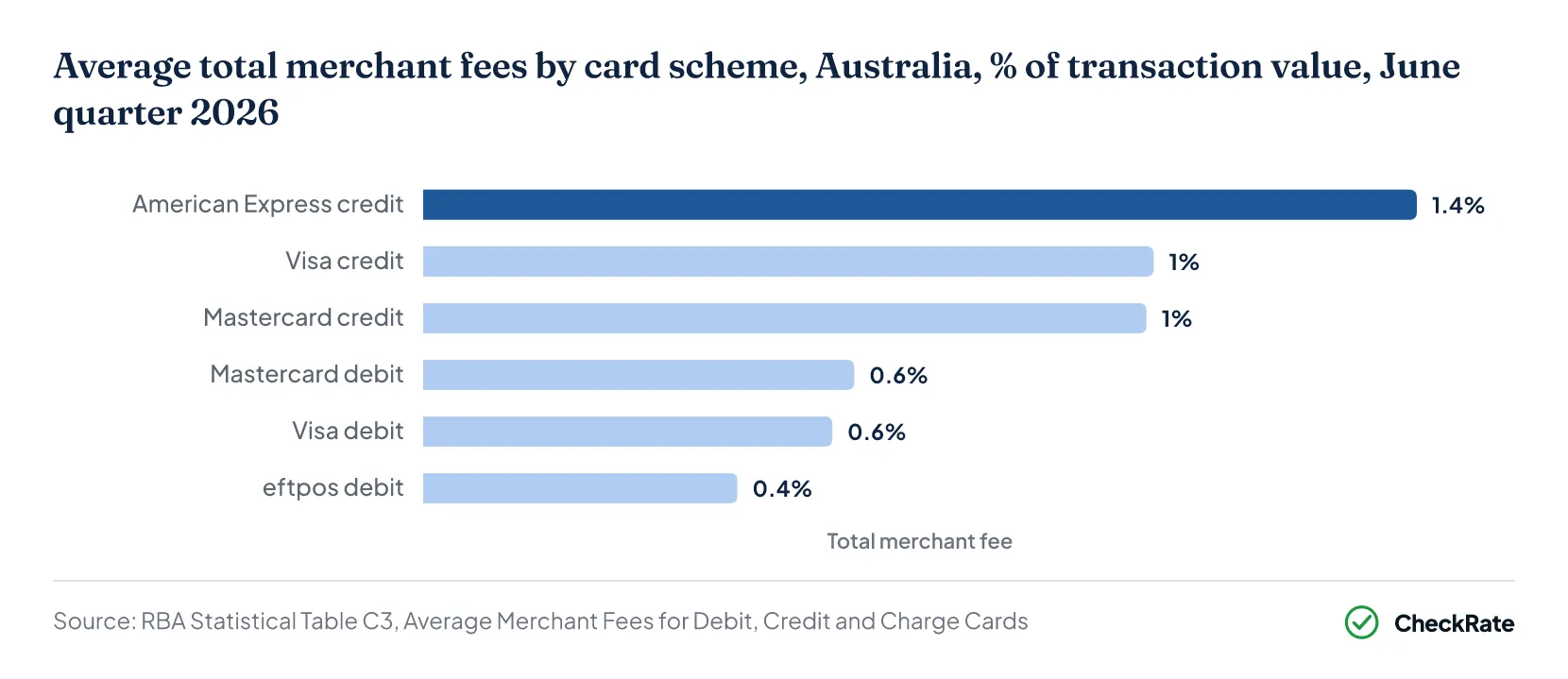
Businesses paid an average total merchant fee of 1.00% of the transaction value on Visa credit cards in the June quarter 20268. Mastercard credit cards cost 0.99%. Mastercard debit cards cost 0.59% and Visa debit cards cost 0.56%. eftpos debit cards had the lowest average total merchant fee among the six card schemes, at 0.43%. American Express cards had the highest average total merchant fee among the six card schemes, at 1.36%. The gap between the American Express fee and the eftpos fee was 0.93 percentage points.
A total merchant fee is the merchant service fee, which is charged on the value or number of transactions, plus other acquiring fees such as terminal rentals, monthly fees and joining fees9. Other acquiring fees averaged 0.03% of purchase value across all card schemes in the June quarter 20268. The merchant service fee was 0.96% on Visa credit cards and 0.40% on eftpos debit cards.
Between the June quarters of 2025 and 2026, the Visa credit card fee rose 0.05 percentage points, from 0.95% to 1.00%8. The eftpos fee fell 0.01 percentage points, from 0.44% to 0.43%, while the Visa debit card fee rose 0.02 percentage points, from 0.54% to 0.56%.
| Average total merchant fees and merchant service fees by card scheme, Australia, % of transaction value, June quarter 2025 to June quarter 2026 | ||||
|---|---|---|---|---|
| Card scheme | Total merchant fee, June quarter 2026 (%) | Merchant service fee, June quarter 2026 (%) | Total merchant fee, June quarter 2025 (%) | Change (percentage points) |
| American Express credit | 1.36 | 1.33 | 1.35 | +0.01 |
| Visa credit | 1.00 | 0.96 | 0.95 | +0.05 |
| Mastercard credit | 0.99 | 0.95 | 0.97 | +0.02 |
| Mastercard debit | 0.59 | 0.55 | 0.58 | +0.01 |
| Visa debit | 0.56 | 0.53 | 0.54 | +0.02 |
| eftpos debit | 0.43 | 0.40 | 0.44 | -0.01 |
Source · RBA, Statistical Table C3
Section 03 · International and online
How do international and online card fees compare with domestic in-person fees?
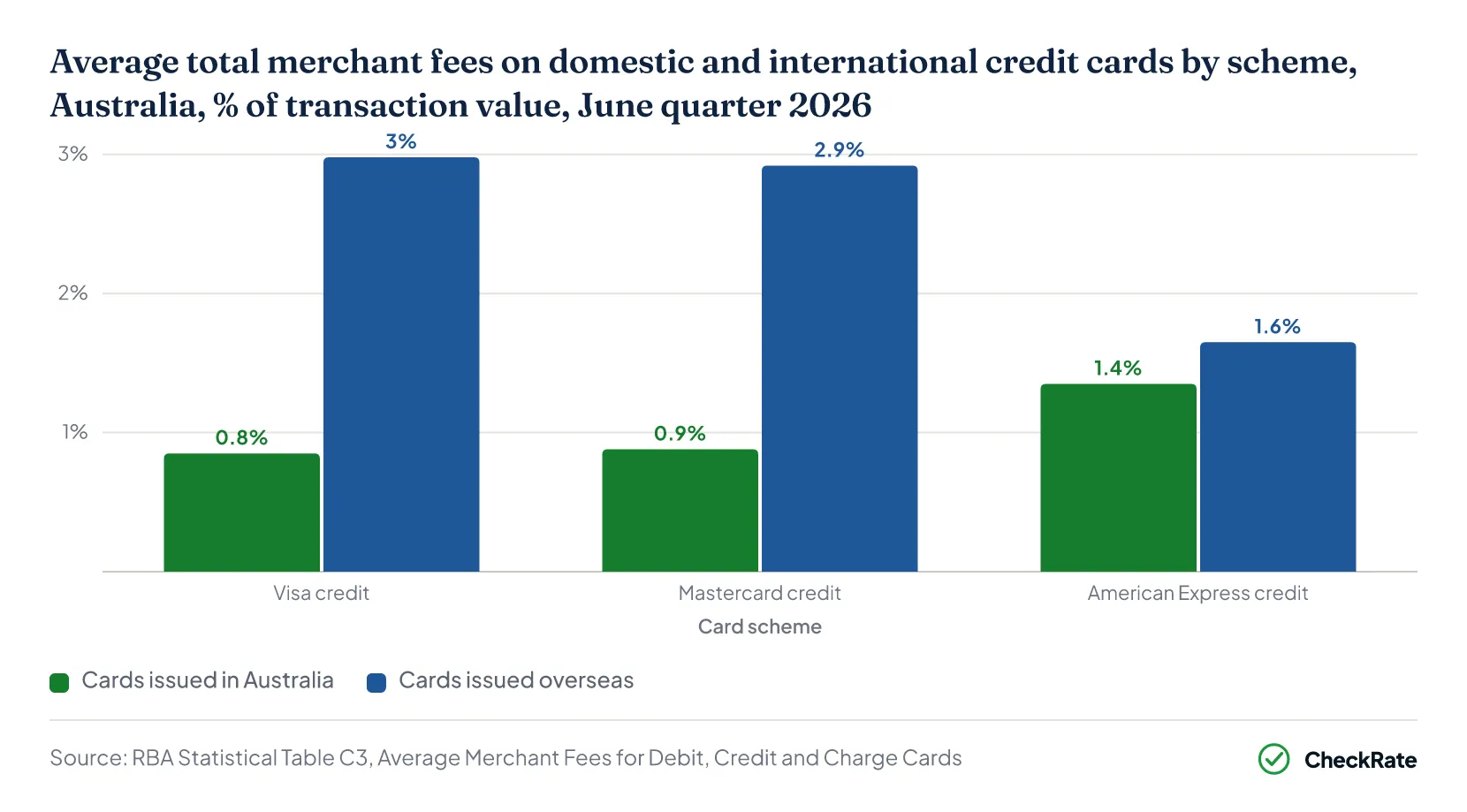
Visa, Mastercard and American Express credit cards issued overseas cost more to accept than those issued in Australia in the June quarter 2026, while domestic Visa credit and debit cards cost less when the card was not present than when used at a terminal8. The average total merchant fee was 2.98% of the transaction value on Visa credit cards issued overseas and 0.85% on Visa credit cards issued in Australia. Visa credit cards issued overseas recorded the highest average total merchant fee among the 25 card categories. Mastercard credit cards issued overseas cost 2.92%, compared with 0.88% for those issued in Australia. American Express cards issued overseas cost 1.65%, compared with 1.35% for those issued in Australia.
The fee on Visa credit cards issued overseas rose from 1.77% in the September quarter 2020 to 2.98% in the June quarter 20268.
The comparison spans the RBA's collection changes in the December quarter 2022 and the December quarter 20249.
The average total merchant fee for online, in-app, mail and telephone payments, which the RBA calls device not present, was 0.82% on Visa credit cards issued in Australia in the June quarter 2026, compared with 0.89% for payments made at a terminal8. Visa debit cards issued in Australia cost 0.44% when the card was not present, compared with 0.52% at a terminal. Other acquiring fees were 0.04% of purchase value for payments at a terminal and 0.03% for remote payments.
| Average total merchant fees by card scheme, card origin and payment channel, Australia, % of transaction value, June quarter 2026 | ||||
|---|---|---|---|---|
| Card scheme | Cards issued in Australia (%) | Cards issued overseas (%) | Domestic cards, device present (%) | Domestic cards, device not present (%) |
| eftpos debit | .. | .. | 0.42 | .. |
| Visa debit | 0.48 | .. | 0.52 | 0.44 |
| Mastercard debit | 0.54 | .. | 0.54 | 0.54 |
| Visa credit | 0.85 | 2.98 | 0.89 | 0.82 |
| Mastercard credit | 0.88 | 2.92 | 0.87 | 0.88 |
| American Express credit | 1.35 | 1.65 | 1.37 | 1.35 |
Source · RBA, Statistical Table C3
Section 04 · Since 2003
How have merchant fees changed since 2003?
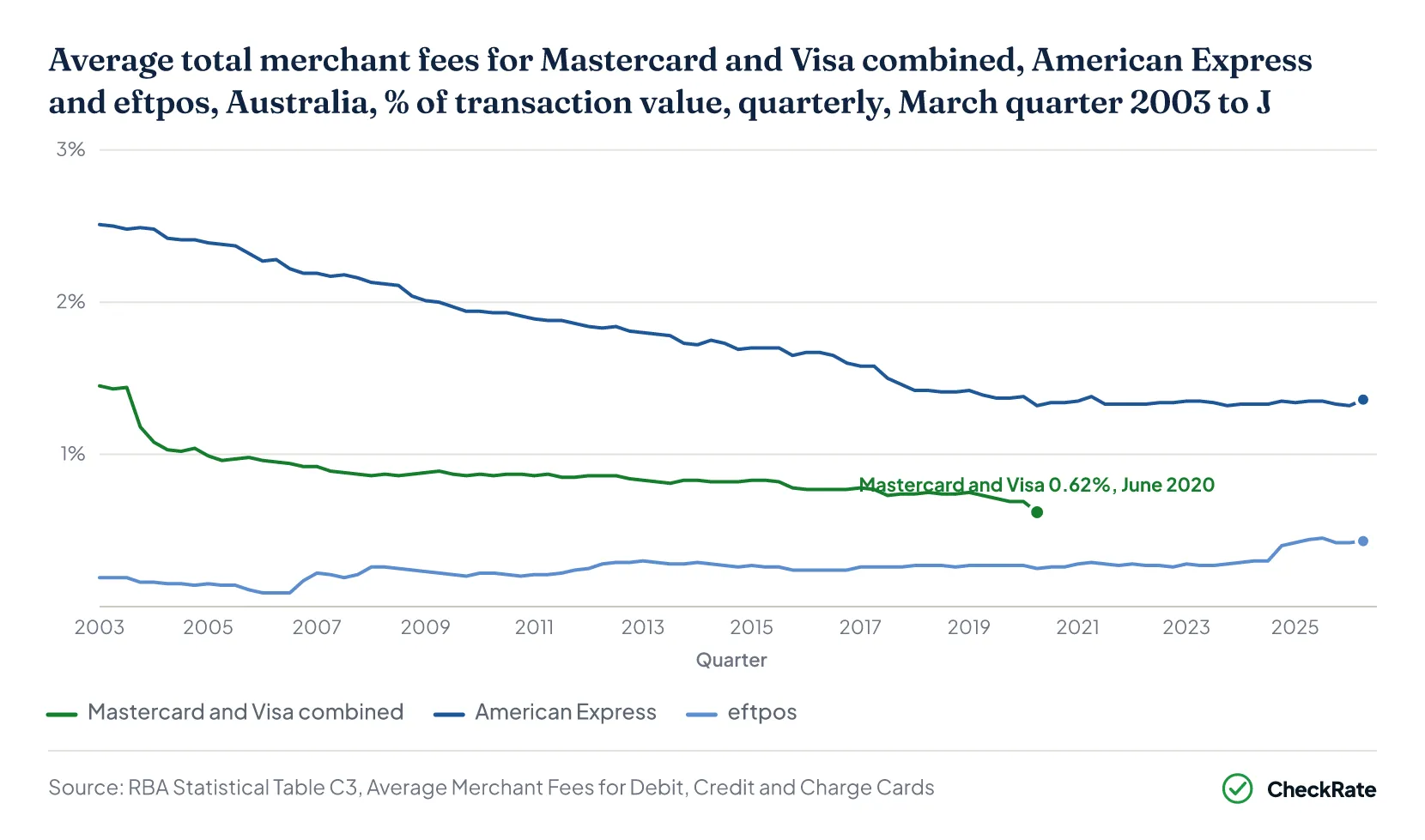
The average total merchant fee on Mastercard and Visa cards combined fell from 1.45% of the transaction value in the March quarter 2003 to 0.62% in the June quarter 2020, the last quarter for which the RBA updated the combined measure8. The fall was 0.83 percentage points over the 70 quarters. American Express fees fell from 2.51% in the March quarter 2003 to 1.36% in the June quarter 2026. eftpos fees rose from 0.19% to 0.43% over the same period.
The eftpos and American Express comparisons span four breaks in the RBA's reporting since 2018: December 2018, September 2020, December 2022 and December 2024. These changes affected reporting, definitions or collection coverage, so movements across the breaks do not reflect fee changes alone9.
Among the 70 quarters from the March quarter 2003 to the June quarter 2020, the combined Mastercard and Visa fee was highest in March 2003, at 1.45%8. Across the 94 quarters to the June quarter 2026, eftpos recorded its lowest average total merchant fee at 0.09% in the March, June and September quarters of 2006, and its highest of 0.45% in the September quarter 2025. American Express recorded its highest fee over the same 94 quarters in the March quarter 2003, at 2.51%.
The Visa credit card fee rose from 0.80% in the September quarter 2020, when the RBA first reported fees by scheme, to 1.00% in the June quarter 20268. The June quarter 2026 figure was the highest among the 24 quarters over that period. The eftpos fee rose from 0.26% to 0.43% over the same period.
| Average total merchant fees by card scheme in selected quarters, Australia, % of transaction value, March quarter 2003 to June quarter 2026 | |||||||
|---|---|---|---|---|---|---|---|
| Quarter | Mastercard and Visa combined (%) | Mastercard and Visa debit (%) | Mastercard and Visa credit (%) | Visa debit (%) | Visa credit (%) | eftpos debit (%) | American Express (%) |
| March quarter 2003 | 1.45 | .. | .. | .. | .. | 0.19 | 2.51 |
| June quarter 2008 | 0.87 | .. | .. | .. | .. | 0.26 | 2.12 |
| March quarter 2013 | 0.83 | 0.70 | 0.86 | .. | .. | 0.30 | 1.80 |
| June quarter 2016 | 0.77 | 0.61 | 0.85 | .. | .. | 0.24 | 1.67 |
| June quarter 2019 | 0.73 | 0.52 | 0.91 | .. | .. | 0.27 | 1.39 |
| June quarter 2020 | 0.62 | 0.43 | 0.86 | .. | .. | 0.25 | 1.32 |
| September quarter 2020 | .. | .. | .. | 0.46 | 0.80 | 0.26 | 1.34 |
| June quarter 2022 | .. | .. | .. | 0.50 | 0.87 | 0.27 | 1.33 |
| September quarter 2024 | .. | .. | .. | 0.49 | 0.91 | 0.30 | 1.33 |
| December quarter 2024 | .. | .. | .. | 0.53 | 0.95 | 0.40 | 1.35 |
| June quarter 2025 | .. | .. | .. | 0.54 | 0.95 | 0.44 | 1.35 |
| June quarter 2026 | .. | .. | .. | 0.56 | 1.00 | 0.43 | 1.36 |
Source · RBA, Statistical Table C3
Section 05 · Card spending
How much do Australians spend on cards each year?
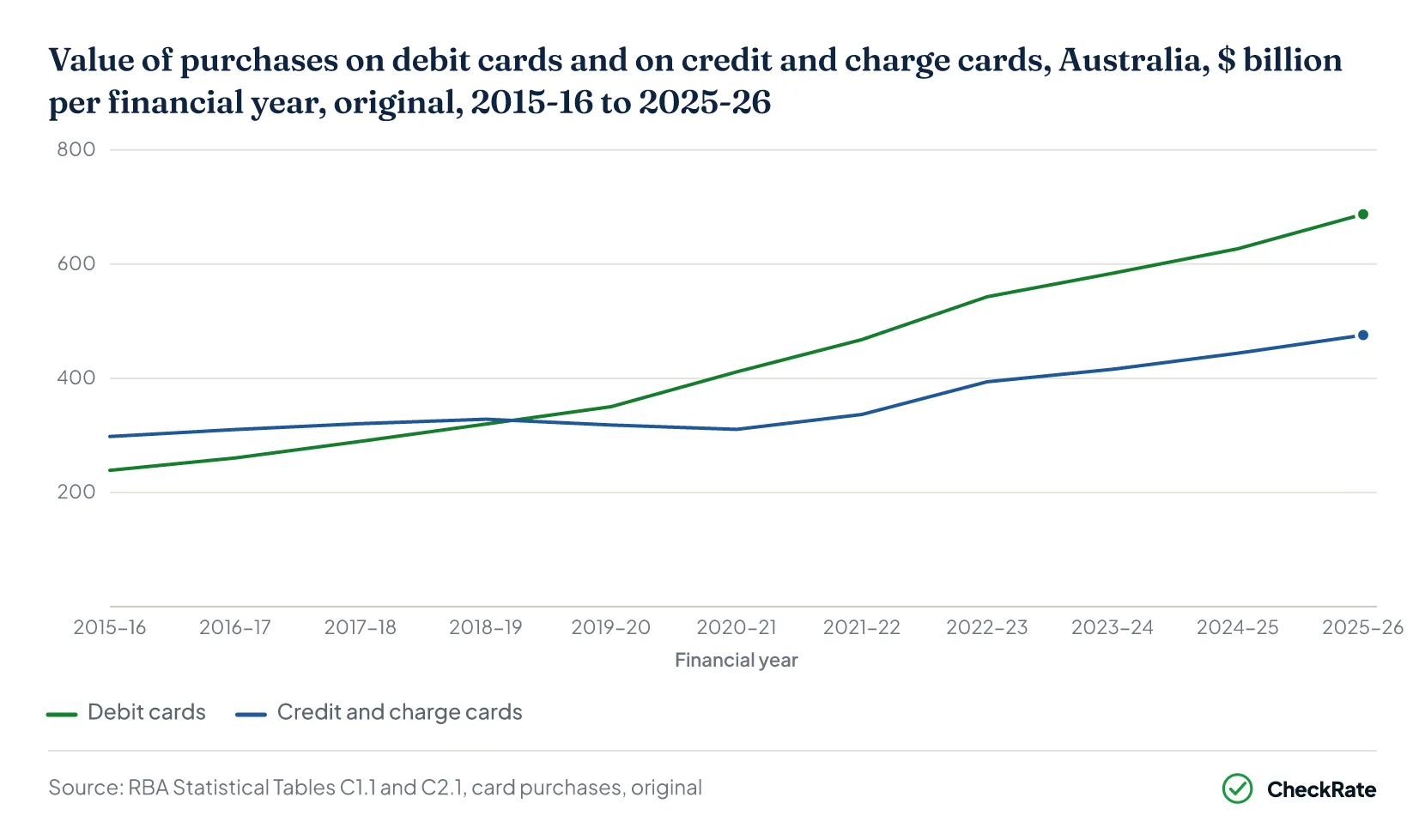
Purchases on Australian-issued debit, credit and charge cards totalled $1.16 trillion in 2025-261011.
Debit card purchases totalled $687.5 billion in 2025-2611 while credit and charge card purchases totalled $475.7 billion10. Debit card purchases rose 9.7%, from $627.0 billion in 2024-25 to $687.5 billion in 2025-2611. Credit and charge card purchases rose 7.1%, from $444.0 billion to $475.7 billion10.
Debit cards were used for 12.62 billion purchases in 2025-2611. Credit and charge cards were used for 3.95 billion purchases in the same year10. Debit cards accounted for 59.1% of total card purchase value in 2025-2611.
Debit card purchases first exceeded credit and charge card purchases in 2019-20, at $350.3 billion compared with $318.1 billion11. From 2015-16 to 2025-26, debit card purchases rose 188.0%, from $238.7 billion to $687.5 billion. Credit and charge card purchases rose 59.7%, from $298.0 billion to $475.7 billion10.
| Value of purchases on debit cards and on credit and charge cards by financial year, Australia, $ billion, original, 2015-16 to 2025-26 | |||||
|---|---|---|---|---|---|
| Financial year | Debit cards ($ billion) | Credit and charge cards ($ billion) | All cards ($ billion) | Debit share of value (%) | Change in all cards (%) |
| 2015-16 | 238.7 | 298.0 | 536.6 | 44.5 | .. |
| 2016-17 | 260.4 | 310.2 | 570.6 | 45.6 | +6.3 |
| 2017-18 | 289.5 | 320.5 | 610.0 | 47.5 | +6.9 |
| 2018-19 | 319.8 | 328.3 | 648.1 | 49.3 | +6.2 |
| 2019-20 | 350.3 | 318.1 | 668.4 | 52.4 | +3.1 |
| 2020-21 | 411.2 | 310.5 | 721.7 | 57.0 | +8.0 |
| 2021-22 | 467.8 | 336.6 | 804.4 | 58.2 | +11.5 |
| 2022-23 | 542.9 | 393.9 | 936.8 | 58.0 | +16.5 |
| 2023-24 | 584.0 | 415.8 | 999.8 | 58.4 | +6.7 |
| 2024-25 | 627.0 | 444.0 | 1,070.9 | 58.5 | +7.1 |
| 2025-26 | 687.5 | 475.7 | 1,163.2 | 59.1 | +8.6 |
Source · RBA, Statistical Tables C1.1 and C2.1
Section 06 · Surcharging
What share of businesses surcharge card payments in Australia?
In its Review of Merchant Card Payment Costs and Surcharging, the RBA estimates that 16% of Australian merchants surcharged eftpos, Mastercard or Visa card payments in 2024-255. Surcharges totalled an estimated $1.8 billion, with consumers paying $1.6 billion and businesses the remaining $0.2 billion.
In the analysis published in March 2026, 85% of small merchants and 89% of large merchants did not surcharge2. Around 5% of merchants surcharged debit and credit cards at different rates5.
In a survey of 3,000 people that JWS Research ran for the RBA in September 2025, 76% of respondents thought surcharging was unnecessary and should stop4. In the same survey, 13% said they were always told about surcharges when they shopped.
Surcharging on card payments doubled in prevalence between the RBA's 2022 and 2025 Consumer Payments Surveys5. Around 20% of consumers who owned a credit card avoided a surcharge by switching payment methods in the 2025 Consumer Payments Survey.
The RBA estimates that removing surcharging would have a small, one-off effect on measured consumer prices of around 0.1%5.
| Surcharging on eftpos, Mastercard and Visa card payments, Australia, RBA estimates and survey findings, 2024-25 and 2025 | ||
|---|---|---|
| Measure | Value | Basis |
| Merchants that surcharged | 16% | Share of Australian merchants, 2024-25, RBA estimate |
| Surcharges charged | $1.8 billion | 2024-25, RBA estimate |
| Surcharges paid by consumers | $1.6 billion | 2024-25, RBA estimate |
| Surcharges paid by businesses | $0.2 billion | 2024-25, RBA estimate |
| Small merchants that did not surcharge | 85% | Share of small merchants, RBA analysis published March 2026 |
| Large merchants that did not surcharge | 89% | Share of large merchants, RBA analysis published March 2026 |
| Merchants surcharging debit and credit at different rates | 5% | Share of merchants, approximate, RBA analysis published March 2026 |
| Consumers who want surcharging to stop | 76% | Survey of 3,000 people, September 2025 |
| Consumers always told about surcharges | 13% | Survey of 3,000 people, September 2025 |
| Credit card owners who avoided a surcharge by switching method | 20% | Share of credit card owners, 2025 Consumer Payments Survey, approximate, RBA estimate |
Source · RBA, Review of Merchant Card Payment Costs and Surcharging, Conclusions Paper, March 2026
Section 07 · By merchant size
Which businesses pay the most to accept cards?
Small merchants on a single-rate pricing plan paid an average of 1.4% of their transaction value to accept card payments, compared with 0.6% for large merchants, in RBA analysis published in March 202612. Small merchants on an unblended plan, which prices each card type separately, paid 0.9% on average. Around 19% of small merchants were on unblended plans.
Smaller merchants paid around 0.13 percentage points more in interchange fees per debit card transaction than strategic merchants, which are large merchants that qualify for lower strategic interchange rates, on average, in the same analysis6.
Differences in average fees between schemes may partly reflect the mix of transactions each scheme processes, such as the share made with cards issued overseas9.
| Average cost of accepting card payments by merchant size and pricing plan, Australia, % of transaction value, RBA analysis published March 2026 | ||
|---|---|---|
| Merchant group and pricing plan | Cost of acceptance (%) | Note |
| Small merchants, single-rate plan | 1.4 | One rate across card types |
| Small merchants, unblended plan | 0.9 | Each card type priced separately; 19% of small merchants |
| Large merchants, all plans | 0.6 | Average across plan types |
Source · RBA, Review of Merchant Card Payment Costs and Surcharging, Conclusions Paper, March 2026, Competition in Card Acquiring Services, Graphs 10 and 11
Section 08 · How Australians pay
How did Australians pay for everyday purchases in 2025?
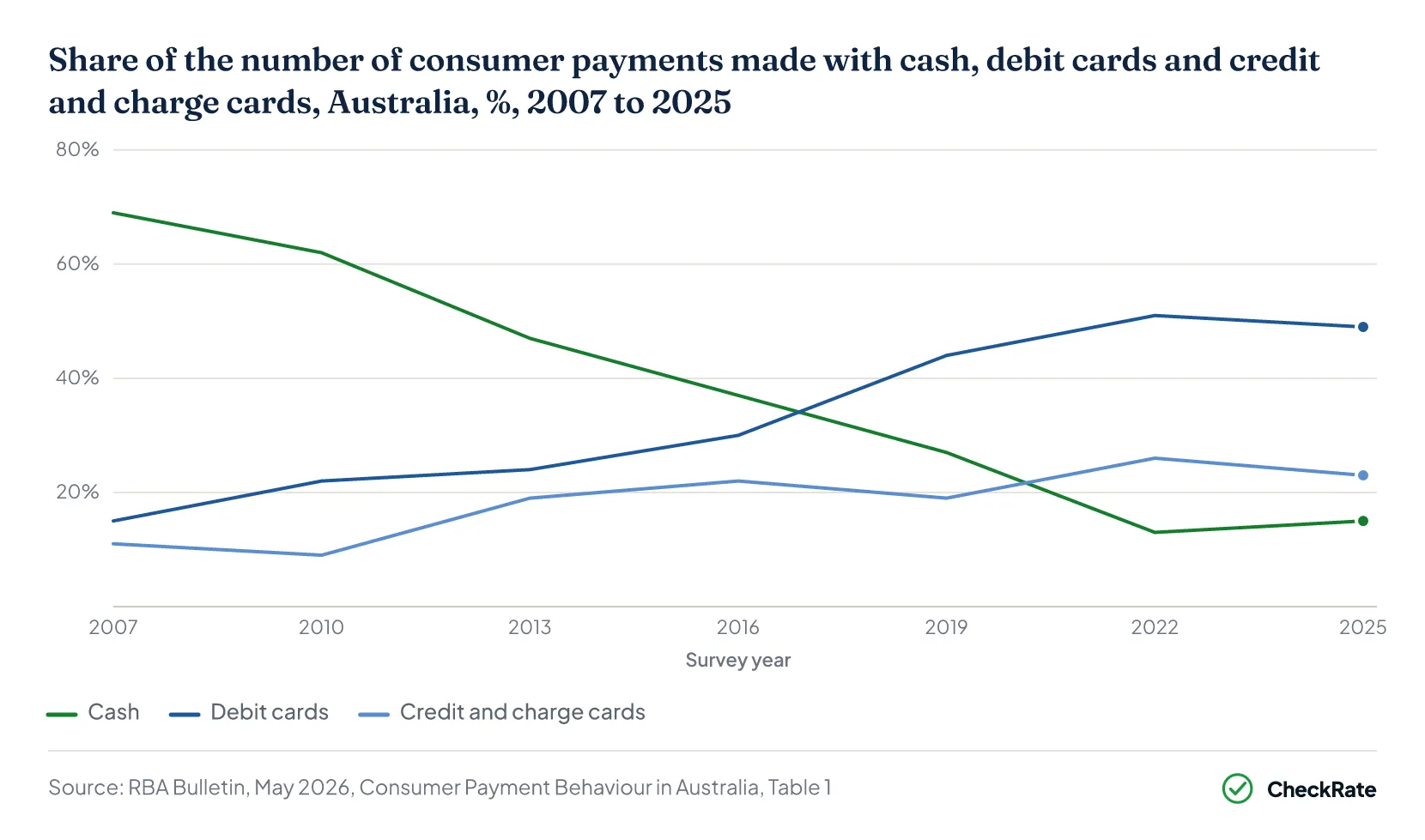
Cards were used for 73% of consumer payments by number in 2025, according to the RBA's 2025 Consumer Payments Survey13. Debit cards were used for 49% of payments and credit and charge cards for 23%. Cash was used for 15% of payments by number. By value, cash was around 8% of payments in 202514.
The card share of payments fell from 76% in 2022 to 73% in 202513. The cash share was 13% in 2022 and 15% in 2025, which the RBA describes as stable. Over the longer term, the debit card share rose from 15% in 2007 to 49% in 2025. The cash share was 69% in 2007.
Device-based payments, made with a phone or other device rather than a physical card, accounted for around 40% of card payments in 2025, up from 31% in 202213. In 2025, 43% of consumers used a mobile device to make a contactless payment during the diary week, up from 35% in 2022.
Around 20% of respondents who wanted to use cash said they did so to avoid surcharges on other payment methods14. Around half of Australians used cash in a typical week in 2025.
The survey ran from October to early December 2025, with around 1,200 people recording around 14,000 transactions over seven days13. Payments over $9,999, transfers to family and friends, transport cards and automatic payments are excluded from the shares.
| Share of the number of consumer payments by payment method, Australia, %, Consumer Payments Survey, 2007 to 2025 | ||||
|---|---|---|---|---|
| Survey year | Cash (%) | All cards (%) | Debit cards (%) | Credit and charge cards (%) |
| 2007 | 69 | 26 | 15 | 11 |
| 2010 | 62 | 31 | 22 | 9 |
| 2013 | 47 | 43 | 24 | 19 |
| 2016 | 37 | 52 | 30 | 22 |
| 2019 | 27 | 63 | 44 | 19 |
| 2022 | 13 | 76 | 51 | 26 |
| 2025 | 15 | 73 | 49 | 23 |
Source · RBA, Bulletin, May 2026, Consumer Payment Behaviour in Australia, Table 1
Section 09
Card surcharges and merchant fees: quick answers
When did card surcharging end in Australia?
Surcharging on eftpos, Mastercard and Visa debit, prepaid and credit cards ended on 1 October 2026, when the Reserve Bank of Australia lifted its prohibition on no-surcharge rules and the three networks introduced their own no-surcharge rules. Merchants can no longer add a card surcharge on those networks unless an exception applies. The government could legislate a ban if surcharging continues, according to the RBA's Conclusions Paper of March 2026.
How much do Australians pay in card surcharges each year?
Merchants charged around $1.8 billion in surcharges on eftpos, Mastercard and Visa card payments in 2024-25, according to the Reserve Bank of Australia's estimate. Consumers paid an estimated $1.6 billion of that total and businesses paid $0.2 billion.
What is the average merchant fee on a debit card in Australia?
Businesses paid an average total merchant fee of 0.43% of the transaction value on eftpos debit cards, 0.56% on Visa debit cards and 0.59% on Mastercard debit cards in the June quarter 2026, according to the Reserve Bank of Australia. The averages cover merchants served by a sample of larger acquirers and payment facilitators, and larger merchants tend to pay lower fees than smaller merchants.
What are the new interchange fee caps from 1 October 2026?
The cap on interchange fees for debit and prepaid cards issued in Australia fell to 8 cents, or 0.16% of the transaction value, and the cap for consumer credit cards fell from 0.8% to 0.3% on 1 October 2026, under the Reserve Bank of Australia's decisions of March 2026. A 1.0% cap on interchange fees for cards issued overseas will apply from 1 April 2027.
Can businesses still surcharge American Express cards after 1 October 2026?
No. The Payments System Board's decisions of March 2026 cover the designated eftpos, Mastercard and Visa networks only, but American Express, which the RBA does not formally regulate, also removed surcharging from 1 October 2026, according to the RBA. UnionPay did the same, and PayPal's no-surcharge rule took effect on 5 October 2026. The board still intends to consider the regulatory settings for American Express in the RBA's Review into Payments System Regulation, which opened on 25 June 2026, with submissions closing on 7 August 2026.
References
- RBA, Frequently Asked Questions – Removal of payment surcharges from 1 October 2026 · Reserve Bank of Australia ↑ b c d
- RBA, Conclusions Paper, March 2026, chapter 8: Impact and Implementation · Reserve Bank of Australia ↑ b c d
- RBA, Media Release 2026-10, Review of Merchant Card Payment Costs and Surcharging – Conclusions Paper · Reserve Bank of Australia ↑
- RBA, Review of Merchant Card Payment Costs and Surcharging, Conclusions Paper, March 2026, in brief · Reserve Bank of Australia ↑ b c
- RBA, Conclusions Paper, March 2026, chapter 2: Surcharging · Reserve Bank of Australia ↑ b c d e f g h
- RBA, Conclusions Paper, March 2026, chapter 3: Interchange Fees · Reserve Bank of Australia ↑ b
- RBA, Media Release 2026-17, Review of Payments System Regulation · Reserve Bank of Australia ↑
- RBA, Statistical Table C3, Average Merchant Fees for Debit, Credit and Charge Cards · Reserve Bank of Australia ↑ b c d e f g h i j k
- RBA, Statistical Table C3 workbook, notes and breaks · Reserve Bank of Australia ↑ b c d e f g
- RBA, Statistical Table C1.1, Credit and Charge Cards – Original Series – Aggregate Data · Reserve Bank of Australia ↑ b c d e
- RBA, Statistical Table C2.1, Debit Cards – Original Series · Reserve Bank of Australia ↑ b c d e f
- RBA, Conclusions Paper, March 2026, chapter: Competition in Card Acquiring Services · Reserve Bank of Australia ↑ b
- RBA, Bulletin, May 2026, Consumer Payment Behaviour in Australia · Reserve Bank of Australia ↑ b c d
- RBA, Bulletin, April 2026, Cash Use in Australia: What the 2025 Consumer Payments Survey Tells Us · Reserve Bank of Australia ↑ b
- RBA, Review of Merchant Card Payment Costs and Surcharging, Conclusions Paper, March 2026, executive summary · Reserve Bank of Australia
- RBA, Review of Payments System Regulation, Issues Paper, June 2026 · Reserve Bank of Australia