

Published
Section 01 · July 2026
What is the average business loan interest rate in Australia?
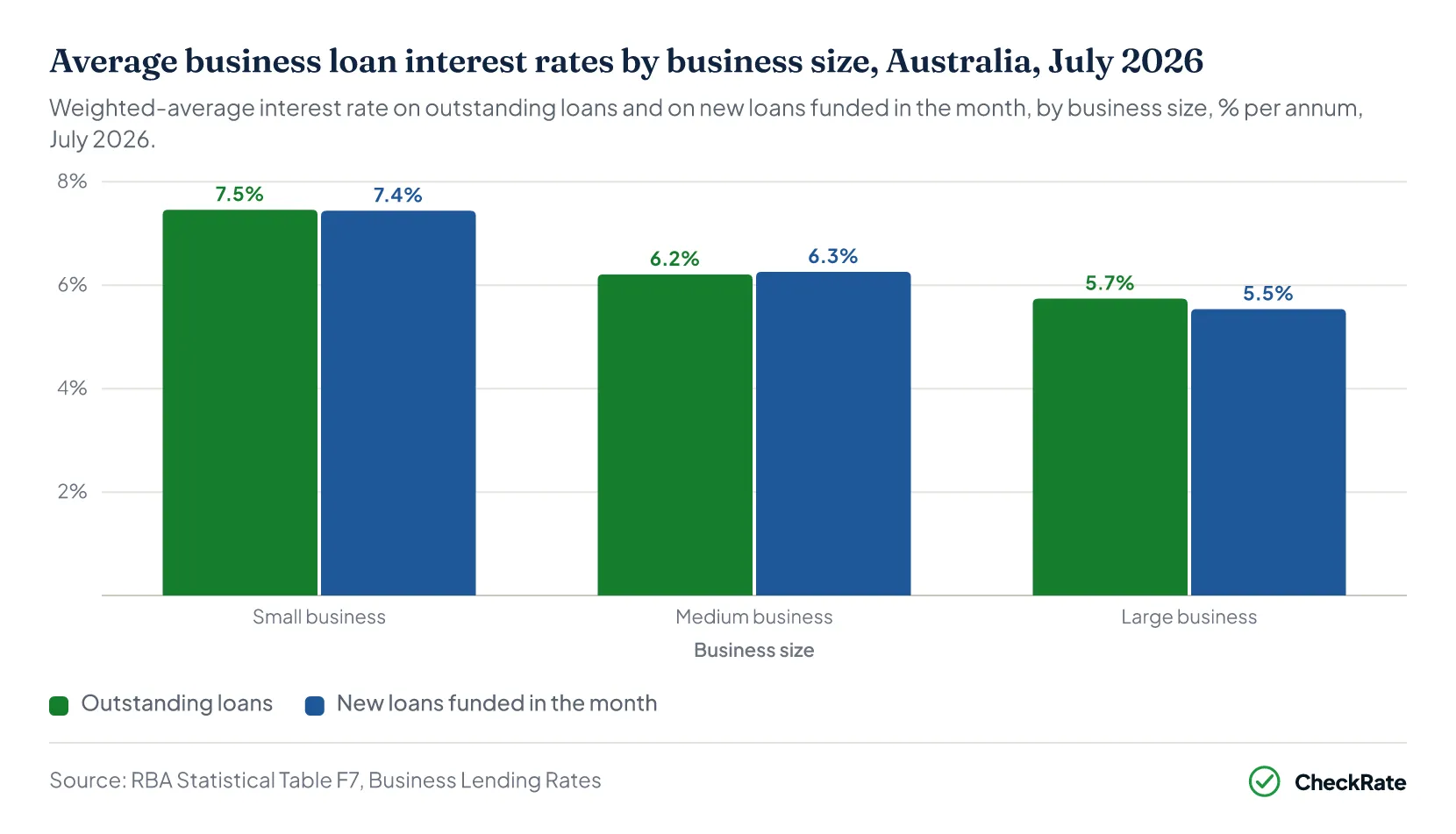
The average interest rate on outstanding small-business loans was 7.46% in July 2026, compared with 6.21% for medium businesses and 5.74% for large businesses1. New loans funded in July 2026 averaged 7.44% for small businesses, 6.26% for medium businesses and 5.54% for large businesses. The small-business average rate was the highest monthly value of the 85 months from July 2019 to July 2026.
The averages cover loans, finance leases and bill acceptances to businesses. They are weighted by value, so larger loans have more influence on the average1. The RBA describes the rates as indicative only and subject to revision.
Three size classes apply. A business is small when the lender's exposure to it is less than $1 million and its turnover is less than $50 million. It is medium when the exposure is $1 million or more and turnover is less than $50 million, and large when turnover is $50 million or more1. Since April 2023, banks that use their own APRA-approved credit risk models have classified businesses under the size definitions in prudential standards APS 112 and APS 113, while other lenders' definitions are unchanged.
The average rate on new small-business loans has been below the average rate on outstanding small-business loans in each of the 26 months from June 2024 to July 20261.
| Average business loan interest rates by business size and loan type, Australia, July 2026 | ||
|---|---|---|
| Business size and loan type | Outstanding loans (% p.a.) | New loans funded in the month (% p.a.) |
| Small business | ||
| All small-business loans | 7.46 | 7.44 |
| Of which, residentially secured | 6.98 | 6.89 |
| Fixed-rate | 7.58 | 8.11 |
| Variable-rate | 7.41 | 7.07 |
| Medium business | ||
| All medium-business loans | 6.21 | 6.26 |
| Fixed-rate | 6.50 | 6.79 |
| Variable-rate | 6.17 | 6.19 |
| Large business | ||
| All large-business loans | 5.74 | 5.54 |
| Fixed-rate | 5.66 | 4.53 |
| Variable-rate | 5.75 | 5.74 |
Source · RBA, Business Lending Rates (Statistical Table F7)
How much small and medium businesses owe, by industry and by security, is covered in the SME lending statistics article.
Section 02 · Size gap
How much more do small businesses pay than large businesses?
Small businesses paid 1.72 percentage points more than large businesses on outstanding loans in July 2026, 7.46% compared with 5.74%1. On new loans funded in the month, the gap was 1.90 points, 7.44% compared with 5.54%. Medium businesses paid 6.21% on outstanding loans, 1.25 points less than small businesses and 0.47 points more than large businesses.
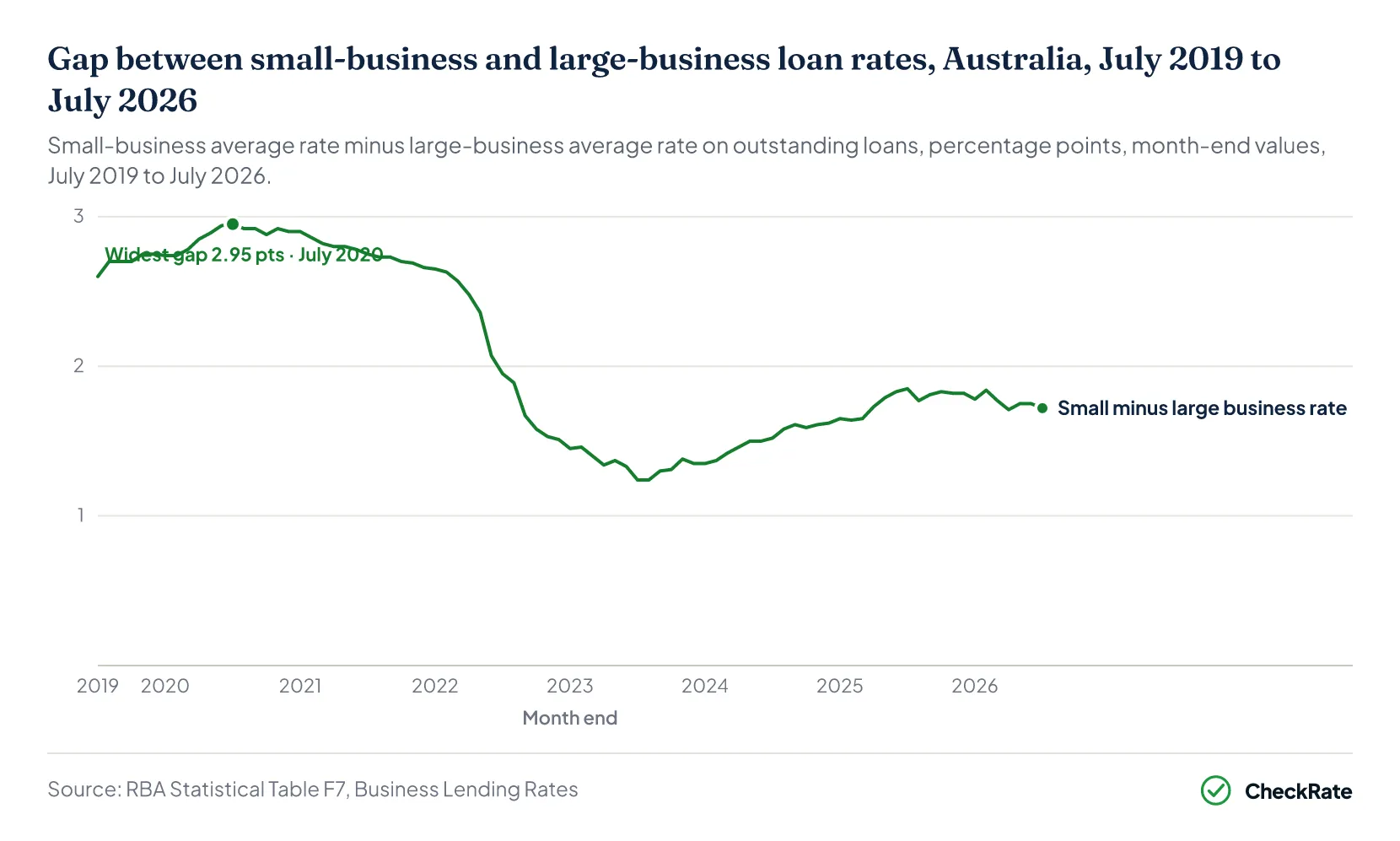
The gap between the small-business and large-business average rates was 2.60 percentage points in July 20191. It widened to 2.95 points in July 2020, the widest monthly gap in the 85 months to July 2026, before narrowing to 1.24 points in July and August 2023. The gap then widened to 1.82 points in December 2025 and was 1.72 points in July 2026.
The RBA's October 2025 Bulletin reports that small businesses typically face higher borrowing costs than larger businesses, partly because banks' risk models assess them as being at greater risk of default and partly because banks hold relatively more capital against loans to small and medium enterprises (SMEs)2. The Bulletin also describes the spread between SME and large-business lending rates as historically low in the years to 2025 and reports that variable rates on SME loans fell by slightly more than the cash rate during 2025.
Section 03 · Cash rate link
How do business loan rates move with the RBA cash rate?
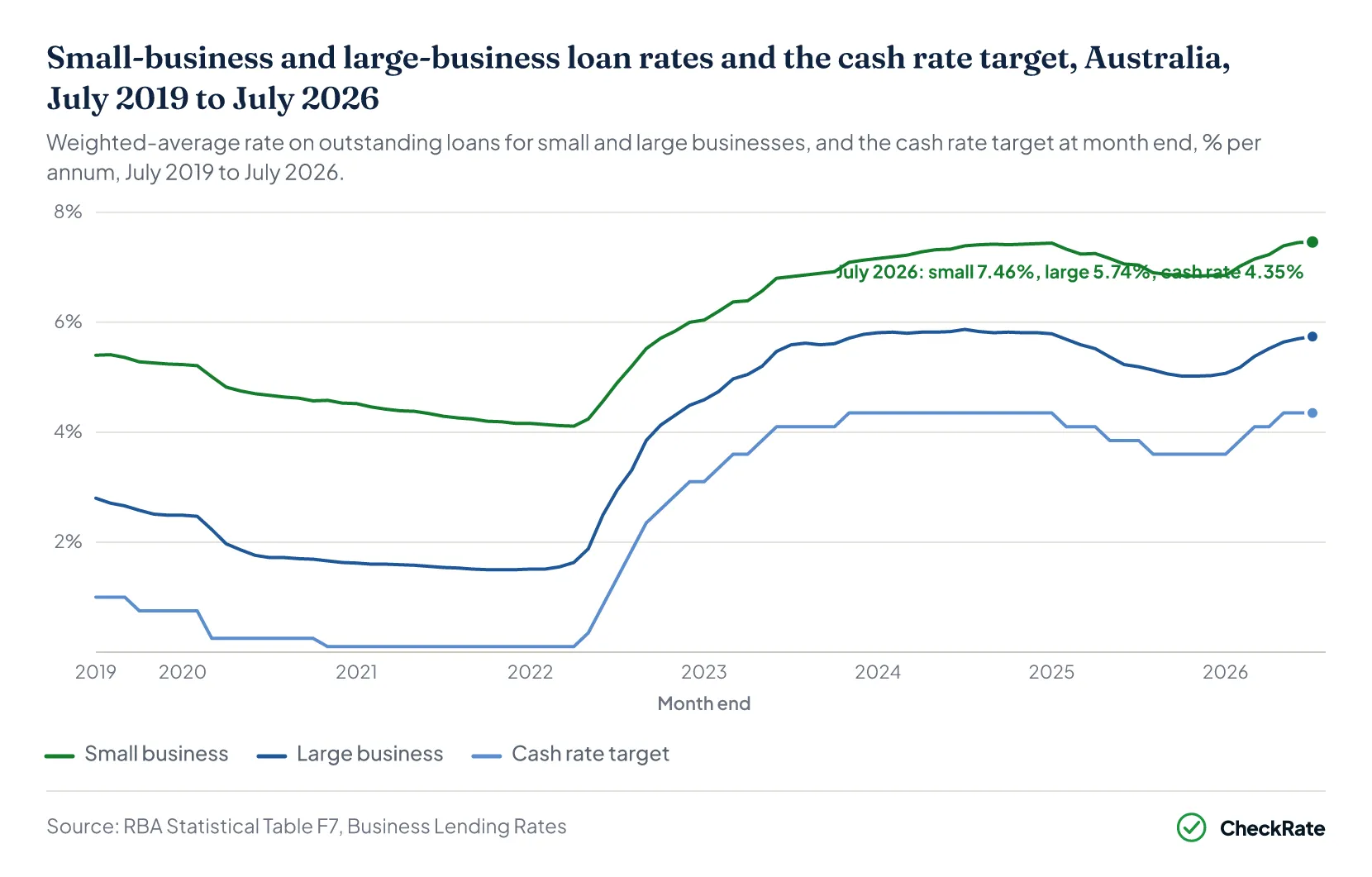
The average rate on outstanding small-business loans was 3.11 percentage points above the cash rate target in July 20261. The medium-business average rate was 1.86 points above the cash rate target, and the large-business average rate was 1.39 points above it. The cash rate target has been 4.35% since 6 May 20263, and the RBA's Monetary Policy Board left it unchanged at its June4 and August 2026 meetings5.
The small-business margin over the cash rate was 4.40 percentage points in July 20191. It reached 4.76 points in March 2020, the widest monthly margin in the 85 months to July 2026, and fell to its narrowest level of 2.70 points in June 2023.
Between April 2022 and December 2023, the cash rate target rose 4.25 percentage points, from 0.10% to 4.35%, while the small-business average rate rose 3.02 points, from 4.11% to 7.13%1. The medium-business average rate rose 3.61 points and the large-business average rate rose 4.15 points.
During 2025, the cash rate target fell 0.75 points, from 4.35% in December 2024 to 3.60% in December 2025. The small-business average rate fell 0.58 points, from 7.43% to 6.85%, and the large-business average rate fell 0.78 points, from 5.81% to 5.03%1. Between December 2025 and July 2026, the cash rate target rose 0.75 points, from 3.60% to 4.35%. The small-business average rate rose 0.61 points, the medium-business average rate rose 0.73 points and the large-business average rate rose 0.71 points.
| Changes in the cash rate target and average business loan rates by business size, Australia, 2022 to 2026 | ||||
|---|---|---|---|---|
| Period | Cash rate target (pts) | Small business (pts) | Medium business (pts) | Large business (pts) |
| Apr 2022 to Dec 2023 | +4.25 | +3.02 | +3.61 | +4.15 |
| Dec 2024 to Dec 2025 | -0.75 | -0.58 | -0.78 | -0.78 |
| Dec 2025 to Jul 2026 | +0.75 | +0.61 | +0.73 | +0.71 |
| Jul 2019 to Jul 2026 | +3.35 | +2.06 | +2.28 | +2.94 |
Source · RBA, Business Lending Rates (Statistical Table F7); RBA, Cash Rate Target interest rate decisions
Every cash rate decision since 1990 is listed in the RBA cash rate history article.
Section 04 · Fixed and variable
Do fixed-rate or variable-rate business loans cost more?
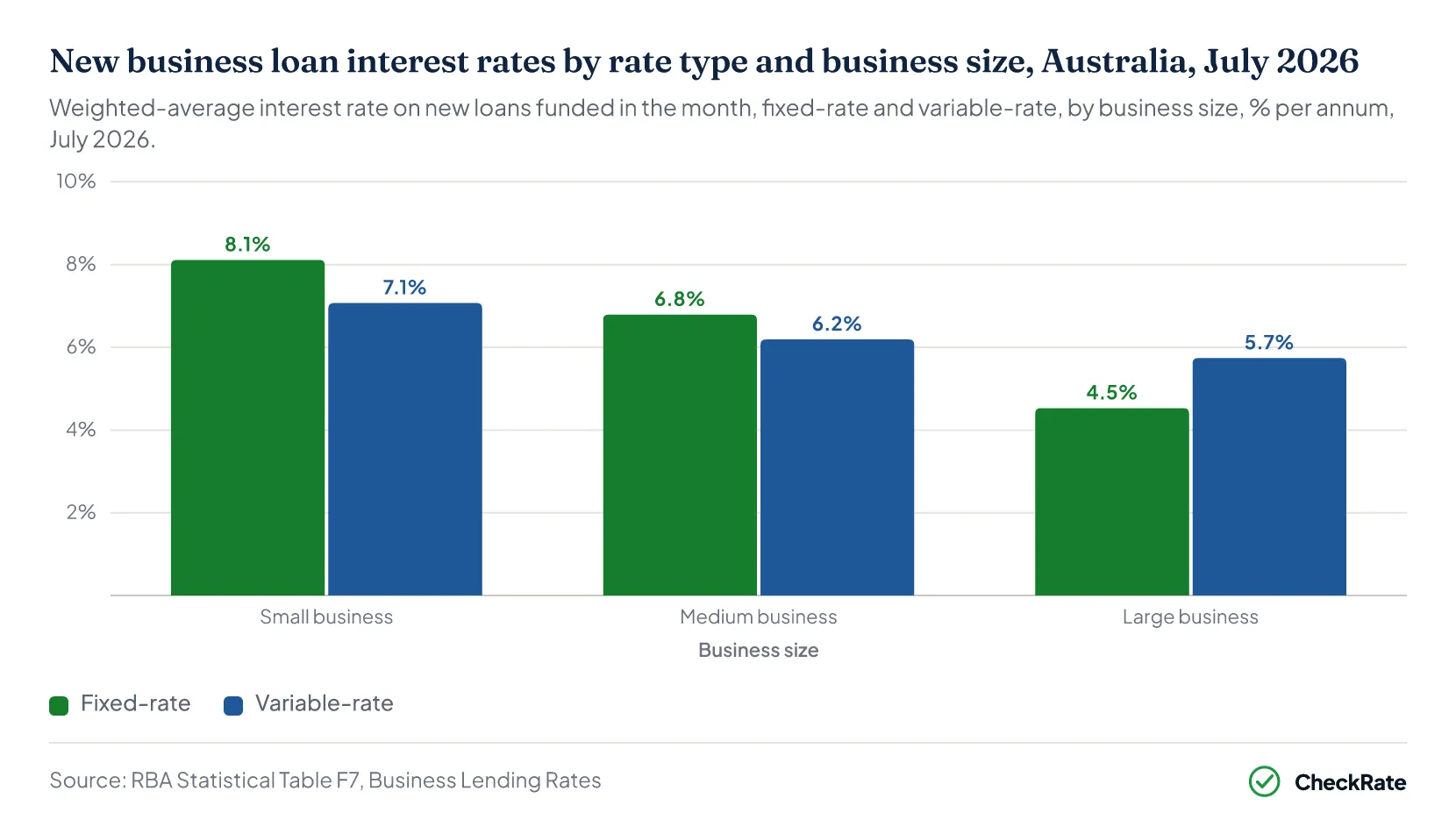
In July 2026, new fixed-rate loans had higher average rates than variable-rate loans for small and medium businesses, but lower rates for large businesses. For small businesses, new fixed-rate loans averaged 8.11%, compared with 7.07% for variable-rate loans, a difference of 1.04 percentage points1. The average rate on new fixed-rate loans to small businesses was higher than the average rate on new variable-rate loans in every month from July 2019 to July 2026.
Medium businesses paid 6.79% on new fixed-rate loans and 6.19% on new variable-rate loans in July 20261. For large businesses, the pattern was reversed: new fixed-rate loans averaged 4.53%, compared with 5.74% for variable-rate loans. New fixed-rate loans to large businesses had lower average rates than variable-rate loans in 82 of the 85 months from July 2019 to July 2026.
On outstanding loans, small businesses paid 7.58% on fixed-rate loans and 7.41% on variable-rate loans, a difference of 0.17 percentage points1. Medium businesses paid 6.50% on outstanding fixed-rate loans and 6.17% on outstanding variable-rate loans, while large businesses paid 5.66% and 5.75% respectively. The published averages do not separate loan terms, so each fixed-rate average combines loans fixed for different periods.
Section 05 · Security
How much lower are rates on residentially secured small-business loans?
Small businesses paid 6.98% on outstanding loans secured by residential property in July 2026, 0.48 percentage points less than the 7.46% average rate for all outstanding small-business loans1. On new loans, the residentially secured average rate was 6.89%, 0.55 points below the 7.44% average rate for all new small-business loans.
A residentially secured loan is one where the borrower offers a home or other residential property as collateral. The residentially secured average rate was below the all-loans average rate in every month from July 2019 to July 2026, with the difference ranging from 0.03 to 0.62 percentage points1.
The RBA's October 2025 Bulletin reports that around half of small loans to SMEs were secured with assets other than residential property, such as vehicles and equipment. The unsecured share of SME credit remained below 5% in the years to October 20252. New loans secured with residential property were on average 4.5 times the size of loans not secured by residential property in the years to October 2025.
Outstanding owner-occupier housing loans averaged 6.2% in July 2026, about 1.3 percentage points below the 7.46% average rate on outstanding small-business loans6.
Section 06 · Advertised rates
How do advertised small-business loan rates compare with rates paid?
The major banks' advertised indicator rate for small-business variable-rate term loans was 9.00% in July 2026, compared with an average rate of 7.46% on all outstanding small-business loans.
The indicator rate for small-business overdrafts was 10.76%7, while the average rate on residentially secured small-business loans was 6.98%1.
An indicator rate is the rate the major banks publish for their small-business lending before individual pricing. The RBA states that a margin may be added in some cases when setting rates on individual loans7. Loans secured by residential property generally do not attract a risk margin, and the term-loan indicator rate applies to residentially secured loans.
The average rates paid include the discounts and margins applied to individual loans and cover reporting lenders beyond the major banks.
The indicator term-loan rate fell from 9.00% in January 2025 to 8.25% in August 2025 and returned to 9.00% in May 2026, matching the cash rate target's 0.75-point fall and subsequent rise over those periods7.
| Advertised indicator rates and average rates paid on small-business loans, Australia, July 2026 | |
|---|---|
| Rate | % p.a. |
| Indicator rate, small-business variable-rate term loan (residentially secured) | 9.00 |
| Indicator rate, small-business overdraft | 10.76 |
| Average paid, all outstanding small-business loans | 7.46 |
| Average paid, new small-business loans funded in the month | 7.44 |
| Average paid, outstanding residentially secured small-business loans | 6.98 |
| Cash rate target | 4.35 |
Source · RBA, Indicator Lending Rates (Statistical Table F5); RBA, Business Lending Rates (Statistical Table F7); RBA, Cash Rate Target interest rate decisions
Section 07 · Since 2019
How have business loan interest rates changed since 2019?
The average rate on outstanding small-business loans fell from 5.40% in July 2019 to 4.11% in April 2022, its lowest monthly level between July 2019 and July 20261. It rose to 7.43% in December 2024, fell to 6.85% in December 2025 and reached 7.46% in July 2026.
The medium-business average rate ranged from 2.59% in January and February 2022 to 6.29% in February and March 20241. The large-business average rate ranged from 1.50% in October, November and December 2021 to 5.87% in July 2024.
Between July 2019 and July 2026, the cash rate target rose 3.35 percentage points, from 1.00% to 4.35%. Over the same period, the small-business average rate rose 2.06 points, the medium-business average rate rose 2.28 points and the large-business average rate rose 2.94 points1. The gap between the small-business and large-business average rates narrowed from 2.60 points to 1.72 points over the same time.
| Average business loan interest rates by business size and the cash rate target, Australia, quarter ends and latest months, July 2019 to July 2026 | ||||
|---|---|---|---|---|
| Month end | Small business (% p.a.) | Medium business (% p.a.) | Large business (% p.a.) | Cash rate target (%) |
| Jul 2026 | 7.46 | 6.21 | 5.74 | 4.35 |
| Jun 2026 | 7.45 | 6.18 | 5.70 | 4.35 |
| Mar 2026 | 7.15 | 5.80 | 5.38 | 4.10 |
| Dec 2025 | 6.85 | 5.48 | 5.03 | 3.60 |
| Sep 2025 | 6.87 | 5.50 | 5.06 | 3.60 |
| Jun 2025 | 7.06 | 5.71 | 5.23 | 3.85 |
| Mar 2025 | 7.24 | 6.04 | 5.59 | 4.10 |
| Dec 2024 | 7.43 | 6.26 | 5.81 | 4.35 |
| Sep 2024 | 7.42 | 6.27 | 5.81 | 4.35 |
| Jun 2024 | 7.33 | 6.26 | 5.83 | 4.35 |
| Mar 2024 | 7.22 | 6.29 | 5.80 | 4.35 |
| Dec 2023 | 7.13 | 6.26 | 5.78 | 4.35 |
| Sep 2023 | 6.89 | 6.08 | 5.59 | 4.10 |
| Jun 2023 | 6.80 | 5.95 | 5.47 | 4.10 |
| Mar 2023 | 6.37 | 5.68 | 4.97 | 3.60 |
| Dec 2022 | 6.00 | 5.25 | 4.49 | 3.10 |
| Sep 2022 | 5.52 | 4.63 | 3.85 | 2.35 |
| Jun 2022 | 4.56 | 3.36 | 2.49 | 0.85 |
| Mar 2022 | 4.12 | 2.60 | 1.55 | 0.10 |
| Dec 2021 | 4.16 | 2.60 | 1.50 | 0.10 |
| Sep 2021 | 4.24 | 2.63 | 1.51 | 0.10 |
| Jun 2021 | 4.34 | 2.70 | 1.56 | 0.10 |
| Mar 2021 | 4.42 | 2.74 | 1.60 | 0.10 |
| Dec 2020 | 4.53 | 2.82 | 1.63 | 0.10 |
| Sep 2020 | 4.62 | 2.92 | 1.70 | 0.25 |
| Jun 2020 | 4.70 | 3.00 | 1.76 | 0.25 |
| Mar 2020 | 5.01 | 3.40 | 2.23 | 0.25 |
| Dec 2019 | 5.24 | 3.64 | 2.49 | 0.75 |
| Sep 2019 | 5.36 | 3.83 | 2.66 | 1.00 |
| Jul 2019 | 5.40 | 3.93 | 2.80 | 1.00 |
Source · RBA, Business Lending Rates (Statistical Table F7); RBA, Cash Rate Target interest rate decisions
Section 08
Business loan interest rates: quick answers
What interest rate do small businesses pay on loans in Australia?
Small businesses paid an average interest rate of 7.46% on outstanding loans in July 2026, according to the Reserve Bank of Australia, compared with 6.21% for medium businesses and 5.74% for large businesses. New loans funded in July 2026 averaged 7.44% for small businesses, 6.26% for medium businesses and 5.54% for large businesses.
Why do small businesses pay higher interest rates than large businesses?
The Reserve Bank of Australia (RBA) reports that small businesses typically face higher borrowing costs partly because banks assess them as having a greater risk of default and hold relatively more capital against small and medium enterprise loans. The gap was 1.72 percentage points on outstanding loans in July 2026, 7.46% compared with 5.74%.
How far above the cash rate are business loan interest rates?
In July 2026, the average rate on outstanding small-business loans of 7.46% was 3.11 percentage points above the 4.35% cash rate target, while the medium-business average rate was 1.86 points above it and the large-business average rate was 1.39 points above it. The small-business margin over the cash rate was 4.40 points in July 2019 and 2.70 points in June 2023.
Do fixed-rate business loans have higher interest rates than variable-rate loans?
New fixed-rate loans to small businesses averaged 8.11% in July 2026 compared with 7.07% for new variable-rate loans. For large businesses, fixed-rate loans averaged less, at 4.53% compared with 5.74% for variable-rate loans.
What interest rate do banks advertise for small-business loans?
The major banks' indicator rate for residentially secured small-business variable-rate term loans was 9.00% in July 2026, and the small-business overdraft indicator rate was 10.76%, according to the Reserve Bank of Australia. By comparison, the average rate paid on all outstanding small-business loans was 7.46%.
References
- RBA, Business Lending Rates: Statistical Table F7 · Reserve Bank of Australia ↑ b c d e f g h i j k l m n o p q r s t
- RBA Bulletin, Small Business Economic and Financial Conditions · Reserve Bank of Australia ↑ b
- RBA — Statement by the Monetary Policy Board, 5 May 2026 (Media Release 2026-12) · Reserve Bank of Australia ↑
- RBA — Statement by the Monetary Policy Board, 16 June 2026 (Media Release 2026-15) · Reserve Bank of Australia ↑
- RBA — Statement by the Monetary Policy Board, 11 August 2026 (Media Release 2026-19) · Reserve Bank of Australia ↑
- RBA Statistical Table F6 Housing Lending Rates workbook (series FLRHOOTA and FLRHOFTA) · Reserve Bank of Australia ↑
- RBA, Indicator Lending Rates (Statistical Table F5) · Reserve Bank of Australia ↑ b c