Key figures: 1989 to 2026
$1,800 → $17,399
Top student contribution amount, 1989 flat charge vs the highest 2026 field rate (law, commerce)
$22,000 → $69,528
Compulsory repayment threshold, original HECS vs the 2026-27 setting
1.19m → 2.96m
Australians with a HELP debt, 2005-06 to 2024-25
$12.4bn → $82.2bn
Total outstanding HELP debt, 2005-06 to 2024-25
HECS began in 1989 with a flat annual charge of $1,800, a compulsory repayment threshold of $22,000, and a maximum repayment rate of 3% of income for the highest earners. That single, flat-rate design, introduced under the Higher Education Contribution Scheme, is the starting point for everything that follows.
That scheme is now called HECS-HELP, one of several loan types grouped under the wider HELP system alongside loans for full-fee-paying students, vocational courses and study overseas. The national debt figures reported by the Australian Taxation Office cover the wider HELP system, not HECS-HELP alone. HECS-HELP is generally understood to be the largest part of the system, but a current breakdown by loan type was not available in the sources reviewed for this article. The figures below therefore tell the broader HELP story, and any figure specific to HECS-HELP course charges is noted directly.
Section 01Timeline
HECS-HELP timeline: key changes from 1989 to 2026
The $1,800 flat charge of 1989 has grown into a system where indexation now runs at 2.8% and the repayment threshold sits at $69,528 for 2026-27. Course prices, indexation rules and repayment settings have each changed more than once along the way.
1989
HECS begins
A flat annual contribution of $1,800 is introduced. Compulsory repayment starts once taxable income reaches $22,000, with a maximum repayment rate of 3% above $35,000.
1997
Course-based pricing arrives
Three differential contribution rates replace the single flat charge, priced by field of study for the first time.
2003-05
HELP is created
The Higher Education Support Act 2003 folds HECS into a wider loan framework. The loan becomes known as HECS-HELP.
2014
Fee deregulation proposed, then defeated
A bill to remove the cap on student contribution amounts is voted down in the Senate on 2 December 2014.
2021
Job-ready Graduates
A new pricing structure resets contribution amounts by field from 1 January 2021. Some continuing students are grandfathered onto the earlier rates.
2024
Indexation is capped
Retrospective legislation passed in November 2024 cuts indexation to the lower of the Consumer Price Index (CPI) or the Wage Price Index, removing about $3 billion in debt for 3 million Australians.
2025
Debt cut and repayment overhaul
A one-off 20% reduction is applied to balances, the repayment threshold jumps to $67,000, and repayments switch to a marginal system from 1 July 2025.
2026
Latest settings
Indexation is set at 2.8%, and the repayment threshold rises again to $69,528 for 2026-27.
No interest, only indexation
HECS-HELP and the other HELP loans do not charge interest. Instead, the balance is adjusted once a year through indexation, which is why the indexation rate, rather than an interest rate, is the figure that determines how fast an unpaid balance grows.
Why the name changed
HECS and HECS-HELP refer to the same underlying loan. The name changed between 2003 and 2005, when the Higher Education Support Act grouped several student loan types, including the original HECS, under the single HELP banner. Both names are still used interchangeably today.
Section 02Fees
How student contribution amounts have changed over time
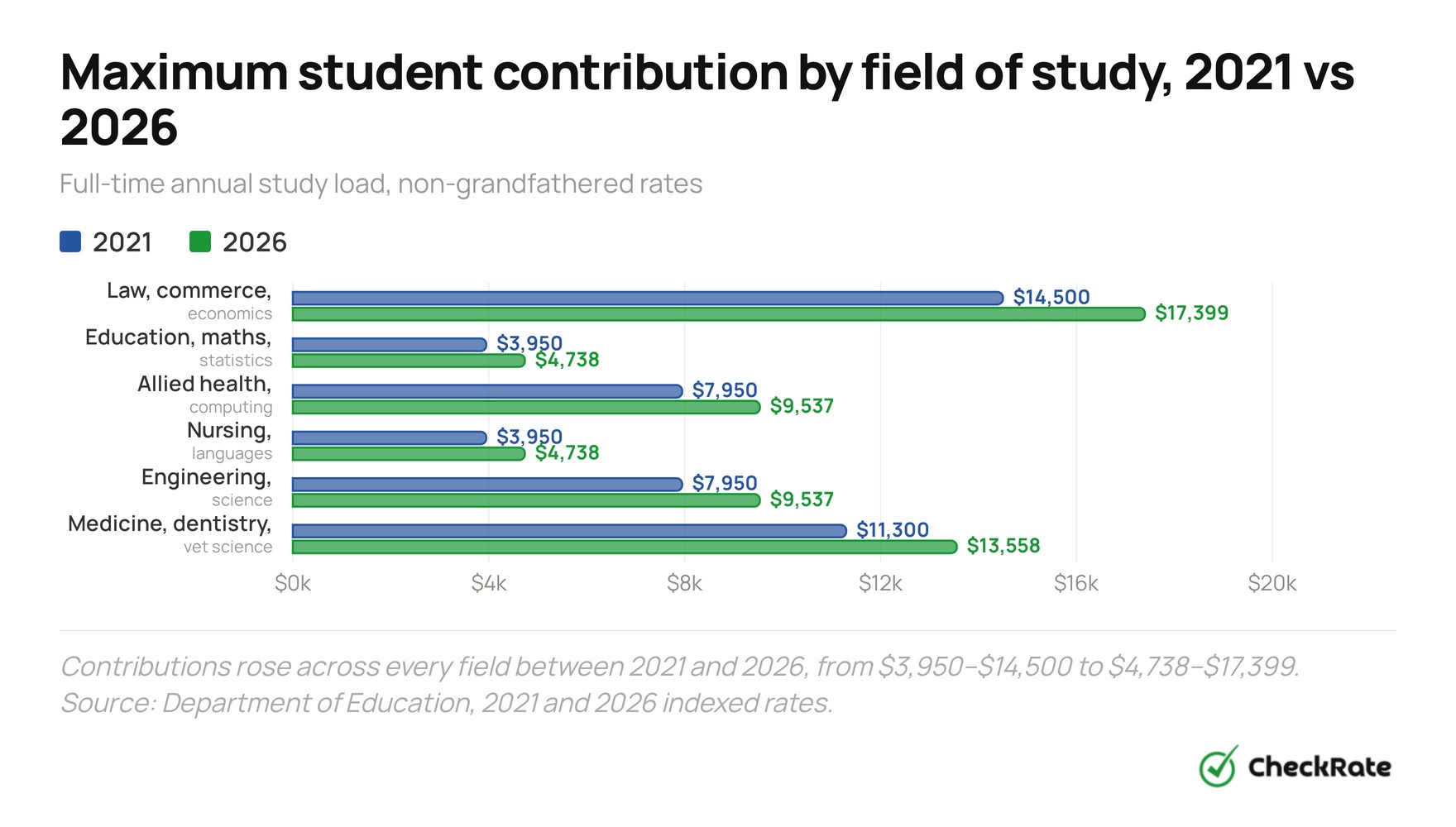
Student contribution amounts have risen by about 20% across every listed field since 2021. Every field of study costs more in 2026 than it did in 2021, although the dollar increase is larger for fields that already had higher student contribution amounts.
Maximum student contribution amounts by field of study in Australia, 2021 vs 2026
Full-time annual study load, non-grandfathered rates
Fields are grouped by the funding-cluster categories used in the official rate tables. The 1989 charge was a single flat rate for every student; field-based pricing did not exist until 1997, so today's figures are not a like-for-like continuation of the 1989 price for the same course.
Source: Department of Education, 2021 and 2026 indexed rates for the Higher Education Loan Program.
Student contribution amounts by field of study, 2021 vs 2026
Maximum annual charge for a Commonwealth supported place
Official data
| Field of study |
2021 |
2026 |
Increase |
| Law, accounting, administration, economics, commerce |
$14,500 |
$17,399 |
20.0% |
| Education, English, mathematics, statistics |
$3,950 |
$4,738 |
19.9% |
| Allied health, built environment, computing |
$7,950 |
$9,537 |
20.0% |
| Nursing, Indigenous and foreign languages |
$3,950 |
$4,738 |
19.9% |
| Engineering, environmental studies, science |
$7,950 |
$9,537 |
20.0% |
| Medicine, dentistry, veterinary science |
$11,300 |
$13,558 |
20.0% |
Source: Department of Education, 2021 and 2026 indexed rates.
The dollar gap between the cheapest and most expensive fields has widened alongside the percentage rise. In 2021, law cost $10,550 more than education for the year; by 2026, that gap had grown to $12,661.
What does grandfathering mean?
In 2021, the grandfathered rate for law, economics and commerce was $11,355, compared with $14,500 for students starting fresh. Students already enrolled before 1 January 2021 in some affected fields kept the older, lower rate for a transition period rather than moving straight to the new Job-ready Graduates price. The reform did not just index prices; it changed how student contribution amounts were grouped by field.
How does the 2026 price compare with the 1989 HECS charge?
The original $1,800 HECS charge cannot be compared directly with today's field-based prices, because every student paid the same annual amount in 1989. Field-based pricing did not exist until 1997, and the current system charges different maximum student contribution amounts depending on the course. In 2026, the lowest listed student contribution amount is $4,738 for fields such as education, nursing and Indigenous languages. The highest listed amount is $17,399 for law, accounting, administration, economics and commerce.
How much can a student borrow overall?
Separately from the annual student contribution amount, HELP sets a combined borrowing limit across all loan types a student uses. For 2026, that limit is $129,883 for most students, rising to $186,544 for medicine, dentistry, veterinary science and eligible aviation courses. Other HELP loan types carry their own, smaller caps: SA-HELP, which covers the student services and amenities fee, is capped at $373 in 2026.
Section 03Average debt
How average HELP debt has grown across the decades
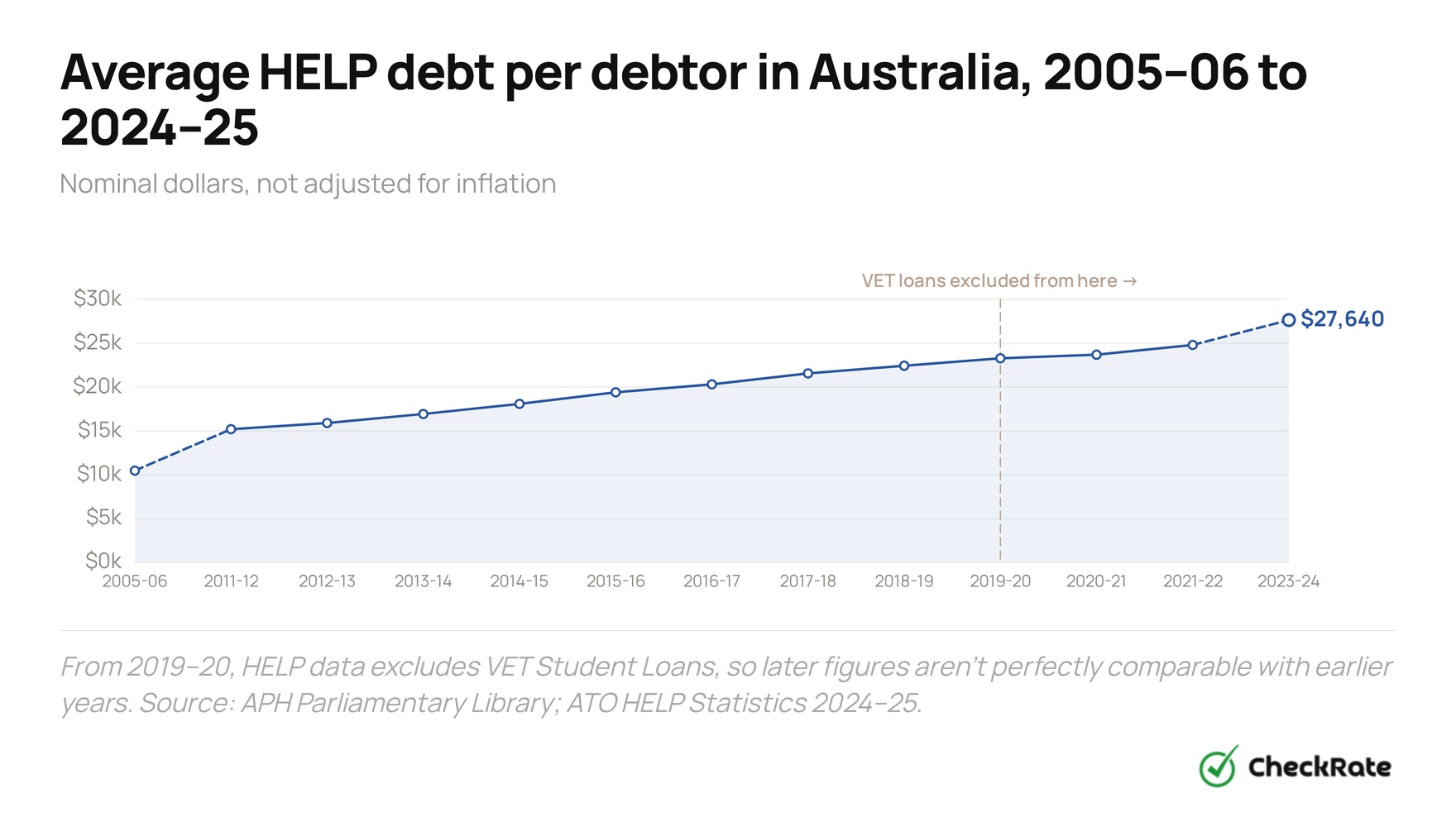
The average HELP balance has grown by about 165% since the mid-2000s. Debt has grown faster than the number of borrowers, and a much larger share of debtors now carry balances above $50,000.
Average HELP debt per debtor in Australia, 2005-06 to 2024-25
Nominal dollars, not adjusted for inflation
From 2019-20, HELP data excludes VET Student Loans, so figures from that year onward are not perfectly comparable with earlier years.
Source: APH Parliamentary Library, Updated HELP debt statistics 2020-21; APH Bills Digest 26bd001; and Australian Taxation Office, HELP Statistics 2024-25, Data.gov.au.
+149.9%
Growth in the number of HELP debtors, from 1.19 million in 2005-06 to 2.96 million in 2024-25
+562.8%
Growth in total outstanding HELP debt over the same period, from $12.4 billion to $82.2 billion
8.2 → 9.5 yrs
Average time to repay a HELP debt in full, 2011-12 to 2021-22
Not every HELP debt runs its full course
By 2020-21, around 2.1 million people had fully repaid their HECS-HELP debt since the scheme began in 1989. A further 18,594 debts had been written off following the debtor's death.
The total HELP debt balance grew about 3.8 times as fast as the debtor count between 2005-06 and 2024-25, showing that average balances increased as well as the number of people with a debt.
Share of HELP debtors in Australia by balance size, 2011-12 vs 2020-21
Percentage of all HELP debtors in each balance band
- Up to $10,000
- $10,000 to $20,000
- $20,000 to $50,000
- $50,000 to $100,000
- Over $100,000
Bands are consolidated from more detailed balance ranges. The share of debtors owing $50,000 or more rose from about 2% to 9.6% over this period, and the share owing over $100,000 rose from about 0.2% to 0.9%.
Source: APH Parliamentary Library, Updated HELP debt statistics 2020-21, citing ATO HELP Statistics.
Effect on other borrowing
HELP debt can be considered by lenders when assessing borrowing capacity, including for a home loan. A larger balance can reduce assessed borrowing capacity, separately from the compulsory repayments collected through the tax system.
Section 04Deregulation
What happened to university fee deregulation in Australia?
On 2 December 2014, the Senate voted down a bill that would have removed the cap on student contribution amounts. Student contribution amounts have remained regulated since then.
The Higher Education and Research Reform Amendment Bill 2014 proposed removing the maximum student contribution amounts that providers could charge students in Commonwealth-supported places, among other changes. Its second reading was negatived in the Senate, and its official status is recorded as "not proceeding".
Instead, the regulated schedule has been redrawn through later changes, including the Job-ready Graduates pricing reset from 2021 and the annually indexed 2026 rates. Australia has kept government-set student contribution caps for Commonwealth-supported places, while changing the way those caps are structured by field.
What if the 2014 bill had passed?
Had the 2014 bill passed, universities would have been free to set their own course prices for Commonwealth-supported students, similar to how full-fee-paying places already work. Instead, every student contribution amount charged today still sits within a government-set schedule, published and indexed each year by the Department of Education.
Section 05National debt
How much HELP debt does Australia have?
HELP debt reached $82.2 billion by 2024-25, more than six times its 2005-06 level. Over the same period, the number of debtors grew more slowly, showing that total HELP debt has risen faster than the number of people with a debt.
Total HELP debt and number of debtors in Australia
2005-06, 2020-21 and 2023-24
- Total outstanding debt ($bn)
- People with HELP debt (millions)
Outstanding debt in 2019-20 was $66.4 billion, with 2,851,725 debtors, sitting between the 2005-06 and 2020-21 points shown here.
Source: Australian Taxation Office, HELP statistics 2005-06 to 2024-25 (data.gov.au); APH Parliamentary Library, Updated HELP debt statistics 2020-21.
Two figures often get confused when discussing national HELP debt: the outstanding balance debtors owe, and the government's own accounting estimate of what it expects to collect.
Face value vs fair value of Australia's HELP receivable
Two ways of measuring national HELP debt
Official data
| Date |
Fair value of HELP receivable |
Why it differs |
| 30 June 2022 |
$49.7bn |
Incorporates expected non-repayment and discounting |
| 30 June 2023 |
$49.7bn |
Incorporates expected non-repayment and discounting |
Source: Department of Education, Reporting of HELP Receivable at 30 June 2022, and Reporting of HELP Receivable at 30 June 2023.
Face value and fair value measure different things
National HELP debt can be measured two ways.
- Face value: $82.2 billion, the balance the ATO says debtors owe.
- Fair value: $49.7 billion, the government's estimate of the HELP receivable at 30 June 2023 after expected non-repayment and discounting are factored in.
Neither figure is wrong. They answer different questions, and using the wrong one for the wrong purpose can make the picture look better or worse than it really is.
Section 06Then vs now
How HECS repayments have changed since 1989
The compulsory repayment threshold has fallen from about 85% of average full-time earnings in 1989 to just over half in 2021-22. The core design has stayed the same: students borrow through a government loan system and repay through the tax system once their income reaches the repayment threshold. The price structure, repayment rates, indexation rules and balance settings have all changed.
85% → 51%
Repayment threshold as a share of average full-time earnings, 1989 vs 2021-22
134% → 150%
Income needed for the top repayment rate, as a share of average earnings, 1989 vs 2021-22
3% → 10%
Top compulsory repayment rate, 1989 flat-rate system vs the pre-2025 flat-rate ceiling
The first row shows this in dollar terms. Compulsory repayment started at $22,000 in 1989, and by 2021-22 the threshold of $47,014 equalled just over half of average full-time earnings. Measured against wages rather than nominal dollars, the repayment threshold sat lower relative to average earnings in 2021-22 than it did when HECS began.
HELP loan indexation rate in Australia, 2013 to 2026
Annual rate applied to outstanding debt on 1 June each year
- Standard rate
- Retrospectively reduced
The 2023 rate was originally 7.1% and the 2024 rate was originally 4.7%. Both were retrospectively reduced by legislation passed in November 2024, which changed indexation to the lower of CPI or the Wage Price Index. Highlighted bars show the final, reduced rates.
Source: Australian Taxation Office, study and training loan indexation rates.
Compared with the 1989 rules, the differences run through every part of the design, not just the headline numbers.
HECS in 1989 vs 2026: how the design has changed
Charge structure, repayment triggers, indexation and balance settings
Official data
| Design feature |
Original scheme (1989) |
Current scheme (2026) |
| Charge structure |
Flat annual charge, $1,800 |
Field-based, $4,738 to $17,399 |
| Repayment trigger |
$22,000 taxable income |
$69,528 minimum repayment income (2026-27) |
| Repayment method |
Percentage of total income once threshold crossed |
Marginal rate on income above the threshold |
| Indexation |
Linked to CPI |
Lower of CPI or the Wage Price Index |
| Balance reduction |
No equivalent mechanism |
One-off 20% cut applied in 2025 |
Source: APH Parliamentary Library and Bills Digests; Australian Taxation Office.
A student starting a Commonwealth-supported place in 2026 pays more in nominal terms, repays under a different formula, and has their debt indexed differently than a student did in 1989. Both systems use the same broad principle: students borrow through the tax system and make compulsory repayments once their income reaches the repayment threshold.
References
- 1APH Bills Digest 26bd001 (2025): Universities Accord (Cutting Student Debt by 20 Per Cent) Bill 2025.
- 2APH Parliamentary Library (2021): The Higher Education Loan Program (HELP) and related loans, a chronology, 1989 to 2021.
- 3Federal Register of Legislation: Higher Education Support Act 2003, assented 19 December 2003.
- 4APH Bills Search: Higher Education and Research Reform Amendment Bill 2014, second reading negatived 2 December 2014.
- 5Department of Education: 2021 indexed rates, Higher Education Loan Program.
- 6Department of Education: 2026 indexed rates, Higher Education Loan Program.
- 7Federal Register of Legislation (2025): Universities Accord (Cutting Student Debt by 20 Per Cent) Act 2025.
- 8Australian Taxation Office: Study and training loan indexation rates, 2013 to 2026.
- 9Australian Taxation Office: Study and training loan repayment thresholds and rates, 2025-26 and 2026-27.
- 10Data.gov.au: Higher Education Loan Program (HELP) statistics, 2005-06 to 2024-25, updated 10 September 2025.
- 11APH Parliamentary Library FlagPost: Updated Higher Education Loan Program (HELP) debt statistics, 2020-21, 10 November 2021.
- 12APH Parliamentary Library FlagPost: HELP debt, the evolution of higher education contributions, 9 June 2023.
- 13Department of Education: Reporting of HELP Receivable at 30 June 2022.
- 14Department of Education: Reporting of HELP Receivable at 30 June 2023.
- 15Study Assist (current guidance, accessed July 2026): HELP loans, balances, indexation and repayments.