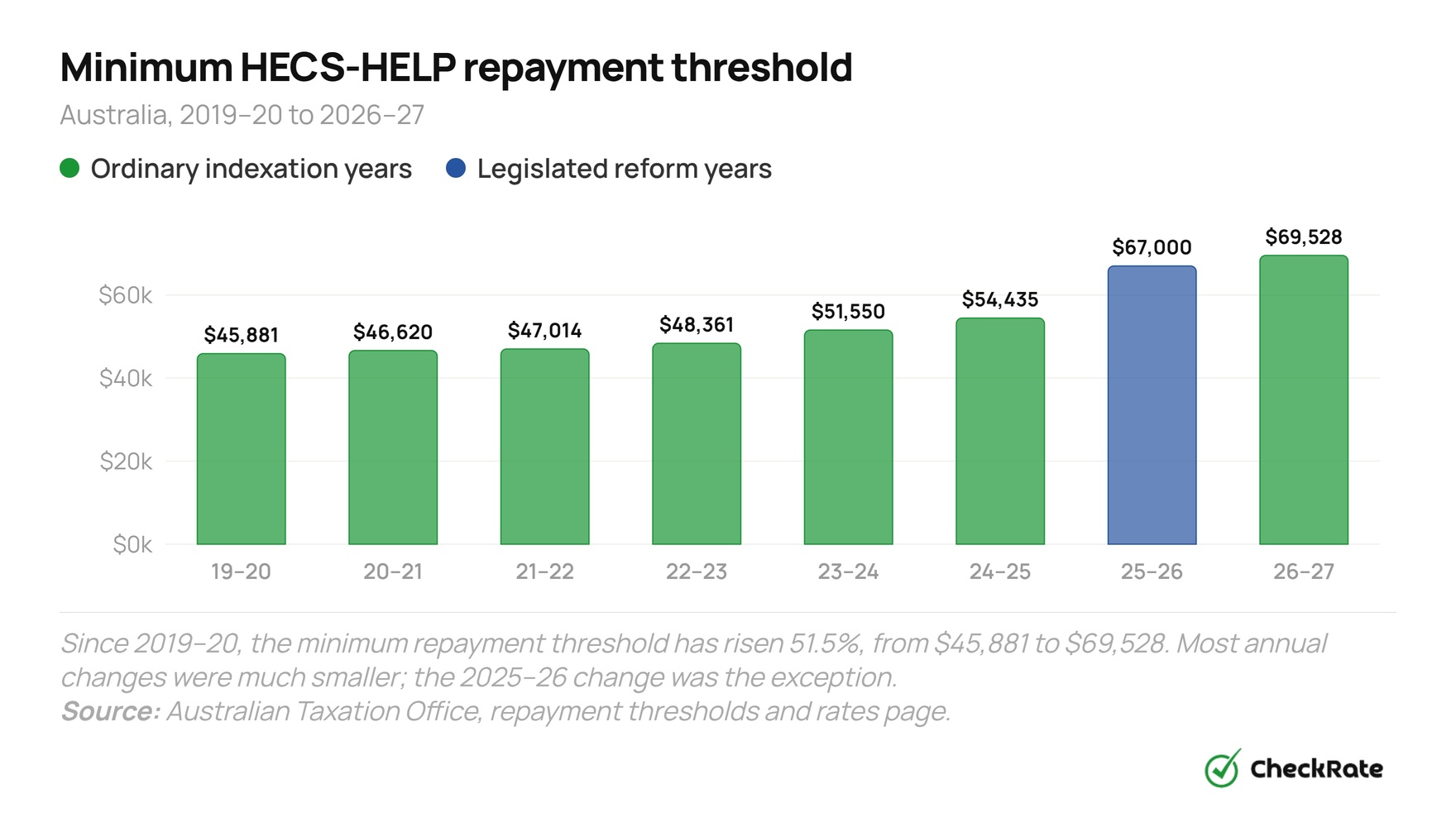
The minimum income needed to start repaying a HECS-HELP debt is $69,528 in the 2026–27 financial year, up from $54,435 just two years earlier. From 1 July 2025, compulsory repayments are calculated on a marginal basis, so only the income above the threshold is charged, rather than a flat percentage of the whole amount.
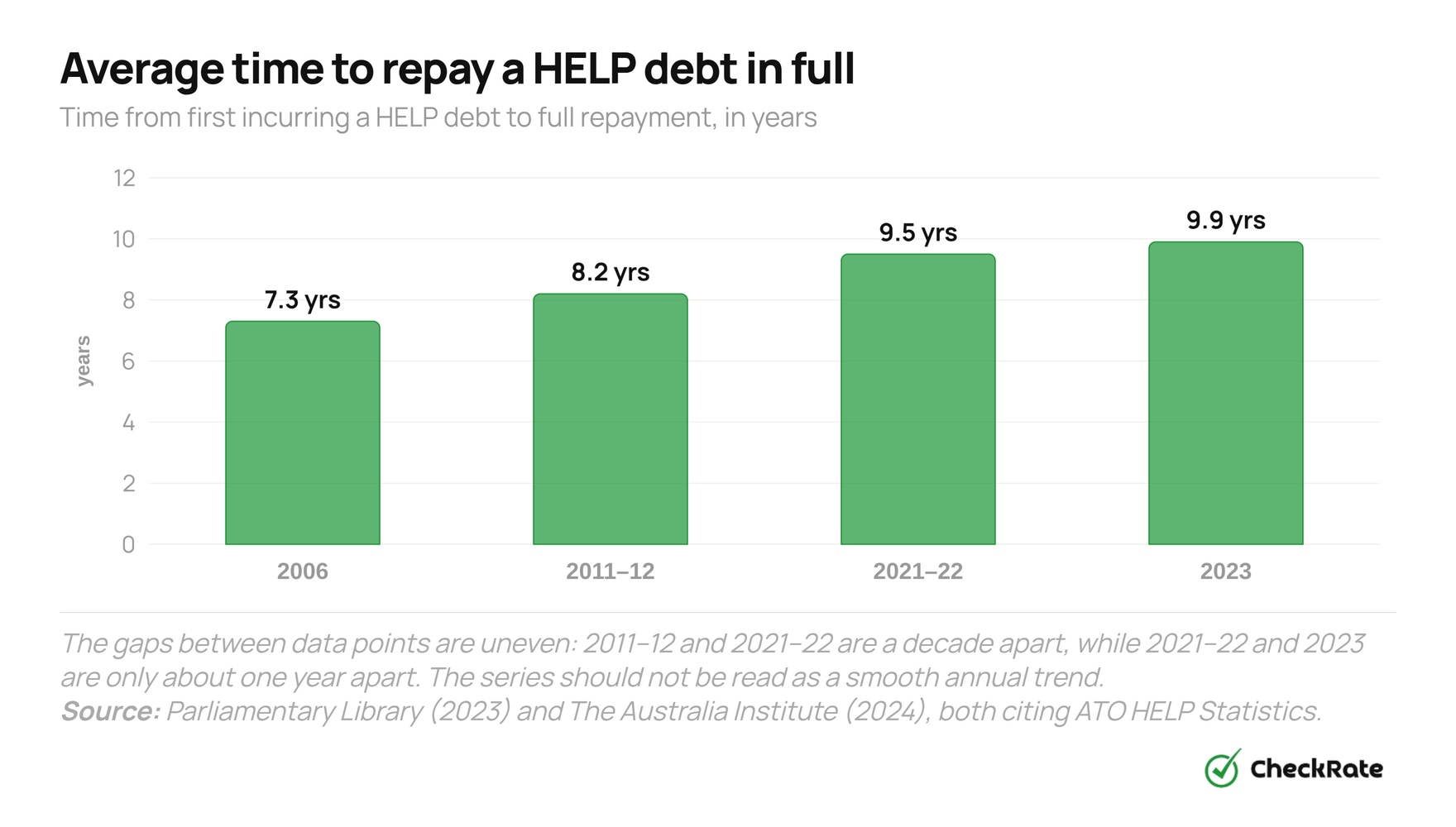
The government also cut existing HELP balances by 20% in 2025, wiping $5,520 from an average $27,600 debt. Even with those changes, the most recent published repayment-time figure shows it took the average borrower 9.9 years to repay a HECS-HELP debt in full, nearly three years longer than in 2006.
At what income does compulsory HECS-HELP repayment start?▾
How long does it take to repay a HECS-HELP debt?▾
How much lower are repayments under the new HECS-HELP system?▾
HECS-HELP repayments start when income exceeds $69,528
The minimum repayment threshold is $69,528 for 2026–27, up from $67,000 in 2025–26 and $54,435 in 2024–25, a rise of more than $15,000 in two years.
Below the threshold, no compulsory repayment is required, no matter how large the underlying debt is. Repayment income is also broader than salary. It includes:
- Taxable income excluding any assessable First Home Super Saver released amount
- Reportable fringe benefits amounts
- Total net investment loss (including net rental losses)
- Reportable super contributions
- Exempt foreign employment income amounts
Someone with a modest salary but a negatively geared rental property, for example, can have a repayment income well above their taxable income alone.
| Income year | Minimum threshold | Change on prior year |
|---|---|---|
| 2019–20 | $45,881 | — |
| 2020–21 | $46,620 | +1.6% |
| 2021–22 | $47,014 | +0.8% |
| 2022–23 | $48,361 | +2.9% |
| 2023–24 | $51,550 | +6.6% |
| 2024–25 | $54,435 | +5.6% |
| 2025–26 ★ | $67,000 | +23.1% |
| 2026–27 | $69,528 | +3.8% |
| ★ Highlighted because this jump came from legislation, not routine indexation. | ||
Most of that history moved in small steps, in line with wages. Section 06 shows why 2025–26 was the exception.
How the 2026 marginal repayment system works
From 1 July 2025, compulsory HECS-HELP repayments moved to a marginal system. For most repayment incomes, only the income above the minimum threshold is charged. For the highest band, the repayment is 10% of total repayment income.
Under the old rules, crossing a threshold meant a single percentage applied to the entire repayment income. A small pay rise that pushed someone into the next band could noticeably increase their total repayment.
| Repayment income (2026–27) | Repayment on this income |
|---|---|
| $0 – $69,528 | Nil |
| $69,529 – $129,717 | 15c for every $1 over $69,528 |
| $129,718 – $186,050 | $9,028 plus 17c for every $1 over $129,717 |
| $186,051 and over | 10% of total repayment income |
| Repayment income (2025–26) | Repayment on this income |
|---|---|
| $0 – $67,000 | Nil |
| $67,001 – $125,000 | 15c for every $1 over $67,000 |
| $125,001 – $179,285 | $8,700 plus 17c for every $1 over $125,000 |
| $179,286 and over | 10% of total repayment income |
The bands moved up slightly for 2026–27, but the structure stayed the same: nil, then 15c, then 17c, then a flat 10% of total repayment income at the top. The 15c and 17c bands apply only to income inside those bands, while the highest band uses a flat 10% rate on total repayment income.
| Repayment income | Band | Calculation | Compulsory repayment |
|---|---|---|---|
| $86,380 | 15c band | 15% of ($86,380 − $69,528) | $2,527.80 |
| $137,064 | 17c band | $9,028 + 17% of ($137,064 − $129,717) | $10,276.99 |
| $254,780 | Top band | 10% of $254,780 | $25,478 |
The repayment grows steadily as income rises through the 15% and 17% bands. Once income passes $186,050, the rate becomes 10% of total repayment income, the same top rate that applied under the old system. This is why the new rules mainly change outcomes for incomes near the threshold and in the middle bands, while making little difference for the highest repayment incomes.
Compulsory repayments are lower for many incomes under the new system
At a 2025–26 repayment income of $70,000, the new system reduced compulsory repayments by about $1,300 a year compared with the old rules. At $80,000, the reduction was $850 a year.
| Repayment income | Old system | New system | Difference |
|---|---|---|---|
| $70,000 | about $1,750 (2.5%) | $450 (15% of $3,000) | About $1,300 lower, government-stated comparison |
| $80,000 | $2,800 (3.5%) | $1,950 (15% of $13,000) | $850 lower per year, about $32 per fortnight |
| $179,286 and over | 10% | 10% | No change |
The $80,000 figures come from the ATO's own published example. The ATO states that, before the law change, a repayment income of $80,000 would have produced a compulsory repayment of $2,800, compared with $1,950 under the new system. The $70,000 figures come from government statements and align with the 2025–26 marginal threshold calculation. The two rows are useful illustrations, but they are not calculated in the same way.
The pattern is consistent. Lower compulsory repayments are concentrated among repayment incomes just above the threshold and through the middle bands. The difference tapers to zero once repayment income reaches $179,286, where both systems reach the same 10% rate.
The average repayment time is now nearly 10 years
The average time to repay a HELP debt in full rose from 7.3 years in 2006 to 9.9 years in 2023, an increase of about 36%.

This average only counts debts already repaid in full, so it looks backwards, not forwards. Older, smaller debts tend to close out faster, so recent figures mix long-closed smaller debts with newer, larger debts that have only just reached full repayment.
The underlying data predates the 2025 reforms, so it doesn't yet reflect the 20% debt cut or the new marginal repayment system. The next update, once it covers 2025–26 and 2026–27, will show whether the reforms change typical repayment times.
Part of the reason repayment is taking longer is that debts themselves have grown. The average HELP debt for people in their 20s more than doubled between 2006 and 2024, from $12,600 to $31,500, a far steeper rise than the roughly 62% that inflation alone would explain. Across all debtors, the average loan debt rose from $15,200 to $24,800 over the decade to 2021–22, and reached about $27,600 by 2023–24, close to the benchmark used for the 2025 debt cut.
HECS-HELP debt can vary widely by field of study
The most expensive funding cluster costs $17,399 a year, more than three times the cheapest at $4,738. There's no official table linking repayment time to field of study, but that cost gap is measurable.
As a share of the median graduate's full-time starting salary, the law, commerce, economics, communications and society and culture cluster equals about 23%. The nursing, education and agriculture cluster equals about 6% of that same benchmark.
This comparison uses one overall salary figure rather than a separate benchmark for each field, so it shows the scale of the contribution gap, not an exact repayment timeline. Actual starting salaries vary by field, and course cost and earning power do not always move together. Social work had a median full-time undergraduate salary of $82,000 in 2024, above the $75,000 overall undergraduate median.
The 2025 threshold jump was bigger than normal indexation
Since 2019–20, the minimum repayment threshold has risen 51.5%, from $45,881 to $69,528. Most annual changes in that period were much smaller. The 2025–26 change was the exception.
Under the previous formula, the 2025–26 threshold would have been $56,156, compared with the legislated $67,000 threshold. The threshold's 2025–26 jump went beyond what the earlier formula would have produced.
The threshold and indexation work differently. Indexation applies to outstanding loan balances, not to the repayment threshold. Each 1 June, the ATO increases any part of a study or training loan that has been unpaid for more than 11 months. From 2025, the rate is based on the lower of the Consumer Price Index or the Wage Price Index.
That rate has ranged from 0.6% in 2021 to 4.0% in 2024, after the 2024 rate was revised down from 4.7%. It was 2.8% in 2026, the lowest rate since 2021. The 2023 rate was also revised down from 7.1% to 3.2% after the government moved to the lower-of-CPI-or-WPI method. The Department of Education said that backdated change cut about $3 billion from outstanding student debt.
| Year | Indexation rate |
|---|---|
| 2013 | 2.0% |
| 2014 | 2.6% |
| 2015 | 2.1% |
| 2016 | 1.5% |
| 2017 | 1.5% |
| 2018 | 1.9% |
| 2019 | 1.8% |
| 2020 | 1.8% |
| 2021 | 0.6% |
| 2022 | 3.9% |
| 2023 | 3.2% (revised from 7.1%) |
| 2024 | 4.0% (revised from 4.7%) |
| 2025 | 3.2% |
| 2026 | 2.8% |
| Indexation applies on 1 June to any part of a loan unpaid for more than 11 months. From 2025, the rate uses the lower of CPI or the Wage Price Index. | |
The threshold and indexation rate are governed separately. The threshold's 2025–26 jump went beyond what the earlier formula would have produced. The indexation change, by contrast, switched the loan-balance formula to the lower of CPI or WPI, applied from 2025 and backdated to 2023 and 2024.
References
- 1ATO: Study and training loan repayment thresholds and rates, last updated 30 June 2026.
- 2ATO: Study and training loans, what's new, last updated 5 February 2026.
- 3ATO: Study and training loan indexation rates, last updated 17 April 2026.
- 4Department of Education: HELP indexation and debt reduction, accessed July 2026.
- 5Department of Education: 2026 indexed rates, funding clusters and student contribution amounts, 2026 calendar year.
- 6Parliamentary Library: HELP debt, the evolution of higher education contributions, published June 2023.
- 7The Australia Institute: University is expensive, discussion paper, published October 2024.
- 8QILT: 2024 Graduate Outcomes Survey National Report, covers graduates surveyed in 2024.
- 9data.gov.au: Study and Training Support Loans dataset, Australian Taxation Office, updated 10 September 2025.
Data Snapshots