HECS debt by degree, field of study and gender in Australia
The annual HECS-HELP cost of a Commonwealth supported degree in 2026 ranges from $4,738 to $17,399 depending on discipline, a gap of $12,661. Move into full-fee postgraduate study and the range widens: a domestic medical degree at Bond University can cost more than $470,000, well above the $186,544 loan limit for that field. Field of study affects the student contribution set for Commonwealth supported places, while provider-set full fees can create much larger debt exposure outside HECS-HELP.
16 min read 08 July 2026Updated 08 July 2026 Fact checked
Key statistics: 2026 update
$12,661
Gap between the highest ($17,399) and lowest ($4,738) annual HECS-HELP student contribution in 2026
$470,540
Indicative total cost of Bond University's Medical Program, above the $186,544 HELP loan limit for that field
62%
Share of domestic commencing students who were female in 2024, up from 58% in 2015
$129,883
Combined HELP loan limit for most courses in 2026 ($186,544 for medicine, dentistry, vet science and eligible aviation)
HECS-HELP is the loan that covers the student contribution for a Commonwealth supported place, commonly known as HECS, where the government subsidises part of the course cost. In 2026, that contribution ranges from $4,738 a year for nursing, education and agriculture to $17,399 a year for law, commerce and related fields. FEE-HELP, a separate loan for full-fee courses such as many postgraduate degrees, works differently again: providers set the price, and it is usually quoted as a total course cost rather than a yearly rate.
Frequently asked questions
How much does a HECS-HELP degree cost per year?▾
In 2026, the annual student contribution for a Commonwealth supported place ranges from $4,738 for nursing, education and agriculture to $17,399 for law, commerce, economics, communications and related fields. The exact amount depends on the discipline of each unit of study, not only on the university attended.
What is the difference between HECS-HELP and FEE-HELP?▾
HECS-HELP pays the student contribution for a Commonwealth supported place, where the government subsidises part of the cost. FEE-HELP is a separate loan for full-fee places, mainly postgraduate coursework, where the provider sets the course price and there is no Commonwealth supported place subsidy. Since 2020, both loan types have drawn on the same combined HELP loan limit and are repaid together as one HELP balance.
How much can someone borrow through HELP?▾
The combined HELP loan limit in 2026 is $129,883 for most courses, and $186,544 for medicine, dentistry, veterinary science and eligible aviation courses. The limit is indexed each year and covers HECS-HELP, FEE-HELP, VET FEE-HELP and VET Student Loans together.
Does field of study affect how fast someone repays their HELP debt?▾
Not directly. Below $69,528 a year in 2026-27, no compulsory repayment is required at all, regardless of field of study. Above that threshold, repayments are based on income, not on what someone studied or how large their debt is. Two people on the same income repay at the same rate, although a smaller balance will usually be cleared sooner at the same repayment rate.
Section 01Discipline costs
Which degrees have the highest HECS-HELP student contributions in 2026?
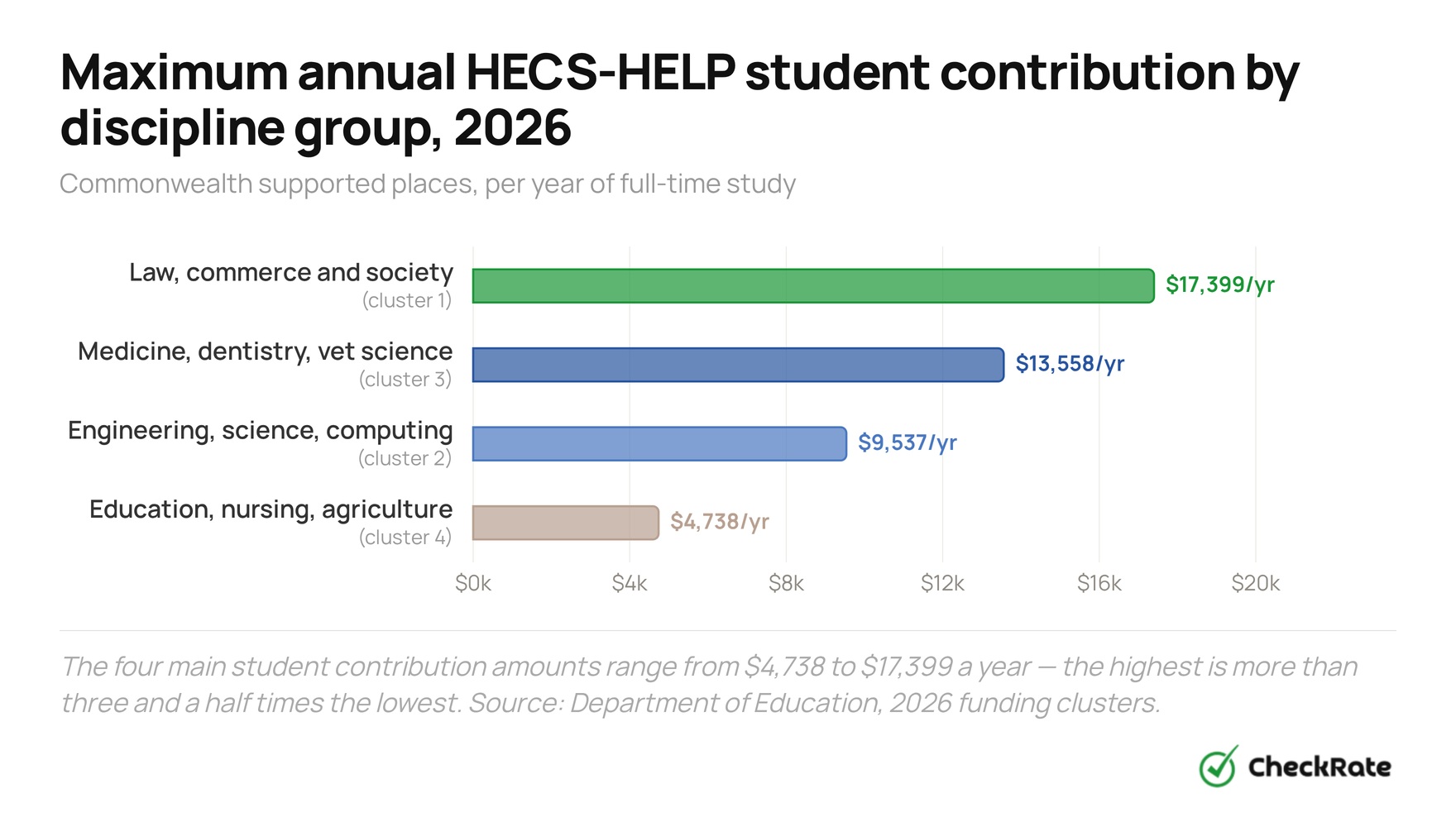
The 2026 student contribution ranges from $4,738 to $17,399 per year, a gap of $12,661 depending solely on discipline.
Every Commonwealth supported place is assigned to a funding cluster, but the student contribution amount does not map neatly to one cluster number. In 2026, the same funding cluster can include more than one student contribution amount, depending on the discipline group. The same law unit has the same maximum student contribution whether it is studied in Sydney, Perth or Hobart.
Maximum annual HECS-HELP student contribution by discipline group in Australia, 2026
Commonwealth supported places, per year of full-time study
The four main student contribution amounts range from $4,738 to $17,399 per year. The highest annual contribution is more than three and a half times the lowest.
Source: Department of Education, 2026 funding clusters and student contribution amounts.
2026 HECS-HELP student contribution by discipline group
Maximum annual amount for a Commonwealth supported place
Official data
Discipline group
2026 student contribution
Law, accounting, administration, economics, commerce, communications, society and culture
$17,399
Medicine, dentistry, veterinary science
$13,558
Allied health, other health, built environment, computing, visual and performing arts, professional pathway psychology and social work
Figures are the maximum student contribution for a non-grandfathered Commonwealth supported place, on an equivalent full-time student load basis. Source: Department of Education, 2026 indexed rates.
For context, multiplying these annual figures across a standard three-year bachelor's degree gives a rough sense of scale: about $14,214 in total student contributions at the lowest student contribution amount, compared with about $52,197 at the highest. Longer professional degrees add further years at the relevant rate, so a four-year engineering degree or a six-year medical degree would accumulate more. These are simple multiplications of the published annual rate, not official total-debt figures, since the government does not publish average HELP debt by named degree.
What HECS-HELP student contribution amounts do and do not show
The student contribution figures are the maximum annual amounts the government sets for Commonwealth supported places, not a record of what any individual actually owes. Real debt also depends on how many years someone studies, whether they study part time, whether units are failed or repeated, indexation, and any repayments made along the way. No official source publishes an average outstanding HELP debt by named degree.
Students can build HECS-HELP debt before finishing a degree
Not every student who takes on HECS-HELP debt completes their course. The domestic bachelor attrition rate, the share of commencing students who do not return the following year, was 12.2% for the 2023 commencing cohort, down from 14.7% for the 2022 cohort and the lowest recorded in the past decade. A student who leaves after one or two years still owes the student contribution for the units they completed, even without finishing the qualification.
Source: Department of Education, key findings from the 2024 higher education student statistics.
Section 02Full-fee debt
How much can a full-fee degree cost in Australia?
A full-fee medical degree at Bond University can cost more than $470,000, well beyond the $186,544 HELP loan limit for that field.
HECS-HELP only applies to Commonwealth supported places. A separate loan, FEE-HELP, covers full-fee places, which include most full-fee postgraduate coursework degrees and some full-fee undergraduate places. Each provider sets its own price, usually as a total course fee rather than an annual rate.
Domestic postgraduate commencements rose from 102,359 in 2015 to 118,607 in 2024, an increase of about 16%, while undergraduate commencements fell slightly over the same period. This shows postgraduate study has become a larger part of domestic commencements than it was in 2015, but commencement data does not directly show how many students used FEE-HELP.
The combined HELP loan limit in 2026 is $129,883 for most courses, and $186,544 for medicine, dentistry, veterinary science and eligible aviation courses. That higher limit reflects how long and expensive courses in those fields can be, as the Bond example below shows. HECS-HELP and FEE-HELP have drawn on this same combined limit since 2020.
$129,883
Combined HELP loan limit for most courses in 2026, covering HECS-HELP, FEE-HELP, VET FEE-HELP and VET Student Loans together
$186,544
Higher HELP loan limit in 2026 for medicine, dentistry, veterinary science and eligible aviation courses
2020
The year HECS-HELP began counting toward the same combined loan limit as FEE-HELP
Source: Study Assist, borrowing limit and HELP debt balance pages.
Full-fee course cost examples
A Juris Doctor at Deakin costs $52,197 as a Commonwealth supported place, or $123,000 as a full-fee place, the same degree priced two different ways.
There is no central price list for full-fee courses, so the closest way to show the range is a small number of real, currently published prices. These are individual examples, not an average or a comprehensive survey.
Full-fee course cost examples in Australia, 2026
Currently published tuition for selected postgraduate and medical programmes
Official data
Course
Provider
Indicative total cost
Loan type
Juris Doctor, Commonwealth supported place
Deakin University
$52,197 (3 years)
HECS-HELP
Juris Doctor, full-fee place
Deakin University
$123,000 (3 years)
FEE-HELP
Full-Time MBA
Melbourne Business School
$112,536 (2 years)
FEE-HELP
Medical Program (BMedSt/MD) — Highest
Bond University
$470,540 (14 semesters)
FEE-HELP
Deakin's Juris Doctor is shown both ways because it is offered as either a Commonwealth supported or a full-fee place at the same provider. Bond's figure is the university's own indicative average programme cost. Source: Deakin University, Melbourne Business School and Bond University course fee pages, 2026.
The Bond medical degree example exceeds the 2026 HELP loan limit
Bond's indicative Medical Program cost of around $470,540 is above the 2026 higher HELP loan limit of $186,544. If a student used FEE-HELP for this programme and reached the loan limit, the remaining tuition amount would need to be paid outside HELP. These are one provider's figures, not a claim about every medical programme in Australia.
A FEE-HELP loan fee can increase some full-fee debts
A 20% FEE-HELP loan fee still applies to some full-fee undergraduate study, added on top of the course price and added directly to the debt. It does not apply to postgraduate study, and some providers are exempt from it for undergraduate study as well, including Bond University. None of the Deakin, Melbourne Business School or Bond examples are affected by the loan fee: the Deakin and Melbourne Business School courses are postgraduate, and Bond is an exempt provider. Where the loan fee does apply, the FEE-HELP debt can be higher than the advertised course price.
MBA fees in Australia range from $16,000 to $153,000 for the full degree, with most programmes costing $50,000 to $80,000. Melbourne Business School's $112,536 full-time programme sits well above the middle of that range. This comes from a private industry compilation, not an official government figure, and is included here for context rather than as a benchmark.
Section 03Job-ready Graduates
How Job-ready Graduates changed HECS-HELP course costs
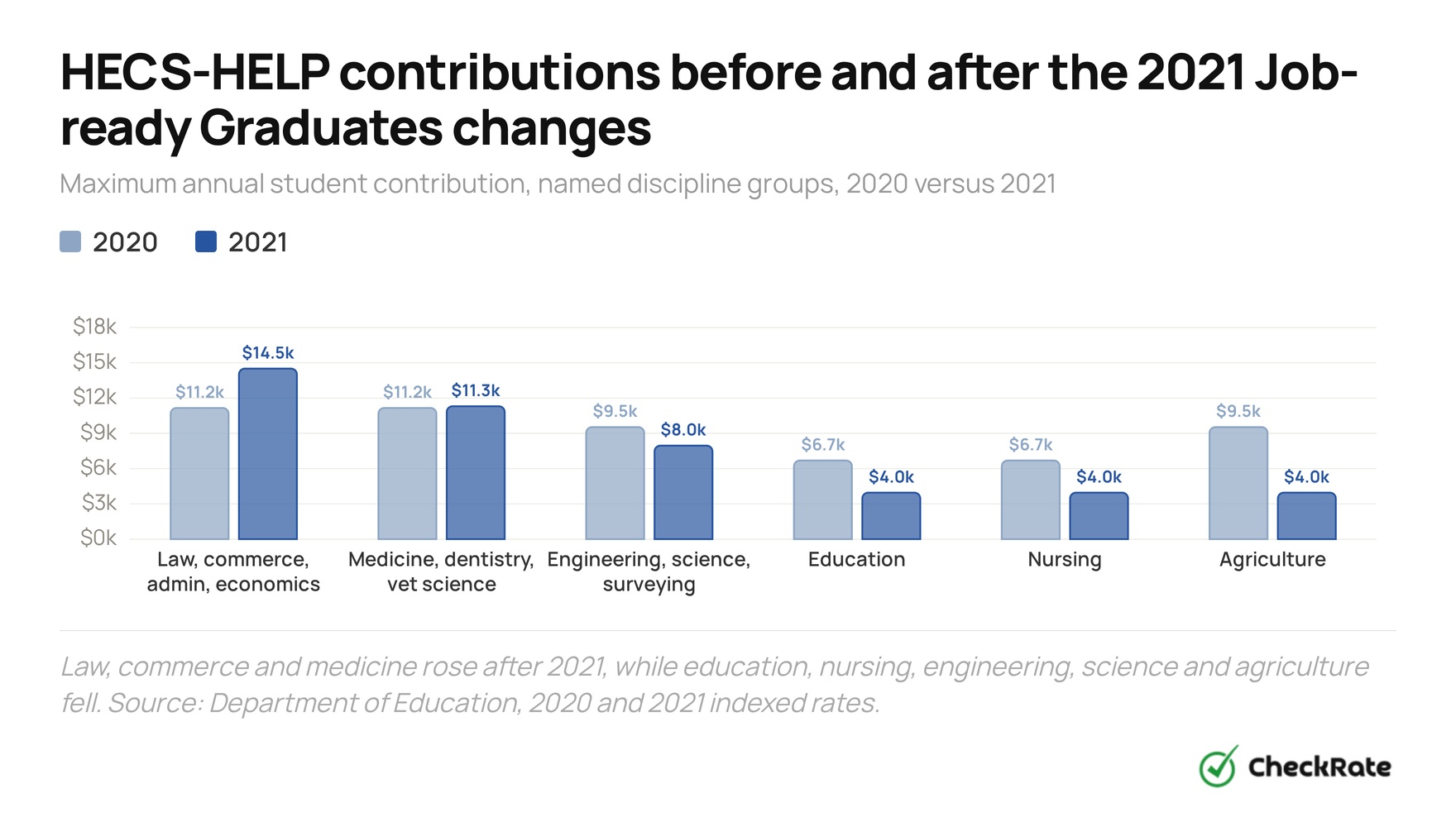
In the first year of the 2021 changes, law and commerce contributions rose by $3,345 a year, while agriculture fell by $5,577.
The Job-ready Graduates package replaced the old system of eight funding clusters and three price bands with four clusters and four bands from the 2021 academic year. Continuing students who would otherwise have faced a higher contribution were grandfathered onto earlier rates.
HECS-HELP student contribution in Australia before and after the 2021 Job-ready Graduates changes
Maximum annual student contribution, named discipline groups, 2020 versus 2021
2020
2021
Law, accounting, commerce and economics moved up, and medicine, dentistry and veterinary science rose slightly too. Education, nursing, engineering, science and agriculture all moved down, with agriculture recording the largest fall among the comparable groups shown.
Source: Department of Education, 2020 and 2021 indexed rates, and the Job-ready Graduates technical note.
HECS-HELP student contribution before and after Job-ready Graduates
Maximum annual contribution by named discipline group, 2020 vs 2021
Official data
Discipline group
2020
2021
Change
Law, accounting, commerce, economics, administration — Largest rise
$11,155
$14,500
+$3,345
Medicine, dentistry, veterinary science
$11,155
$11,300
+$145
Engineering, science, surveying
$9,527
$7,950
-$1,577
Education
$6,684
$3,950
-$2,734
Nursing
$6,684
$3,950
-$2,734
Agriculture
$9,527
$3,950
-$5,577
The 2020 and 2021 systems used different structures, with eight clusters and three bands in 2020 compared with four clusters and four bands in 2021. Only categories named in both official tables are compared directly here. Source: Department of Education, 2020 and 2021 indexed rates.
Job-ready Graduates changed price bands, not just indexation
The 2021 Job-ready Graduates changes restructured the HECS-HELP pricing system rather than simply adjusting existing rates for inflation. That is why a plain "cost rose from X to Y" comparison does not always hold up, and why only disciplines named in both the 2020 and 2021 rate structures can be compared directly. Job-ready Graduates only applies to Commonwealth supported places. It does not set FEE-HELP pricing, which providers set independently.
Since 2021, the new student contribution amounts have continued to rise with indexation. Law, commerce and related fields climbed from $14,500 to $17,399 by 2026, while lower-contribution fields such as education, nursing and agriculture rose from $3,950 to $4,738. Both moves reflect ordinary annual indexation applied inside the post-2021 structure, not a second policy redesign.
HECS-HELP student contribution amounts under the 2021 structure, 2021 vs 2026
Ordinary annual indexation applied to the four post-Job-ready Graduates groups
Official data
Student contribution group
2021 rate
2026 rate
Increase
Law, commerce, communications, society and culture — Highest
$14,500
$17,399
+$2,899
Medicine, dentistry, veterinary science
$11,300
$13,558
+$2,258
Allied health, engineering, science, computing
$7,950
$9,537
+$1,587
Education, nursing, agriculture and related lower-contribution fields
$3,950
$4,738
+$788
All four groups have risen every year since 2021 under ordinary indexation, with no further restructuring of the bands themselves. Source: Department of Education, 2021 and 2026 indexed rates.
Section 04Field of study
Which fields of study have the highest potential HECS-HELP exposure?
Society and culture, Australia's largest field of study with 98,994 domestic commencements in 2024, sits at the highest 2026 student contribution amount, and so does management and commerce, the third largest at 58,618.
Short answer
No official source publishes average HELP debt by field of study. What the data does show is how many students are studying in each field, and which student contribution amount that field most commonly falls into. Combining the two gives an indicative view of where potential HECS-HELP exposure may be concentrated, but it is not an official debt-by-field measure.
Domestic commencing students by field of education in Australia, 2024
Selected broad fields, ranked by number of domestic commencing students
Society and culture, the largest field shown, and management and commerce, the third largest, both sit at the highest 2026 student contribution amount of $17,399 a year. Health, the second largest, spans several student contribution amounts rather than one. Education, the fourth largest, sits at the lowest 2026 student contribution amount of $4,738 a year.
Source: Department of Education, key findings from the 2024 higher education student statistics.
Domestic commencements and indicative HECS-HELP cost by field of education
2024 commencing student numbers with the 2026 student contribution amount most common to each field
Official data
Field of education
2024 commencements
Change since 2015
Indicative 2026 student contribution amount
Society and culture — Highest cost
98,994
-7.5%
$17,399
Health
93,979
+25.0%
Spans $4,738 to $13,558
Management and commerce — Highest cost
58,618
-15.9%
$17,399
Education
46,436
-0.5%
$4,738
Natural and physical sciences
33,125
-1.5%
$9,537
Creative arts
25,405
-21.8%
$9,537
Engineering and related technologies
23,616
+15.0%
$9,537
Information technology
21,983
+91.4%
$9,537
Agriculture, environmental and related studies
5,102
+6.3%
Spans $4,738 to $9,537
Student contribution amounts are indicative, based on where each broad field most commonly falls in the 2026 Department of Education tables. Health spans three separate amounts depending on specialisation, and agriculture and environmental studies span two different amounts. Source: Department of Education, key findings from the 2024 higher education student statistics, and 2026 funding cluster tables.
Why a broad field of study is not one HECS-HELP price
Health is the clearest example of why field of education and student contribution amount do not map neatly onto each other. Nursing sits in the lowest-cost group at $4,738 a year, allied and other health sit in the middle-cost group at $9,537, and medicine, dentistry and veterinary science sit in a higher-cost group at $13,558.
Two things stand out. Information technology grew faster than any other field shown, up 91.4% in domestic commencements between 2015 and 2024, while creative arts fell furthest, down 21.8% over the same period. And the size of a field does not track its price: education is the fourth largest field and among the lowest-cost groups, while society and culture and management and commerce are both large and sit at the top of the pricing scale.
What official HELP debt data cannot show by field
There is no published table of average outstanding HELP debt by field of study. Fields with common postgraduate pathways, such as commerce into an MBA or an undergraduate degree into a Juris Doctor, can carry further FEE-HELP exposure beyond the Commonwealth supported student contribution for that field.
Section 05Gender
Women make up a growing majority of domestic commencing students
Sixty-two per cent of domestic commencing students were female in 2024, up from 58% in 2015.
Domestic commencing student data is not the same as HELP borrower data. However, because HELP debt starts with enrolment in eligible higher education study, the gender split of domestic commencements gives useful context for where potential new HELP exposure may sit. No official public table tracks HELP balances by gender directly.
Domestic commencing students by gender in Australia, 2015 to 2024
Number of domestic commencing students
Female
Male
Both lines rose sharply in 2020 and 2021 before easing back, a pattern linked to pandemic-era disruption rather than a lasting shift in enrolment. Measured end to end, female commencements rose 7.3% between 2015 and 2024, while male commencements fell 5.9%. A small remaining share, 2,440 students in 2024, was recorded as indeterminate, intersex or another category.
Source: Department of Education, key findings from the 2024 higher education student statistics.
62%
Share of 2024 domestic commencing students who were female, of those recorded as female or male
+7.3%
Growth in female domestic commencements, 2015 to 2024
-5.9%
Change in male domestic commencements over the same period
Source: Department of Education, key findings from the 2024 higher education student statistics.
What the data cannot show about gender and HELP debt
There is no public table combining field of study, gender and HELP debt in one place. It is not possible from currently published data to say whether female or male HECS-HELP borrowers carry larger debts on average, or whether they are more concentrated in cheaper or more expensive disciplines.
Section 06Repayment
Does field of study affect HECS-HELP repayment speed?
Below $69,528 a year, no HELP repayment is required at all, regardless of field of study, provider or debt size.
From the 2025-26 income year, HECS-HELP and FEE-HELP repayments both use the same marginal system, based on repayment income rather than field of study.
Since 2020, HECS-HELP and FEE-HELP also combine into a single balance for repayment purposes. A borrower with both loan types does not choose which one to pay off first, or pay them at different rates. The entire combined balance is repaid together, at whatever rate their income places them in.
2026-27 compulsory repayment, by income (illustrative)
$75,000
$821
a year
$150,000
$12,476
a year
$200,000
$20,000
a year
Source: Calculated using the published 2026-27 ATO repayment formula.
These three examples show why the system is described as income-contingent. Someone on $150,000 pays an amount calculated under the 2026-27 marginal repayment formula, regardless of whether their debt came from a $4,738-a-year nursing degree or a $470,540 medical programme.
Section 07The bigger picture
Why total HELP debt keeps rising in Australia
HELP debt reached a fair value of $51.4 billion across 2.96 million debtors at 30 June 2025, according to the 2025-26 Mid-Year Economic and Fiscal Outlook.
Government policy sets the student contribution for a Commonwealth supported place. Provider pricing sets the cost of full-fee study. The 2021 Job-ready Graduates package shows how directly policy can reshape Commonwealth supported place pricing: it moved some disciplines up and others down within one year, separate from ordinary indexation. FEE-HELP pricing works differently. Providers set their own fees for full-fee courses, and some provider-set courses, such as Bond University's Medical Program, can sit well above the HELP loan limit.
Meanwhile, society and culture, the field with the largest domestic commencing cohort in 2024, sits in the highest-cost Commonwealth supported discipline group, alongside management and commerce. Women made up 62% of domestic commencing students recorded as female or male in 2024, although that figure is enrolment data rather than direct HELP borrower data.
$51.4bn
Fair value of HELP debt outstanding at 30 June 2025
2.96m
Number of HELP debtors at 30 June 2025
10.2 yrs
Average time to repay a HELP debt in full, to June 2025
Source: Commonwealth Treasury, 2025-26 Mid-Year Economic and Fiscal Outlook.
Why HELP debt figures from different dates may not line up
Treasury estimated the fair value of HELP debt outstanding at $51.4 billion at 30 June 2025, with 2,962,650 HELP debtors. The same MYEFO section said the average time taken to repay HELP debts was 10.2 years, measured only for people who had fully repaid their debt. Those figures do not include the impacts of the 2024-25 MYEFO measure Building Australia's Future, a fairer deal for students, which was legislated after 30 June 2025. Treasury said those impacts would be reflected in the estimated fair value as at 30 June 2026. This means the 30 June 2025 fair-value figure should not be read as the post-reduction value of HELP debt. The ATO has since said it completed processing the 20% reduction for student and training support debts that existed on 1 June 2025, but that later processing is not reflected in Treasury's 30 June 2025 fair-value estimate.
Put together, the data shows four separate forces shaping HELP debt: discipline determines the student contribution for Commonwealth supported places, the 2021 Job-ready Graduates package reset those contributions across fields, full-fee study can add a larger provider-priced layer of debt, and repayment speed depends on income rather than course type. What the data cannot yet show is average HELP debt by named degree, field of study or gender.
Course cost calculator
What does a Commonwealth supported place cost in 2026?
Selecting a student contribution amount and number of years of full-time study shows the estimated total student contribution at 2026 rates. It does not include FEE-HELP, indexation on unpaid debt, part-time study patterns, failed or repeated units, or future changes to student contribution rates.
General information only
This article is for general informational purposes. Course fees, funding cluster amounts, loan limits and repayment thresholds are updated periodically by the Department of Education, the Australian Taxation Office and individual providers. Individual course costs, especially FEE-HELP courses, vary by provider and by year. CheckRate does not provide financial, tax or study advice. Current fees are available directly from each provider, and the Australian Government's Study Assist website carries information about HELP loans and eligibility.