What is the average HECS debt in Australia in 2026?
The average outstanding HELP debt in Australia was $27,739 in the 2024–25 financial year, up slightly from $27,641 the year before and 165% higher than two decades ago. Across the country, 2,962,650 debtors owed a combined $82.18 billion.
The government has separately cited a benchmark average of $27,600 when explaining the 20% debt reduction applied to eligible student loan balances. The small difference reflects rounding in public communications. Using that benchmark, a 20% reduction would remove about $5,520 from an average balance. This is a basic calculation based on the government's published example, not a separate ATO average.
Indexation of 2.8% was applied to eligible balances on 1 June 2026. The minimum repayment threshold for 2025–26 is $67,000, meaning no compulsory repayments are required on income below that level. From 2025–26, the repayment system shifted from a flat-rate structure to a marginal system, where only income above the threshold attracts compulsory repayments.
These changes followed a period of unusually high indexation. In 2023, a rate of 7.1% was originally applied to HELP balances, the highest in the published rate series going back to 2013. The government subsequently legislated a cap tying indexation to the lower of the Consumer Price Index or the Wage Price Index, and retrospectively reduced the 2023 rate to 3.2% and the 2024 rate from 4.7% to 4.0%. The one-off 20% debt reduction, which according to the government removed over $16 billion in student debt for more than 3 million borrowers, was part of the same reform package.
| Measure | Figure | Period |
|---|---|---|
| Average outstanding HELP debt | $27,739 | 2024–25 (ATO) |
| Government benchmark average | $27,600 | Govt debt-reduction example |
| 20% reduction on benchmark average | $5,520 | Applied 2025 |
| Indexation rate | 2.8% | Applied 1 June 2026 |
| Minimum repayment threshold | $67,000 | 2025–26 |
| Source: ATO HELP statistics 2024–25; Department of Education; Study Assist. | ||
How HECS debt is distributed across borrowers
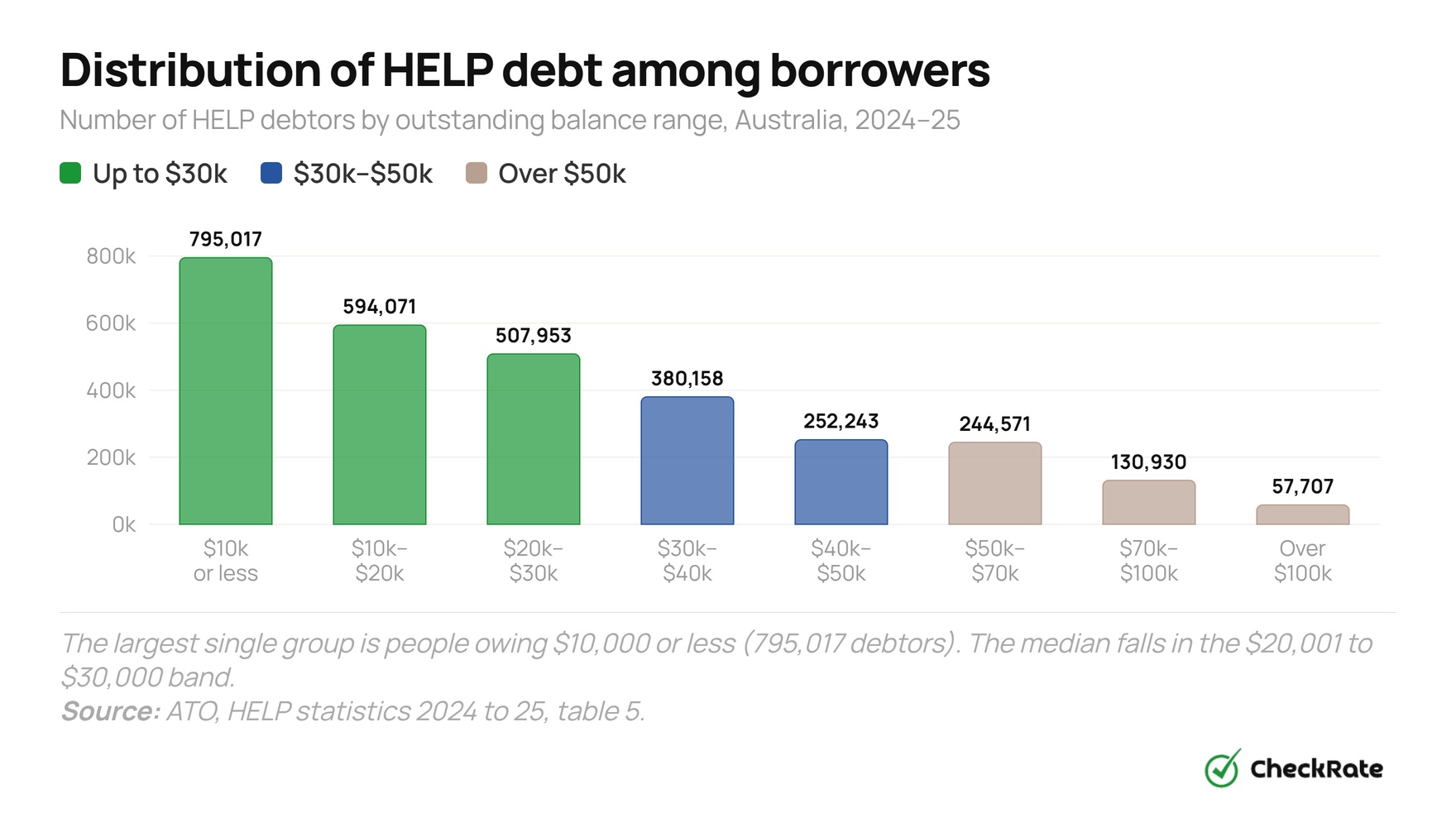
The median HELP debt in Australia falls in the $20,001 to $30,000 range, below the $27,739 average. Nearly 47% of debtors owe $20,000 or less, while 1.9% of debtors, or 57,707 people, owe more than $100,000.
The gap between the two figures reflects a right-skewed distribution: a relatively small number of very large debts can pull the average above the midpoint that most debtors actually experience. These high-value balances are what push the national average above the median.

A borrower with a $20,000 balance is below the national average but close to the median range. A borrower with a $60,000 balance is well above average and, based on the ATO's published debt bands, would sit roughly within the highest 10% to 15% of HELP debtors by balance size. This is an estimate based on published balance ranges, not a directly published ATO percentile.
How many Australians have a HECS debt?
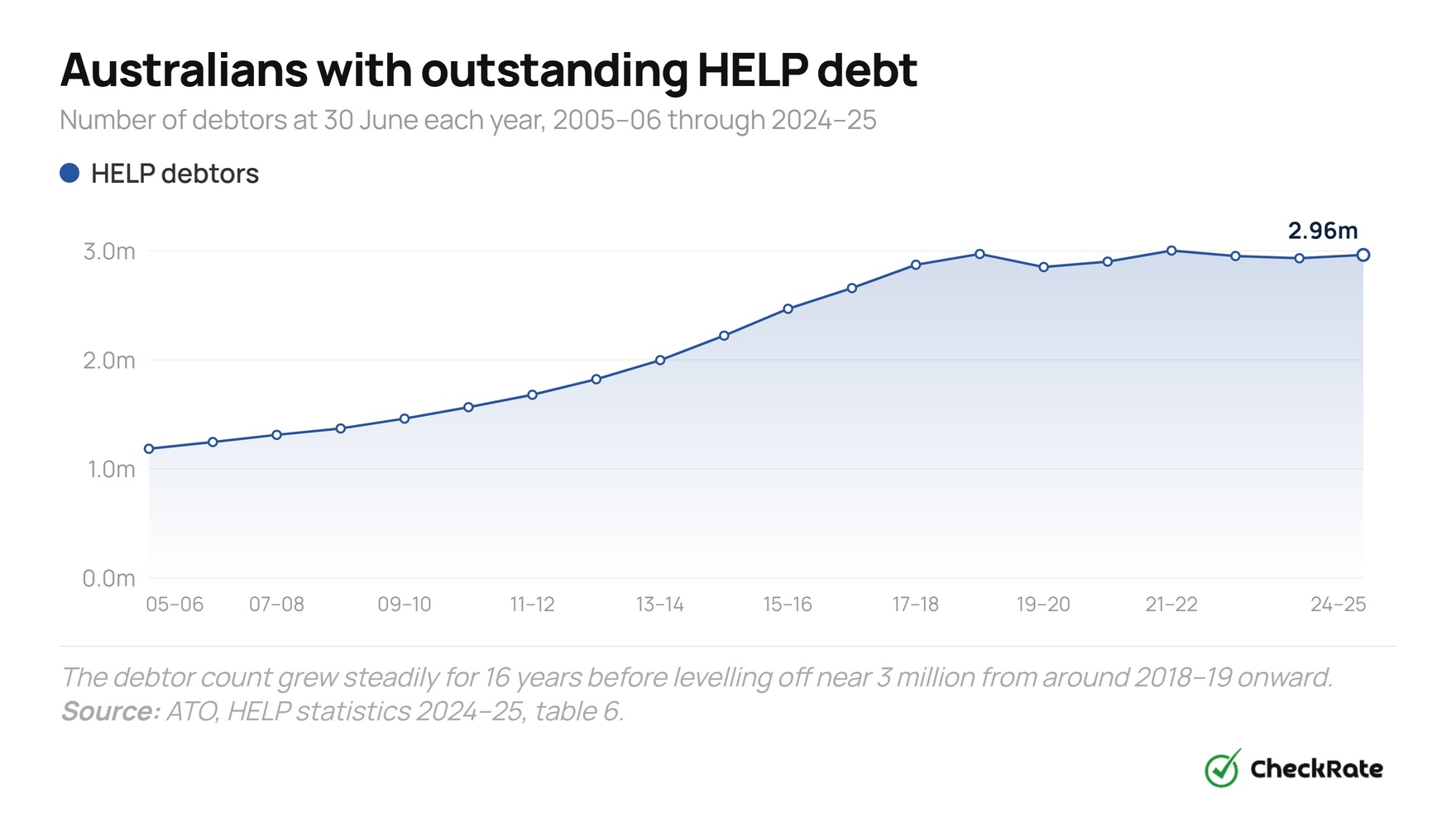
At 30 June 2025, 2,962,650 Australians had an outstanding HELP debt. That was up from 1,185,432 in 2005–06, a 150% increase over two decades. The increase may reflect expanded higher education participation, accumulated indexation on unpaid balances and changes in the mix of HELP loan types.
A derived estimate suggests about 5.8 million Australians have held a HELP debt at some point since the scheme began in 1989. This figure is calculated by combining current debtors, people who have fully repaid a HELP debt and debts written off due to death.
The debtor count peaked at 3,002,984 in 2021–22, eased over the following two years, then edged back up to 2,962,650 in 2024–25.
Since 1989, 2,778,392 individuals have fully repaid their HELP debt. A further 1,363,506 current debtors have never made any repayment, whether compulsory or voluntary, and 23,324 debts have been written off due to death.
Most current debtors are not making compulsory repayments in any given year. HELP repayment income is assessed using the prior year's tax return, so the income data reported against 2024–25 reflects 2023–24 earnings. The compulsory repayment threshold that applied in 2023–24 was $51,550. Around 63% of current debtors had HELP repayment income below $50,000 or had not lodged a return. A further 7.5% fell in the $50,000 to $59,999 band, which partly overlapped that threshold, and about 30% had income of $60,000 or more. This pattern, combined with continuing indexation, may help explain why the national total keeps growing even as many debtors make repayments each year.
Total outstanding HECS debt in Australia
Outstanding HELP debt stood at $82.18 billion at 30 June 2025, up from $12.4 billion in 2005–06. The total has risen in all but one year of the published series, with a small dip in 2019–20. New lending and annual indexation have generally outpaced repayment flows, even as millions of individual debtors have made repayments.
Since the HELP scheme began in 1989, a cumulative total of $125.3 billion has been lent to students. Of that, $52.1 billion has been recovered through compulsory repayments and $11.8 billion through voluntary repayments. Cumulative indexation has added $21.8 billion to balances over the same period, equivalent to about 42% of the amount recovered through compulsory repayments.
Outstanding HELP debt by state and territory
New South Wales has the most HELP debtors at 902,137, owing $25.84 billion combined. Victoria is close behind with 817,167 debtors and $23.67 billion. Those two states together account for 58% of all HELP debtors nationally.
Average debt per debtor varies more than the raw totals suggest. Victoria has the highest state average at $28,971, followed by New South Wales at $28,644 and the ACT at $28,126. Tasmania ($22,709) and the Northern Territory ($22,994) have the lowest averages.
- Average debt
- Debtors
| State/territory | Debtors | Total debt | Average debt |
|---|---|---|---|
| NSW | 902,137 | $25.84b | $28,644 |
| VIC | 817,167 | $23.67b | $28,971 |
| QLD | 611,457 | $16.36b | $26,756 |
| WA | 265,221 | $6.83b | $25,748 |
| SA | 202,083 | $5.23b | $25,875 |
| ACT | 55,332 | $1.56b | $28,126 |
| TAS | 52,462 | $1.19b | $22,709 |
| NT | 17,375 | $0.40b | $22,994 |
| Overseas | 35,222 | $1.03b | $29,351 |
| Source: ATO, HELP statistics 2024–25, table 6. Excludes a small number of debtors with unknown state. | |||
The 35,222 Australians living overseas carry the highest average balance of any group in this table, at $29,351.
How the average HECS debt has grown over 20 years
Average outstanding HELP debt has risen from $10,459 in 2005–06 to $27,739 in 2024–25, a 165% increase. The average crossed $20,000 for the first time in 2016–17 and $25,000 in 2022–23.
Several factors may have contributed to this growth. Student contribution amounts have changed over time, including a 2021 shift in per-field pricing under the Job-ready Graduates package. FEE-HELP lending, which typically involves higher balances than HECS-HELP, has expanded. Annual indexation has also compounded on outstanding balances: the 7.1% rate applied in 2023, before its retrospective reduction to 3.2%, was the highest in the published rate series. Even at the lower rates applied more recently, indexation on a debt stock of more than $80 billion adds billions of dollars to the national total each year.
The average time to repay a HELP debt in full has also lengthened, from 7.3 years in 2005–06 to 10.2 years in 2024–25. Longer repayment periods mean balances are exposed to more years of indexation before being cleared.
The debtor population grew by about 87% between 2005–06 and 2014–15, while average debt grew by 73% over the same period. Debtor numbers then levelled off near 3 million from around 2018–19 onward, but the average has kept climbing as existing balances continue to accumulate indexation.
| Year | Debtors | Total debt | Average debt |
|---|---|---|---|
| 2005–06 | 1,185,432 | $12.40b | $10,459 |
| 2008–09 | 1,371,914 | $17.82b | $12,990 |
| 2011–12 | 1,680,700 | $25.53b | $15,191 |
| 2014–15 | 2,223,041 | $40.18b | $18,075 |
| 2016–17 | 2,659,057 | $53.99b | $20,303 |
| 2018–19 | 2,972,032 | $66.65b | $22,425 |
| 2021–22 | 3,002,984 | $74.39b | $24,771 |
| 2024–25 | 2,962,650 | $82.18b | $27,739 |
| Source: ATO, HELP statistics 2024–25. The 2016–17 financial year is highlighted because it was the first year in which average outstanding HELP debt exceeded $20,000. | |||
How much HECS debt does each age group owe?
The 20 to 29 age group accounts for 42.5% of all HELP debtors in Australia and carries an average balance of $31,727. The 30 to 39 group holds a marginally higher average at $31,801. Together, people under 40 make up 75.8% of all HELP debtors.
Average debt declines progressively in older age groups: $23,791 for 40 to 49, $19,310 for 50 to 59, $17,814 for 60 to 69, and $14,711 for those 70 and over. This may reflect lower historical student contribution amounts, longer repayment periods and differences in the types of study undertaken by older cohorts.
The number of debtors aged 70 and over rose from 3,167 in 2005–06 to 52,563 in 2024–25, a more than fifteen-fold increase. This shows that a growing number of older Australians still had outstanding HELP balances at the end of the financial year.
Women make up 61.1% of all HELP debtors. Female debtors carry a lower average balance, at $26,710, than male debtors, at $29,355. The gap varies by age group. In the 30 to 39 bracket, for example, the average female debt is $30,235, compared with $34,371 for men. This data does not break debt down by field of study.
Frequently asked questions
What is the average HECS debt in Australia right now?▾
How many Australians have a HECS debt?▾
What is the total HECS debt in Australia?▾
Which state has the highest average HECS debt?▾
Is HECS the same as HELP?▾
What happened to HECS indexation in 2023?▾
Which age group has the highest average HECS debt?▾
How long does it take to repay a HECS debt?▾
References
- 1Australian Taxation Office, HELP Statistics 2024–25, official HELP statistics covering the 2005–06 to 2024–25 financial years.
- 2Department of Education, HELP indexation and debt reduction, official summary of the 20% student loan debt reduction and indexation changes.
- 3Department of Education, Legislation to reduce student loan debt passes Parliament, 31 July 2025 announcement covering the 20% reduction, $27,600 benchmark and $5,520 example.
- 4Study Assist, 2026 study loan indexation, 7 May 2026 update confirming the 2.8% indexation rate applied on 1 June 2026.
- 5Australian Taxation Office, study loan indexation rates, official indexation rates from 2013 to 2026.
- 6Australian Taxation Office, repayment thresholds and rates, current and previous compulsory repayment thresholds and rates.
- 7Department of Education, Reporting of HELP Receivable, Australian Government Actuary reporting on the fair-value HELP receivable and debt not expected to be repaid.
Data Snapshots