What is HECS indexation, and when does it apply?
Indexation applies once a year, on 1 June, to the part of a loan balance that has remained unpaid for more than 11 months. Debt taken on within the previous 11 months is not yet indexed, and indexation is separate from compulsory repayments, which are worked out through the tax system.
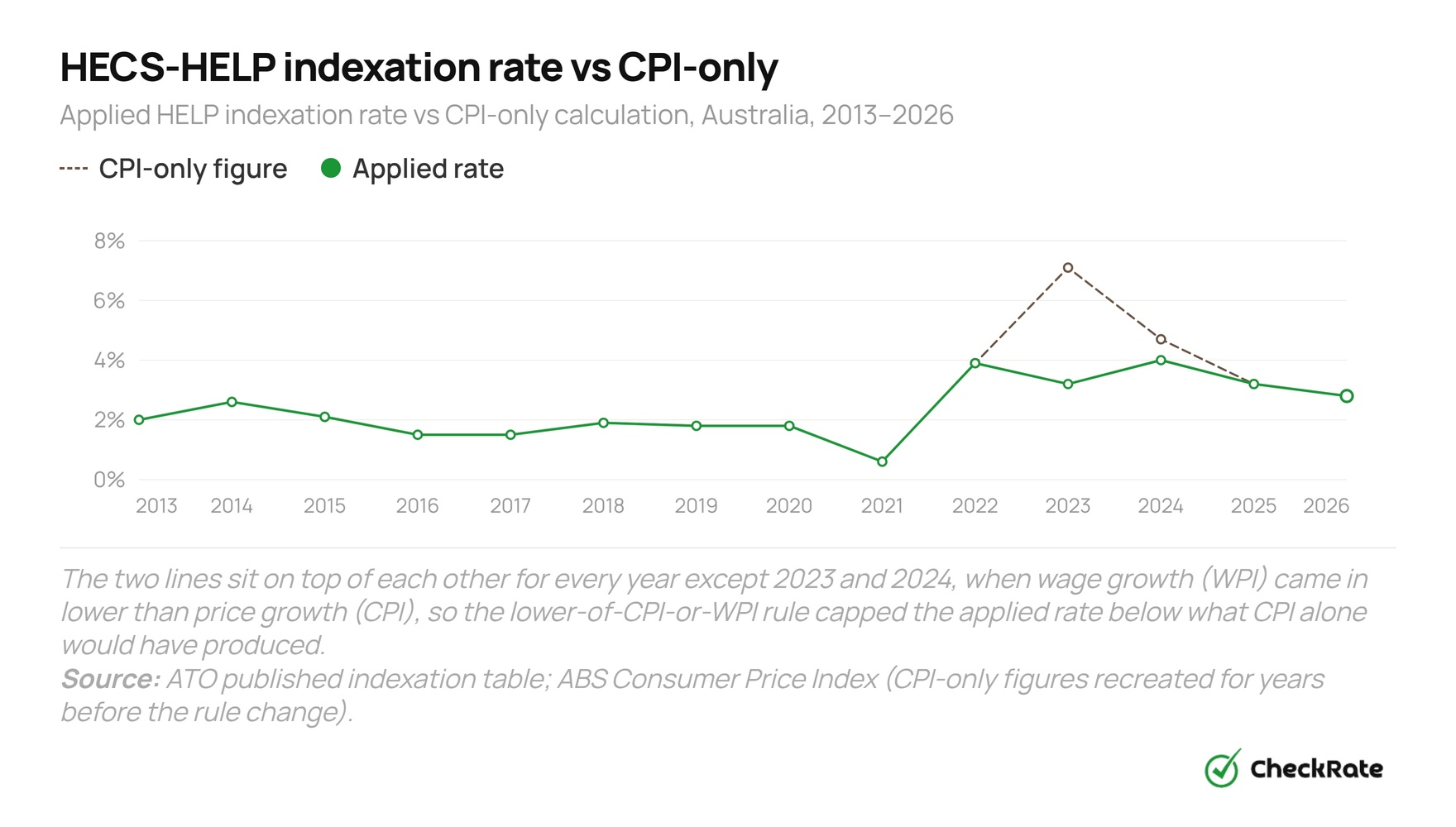
Under this rule, the HELP indexation rate for 2026 is 2.8%, the lowest since 2021 and down from a peak of 7.1% in 2023. It is also the second straight year of decline, after the rate rose to 4.0% in 2024.
HECS-HELP is one loan type within the wider Higher Education Loan Program, known as HELP. HELP also covers:
- FEE-HELP, for full-fee courses
- SA-HELP, for student services and amenities fees
- OS-HELP, for overseas study
- VET Student Loans
- the Australian Apprenticeship Support Loan
- the Student Start-up Loan
- the Student Financial Supplement Scheme
All of these loans are indexed the same way.
How is the HECS indexation rate calculated?
Before 2023, the rate was based solely on the Consumer Price Index (CPI), worked out by comparing the sum of four quarters of CPI against the same four quarters a year earlier, then rounding to three decimal places.
Since 1 June 2023, the rate has instead been the lower of the CPI factor or the Wage Price Index (WPI) factor, calculated the same way but using wage growth instead of price growth. The change was legislated under the Universities Accord (Student Support and Other Measures) Act 2024 and backdated to 1 June 2023.
A second, smaller change followed in 2025: the reference quarter moved from March to December. The rate applied on 1 June 2026 was calculated from the December 2025 quarter and the three quarters before it, compared with the same four quarters a year earlier, producing a factor of 1.028, matching the published rate. This calculation can be recreated closely from ABS price data, confirming CPI, not wage growth, was the lower measure for 2026.
- CPI-only figure
- Applied rate

Set out year by year, the same pattern holds across the full series: every rate on record matches a straightforward CPI calculation, except for the two years the lower-of-CPI-or-WPI rule actually changed the outcome.
| Year | Applied rate | Basis |
|---|---|---|
| 2013 | 2.0% | CPI (March quarter) |
| 2014 | 2.6% | CPI (March quarter) |
| 2015 | 2.1% | CPI (March quarter) |
| 2016 | 1.5% | CPI (March quarter) |
| 2017 | 1.5% | CPI (March quarter) |
| 2018 | 1.9% | CPI (March quarter) |
| 2019 | 1.8% | CPI (March quarter) |
| 2020 | 1.8% | CPI (March quarter) |
| 2021 | 0.6% | CPI (March quarter) · lowest on record |
| 2022 | 3.9% | CPI (March quarter) |
| 2023 | 3.2% | WPI · originally 7.1% on CPI before the retrospective fix |
| 2024 | 4.0% | WPI · originally 4.7% on CPI before the retrospective fix |
| 2025 | 3.2% | CPI (December quarter) |
| 2026 | 2.8% | CPI (December quarter) |
| Rates are the official ATO figures actually applied on 1 June each year. From 2023, the basis column shows which measure, CPI or WPI, was the lower and therefore binding figure. | ||
Why did HECS indexation spike in 2023?
The indexation factor applied on 1 June 2023 was 1.071, an effective increase of 7.1%, the largest since the current rate series began in 2013. This came against a high-inflation backdrop: annual CPI had run at 7.8% in the year to the December 2022 quarter and 7.0% in the year to the March 2023 quarter, some of the fastest price growth Australia had seen in decades.
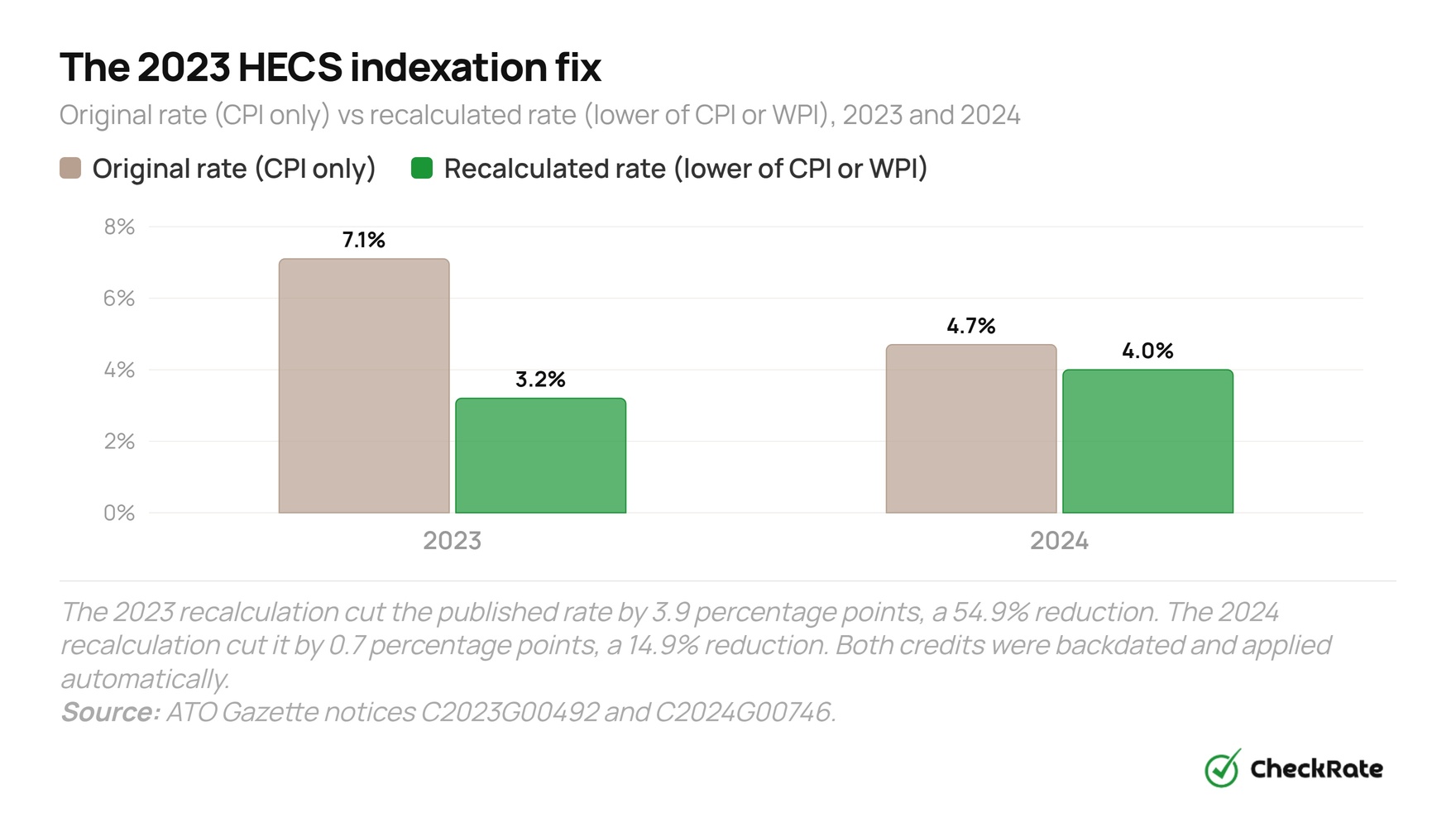
Because indexation was still CPI-only at that point, HELP debts rose in line with that inflation spike, regardless of how wages were tracking. The response came less than a year later. In the May 2024 Budget, the Government announced that HELP indexation would move to the lower of CPI or WPI, and applied the change retrospectively to 1 June 2023. The 2023 rate was recalculated down from 7.1% to 3.2%, and the 2024 rate from 4.7% to 4.0%. The ATO applied the resulting credits automatically, with no application required.
- Original rate (CPI only)
- Recalculated rate (lower of CPI or WPI)
How does the lower-of-CPI-or-WPI rule work for HELP debt?
Wage growth capped indexation at 3.2% in 2023 and 4.0% in 2024, well below the 7.1% and 4.7% that consumer prices alone would have produced. From 2025, CPI became the lower measure instead.
The rule is now built into the Higher Education Support Act 2003. For HELP debt, the annual indexation factor is based on whichever measure is lower for the relevant period: consumer price growth or wage growth. The same lower-of-CPI-or-WPI approach also applies to VET Student Loans and other related student loan types.
The binding measure can change from year to year. In 2023 and 2024, WPI was lower than CPI, so WPI capped the rate. In 2025 and 2026, the CPI-based calculation was lower, so CPI was the binding measure.
| Year | CPI figure | WPI figure | Lower (binding) measure |
|---|---|---|---|
| 2023 | 7.1% | 3.2% | WPI |
| 2024 | 4.7% | 4.0% | WPI |
| 2025 | 3.2% | Not shown | CPI |
| 2026 | 2.8% | Not shown | CPI |
| 2023 and 2024 WPI figures are the Department of Education's published figures used to calculate the indexation credit. For 2025 and 2026, the table shows the published applied rates and the binding measure only. It does not recreate WPI factors for those years, because the purpose of the comparison is to show which measure set the final HELP indexation rate. | |||
The rule acts as a ceiling. HELP debt cannot be indexed faster than the lower of price growth or wage growth for the relevant period. When prices rise faster than wages, as they did in 2023 and 2024, WPI limits the rate. When CPI is lower, as it was for 2025 and 2026, CPI becomes the effective ceiling.
How did the 20% HELP debt reduction affect balances?
The 2025 debt reduction removed more than $16 billion from HELP and other student loan balances, benefiting over 3 million Australians. Around 70% of people repaying a HELP debt are 35 or younger, so the reduction mostly affected younger borrowers.
The Universities Accord (Cutting Student Debt by 20 per cent) Bill 2025 passed Parliament in July 2025 and cut every eligible balance by 20%, based on what was owed on 1 June 2025, before that year's indexation.
This is a separate policy from the lower-of-CPI-or-WPI indexation rule. The indexation formula changes how much a balance grows each year. The 20% reduction was a one-off cut to the balance itself, applied once. Both affected 2025 balances, but they are not the same mechanism, and neither replaces the other going forward.
An average HELP debt of $27,600 remained below its starting balance even after two indexation events on top of the 20% cut.
The 20% cut removed $5,520 from the balance, well over four times the $1,345 added back by the 2025 and 2026 indexation events combined. A borrower who also made voluntary repayments over the same period would end up further below their starting balance again.
A real ATO processing example applies both changes to an actual $110,000 starting balance, ending at $90,304.
| Step | Detail | Amount |
|---|---|---|
| 31 May 2025 | Starting balance: $90,000 existing debt plus two new debts | $110,000 |
| 1 June 2025 | Indexation (3.2%) applied to the $90,000 existing debt only | +$2,880 |
| 26 November 2025 | 20% reduction processed on the original $90,000 and both new debts | −$22,000 |
| Indexation adjustment | 3.2% recalculated on the reduced $72,000 balance; excess indexation credited back | −$576 |
| Resulting balance | After all adjustments | $90,304 |
| New debts drawn down within 11 months of 1 June 2025 were not yet eligible for indexation, so only the $90,000 existing debt was indexed before the 20% reduction was processed months later. Processing indexation before the reduction made no difference to the final result, since the excess indexation was credited back once the reduction went through. | ||
Why can HELP debt grow even while repayments are being made?
The minimum repayment threshold rose 23.1% in 2025–26, from $54,435 to $67,000, alongside a switch from a flat percentage of total income to a marginal system that only charges repayments on income above the threshold.
Compulsory HELP repayments are worked out through the income tax system, rather than deducted directly from the loan balance as they are withheld from pay. Money withheld from pay throughout the year, known as PAYG withholding, is not credited to a HELP account until a tax return is lodged and assessed. Indexation, by contrast, applies on 1 June to whatever balance is sitting on the loan that day. A borrower can have money withheld all year and still see their balance indexed in full, because the withheld amount has not yet reached the loan account.
Voluntary repayments work differently: they reduce the balance as soon as the ATO processes them, so a voluntary payment made before 1 June does reduce that year's indexation. It is this distinction between payment types, not repayments in general, that explains why some balances kept growing despite regular payments through the year.
Year by year, most of that movement was incremental. The jump only appears once the new marginal system takes effect.
| Income year | Minimum threshold | Change on prior year |
|---|---|---|
| 2019–20 | $45,881 | — |
| 2020–21 | $46,620 | +1.6% |
| 2021–22 | $47,014 | +0.8% |
| 2022–23 | $48,361 | +2.9% |
| 2023–24 | $51,550 | +6.6% |
| 2024–25 | $54,435 | +5.6% |
| 2025–26 | $67,000 | +23.1% |
| 2026–27 | $69,528 | +3.8% |
| Figures are the ATO's published thresholds. The Department of Education's own page separately cites $56,156 as the prior-year figure ahead of the 2025–26 change; that figure does not match the ATO's $54,435 for 2024–25, and the discrepancy has not been resolved between the two sources at the time of writing. | ||
The marginal system also changes how much someone pays once they cross the threshold. Under the old flat-rate system, crossing into a new income band applied that band's rate to a borrower's entire repayment income. Under the marginal system, each rate applies only to the slice of income above the relevant threshold, the same principle used for income tax brackets.
- the balance was still outstanding on 1 June, so indexation applied before that year's compulsory repayment was assessed
- repayments were only withheld through PAYG rather than already credited via a lodged tax return
- repayment income sat below the minimum threshold, so no compulsory repayment was due at all
How much does 2026 indexation add to the average HELP debt?
For an average HELP balance of $27,739, the 2026 indexation rate of 2.8% would add about $777 before repayments or other balance changes. This is an estimate only, because the actual amount indexed depends on how much of the debt is more than 11 months old, whether voluntary repayments were processed before 1 June, and whether any other adjustments apply.
Frequently asked questions
Is HECS indexation the same as interest?▾
Can paying before 1 June reduce HECS indexation?▾
What happens if income is below the repayment threshold?▾
Will there be another 20% debt reduction?▾
References
- 1ATO: Study and training loan indexation rates, 2023 to 2026 indexation rates, updated 17 April 2026.
- 2Federal Register of Legislation: ATO Gazette C2023G00492, original 2023 HELP indexation factor, 3 May 2023.
- 3Federal Register of Legislation: ATO Gazette C2024G00746, recalculated 2023 and 2024 HELP indexation factors, 9 December 2024.
- 4Universities Accord (Student Support and Other Measures) Act 2024, HELP indexation formula amendments, 5 December 2024.
- 5Federal Register of Legislation: ATO Gazette C2026G00229, 2026 HELP indexation factor, 9 April 2026.
- 6Department of Education: HELP indexation and debt reduction, 2025 HELP debt reduction and indexation changes, accessed 1 July 2026.
- 7Department of Education: Legislation to reduce student loan debt passes Parliament, 20% student debt reduction announcement, July 2025.
- 8StudyAssist: Loan increases and indexation, HELP indexation rules, accessed 1 July 2026.
- 9StudyAssist: Loan repayments, HELP repayment rules, accessed 1 July 2026.
- 10ATO: Study and training loan repayment thresholds and rates, 2019–20 to 2026–27 repayment thresholds, updated 30 June 2026.
- 11ATO: Compulsory repayments, compulsory HELP repayment rules, updated 3 June 2026.
- 12ATO: Study and training loans, what's new, 2025–26 repayment changes and 20% debt reduction update, accessed 1 July 2026.
- 13ATO: View your study loan account online, worked HELP debt reduction processing example, accessed 1 July 2026.
- 14ABS: Consumer Price Index, Australia, December quarter 2022, December quarter 2025 and March quarter 2026 releases.
- 15data.gov.au / ATO: HELP statistics, 2005–06 to 2024–25, national HELP debt statistics.
Data Snapshots