


Published
 The cheapest countries to retire on the Australian Age PensionThe maximum Age Pension for a single person living outside Australia is A$29,520.40 a year from 20 September 2026, according to Services Australia. A couple who are both eligible can receive up to A$4…
 Can Australian super be accessed while living overseas?Moving overseas is not a condition of release for superannuation, so Australian citizens and permanent residents who leave Australia cannot withdraw their super until they meet a standard condition of…
 How is Australian super taxed for non-residents?A super lump sum paid to a person aged 60 or older carries no Australian tax on its tax-free component or its taxed element, which the ATO treats as non-assessable, non-exempt income.
Section 01 · Paid in dollars
Is the Age Pension paid in Australian dollars to people living overseas?
The Age Pension for a single person living outside Australia is set in Australian dollars, with a maximum basic rate of A$29,520.40 a year from 20 September 2026, according to Services Australia1. The rate is equal to A$1,135.40 a fortnight, the same maximum basic rate a single pensioner receives in Australia2. A couple living overseas where both partners are eligible has a combined maximum basic rate of A$44,506.80 a year1.
Services Australia pays people who live outside Australia long term every four weeks, either in Australian dollars into an Australian bank account, or in local currency or US dollars into an overseas account, depending on the country1.
The Energy Supplement and the Pension Supplement stop when a pensioner leaves Australia to live in another country, and the Pensioner Concession Card is cancelled3. A single pensioner in Australia receives up to A$1,237.70 a fortnight including both supplements, compared with A$1,135.40 for a single pensioner living overseas2.
From 20 September 2026, the Pension Supplement is no longer paid to pensioners living overseas. Before this change, a single pensioner living overseas could receive the basic amount of A$30.10 a fortnight, based on March 2026 rates. The Department of Social Services (DSS) estimated that around 88,000 recipients living permanently overseas would receive a "small payment reduction" from that date4.
Residence also affects the rate after 26 weeks outside Australia. A pensioner who was an Australian resident for 35 years or more between age 16 and Age Pension age keeps the full rate in most cases, while a shorter period can result in a proportional rate. For example, 10 years' residence can result in 10/35ths of the usual rate3.
| Age Pension maximum rates per fortnight in Australia and living outside Australia, A$, from 20 September 2026 | ||||
|---|---|---|---|---|
| Component | Single, Australia | Single, overseas | Couple, Australia | Couple, overseas |
| Maximum basic rate | 1,135.402 | 1,135.40 | 855.90 | 855.90 |
| Pension Supplement | 88.20 | Not paid | 66.50 | Not paid |
| Energy Supplement | 14.10 | Not paid | 10.60 | Not paid |
| Total | 1,237.702 | 1,135.40 | 933.00 | 855.90 |
Source · Services Australia, How much Age Pension you can get; Services Australia, Payment schedule and rates for people outside Australia.
Section 02 · Currency moves
How much has the Australian dollar moved against the baht, ringgit and zloty?
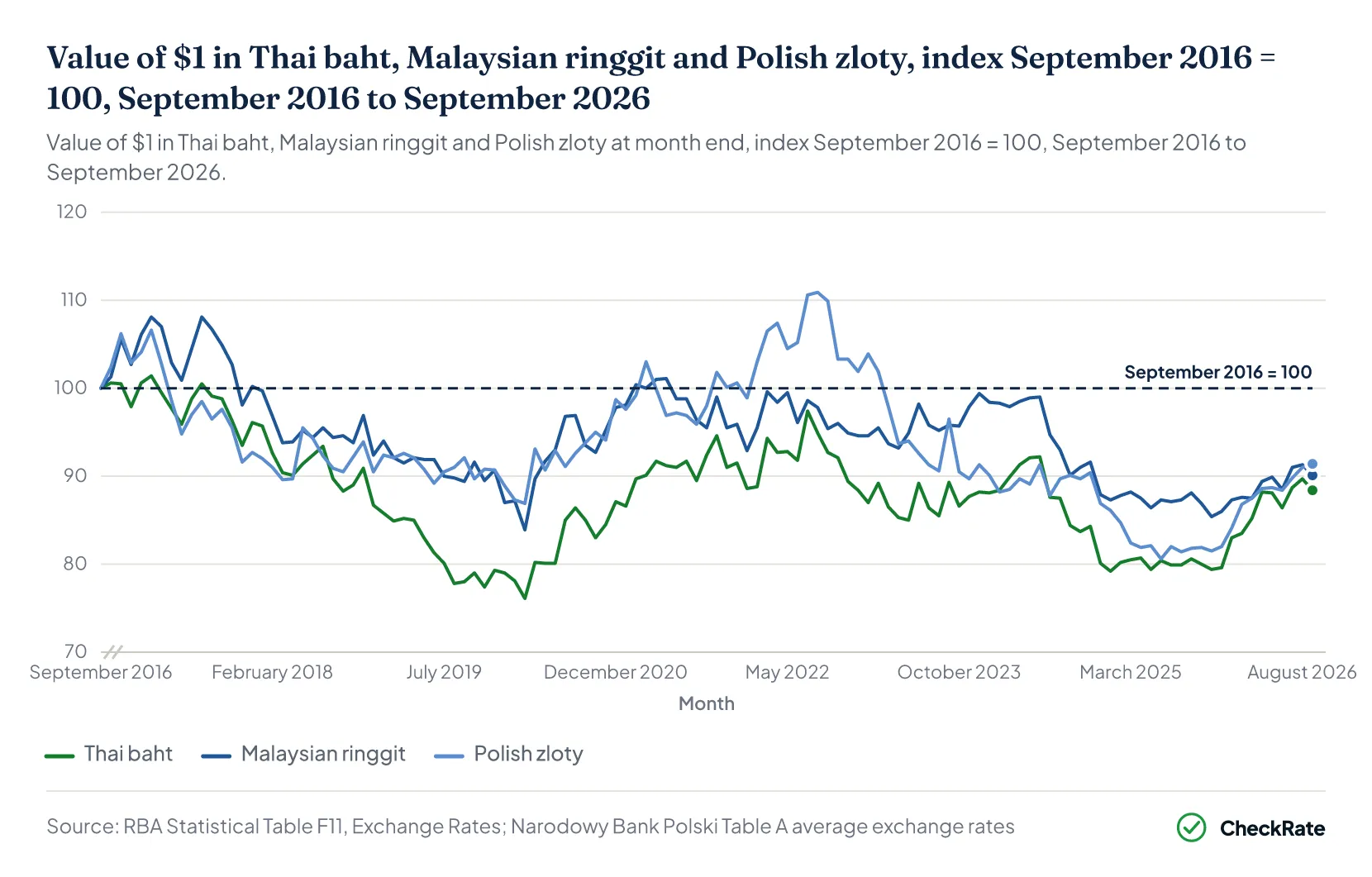
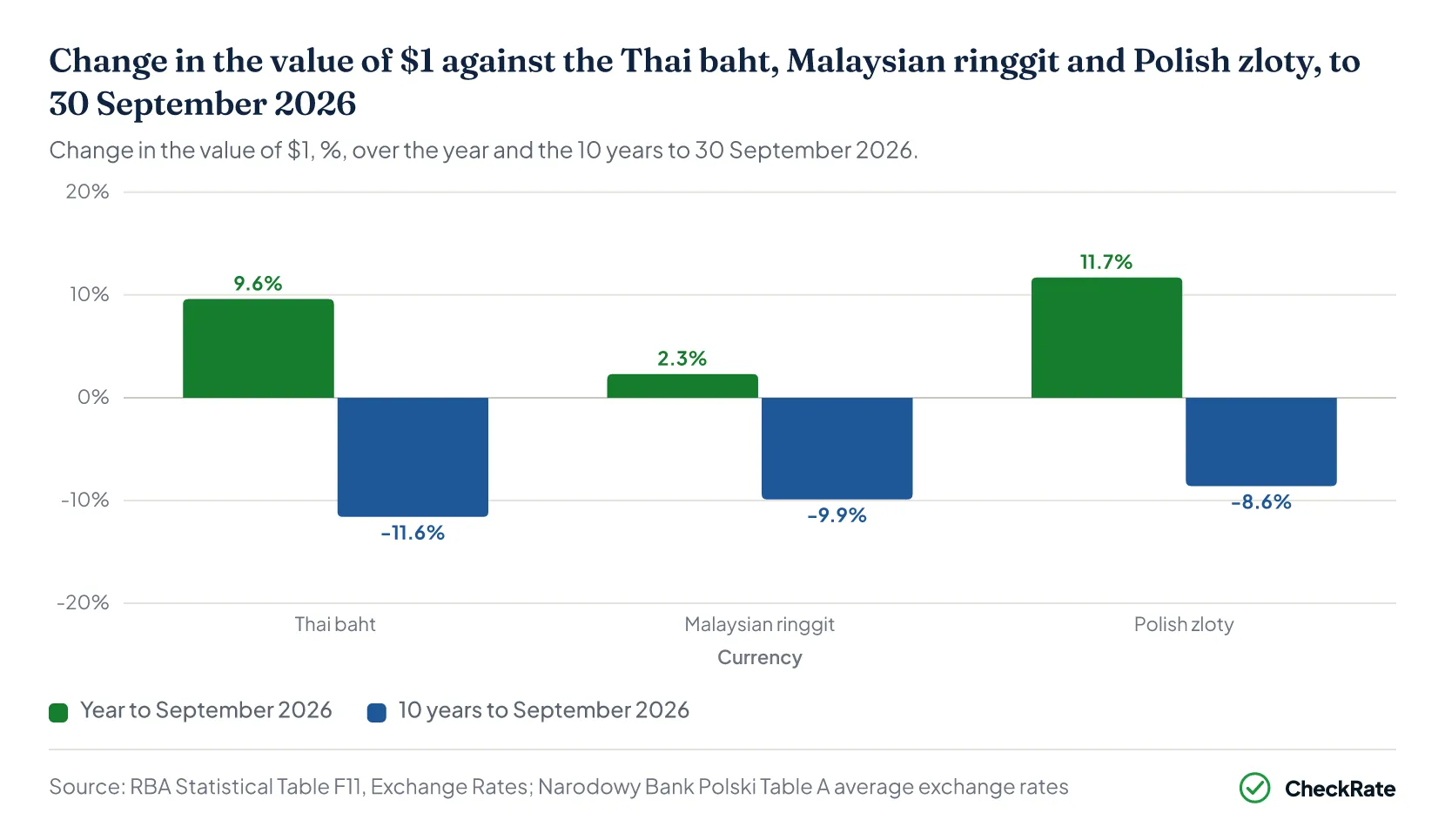
The Australian dollar rose 9.6% against the Thai baht over the year to 30 September 2026, from 21.35 baht to 23.41 baht, according to Reserve Bank of Australia (RBA) exchange rate data5. Over the same 12 months, it rose 11.7% against the Polish zloty, from 2.4004 to 2.6818 zloty, according to Narodowy Bank Polski (NBP), Poland's central bank6. Against the Malaysian ringgit, it rose 2.3%, from 2.7834 to 2.8477 ringgit5.
The Australian dollar fell against all three currencies over the 10 years to 30 September 2026. The value of A$1 fell 11.6% against the baht, from 26.48 baht to 23.41 baht, and 9.9% against the ringgit, from 3.1600 to 2.8477 ringgit5. The zloty value of A$1 fell 8.6% over the same period, from 2.9339 to 2.6818 zloty6.
The value of A$1 against the baht was at least 10% higher or lower than a year earlier in 25 of the 109 months from September 2017 to September 2026. This occurred in 15 months for the ringgit and 23 months for the zloty6.
The value of A$1 was at its 10-year low against both the baht and the ringgit in March 2020, at 20.16 baht and 2.6525 ringgit5. Against the zloty, A$1 reached its 10-year high of 3.2542 zloty in August 2022 and its low of 2.3646 zloty in June 20256.
| Value of A$1 in Thai baht, Malaysian ringgit and Polish zloty, September 2016 to September 2026 | |||||
|---|---|---|---|---|---|
| Currency | 30 Sep 2016 | 30 Sep 2025 | 30 Sep 2026 | 10-year high | 10-year low |
| Thai baht | 26.48 | 21.35 | 23.415 | 26.84 (Feb 2017) | 20.16 (Mar 2020) |
| Malaysian ringgit | 3.1600 | 2.7834 | 2.84775 | 3.4172 (Jul 2017) | 2.6525 (Mar 2020) |
| Polish zloty | 2.9339 | 2.4004 | 2.6818 | 3.2542 (Aug 2022) | 2.3646 (Jun 2025) |
Source · RBA, Exchange Rates (Statistical Table F11); Narodowy Bank Polski, Table A average exchange rates.
Section 03 · A 10% move
What does a 10% currency move do to an Age Pension budget overseas?
A 10% move in the Australian dollar changes the local-currency value of an Age Pension payment by the same 10%, because the payment is fixed in Australian dollars1. At the 30 September 2026 exchange rate, a four-weekly payment of A$2,270.80 at the single maximum basic rate converted to 53,159 baht. A 10% lower Australian dollar would reduce it to 47,843 baht5.
This is an example calculation based on the single maximum basic rate for people living outside Australia, paid every four weeks. At the same exchange rate, the payment converted to 6,467 ringgit or 6,090 zloty6. A 10% lower Australian dollar would reduce those amounts to 5,820 ringgit and 5,481 zloty, while a 10% higher dollar would increase them to 7,113 ringgit and 6,699 zloty.
| Four-weekly single Age Pension payment of A$2,270.80 in local currency at the 30 September 2026 exchange rate and 10% either side | |||
|---|---|---|---|
| Currency | A$ 10% lower | 30 Sep 2026 rate | A$ 10% higher |
| Thai baht | 47,843 | 53,159 | 58,475 |
| Malaysian ringgit | 5,820 | 6,467 | 7,113 |
| Polish zloty | 5,481 | 6,090 | 6,699 |
Source · Services Australia, Payment schedule and rates for people outside Australia; RBA, Exchange Rates (Statistical Table F11); Narodowy Bank Polski, Table A average exchange rates.
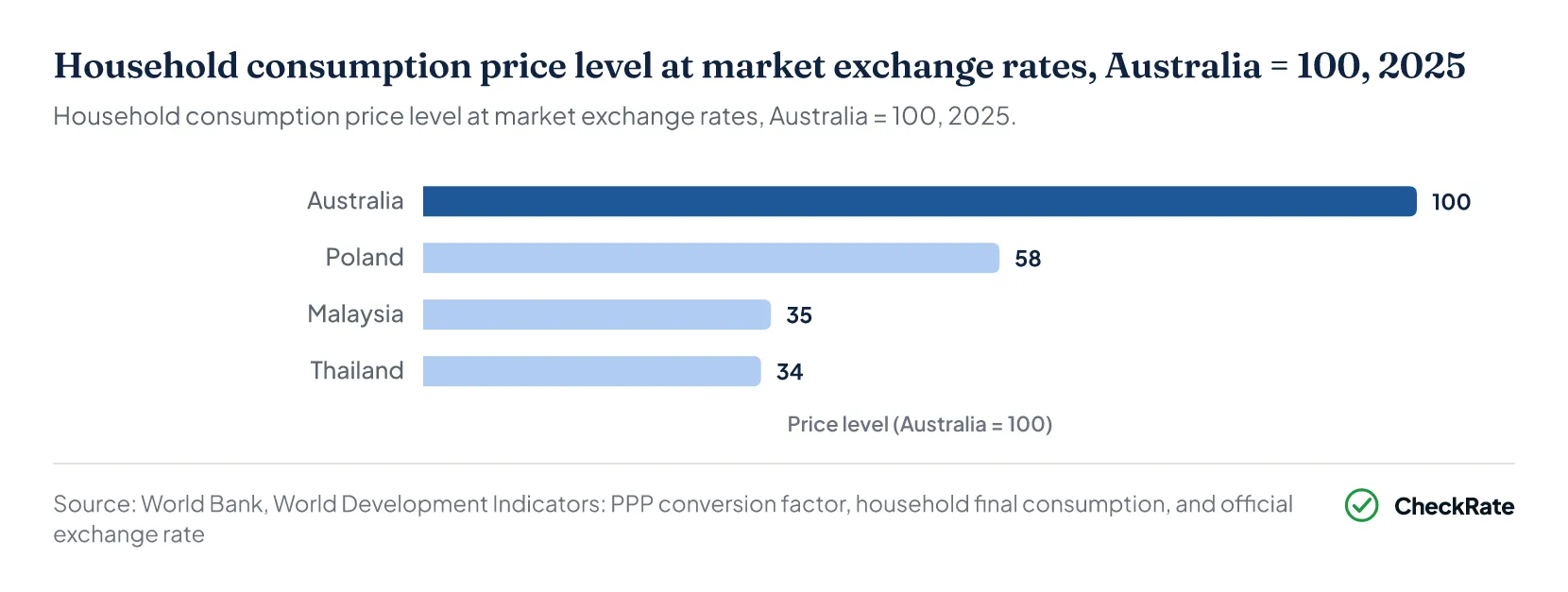
Thailand's household consumption price level at market exchange rates was about 34% of Australia's in 2025, compared with 35% in Malaysia and 58% in Poland, according to World Bank purchasing power parity (PPP) estimates7.
At 2025 exchange rates, A$1 bought about 2.9 times as much household consumption in Thailand as in Australia, 2.8 times as much in Malaysia and 1.7 times as much in Poland7. A 10% lower Australian dollar would reduce the Thailand comparison from about 2.9 times to about 2.6 times the Australian amount.
Section 04 · Fees and margins
What fees and margins apply when converting an Age Pension overseas?
Sending A$10,000 to the United States cost an average of 1.71% of the amount transferred across 14 providers checked by the Australian Competition and Consumer Commission (ACCC) between 26 February and 3 March 2024. For an A$250 transfer, the average cost was 2.71%8. Costs varied widely between providers, from 0.41% to 4.06% for an A$10,000 transfer and from 0.41% to 9.58% for an A$250 transfer.
The cost of a transfer includes the provider's exchange rate and its fees, according to Moneysmart, the consumer website of the Australian Securities and Investments Commission (ASIC)9. The ACCC measures the margin as the difference between a provider's exchange rate and the mid-market rate. Providers that advertise no fee may still charge a margin8.
Fees make up a larger share of small transfers, while the margin has a larger effect on large ones8. Weekend transfers can cost more, with some providers charging an extra fee or using a less favourable exchange rate.
When Australian dollars are sent unconverted, the receiving bank may convert them at its own exchange rate. The big four banks charged between A$18 and A$30 to send Australian dollars overseas without converting them, as at 12 April 2024, with one bank charging A$7 for most Pacific countries8.
At those averages, a four-weekly payment of A$2,270.80 would cost A$38.83 at the A$10,000 rate and A$61.54 at the A$250 rate. The ACCC did not publish costs for amounts between A$250 and A$10,000, and its figures are for US dollar transfers, so neither is a measured cost for a payment of this size.
| Cost of an international money transfer from Australia to the United States across 14 providers, February to March 2024 | |||
|---|---|---|---|
| Amount sent | Lowest cost (%) | Average cost (%) | Highest cost (%) |
| A$250 | 0.41 | 2.718 | 9.58 |
| A$10,000 | 0.41 | 1.718 | 4.068 |
Source · ACCC, Transparency and competition in international money transfer services, update report, July 2024.
Section 05 · Indexation
Does Age Pension indexation make up for currency moves?
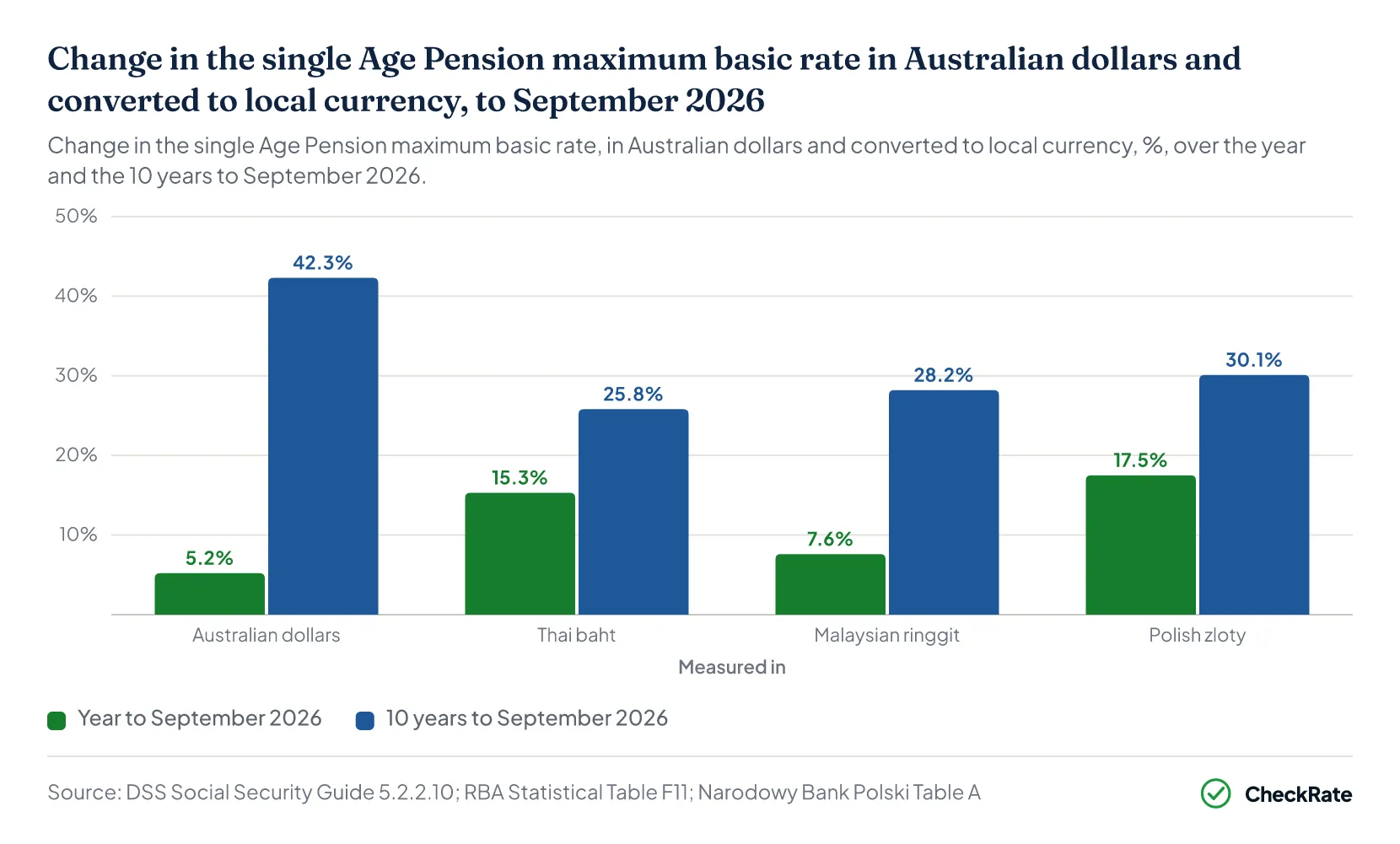
The single Age Pension maximum basic rate rose 5.2% over the year to 20 September 2026, through indexation increases on 20 March and 20 September, from A$28,072.20 a year to A$29,520.4010. Converted at end-of-September exchange rates, the value of that rate rose 15.3% in baht, 7.6% in ringgit and 17.5% in zloty over the same year56. The Australian dollar also rose against all three currencies over that year.
Over the 10 years to September 2026, the single maximum basic rate rose 42.3%, from A$20,745.40 a year at 20 September 2016 to A$29,520.40. Over the same period, its value rose 25.8% in baht, 28.2% in ringgit and 30.1% in zloty. The Australian dollar fell against all three currencies over the same period10.
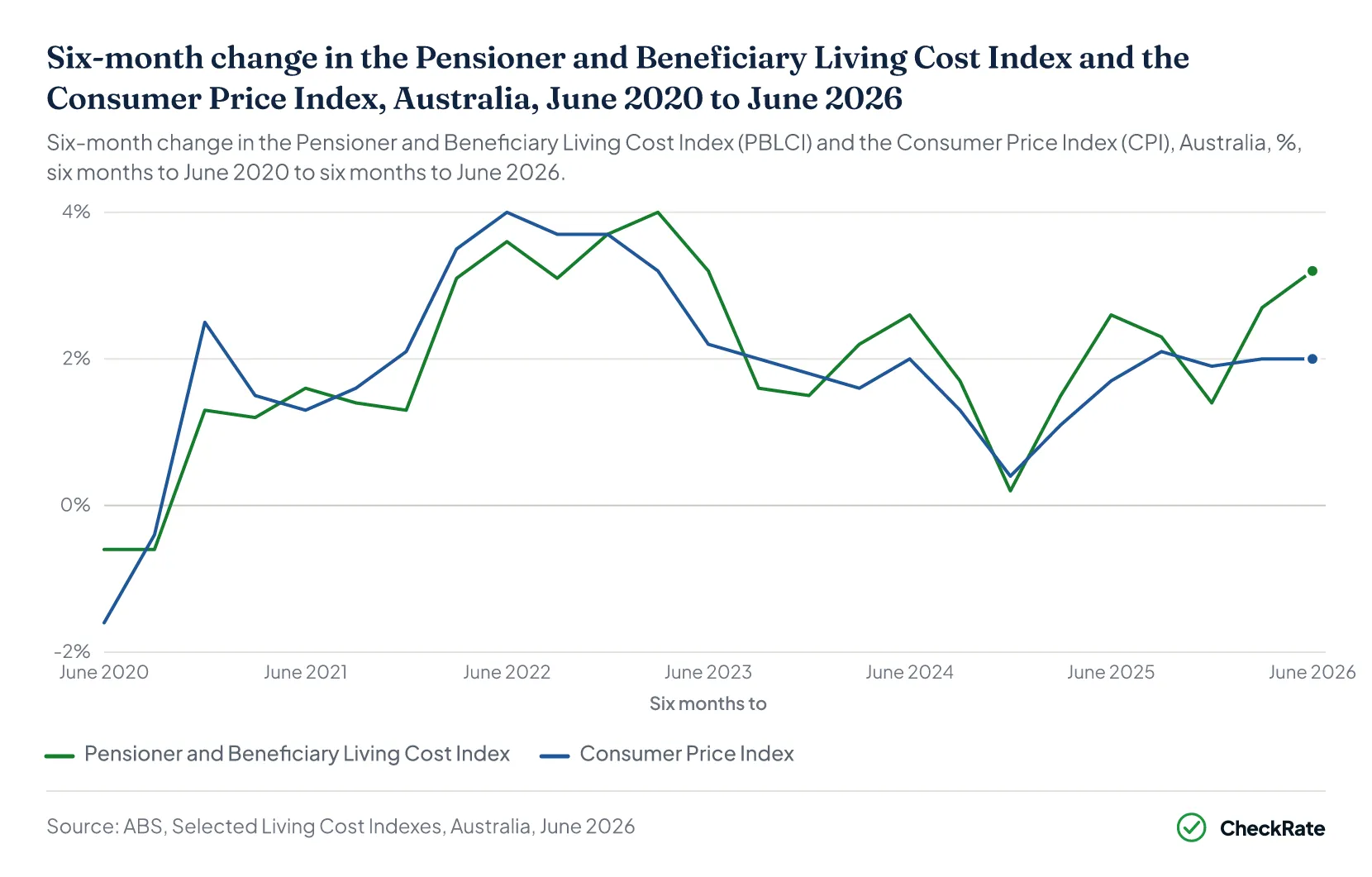
Pensions are indexed on 20 March and 20 September by the greater of the rise in the Consumer Price Index (CPI) and the Pensioner and Beneficiary Living Cost Index (PBLCI) over six months. They are also benchmarked to Male Total Average Weekly Earnings, according to the Australian Bureau of Statistics (ABS)11.
Over the six months to the June quarter 2026, the PBLCI rose 3.2% and the CPI rose 2.0%11. The single maximum basic rate then rose 3.2% on 20 September 2026, from A$28,607.80 to A$29,520.40 a year10.
Both indexes measure price changes for households in Australia. Consumer price inflation in 2025 was 2.9% in Australia, compared with 3.8% in Poland and 1.4% in Malaysia, while consumer prices in Thailand fell 0.1%, according to World Bank data12.
Section 06 · Currency risk
What affects currency risk for Age Pension recipients living overseas?
Age Pension recipients living overseas can be paid in Australian dollars into an Australian bank account, or in local currency or US dollars into an overseas account, depending on the country1. When payments go into an Australian account, the pensioner chooses when and how the money is converted into another currency.
Moneysmart lists the exchange rate, any exchange rate guarantee, fees, commission and transfer times as factors that can differ between money transfer providers9. The Australian Competition and Consumer Commission (ACCC) uses the total price and the amount received to compare the cost of different providers8.
Superannuation can be withdrawn from age 65, or on retiring once a person has reached preservation age. Preservation age is 60 for people born from 1 July 1964, according to the Australian Taxation Office (ATO)13. Leaving Australia allows early access to super only for eligible temporary residents.
For people aged 60 or older, super income stream payments and lump sums from the taxed element and the tax-free component generally carry no Australian tax14. Payments from an untaxed element, most common in public sector funds, can be taxed at up to the person's marginal tax rate.
Super paid out in Australian dollars and converted overseas is also affected by exchange rate movements.
Savings balances by age group in Australia are covered in average savings by age.
Section 07
Age Pension overseas: quick answers
Can the Age Pension be paid into an overseas bank account?
The Age Pension can be paid into a bank account outside Australia, in local currency or US dollars depending on the country, according to Services Australia. Payments into an Australian bank account are made in Australian dollars, every four weeks for people living outside Australia long term.
How much is the Age Pension for a single person living overseas?
The maximum basic rate of the Age Pension for a single person living outside Australia is A$29,520.40 a year from 20 September 2026, equal to A$1,135.40 a fortnight, according to Services Australia. The rate can be lower under the income and assets tests, or under a proportional rate for people with less than 35 years of Australian residence between age 16 and Age Pension age.
Is the Pension Supplement paid to Age Pension recipients living overseas?
The Pension Supplement is not paid to Age Pension recipients who live overseas. It stops when a pensioner leaves Australia to live in another country, as does the Energy Supplement, according to Services Australia. Before 20 September 2026, pensioners living overseas kept the basic amount of the Pension Supplement.
How much does a 10% fall in the Australian dollar reduce an Age Pension paid overseas?
A 10% fall in the Australian dollar reduces the local-currency value of an Age Pension payment by 10%, because the rate is set in Australian dollars. At the 30 September 2026 exchange rate, a four-weekly payment of A$2,270.80 at the single maximum basic rate converted to 53,159 Thai baht, and a 10% lower dollar would reduce it to 47,843 baht.
Does the Age Pension rise with inflation for people living overseas?
The Age Pension is indexed on 20 March and 20 September using the higher of the changes in the Consumer Price Index and the Pensioner and Beneficiary Living Cost Index, which both measure prices in Australia rather than overseas. The single maximum basic rate rose 3.2% on 20 September 2026, to A$29,520.40 a year.
Is super taxed after age 60 in Australia?
Super income stream payments and lump sums paid to people aged 60 or older from the taxed element and the tax-free component generally carry no Australian tax, according to the Australian Taxation Office. Payments from an untaxed element, most common in public sector funds, are taxed at up to the person's marginal rate.
References
- Services Australia, Payment schedule and rates for people outside Australia: Age Pension · servicesaustralia.gov.au ↑ b c d e f
- Services Australia, How much Age Pension you can get (rates from 20 September 2026) · servicesaustralia.gov.au ↑ b c d
- Services Australia, When you leave Australia if you get Age Pension · servicesaustralia.gov.au ↑ b
- Department of Social Services, Better targeting the Pension Supplement (2026-27 Budget) · dss.gov.au ↑
- Reserve Bank of Australia, Exchange Rates: Statistical Table F11 (monthly) · Reserve Bank of Australia ↑ b c d e f g h i
- Narodowy Bank Polski, Table A average exchange rates (NBP Web API) · api.nbp.pl ↑ b c d e f
- World Bank, World Development Indicators: PPP conversion factor, household final consumption (PA.NUS.PRVT.PP) · data.worldbank.org ↑ b
- ACCC, Transparency and competition in international money transfer services: update report (July 2024) · accc.gov.au ↑ b c d e f g h
- ASIC Moneysmart, Sending money overseas · moneysmart.gov.au ↑ b
- Department of Social Services, Social Security Guide 5.2.2.10: Maximum basic rates of pension, July 1909 to present date · guides.dss.gov.au ↑ b c
- Australian Bureau of Statistics, Selected Living Cost Indexes, Australia, June 2026 · Australian Bureau of Statistics ↑ b
- World Bank, World Development Indicators: Inflation, consumer prices (annual %) (FP.CPI.TOTL.ZG) · data.worldbank.org ↑
- Australian Taxation Office, Super withdrawal options · ato.gov.au ↑
- Australian Taxation Office, Tax on super benefits · ato.gov.au ↑