


Published
 How far does Australian retirement income go in Thailand, Poland and Malaysia?The maximum basic rate of Age Pension for a single person living outside Australia long term is A$29,520.40 a year from 20 September 2026, according to Services Australia. For a couple who are both el…
 Splitting retirement between Australia and another country: Age Pension, tax and Medicare rulesAge Pension recipients can stay outside Australia for up to 26 weeks before their rate depends on how long they were Australian residents, according to Services Australia. A recipient with 35 years or…
 How do exchange rates change the value of the Age Pension overseas?The Age Pension for a single person living outside Australia is set in Australian dollars, with a maximum basic rate of A$29,520.40 a year from 20 September 2026, according to Services Australia. The…
Section 01 · Pension rates
How much does the Age Pension pay to people living outside Australia?
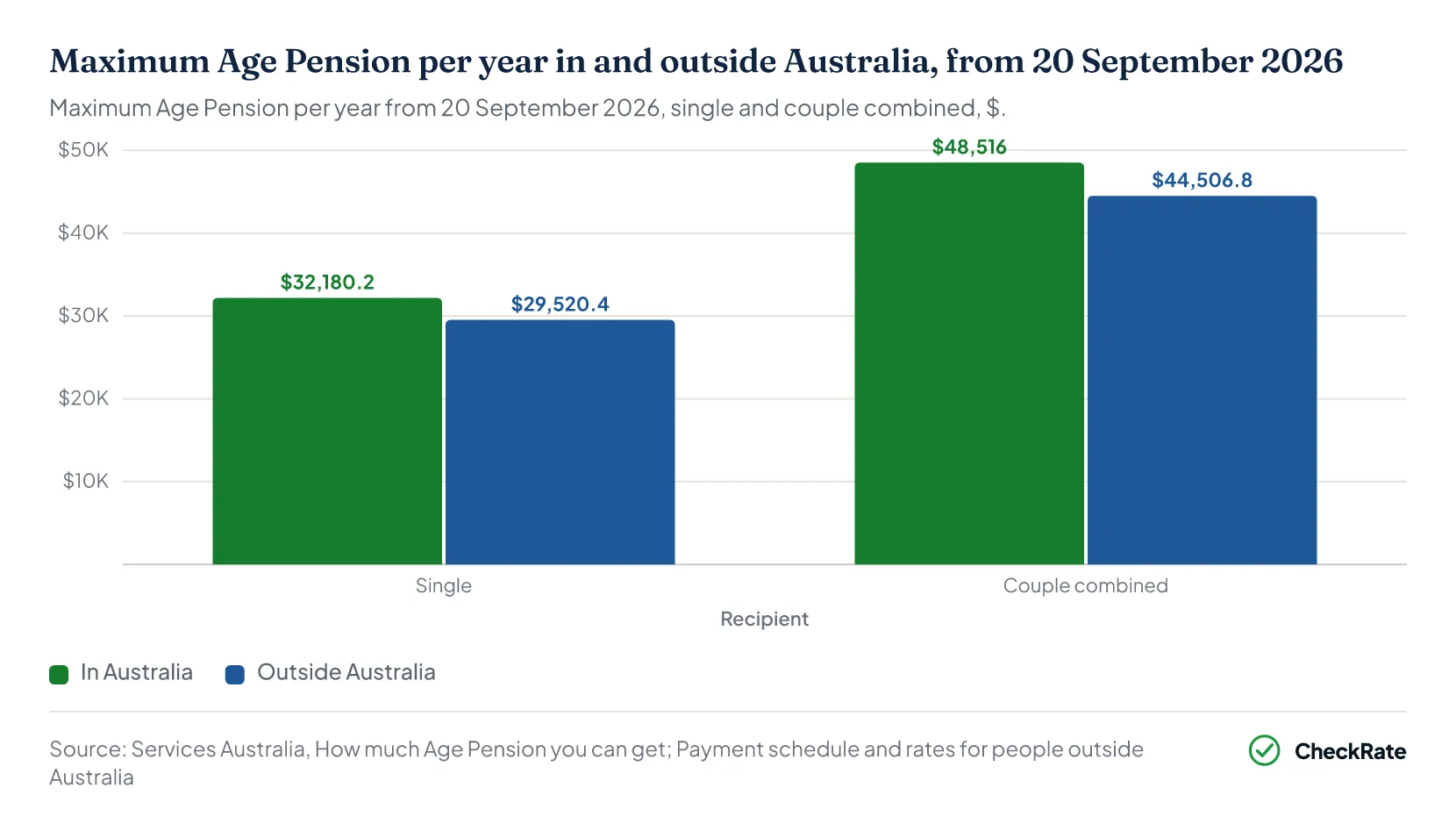
The maximum Age Pension for a single person living outside Australia is A$29,520.40 a year from 20 September 2026, according to Services Australia1. A couple who are both eligible can receive up to A$44,506.80 a year combined.
In Australia, the maximum single rate is A$1,237.70 a fortnight, made up of a basic rate of A$1,135.40, a Pension Supplement of A$88.20 and an Energy Supplement of A$14.102. This equals A$32,180.20 a year, while the overseas maximum is the basic rate alone.
Age Pension age is 67, and a claimant needs to have been an Australian resident for at least 10 years in total, including at least five years without a break34. On the day of the claim, the person must be living in Australia and physically present in Australia.
Once granted, the Age Pension can be paid while a person is outside Australia, including when they move to another country5. The rate may be reduced depending on how long the person was an Australian resident, and the income and assets tests continue to apply1.
A single homeowner living outside Australia can receive the full pension with assets of up to A$333,000 and income of up to A$5,876 a year1.
People living outside Australia on a long-term basis are paid every four weeks, into an Australian or an overseas bank account6.
The Pension Supplement stops immediately when a pensioner leaves Australia to live in another country, and after 12 weeks on a short-term trip7.
The rates are indexed on 20 March and 20 September by the greater of the rise in the Consumer Price Index (CPI) and the Pensioner and Beneficiary Living Cost Index (PBLCI), according to the Australian Bureau of Statistics (ABS)8. The PBLCI rose 3.2% over the six months from the December quarter 2025 to the June quarter 2026, compared with 2.0% for the CPI.
Section 02 · Super
When can Australian super be withdrawn tax-free?
Super withdrawals from the tax-free component and the taxed element are not taxed in Australia once a person is 60 or older, whether taken as a lump sum or as an income stream, according to the Australian Taxation Office (ATO)9.
The untaxed element, most common in public sector funds, is taxed differently. Income streams are taxed at the person's marginal rate, while lump sums are taxed at the marginal rate or 17%, whichever is lower, up to the untaxed plan cap9.
Super can be withdrawn once a person turns 65, even if they are still working, or once they reach their preservation age and retire10. Preservation age is 60 for anyone born from 1 July 1964, and a person who ceases paid employment at 60 or older is treated as retired.
Once super can be accessed, it can stay in super, start an account-based pension, be withdrawn as a lump sum or buy an annuity, according to Moneysmart, the Australian Securities and Investments Commission's (ASIC) guidance site11. Investment earnings are taxed at 15% when left in super and at 0% inside an account-based pension.
Before preservation age, super can be released only in limited circumstances, including on compassionate grounds, for a terminal medical condition, for incapacity and in severe financial hardship12. Leaving Australia is a listed ground for early access only for temporary residents10.
| Australian tax on super withdrawals at age 60 or older | ||
|---|---|---|
| Type of withdrawal | Part of the super | Effective tax rate, including Medicare levy |
| Income stream | Tax-free component | No tax |
| Income stream | Taxable component, taxed element | No tax |
| Income stream | Taxable component, untaxed element | Marginal tax rate |
| Lump sum | Taxable component, taxed element | No tax |
| Lump sum | Taxable component, untaxed element | Marginal tax rate or 17%, whichever is lower, up to the untaxed plan cap |
Source · ATO, Tax on super benefits
Savings balances at each age are compared in average savings by age in Australia.
Section 03 · Method
How do World Bank price levels compare living costs across countries?
Household consumption prices in the 38 countries compared ranged from 24.1% of Australia's level in India to 135.8% in Switzerland in 2025, based on World Bank purchasing power parities and market exchange rates13.
The 38 countries are the 32 with a social security agreement with Australia, five non-agreement countries in Asia and the Pacific with a published retirement or long-stay visa programme, and the United Kingdom, whose agreement with Australia ended in 200114.
A purchasing power parity (PPP) is the number of units of a country's currency that buy the same amount of household goods and services as a US dollar buys in the United States15. Dividing a country's PPP by its market exchange rate gives its price level. That figure is then compared with Australia's price level, with Australia equal to 10016.
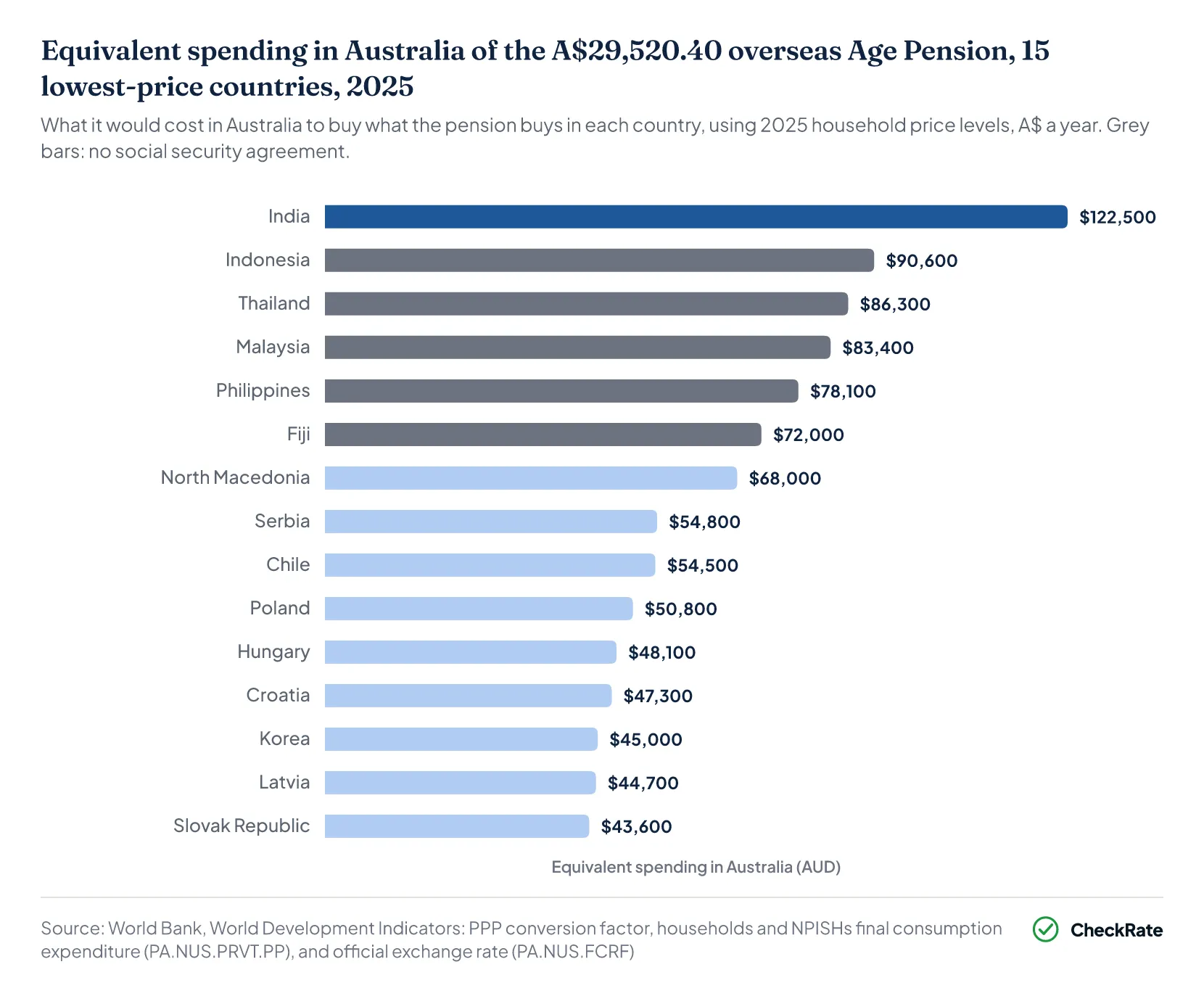
In an example calculation using 2025 price levels, the A$29,520.40 overseas pension bought about as much household consumption in India as A$122,500 would buy in Australia13.
The World Bank does not recommend using PPP-based price levels for precise country rankings15. The 2025 values are extrapolated from the 2021 International Comparison Program.
Section 04 · Price levels
Which countries have the lowest household consumption price levels?
India recorded the lowest household consumption price level among the 38 countries compared, at 24.1% of Australia's level in 202513. In an example calculation at that price level, the A$29,520.40 overseas Age Pension bought about as much household consumption in India as A$122,500 would buy in Australia.
Indonesia, Thailand, Malaysia and the Philippines followed, with price levels between 32.6% and 37.8% of Australia's13. On the same calculation, the overseas pension bought as much in these countries as about A$78,100 to A$90,600 would buy in Australia.
Fiji and North Macedonia had the sixth- and seventh-lowest price levels, at 41.0% and 43.4% of Australia's level respectively13. Serbia, Chile and Poland had the eighth- to tenth-lowest price levels, at 53.9%, 54.2% and 58.1% respectively.
Five of the 10 countries with the lowest price levels have a social security agreement with Australia: India, North Macedonia, Serbia, Chile and Poland14.
Price levels were higher than Australia's in five countries: Norway, the United States, Ireland, Denmark and Switzerland13. Switzerland recorded the highest price level among the 38 countries, at 135.8% of Australia's level.
At that level, the overseas pension bought only as much as about A$21,700 would buy in Australia13. New Zealand and the United Kingdom had price levels of 94.2% and 97.9% of Australia's respectively.
| Household consumption price levels and the overseas Age Pension at Australian prices, 38 countries, 2025 | |||||
|---|---|---|---|---|---|
| Rank | Country | Price level (Australia = 100) | Equivalent spending in Australia (A$ a year) | Social security agreement | Retirement visa |
| 1 | India | 24.1 | 122,500 | Yes | Not compared |
| 2 | Indonesia | 32.6 | 90,600 | No | Yes |
| 3 | Thailand | 34.2 | 86,300 | No | Yes |
| 4 | Malaysia | 35.4 | 83,400 | No | Yes |
| 5 | Philippines | 37.8 | 78,100 | No | Yes |
| 6 | Fiji | 41.0 | 72,000 | No | Yes |
| 7 | North Macedonia | 43.4 | 68,000 | Yes | Not compared |
| 8 | Serbia | 53.9 | 54,800 | Yes | Not compared |
| 9 | Chile | 54.2 | 54,500 | Yes | Not compared |
| 10 | Poland | 58.1 | 50,800 | Yes | Not compared |
| 11 | Hungary | 61.4 | 48,100 | Yes | Not compared |
| 12 | Croatia | 62.4 | 47,300 | Yes | Not compared |
| 13 | Korea | 65.6 | 45,000 | Yes | Not compared |
| 14 | Latvia | 66.1 | 44,700 | Yes | Not compared |
| 15 | Slovak Republic | 67.7 | 43,600 | Yes | Not compared |
| 16 | Portugal | 68.8 | 42,900 | Yes | Not compared |
| 17 | Greece | 69.5 | 42,500 | Yes | Not compared |
| 18 | Cyprus | 70.9 | 41,600 | Yes | Not compared |
| 19 | Czech Republic | 71.0 | 41,600 | Yes | Not compared |
| 20 | Slovenia | 71.0 | 41,600 | Yes | Not compared |
| 21 | Spain | 72.8 | 40,600 | Yes | Not compared |
| 22 | Malta | 73.1 | 40,400 | Yes | Not compared |
| 23 | Japan | 73.2 | 40,300 | Yes | Not compared |
| 24 | Italy | 77.2 | 38,200 | Yes | Not compared |
| 25 | Estonia | 80.4 | 36,700 | Yes | Not compared |
| 26 | Germany | 86.1 | 34,300 | Yes | Not compared |
| 27 | Austria | 89.8 | 32,900 | Yes | Not compared |
| 28 | Netherlands | 91.9 | 32,100 | Yes | Not compared |
| 29 | Belgium | 92.4 | 31,900 | Yes | Not compared |
| 30 | New Zealand | 94.2 | 31,300 | Yes | Not compared |
| 31 | Canada | 95.5 | 30,900 | Yes | Not compared |
| 32 | Finland | 96.0 | 30,800 | Yes | Not compared |
| 33 | United Kingdom | 97.9 | 30,200 | No | Not compared |
| 34 | Norway | 101.9 | 29,000 | Yes | Not compared |
| 35 | United States | 106.0 | 27,800 | Yes | Not compared |
| 36 | Ireland | 108.2 | 27,300 | Yes | Not compared |
| 37 | Denmark | 110.8 | 26,600 | Yes | Not compared |
| 38 | Switzerland | 135.8 | 21,700 | Yes | Not compared |
Source · World Bank, World Development Indicators; Services Australia; Department of Social Services
Section 05 · Agreements
Which countries have a social security agreement with Australia?
Australia has social security agreements with 32 countries, made up of 25 in Europe, three in Asia, three in the Americas and New Zealand, according to the Department of Social Services (DSS)14.
The agreements allow a person to lodge a pension claim from either country, and combine periods of Australian residence with periods of contributions in the other country to help meet minimum eligibility requirements14. Services Australia states that a person may receive a part pension from each country covered by an agreement17.
A person with fewer than 10 years of Australian residence may still qualify for the Age Pension using periods of residence or contributions in an agreement country4.
A person who started the Age Pension after returning to Australia to live, and who travels overseas within two years, may have the payment stopped, although it may continue if they travel to an agreement country5.
Australia is implementing a new agreement with Uruguay, signed on 26 August 2025, and is negotiating agreements with Bosnia and Herzegovina, Lithuania, Mongolia, Brazil and Sweden14. The agreement with the United Kingdom ended on 1 March 2001, after the United Kingdom declined to change its policy of not indexing UK pensions paid in Australia.
| Countries with a social security agreement with Australia, by region | ||
|---|---|---|
| Region | Countries | Number |
| Europe | Austria, Belgium, Croatia, Cyprus, Czech Republic, Denmark, Estonia, Finland, Germany, Greece, Hungary, Ireland, Italy, Latvia, Malta, Netherlands, North Macedonia, Norway, Poland, Portugal, Serbia, Slovak Republic, Slovenia, Spain, Switzerland | 25 |
| Asia | India, Japan, Korea | 3 |
| Americas | Canada, Chile, United States | 3 |
| Australasia | New Zealand | 1 |
| Total | 32 | |
Source · Department of Social Services, International social security agreements
Section 06 · Visas
Which lower-cost countries offer a retirement visa?
Of the 38 countries compared, five countries without a social security agreement were reviewed for retirement visas. Thailand, Malaysia, the Philippines, Indonesia and Fiji each publish a retirement or long-stay visa programme open to foreign retirees. Their household price levels were below 42% of Australia's in 202513.
Thailand's retirement visa is for people aged 50 or older and requires a monthly income of at least 65,000 baht or a bank balance of at least 800,000 baht, according to Thailand's official e-Visa site18. The visa is a single-entry visa valid for three months.
Malaysia's long-stay programme, Malaysia My Second Home (MM2H), requires a fixed deposit of US$150,000 in a Malaysian financial institution and the purchase of a residence worth RM600,000 or more under the Silver category19. The Silver pass runs for five years and is renewable, and applicants for the Silver, Gold and Platinum categories must be 25 or older20.
The Philippines' Special Resident Retiree's Visa (SRRV) is for principal applicants aged 40 or older, according to the Philippine Retirement Authority21. A pensioner aged 50 or older must place a visa deposit of US$15,000 and show a lifetime pension of at least US$800 a month, or US$1,000 with dependants. A non-pensioner aged 50 or older must place a deposit of US$30,000.
Indonesia's Directorate General of Immigration lists a Silver Hair and Retirement visa category on its e-Visa portal22.
Fiji's Residence Permit on Assured Income is for people aged 45 or older with a regular pension, retirement income or assets outside Fiji, who do not work in Fiji, according to Fiji's Ministry of Immigration23. The permit runs for three years, with six months issued first and the balance issued after meeting the required remittance or property purchase conditions.
| Retirement and long-stay visa programmes in five lower-cost countries | ||||
|---|---|---|---|---|
| Country | Programme | Minimum age | Financial requirement | Price level (Australia = 100) |
| Indonesia | Silver Hair and Retirement visa | Not compared | Not compared | 32.6 |
| Thailand | Retirement visa | 50 | Monthly income of 65,000 baht or a balance of 800,000 baht | 34.2 |
| Malaysia | Malaysia My Second Home, Silver | 25 | US$150,000 fixed deposit and a residence worth RM600,000 or more | 35.4 |
| Philippines | Special Resident Retiree's Visa | 40 | US$15,000 deposit with a pension of US$800 a month, aged 50 or older | 37.8 |
| Fiji | Residence Permit on Assured Income | 45 | Assets or a reliable income outside Fiji | 41.0 |
Source · Thai e-Visa; Malaysia My Second Home; Philippine Retirement Authority; Indonesia Directorate General of Immigration; Fiji Ministry of Immigration; World Bank, World Development Indicators
Section 07 · Healthcare
What share of health costs is paid out of pocket in lower-cost countries?
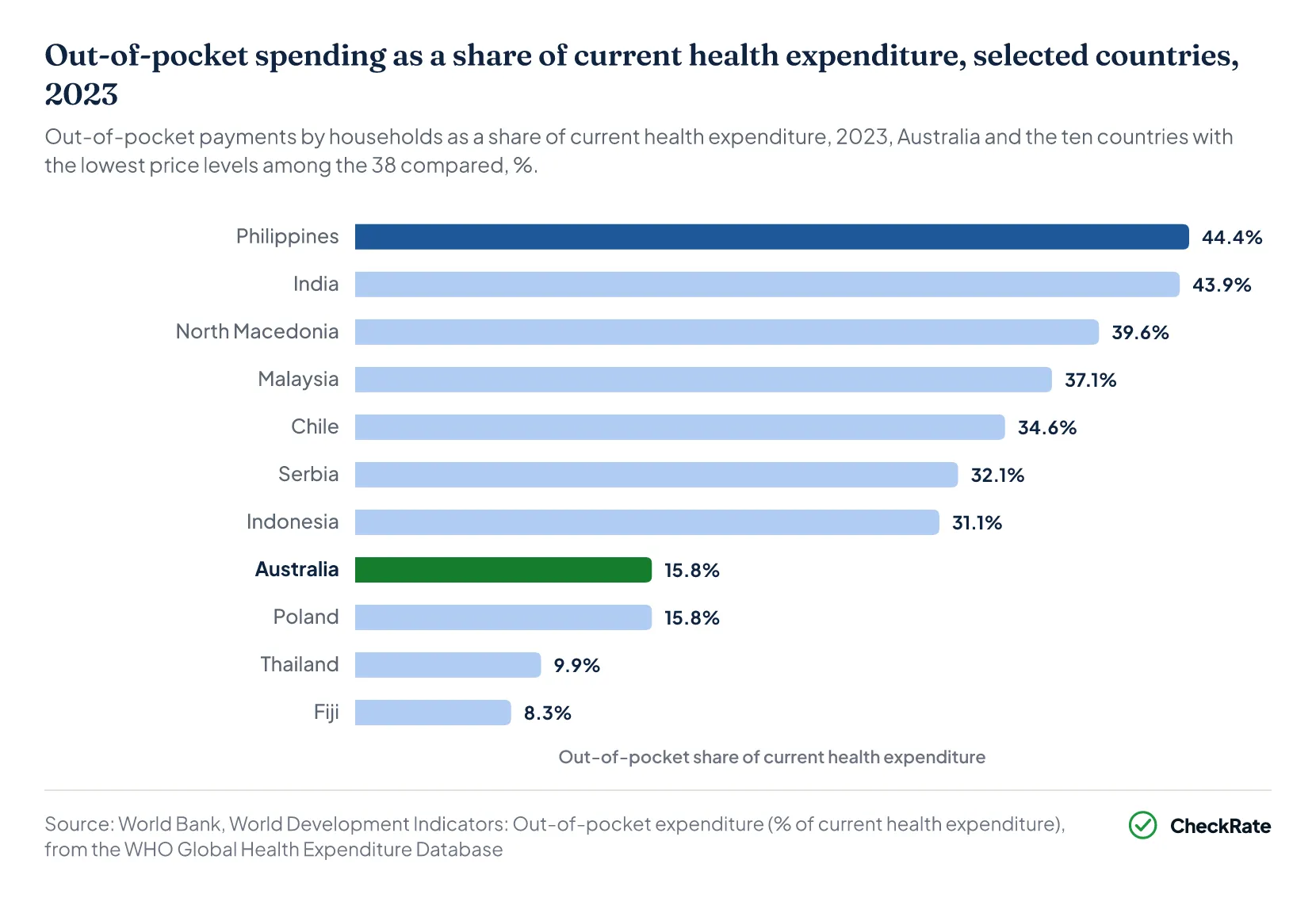
The Philippines recorded the highest out-of-pocket share of health spending among Australia and the 10 countries with the lowest price levels, at 44.4% of current health expenditure in 2023, according to World Health Organization (WHO) data published by the World Bank24.
India had the second-highest out-of-pocket share, at 43.9%, followed by North Macedonia at 39.6% and Malaysia at 37.1%24.
Out-of-pocket payments accounted for 15.8% of current health expenditure in both Australia and Poland in 2023, compared with 9.9% in Thailand and 8.3% in Fiji24.
Australia has reciprocal health care agreements with 11 countries: Belgium, Finland, Ireland, Italy, Malta, the Netherlands, New Zealand, Norway, Slovenia, Sweden and the United Kingdom, according to Smartraveller25. These agreements provide access to some medically necessary care while Australians are visiting those countries.
Australian insurers might not cover people who live overseas long term, and visa conditions may require a local health insurance policy26. Age and pre-existing conditions can affect the cost and type of cover available.
Official comparative data on health insurance premiums for retirees living overseas is unavailable.
Section 08 · Currency
How has the Australian dollar changed against other currencies since 2016?
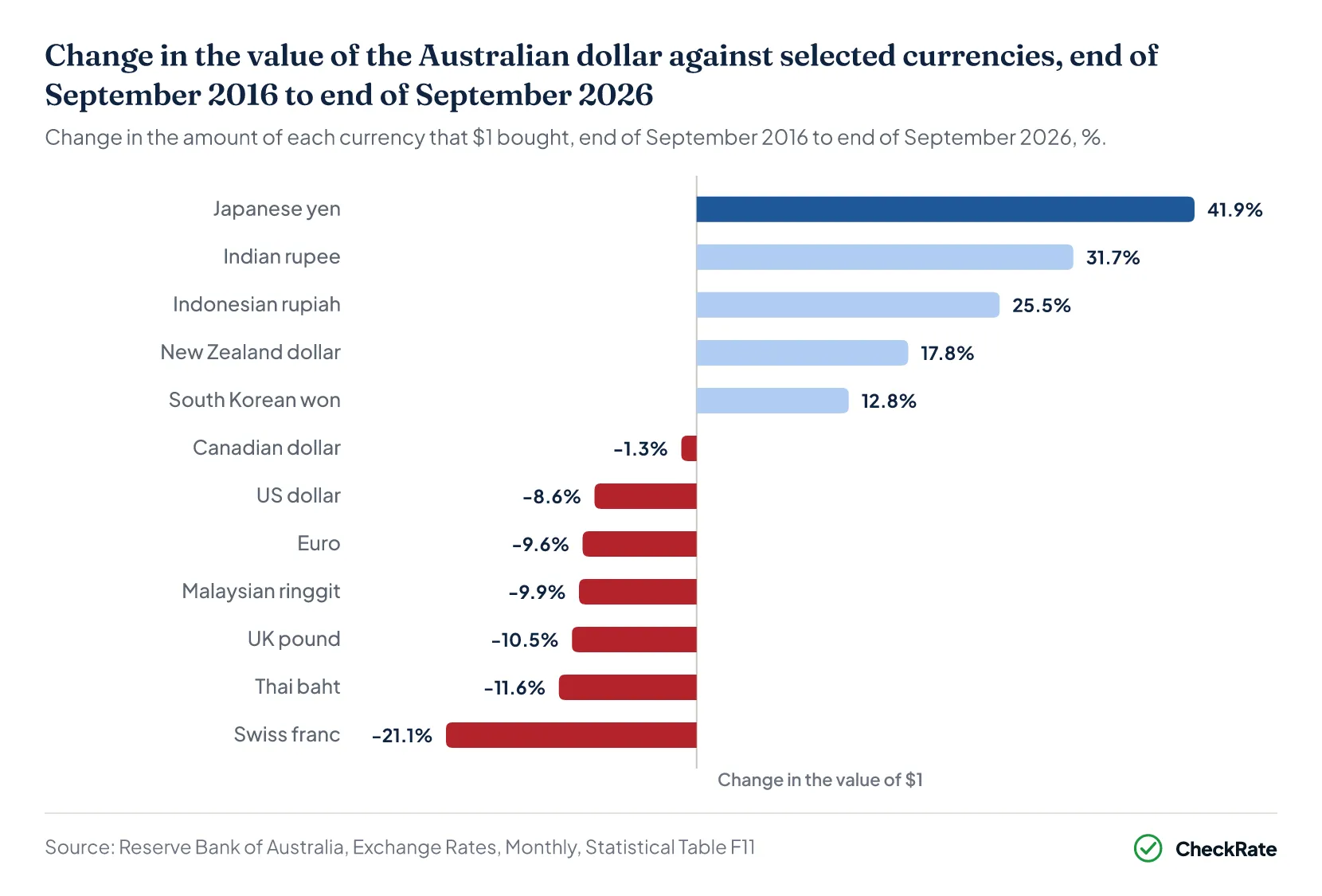
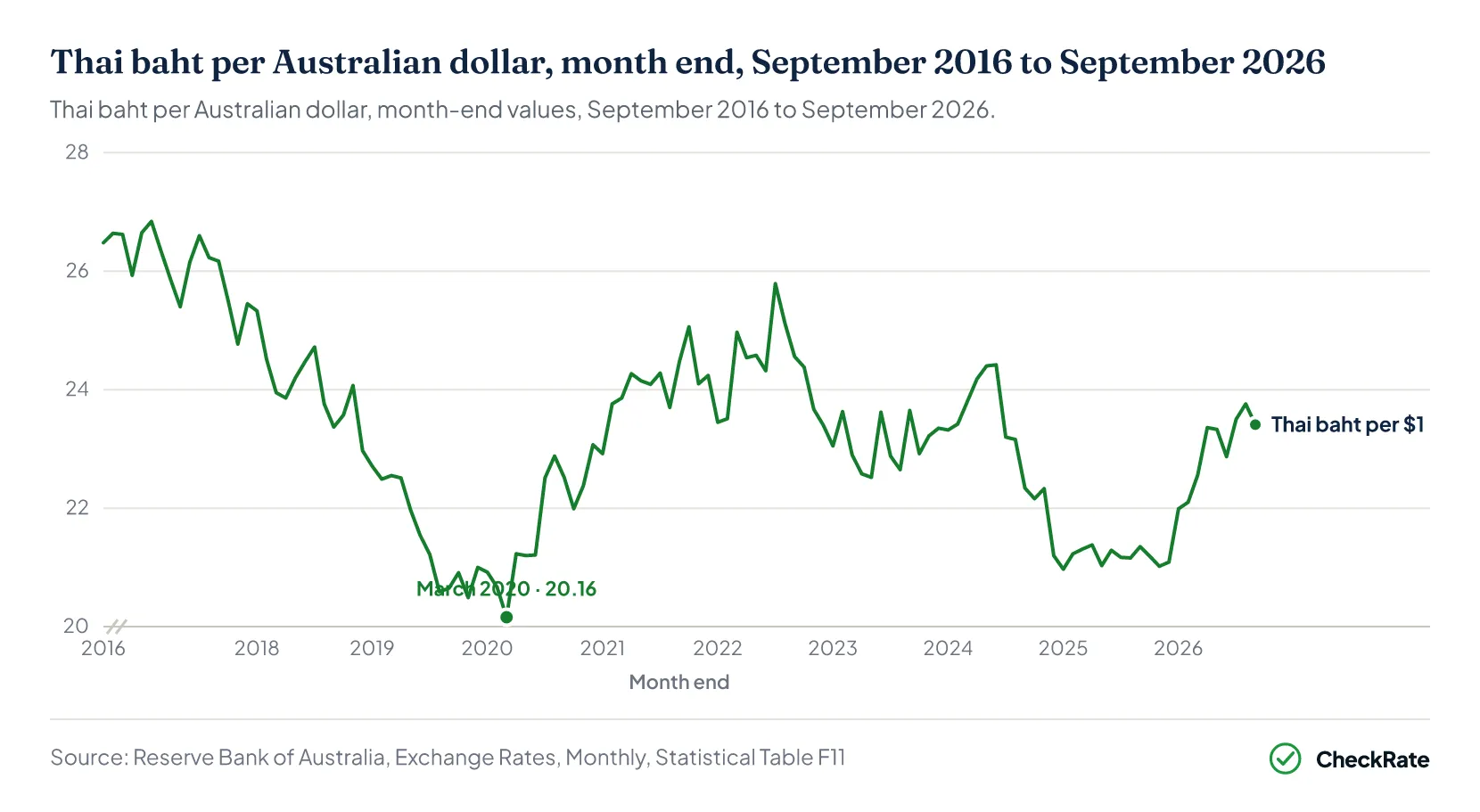
At the end of September 2026, A$1 bought 11.6% fewer Thai baht than at the end of September 2016, falling from 26.48 baht to 23.41 baht, according to Reserve Bank of Australia (RBA) exchange rates27.
Over the same 10 years, the Australian dollar fell 9.9% against the Malaysian ringgit, 9.6% against the euro, 10.5% against the UK pound and 21.1% against the Swiss franc27.
The Australian dollar rose 25.5% against the Indonesian rupiah, 31.7% against the Indian rupee and 41.9% against the Japanese yen over the same period27. Against the US dollar, it fell 8.6%, from US$0.7630 to US$0.6977.
Services Australia pays the Age Pension into an overseas bank account in local currency or US dollars, depending on the country, and the RBA converts each payment at the exchange rate at the time of payment6. The pension rate is indexed to Australian living costs, not to prices in the country of residence8.
Using an example calculation, the A$29,520.40 overseas rate converts to about 691,100 baht a year at the end-September 2026 rate of 23.41 baht per Australian dollar27. At the February 2017 high of 26.84, it would have converted to about 792,300 baht, compared with about 595,100 baht at the March 2020 low of 20.16.
At its February 2017 high, A$1 bought 33.1% more baht than at its March 2020 low, the widest gap between month-end rates from September 2016 to September 202627.
Section 09
Retiring overseas on the Age Pension: quick answers
Can you keep getting the Age Pension if you move overseas?
The Age Pension can be paid for the whole time a person is outside Australia, including when they leave to live in another country, provided they continue to meet the qualification rules, according to Services Australia. The maximum rate for a single person living outside Australia is A$29,520.40 a year from 20 September 2026, and the rate may be reduced depending on how long the person was an Australian resident.
Where does the Age Pension go furthest overseas?
India had the lowest household consumption price level among the 38 countries compared, at 24.1% of Australia's in 2025, based on World Bank purchasing power parities. At that price level, the A$29,520.40 overseas Age Pension buys about as much household consumption in India as A$122,500 would buy in Australia, by CheckRate's calculation. The World Bank does not recommend these measures for strict rankings.
How many countries have a pension agreement with Australia?
Australia has social security agreements with 32 countries, including India, Japan, Korea, New Zealand, Canada, the United States, Chile and 25 countries in Europe, according to the Department of Social Services. The United Kingdom's agreement with Australia ended on 1 March 2001.
Is super taxed in Australia after age 60?
Withdrawals from the tax-free component and the taxed element of super are not taxed in Australia once a person is 60 or older, whether taken as a lump sum or as an income stream, according to the Australian Taxation Office. The untaxed element, most common in public sector funds, is taxed at the person's marginal rate, with lump sums taxed at the lower of the marginal rate and 17% up to the untaxed plan cap.
Which countries have a reciprocal health care agreement with Australia?
Australia has reciprocal health care agreements with 11 countries: Belgium, Finland, Ireland, Italy, Malta, the Netherlands, New Zealand, Norway, Slovenia, Sweden and the United Kingdom, according to Smartraveller. The agreements generally cover urgent and medically necessary care, often with a co-payment, and do not cover medical evacuation.
How do exchange rates affect an Age Pension paid overseas?
An Age Pension paid into an overseas bank account is converted to local currency or US dollars by the Reserve Bank of Australia at the exchange rate at the time of payment, according to Services Australia. At the end-September 2026 rate of 23.41 baht, the A$29,520.40 overseas rate converted to about 691,100 baht a year, compared with about 781,700 baht at the September 2016 rate of 26.48.
References
- Services Australia, Payment schedule and rates for people outside Australia: Age Pension · servicesaustralia.gov.au ↑ b c
- Services Australia, How much Age Pension you can get (rates from 20 September 2026) · servicesaustralia.gov.au ↑
- Services Australia, Who can get Age Pension · servicesaustralia.gov.au ↑
- Services Australia, Residence rules for Age Pension · servicesaustralia.gov.au ↑ b
- Services Australia, Travel outside Australia rules for Age Pension · servicesaustralia.gov.au ↑ b
- Services Australia, Payments while outside Australia (Age Pension) · servicesaustralia.gov.au ↑ b
- Services Australia, Travel outside Australia rules for Pension Supplement · servicesaustralia.gov.au ↑
- Australian Bureau of Statistics, Selected Living Cost Indexes, Australia, June 2026 · Australian Bureau of Statistics ↑ b
- Australian Taxation Office, Tax on super benefits · ato.gov.au ↑ b
- Australian Taxation Office, Super withdrawal options · ato.gov.au ↑ b
- Moneysmart (ASIC), Getting your super · moneysmart.gov.au ↑
- Australian Taxation Office, When you can access your super early · ato.gov.au ↑
- World Bank, World Development Indicators: PPP conversion factor, household final consumption (PA.NUS.PRVT.PP) · data.worldbank.org ↑ b c d e f g h
- Department of Social Services, International social security agreements · dss.gov.au ↑ b c d e
- World Bank, World Development Indicators metadata: PPP conversion factor, households and NPISHs final consumption expenditure (PA.NUS.PRVT.PP) · databank.worldbank.org ↑ b
- World Bank, World Development Indicators: Official exchange rate (PA.NUS.FCRF) · data.worldbank.org ↑
- Services Australia, International social security agreements · servicesaustralia.gov.au ↑
- Thai e-Visa (Ministry of Foreign Affairs of Thailand), Retirement · thaievisa.go.th ↑
- Malaysia My Second Home, Silver category · mm2h.gov.my ↑
- Malaysia My Second Home, Guidelines · mm2h.gov.my ↑
- Philippine Retirement Authority, Special Resident Retiree's Visa (SRRV) · pra.gov.ph ↑
- Indonesia Directorate General of Immigration, e-Visa visa selection · evisa.imigrasi.go.id ↑
- Fiji Ministry of Immigration, Residence Permit on Assured Income · immigration.gov.fj ↑
- World Bank, World Development Indicators: Out-of-pocket expenditure (% of current health expenditure) (SH.XPD.OOPC.CH.ZS), from the WHO Global Health Expenditure Database · data.worldbank.org ↑ b c
- Smartraveller, Using a health care agreement for medical care · smartraveller.gov.au ↑
- Smartraveller, Travel insurance · smartraveller.gov.au ↑
- Reserve Bank of Australia, Exchange Rates: Statistical Table F11 (monthly) · Reserve Bank of Australia ↑ b c d e