


Published
 How much income tax does the average Australian pay?The median net tax bill was substantially lower than the average. The median taxable individual paid $14,993 for 2023–24, about 60% of the $24,888 average, because very large bills at the top pull the…
 What is the average tax refund in Australia?The mean refund of $3,052 is pulled upwards by a small number of large refunds, while the median refund was $1,609: more than half of all refunds were under $2,000. Both figures relate to individual i…
 Tax deductions, tax offsets and tax refunds: what is the difference?A tax deduction is subtracted from income before any tax is worked out. The ATO's formula is assessable income minus allowable deductions equals taxable income, and income tax is then calculated on th…
Section 01 · The new rule
What is the $1,000 standard deduction?
The standard deduction is applied automatically for eligible taxpayers, up to $1,000, and is reduced dollar for dollar by any covered work-related expenses they itemise in their return. A new section of the tax law gives Australian tax residents who earn income from work a deduction equal to the lesser of $1,000 and their assessable labour income for the year, with no requirement to have incurred or substantiated any expense.1 Anyone whose genuine work expenses exceed $1,000 can still itemise them under the existing rules, so the change provides a minimum deduction for eligible taxpayers rather than placing a cap on work-related expense claims.
Because it reduces taxable income rather than tax, the deduction is not worth $1,000 in cash. The tax reduction depends on the marginal rate that applies to the income affected by the deduction and the taxpayer's broader tax position. For a taxpayer whose full $1,000 deduction falls within one of the 15, 30, 37 or 45 per cent marginal rate bands, a simple rate-based calculation gives an income-tax reduction of between $150 and $450. This is derived by multiplying $1,000 by each rate of 15, 30, 37 and 45 per cent, while any Medicare levy reduction depends on the person's income and circumstances.2 The rates each slice of income falls into are tabled in the income tax brackets reference. At the bill's introduction the government estimated that around 6.2 million people would benefit, at an average of $205 a year, with more than a quarter of beneficiaries under 30 and more than half women.3 The explanatory memorandum put the estimated cost at $2.6 billion over the four years from 2025–26.1
Section 02 · Key dates
When does the standard deduction take effect?
The standard deduction applies from the 2026–27 income year, but the first claims will not be made until 2026–27 tax returns are lodged from July 2027. Schedule 4 commenced on 1 July 2026, the first day of the quarter after royal assent on 26 June 2026, and applies to assessments for the 2026–27 income year onwards.1 That timing is reflected in the budget arithmetic: the measure first reduces revenue in 2027–28, the year 2026–27 returns are assessed, when the estimated cost is $1,240.1 million.
13 April 2025
Announced as a Labor election commitment: a $1,000 instant tax deduction for work-related expenses.
12 May 2026
Confirmed in the 2026–27 Budget as part of the government's tax reform package.
28 May 2026
The Treasury Laws Amendment (Tax Reform No. 1) Bill 2026 was introduced, with the standard deduction as Schedule 4.
25 to 26 June 2026
Passed both houses on 25 June and received royal assent on 26 June as Act No. 49 of 2026. The Senate's amendments all fell on other schedules; Schedule 4 passed as introduced.
1 July 2026
Schedule 4 commenced and the 2026–27 income year began; the deduction applies from this income year.
From July 2027
Taxpayers can lodge 2026–27 returns, the first that can claim the standard deduction. Related fringe benefits tax changes apply to FBT years starting on or after 1 April 2027.
Source · ATO QC 107405; Parliament of Australia bill homepage; explanatory memorandum; 2026–27 Budget speech, 12 May 2026.
Section 03 · Eligibility
Who is eligible to claim the $1,000 deduction?
Eligibility is based on whether a taxpayer earns assessable labour income. The Act ties the deduction to payments that fall under the pay-as-you-go withholding rules for work, which cover employees, company directors, office holders and several related categories, rather than using an occupation test.1 Someone with both wages and other income qualifies through the wages while someone with only business or investment income does not.4
Two limits apply to the deduction:
- A resident whose labour income for the year is under $1,000 has the deduction capped at that amount, so the deduction never exceeds the work income it relates to.1
- The deduction is limited to Australian tax residents, so foreign residents cannot claim it at all.
| Payments that count as assessable labour income | |
|---|---|
| Payment type | Who it covers |
| Salary and wages | Employees |
| Director payments | Company directors |
| Office holder payments | People paid for holding an office, such as statutory appointees |
| Religious practitioner payments | Ministers of religion and members of religious orders |
| Return to work payments | Payments made to induce someone to resume work |
| Retirement and termination payments | Payments made because employment ended |
| Parental leave pay | Recipients of government parental leave pay |
Source · explanatory memorandum, paragraph 4.21.
Section 04 · Covered expenses
Which work-related expenses does the deduction cover?
The standard deduction covers a defined set of work-related expenses: itemising any of them in a return reduces the deduction dollar for dollar. The Act lists the covered categories: general deductions incurred in producing labour income, car expenses, transport between workplaces, the decline in value of depreciating assets used for work, balancing adjustments on those assets, repairs, and COVID-19 tests.1 Claiming any of these covered expenses in a return reduces the standard deduction dollar for dollar, preventing the same expense from being counted twice.
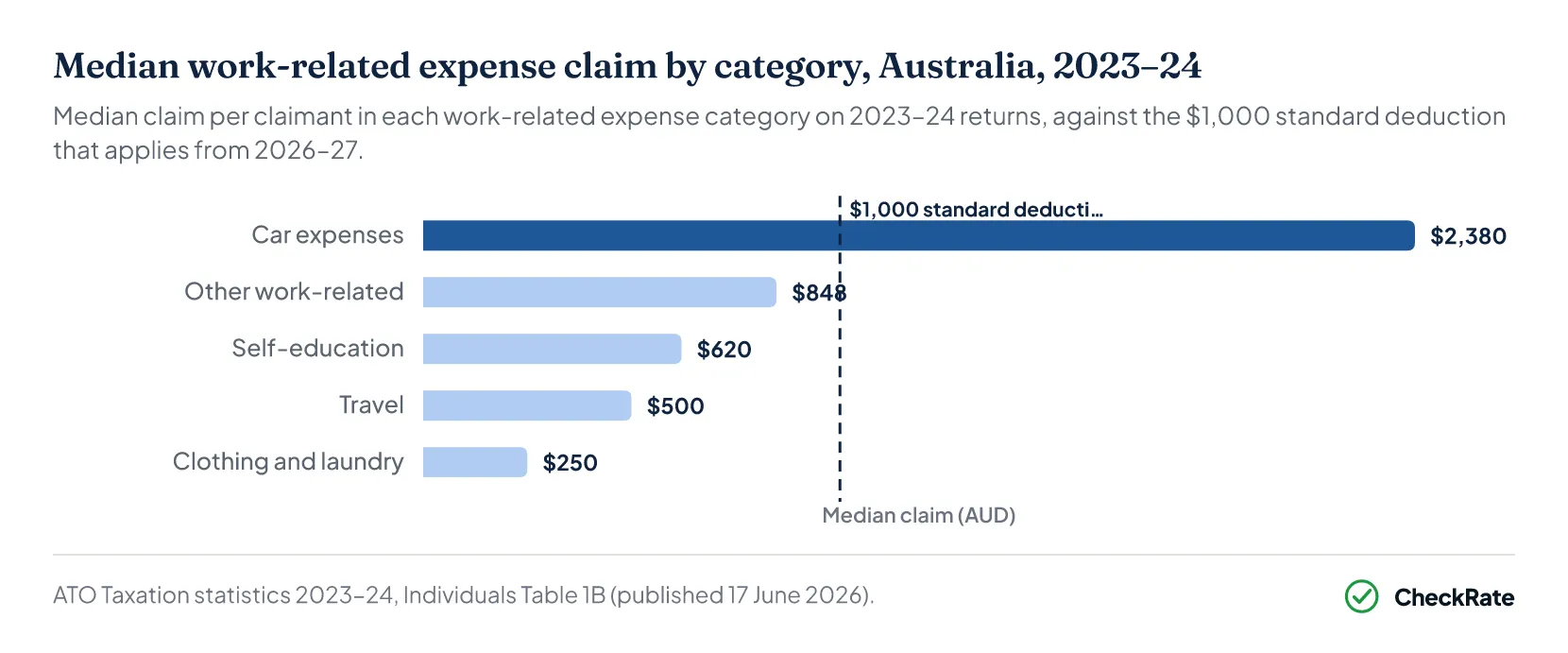
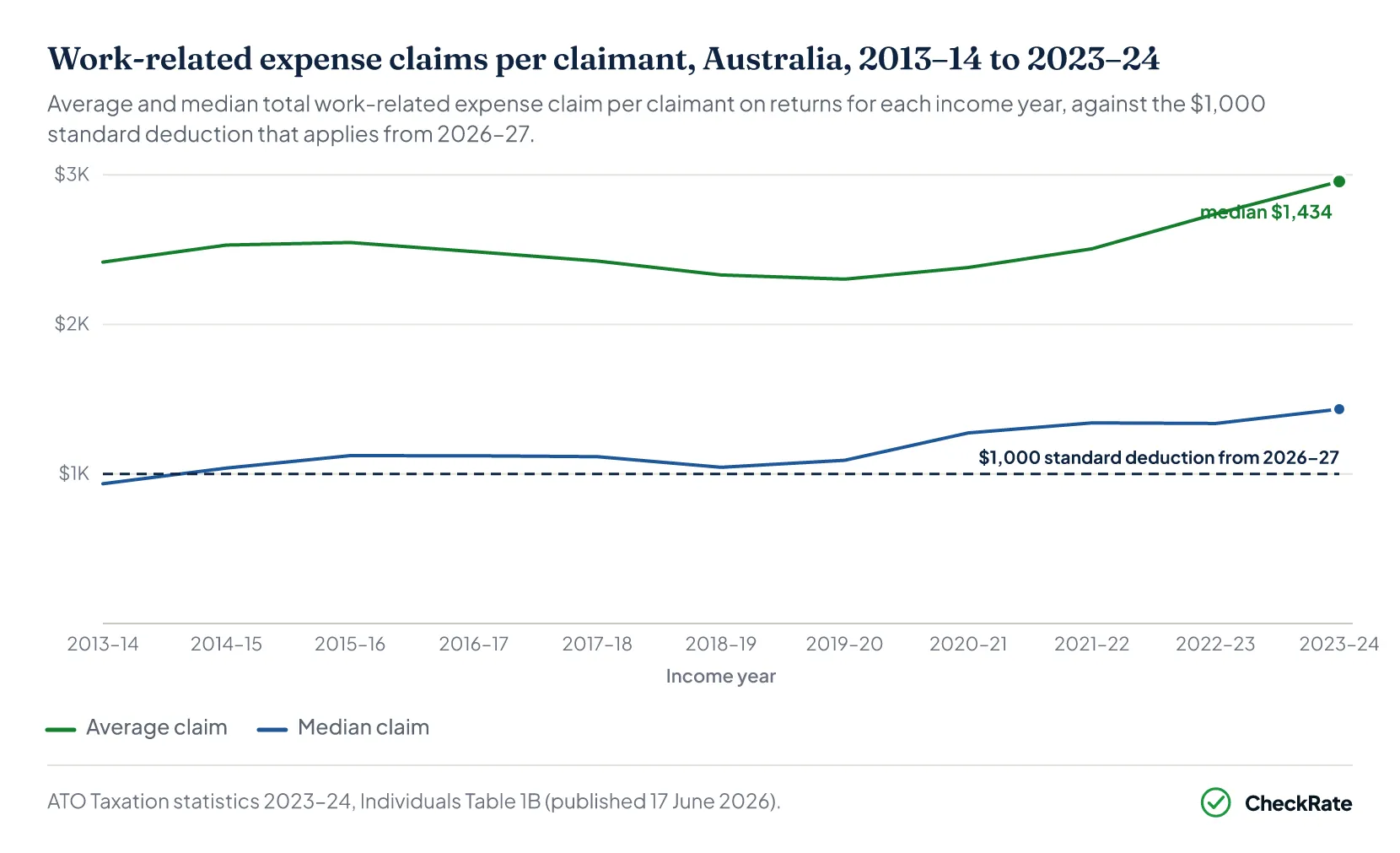
Work-related expense claims are widespread. In 2023–24, 10.7 million of the 16.6 million individuals who lodged a return, about 64 per cent, claimed work-related expenses totalling $31.6 billion. This figure is derived by dividing 10,678,121 by 16,584,287. The average claim was $2,956, and the median was $1,434.5 Median claims for several individual categories were below $1,000: clothing and laundry was $250 and travel was $500, self-education was $620 and other work-related expenses was $848. Car expenses were the exception with a median above $1,000 at $2,380.
Section 05 · Claimed separately
Which deductions can be claimed separately?
Several deductions can still be claimed separately from the standard deduction. The Act keeps a list of deductions claimable in addition to it: deductions unconnected with labour income, such as expenses against interest or dividend income, as well as gifts and contributions and the cost of managing tax affairs. Certain expenses that are work-related in the everyday sense can also be claimed separately, including income protection, sickness and accident insurance premiums, and membership of a union or a trade, business or professional association.1
Some of these separately claimable deductions are common. In 2023–24, 4.6 million individuals claimed gifts or donations, at an average of $932 and a median of $150, and 6.3 million claimed costs of managing their tax affairs, mostly tax agent fees, at an average of $389.5 Under the new rules, claims made separately still require the usual records, because the no-substantiation treatment attaches only to the standard deduction itself, not to deductions claimed in addition to it.
Section 06 · Over $1,000
What happens if work-related expenses are higher than $1,000?
If an eligible taxpayer’s covered work-related expenses exceed their standard deduction entitlement, the standard deduction reduces to zero and they itemise and substantiate the full amount.1 If itemised covered expenses are below the entitlement, the standard deduction tops the total deduction up to that amount; if none are itemised, the taxpayer receives the full standard deduction.
The memorandum's worked examples, reproduced below, show each path. In a separate review example, a taxpayer whose itemised claims were partly disallowed by the ATO had the standard deduction restored to fill the gap back up to $1,000.1
| Examples of itemised expenses and the standard deduction | |||
|---|---|---|---|
| Scenario | Covered expenses incurred | Itemised in the return | Total deduction received |
| Itemises $450 of covered expenses | $450 | $450 | $1,000 |
| Same expenses, itemises nothing | $450 | $0 | $1,000 |
| Itemises $1,050 of covered expenses | $1,050 | $1,050 | $1,050 |
| Same expenses, itemises nothing | $1,050 | $0 | $1,000 |
Source · Explanatory memorandum, examples 4.1 to 4.3.
Historical claim data shows that work-related expense claims above $1,000 have been common. Among the 10.7 million individuals who claimed work-related expenses for 2023–24, the median claim was $1,434, meaning at least half had total claims above $1,000. The median claim has also remained above $1,000 in every year since 2014–15, reaching $1,434 in 2023–24 from $935 in 2013–14, a rise of $499 or 53.4 per cent.5
standard deduction
Up to $1,000 off taxable income, no receipts
No expense needs to have been incurred
Applies automatically to eligible taxpayers
Donations, agent fees and union fees still claimable on top
Reduced dollar for dollar by any covered work-related expenses itemised
Itemise work-related expenses
The full substantiated amount, with no cap
Receipts and records required as before
Covered expenses claimed reduce the standard deduction dollar for dollar
Standard deduction reduces to zero
Amounts above the entitlement can still be claimed in full if substantiated
Section 07 · Records
How does the $1,000 standard deduction change record-keeping?
For taxpayers who rely on the standard deduction, no receipts, logbooks or diaries are needed to claim it. The government estimated the compliance saving across individuals at $380 million a year.1 At the same time, the existing small-claim shortcuts are being removed. The concessions that allowed work-related expenses up to $300, and laundry claims up to $150, to be claimed without written evidence are repealed, along with the award transport payment concession, because the standard deduction now does that job. From 2026–27, itemising any covered work expense means substantiating it, whatever its size.
Work equipment gets its own transitional treatment. New depreciating assets expected to be used mainly for work cannot be added to a low-value pool from 1 July 2026. A taxpayer who later sells or scraps a work asset after years of relying on the standard deduction can choose a fixed 50 per cent reduction of the balancing adjustment instead of reconstructing usage records.1
Employers are affected too. From FBT years starting 1 April 2027, salary packaging a work expense that the standard deduction covers no longer reduces the employer's fringe benefits tax, preventing the double benefit of packaging an expense and receiving the deduction as well.1
Section 08
The $1,000 standard deduction: quick answers
Can the $1,000 instant tax deduction be claimed this tax time?
No. The standard deduction first applies to the 2026–27 income year, so the first returns that can use it are lodged from July 2027. It cannot be claimed on 2025–26 returns lodged during the current tax time.
Are receipts needed to claim the standard deduction?
No. A taxpayer is not required to incur or substantiate work-related expenses to receive the standard deduction. Receipts are still required for anyone who itemises work-related expenses instead, and for deductions claimed in addition to it, such as donations.
How much is the $1,000 standard deduction actually worth?
It reduces taxable income, not tax, by up to $1,000. For a taxpayer whose full deduction falls within one of the 15, 30, 37 or 45 per cent marginal rate bands, a simple rate-based calculation gives an income tax reduction of between $150 and $450, before any Medicare levy effect. These figures are derived by multiplying $1,000 by each rate. Any Medicare levy reduction depends on the person's income and circumstances. The exact value depends on the person's broader tax position; the government's estimate of the average gain for those who benefit is $205 a year.
Can charitable donations and tax agent fees be claimed on top of the standard deduction?
Yes. Gifts and donations, the cost of managing tax affairs, deductions unrelated to work income such as investment expenses, income protection insurance premiums, and union or professional association fees can all be claimed in addition to the standard deduction.
What happens when work expenses are more than $1,000?
The taxpayer can itemise and substantiate the full amount as under the previous rules, and the automatic standard deduction reduces dollar for dollar as those expenses are claimed, reaching zero once they equal $1,000. Above $1,000, itemising the full amount gives the larger total deduction; nothing is lost by doing so, since the standard deduction alone is capped at $1,000 regardless.
Who cannot claim the standard deduction?
Foreign residents, and people whose income is only from business or investments, because the deduction is limited to Australian tax residents who earn assessable labour income. For a resident whose labour income is under $1,000, the deduction is capped at that labour income.
References
- Explanatory memorandum, Treasury Laws Amendment (Tax Reform No. 1) Bill 2026 · parlinfo.aph.gov.au ↑ b c d e f g h i j k l
- ATO, Tax rates – Australian resident (QC 73320) · ato.gov.au ↑
- Treasurer, second reading speech, Treasury Laws Amendment (Tax Reform No. 1) Bill 2026 · ministers.treasury.gov.au ↑
- ATO, Standard deduction for work-related expenses (QC 107405) · ato.gov.au ↑
- ATO, Taxation statistics 2023–24, Individuals Table 1: selected items by year (Tables 1A and 1B) · data.gov.au ↑ b c
- Supplementary explanatory memorandum, Treasury Laws Amendment (Tax Reform No. 1) Bill 2026 · parlinfo.aph.gov.au
- Treasury Laws Amendment (Tax Reform No. 1) Act 2026 (Cth), No. 49 of 2026 · legislation.gov.au
- Treasurer, 2026–27 Budget speech · ministers.treasury.gov.au