


Published
 What is the average tax refund in Australia?The mean refund of $3,052 is pulled upwards by a small number of large refunds, while the median refund was $1,609: more than half of all refunds were under $2,000. Both figures relate to individual i…
 What triggers capital gains tax in Australia?When a person stops owning an asset, or certain rights over an asset are created or ended, tax law calls that a CGT event: the point at which a capital gain or loss is made.
 Is Australia a high-tax country? How it compares with other OECD countriesAustralia's tax-to-GDP ratio was 29.9% in 2023–24, the latest OECD figure available for Australia, up 0.6 percentage points from 29.3% the year before. The ratio counts the tax collected by all levels…
Section 01 · Current brackets
What are the Australian income tax brackets in 2026–27?
The 2026–27 scale changed in one respect from 1 July 2026. The rate on income between $18,201 and $45,000 fell from 16% to 15% on 1 July 2026 under the Treasury Laws Amendment (More Cost of Living Relief) Act 20251. Every other rate and threshold is unchanged from 2024–25. Under this scale, a resident owes nothing until taxable income passes $18,200, and the 45% rate applies only to income above $190,000.
Using the base resident scale, cumulative tax reaches $4,020 at $45,000, $31,020 at $135,000 and $51,370 at $190,000. These amounts are derived by multiplying the width of each tax band by its rate and adding the results. The ATO publishes the same cumulative amounts for the years it has tabulated2.
| Resident tax scale · 2026–27 | ||
|---|---|---|
| Taxable income | Marginal rate | Tax at top of band (derived) |
| $0 to $18,200 | Nil | $0 |
| $18,201 to $45,000 | 15% | $4,020 |
| $45,001 to $135,000 | 30% | $31,020 |
| $135,001 to $190,000 | 37% | $51,370 |
| Over $190,000 | 45% | n/a |
Source · Federal Register of Legislation C2025A00028; ATO, Tax rates - Australian residents.
Section 02 · How it works
How do marginal tax rates and the tax-free threshold work?
Australia's scale is marginal. Income is divided into brackets, with each part taxed at its own rate. Moving into a higher bracket does not reduce take-home pay. The higher rate applies only to the income above the threshold, not to the whole income. This is also why a person's average tax rate is lower than their highest marginal rate, as it includes the untaxed portion of income and amounts taxed at lower rates.
The tax-free threshold is the first $18,200 of taxable income. The low income tax offset can increase the income level at which tax first becomes payable above $18,200 for lower incomes, without changing the tax brackets themselves3. The effect of a change to the tax scale depends on a person's taxable income and the marginal rates that apply. Their final tax position can also be affected by tax offsets and the Medicare levy. How assessments then net out into refunds is covered in the average tax refund article.
Section 03 · The full record
Income tax brackets by year since 1983
The tables group identical consecutive years into one row, so every income year from 1983–84 onwards is covered2. Fractional rates in 1984–85, 1986–87, 1990–91 and 1993–94 are the ATO's published blended full-year figures for years in which rates changed part-way through the year. The 1983–84 to 2020–21 tables also match the ATO's prior-years page, archived separately4.
| Income years | Tax-free threshold | Rates above the threshold |
|---|---|---|
| 2020–21 to 2023–24 | $18,200 | 19% to $45,000 · 32.5% to $120,000 · 37% to $180,000 · 45% over $180,000 |
| 2024–25 to 2025–26 | $18,200 | 16% to $45,000 · 30% to $135,000 · 37% to $190,000 · 45% over $190,000 |
| 2026–27 (current) | $18,200 | 15% to $45,000 · 30% to $135,000 · 37% to $190,000 · 45% over $190,000 |
| 2027–28 (legislated) | $18,200 | 14% to $45,000 · 30% to $135,000 · 37% to $190,000 · 45% over $190,000 |
Source · ATO, Tax rates – Australian residents; 2026–27 and 2027–28 rates also per the More Cost of Living Relief Act 2025, Schedule 1. Excludes the Medicare levy of 2%.
| Income years | Tax-free threshold | Rates above the threshold |
|---|---|---|
| 2010–11 to 2011–12 | $6,000 | 15% to $37,000 · 30% to $80,000 · 37% to $180,000 · 45% over $180,000 |
| 2012–13 to 2015–16 | $18,200 | 19% to $37,000 · 32.5% to $80,000 · 37% to $180,000 · 45% over $180,000 |
| 2016–17 to 2017–18 | $18,200 | 19% to $37,000 · 32.5% to $87,000 · 37% to $180,000 · 45% over $180,000 |
| 2018–19 to 2019–20 | $18,200 | 19% to $37,000 · 32.5% to $90,000 · 37% to $180,000 · 45% over $180,000 |
Source · ATO, Tax rates – Australian residents (retrieved 18 August 2026). Excludes the Medicare levy; the temporary budget repair levy (2 points over $180,000, 2014–15 to 2016–17) sat outside the scale.
| Income years | Tax-free threshold | Rates above the threshold |
|---|---|---|
| 2000–01 to 2002–03 | $6,000 | 17% to $20,000 · 30% to $50,000 · 42% to $60,000 · 47% over $60,000 |
| 2003–04 | $6,000 | 17% to $21,600 · 30% to $52,000 · 42% to $62,500 · 47% over $62,500 |
| 2004–05 | $6,000 | 17% to $21,600 · 30% to $58,000 · 42% to $70,000 · 47% over $70,000 |
| 2005–06 | $6,000 | 15% to $21,600 · 30% to $63,000 · 42% to $95,000 · 47% over $95,000 |
| 2006–07 | $6,000 | 15% to $25,000 · 30% to $75,000 · 40% to $150,000 · 45% over $150,000 |
| 2007–08 | $6,000 | 15% to $30,000 · 30% to $75,000 · 40% to $150,000 · 45% over $150,000 |
| 2008–09 | $6,000 | 15% to $34,000 · 30% to $80,000 · 40% to $180,000 · 45% over $180,000 |
| 2009–10 | $6,000 | 15% to $35,000 · 30% to $80,000 · 38% to $180,000 · 45% over $180,000 |
Source · ATO, Individual income tax rates for prior years. Excludes the Medicare levy.
| Income years | Tax-free threshold | Rates above the threshold |
|---|---|---|
| 1990–91 (blended) | $5,250 | 20.5% to $17,649 · 24.5% to $20,599 · 29.5% to $20,699 · 38.5% to $34,999 · 42.5% to $35,999 · 46.5% to $49,999 · 47% over $49,999 |
| 1991–92 to 1992–93 | $5,400 | 20% to $20,700 · 38% to $36,000 · 46% to $50,000 · 47% over $50,000 |
| 1993–94 (blended) | $5,400 | 20% to $20,700 · 35.5% to $36,000 · 38.5% to $38,000 · 44.125% to $50,000 · 47% over $50,000 |
| 1994–95 to 1999–2000 | $5,400 | 20% to $20,700 · 34% to $38,000 · 43% to $50,000 · 47% over $50,000 |
Source · ATO, Tax rates – Australian residents (retrieved 18 August 2026). Blended rows are the ATO's published full-year composite rates for years with mid-year rate changes. Excludes the Medicare levy.
| Income years | Tax-free threshold | Rates above the threshold |
|---|---|---|
| 1983–84 | $4,595 | 30% to $19,499 · 46% to $35,787 · 60% over $35,787 |
| 1984–85 (blended) | $4,595 | 26.67% to $12,499 · 30% to $19,499 · 46% to $27,999 · 47.33% to $34,999 · 55.33% to $35,787 · 60% over $35,787 |
| 1985–86 | $4,595 | 25% to $12,499 · 30% to $19,499 · 46% to $27,999 · 48% to $34,999 · 60% over $34,999 |
| 1986–87 (blended) | $4,890 | 24.42% to $12,499 · 26.5% to $12,599 · 29.42% to $19,499 · 44.25% to $27,999 · 46.83% to $34,999 · 57.08% over $34,999 |
| 1987–88 to 1988–89 | $5,100 | 24% to $12,600 · 29% to $19,500 · 40% to $35,000 · 49% over $35,000 |
| 1989–90 | $5,100 | 21% to $17,649 · 29% to $20,599 · 39% to $34,999 · 47% to $49,999 · 48% over $49,999 |
Source · ATO, Tax rates – Australian residents (retrieved 18 August 2026); cross-checked against the ATO's archived prior-years page. Blended rows are the ATO's published full-year composite rates. Excludes the Medicare levy.
Section 04 · Rates over time
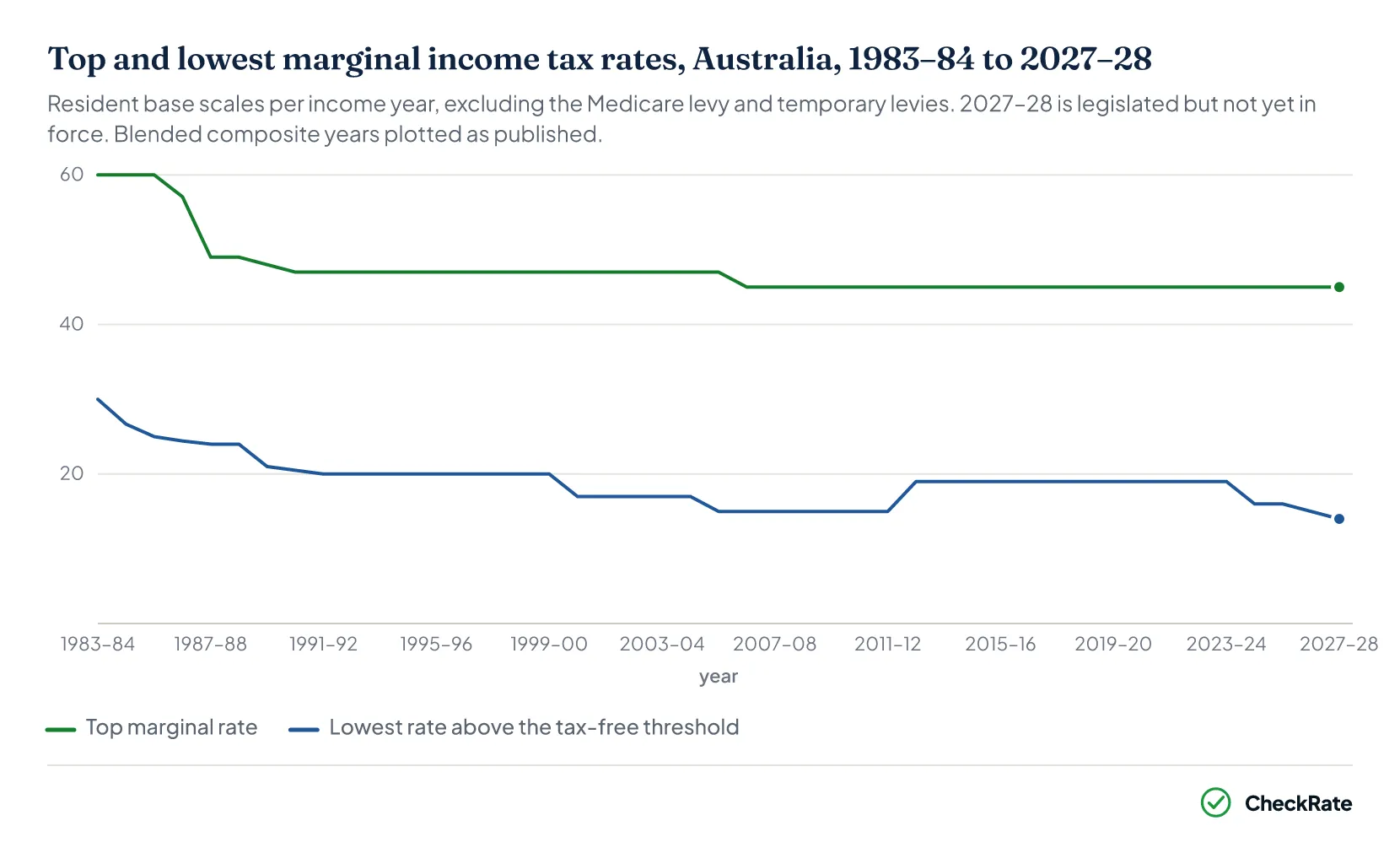
How have Australia's lowest and highest income tax rates changed since 1983?
Australia's top marginal income tax rate fell from 60% in 1983–84 to 45% from 2006–07. The 60% rate remained in place until 1985–86, before falling to 49% in 1987–88, and then 48% in 1989–90 and 47% in 1990–91. After remaining at 47%, the top rate fell to 45% in 2006–07, where it has stayed for 21 income years2.
The lowest taxed rate followed a different path. It fell from 30% in 1983–84 to 15% by 2005–06, before rising to 19% in 2012–134. That change coincided with the tax-free threshold rising from $6,000 to $18,200, meaning the lowest marginal rate began at a substantially higher level of taxable income.
Section 05 · Bracket creep
How does inflation create bracket creep in Australia?
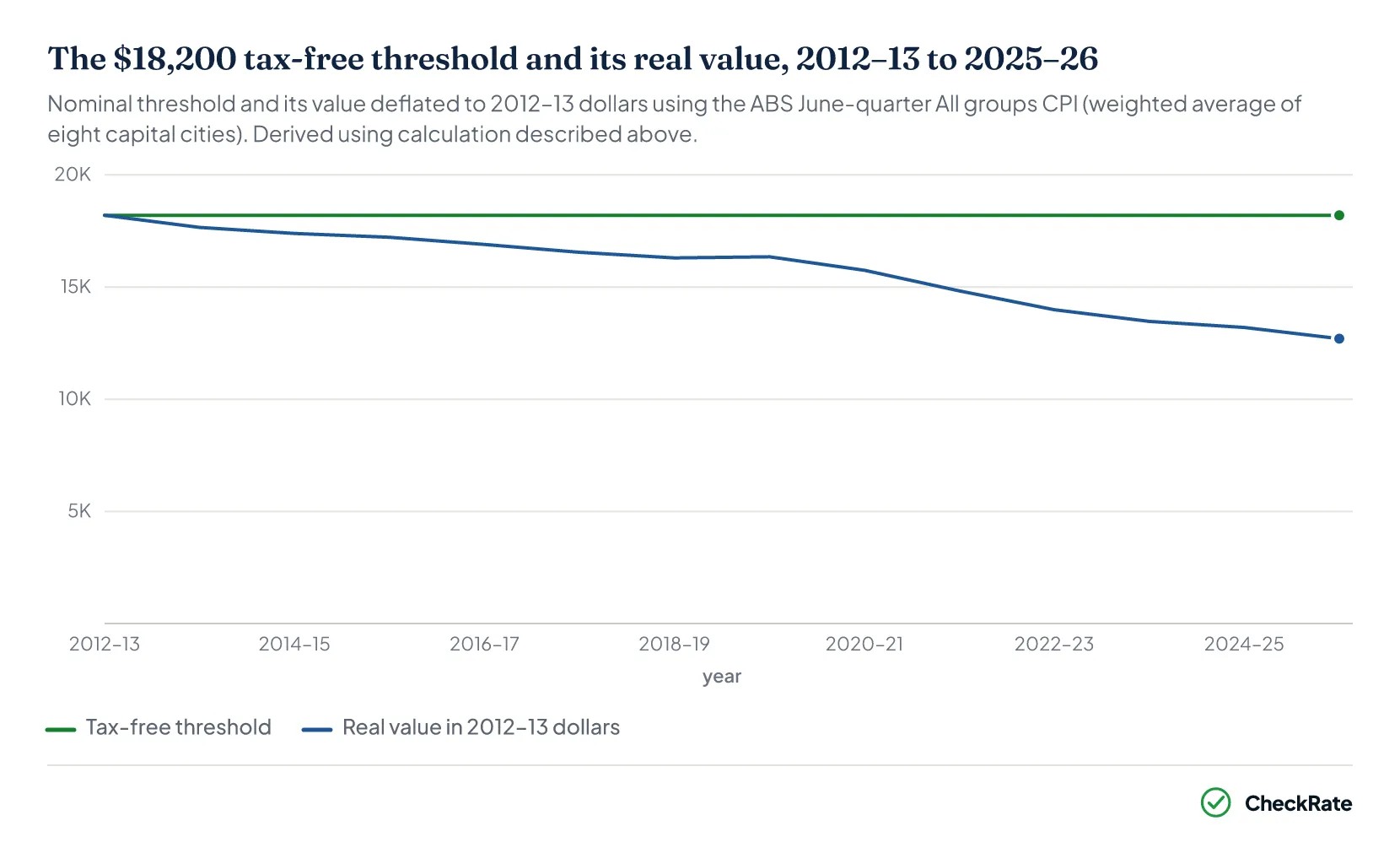
Bracket creep occurs during periods when thresholds remain fixed while incomes rise. The tax-free threshold shows the effect clearly. It has remained at $18,200 since 2012–13. Measured with the ABS June-quarter consumer price index, the $18,200 threshold in 2025–26 had the same purchasing power as about $12,700 in 2012–13, a decline of 30.2%. The calculation uses June-quarter CPI values for 2012–13 and 2025–26 and is derived as 18,200 × 71.38 ÷ 102.315. To match its 2012–13 purchasing power, the threshold would need to be about $26,100 in 2025–26, based on 18,200 × 102.31 ÷ 71.38.
Over the full period, threshold increases have partly offset the effect of inflation. Prices roughly quadrupled between the June quarters of 1983–84 and 2025–26, with the CPI rising from 25.28 to 102.31, or 4.05 times5. Across the same period, the tax-free threshold rose 3.96 times from $4,595 to $18,200, while the top threshold rose 5.31 times from $35,788 to $190,000. The tax-free threshold remained unchanged from 2012–13 to 2025–26.
Section 06 · Recent cuts
What changed under the 2024 and 2026 tax cuts?
The 2024–25 scale came from the Treasury Laws Amendment (Cost of Living Tax Cuts) Act 2024, which replaced the resident rates table for 2024–25 and later years. The scale set rates of 16% to $45,000, 30% to a new $135,000 threshold, 37% to a new $190,000 threshold, and 45% above6.
Two income years later, the More Cost of Living Relief Act 2025 reduced the lowest marginal rate from 16% to 15% for 2026–271.
For anyone with taxable income of $45,000 or more, that one-percentage-point step reduction lowers tax under the base scale by $268 a year. This is derived from 1% of the $26,800 band. For taxable income below $45,000, the reduction depends on how much of the band is filled. A person's exact outcome can also depend on their broader tax position, including offsets and the Medicare levy.
2023–24 · before the cuts
- To $18,200
Nil
- To $45,000
19%
- To $120,000
32.5%
- To $180,000
37%
- Above $180,000
45%
The scale in place 2020–21 to 2023–24.
2024–25 and 2025–26
- To $18,200
Nil
- To $45,000
16%
- To $135,000
30%
- To $190,000
37%
- Above $190,000
45%
Cost of Living Tax Cuts Act 2024.
2026–27 · current
- To $18,200
Nil
- To $45,000
15%
- To $135,000
30%
- To $190,000
37%
- Above $190,000
45%
More Cost of Living Relief Act 2025, first step.
Section 07 · Legislated next step
How do the legislated 2027 changes affect the tax brackets?
The second step of the 2025 act applies from the 2027–28 income year. The rate on income from $18,201 to $45,000 falls from 15% to 14%, while every other rate and threshold remains unchanged1. The change is already legislated and is scheduled to apply from 1 July 2027. No further change to the resident tax scale is currently legislated after 2027–28.
Like the 2026 step, the reduction is worth up to $268 a year under the base tax scale. This is derived from 1% of the $26,800 band and applies in full at taxable incomes of $45,000 and above. A person's exact outcome can also depend on their broader tax position, including offsets and the Medicare levy.
| 2026–27 vs 2027–28 (legislated) | ||
|---|---|---|
| Taxable income | 2026–27 rate | 2027–28 rate |
| $0 to $18,200 | Nil | Nil |
| $18,201 to $45,000 | 15% | 14% |
| $45,001 to $135,000 | 30% | 30% |
| $135,001 to $190,000 | 37% | 37% |
| Over $190,000 | 45% | 45% |
Source · More Cost of Living Relief Act 2025 (No. 28 of 2025), Schedule 1. 2027–28 is legislated, commencing 1 July 2027. Rates exclude the Medicare levy of 2%.
Section 08
Tax brackets: quick answers
What are the income tax brackets for 2026–27 in Australia?
Resident rates for 2026–27 are nil on income to $18,200, 15% from $18,201 to $45,000, 30% from $45,001 to $135,000, 37% from $135,001 to $190,000, and 45% above $190,000. These rates exclude the 2% Medicare levy.
What is the tax-free threshold in Australia?
The tax-free threshold is $18,200, unchanged since 2012–13, when it was tripled from $6,000. Measured using the ABS June-quarter consumer price index, $18,200 in 2025–26 had the same purchasing power as about $12,700 in 2012–13, about 30% less purchasing power. The low income tax offset can lift the income level at which tax first becomes payable above $18,200.
What was the highest income tax rate in Australia since 1983?
The highest rate was 60%, the top marginal rate on the resident scales from 1983–84 to 1985–86, and it applied above $35,787 in 1983–84. These are base scales excluding levies; from 2014–15 to 2016–17 the temporary budget repair levy added 2 percentage points above $180,000 on top of the 45% rate.
When do Australian tax brackets change next?
The next legislated change takes effect on 1 July 2027, when the 15% rate falls to 14% under the Treasury Laws Amendment (More Cost of Living Relief) Act 2025. No further change to the resident tax scale is currently legislated after 2027–28.
Do the tax brackets include the Medicare levy?
No. The scales on this page are the base resident rates. The Medicare levy of 2% is calculated separately. Temporary levies, including the temporary flood and cyclone reconstruction levy in 2011–12 and the temporary budget repair levy from 2014–15 to 2016–17, also sat outside the scales.
What is bracket creep?
Bracket creep is the rise in average tax rates that happens when incomes grow while bracket thresholds stay fixed in dollars. As incomes rise, a larger share can fall into higher brackets even if purchasing power has not increased. Australia's thresholds are not indexed. Parliament changes them through legislation from time to time.
References
- Treasury Laws Amendment (More Cost of Living Relief) Act 2025 (Cth), No. 28 of 2025 · legislation.gov.au ↑ b c
- ATO, Tax rates – Australian resident (QC 73320) · ato.gov.au ↑ b c
- ATO, Low income tax offset · ato.gov.au ↑
- ATO, Individual income tax rates for prior years · web.archive.org ↑ b
- ABS Consumer Price Index, Australia (latest release, Cat. 6401.0) · Australian Bureau of Statistics ↑ b
- Treasury Laws Amendment (Cost of Living Tax Cuts) Act 2024 (Cth), No. 3 of 2024 · legislation.gov.au ↑
- ABS Data API, dataflow CPI (2.0.0) · data.api.abs.gov.au
- ABS, Monthly and quarterly data series · Australian Bureau of Statistics