

Published
Section 01 · Deductions
How does a tax deduction reduce taxable income?
A tax deduction is subtracted from income before any tax is worked out. The ATO's formula is assessable income minus allowable deductions equals taxable income, and income tax is then calculated on that taxable income.1 A deduction does not reduce the tax itself directly. It reduces the income the tax scale is applied to, and the tax falls as a consequence.
Most deductible expenses relate to earning income. To claim a work-related expense, the ATO requires that the taxpayer spent the money and was not reimbursed, that the expense directly relates to earning their income, and that they have a record to prove it, usually a receipt.1 A few deductions, such as gifts and donations, are allowed without being related to earning income. From the 2026–27 income year, a standard deduction of up to $1,000 for work-related expenses also applies, so eligible taxpayers with work income can claim up to that amount without receipts.2
How the standard deduction works, who is eligible and which expenses it covers is set out in the standard deduction article.
How deductions, tax offsets and withholding affect a tax assessment

Section 02 · Offsets
How does a tax offset reduce tax payable?
A tax offset is subtracted from the tax itself, after the tax scale has been applied. The ATO describes an offset, sometimes known as a tax rebate, as reducing the tax paid on taxable income.3 Because the offset is applied after tax is calculated, each dollar of a non-refundable offset generally reduces tax payable by a dollar, up to the amount of tax otherwise payable. The amount received depends on the person's taxable income and on the amount of tax they need to pay, and a person with no tax to pay receives no offset.
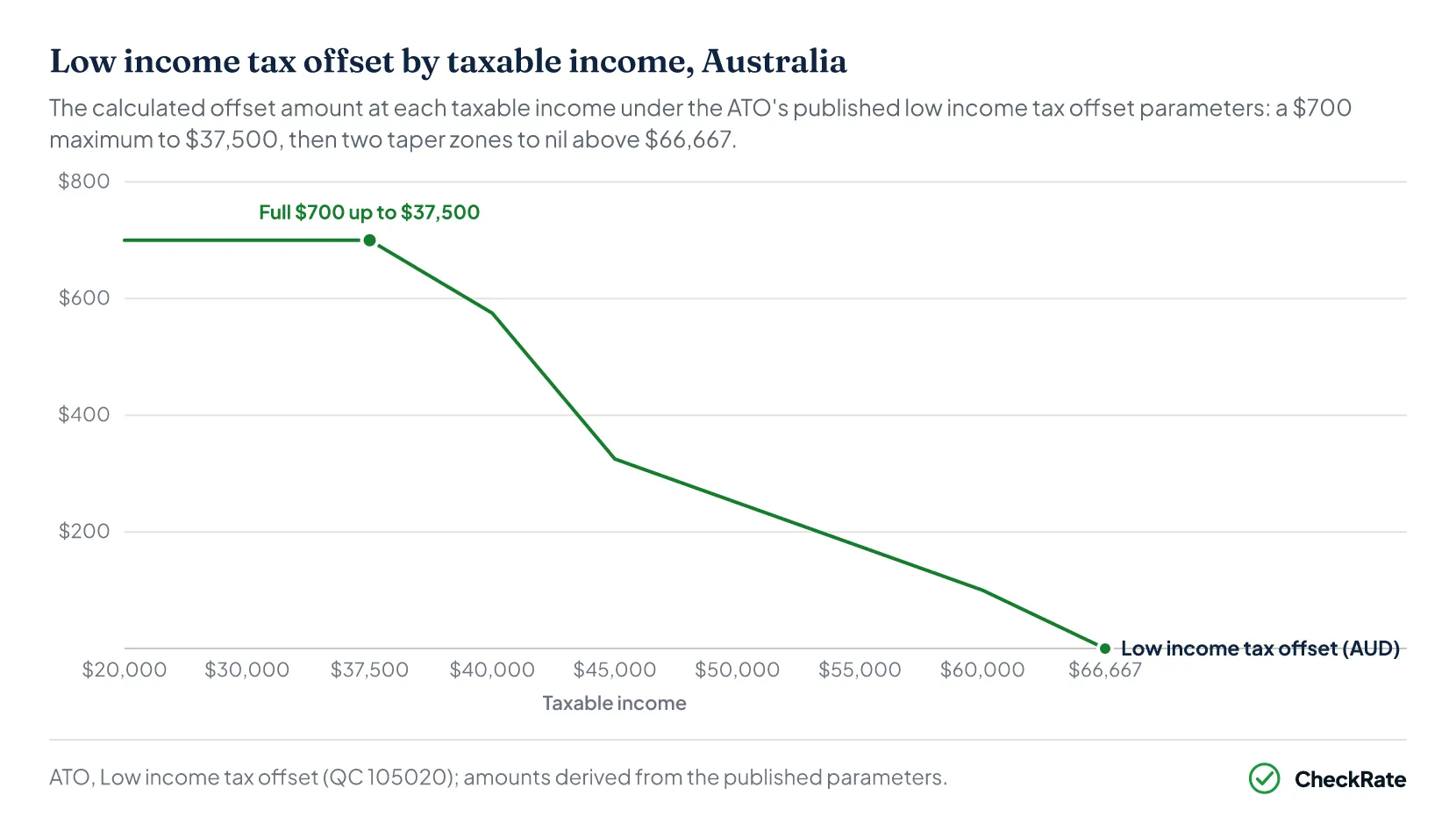
The low income tax offset applies to taxable incomes up to $66,667 and does not need to be claimed. It is worth up to $700 for a taxable income of $37,500 or less, then $700 minus 5 cents for every dollar above $37,500, then $325 minus 1.5 cents for every dollar above $45,000, cutting out above $66,667.4 The ATO works some offsets out automatically after a return is lodged. The low income tax offset is calculated automatically at lodgment and appears on the notice of assessment at the line for non-refundable tax offsets; other offsets are claimed in the offsets section of the return.
| Low income tax offset by taxable income, Australia | |
|---|---|
| Taxable income | Offset amount |
| $37,500 or less | $700 |
| $37,501 – $45,000 | $700 minus 5 cents for every $1 above $37,500 |
| $45,001 – $66,667 | $325 minus 1.5 cents for every $1 above $45,000 |
| More than $66,667 | Nil |
Source · ATO, Low income tax offset (QC 105020), last updated 8 June 2026.
A tax deduction
Subtracted from income before tax is worked out
Worth the deduction multiplied by the marginal rate that would have applied
Claimed in the deductions sections of the tax return
Assessable income minus allowable deductions equals taxable income.
A tax offset
Subtracted from the tax after it has been worked out
Generally reduces income tax dollar for dollar, subject to the rules and limits of the offset
Some worked out automatically at lodgment, others claimed in the offsets section
Most offsets are non-refundable; a few, such as the private health insurance offset, are refundable.
Section 03 · Refundable offsets
What is the difference between refundable and non-refundable tax offsets?
A non-refundable offset can reduce income tax payable to zero but no further, while a refundable offset can still result in a payment after income tax has been reduced to zero. The ATO states that most offsets are not refundable and cannot reduce tax below zero, and names the private health insurance rebate as a refundable exception.3 The low income tax offset is non-refundable. It can only reduce tax payable to zero, it is not a separate payment, and any unused amount is not refunded.4
The private health insurance offset is an example of a refundable offset. It is an amount the government contributes towards private health insurance, and an eligible person can take it either as a reduced premium during the year or as a refundable offset when they lodge their tax return.5 When taken as a refundable offset at lodgment, it can result in a payment even if it exceeds the income tax otherwise payable. Whether an offset is refundable therefore matters most at low taxable incomes, where there is little income tax for a non-refundable offset to reduce.
Section 04 · Deduction vs refund
Why is a tax deduction not a dollar-for-dollar refund?
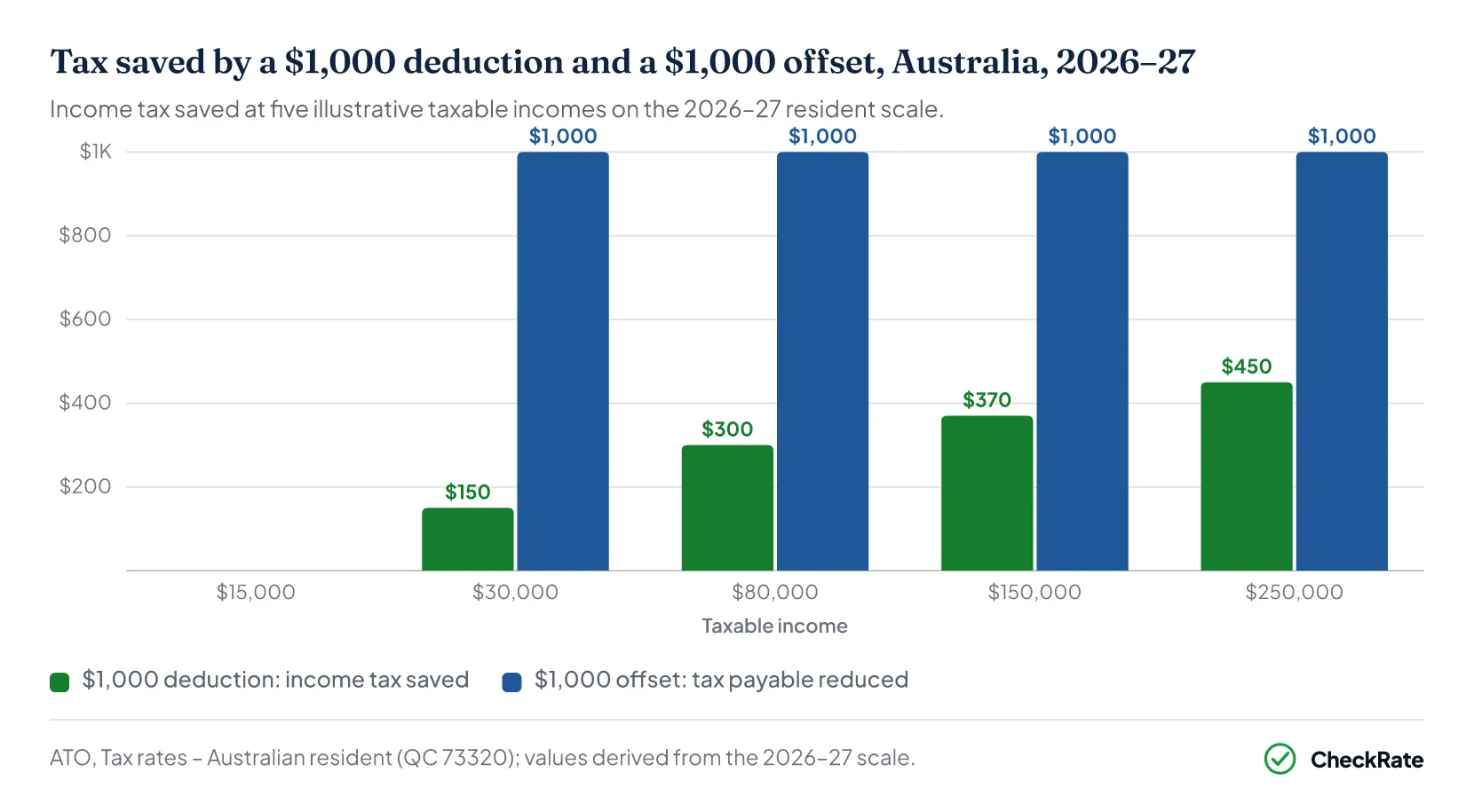
A deduction removes income from the top of a person's tax scale, so the tax saved is based on the marginal rate that would have applied to the deducted income, rather than the amount of the deduction itself. The saving depends on the person's marginal rate and their broader tax position. On the 2026–27 resident scale, a $1,000 deduction saves $150 where the deducted income would have been taxed at 15%, $300 at 30%, $370 at 37% and $450 at 45%. Each amount is derived by multiplying $1,000 by the relevant marginal rate.6 Below the $18,200 tax-free threshold, a deduction saves no income tax, because no income tax applies to that income.
A deduction can also reduce the Medicare levy. The levy is generally 2% of taxable income and is not included in the resident income tax rate tables. Where the full levy applies, a $1,000 deduction can therefore reduce the Medicare levy by a further $20.6 How marginal rates and brackets produce this arithmetic is covered in the tax brackets article.
Section 05 · Withholding
How does pay as you go withholding affect a tax refund or tax bill?
A refund or a tax bill reflects the difference between the assessed amount and the credits for tax already paid during the year. The ATO states that most people who earn income as employees have tax payments made on their behalf throughout the income year through pay as you go withholding.7 Those amounts are collected throughout the year, not the assessed tax. When the return is processed, the notice of assessment shows the tax owed on taxable income, the credit for tax already paid during the income year, and either the tax to pay or the refund.8
The amount withheld during the year can change, which can affect the eventual refund or tax bill. Claiming the tax-free threshold with a payer reduces the amount withheld from each pay, so claiming it with more than one payer at a time can leave the year's withholding short of the assessed amount.9 Deductions and offsets change the assessed amount instead. By reducing the assessed tax, they can result in a larger refund or a smaller bill when the same amount has been withheld.
The average amounts refunded, measured from ATO data, are covered in the average tax refund article.
Section 06 · Worked examples
What difference do a tax deduction and a tax offset make in a worked example?
On the 2026–27 resident scale, a $1,000 deduction from an $80,000 salary reduces the combined income tax and Medicare levy by $320. With the illustrative withholding used below, the assessment ends in a refund rather than a small bill. The two calculations are illustrative applications of the published scale, with every step shown.
Worked example · $80,000 salary with the $1,000 standard deduction
A resident employee earns $80,000 of salary in 2026–27 and claims the $1,000 standard deduction, so their taxable income is $79,000. Income tax on the scale is $4,020 plus 30% of the $34,000 above $45,000, which is $10,200, giving $14,220. The Medicare levy at the full 2% of taxable income adds $1,580, so the total assessed is $15,800. Without the deduction, tax on $80,000 would be $14,520 plus a $1,600 levy, a total of $16,120. The deduction saves $300 of income tax and $20 of Medicare levy, or $320 in all.6 If the employer withheld $16,100 during the year, an illustrative amount, the assessment ends $300 in the taxpayer's favour with the deduction, and $20 against them without it. The same withholding produces a refund in one case and a bill in the other, because only the assessed amount changes.
| Illustrative assessment at $80,000 of salary, 2026–27 resident scale | ||
|---|---|---|
| Assessment step | With $1,000 deduction | Without deduction |
| Taxable income | $79,000 | $80,000 |
| Income tax on the scale | $14,220 | $14,520 |
| Medicare levy at 2% | $1,580 | $1,600 |
| Total assessed | $15,800 | $16,120 |
| Tax withheld (illustrative) | $16,100 | $16,100 |
| Refund or (bill) | $300 refund | ($20 bill) |
Source · ATO, Tax rates – Australian resident (QC 73320).
Worked example · $45,000 taxable income with the low income tax offset
A resident with $45,000 of taxable income in 2026–27 has income tax of $4,020 on the scale, calculated as 15% of the $26,800 between $18,201 and $45,000. Their low income tax offset is $325, derived as $700 minus 5 cents for each of the $7,500 above $37,500, and it applies automatically at lodgment. Income tax payable falls to $3,695, and the Medicare levy at the full 2% adds $900.4 The $325 offset reduces income tax payable by the full $325. A $325 deduction at this income would have reduced income tax by about $49, derived as 15% of $325.
Section 07 · Tax bills
Why does a taxpayer receive a tax bill instead of a refund?
A tax bill arises when the credits for tax already paid fall short of the assessed amount. The ATO lists several common reasons, including too little tax being withheld during the year. Changes in income, such as a promotion, multiple jobs or extra income sources, can contribute to a shortfall, as can incorrectly claiming the tax-free threshold for more than one job at a time.7 Income that has no tax withheld can also contribute to a bill. Examples listed by the ATO include sole trader and partnership or trust income, capital gains from selling real estate, crypto assets or shares, dividends, rent and sharing economy earnings.
Other reasons involve offsets, levies, rebates and study loan repayments. An offset may end or eligibility for it may be lost, as happened when the low and middle income tax offset ended on 30 June 2022.7 Income changes can make the Medicare levy or Medicare levy surcharge apply, too much private health insurance rebate may have been taken during the year, or a study loan repayment may not have been covered by withholding. The ATO also lists having additional amounts withheld by a payer, voluntarily entering pay as you go instalments and making tax prepayments as ways a future tax bill may be managed.
Section 08
Deductions, offsets and refunds: quick answers
What is the difference between a tax deduction and a tax offset?
A tax deduction is subtracted from income before tax is worked out, so its value depends on the marginal rate that would have applied to the deducted income. A tax offset is subtracted from the tax itself after it has been worked out, so each dollar of offset generally reduces tax payable by a dollar, subject to the rules and limits of the offset.
Does a $1,000 tax deduction mean a $1,000 refund?
No. A $1,000 tax deduction does not produce a $1,000 refund, because a deduction reduces taxable income rather than the tax itself. On the 2026–27 resident scale, a taxpayer whose deducted income would have been taxed at 30% saves $300 of income tax from a $1,000 deduction. This is an illustrative calculation based on the published scale, and the saving depends on the person's marginal rate and broader tax position.
What is a refundable tax offset?
A refundable tax offset is an offset that can result in a payment even after it has reduced income tax payable to zero. The ATO states that most offsets are not refundable and cannot reduce tax below zero, and names the private health insurance rebate as a refundable exception. The low income tax offset is non-refundable, so any unused amount is not refunded.
Is the low income tax offset paid automatically?
The ATO works out the low income tax offset automatically when a tax return is lodged, and no separate claim is needed. It is worth up to $700 for taxable incomes of $37,500 or less, tapers as income increases, and cuts out above $66,667. It reduces tax payable rather than being paid as a separate amount, and any unused portion is not refunded.
Why can a taxpayer get a tax bill even though tax was withheld all year?
A taxpayer can get a tax bill even though tax was withheld all year because withholding during the year may be less than the final assessed amount. The ATO's listed reasons include too little tax being withheld across multiple jobs, the tax-free threshold being claimed with more than one payer, income that had no tax withheld such as capital gains, dividends, rent or sole trader income, study loan repayments not covered by withholding, and offsets that ended or no longer apply.
References
- ATO, Claiming deductions (QC 72120) · ato.gov.au ↑ b
- ATO, Standard deduction for work-related expenses (QC 107405) · ato.gov.au ↑
- ATO, About tax offsets (QC 72195) · ato.gov.au ↑ b
- ATO, Low income tax offset · ato.gov.au ↑ b c
- ATO, Private health insurance offset (QC 72200) · ato.gov.au ↑
- ATO, Tax rates – Australian resident (QC 73320) · ato.gov.au ↑ b c
- ATO, Why you may receive a tax bill (QC 54461) · ato.gov.au ↑ b c
- ATO, Your notice of assessment (QC 16302) · ato.gov.au ↑
- ATO, How to claim the tax-free threshold (QC 103970) · ato.gov.au ↑
- ATO, Working Australians tax offset (QC 107797) · ato.gov.au