


Published
- Combined reported scam losses
- $2.18 billion
- Calendar year 2025, up 7.8% on 2024
- Scam reports with a financial loss
- 274,577
- Of 481,523 scam reports in 2025
- Investment scam losses
- $837.7 million
- Largest reported losses of any scam type, 2025
- People who experienced a scam
- 2.7%
- Of people aged 15 and over, 2024-25
 Investment scam losses in AustraliaInvestment scams recorded the largest reported losses of any scam type in 2025. The investment scam article covers those losses in more detail.
 Card fraud in AustraliaThe ABS estimated that 10% of people aged 15 and over experienced card fraud in 2024-25. The card fraud article covers how many people are affected and how much is lost.
 Card surcharges and merchant feesThe payments article covers the card surcharge ban and the fees merchants pay to accept card payments.
Section 01 · Total losses
How much money was reported lost to scams in Australia in 2025?
Reported scam losses in Australia totalled $2.18 billion in 2025, up 7.8% from $2.03 billion in 2024, according to data from the National Anti-Scam Centre (NASC)1.
Combined reported losses include scams reported to Scamwatch (the Australian Competition and Consumer Commission's scam reporting service), ReportCyber, banks through the Australian Financial Crimes Exchange (AFCX), IDCARE and the Australian Securities and Investments Commission (ASIC)1.
The five reporting bodies received 481,523 scam reports in 2025, down from 494,732 in 20241. Of those reports, 274,577 recorded a financial loss.
Bank reports through the AFCX recorded the largest losses among the five reporting bodies, at $842.3 million, followed by ReportCyber at $774.2 million and IDCARE at $535.8 million1. Scamwatch and ASIC recorded $334.8 million and $135.0 million, respectively.
The totals of the five reporting bodies add up to $2.62 billion, because the same scam can be reported more than once1. The NASC deducts $438.1 million in duplicated losses to reach the combined figure.
| Scam reports and reported losses by reporting body, Australia, 2025 | |||
|---|---|---|---|
| Reporting body | Reports | Reported losses ($ million) | Change in losses from 2024 (%) |
| AFCX (bank reports) | 202,943 | 842.3 | 3.7 |
| ReportCyber | 58,876 | 774.2 | 5.4 |
| IDCARE | 47,589 | 535.8 | 4.3 |
| Scamwatch | 200,675 | 334.8 | 5.0 |
| ASIC | 1,565 | 135.0 | 44.5 |
| Adjustment for duplication | -30,125 | -438.1 | |
| Combined total | 481,523 | 2,184.0 | 7.8 |
Source · National Anti-Scam Centre, Targeting scams report 2025, Table 1.
Section 02 · Reports and losses
How did scam reports and financial losses change in Australia in 2025?
Scam reports with a financial loss rose 11.2% in 2025 and reported losses increased 7.8%, while total scam reports fell from 494,732 in 2024 to 481,523 in 2025, according to the National Anti-Scam Centre (NASC)1. This means fewer reports were made without a financial loss.
Of the 200,675 reports to Scamwatch in 2025, 14.1% involved a financial loss, compared with 9.0% in 20241. In 2025, a financial loss was recorded in 98.4% of bank reports through the AFCX, 52.4% of ReportCyber reports and 33.3% of IDCARE reports.
Scamwatch accounted for 39.2% of the five bodies' scam reports in 2025, before the adjustment for duplication, and 12.8% of their reported losses1. Phishing was the most frequently reported scam type to Scamwatch in 2025, at 65,361 reports. Of these, 2.3% involved a financial loss.
According to the Australian Bureau of Statistics (ABS), 71.1% of people aged 15 and over who experienced a scam in 2024-25 reported their most serious incident to an authority or were notified about it by one2.
The ABS estimates are based on telephone interviews with 25,368 people aged 15 and over between July 2024 and June 20253.
| Scam reports with a financial loss by reporting body, Australia, 2025 | |||
|---|---|---|---|
| Reporting body | Reports | Reports with a loss | Share with a loss (%) |
| AFCX (bank reports) | 202,943 | 199,666 | 98.4 |
| ReportCyber | 58,876 | 30,876 | 52.4 |
| IDCARE | 47,589 | 15,833 | 33.3 |
| Scamwatch | 200,675 | 28,202 | 14.1 |
| All reporting bodies | 481,523 | 274,577 | 57.0 |
Source · National Anti-Scam Centre, Targeting scams report 2025, Tables 1 and 2.
Section 03 · Scam types
Which scam types account for the largest losses in Australia?
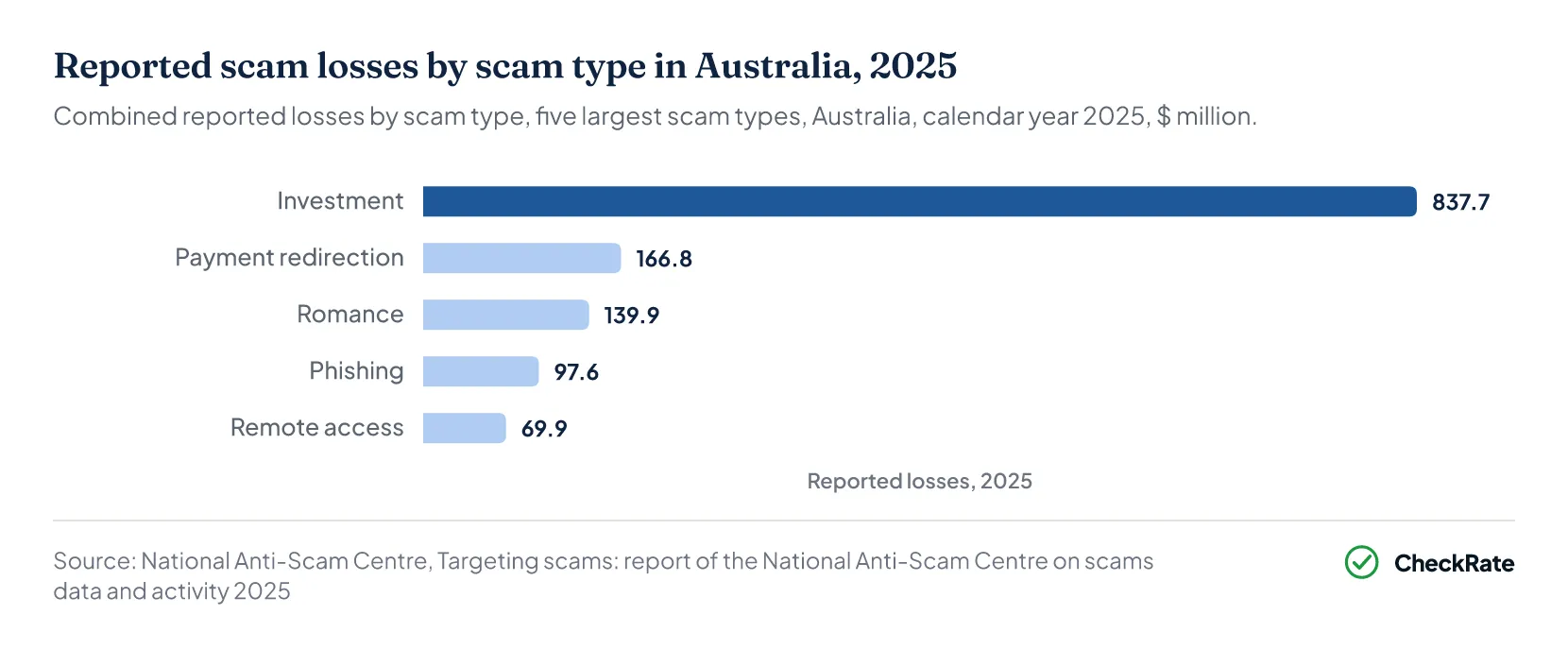
Investment scams accounted for the largest reported losses of any scam type in 2025, at $837.7 million, according to the National Anti-Scam Centre (NASC)1. This was 11.4% lower than the $945.0 million reported in 2024.
Payment redirection scams were second, at $166.8 million, followed by romance scams at $139.9 million, phishing at $97.6 million and remote access scams at $69.9 million1. These five scam types accounted for 60% of combined reported losses in 2025, compared with 71% in 2024.
Between 2024 and 2025, losses from phishing increased 15.5% and payment redirection scam losses increased 9.3%. Meanwhile, losses from remote access scams fell 34.1% and romance scam losses declined 10.8%1.
Among reports to Scamwatch alone, investment scams also accounted for the largest losses, at $172.2 million in 20251. Job and employment scam losses reported to Scamwatch increased from $13.7 million in 2024 to $24.8 million in 2025.
Buying or selling scams had the highest victimisation rate of any scam type in 2024-25, at 1.4% of people aged 15 and over, according to the Australian Bureau of Statistics (ABS)2.
The investment scam article covers investment scam losses in Australia in more detail.
| Reported scam losses by scam type, Australia, 2024 and 2025 | |||
|---|---|---|---|
| Scam type | 2024 ($ million) | 2025 ($ million) | Change (%) |
| Investment | 945.0 | 837.7 | -11.4 |
| Payment redirection | 152.6 | 166.8 | 9.3 |
| Romance | 156.8 | 139.9 | -10.8 |
| Phishing | 84.5 | 97.6 | 15.5 |
| Remote access | 106.0 | 69.9 | -34.1 |
| All other scam types | 582.3 | 872.1 | 49.8 |
Source · National Anti-Scam Centre, Targeting scams report 2025, Table 3.
Section 04 · Contact method
Which contact methods account for the largest scam losses in Australia?
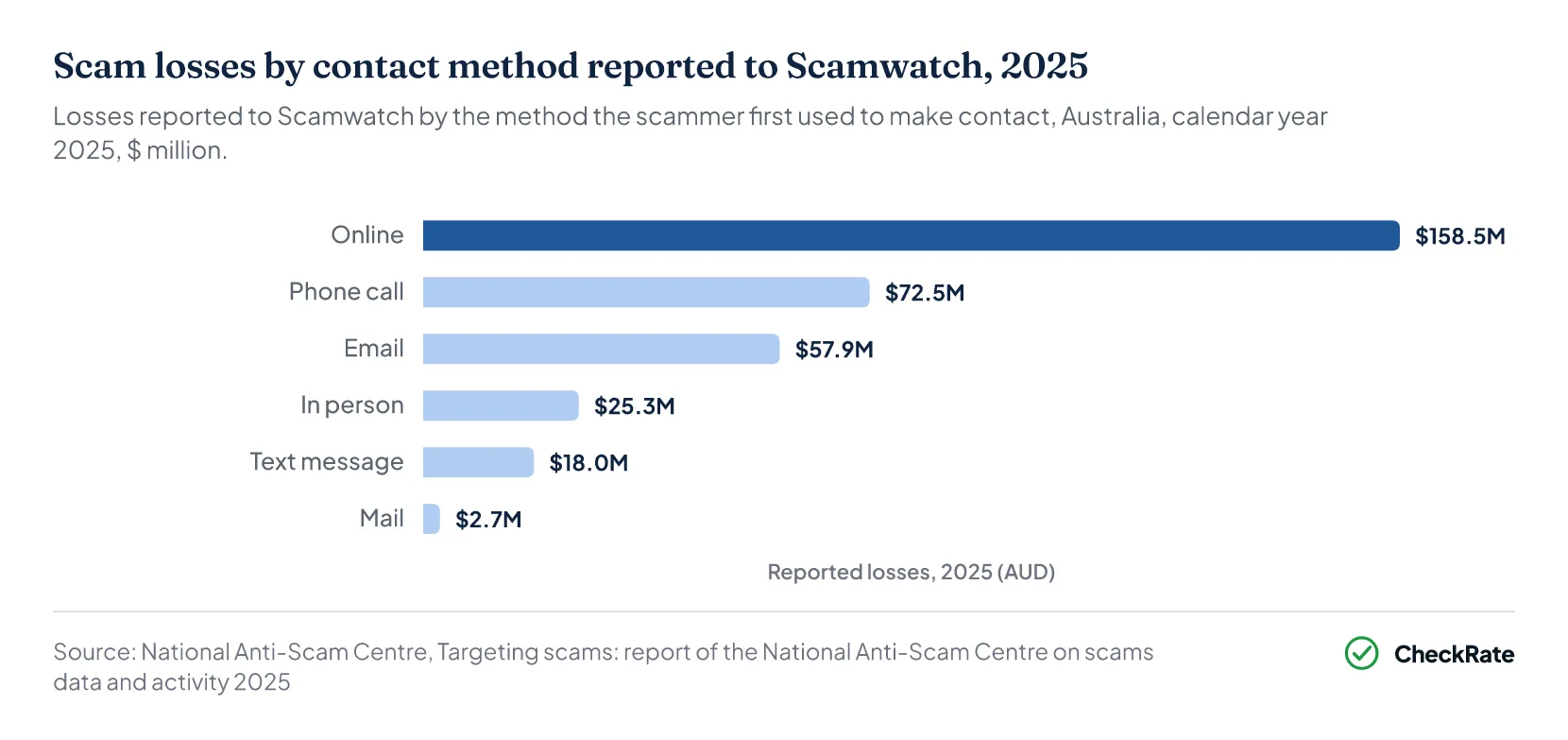
Scams that began online recorded the largest losses reported to Scamwatch in 2025, at $158.5 million, according to the National Anti-Scam Centre (NASC)1. Losses from online contact rose 21.8%, from $130.1 million in 2024 to $158.5 million in 2025.
Losses from phone scams fell from $107.2 million in 2024 to $72.5 million in 2025, with a median loss of $3,8001. Email scams accounted for $57.9 million in losses reported to Scamwatch in 2025.
Email was the most common contact method reported to Scamwatch in 2025, at 84,861 reports. Of these, 4,329 involved a financial loss, or about 5% of reports1.
Text message reports to Scamwatch fell from 77,365 in 2024 to 29,058 in 2025, while losses from text message scams rose from $14.0 million in 2024 to $18.0 million in 20251.
| Scamwatch reports with a loss and reported losses by contact method, Australia, 2025 | ||
|---|---|---|
| Contact method | Reports with a loss | Reported losses ($) |
| Online | 19,169 | 158,504,957 |
| Phone call | 2,012 | 72,477,723 |
| 4,329 | 57,877,574 | |
| In person | 870 | 25,255,402 |
| Text message | 1,603 | 17,977,491 |
| 218 | 2,738,406 | |
Source · National Anti-Scam Centre, Targeting scams report 2025, Appendix 1, Figures 5 and 6.
Section 05 · By age
Which age groups report the largest scam losses in Australia?
People aged 65 and over reported the largest scam losses to Scamwatch in 2025, at $88.8 million, according to the National Anti-Scam Centre (NASC)1. Their losses accounted for 26.5% of all losses reported to Scamwatch, although this age group represented 17.2% of Australia's population.
Losses reported by people aged 65 and over fell from $99.6 million in 2024 to $88.8 million in 20251. This age group also recorded the most Scamwatch reports, at 44,411, and had the highest median loss, at $716. However, people aged 35 to 44 made the most reports involving a financial loss, at 5,037, with losses of $43.7 million.
Investment scams accounted for the largest losses reported to Scamwatch in every age group aged 25 and over, including $50.8 million among people aged 65 and over1. Threat-based scams accounted for the largest losses among people aged 18 to 24, at $8.2 million.
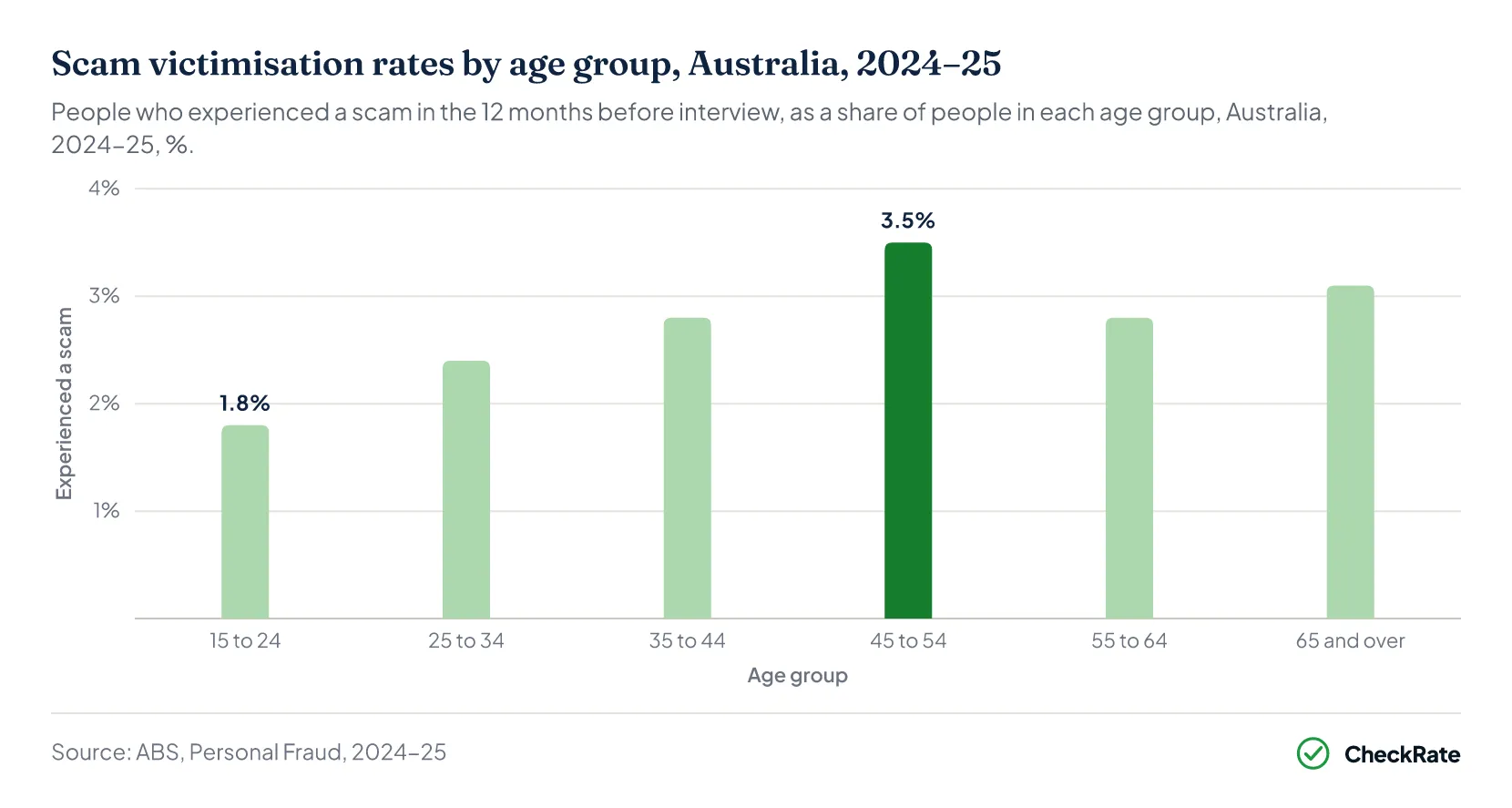
According to the Australian Bureau of Statistics (ABS), people aged 45 to 54 were the most likely to experience a scam in 2024-25, at 3.5%, while those aged 15 to 24 were the least likely, at 1.8%2.
| Scam type with the largest losses reported to Scamwatch, by age group, Australia, 2025 | ||
|---|---|---|
| Age group | Scam type with the largest losses | Reported losses |
| Under 18 | Shopping | $926,636 |
| 18 to 24 | Threat-based | $8.2 million |
| 25 to 34 | Investment | $10.8 million |
| 35 to 44 | Investment | $17.9 million |
| 45 to 54 | Investment | $33.2 million |
| 55 to 64 | Investment | $39.2 million |
| 65 and over | Investment | $50.8 million |
Source · National Anti-Scam Centre, Targeting scams report 2025, Appendix 1, Table 6.
Section 06 · By state
Which Australian states have the highest scam rates?
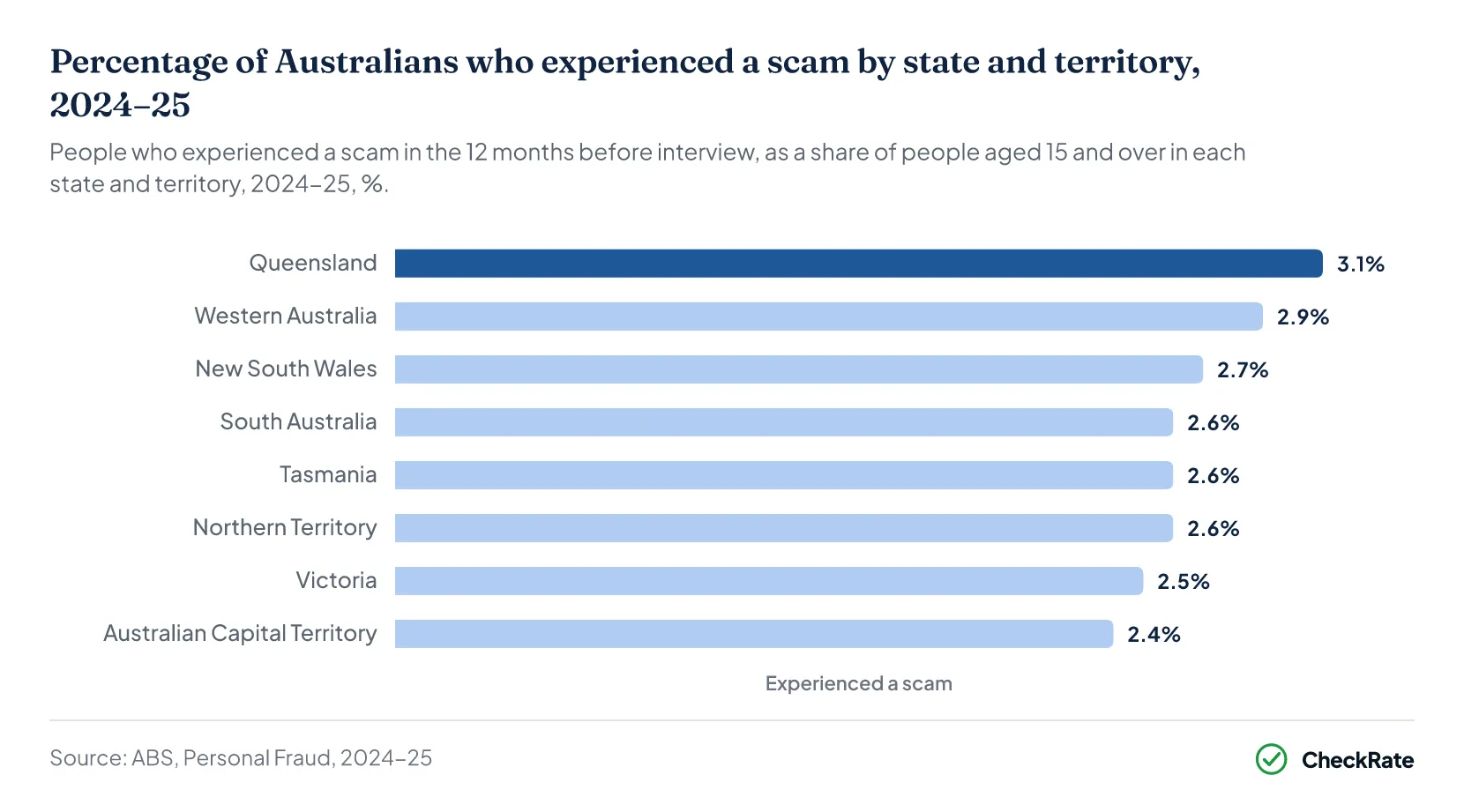
Queensland recorded the highest rate of people who fell victim to scams of any state or territory in 2024-25, at 3.1% of people aged 15 and over. The Australian Capital Territory (ACT) had the lowest rate, at 2.4%, according to the Australian Bureau of Statistics (ABS)2.
New South Wales had the largest number of people who experienced a scam of any state or territory in 2024-25, at 183,300, followed by Victoria at 144,000 and Queensland at 137,9002.
However, the differences between states and territories may not be statistically significant. At the 95% confidence level, Queensland's estimated rate of 3.1% has a margin of error of about 0.7 percentage points, while the ACT's rate of 2.4% has a margin of error of about 1.1 percentage points2.
In 2024-25, the share of people who reported their most serious scam to an authority ranged from 64.3% in the Northern Territory to 89.2% in the Australian Capital Territory2.
| People who experienced a scam by state and territory, Australia, 2024-25 | |||
|---|---|---|---|
| State or territory | People who experienced a scam | Victimisation rate (%) | Reported to an authority (%) |
| New South Wales | 183,300 | 2.7 | 68.1 |
| Victoria | 144,000 | 2.5 | 69.7 |
| Queensland | 137,900 | 3.1 | 70.7 |
| South Australia | 39,100 | 2.6 | 68.5 |
| Western Australia | 68,400 | 2.9 | 79.8 |
| Tasmania | 12,000 | 2.6 | 70.0 |
| Northern Territory | 4,200 | 2.6 | 64.3 |
| Australian Capital Territory | 9,300 | 2.4 | 89.2 |
| Australia | 596,600 | 2.7 | 71.1 |
Source · ABS, Personal Fraud, 2024-25, Table 3a.
Section 07 · Reimbursement
How much money do Australian banks reimburse for scams?
The four major Australian banks reimbursed or compensated customers for between 2% and 5% of their scam losses in 2021-22, according to the Australian Securities and Investments Commission (ASIC)4. Customers of the four major banks lost more than $558 million to scams during that period, and the banks paid about $21 million in reimbursements or compensation5.
Among 15 banks outside the four majors, 4% of scam losses were reimbursed or compensated in 2022-23, compared with 7% at the four major banks6. This means customers of the 15 banks received no reimbursement or compensation for 96% of their scam losses during that period.
The National Anti-Scam Centre (NASC) does not publish how much of the $2.18 billion in scam losses reported in 2025 was recovered. Bank-reported losses are also not adjusted for recoveries1.
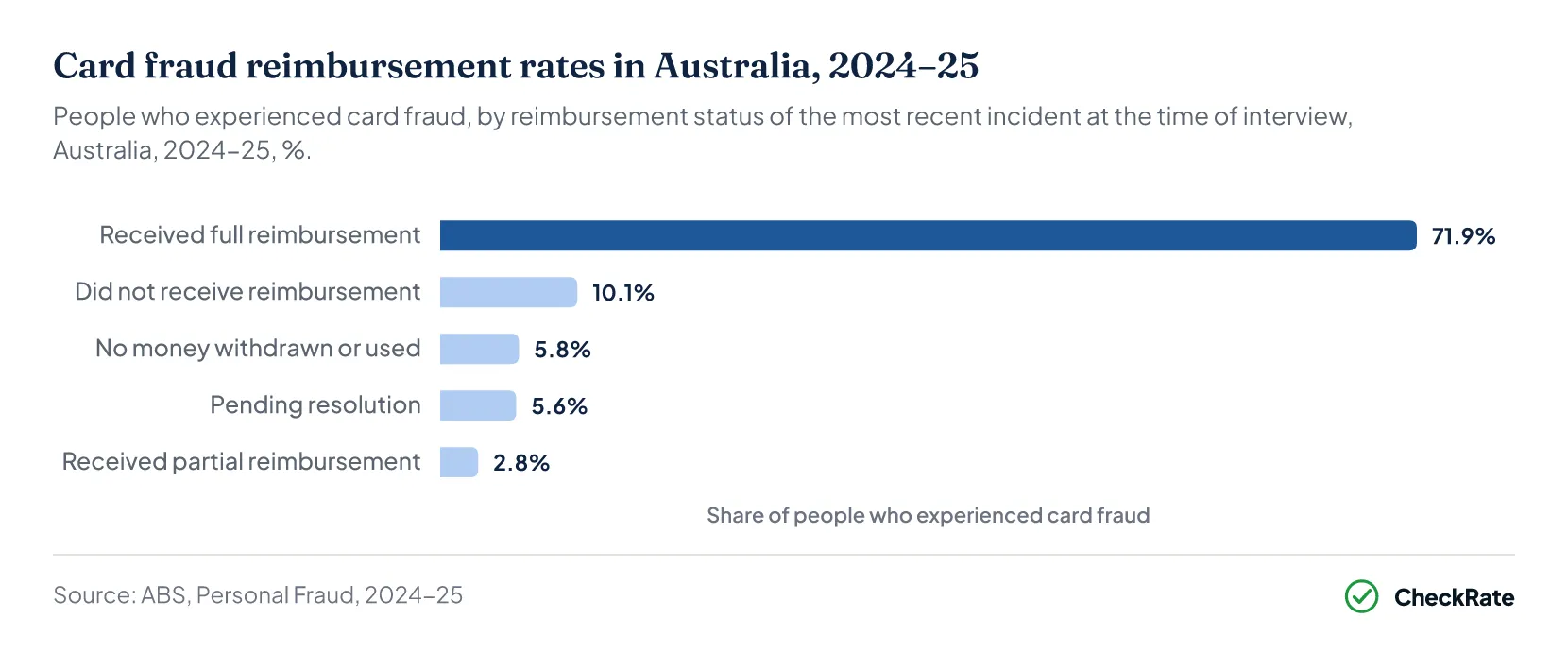
Card fraud figures show a different picture. According to the ABS, 75% of people who experienced card fraud in 2024-25 received a reimbursement from their card issuer, including 72% who were reimbursed in full2. In each person's most recent card fraud incident, a total of $2.2 billion was withdrawn or used, but the loss after reimbursements was $350 million.
The ABS card fraud figures count people and incidents, while the ASIC figures measure shares of scam losses. The two are not directly comparable.
Under the Scams Prevention Framework, most obligations for regulated banks, telecommunications providers and digital platforms will apply from 31 March 20277. From that date, the Australian Financial Complaints Authority (AFCA) will handle eligible scam complaints that remain unresolved after a business's internal complaints process.
The card fraud article covers card fraud in Australia, including how much is lost and reimbursed.
Section 08 · Since 2020
How have scam losses in Australia changed since 2020?
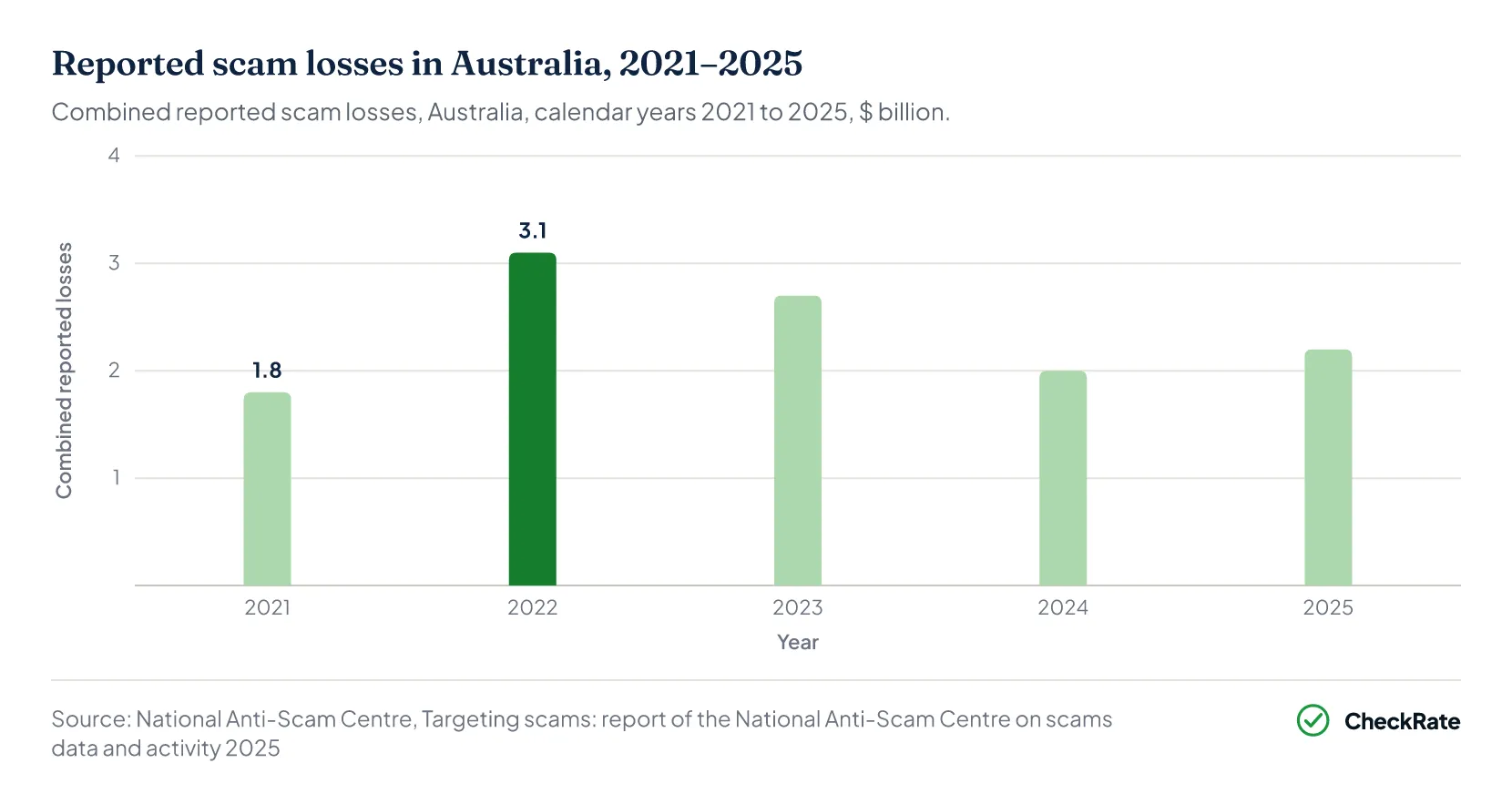
Reported scam losses in Australia peaked at $3.1 billion in 2022. By 2025, they had fallen to $2.18 billion, 29.7% below that peak, according to the National Anti-Scam Centre (NASC)8.
Reported losses rose from $1.8 billion in 2021 to $3.1 billion in 2022, before falling to $2.7 billion in 2023 and $2.0 billion in 2024. They then rose again to $2.2 billion in 20251.
According to the Australian Competition and Consumer Commission (ACCC), combined reported scam losses were $851 million in 20209. However, that figure was based on a different set of reporting bodies, including 10 financial institutions, so it is not directly comparable with the later totals.
The share of people aged 15 and over who experienced a scam fell from 3.6% in 2020-21 to 2.5% in 2022-23. It then rose to 3.1% in 2023-24 before falling again to 2.7% in 2024-252.
The ABS changed the wording of its scam question in 2022-23, so comparisons with earlier years should be treated with caution2.
The scam losses over time article covers how scam and fraud losses have changed over a decade.
Section 09 · Common questions
Scam losses in Australia: quick answers
How much money is lost to scams in Australia each year?
Combined reported scam losses in Australia were $2.18 billion in 2025, up 7.8% from $2.03 billion in 2024, according to the National Anti-Scam Centre. Actual losses may be higher because not every scam is reported. The figures are also not adjusted for money recovered later.
Which scam type causes the largest losses in Australia?
Investment scams recorded the largest reported losses of any scam type in 2025, at $837.7 million, according to the National Anti-Scam Centre. Payment redirection scams were second, at $166.8 million.
Can Scamwatch, ReportCyber and bank scam figures be added together?
No, because the same scam can be reported to more than one body, and the five reporting bodies' separate 2025 loss totals add up to $2.62 billion. The National Anti-Scam Centre deducted $438.1 million of duplicated losses to reach its combined figure of $2.18 billion.
How many people experience a scam in Australia each year?
An estimated 596,600 people aged 15 and over, or 2.7%, experienced a scam in 2024-25, according to the Australian Bureau of Statistics (ABS). The ABS includes people who responded to a scam, such as by providing money or personal information or clicking a link.
Which age group loses the most money to scams in Australia?
People aged 65 and over reported the largest losses to Scamwatch of any age group in 2025, at $88.8 million, or 26.5% of losses reported to Scamwatch. However, people aged 35 to 44 made the most Scamwatch reports with a financial loss of any age group, at 5,037.
Do banks reimburse scam losses in Australia?
Banks reimbursed or compensated only a small share of customers' scam losses in Australian Securities and Investments Commission (ASIC) reviews: between 2% and 5% at the four major banks in 2021-22 and 4% at 15 other banks in 2022-23. From 31 March 2027, the Australian Financial Complaints Authority will handle eligible scam complaints under the Scams Prevention Framework.
References
- National Anti-Scam Centre, Targeting scams: report of the National Anti-Scam Centre on scams data and activity 2025 · nasc.gov.au ↑ b c d e f g h i j k l m n o p q r s t u
- Australian Bureau of Statistics, Personal fraud, 2024-25 financial year · Australian Bureau of Statistics ↑ b c d e f g h i j
- Australian Bureau of Statistics, Personal fraud methodology, 2024-25 financial year · Australian Bureau of Statistics ↑
- ASIC, media release 23-101MR: ASIC calls for improved approaches to scams as major bank customers report over $550 million in scam losses · asic.gov.au ↑
- ASIC, Report 761: Scam prevention, detection and response by the four major banks · asic.gov.au ↑
- ASIC, Report 790: Anti-scam practices of banks outside the four major banks · asic.gov.au ↑
- ACCC, Scams Prevention Framework · accc.gov.au ↑
- National Anti-Scam Centre, media release: Continued action critical to combat fraud as annual scam losses exceed $2 billion · nasc.gov.au ↑
- ACCC, Targeting scams: report of the ACCC on scam activity 2020 · nasc.gov.au ↑