


Published
- Change in investment scam losses, 2024 to 2025
- $945.0m → $837.7m1
- Down 11.4%, combined reported losses
- Share of all scam losses
- 38.4%
- Of $2.18 billion in combined scam losses, 2025
 Scam losses in AustraliaCombined reported losses for every scam type, from investment and romance scams to phishing and payment redirection.
 How scam and fraud losses have changed over a decadeReported scam and fraud losses in Australia year by year, with the changes in who collects the reports.
 Average savings in Australia by ageSuperannuation and bank balances by age group, from the official household and super statistics.
Section 01 · The total
How much is lost to investment scams in Australia each year?
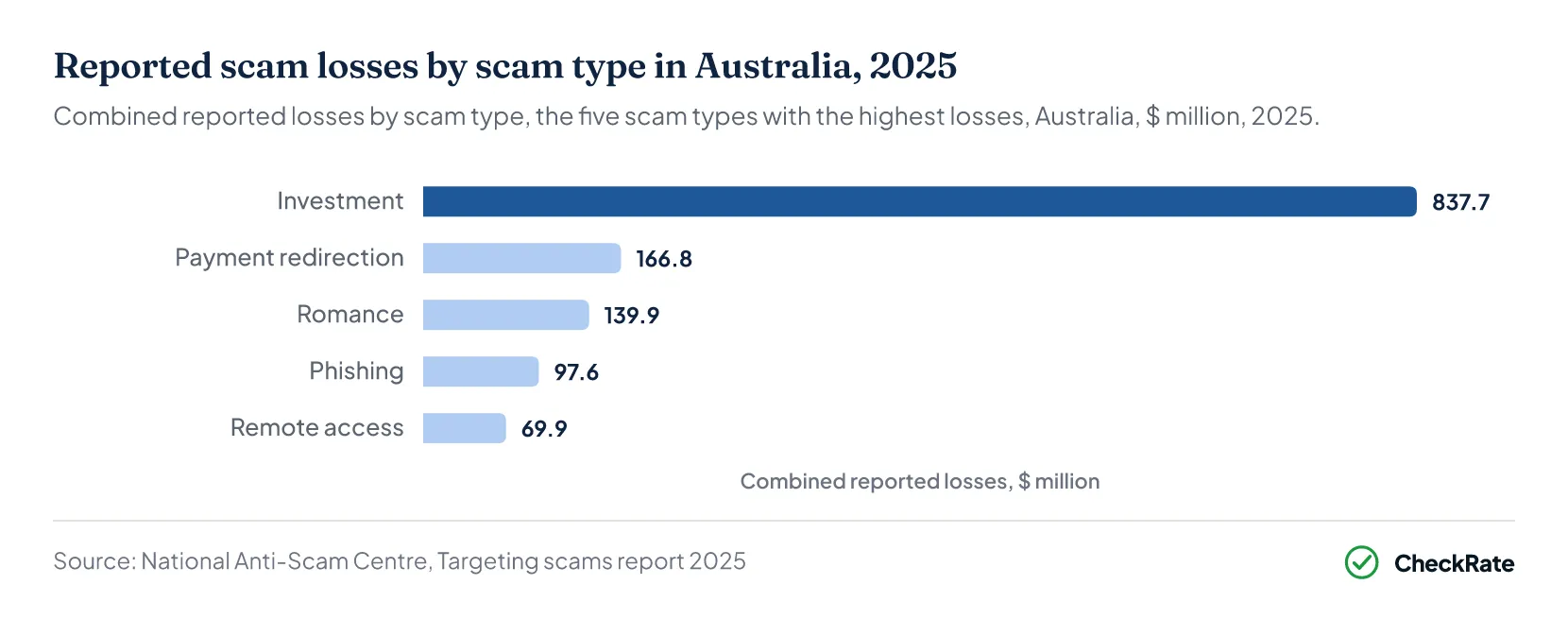
Investment scams recorded the highest reported loss of any scam type in Australia in 2025, at $837.7 million, according to the National Anti-Scam Centre1.
Investment scam losses fell 11.4%, from $945.0 million in 2024 to $837.7 million in 20251. Across all scam types, combined reported losses increased 7.8% to $2.18 billion in 2025, with 481,523 reports.
Investment scams accounted for 38.4% of combined reported scam losses in 20251. Payment redirection scams recorded the second-highest combined losses at $166.8 million.
ReportCyber, the Australian Government’s online cybercrime reporting service, recorded the highest investment scam losses of the five reporting bodies, at $357.8 million in 2025 before adjustment for duplicate reports1. Investment scam losses reported to Scamwatch alone were $172.2 million in 2025.
Reported losses include only scams reported to the relevant authorities and organisations. According to the Australian Bureau of Statistics (ABS), 66.2% of people whose most serious scam in 2024-25 was a financial advice scam reported it to an authority2.
| Investment scam losses by reporting body, Australia, $ million, 2025 | |
|---|---|
| Reporting body | Investment scam losses ($ million) |
| Scamwatch | 172.2 |
| ReportCyber | 357.8 |
| Australian Financial Crimes Exchange (AFCX) | 190.9 |
| ASIC | 64.0 |
| IDCARE | 284.0 |
| Adjustment for duplicate reports | -231.1 |
| Combined total, 2025 | 837.7 |
| Combined total, 2024 | 945.0 |
Source · National Anti-Scam Centre, Targeting scams report 2025, Table 3
Scam losses in Australia covers the losses for every scam type.
Section 02 · Average loss
What is the average loss from an investment scam in Australia?
The National Anti-Scam Centre does not publish an average or a median loss per investment scam report with a loss for 2025, either in its combined data or for Scamwatch alone1. However, it does publish median losses for two groups of people who reported investment scams to Scamwatch.
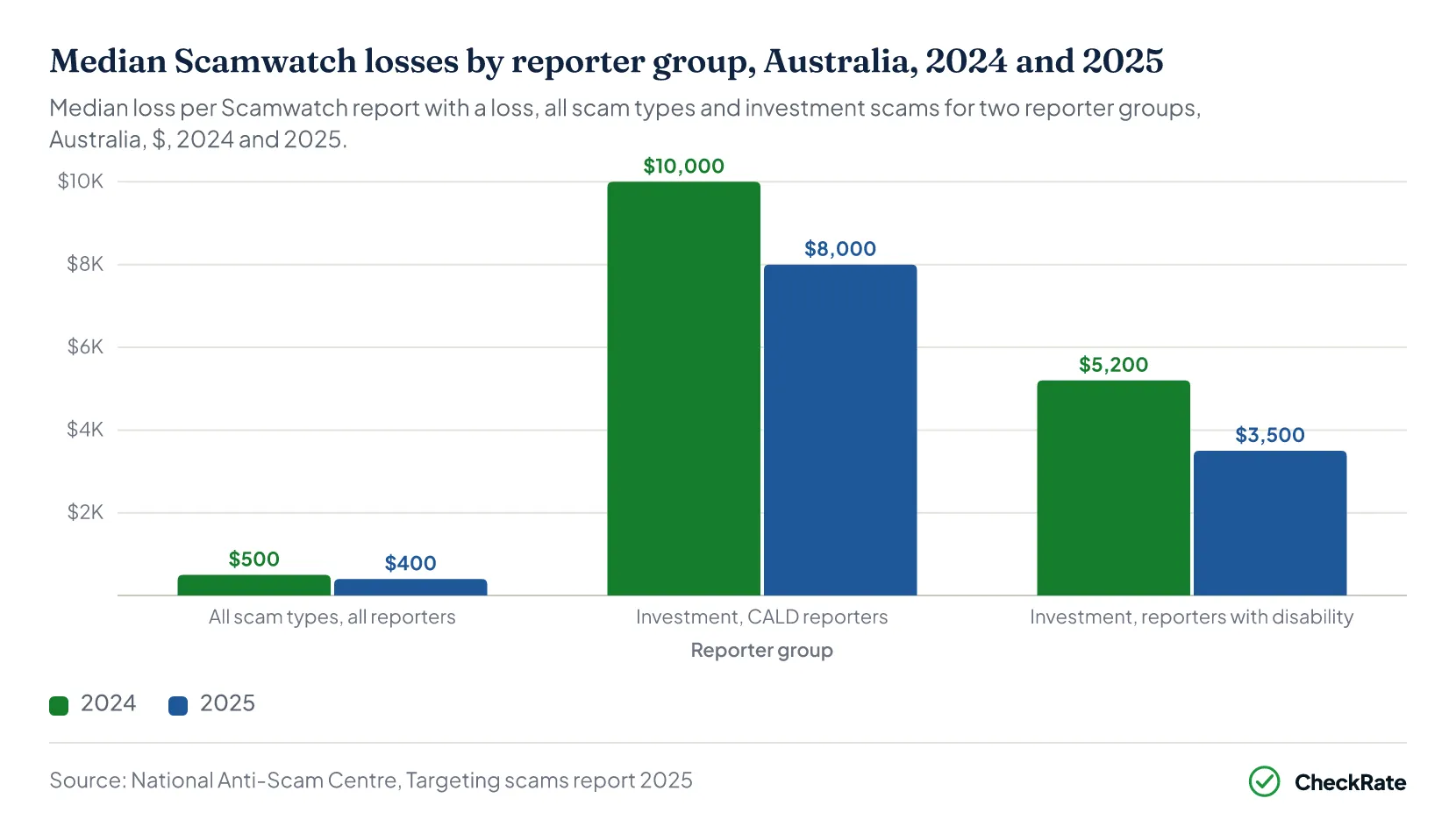
The median investment scam loss reported by people from culturally and linguistically diverse (CALD) communities fell from $10,000 in 2024 to $8,000 in 202513. The 2025 median covers 321 reports with a loss, totalling $15.8 million1.
The median investment scam loss reported by people with a disability fell from $5,200 in 2024 to $3,500 in 202513. The 2025 median covers 160 reports totalling $5.0 million1.
Across all scam types, the Scamwatch median loss per report with a loss fell from $500 in 2024 to $400 in 20251.
The median is the middle value when reported losses are ranked from lowest to highest. The mean, or average, is calculated by dividing total losses by the number of reports. A small number of very large losses can push the average well above the median.
For 2020, the Australian Competition and Consumer Commission (ACCC) published an average investment scam loss of $26,713 per Scamwatch report with a loss4. This covered 2,464 reports and $65.8 million in losses.
| Median loss per Scamwatch report with a loss, Australia, 2024 and 2025 | |||
|---|---|---|---|
| Reporter group and scam type | Reports with a loss, 2025 | Median, 2024 ($) | Median, 2025 ($) |
| All reporters, all scam types | 28,202 | 500 | 400 |
| CALD reporters, investment scams | 321 | 10,000 | 8,000 |
| Reporters with disability, investment scams | 160 | 5,200 | 3,500 |
Source · National Anti-Scam Centre, Targeting scams reports 2024 and 2025, Tables 2, 4 and 5
Section 03 · Cryptocurrency
How much is lost to cryptocurrency investment scams in Australia?
Cryptocurrency recorded the highest reported losses of any payment method used in scams reported to Scamwatch in 2025, at $121.3 million across all scam types1. The National Anti-Scam Centre does not publish how much of the $837.7 million in investment scam losses reported in 2025 was paid in cryptocurrency.
Cryptocurrency payments accounted for 36.2% of all losses reported to Scamwatch in 2025, across 3,993 transactions1. Bank transfers recorded the second-highest reported losses, at $118.1 million across 8,858 reports in 2025.
The Australian Securities and Investments Commission (ASIC) removed 3,106 cryptocurrency investment scams in 2025-26, almost 30% more than in 2024-255.
According to the Australian Transaction Reports and Analysis Centre (AUSTRAC), the number of cryptocurrency ATMs in Australia increased from about 20 in 2019 to more than 2,000 in 20261. These ATMs were estimated to process about $275 million in transactions each year.
An estimated 85% of the most frequent cryptocurrency ATM users had been coerced into making the transactions by scammers or were involved in money mule activity1.
AUSTRAC introduced conditions for all cryptocurrency ATM operators, including a $5,000 limit on cash deposits and withdrawals1.
Section 04 · Contact methods
How do investment scams reach victims in Australia?
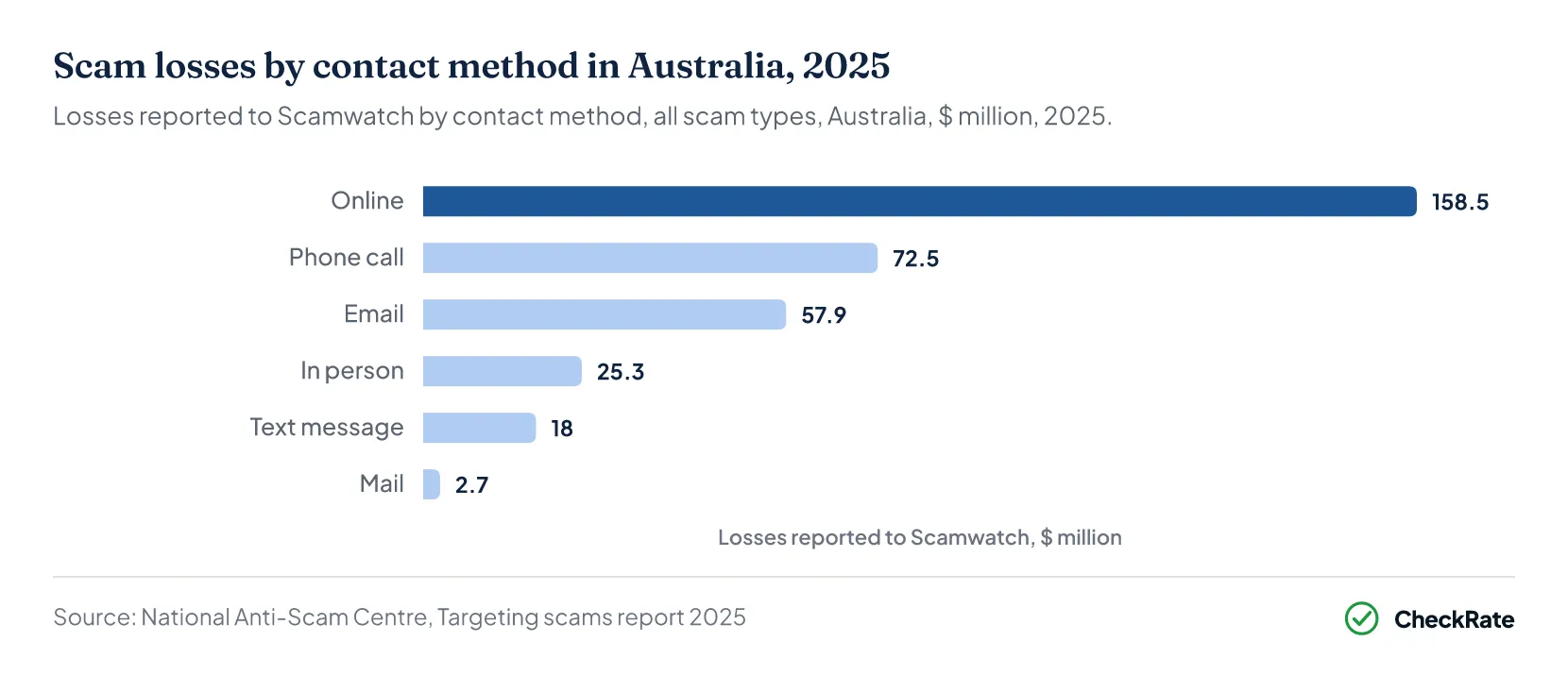
Online contact, including websites, mobile apps and social media, accounted for the highest scam losses of any contact method reported to Scamwatch in 2025, at $158.5 million across all scam types1.
Phone calls recorded the second-highest reported losses at $72.5 million1. The median loss per report with a loss was $3,800 for phone calls in 2025, compared with $400 for online contact.
The number of phishing and investment scam websites ASIC removed rose from 6,270 in 2024 to 11,964 in 2025, an average of 230 a week during 20256.
In 2025-26, ASIC removed more than 19,400 scam websites, social media advertisements and phishing scams5. Fake investment platforms accounted for the largest number of takedowns, at 7,051.
| ASIC scam takedowns by type, Australia, 2025-26 | |
|---|---|
| Takedown type | Number removed, 2025-26 |
| Fake investment platforms | 7,051 |
| Phishing scam links | 5,476 |
| Cryptocurrency investment scams | 3,106 |
| All takedowns, including other types | More than 19,400 |
Source · ASIC, media release 26-195MR, 17 August 2026
Section 05 · Age groups
Which age groups lose the most to investment scams in Australia?
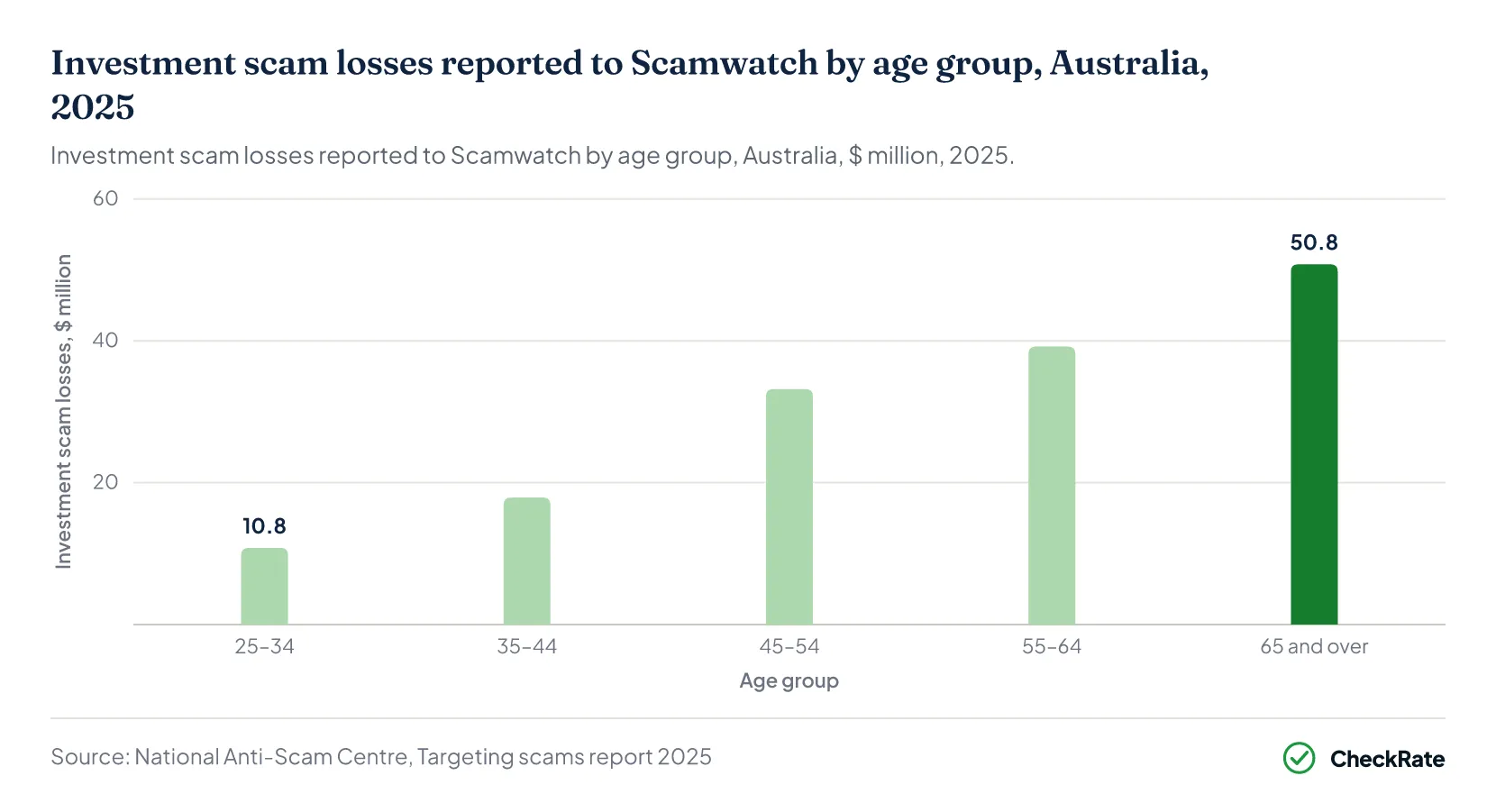
People aged 65 and over reported the highest investment scam losses to Scamwatch of any age group in 2025, at $50.8 million1. Investment scams recorded the highest loss of any scam type across all age groups from 25 to 34 through to 65 and over in 2025.
Investment scam losses reported by people aged 65 and over fell 23.8%, from $66.6 million in 20243 to $50.8 million in 20251. This followed a 20.4% fall from 2023 to 20243.
People aged 55 to 64 reported $39.2 million in investment scam losses in 2025, 4.2% less than in 20241. People aged 45 to 54 reported $33.2 million in investment scam losses that year.
Among people aged 18 to 24, threat-based scams recorded the highest loss of any scam type in 2025, at $8.2 million, and investment scams were not among the two scam types with the highest reported losses for this age group1.
| Investment scam losses reported to Scamwatch by age group, Australia, 2025 | ||
|---|---|---|
| Age group | Investment scam losses | Scam type with the highest loss |
| Under 18 | $56,469 | Shopping |
| 18–24 | Not published | Threat-based |
| 25–34 | $10.8 million | Investment |
| 35–44 | $17.9 million | Investment |
| 45–54 | $33.2 million | Investment |
| 55–64 | $39.2 million | Investment |
| 65 and over | $50.8 million | Investment |
| Age not given | $18.5 million | Investment |
Source · National Anti-Scam Centre, Targeting scams report 2025, Table 6
Average savings in Australia by age covers super and bank balances for each age group.
Section 06 · Recovery
Can money lost to investment scams be recovered in Australia?
The National Anti-Scam Centre does not publish how much of the $837.7 million in investment scam losses reported in 2025 was recovered1. Bank-reported losses in its data are not adjusted for money recoveries.
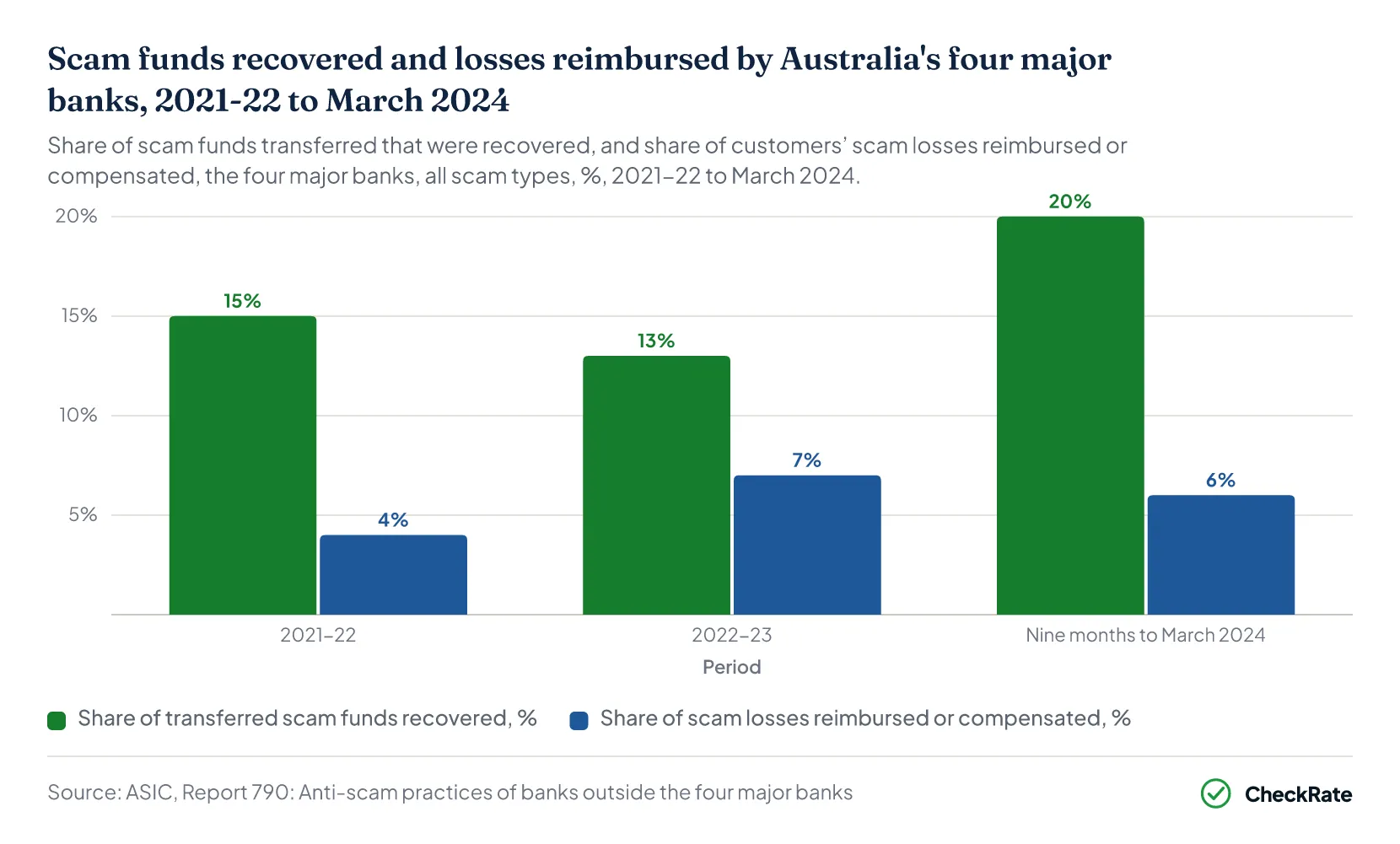
ASIC found that the four major banks recovered 20% of the scam funds their customers transferred to other banks or financial institutions in the nine months to 31 March 20247. This compares with 15% in 2021-22 and 13% in 2022-23.
The four major banks reimbursed or compensated customers for 4% of their scam losses in 2021-22, 7% in 2022-23 and 6% in the nine months to 31 March 20247. One bank accounted for the entire increase from 4% to 7% between 2021-22 and 2022-23.
Among the 11 banks outside the four major banks whose data ASIC analysed, 4% of customers’ scam losses were reimbursed or compensated in 2022-237. These banks also recovered 20% of the funds their customers transferred to other banks or financial institutions in 2022-23.
The National Anti-Scam Centre referred 8,536 Scamwatch reporters to IDCARE, a not-for-profit service providing support to people affected by scams and identity theft, for scam recovery support in 20251.
| Scam outcomes for customers of the four major banks, all scam types, 2021-22 to March 2024 | |||
|---|---|---|---|
| Measure | 2021-22 | 2022-23 | Nine months to 31 March 2024 |
| Scam transactions made by customers | $845 million | $1.38 billion | $941 million |
| Share detected and stopped by value | 13% | 23% | 24% |
| Share of transferred funds recovered | 15% | 13% | 20% |
| Share of losses reimbursed or compensated | 4% | 7% | 6% |
Source · ASIC, Report 790, Table 1
Section 07 · Over time
How have investment scam losses in Australia changed since 2020?
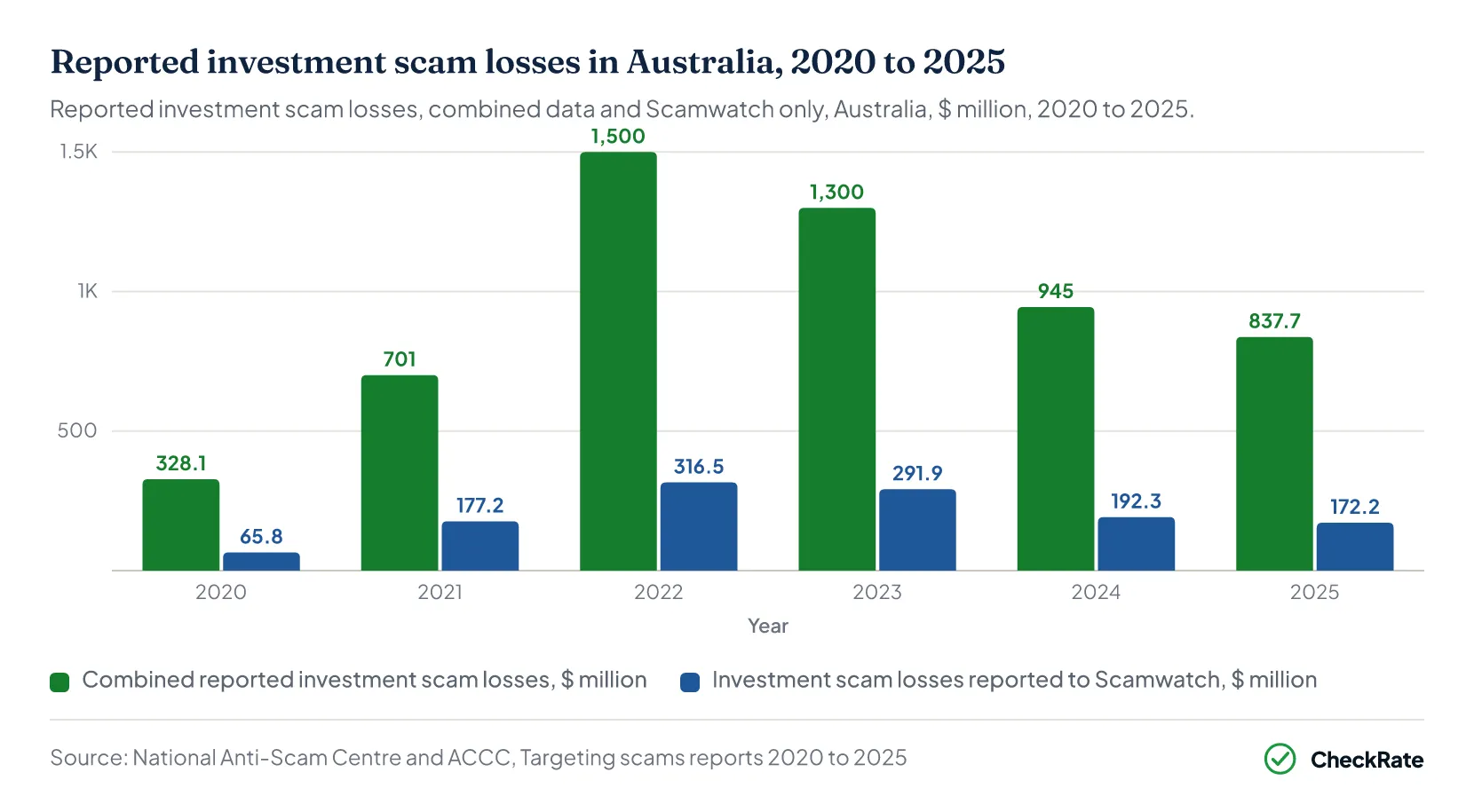
Combined reported investment scam losses in Australia reached $1.5 billion in 2022, the highest level recorded from 2020 to 20258. Losses then fell to $837.7 million in 20251.
Combined losses increased from $328.1 million in 2020 to $701 million in 202194. They reached $1.3 billion in 2023 before falling to $945.0 million in 2024310.
The reporting bodies included in the combined figure changed over the period. ASIC data was first included in 20204. From 2022, bank data came from the AFCX, and IDCARE data was added8.
Investment scam losses reported to Scamwatch alone were $65.8 million in 20204, $316.5 million in 2022 and $172.2 million in 2025110.
The ABS estimated that 69,100 people aged 15 and over experienced a financial advice scam in 2024-25, accounting for 0.3% of people in that age group2. The ABS defines a financial advice scam as a false offer of an investment or other financial advice promising a guaranteed high return11.
An estimated 82,800 people experienced a financial advice scam in 2023-242. However, the difference is within the survey’s margin of error, so it is not clear that fewer people experienced this type of scam.
| Reported investment scam losses, Australia, $ million, 2020 to 2025 | ||
|---|---|---|
| Year | Combined data ($ million) | Scamwatch only ($ million) |
| 2020 | 328.1 | 65.8 |
| 2021 | 701 | 177.2 |
| 2022 | 1,500 | 316.5 |
| 2023 | 1,300 | 291.9 |
| 2024 | 945.0 | 192.3 |
| 2025 | 837.7 | 172.2 |
Source · National Anti-Scam Centre and ACCC, Targeting scams reports 2020 to 2025
| People aged 15 and over who experienced a financial advice scam, Australia, 2020-21 to 2024-25 | |||
|---|---|---|---|
| Year | People (thousands) | Share aged 15 and over (%) | Relative standard error (%) |
| 2020-21 | 78.0 | 0.4 | 11.2 |
| 2021-22 | 83.2 | 0.4 | 13.1 |
| 2022-23 | 64.6 | 0.3 | 13.1 |
| 2023-24 | 82.8 | 0.4 | 10.5 |
| 2024-25 | 69.1 | 0.3 | 12.6 |
Source · ABS, Personal Fraud, 2024-25, Tables 8a and 8b
How scam and fraud losses in Australia have changed over a decade covers the totals for every scam type.
Section 08 · Common questions
Investment scam losses: quick answers
How much money was lost to investment scams in Australia in 2025?
Reported losses to investment scams in Australia were $837.7 million in 2025, according to the National Anti-Scam Centre’s combined data. This was 11.4% less than the $945.0 million reported in 2024.
What is the median loss from an investment scam in Australia?
The National Anti-Scam Centre does not publish an overall median investment scam loss for 2025. For Scamwatch reports with a loss in 2025, it reported a median investment scam loss of $8,000 for people from culturally and linguistically diverse communities and $3,500 for people with disability.
Can money lost to an investment scam be recovered?
Some money lost to scams is recovered, but the National Anti-Scam Centre does not publish how much of the investment scam losses reported in 2025 was recovered. For all scam types, ASIC found that the four major banks recovered 20% of the scam funds their customers transferred in the nine months to 31 March 2024.
Which age group loses the most to investment scams in Australia?
People aged 65 and over reported the highest investment scam losses to Scamwatch of any age group in 2025, at $50.8 million. Their reported losses fell 23.8% from $66.6 million in 2024.
How many people experience investment scams in Australia?
The Australian Bureau of Statistics (ABS) estimated that 69,100 people aged 15 and over experienced a financial advice scam in 2024-25, accounting for 0.3% of that age group. A financial advice scam is a false offer of an investment or other financial advice promising a guaranteed high return.
References
- National Anti-Scam Centre, Targeting scams: report of the National Anti-Scam Centre on scams data and activity 2025 · nasc.gov.au ↑ b c d e f g h i j k l m n o p q r s t u v w x y z a2 b2
- Australian Bureau of Statistics, Personal fraud, 2024-25 financial year · Australian Bureau of Statistics ↑ b c
- National Anti-Scam Centre, Targeting scams: report of the National Anti-Scam Centre on scams data and activity 2024 · nasc.gov.au ↑ b c d e
- ACCC, Targeting scams: report of the ACCC on scam activity 2020 · nasc.gov.au ↑ b c d
- ASIC, media release 26-195MR, ASIC warns scammers are using AI to spin vast webs of deception · asic.gov.au ↑ b
- ASIC, media release 26-063MR, ASIC ramps up action to protect consumers from AI-powered online investment scams · asic.gov.au ↑
- ASIC, Report 790: Anti-scam practices of banks outside the four major banks · asic.gov.au ↑ b c
- ACCC, Targeting scams: report of the ACCC on scams activity 2022 · nasc.gov.au ↑ b
- ACCC, Targeting scams: report of the ACCC on scams activity 2021 · nasc.gov.au ↑
- National Anti-Scam Centre, Targeting scams: report on scams activity 2023 · nasc.gov.au ↑ b
- Australian Bureau of Statistics, Personal fraud methodology, 2024-25 financial year · Australian Bureau of Statistics ↑