

Published
 Scam losses in AustraliaReported scam losses were $2.18 billion in 2025. The scam losses article covers the latest year's losses in more detail, including the scam types with the highest reported losses.
 Investment scam lossesInvestment scams have had the highest reported losses in every year from 2020 to 2025. The investment scam article covers how much is lost and to which schemes.
 Card fraud in AustraliaThe ABS card fraud victimisation rate rose from 5.9% in 2014-15 to 10.4% in 2024-25. The card fraud article covers how many people are affected and how much is lost.
Section 01 · Losses by year
How have reported scam losses in Australia changed since 2014?
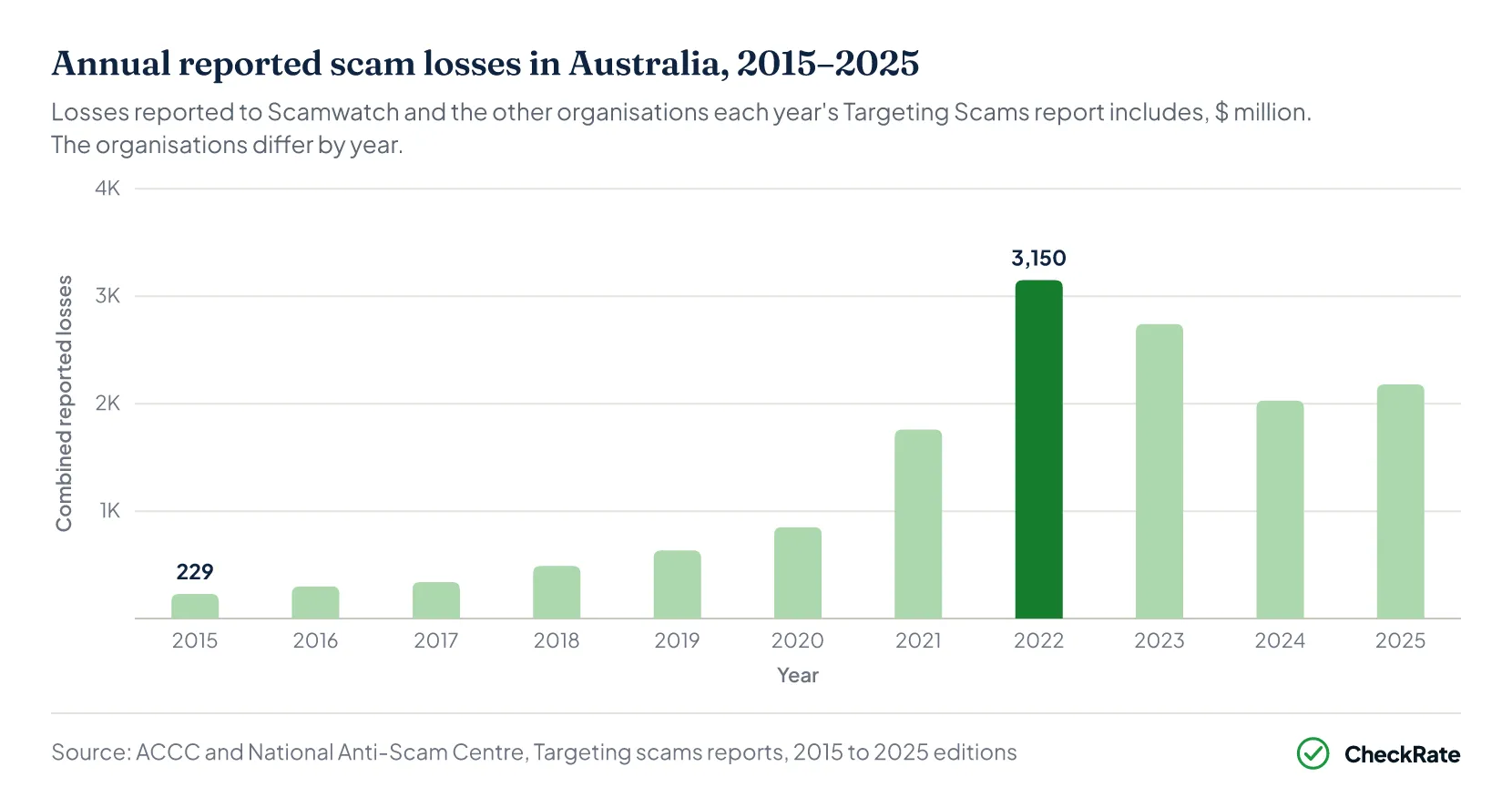
Reported scam losses in Australia rose from $2.03 billion in 2024 to $2.18 billion in 2025, according to the National Anti-Scam Centre's Targeting Scams 2025 report1. The 2025 total includes losses reported to Scamwatch, ReportCyber, the Australian Financial Crimes Exchange (AFCX), IDCARE and the Australian Securities and Investments Commission (ASIC), with duplicate reports removed.
The highest total was recorded in 2022, at $3.15 billion4. Reported scam losses then fell to $2.74 billion in 20235.
The organisations contributing to these totals changed over time. The 2015 total of $229 million included Scamwatch, the Australian Cybercrime Online Reporting Network (ACORN) and scam-disruption programs6. The 2018 total of $489.7 million included Scamwatch, ACORN and other government agencies, with ACORN losses for the second half of the year estimated using figures from the first six months7.
The 2019 total of $634 million included losses reported to the big four banks for the first time8. The 2022 total added IDCARE and the AFCX and was not adjusted to remove duplicate reports4.
The ACCC estimated scam losses at more than $2 billion in 2021, including an allowance for unreported losses9. Reported losses alone totalled $1.76 billion. The ACCC and the National Anti-Scam Centre later rounded the 2021 total to $1.8 billion1.
Losses reported to Scamwatch alone rose from $81.8 million in 2014 to $569.5 million in 202224. They then fell to $318.8 million in 2024 before rising to $334.8 million in 20251.
| Reported scam losses and the organisations included, Australia, 2014 to 2025 | |||
|---|---|---|---|
| Year | Reported losses ($ million) | Organisations included | Scamwatch ($ million) |
| 2014 | Not published | ACCC (Scamwatch) only | 81.82 |
| 2015 | 2296 | Scamwatch, ACORN and scam-disruption programs | 84.96 |
| 2016 | 30010 | Scamwatch, ACORN and scam-disruption programs | 83.610 |
| 2017 | 34011 | Scamwatch, ACORN and other government agencies | 90.911 |
| 2018 | 489.77 | Scamwatch, ACORN and other government agencies | 107.07 |
| 2019 | 6348 | Scamwatch, ACORN, ReportCyber, other government agencies and the big four banks | 142.98 |
| 2020 | 851.412 | Scamwatch, ReportCyber, ASIC, other government agencies and 10 banks and money remitters | 175.712 |
| 2021 | 1,7609 | Scamwatch, ReportCyber, ASIC, other government agencies and 12 banks and money remitters | 323.79 |
| 2022 | 3,1504 | Scamwatch, ReportCyber, AFCX, IDCARE, ASIC and other government agencies | 569.54 |
| 2023 | 2,741.95 | Scamwatch, ReportCyber, AFCX, IDCARE and ASIC | 476.85 |
| 2024 | 2,03013 | Scamwatch, ReportCyber, AFCX, IDCARE and ASIC | 318.813 |
| 2025 | 2,1801 | Scamwatch, ReportCyber, AFCX, IDCARE and ASIC | 334.81 |
Source · ACCC and National Anti-Scam Centre, Targeting scams reports, 2014 to 2025 editions.
Section 02 · Scam types
Which scam types have caused the largest reported losses in Australia since 2014?
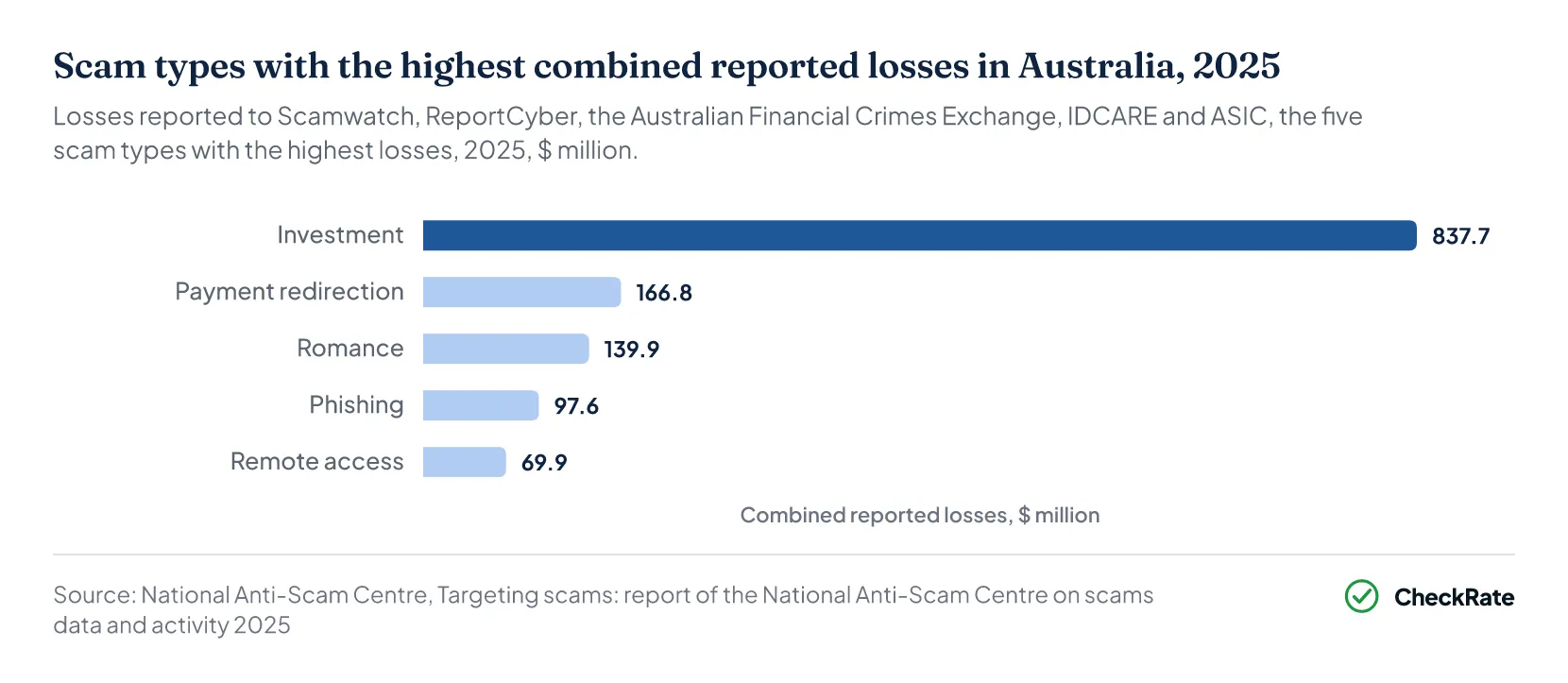
Investment scams had the highest reported losses in Australia in 2025, at $837.7 million, followed by payment redirection scams at $166.8 million and romance scams at $139.9 million1. The five scam types with the highest losses accounted for 60% of reported losses in 2025.
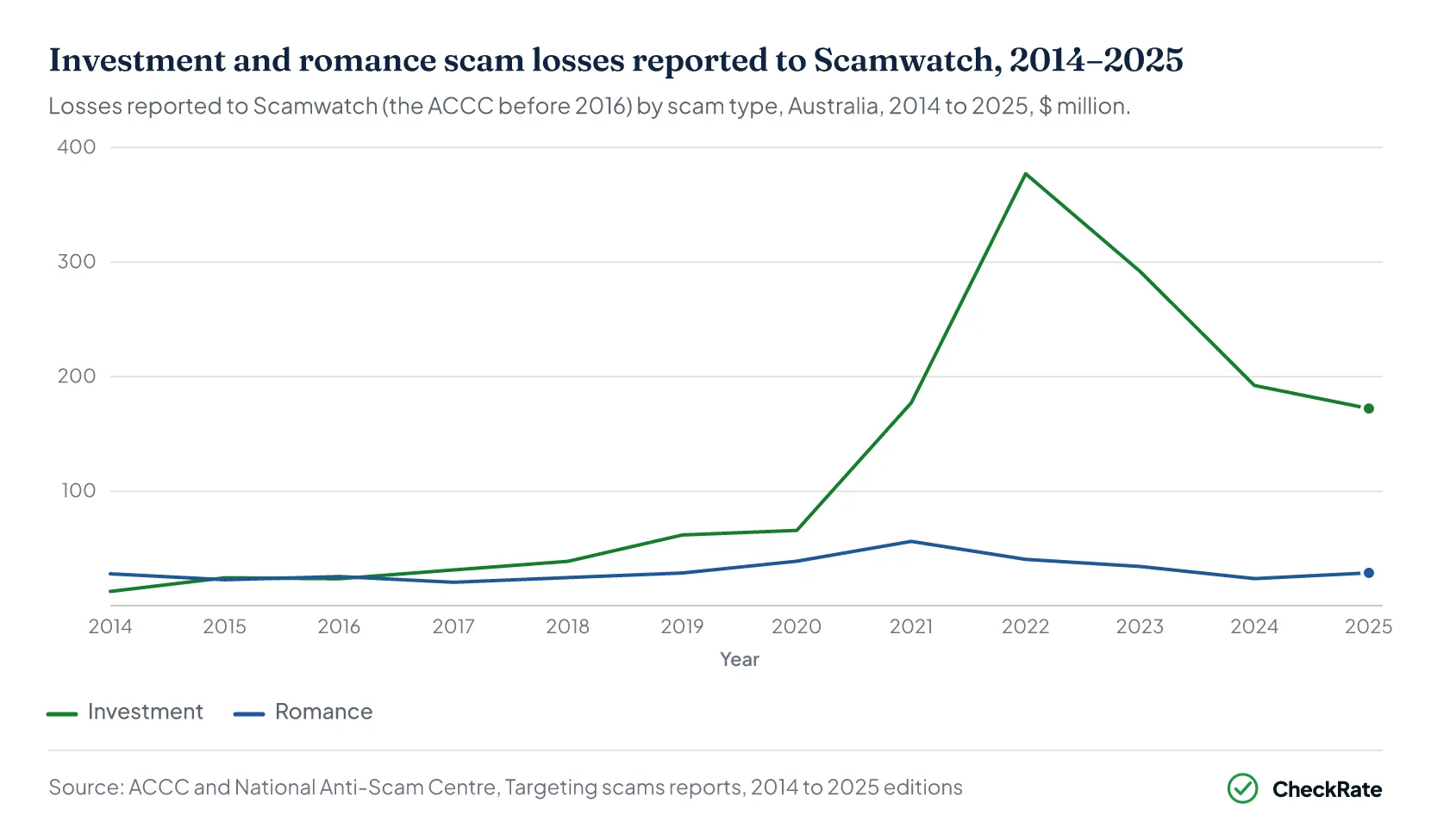
Dating and romance scams recorded the highest losses reported to the ACCC in 2014, at $27.9 million, or 34% of Scamwatch losses2. Investment scams overtook romance scams in 2015 with Scamwatch losses of $24.4 million compared with $22.7 million6. Romance scams were back on top in 2016, at $25.5 million compared with $23.6 million for investment schemes10.
Investment scams have recorded the highest Scamwatch losses of any scam type in each year since 2017111. Losses reported to Scamwatch from investment scams fell from $377.2 million in 2022 to $172.2 million in 20254.
Business email compromise scams had the highest combined reported losses of any scam type in 2019, at $132 million, compared with $126 million for investment scams8. Investment scams have had the highest reported losses every year from 2020 to 202513549112.
Reported investment scam losses rose from $328 million in 202012 to $701 million in 2021, partly because of cryptocurrency investment scams, according to the ACCC9. The 2020 figure included only two weeks of ReportCyber investment scam data12. Losses then reached $1.5 billion in 2022, before falling to $1.3 billion in 2023 and $945.0 million in 20244513.
The investment scam losses article covers the schemes behind these losses in more detail.
Section 03 · Contact methods
How have scam contact methods in Australia changed since 2015?
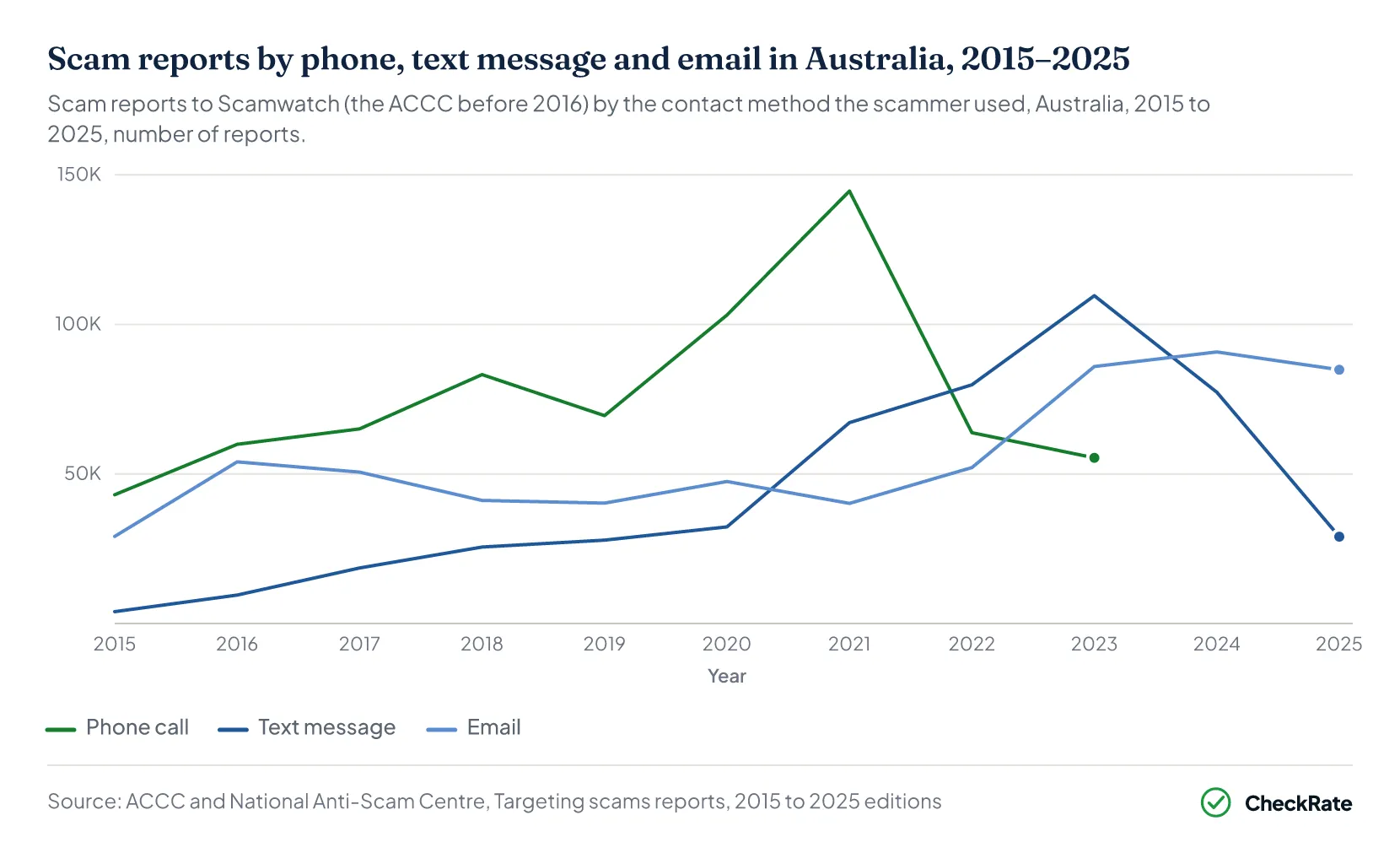
Text messages overtook phone calls as the most common scam contact method reported to Scamwatch in 2022, with 79,835 text message reports compared with 63,821 phone reports4. Before this, phone calls had been the most common contact method reported to the ACCC since 20118.
Phone reports reached 144,603 in 2021, accounting for 50% of all Scamwatch reports9. They then fell 55.9%, from 144,603 in 2021 to 63,821 in 20224. According to the ACCC, the decline coincided with the introduction of the Reducing Scam Calls and SMS Code, which requires telecommunications providers to monitor and block scam calls.
Text message reports rose from 3,985 in 2015 to 109,621 in 2023105. They had reached 67,180 in 20219. Scamwatch received 26,496 reports of FluBot scam text messages, which tricked recipients into downloading malicious software onto their phones, between 2 August and 31 December 2021. Text message reports then fell by 62.4% from 77,365 in 2024 to 29,058 in 20251.
Email became the most commonly reported contact method in 2024 and remained so in 2025, at 90,819 and 84,861 reports, respectively131.
Phone calls had the highest Scamwatch losses of any contact method in 2024, at $107.2 million13. Losses linked to social media rose from $9.5 million in 2016 to $93.5 million in 2023, before falling to $69.5 million in 202410513.
In 2025, online contact, including websites, mobile apps and social media, accounted for the highest Scamwatch losses of any contact method, at $158.5 million, compared with $72.5 million for phone calls1.
| Losses reported to Scamwatch by contact method, Australia, 2017 to 2024 | ||||
|---|---|---|---|---|
| Contact method | 2017 ($ million) | 2020 ($ million) | 2023 ($ million) | 2024 ($ million) |
| Phone call | 29.211 | 48.212 | 116.05 | 107.213 |
| Social media | 15.811 | 27.112 | 93.55 | 69.513 |
| 17.511 | 35.212 | 80.05 | 47.613 | |
| Text message | 1.711 | 3.112 | 26.95 | 14.013 |
Source · ACCC and National Anti-Scam Centre, Targeting scams 2017, 2020, 2023 and 2024.
Section 04 · Pandemic years
How did scam reports and losses in Australia change during the COVID-19 pandemic?
Scam reports to Scamwatch rose by 29%, from 167,797 in 2019 to 216,087 in 2020, while losses rose by 23% to $175.7 million12. In 2021, reports rose by a further 33% to 286,622, while reported losses increased by 84% to $323.7 million9.
Scamwatch received more than 5,400 reports that directly mentioned COVID-19 between February and December 2020, with more than $6 million in reported losses12. Reports mentioning COVID-19 then fell to 4,283 in 2021, although losses from these reports rose to $8.6 million9.
Phishing reports rose by 75% to about 44,000 in 2020, partly because of a rise in government impersonation scams during the pandemic, according to the ACCC12.
Combined reported scam losses rose from $851.4 million in 202012 to $1.76 billion in 20219. The 2021 total included data from 12 banks and money remitters, compared with 10 in 2020129.
The data does not show how much of the increase was due to the pandemic.
An estimated 3.6% of people aged 15 and over responded to a scam in 2020-21, compared with 2.4% in 2014-15, according to ABS Personal Fraud data14. An estimated 2.1% of people, or 431,100, were exposed to at least one scam they believed was related to COVID-19. The scam victimisation rate fell to 2.7% in 2021-2215.
Section 05 · ABS surveys
How have personal fraud rates in Australia changed since 2007?
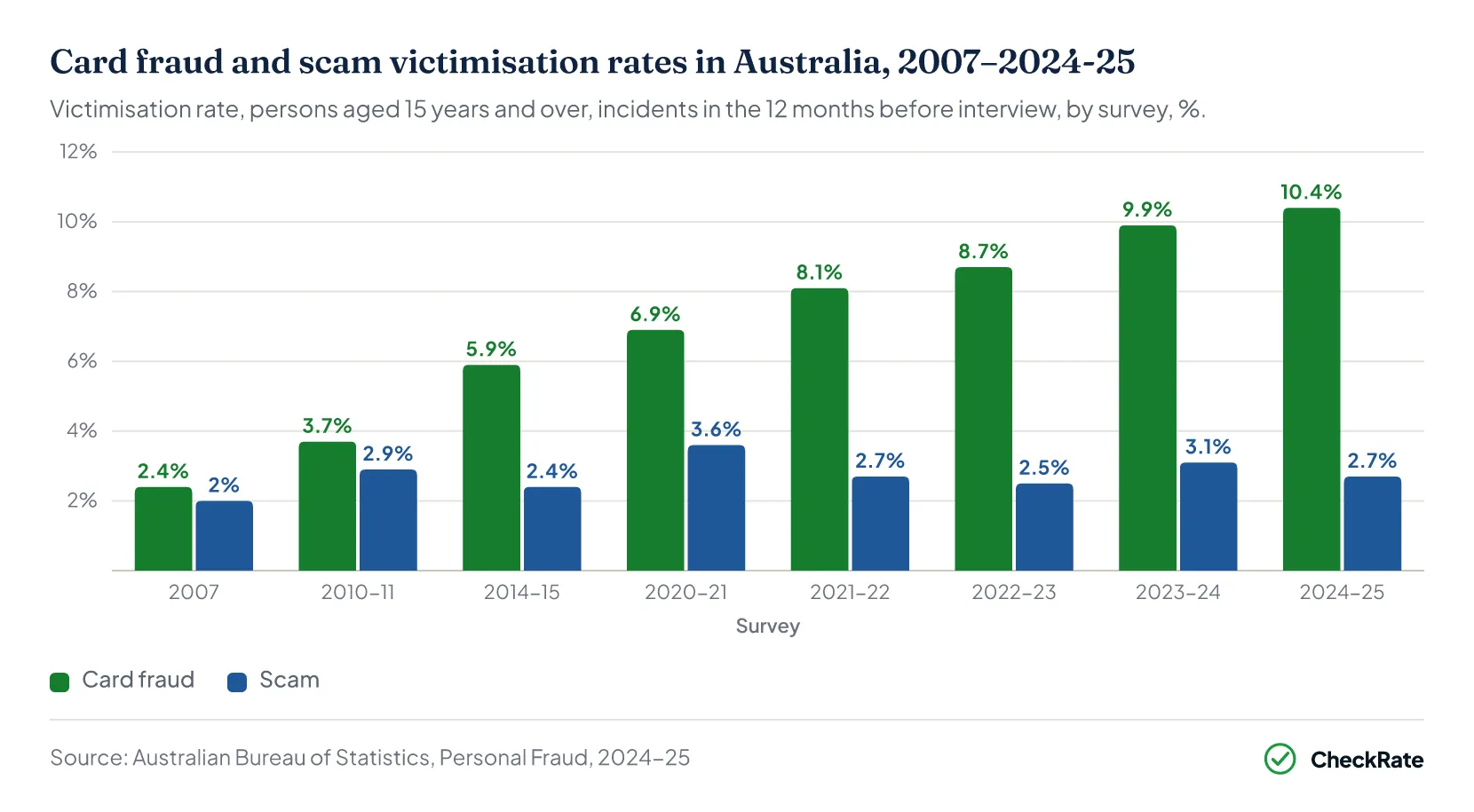
An estimated 10.4% of people aged 15 and over in Australia, or 2.3 million people, experienced card fraud in 2024-25, up from 5.9% in 2014-15, according to ABS Personal Fraud data3. The card fraud victimisation rate rose in each survey year from 2014-15 to 2023-24, reaching 9.9% in 2023-24, and was largely unchanged in 2024-25163.
The share of Australians who experienced card fraud was 2.4% in 2007, when the first national survey was conducted, and 3.7% in 2010-111718.
Card fraud victims had $2.2 billion taken or spent through fraud in their most recent incident in 2024-253. After reimbursements, their net loss was $350 million.
An estimated 2.7% of Australians aged 15 and over experienced a scam in 2024-25, equivalent to 596,600 people3. This was down from 3.1% in 2023-24 and similar to 2.4% in 2014-15. The scam rate ranged from 2.0% in 2007 to 3.6% in 2020-211714. Meanwhile, the share of Australians who experienced identity theft was 1.0% in 2024-25, up from 0.7% in 2014-153.
The share of people experiencing any personal fraud rose from 5.0% in 2007 to 8.5% in 2014-15 and 11% in 2020-21171914. It reached 13.1% in 2024-25, or 15% including online impersonation, which the ABS began measuring in 2021-223.
The card fraud article covers card fraud victims and their losses in more detail.
Section 06 · Underreporting
What share of scam victims in Australia report the scam to an authority?
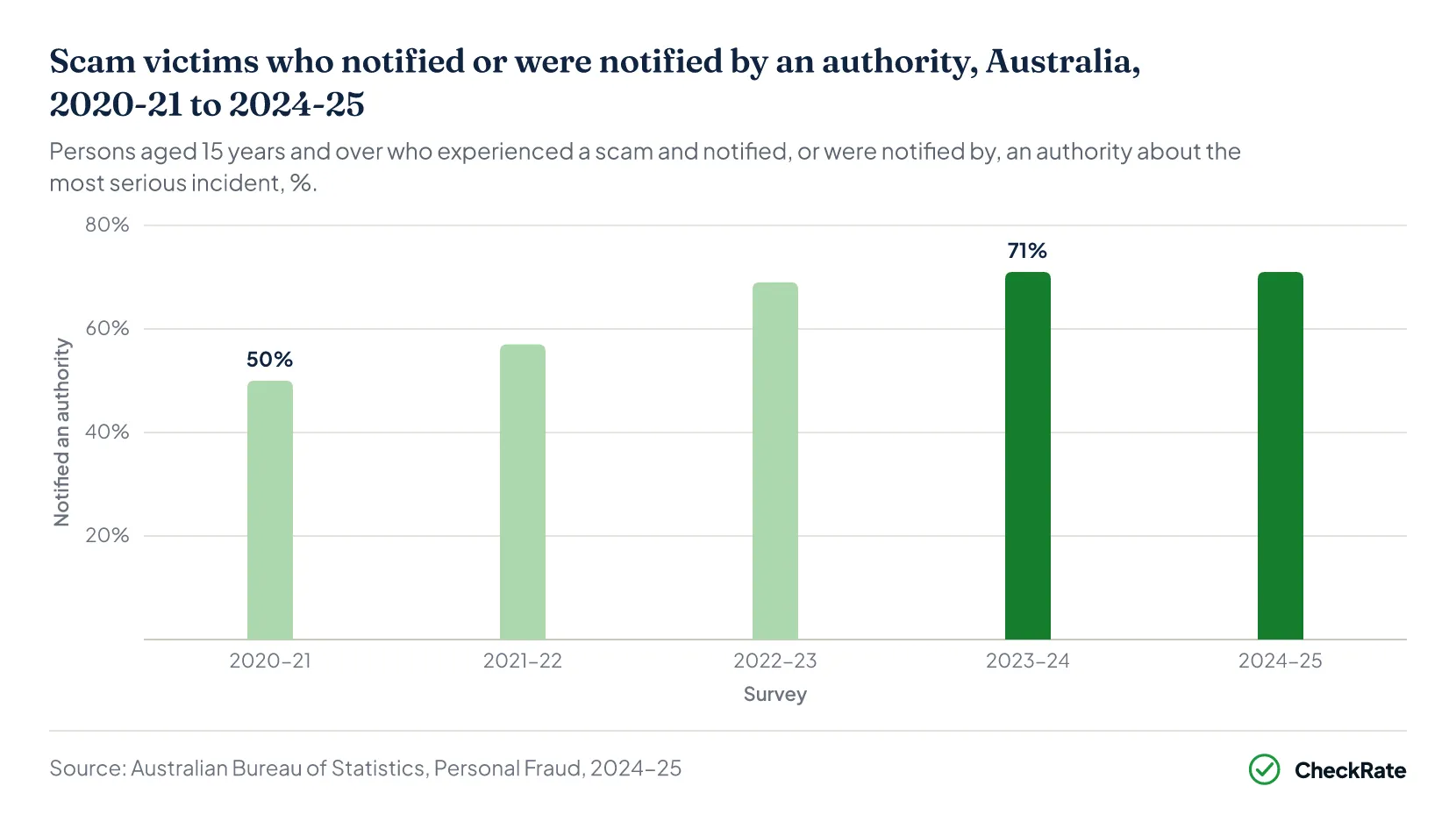
An estimated 71% of people aged 15 and over who experienced a scam in 2024-25 (424,400 people) either notified an authority or were notified by one about the most serious incident3. This was unchanged from 2023-24163.
The share of scam victims who reported a scam or were contacted by an authority was 57% in 2021-22 and 69% in 2022-231520.
A bank or other financial institution was the authority most often involved, accounting for 54% of scam victims in 2024-25, while 8.5% notified police3.
Almost 30% of people who experienced a scam in 2024-25 did not report it, according to the National Anti-Scam Centre1. The centre estimates that many of those people lost little or no money, meaning actual losses would not necessarily be 30% higher than reported losses.
Scamwatch accounted for 39.2% of scam reports and 12.8% of losses across the five reporting organisations in 2025, before duplicate reports were removed1. Of the reports Scamwatch received that year, 85.9% involved no financial loss.
An ACCC-commissioned Roy Morgan survey of 1,508 people in 2021 found that 30% of scam victims did not report to anyone, 13% reported to Scamwatch, 37% to a bank and 16% to police9. A 2019 survey for the ACCC found that around 33% of people who had lost money to scams in the previous five years did not report the loss to any organisation8.
In 2014-15, 36% of scam victims reported the incident to an agency19. In 2010-11, 31.2% of scam victims reported the incident to an agency18. These rates are not directly comparable with the figures above, as the ABS reporting series starts in 2020-21 and also counts people notified by an authority3.
The ABS estimated total losses from personal fraud at $3 billion in 2014-15, including $2.1 billion from card fraud19. The ABS has not published an estimate of total personal fraud losses since 2014-15, so its figures cannot be directly compared with recent reported scam losses3.
Section 07 · Common questions
Scam and fraud losses: quick answers
How much money do people in Australia lose to scams each year?
Combined reported scam losses in Australia were $2.18 billion in 2025, according to the National Anti-Scam Centre, based on reports to Scamwatch, ReportCyber, the Australian Financial Crimes Exchange, IDCARE and ASIC. Losses reported to Scamwatch alone were $334.8 million in 2025.
What was the worst year for scam losses in Australia?
Reported scam losses were highest in 2022, at $3.15 billion, among the years from 2015 to 2025 for which the ACCC and the National Anti-Scam Centre publish a combined total. However, the 2022 total did not remove duplicate reports, and the organisations contributing data changed over time.
Which type of scam causes the biggest losses in Australia?
Investment scams had the highest reported losses in Australia in 2025, at $837.7 million, accounting for 38% of the $2.18 billion total. Investment scams have had the highest reported losses in every year from 2020 to 2025.
Are scam losses in Australia going down?
Combined reported scam losses fell from $3.15 billion in 2022 to $2.03 billion in 2024, then rose to $2.18 billion in 2025. Losses reported to Scamwatch fell from $569.5 million in 2022 to $318.8 million in 2024, then rose to $334.8 million in 2025.
How many scam victims in Australia report the scam?
An estimated 71% of people aged 15 years and over who experienced a scam in 2024-25 either contacted an authority or were contacted by one about the most serious incident, according to the ABS. The National Anti-Scam Centre estimates that almost 30% of people who experienced a scam in 2024-25 did not report it.
References
- National Anti-Scam Centre, Targeting scams: report of the National Anti-Scam Centre on scams data and activity 2025 · nasc.gov.au ↑ b c d e f g h i j k l m n o p q
- ACCC, Targeting scams: report of the ACCC on scam activity 2014 · nasc.gov.au ↑ b c d
- Australian Bureau of Statistics, Personal fraud, 2024-25 financial year · Australian Bureau of Statistics ↑ b c d e f g h i j k l m
- ACCC, Targeting scams: report of the ACCC on scams activity 2022 · nasc.gov.au ↑ b c d e f g h i j
- National Anti-Scam Centre, Targeting scams: report on scams activity 2023 · nasc.gov.au ↑ b c d e f g h i j k l
- ACCC, Targeting scams: report of the ACCC on scam activity 2015 · nasc.gov.au ↑ b c d
- ACCC, Targeting scams: report of the ACCC on scam activity 2018 · nasc.gov.au ↑ b c
- ACCC, Targeting scams 2019: a review of scam activity since 2009 · nasc.gov.au ↑ b c d e f
- ACCC, Targeting scams: report of the ACCC on scams activity 2021 · nasc.gov.au ↑ b c d e f g h i j k l
- ACCC, Targeting scams: report of the ACCC on scam activity 2016 · nasc.gov.au ↑ b c d e
- ACCC, Targeting scams: report of the ACCC on scam activity 2017 · nasc.gov.au ↑ b c d e f g
- ACCC, Targeting scams: report of the ACCC on scam activity 2020 · nasc.gov.au ↑ b c d e f g h i j k l m n
- National Anti-Scam Centre, Targeting scams: report of the National Anti-Scam Centre on scams data and activity 2024 · nasc.gov.au ↑ b c d e f g h i j k
- Australian Bureau of Statistics, Personal Fraud, 2020-21 · Australian Bureau of Statistics ↑ b c
- Australian Bureau of Statistics, Personal Fraud, 2021-22 · Australian Bureau of Statistics ↑ b
- Australian Bureau of Statistics, Personal fraud, 2023-24 financial year · Australian Bureau of Statistics ↑ b
- Australian Bureau of Statistics, Personal Fraud, 2007 (cat. no. 4528.0), Summary of findings · Australian Bureau of Statistics ↑ b c
- Australian Bureau of Statistics, Personal Fraud, 2010-11 (cat. no. 4528.0), Snapshot of personal fraud · Australian Bureau of Statistics ↑ b
- Australian Bureau of Statistics, Personal Fraud, 2014-15 · Australian Bureau of Statistics ↑ b c
- Australian Bureau of Statistics, Personal fraud, 2022-23 financial year · Australian Bureau of Statistics ↑