

Published
 Scam losses in AustraliaHow much people in Australia lose to scams, and which types of scam account for the losses.
 Card surcharges and merchant feesWhat merchants pay to accept card payments, and what changed with the card surcharge ban.How have scam and fraud losses in Australia changed over a decade?
Section 01 · Prevalence
How many people in Australia experience card fraud each year?
An estimated 2.3 million people aged 15 and over experienced card fraud in Australia in 2024-25, equal to 10.4% of that population1. The ABS describes the rate as similar to 2023-24, when it was 9.9%.
Card fraud occurs when someone uses a person’s credit, debit or EFTPOS card details, without the account owner’s permission, to buy goods or services or to withdraw cash1. The estimates come from a survey of 25,368 people aged 15 and over, interviewed between July 2024 and June 20252.
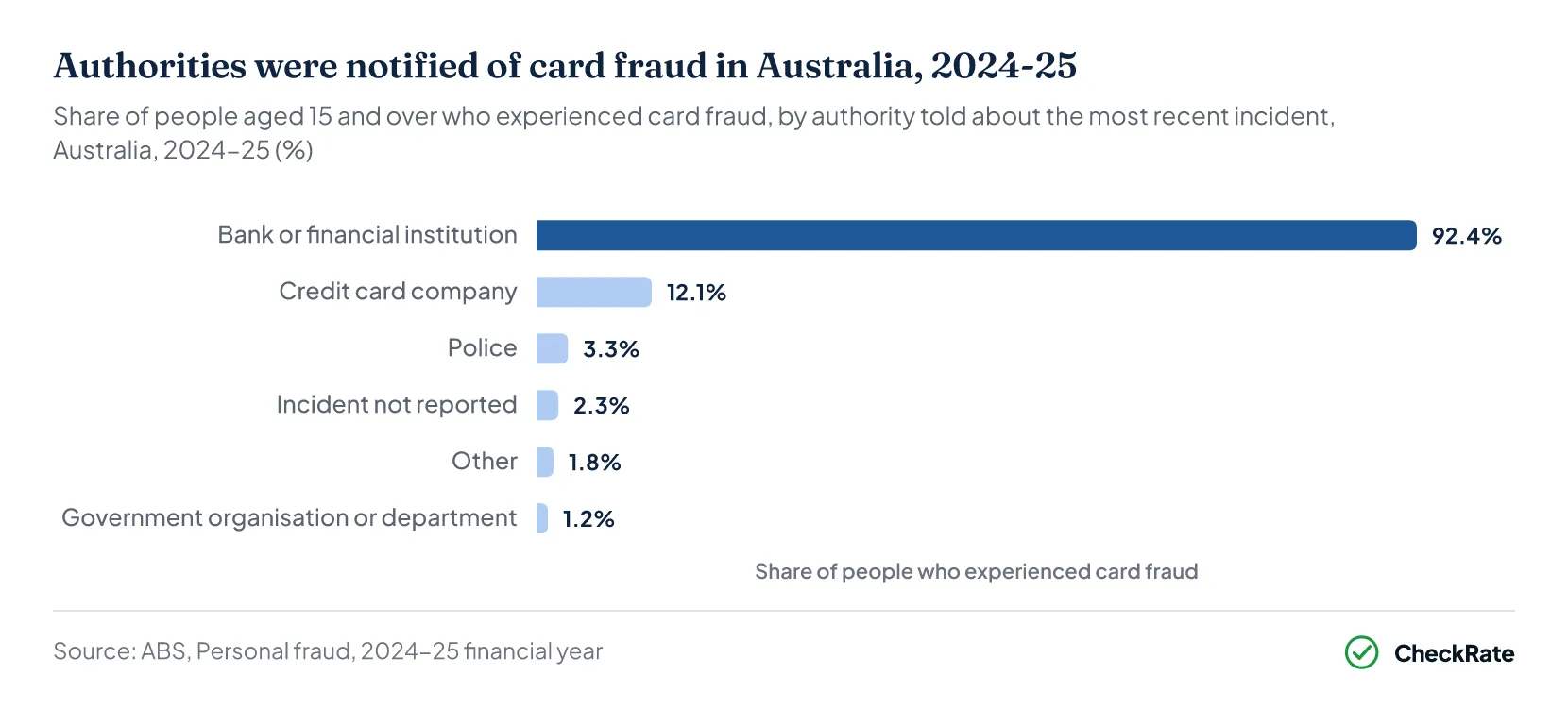
Nearly all people who experienced card fraud in 2024-25 (98%, or 2.2 million people) either reported their most recent incident to an authority or were notified by one1. Banks and financial institutions were the most common authority involved, at 92.4%, compared with 12.1% for a credit card company and 3.3% for police.
Section 02 · Losses
How much money is lost to card fraud in Australia?
People who experienced card fraud in 2024-25 had an estimated $2.2 billion withdrawn or used in their most recent incidents, before any reimbursement1. After reimbursements received by the time of the survey, the estimated net loss was $350 million.
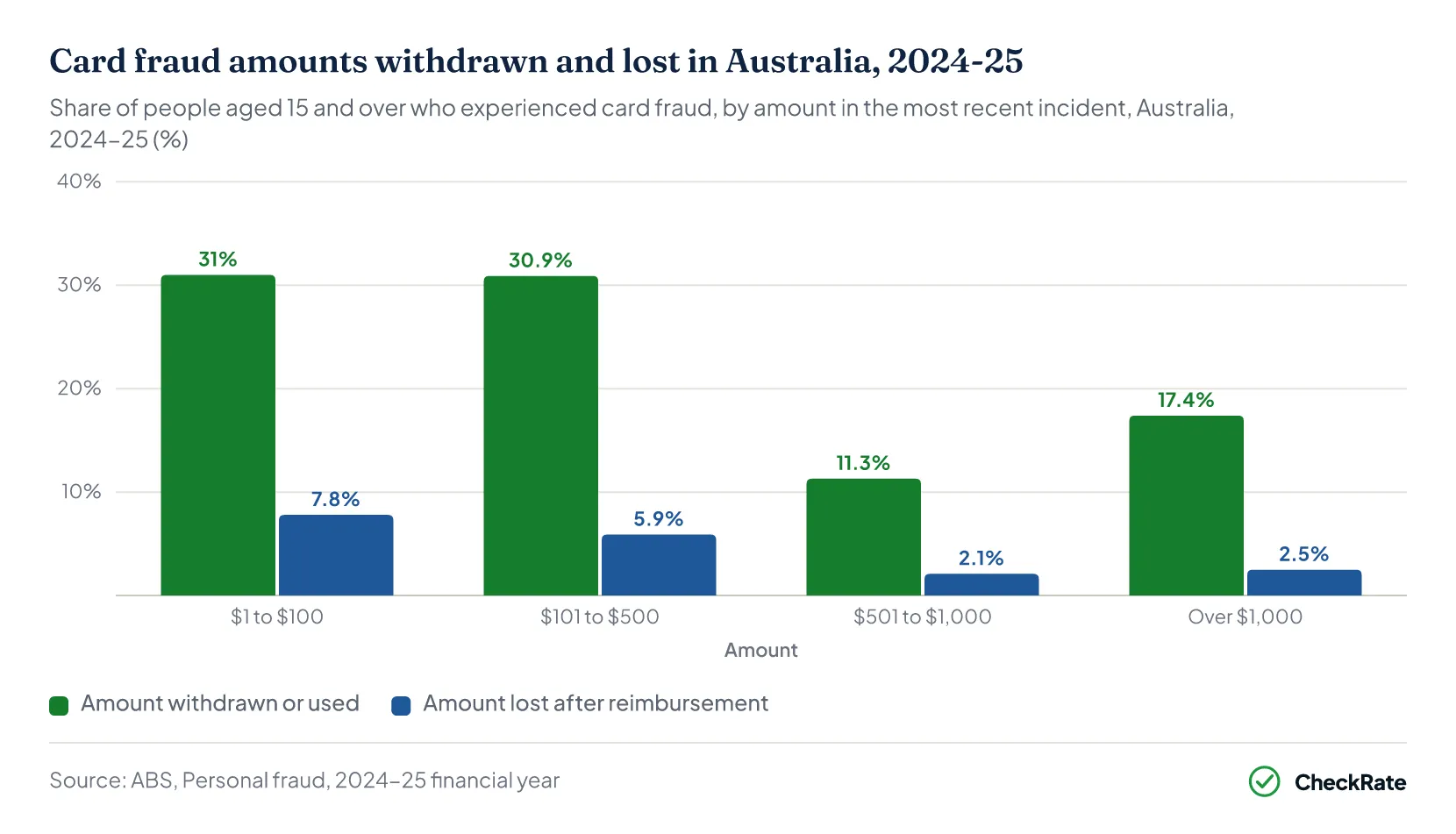
An estimated 90% of people who experienced card fraud had money withdrawn or used in their most recent incident, including 17% who had more than $1,000 withdrawn or used1. The median amount withdrawn or used was $250.
| Card fraud amounts in the most recent incident, Australia, 2024-25 | ||
|---|---|---|
| Measure | Estimate ($ million) | Relative standard error (%) |
| Gross amount withdrawn or used | 2,239.71 | 9.01 |
| Net loss after any reimbursements paid | 350.21 | 17.51 |
Source · ABS, Personal fraud, 2024-25 financial year, Table 6.
Three in four people who experienced card fraud (75%) were reimbursed by their card issuer, while 72% were reimbursed in full1. Another 10.1% received no reimbursement, and 5.6% had a claim pending resolution when they were surveyed.
After reimbursement, 77.8% of people who experienced card fraud had no financial loss from the most recent incident1. A loss of $1 to $100 was the most common among the listed loss ranges, at 7.8% of people who experienced card fraud, compared with 2.5% for losses of more than $1,000.
Section 03 · Age and sex
How does card fraud in Australia vary by age and sex?
Card fraud rates were similar for males and females in Australia in 2024-25, at 10.1% and 10.7% respectively1. An estimated 1.09 million males and 1.19 million females aged 15 and over experienced card fraud.
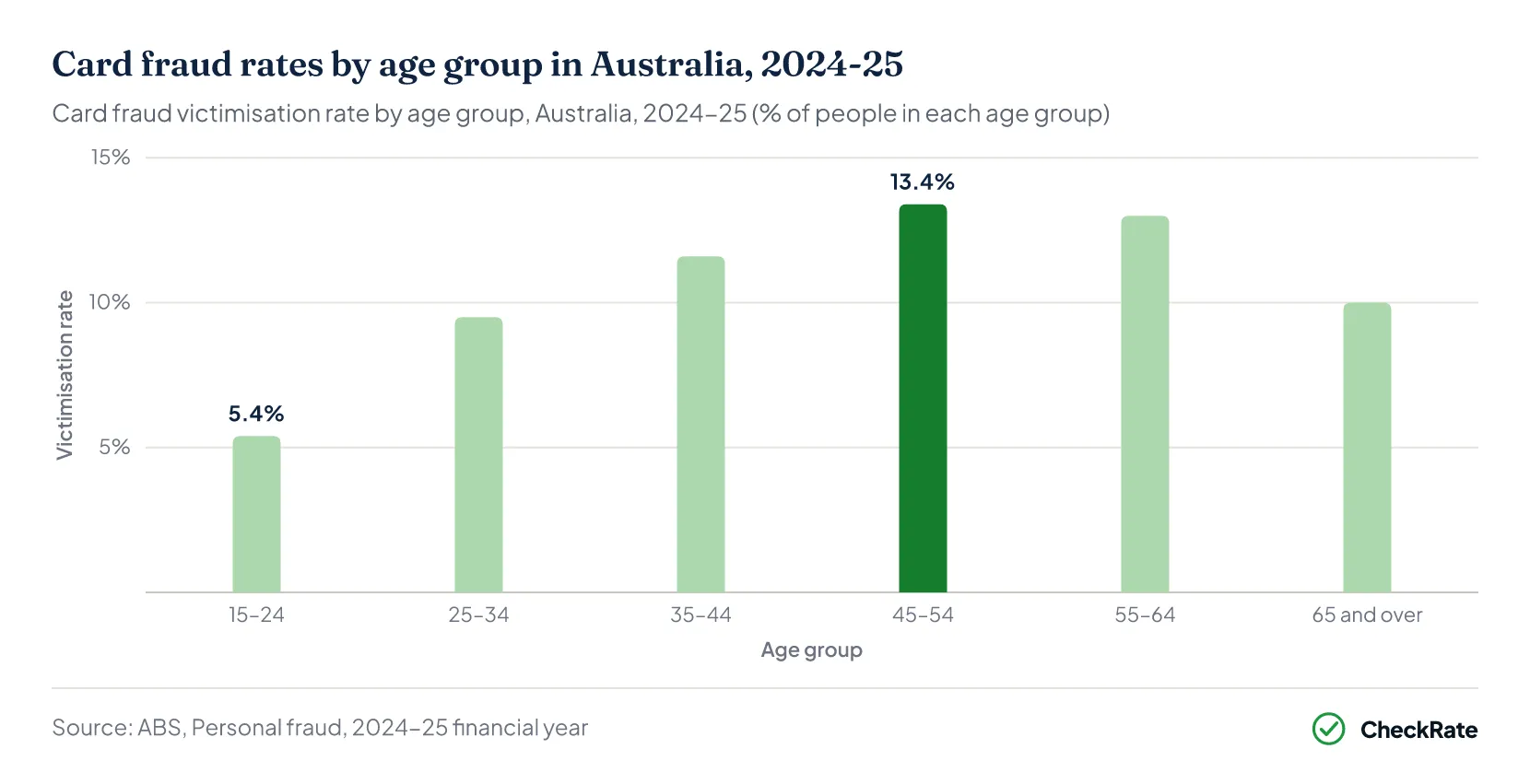
People aged 15 to 24 recorded the lowest card fraud rate among the six age groups in 2024-25, at 5.4%1. People aged 45 to 54 had the highest card fraud rate, at 13.4%, followed by those aged 55 to 64, at 13.0%. The gap of 0.4 percentage points is within the survey’s margin of error.
The rate for people aged 65 and over was 10.0%, compared with 10.4% for all people aged 15 and over1.
Card fraud rates also differed across other population groups in 2024-25:
- People with a disability or a restrictive condition had a rate of 12%, compared with 10% for people without.1
- People with a non-school qualification, such as a certificate, diploma or degree, had a rate of 12%, compared with 8.3% for people without one.1
- Employed people had a rate of 11%, compared with 8.0% for unemployed people and 9.2% for people not in the labour force1.
| People who experienced card fraud by sex, Australia, 2024-25 | |||
|---|---|---|---|
| Sex | People (’000) | Victimisation rate (%) | Relative standard error of rate (%) |
| Males | 1,088.11 | 10.11 | 2.61 |
| Females | 1,192.21 | 10.71 | 3.11 |
| All people | 2,280.31 | 10.41 | 1.81 |
Source · ABS, Personal fraud, 2024-25 financial year, Table 1.
Section 04 · Fraud and scams
Is card fraud more common than scams in Australia?
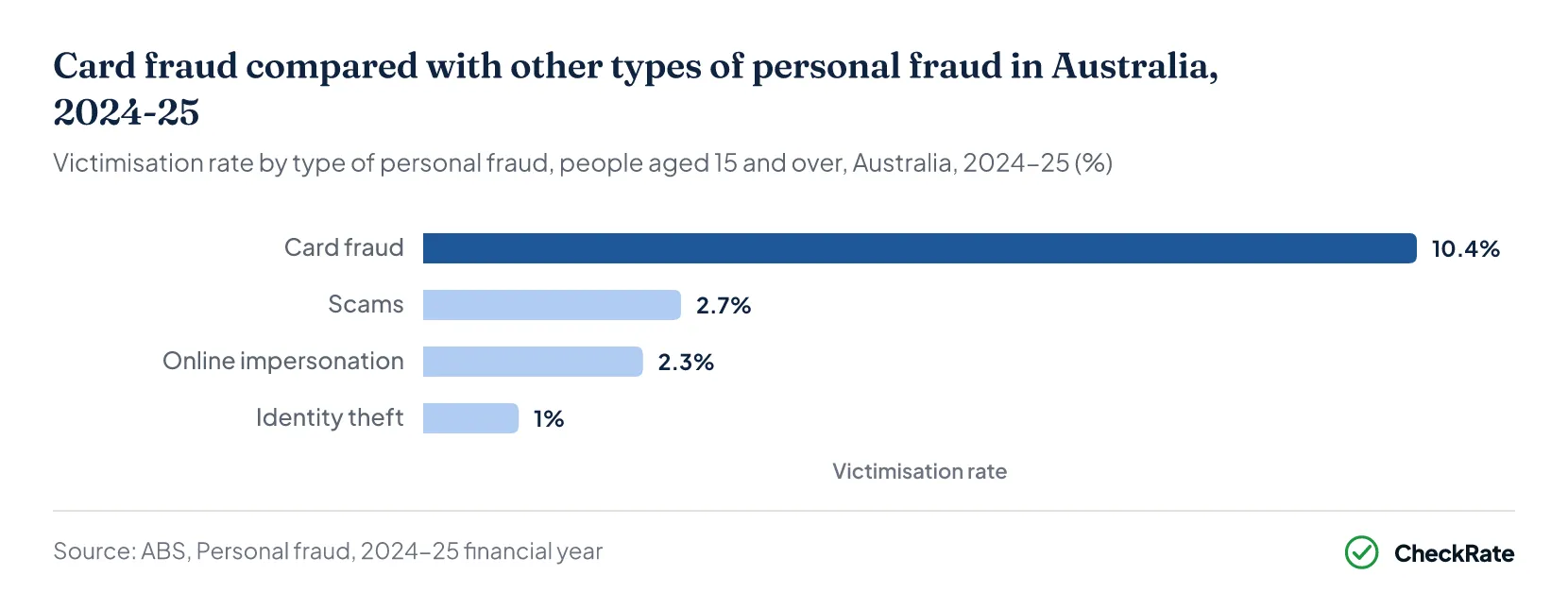
Card fraud affected almost four times as many people in Australia as scams in 2024-25.1 An estimated 2.3 million people experienced card fraud compared with 596,600 experiencing scams. Card fraud had the highest victimisation rate among the four types of personal fraud measured by the ABS, at 10.4%, compared with 2.7% for scams, 2.3% for online impersonation and 1.0% for identity theft.
Card fraud and scams are measured differently. Card fraud is the unauthorised use of a person’s card details, while a scam is a dishonest approach, such as a message, request or offer, intended to trick a person into handing over money or personal information21.
The ABS counts a person as experiencing a scam only if they responded to it, for example by asking for more details, sending money or personal information, or opening a link in the scam1. The incident details also differ, describing the most recent incident for card fraud and the most serious incident for scams.
The scam victimisation rate fell from 3.1% in 2023-24 to 2.7% in 2024-25, while the card fraud rate remained similar across the two years1. An estimated 71% of people who experienced a scam either notified an authority, or were notified by one, about the most serious incident, compared with 98% for the most recent card fraud incident.
The scam losses article covers how much people in Australia lose to scams and which scam types account for the losses.
Section 05 · Over time
How has card fraud in Australia changed since 2014-15?
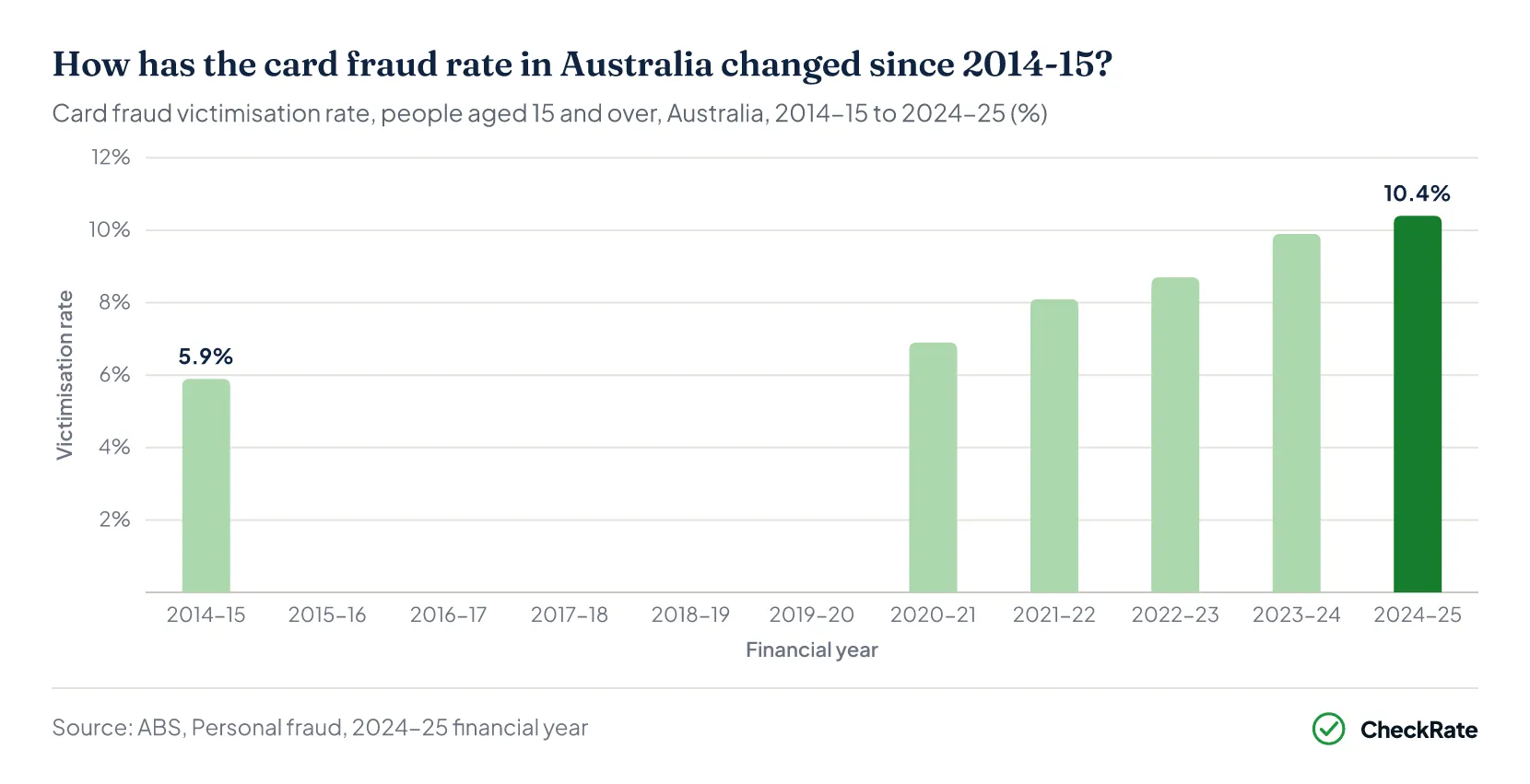
The card fraud rate in Australia increased from 5.9% in 2014-15 to 10.4% in 2024-25, a rise of 4.5 percentage points1. The estimated number of people who experienced card fraud doubled over the same period, from 1.1 million to 2.3 million. Part of that increase reflects growth in the population aged 15 and over, which is why the ABS uses victimisation rates, not counts, to compare years.
The ABS collected card fraud data in 2014-15 and then every year from 2020-21, so no estimates are available for 2015-16 to 2019-201. The card fraud rate rose each year between 2020-21 and 2023-24, from 6.9% to 9.9%, before reaching 10.4% in 2024-25.
In 2022-23, people who experienced card fraud had an estimated $2.2 billion withdrawn or used in their most recent incidents, with an estimated net loss after reimbursement of $476 million3. In 2023-24, these amounts were $2.1 billion and $477 million respectively4.
The 2024-25 survey introduced a new response option for reimbursement claims that were still pending resolution. Previously, these cases were counted as not receiving reimbursement.1 The ABS states that reimbursement data for 2024-25 are not comparable with earlier years.
| Card fraud amounts withdrawn and lost in Australia, 2022-23 to 2024-25 | ||
|---|---|---|
| Financial year | Withdrawn or used ($ billion) | Lost after reimbursement ($ million) |
| 2022-23 | 2.23 | 4763 |
| 2023-24 | 2.14 | 4774 |
| 2024-25 | 2.21 | 3501 |
Source · ABS, Personal fraud, 2022-23, 2023-24 and 2024-25 financial years.
Section 06 · Common questions
Card fraud in Australia: quick answers
How many people in Australia experience card fraud?
An estimated 2.3 million people aged 15 and over experienced card fraud in Australia in 2024-25, equal to 10.4% of that population. The Australian Bureau of Statistics describes the rate as similar to 2023-24, when it was 9.9%.
How much money is lost to card fraud in Australia?
People who experienced card fraud in 2024-25 had an estimated $2.2 billion withdrawn or used in their most recent incident, before reimbursement. After reimbursements received by the time of the survey, the estimated net loss was $350 million.
Do card issuers reimburse card fraud in Australia?
In 2024-25, 75% of people who experienced card fraud received a reimbursement from their card issuer for their most recent incident, while 72% were reimbursed in full. Another 10.1% received no reimbursement, and 5.6% had a claim pending resolution when they were surveyed.
Which age group experiences the most card fraud in Australia?
People aged 45 to 54 recorded the highest card fraud rate among the six age groups in 2024-25, at 13.4%, compared with 13.0% for people aged 55 to 64. However, the difference was within the survey’s margin of error. People aged 15 to 24 recorded the lowest rate, at 5.4%.
Is card fraud the same as a scam?
No. Card fraud occurs when someone uses a person’s credit, debit or EFTPOS card details without the account owner’s permission. A scam is a dishonest approach intended to trick someone into providing money or personal information. The ABS counts a person as experiencing one only if they responded to it.
References
- Australian Bureau of Statistics, Personal fraud, 2024-25 financial year · Australian Bureau of Statistics ↑ b c d e f g h i j k l m n o p q r s t u v w x y z a2 b2 c2 d2 e2 f2 g2 h2 i2 j2 k2 l2 m2 n2 o2
- Australian Bureau of Statistics, Personal fraud methodology, 2024-25 financial year · Australian Bureau of Statistics ↑ b
- Australian Bureau of Statistics, Personal fraud, 2022-23 financial year · Australian Bureau of Statistics ↑ b c
- Australian Bureau of Statistics, Personal fraud, 2023-24 financial year · Australian Bureau of Statistics ↑ b c