How does the ATO define a high-income earner?
Australia doesn't have a single official definition of a high income. Three separate government thresholds each serve a different purpose, ranging from $101,000 for singles under the Medicare levy surcharge to $250,000 under the Division 293 super tax.
In workplace settings, the Fair Work threshold is the most commonly cited benchmark. At $183,100, it sits above the top 10% employee threshold of $156,000.
It is still below the top 5% threshold of around $203,000. This puts it roughly in the top 7% to 8% of employee earnings.
Each threshold serves a different purpose. Crossing the $101,000 Medicare levy surcharge line does not make someone a high earner under Fair Work definitions. Earning above the $183,100 Fair Work threshold also leaves a $66,900 gap before the Division 293 super tax threshold applies. For income comparisons, the ABS earnings distribution gives a clearer picture of where a salary sits.
Why is there no single 'high income' number in Australia?+
Does the $183,100 Fair Work threshold mean all award protections are lost?+
What salary puts an employee in the top 20% in Australia?
A salary of around $122,200 a year, or $2,350 a week in a main job, sits in the top 20% of Australian employee earnings. This is an estimate based on the ABS grouped earnings distribution and rounded to the nearest $50. It is not a directly published ABS figure.
The median employee salary is $74,100, or $1,425 a week. Three quarters of employees earn below $110,604, or $2,127 a week. An employee at the 80th percentile earns about 65% more than the median.
| Percentile | Aug 2020 | Aug 2024 | Aug 2025 | Annualised (2025) | 1-yr change |
|---|---|---|---|---|---|
| 10th percentile | $404 | $445 | $450 | $23,400 | +1.1% |
| 25th percentile | $750 | $899 | $900 | $46,800 | +0.1% |
| 50th percentile (median) | $1,150 | $1,399 | $1,425 | $74,100 | +1.9% |
| 75th percentile | $1,736 | $2,055 | $2,127 | $110,604 | +3.5% |
| 90th percentile | $2,500 | $3,040 | $3,000 | $156,000 | −1.3% |
| The 90th percentile fell 1.3% from August 2024 to August 2025, the only percentile to decline in this period. All figures are weekly gross earnings in the employee's main job. | |||||

What does the full Australian income distribution look like?
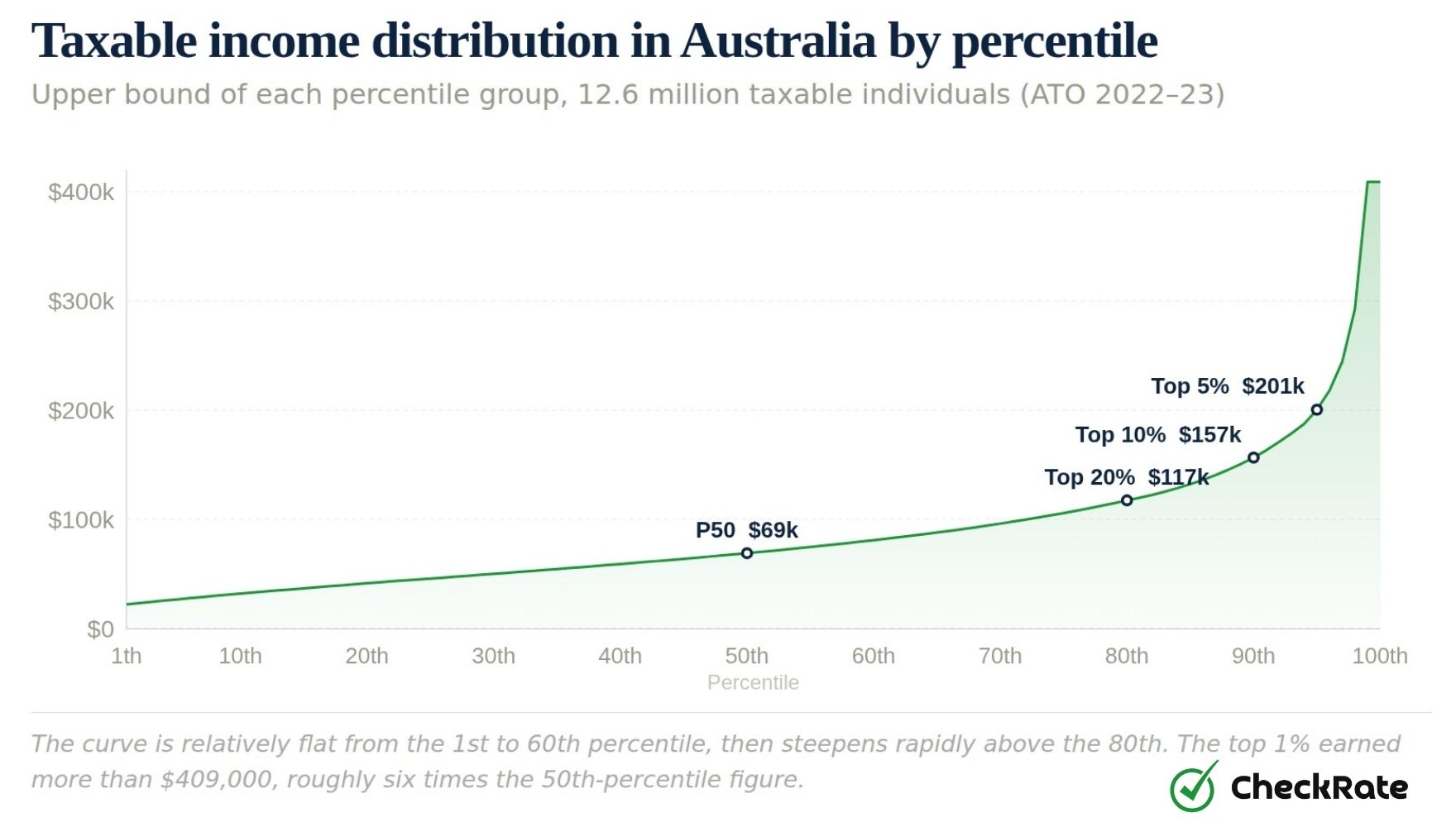
Among the 12.6 million people in the ATO taxable income dataset, half earned below roughly $69,000.
The 90th percentile was $156,592, the 95th percentile was $200,515, and the top 1% threshold was $408,973. The top 1% threshold was nearly six times the median.
What salary puts an employee in the top 10% in Australia?
The ABS publishes the top 10% employee threshold directly. As of August 2025, it was $3,000 a week, or $156,000 a year.
This figure fell 1.3% from $3,040 in August 2024, making it the only published percentile to decline over the year. The decline likely reflects a change in the mix of workers at the top of the distribution, rather than a fall in individual pay rates.
The Fair Work threshold of $183,100 appears to sit roughly around the top 7% to 8% of employee earnings, although the ABS does not publish that exact percentile. This distinction matters because the Fair Work threshold and ABS earnings percentiles measure different things.
Which states have the highest share of top earners?
The share of high earners varies considerably across states and territories. The ACT and Western Australia have the largest proportion of taxpayers earning above $120,000; Tasmania and South Australia have the smallest.
Is $100,000 a high income in Australia?+
How many Australians earn over $150,000?+
What salary puts an employee in the top 5% in Australia?
An employee needs to earn around $202,800 a year, or $3,900 a week, to reach the top 5% of employee earnings in Australia. This is an estimate based on ABS grouped data. It is not a directly published ABS figure, so it should be treated as a guide.
The ATO taxable income data shows a similar result. Its 95th percentile was $200,515 in 2022–23. The ABS and ATO datasets measure different groups and time periods, but both point to a figure of about $200,000.
A salary above $200,000 puts an employee near the top 5% under either measure. The $250,000 Division 293 threshold is still around $50,000 higher than this. Most top 5% earners do not pay this extra super tax. In practice, Division 293 applies closer to the top 2% to 3% of earners.
| Threshold | ABS employee earnings (Aug 2025) | ATO taxable income (2022–23) |
|---|---|---|
| Median (50th pctl) | $74,100 | $69,161* |
| Top 20% (80th pctl) | approx. $122,200 | $117,412 |
| Top 10% (90th pctl) | $156,000 | $156,592 |
| Top 5% (95th pctl) | approx. $202,800 | $200,515 |
| Top 1% (99th pctl) | n/a | $408,973 |
| *The ATO 50th-percentile figure is the upper bound of the 50th percentile band in the 12.6M-person dataset; the ATO published median for all 16.1M taxpayers is $55,868. The ABS median is higher because it covers employees only. | ||
How location changes what counts as a high income
A high income can mean different things depending on location.
The 2021 Census recorded a median weekly household income of $2,077 in Greater Sydney, alongside median monthly mortgage repayments of $2,427 and median weekly rent of $470.
In the Rest of NSW, those figures were $1,434, $1,733 and $330. Sydney households earn more on average, but higher housing costs absorb a large share of that advantage.
What does a $156,000 salary mean in Sydney versus regional NSW?
Earning $156,000 a year places an employee in the top 10% of Australian employee earnings. However, the value of that salary depends heavily on location.
In Sydney, higher mortgage repayments and rents can take up a larger share of income, which means $156,000 may not stretch as far as the national ranking suggests. In regional NSW, the same income can go further where housing costs are lower.
That does not mean $156,000 is ordinary in Sydney. It still sits above the earnings of 90% of Australian employees. The key point is that a national income ranking and the day-to-day value of that salary can look different, and both can be true.
How the high-income threshold has changed over time
The Fair Work high-income threshold has risen from $108,300 in 2009–10 to $183,100 in 2025–26. That is a 69.1% increase over 16 years. Over the past decade, from 2015–16 to 2025–26, the threshold increased by $46,400, or 33.9%.
The two largest annual increases came in recent years. The threshold rose by $7,500 in 2024–25 and by $8,100 in 2025–26.
| Financial year | Threshold | Change from prior year |
|---|---|---|
| 2009–10 | $108,300 | Base year |
| 2010–11 | $113,800 | +$5,500 (+5.1%) |
| 2011–12 | $118,100 | +$4,300 (+3.8%) |
| 2012–13 | $123,300 | +$5,200 (+4.4%) |
| 2013–14 | $129,300 | +$6,000 (+4.9%) |
| 2014–15 | $133,000 | +$3,700 (+2.9%) |
| 2015–16 | $136,700 | +$3,700 (+2.8%) |
| 2016–17 | $138,900 | +$2,200 (+1.6%) |
| 2017–18 | $142,000 | +$3,100 (+2.2%) |
| 2018–19 | $145,400 | +$3,400 (+2.4%) |
| 2019–20 | $148,700 | +$3,300 (+2.3%) |
| 2020–21 | $153,600 | +$4,900 (+3.3%) |
| 2021–22 | $158,500 | +$4,900 (+3.2%) |
| 2022–23 | $162,000 | +$3,500 (+2.2%) |
| 2023–24 | $167,500 | +$5,500 (+3.4%) |
| 2024–25 | $175,000 | +$7,500 (+4.5%) |
| 2025–26 | $183,100 | +$8,100 (+4.6%) |
| Total change 2009–10 to 2025–26 | +$74,800 | +69.1% |
At the top of the employee pay range, the 90th percentile rose from $2,500 a week in August 2020 to $3,000 a week in August 2025, a 20% increase over five years. In the most recent year, it fell by 1.3%, down from $3,040 in August 2024.
Separately, the Division 293 threshold was lowered from $300,000 to $250,000 in 2017–18 and has not changed since. As wages have risen while the threshold has stayed fixed, more high earners now sit above the $250,000 line than when the threshold was first introduced.
How has the gender pay gap in taxable income changed?
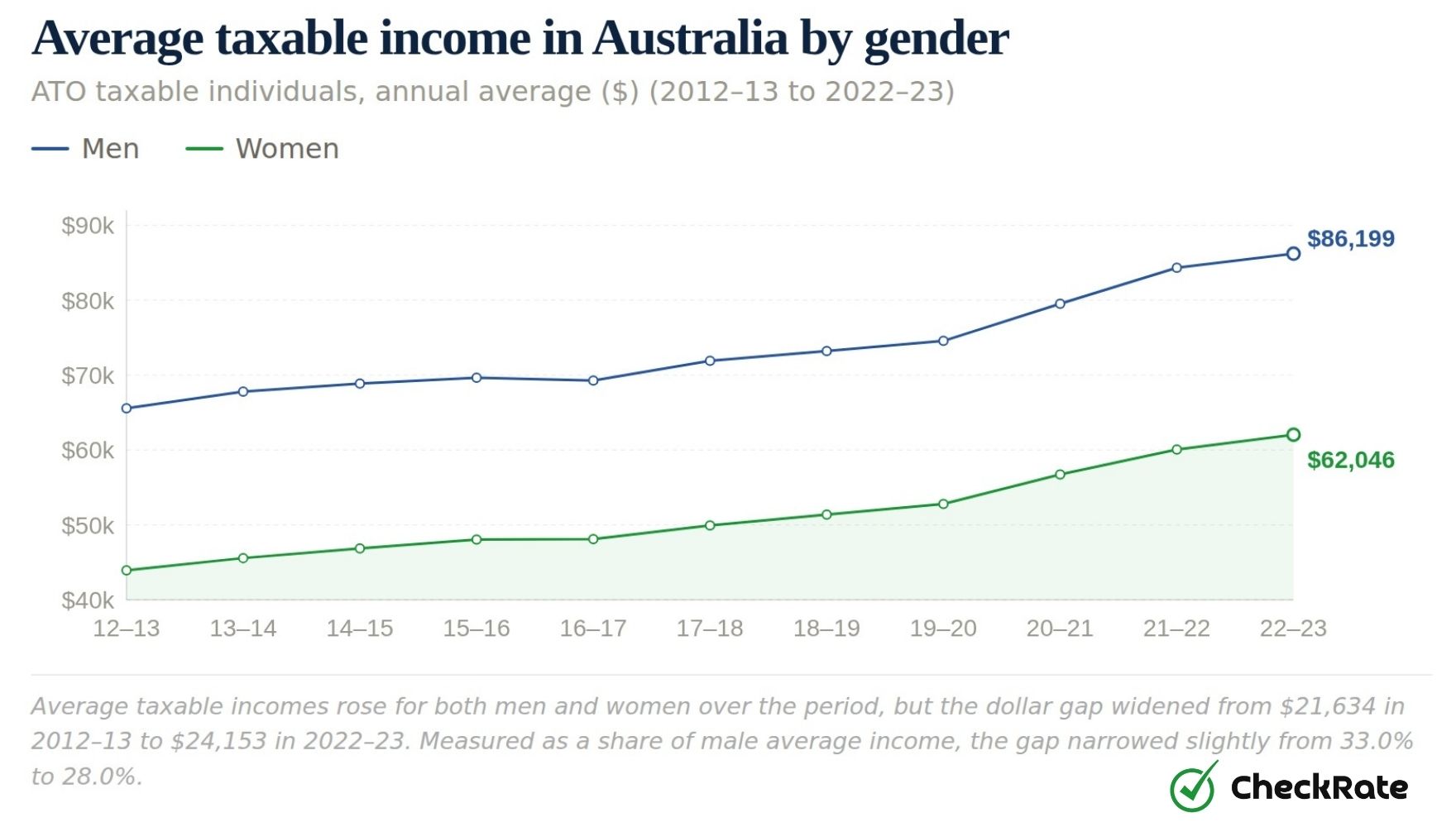
The gap in average taxable income between men and women has narrowed slightly as a percentage, but widened in dollar terms. In 2022–23, average taxable income was $86,199 for men and $62,046 for women. That was a gap of $24,153. A decade earlier, in 2012–13, average taxable income was $65,578 for men and $43,944 for women. That was a gap of $21,634.
Are more Australians moving into higher tax brackets?
The number of taxable individuals earning above $180,000 grew from 252,395 in 2010–11 to 860,021 in 2022–23, a rise of 241%. Over the same period, the total taxable population grew by just 27%. The share of taxpayers in the top bracket climbed from 2.0% to 5.3%.
Some of this growth reflects real wage increases. Bracket creep also plays a role. This happens when wages rise in dollar terms, often because of inflation, and more taxpayers move into higher tax brackets even if their spending power has not increased by the same amount.
The Stage 3 tax cuts from 1 July 2024 partly addressed this by reducing the 32.5% marginal tax rate to 30% and changing some bracket thresholds. However, the longer-term trend shows more Australians moving into higher tax brackets over time.
What are the current income tax brackets in Australia for 2025–26?+
How does the gender pay gap affect the definition of "high income"?+
High income vs high wealth in Australia
Income and wealth are different measures, and the data show a clear gap between them.
Average household net worth was $1.04 million in 2019–20, but the median sat at $579,200. This gap shows that wealth is concentrated more heavily at the top.
The Gini coefficient, which measures inequality on a scale from 0 to 1, also shows this difference. Household net worth had a Gini coefficient of 0.606 in 2022–23, compared with 0.307 for income. This means wealth is distributed roughly twice as unevenly as income in Australia.
Is high income the same as wealth in Australia?
A high income and wealth are not always the same thing. A household with two strong salaries and a large mortgage may rank well on income while having relatively little net wealth.
A retiree may have a modest current income but hold substantial assets in property and superannuation.
Annual taxable income can also rise in a single year due to a property sale, a redundancy payment or a capital gain. This may not reflect a person's usual earnings. For this reason, income data from one year should not be treated as a permanent measure of financial status.
Can someone have a high income but low wealth?+
Why is wealth inequality so much higher than income inequality?+
References
- 1Fair Work Commission: high income threshold amounts, 2009–10 to 2025–26.
- 2Australian Taxation Office: Division 293 tax on concessional super contributions; Medicare levy surcharge thresholds for 2025–26; individual income tax rates for 2025–26.
- 3ABS Employee Earnings, August 2025: (Cat. No. 6333.0): weekly employee earnings in main job, grouped distribution, and published percentile markers.
- 4ATO Taxation Statistics 2022–23: Individuals Table 16: percentile distribution of taxable individuals, by taxable income and sex.
- 5ATO Taxation Statistics 2022–23: Individuals Table 4: selected items by sex, taxable status, state or territory and taxable income range. Used for state-level income shares.
- 6ABS 2021 Census QuickStats: 2021: median household income, mortgage repayments and rent for Greater Sydney and rest of NSW.
- 7ATO Taxation Statistics 2022–23: Individuals Table 3: median and average key items, by sex.
- 8ATO Taxation Statistics: number of individuals and net tax by tax bracket, 2010–11 to 2022–23.
- 9ABS Household Income and Wealth, Australia, 2019–20: average and median household net worth. The 2023–24 release was not published due to data quality issues.
- 10ABS Measuring What Matters: wealth inequality (Gini 0.606) and income inequality (Gini 0.307) indicators, 2022–23 series.
Data Snapshots