How much Australian households spend on electricity
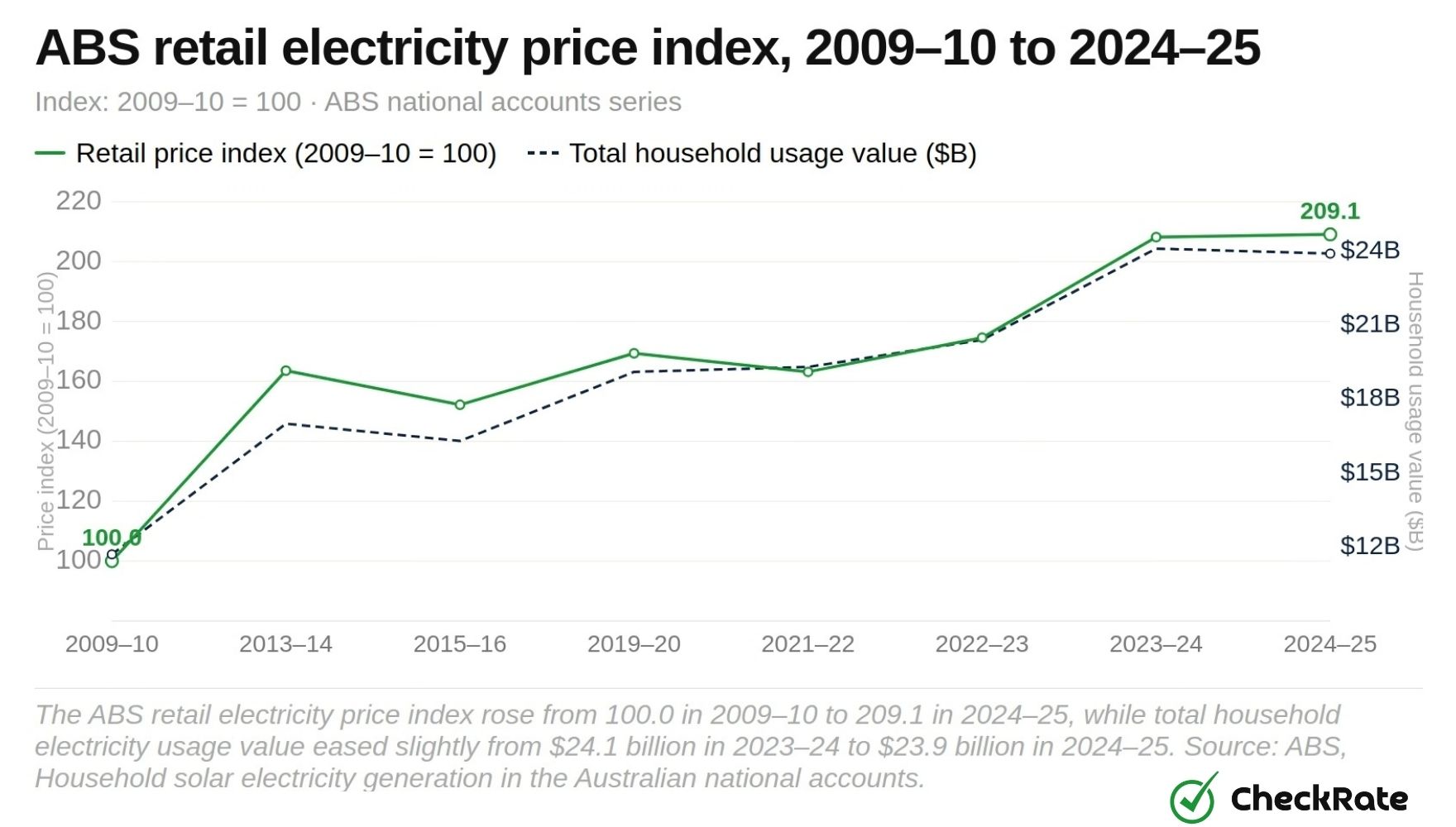
Australian household electricity usage was valued at $23.9 billion in 2024–25, up from $11.674 billion in 2009–10. That represents an increase of around 105% in nominal terms over 15 years.
Of that $23.9 billion, households paid $17.752 billion directly to retailers, governments covered a further $5.368 billion through rebates, and $798.8 million was attributed to household solar electricity consumed at home. The national average retail rate was approximately $0.29 per kWh, also around twice the 2009–10 level.
In the 12 months to April 2026, the electricity CPI rose 22.5%, primarily because government rebates that had reduced bills in 2024–25 came to an end. Excluding that rebate effect, underlying prices rose 3.1%, reflecting annual retailer reviews in July 2025.
- Retail price index
- Total household usage value ($B)

What is the most current official measure of what Australian households spend on electricity?+
How much do electricity bills vary by state?
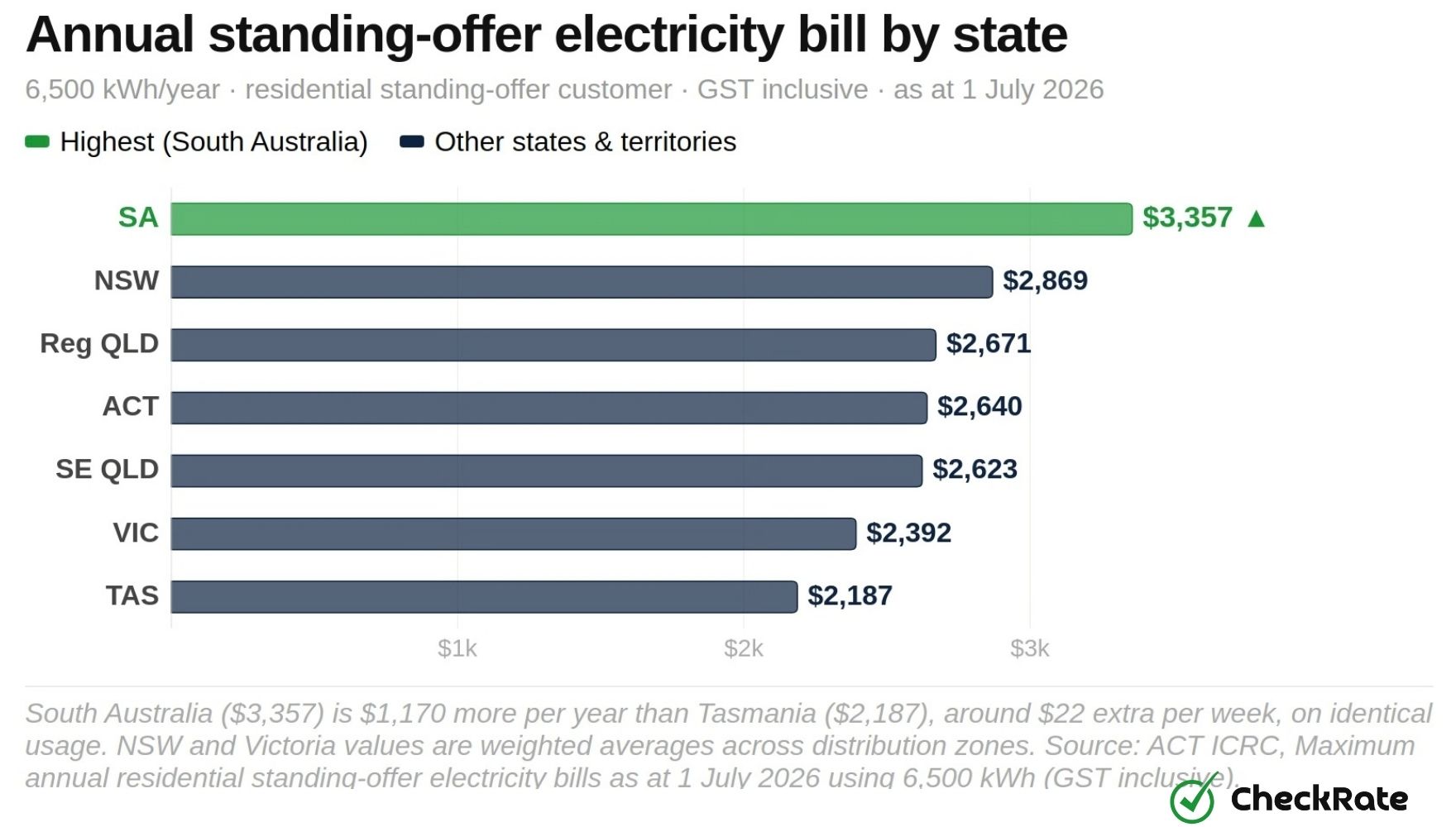
Using this benchmark, a South Australian household on a standing offer pays around $3,357 a year, or about $280 a month and $65 a week. A Tasmanian household using the same amount pays $2,187 a year, or about $182 a month and $42 a week. The $1,170 annual gap works out to about $22 a week more in South Australia, based on identical usage under the same plan type.
Usage above or below 6,500 kWh, concessions, solar and market offers will change the final bill.
The final determinations were released on 26 May 2026 and apply from 1 July 2026. Under these changes, NSW standing-offer benchmarks fall by 3.4% to 5.0%, south-east Queensland falls by 7.2%, and Victoria falls by 5.0%. South Australia rises by 1.4%, and the ACT rises by 2.73%.
Standing-offer benchmarks at 6,500 kWh (GST inclusive) as at 1 July 2026. WA and NT are outside the ICRC comparison; figures shown are from the Tasmanian Economic Regulator November 2025 report at 7,796 kWh and are marked with a dagger (†).
Source: ACT ICRC, Figure ES0.1, as at 1 July 2026. Tasmanian Economic Regulator, November 2025.
How network charges affect electricity bills
One major factor is network charges, which cover poles, wires and metering. These charges make up 39% to 54% of the standing-offer reference price, depending on the region. They are set by regulators, not retailers, so switching plans does not remove this part of the bill. Network tariff estimates increased for most customers in 2025–26.
Each state also runs a different pricing framework. NSW, south-east Queensland and South Australia use the AER's Default Market Offer. Victoria has its own Victorian Default Offer. The ACT has a regulated standing offer set by the ICRC. Western Australia uses state-approved tariffs. As a result, the same household using the same amount of electricity can face a structurally different bill depending on where it lives.
What does the $1,170 gap between South Australia and Tasmania actually mean for a household?+
How much of an electricity bill is made up of network costs?+
Electricity use rises with household size and colder climates
Household size is one of the main drivers of electricity consumption in the AER benchmark framework. A one-person household in Sydney uses around 3,109 kWh a year. A four-person household in the same area uses around 7,311 kWh, more than double.
The AER benchmarks are based on household size and climate zone; they do not publish separate electricity-use figures by dwelling type.
Climate zone is also a significant factor. A two-person household uses 4,840 kWh a year in Melbourne, which is Climate Zone 6, compared with 8,784 kWh in Tasmania, which is Climate Zone 7. That is an 82% difference and may reflect higher heating demand in colder months.
Climate zones are the Australian Building Codes Board (ABCB) thermal zones used across the National Electricity Market:
- Zone 1 and 3: Tropical and hot-dry inland (far north QLD)
- Zone 2: Brisbane, Gold Coast; hot humid summers, mild winters
- Zone 4: Hot-dry inland belt (parts of NSW, SA, VIC); hot summers, cool winters
- Zone 5: Sydney, Adelaide; warm summers, cool winters
- Zone 6: Melbourne; mild summers, cool winters, high gas penetration
- Zone 7: ACT, Tasmania, sub-alpine NSW and Victoria, and other colder southern areas; cold winters and high benchmark electricity consumption
AER benchmarks show annual grid electricity use across representative locations, household sizes and climate zones.
Consumption by household size and location
The table below shows annual electricity consumption benchmarks across representative locations and household sizes. These figures come from the AER's December 2020 benchmark report and are the most detailed official breakdown available at this level.
| Location | Climate zone | 1 person | 2 people | 3 people | 4 people |
|---|---|---|---|---|---|
| Brisbane / Gold Coast | Zone 2 (QLD) | 3,412 | 5,126 | 6,169 | 7,682 |
| Sydney / NSW Climate Zone 5 | Zone 5 (NSW) | 3,109 | 5,237 | 6,361 | 7,311 |
| Melbourne | Zone 6 (VIC) | 2,953 | 4,840 | 5,077 | 5,805 |
| Canberra / ACT | Zone 7 (ACT) | 4,360 | 6,107 | 7,722 | 9,542 |
| Tasmania | Zone 7 (TAS) | 6,003 | 8,784 | 9,475 | 10,820 |
Annual totals are the sum of the four quarterly seasonal benchmarks. Figures are electricity consumed from the grid only; self-consumed solar is not included. These are benchmarks for households without controlled load. In the AER benchmark report, households with controlled load typically consume about 25% to 45% more electricity than households without controlled load. Source: AER, Residential Energy Consumption Benchmarks, December 2020 (Frontier Economics), Tables 13–18.
What the data shows about dwelling type
The AER benchmarks do not publish separate figures for houses and apartments. The data is stratified by household size and climate zone only. A 1-person household in Sydney uses around 3,109 kWh a year, while a 4-person household in the same area uses around 7,311 kWh. The 135% difference reflects the number of occupants, not the building type. The benchmark data does not distinguish between a 4-person apartment and a 4-person house in the same climate zone.
Climate zone is also a major driver. A 2-person household in Tasmania uses 8,784 kWh a year, substantially more than a 4-person household in Melbourne, at 5,805 kWh a year. This comparison reflects climate zone and household size differences, not dwelling type.
Why do the AER benchmarks not break down by dwelling type?+
Why does Tasmania use so much more electricity than Melbourne?+
When are electricity bills highest in Australia?
Electricity bills are usually highest in summer in warmer climates and in winter in colder climates. Electricity prices rose by 22.5% in the 12 months to April 2026, primarily because government rebates that had reduced bills in 2024–25 ended. Excluding that rebate effect, underlying prices rose 3.1%, reflecting annual retailer reviews in July 2025.
No official source publishes a national table of household electricity bills by season. However, the AER's climate zone consumption benchmarks show when electricity use peaks across different parts of Australia.
- Warm climates (Brisbane, Gold Coast): Summer is the peak season. Air conditioning drives the highest electricity consumption in these zones.
- Cold climates (ACT, Tasmania, alpine NSW and VIC): Winter is the peak season. Climate Zone 7 records the highest total electricity consumption of any zone in Australia.
According to AER residential benchmark data, a two-person Hobart household uses an estimated 2,950 kWh in winter, compared with 1,581 kWh in summer. In Canberra, a two-person household uses 2,042 kWh in winter, about 70% higher than its summer figure of 1,200 kWh.
- Summer seasonal benchmark
- Winter seasonal benchmark
Summer electricity use peaks in warm climates
For households in Queensland and warmer parts of NSW, summer is the peak season for electricity use. Air conditioning is the key driver of higher summer consumption in these areas. Spring and autumn are typically the lowest-consumption seasons in warm climates.
Winter electricity use can nearly double in cold climates
For Tasmanians, ACT residents and those in alpine or inland southern regions, winter is the highest-consumption season by a significant margin. A two-person Hobart household's winter consumption of 2,950 kWh is 87% higher than its summer figure, with heating likely to be a major factor.
Time-of-use tariffs can widen seasonal bill differences
Where time-of-use tariffs apply, the seasonal difference in bills can widen further. Households with heavy evening loads such as air conditioning, EV charging, electric heating or cooking may face higher bills if more of their usage falls during peak-priced periods. The key variable is not just how much electricity a household uses, but when it uses it.
What is the dollar value of Hobart's seasonal electricity swing?+
How does seasonal electricity variation in Brisbane compare to Hobart?+
How electricity bills affect household budgets
Electricity costs take up a larger share of income for low-income households than for average-income households. As at 31 March 2025, after eligible concessions and rebates, low-income households spent 1.8% to 5.1% of income on electricity, compared with 1.0% to 2.7% for average-income households. This shows how electricity costs can fall unevenly across the income distribution.
On a broader spending basis, domestic fuel and power costs averaged $41 per week in the ABS Household Expenditure Survey 2015–16. This represented 2.9% of average weekly household spending. The ABS data is older than the AER income-share figures, but it provides a broad household spending benchmark.
The AER's State of the Energy Market 2025 also points to wider financial pressure among energy customers. In AER-commissioned research, 37% of surveyed energy customers were experiencing financial stress, and more than a third of financially stressed customers had been unable to pay an energy or water bill on time in the previous 12 months.
Source: Australian Energy Regulator, State of the Energy Market 2025, Chapter 6, customer debt and hardship data, 12 months to 31 March 2025.
As at 31 March 2025, 3.1% of residential customers had outstanding energy debt. The average balance per indebted customer rose from $1,106 to $1,415 over the same period.
Disconnection rates remain below pre-COVID levels, but energy debt and partial payments can continue to build for customers already in arrears.
Government rebates
Several rebates reduced out-of-pocket electricity costs in 2024–25, although they did not change underlying electricity tariffs. These include:
- Commonwealth Energy Bill Relief Fund: up to $300 in 2024–25, then a further $150 from 1 July 2025
- Queensland: additional $1,000 cost-of-living rebate in 2024–25
- Western Australia: separate $400 household rebate in 2024–25
Renters, older households and younger households
Electricity bill pressure does not fall evenly across households. Age, tenure, income, eligibility for concessions and access to solar or efficient appliances all affect how much a household pays relative to its income.
- Older households may report lower bills in some datasets, partly due to concessions, smaller household sizes and higher rates of rooftop solar ownership.
- Younger renters may have less access to efficiency upgrades, solar or batteries, and less control over insulation or heating systems.
- Renters may also live in embedded networks, which can limit access to competitive retail offers.
Combined with generally lower incomes, younger renters may be more exposed to electricity bill pressure than national averages suggest.
What is the estimated total value of outstanding residential energy debt in Australia?+
By how much has average energy debt per customer grown in one year?+
- 1.Australian Bureau of Statistics, Household solar electricity generation in the Australian national accounts: 2024–25.
- 2.ABS: Consumer Price Index, Australia, April 2026.
- 3.ABS: Household Expenditure Survey, summary of results, 2015–16.
- 4.Independent Competition and Regulatory Commission: retail electricity price recalibration 2026–27, May 2026.
- 5.Tasmanian Economic Regulator: Comparison of electricity and gas prices for small customers in Australia, November 2025.
- 6.Australian Energy Regulator: Default Market Offer 2026–27: Final Determination, 26 May 2026.
- 7.Essential Services Commission Victoria: Victorian Default Offer price review 2026–27.
- 8.Australian Energy Regulator: State of the Energy Market 2025: Chapter 6: Retail energy markets and energy consumers.
- 9.Australian Energy Regulator: Annual retail markets report 2024–25: Retail energy markets and energy consumers.
- 10.Australian Energy Regulator, Residential Energy Consumption Benchmarks, December 2020, prepared by Frontier Economics.
Data Snapshots