


Published
 The 50% CGT discount vs indexation: the numbers behind the 2026 reformThe Treasury Laws Amendment (Tax Reform No. 1) Act 2026 and the Income Tax Rates Amendment (Tax Reform No. 1) Act 2026 introduce cost base indexation and a 30% minimum tax on eligible real gains from…
 How does the Australian tax system work?Australian governments collected $839.0 billion in tax revenue in 2024–25, according to the ABS. The Commonwealth collected 80.5% of that total, compared with 16.6% for state and territory governments…
 Is Australia a high-tax country? How it compares with other OECD countriesAustralia's tax-to-GDP ratio was 29.9% in 2023–24, the latest OECD figure available for Australia, up 0.6 percentage points from 29.3% the year before. The ratio counts the tax collected by all levels…
Section 01 · The headline numbers
How much net capital gain did taxpayers report in 2023–24?
Individuals reported $40.6 billion in net capital gains in 2023–24. The ATO's Taxation statistics 2023–24 record a net capital gain label of $40,599,125,002 across 1,324,862 returns, up 2.5% from the $39.6 billion of 2022–23 as updated in the same edition1. Net capital gain is the amount left after capital losses, the CGT discount and small business concessions, so the gross gains were much higher.
The tax attributable to those gains is an estimate, because capital gains tax is not a separate tax: the gain is added to taxable income and taxed at the person's rates. The ATO estimated that tax was payable on gains reported in 1,126,041 returns, totalling $14.1 billion, an average of $12,487 and a median of $238 among those with estimated tax payable on their gains1. The remaining 198,821 reporters (1,324,862 minus 1,126,041) had no estimated tax on their gains; nearly all were in returns the ATO classes as non-taxable2.
How assessments like these net out into refunds or bills is covered in the average tax refund article.
| Individual net capital gains and estimated tax, Australia, 2023–24 | |
|---|---|
| Measure | Value |
| Individuals reporting a net capital gain | 1,324,862 |
| Share of all 16,584,287 individuals who lodged | 8.0% |
| Total net capital gains | $40,599,125,002 |
| Average net capital gain | $30,644 |
| Median net capital gain | $1,247 |
| Estimated tax on net capital gains (ATO estimate) | $14,061,275,567 |
Source · ATO, Taxation statistics 2023–24, Individuals Tables 1A and 1B (published 17 June 2026). Returns processed by 31 October 2025. Share derived: 1,324,862 ÷ 16,584,287.
Section 02 · Who reports
How many taxpayers reported a capital gain?
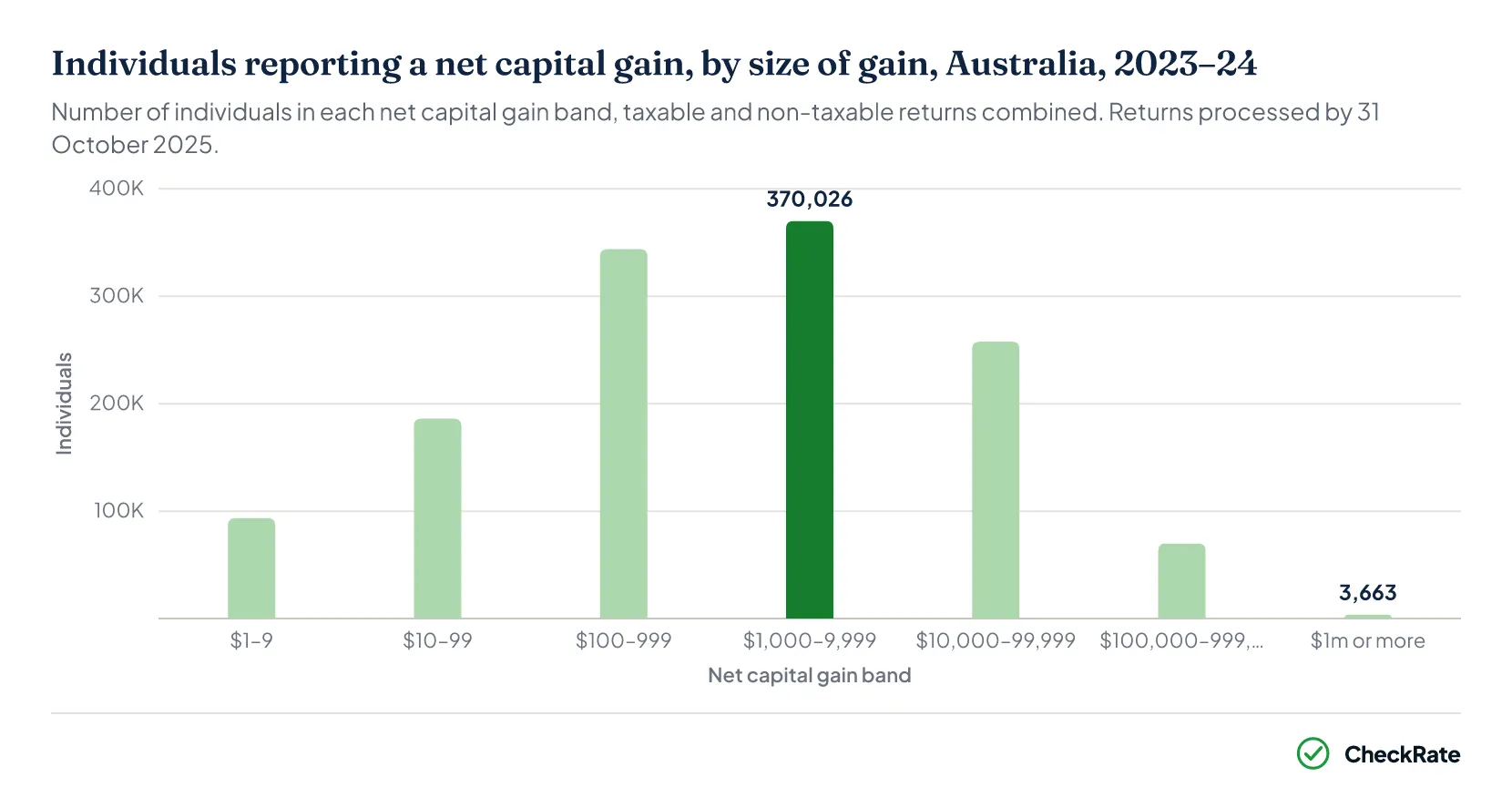
A total of 1,324,862 individuals reported a net capital gain in 2023–24, equal to 8.0% of all individuals who lodged a return. Of those individuals, 993,571 reported less than $10,000, equal to 75.0% of all reporters2. That is why the median gain of $1,247 sits so far below the average of $30,644: a small group of very large gains pulls the average up.
At the top end, 3,663 people, 0.28% of reporters, had a net capital gain of $1 million or more in 2023–24, yet their gains totalled $14.0 billion, accounting for 34.5% of all net capital gains, and carried $6.2 billion, or 43.8%, of the estimated tax.2 Across the broader group with gains of $100,000 or more, 73,570 reporters, or 5.6% of all reporters, accounted for 72.7% of total net capital gains.
Section 03 · By income range
Capital gains by taxable income range
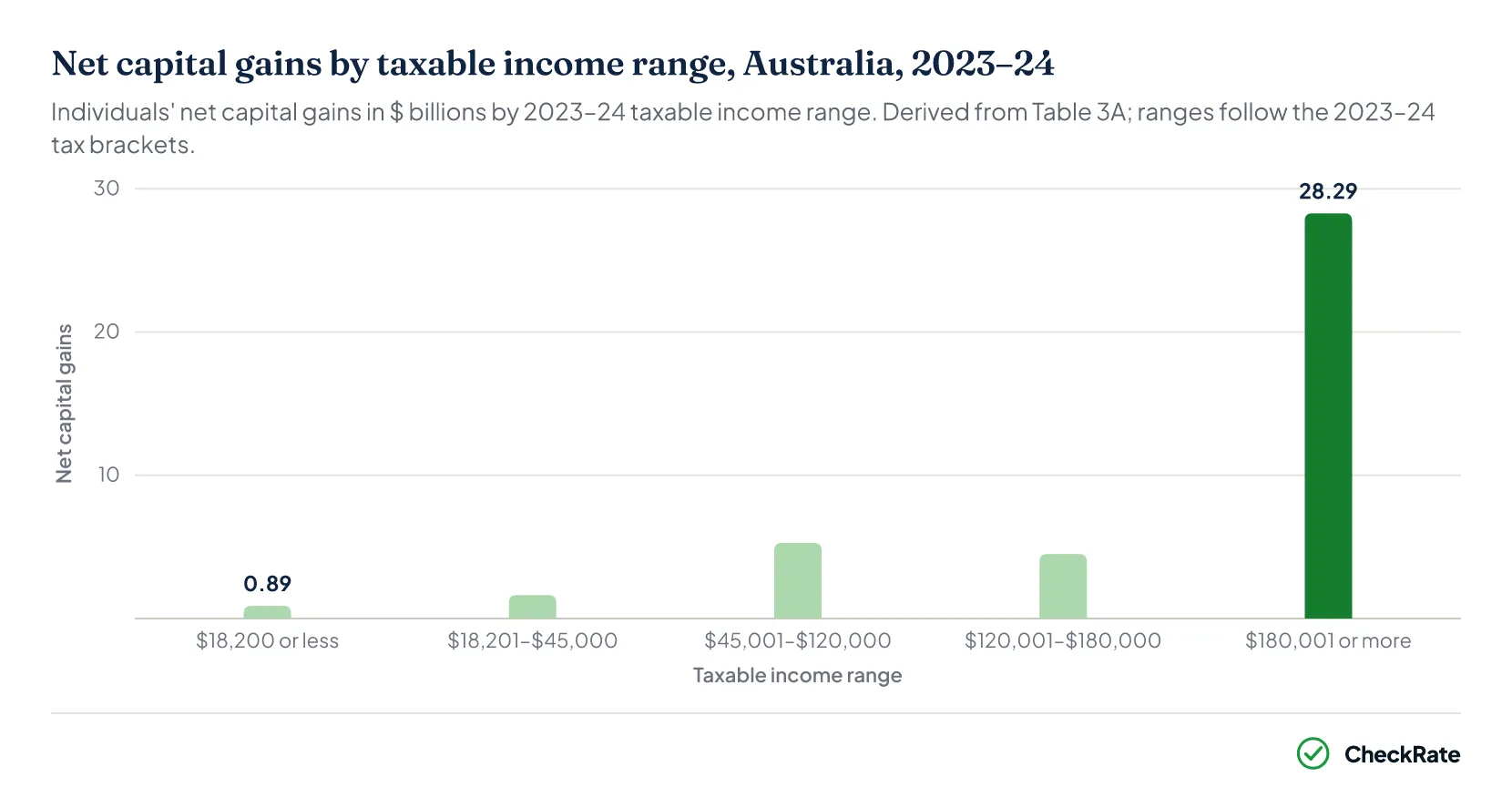
Capital gains were concentrated at the top of the taxable income scale in 2023–24. Individuals with taxable income above $180,000 reported $28.3 billion of the $40.6 billion in net capital gains, and accounted for $11.7 billion of the $14.1 billion in estimated tax3. Reporting a gain was also far more common in this income range: 21.9% of the 997,429 people with taxable income above $180,000 reported one, against 8.0% of individuals overall and 5.3% of those at or below the $18,200 tax-free threshold.
One limitation applies when reading this table: taxable income includes the net capital gain itself, so a person who realises a large gain can move into the top range for that year alone4.
Marginal rates for each range are set out in the income tax brackets article.
| Capital gains by taxable income range, Australia, 2023–24 | ||||
|---|---|---|---|---|
| Taxable income range | Reporting a gain | Share of that range | Net capital gains | Estimated tax |
| $18,200 or less | 126,557 | 5.3% | $0.89b | $3.5m |
| $18,201 – $45,000 | 238,799 | 6.0% | $1.64b | $75.4m |
| $45,001 – $120,000 | 514,804 | 6.9% | $5.28b | $1.08b |
| $120,001 – $180,000 | 226,356 | 12.9% | $4.51b | $1.24b |
| $180,001 or more | 218,346 | 21.9% | $28.29b | $11.67b |
Source · derived from ATO, Taxation statistics 2023–24, Individuals Table 3A, aggregated by taxable income range; aggregates reconcile exactly with Table 1A. Share of that range is reporters divided by all individuals lodging in the range. Dollar values rounded from exact cells.
Section 04 · Asset types
Which asset types generated the capital gains?
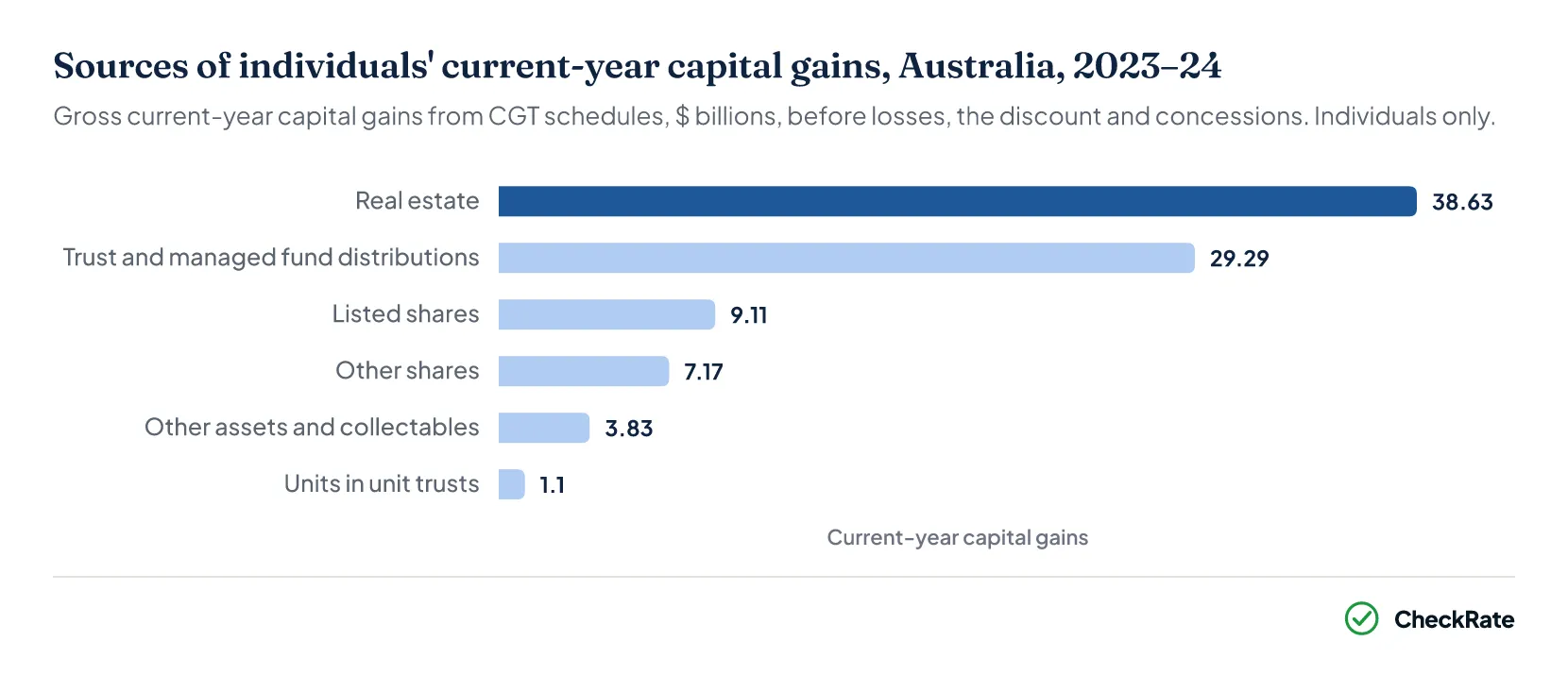
Real estate generated the largest dollar value of current-year capital gains in 2023–24. Individuals reported $37.6 billion of current-year gains from real estate situated in Australia, with 212,960 individuals reporting gains in this category, plus $1.0 billion from other real estate.5 Listed shares were the most common source, with 301,970 people reporting gains on Australian-exchange shares. Those gains totalled $9.1 billion, less than a quarter of the real estate figure.
The main residence is generally exempt from CGT, so the real estate figures do not represent gains across all residential property6.
The asset components below sum to $89.1 billion against a published total of $90.6 billion; the ATO notes that totals may not equal the sum of components, and some items are combined for privacy5.
Section 05 · Revenue
How much revenue does capital gains tax raise?
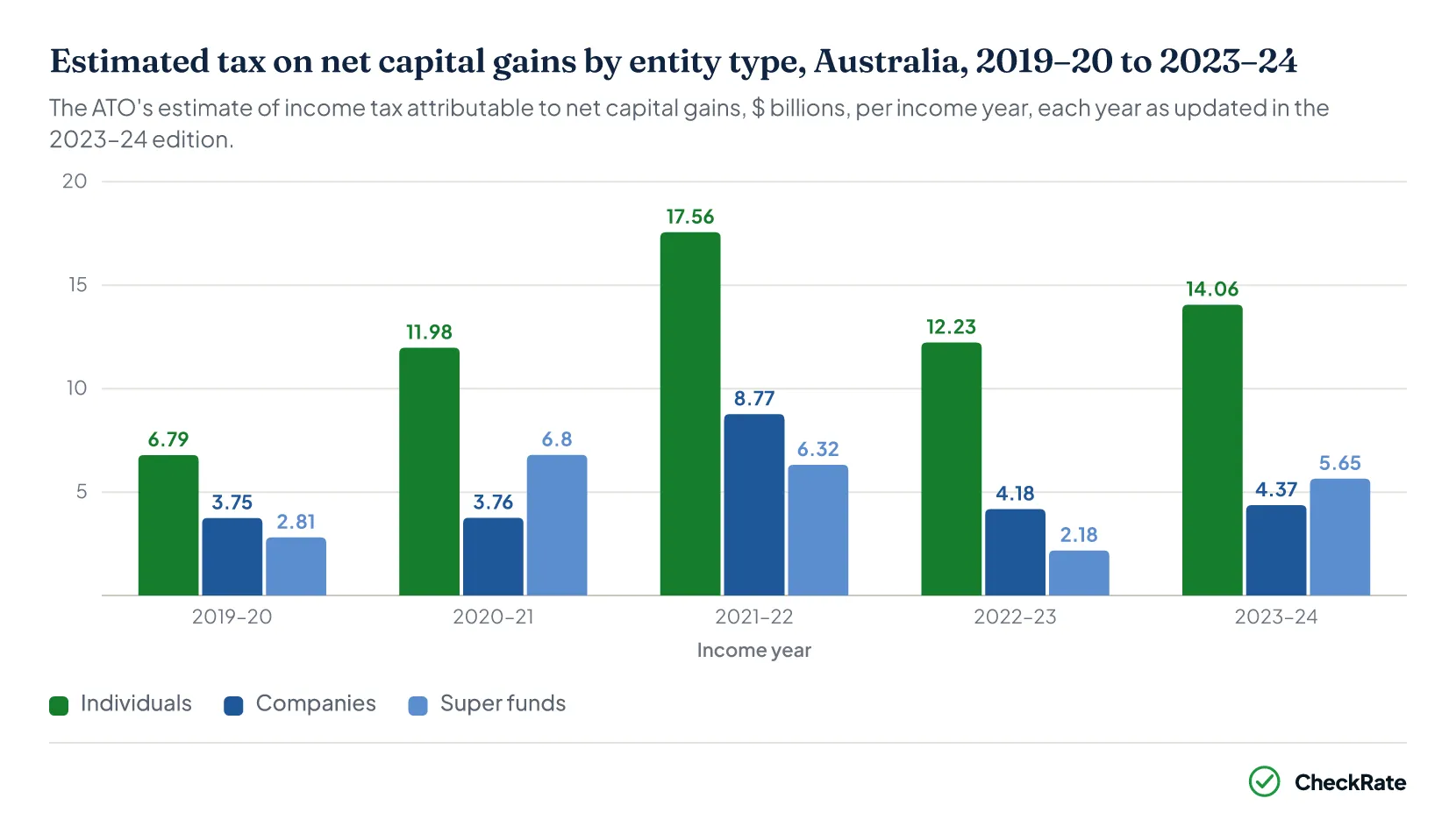
Capital gains tax is not reported as a separate government revenue line because net capital gains form part of taxable income and are taxed under income tax. Instead, the ATO publishes an estimate of tax attributable to net capital gains. For 2023–24 it estimated $14.06 billion for individuals, $4.37 billion for companies and $5.65 billion for super funds, or $24.1 billion in total7. Against the edition's $630.9 billion of total tax liabilities from all sources, the combined estimate is about 3.8%, derived by dividing 24.08 by 630.9. For individuals alone, the estimate equals about 4.3% of the $329.5 billion in individual income tax.
Individuals are not the whole picture. In the 2023–24 CGT schedules, super funds reported $42.4 billion of net capital gains, more than individuals' $40.6 billion, with companies at $18.6 billion5. The estimated tax ranks differently because the entities face different rates: complying super funds discount eligible gains by one third and generally pay 15% on accumulation-phase earnings8.
Section 06 · The discount
How does the CGT discount change taxable gains?
The discount is the largest reported reduction between gross current-year gains and net capital gains. Under the rules that apply until 30 June 2027, a resident individual or trust that has owned an asset for at least 12 months can generally reduce an eligible capital gain by 50%8.
In the 2023–24 schedules, 602,746 individuals applied a combined $38.9 billion of CGT discount, reducing $90.6 billion of gross current-year gains to $40.6 billion of net capital gains after losses, the discount, concessions and other adjustments5.
The tax effect of the discount varies according to the marginal tax rate that applies to the net capital gain and the person's broader tax position, including offsets and levies.
Treasury counts the discount for individuals and trusts as tax expenditure E15, with revenue forgone of $17.4 billion in 2023–24.9 Its distributional analysis for 2022–23 found around 83% of the benefit went to the top taxable income decile, and that the top 1% of tax filers accounted for 54% of all capital gains income, with an average gain of $850,690 compared with $29,240 for other reporters8.
| How gross capital gains were reduced to net capital gains, Australia, 2023–24 | ||
|---|---|---|
| Step (CGT schedule data) | Amount | People |
| Total current-year capital gains | $90.59b | 1,678,315 |
| Capital losses applied (current and prior year) | −$6.62b | 381,294 |
| CGT discount applied | −$38.86b | 602,746 |
| Small business CGT concessions | −$3.67b | 17,688 |
| Net capital gain | $40.63b | 1,321,190 |
Source · ATO, Taxation statistics 2023–24, CGT Table 1 (CGT schedules). The steps do not reconcile exactly to the net figure (residual about $0.81 billion) because of other exemptions and adjustments; the ATO notes totals may not equal the sum of components.
Section 07 · The 2027 change
What replaces the CGT discount from 1 July 2027?
From 1 July 2027, the 50% CGT discount for individuals, trusts and partnerships will be replaced with CPI-based cost base indexation, alongside a 30% minimum tax rate on real capital gains accruing after that date.6
Announced in the 2026–27 Budget on 12 May 2026, the Treasury Laws Amendment (Tax Reform No. 1) Act 2026 received assent on 26 June 2026 and is in force, with Schedule 1 carrying the CGT adjustments and the minimum rate. The companion Income Tax Rates Amendment (Tax Reform No. 1) Act 2026 received assent the same day10.
CPI indexation of cost bases previously applied between 1985 and 1999, before the 50% discount replaced it. Under the new rules, only the gain above inflation is taxed in full, whereas the discount taxed half the nominal gain regardless of inflation. Whether a person pays more or less than under the discount depends on their returns, the inflation rate over the holding period and their marginal rate. Budget examples show a low-return investor paying less under indexation and a high-return investor paying more.
For existing holdings, the discount still applies to the gain accrued to 1 July 2027, valued at that date, with indexation and the minimum tax applying beyond it. The main residence exemption and the small business CGT concessions are unchanged, and recipients of means-tested income support are exempt from the minimum tax in a year in which they receive a payment6.
Until 30 June 2027
50% of the nominal gain excluded for resident individuals and trusts, after 12 months' ownership
Gain taxed at the person's marginal rates
No minimum rate
The rules in force since 1999; still the law for gains accrued to 30 June 2027.
From 1 July 2027 · legislated
Cost base indexed by CPI; only the above-inflation gain is taxed
30% minimum tax rate on capital gains
Applies to gains accruing after 1 July 2027, on realisation
Treasury Laws Amendment (Tax Reform No. 1) Act 2026, assent 26 June 2026.
Unchanged
Main residence exemption
The four small business CGT concessions
60% discount for qualifying affordable housing
New builds: investors may choose the discount instead
Per the Budget 2026–27 factsheet's exemptions list.
Section 08 · The long run
How have reported capital gains changed over time?
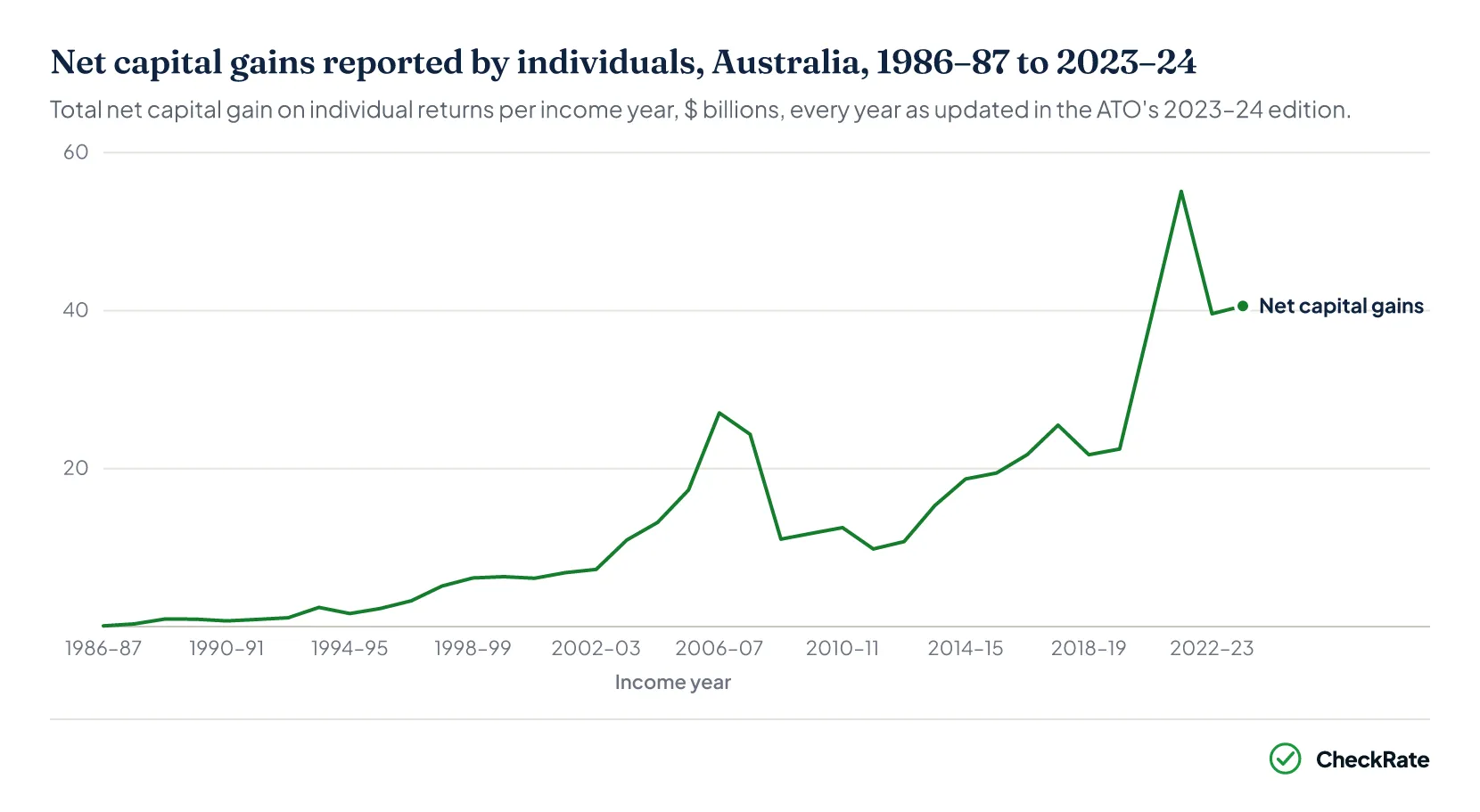
Individuals' reported net capital gains have varied sharply over time. The ATO's long-run table starts the net capital gain series at $103 million in 1986–87, the first full year after CGT began. Net capital gains passed $6 billion by 1998–99, $27 billion in 2006–07, and peaked at $55.1 billion in 2021–22. They then fell to $39.6 billion in 2022–23 before rising slightly to $40.6 billion in 2023–24.1 Reported gains more than halved in 2008–09, falling 54% from the previous year, and fell 28% from the 2021–22 peak to 2022–23.
The number of people reporting gains has also moved with the total value of gains. Reporters climbed from 885,543 in 2019–20 to 1,494,888 in 2021–22, eased to 1,172,068 in 2022–23 and stood at 1,324,862 in 2023–24, all within a return population that grew steadily1. Statistics for years under the new indexation rules do not yet exist: the first income year they can affect is 2027–28.
Section 09
Capital gains tax: quick answers
How many people pay capital gains tax in Australia?
The ATO estimated that about 1.13 million individuals had tax payable on net capital gains in 2023–24. In total, 1,324,862 individuals reported a net capital gain, equal to 8.0% of the 16.58 million who lodged a return, while about 199,000 had no estimated tax on their gains. CGT is part of income tax, not a separate tax, so the tax figures are ATO estimates of the income tax attributable to gains.
How much capital gains tax do individuals pay?
The ATO's estimate for 2023–24 was $14.1 billion of tax on individuals' net capital gains, an average of $12,487 and a median of $238 per person with estimated tax payable. Because CGT is part of income tax rather than a separate tax, this is an ATO estimate of the tax attributable to gains, not a separately assessed amount.
What is the average capital gain in Australia?
Among the 1.32 million individuals who reported a net capital gain in 2023–24, the average was $30,644 and the median was $1,247. The two differ because a small number of very large gains lift the average: the 3,663 people with gains of $1 million or more accounted for 34.5% of all net capital gains.
Is the 50% capital gains tax discount being abolished?
Yes, for gains accruing from 1 July 2027. The Treasury Laws Amendment (Tax Reform No. 1) Act 2026, which received assent on 26 June 2026, replaces the 50% discount for individuals, trusts and partnerships with CPI cost base indexation and a 30% minimum tax on those future gains. Gains accrued before 1 July 2027 keep the discount under transitional rules, and the main residence exemption is unchanged.
What is the biggest source of capital gains in Australia?
Real estate. Individuals with CGT schedules for 2023–24 reported $38.6 billion of current-year gains from real estate, ahead of $29.3 billion from trusts and managed funds distributions and $16.3 billion from shares. The asset components sum to $89.1 billion against a published $90.6 billion total; the ATO notes that totals may not equal the sum of components.
Do superannuation funds pay capital gains tax?
Yes. Super funds reported $42.4 billion of net capital gains in 2023–24 CGT schedules, more than the individuals or companies in the same tables, with an ATO-estimated $5.65 billion of tax. Complying super funds discount eligible gains by one third, and their earnings are generally taxed at 15% in the accumulation phase.
References
- ATO, Taxation statistics 2023–24, Individuals Table 1: selected items by year (Tables 1A and 1B) · data.gov.au ↑ b c d
- ATO, Taxation statistics 2023–24: CGT Table 2 · data.gov.au ↑ b c
- ATO, Taxation statistics 2023–24: Individuals Table 3 (Table 3A) · data.gov.au ↑
- ATO, What is capital gains tax? (QC 69844) · web.archive.org ↑
- ATO, Taxation statistics 2023–24: CGT Table 1 · data.gov.au ↑ b c d
- Australian Government, Budget 2026–27 factsheet: Negative Gearing and Capital Gains Tax Reform · budget.gov.au ↑ b c
- ATO, Taxation statistics 2023–24, Snapshot chart data · data.gov.au ↑
- Treasury, 2025–26 Tax Expenditures and Insights Statement · treasury.gov.au ↑ b c
- Treasury, 2025–26 Tax Expenditures and Insights Statement (PDF) · treasury.gov.au ↑
- Treasury Laws Amendment (Tax Reform No. 1) Act 2026 (Cth), No. 49 of 2026 · legislation.gov.au ↑
- ATO, Tax reform: boosting home ownership, reforming negative gearing and capital gains tax (QC 107304) · web.archive.org
- ATO, Taxation statistics 2023–24 overview (QC 107505) · web.archive.org