


Published 17 July 2026
- Revenue forgone
- $21.79bn
- Revenue forgone from the current 50% CGT discount in 2025-26, Treasury estimate
- Top income decile
- 83%
- Share of the discount's benefit going to the top income decile, 2022-23
- Minimum tax rate
- 30%
- Minimum tax rate applying to eligible real capital gains from 1 July 2027
- Royal assent
- 26 Jun 2026
- Date the reform received royal assent and became law
- Annual CPI inflation
- 4.0%
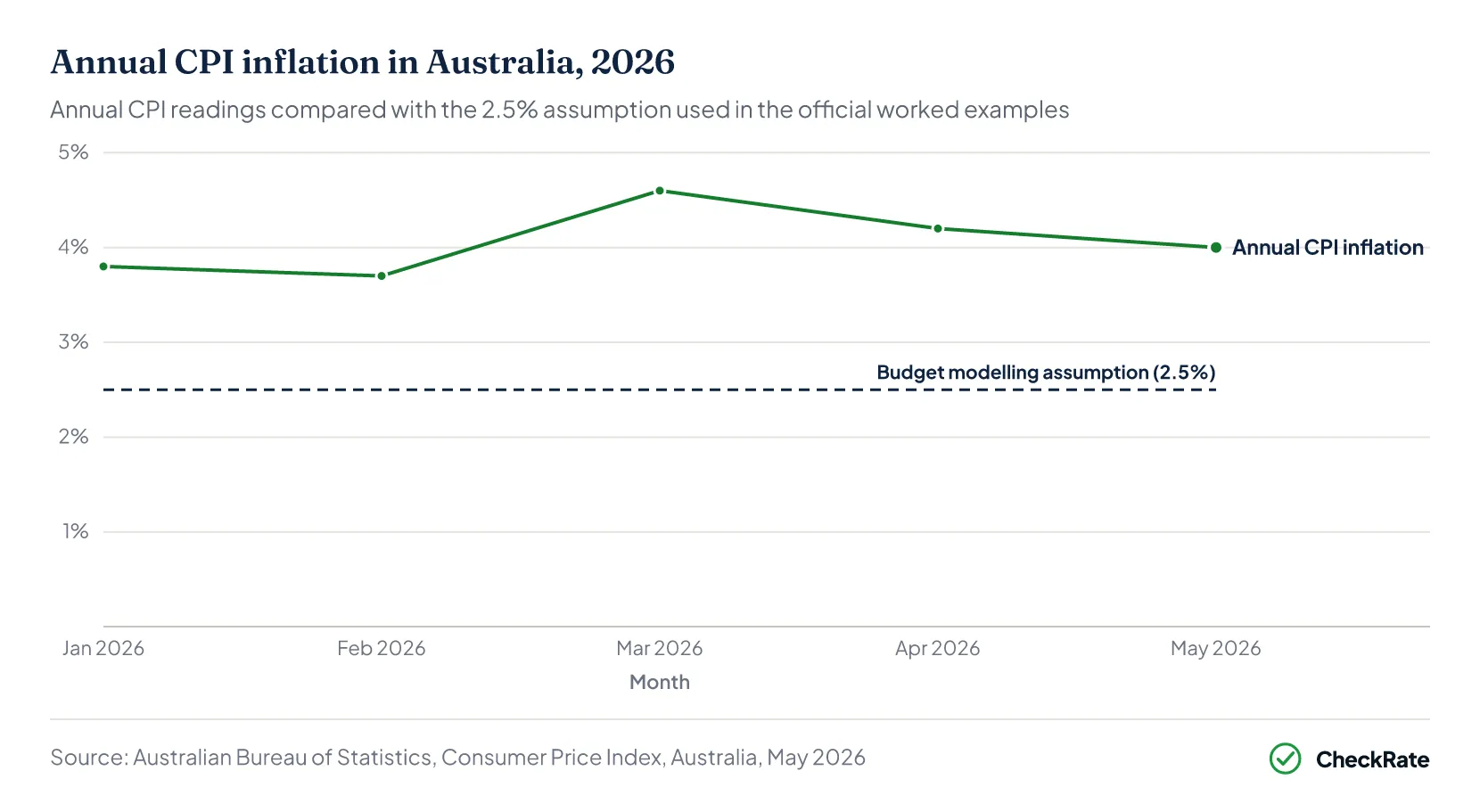
- Annual CPI inflation in the 12 months to May 2026; current context only
The Treasury Laws Amendment (Tax Reform No. 1) Act 2026 and the Income Tax Rates Amendment (Tax Reform No. 1) Act 2026 introduce cost base indexation and a 30% minimum tax on eligible real gains from 1 July 2027, replacing the flat 50% discount for affected gains. Both Acts passed Parliament on 25 June 2026 and received royal assent the following day.
The reform applies broadly to eligible gains made directly by individuals or attributed through trusts and partnerships on assets held for at least 12 months. The minimum tax is imposed at the Australian-resident individual level, including relevant gains attributed through trusts. It does not affect the 2026 tax return. Gains that accrue before 1 July 2027 keep the existing 50% discount, and only the portion of a gain accruing after that date is taxed under the new rules.

Section 01 · The current discount
How the current 50% capital gains tax discount works
Australian resident individuals who hold a CGT asset for at least 12 months can reduce an eligible capital gain by 50%. Complying superannuation funds can reduce an eligible capital gain by one-third; companies generally cannot use the discount, and foreign or temporary residents may have the discount apportioned to reflect their periods of Australian residence after 8 May 2012. Capital losses are applied first, and the discount is applied only after that.
The discount ranks among the largest tax expenditures and deductions tracked by Treasury. In 2025-26, its estimated revenue forgone is below the tax expenditure for concessional employer superannuation contributions and the tax reduction from rental deductions, but above the tax reduction from work-related expense deductions.
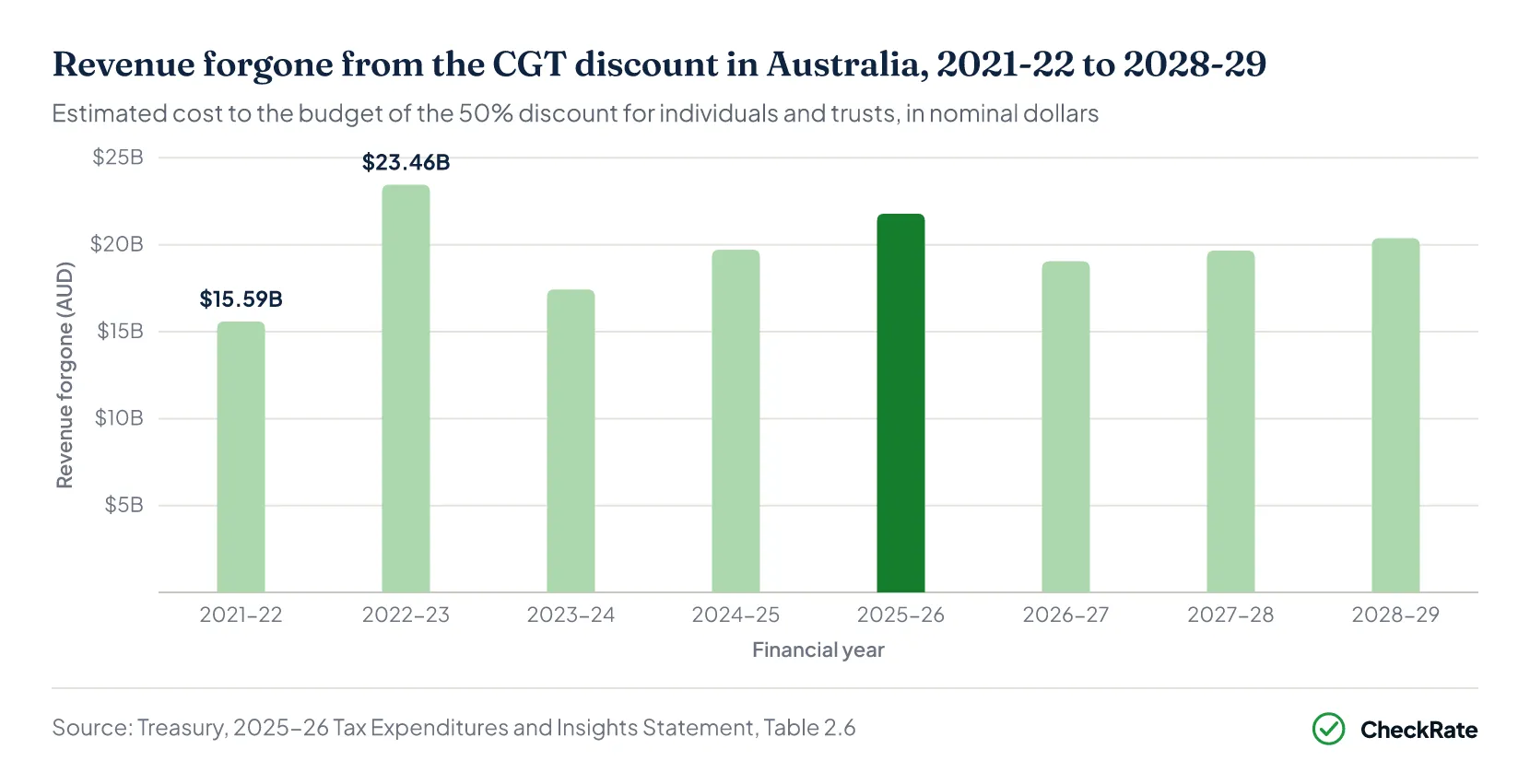
The benefit is also heavily concentrated. In 2022-23, the most recent year with detailed data, around 830,000 people were affected by the discount and more than 1.1 million individual tax filers realised a net capital gain. Of those filers, 71% benefited from the discount.
The distribution of the discount also differs by gender and age. In 2022-23, around 420,000 men and 410,000 women used the discount, with men receiving 58% of the benefit and women 42%. By age, the single largest share of the benefit, 20%, went to people aged 60 to 64, with a small number of individuals receiving a particularly large share of the benefit.
Section 02 · History
How capital gains tax indexation worked before 1999
For 14 years, from 1985 to 1999, Australia taxed only the inflation-adjusted part of a capital gain, with the cost base of an asset increased in line with the consumer price index (CPI). The 50% discount replaced that system in 1999 to simplify the rules and encourage investment. The 2026 reform reintroduces indexation in a modified form: it is not an exact return to the pre-1999 system, since it also adds a 30% minimum tax on real gains that did not exist before 1999.
1985
CGT introduced
Cost base indexed to CPI. Only real gains above inflation were taxed.
1999
Discount replaces indexation
Flat 50% discount introduced for assets held 12 months or more, frozen indexation preserved for older assets.
2027
Indexation returns
Cost base indexation replaces the 50% discount, with a 30% minimum tax applying to eligible real gains from 1 July 2027.
The old indexation method is still relevant today. For assets acquired at or before 11.45am on 21 September 1999, a taxpayer can still choose to index the cost base, though only up to 30 September 1999, since indexation was frozen at that point. For a particular capital gain, a taxpayer can choose the method that produces the better result, but the two methods cannot be combined for that gain. Indexation can reduce a capital gain but can never create or increase a capital loss, and the third element of the cost base, which covers holding costs, can never be indexed.
The result can change when capital losses are involved. In an ATO illustrative example, a taxpayer with a gain of $10,000 under the discount method, before the 50% reduction, or $7,000 under indexation, and no capital losses, ends up better off under the discount method: a taxable gain of $5,000 against $7,000 under indexation. Add a $5,000 capital loss on a separate asset, and the result flips: indexation gives a net taxable gain of $2,000, compared with $2,500 under the discount method, a better outcome by $500. This illustrates why capital losses can change which method produces the lower taxable gain.
| Discount vs indexation, with and without a capital loss | |||
|---|---|---|---|
| Scenario | Discount method | Indexation method | Better result |
| No capital losses | $5,000 taxable gain | $7,000 taxable gain | Discount |
| With a $5,000 capital loss on another asset | $2,500 net taxable gain | $2,000 net taxable gain | Indexation |
Source · Australian Taxation Office, Choosing the indexation or discount method.
Section 03 · The 2027 reform
What changes to capital gains tax from 1 July 2027
From 1 July 2027, eligible capital gains will be calculated using cost base indexation instead of the 50% CGT discount. The indexation rules apply to affected gains made directly by individuals or through trusts and partnerships. A separate 30% minimum tax may apply at the Australian-resident individual level, including where a gain is attributed through a trust.
The change applies broadly across CGT assets held for at least 12 months, including post-1 July 2027 growth on assets acquired before 20 September 1985, which are generally treated as pre-CGT assets under current rules.
Some parts of the system stay the same:
- The main residence exemption is unchanged.
- The four small business CGT concessions remain available, but from 1 July 2027 the aggregated turnover threshold for the 50% active asset reduction increases from $2 million to $10 million.
- Complying superannuation funds keep the existing one-third discount.
- Companies remain ineligible for the general 50% CGT discount, as they were never eligible for one.
Two exceptions preserve the current discount as a choice. Investors in eligible new residential dwellings can choose either the 50% discount or the new indexation and minimum tax arrangements when they sell. Owners of eligible affordable housing have the same choice, with the affordable housing discount reaching up to 60% instead of 50%.
The Budget sets out the fiscal impact of the combined package below, covering both the related implementation payments and the additional receipts the package is expected to raise.
| Budget impact of the combined negative gearing and CGT reform package | ||||
|---|---|---|---|---|
| Budget measure | 2026-27 | 2027-28 | 2028-29 | 2029-30 |
| Related implementation payments | $16.4m | $45.0m | $23.9m | $13.7m |
| Additional receipts from the combined negative-gearing and CGT reform package | not zero, rounded to zero | not zero, rounded to zero | $1,350.0m | $2,280.0m |
Source · Budget Paper No. 2, 2026-27, Tax Reform, Boosting Home Ownership, reforming negative gearing and capital gains tax.
Over the five years from 2025-26, the combined negative gearing and CGT reform package is projected to raise $3.6 billion in additional receipts, helping to fund other measures in the same Budget, including a new $250 Working Australians Tax Offset from 2027-28. The Budget does not separately identify the CGT component of that total. Non-zero effects begin in 2026-27 but round to zero at this level of precision, and material receipts first appear from 2028-29.
Section 04 · The transition
How the 2027 CGT transition rules work
Assets owned before 1 July 2027 and sold after that date are split into two tax portions: one taxed under the 50% discount, the other under indexation and the minimum tax. Under a mechanism known as a deemed sale, each relevant CGT asset is treated as sold just before 1 July 2027 and immediately reacquired on that date. Any notional gain or loss from that deemed sale is disregarded at the time and calculated only once the asset is actually sold. Taxpayers can use a formal valuation around the transition date, or an apportioning formula, and can wait until the year the asset is actually sold to make that choice.
Section 05
Total taxable gain under Australia's 2027 CGT transition
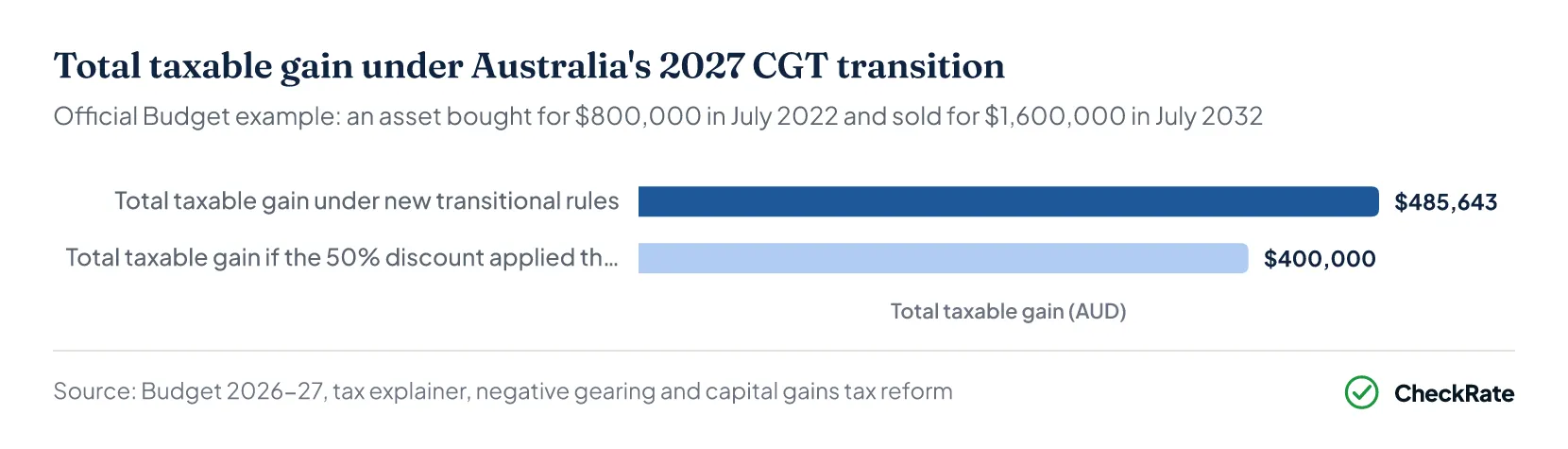
In this example, the asset is worth $1,131,371 at 1 July 2027. The pre-reform gain of $331,371 is reduced by the 50% discount to a taxable amount of $165,685. The post-reform gain of $468,629 is reduced by indexation to $319,958. The combined taxable gain of $485,643 is $85,643 more than the $400,000 that would have applied had the 50% discount covered the whole period. At a 47% tax rate, that is $228,252 in tax under the new rules, against $188,000 under the old rules, a difference of $40,252.
For comparison, a shorter two-year example uses an investor already owning a property before the reform, worth $500,000 at 1 July 2027 and sold for $560,000 two years later. Assuming annual inflation of 2.5%, it produces a post-reform taxable gain of $34,688 under indexation, against $30,000 under the 50% discount.
This is an official Budget example. Calculation: $560,000 − ($500,000 × 1.025²) = $34,688, rounded to the nearest dollar.
Source: Budget 2026-27, tax explainer, negative gearing and capital gains tax reform.
Section 06 · Returns and inflation
How inflation and returns affect the 50% CGT discount vs indexation
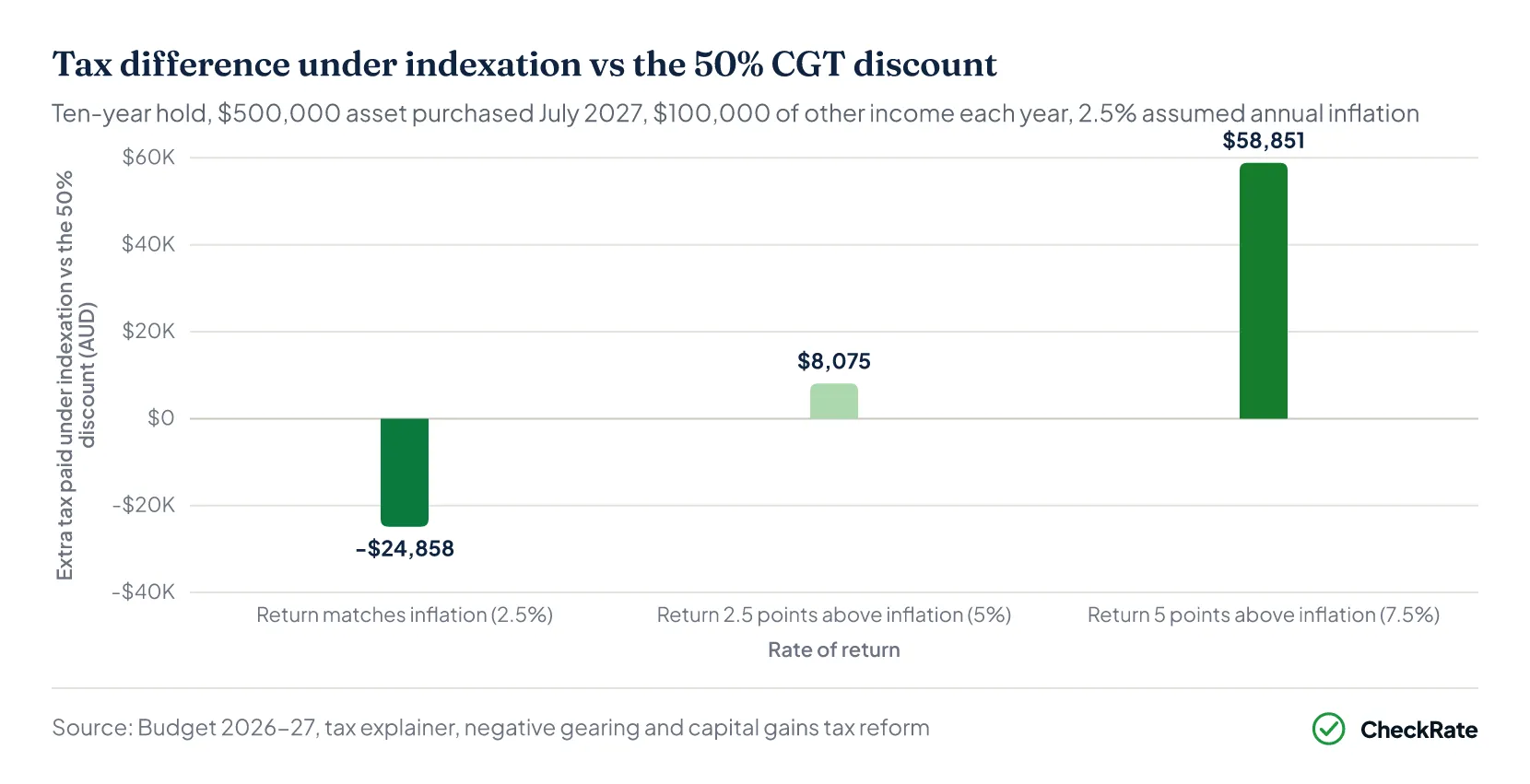
The official government case studies for the new rules assume annual inflation of 2.5%. This is a modelling assumption, not a forecast of inflation from 2027. Holding that inflation assumption constant, the outcome still depends heavily on the rate of return an asset achieves above inflation.
Using a $500,000 asset purchased in July 2027 and held for ten years, with $100,000 of other income each year and 2.5% annual inflation, the published examples cover three rates of return.
Australia's annual CPI inflation was 4.0% in the 12 months to May 2026, after reaching 4.6% in the 12 months to March. These figures provide current inflation context but are not an alternative assumption for assets held over several years from 2027.
Section 07 · Holding periods and asset types
How holding periods and asset types affect CGT under indexation
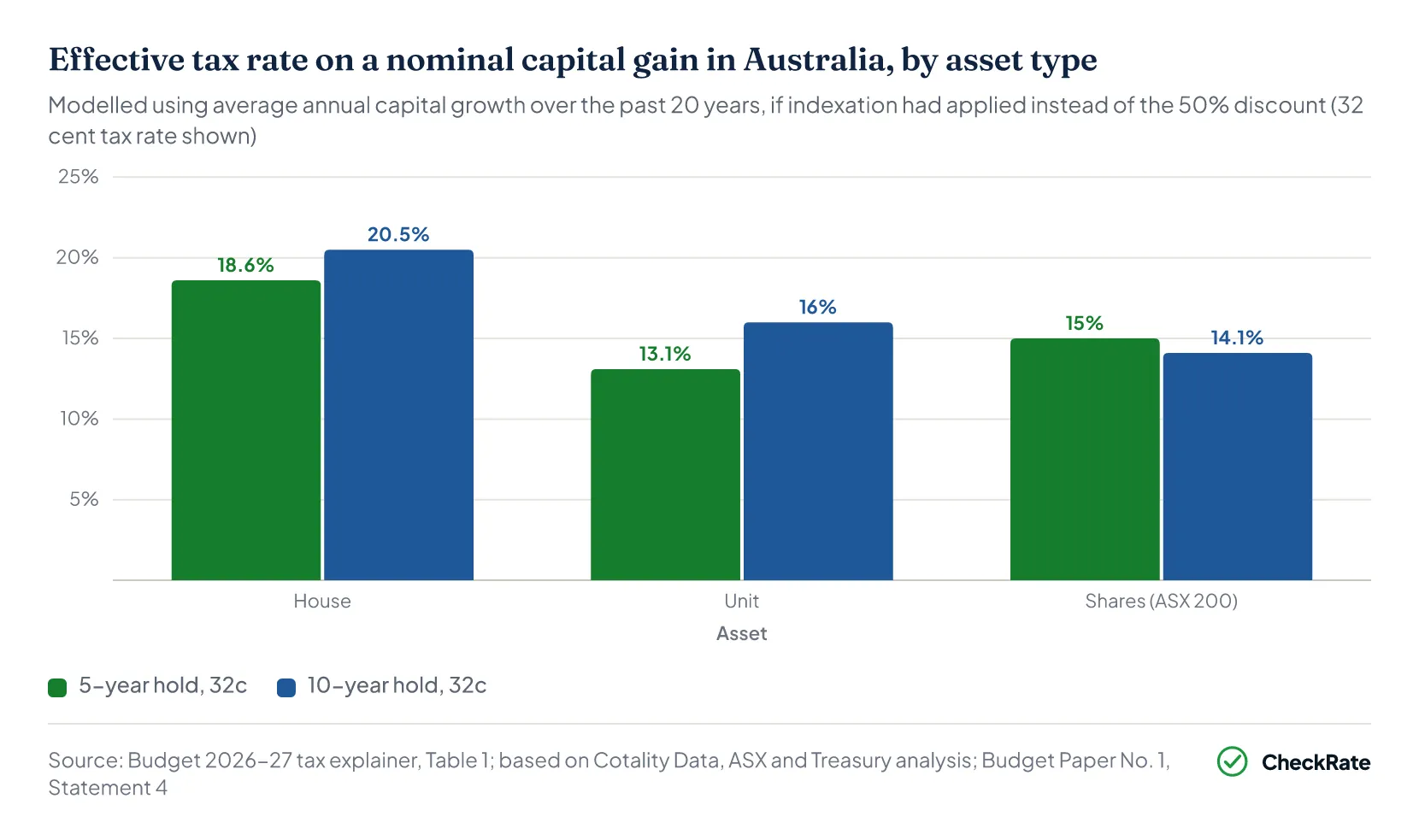
Both the current discount and the new indexation rules share the same 12-month minimum holding period. Beyond that threshold, the size of the change varies by asset type as much as by how long an asset is held, based on official modelling of 20 years of historical returns.
Average annual capital growth on houses, units and shares over the past 20 years, excluding rental income, dividends and investor costs, gives the effective tax rate on a nominal gain under indexation instead of the discount, for holding periods of five and ten years.
| Full figures: capital growth and tax rates by asset type in Australia | |||||
|---|---|---|---|---|---|
| Asset | Hold | Avg. growth | Inflation's share | Rate at 32c | Rate at 47c |
| House | 5 years | 5.8% | 42% | 18.6% | 27.3% |
| House | 10 years | 6.1% | 36% | 20.5% | 30.1% |
| Unit | 5 years | 4.1% | 59% | 13.1% | 19.3% |
| Unit | 10 years | 4.8% | 50% | 16.0% | 23.5% |
| Shares (ASX 200) | 5 years | 4.4% | 53% | 15.0% | 22.1% |
| Shares (ASX 200) | 10 years | 4.3% | 56% | 14.1% | 20.7% |
Source · Budget 2026-27 tax explainer, Table 1; based on Cotality Data, ASX and Treasury analysis, Budget Paper No. 1, Statement 4.
A five-year share example, bought for $100 after the reform starts and sold for $125, a 4.6% annual return, produces a taxable gain of $12 under indexation, only slightly less than the approximately $13 that would apply under the 50% discount. The official example assumes annual inflation of 2.5%. This points to the same conclusion as the ten-year asset examples in the previous section, where the gap between the two methods varies depending on the return achieved. Holding period on its own does not decide the outcome: the return achieved, inflation and the length of the holding period all interact.
In Treasury's historical analysis, inflation represented between 36% and 59% of nominal growth across the five-year and ten-year examples shown above. Houses held for ten years were at the low end, meaning a larger proportion of their nominal growth was a real gain. Units held for five years were at the high end, meaning a larger proportion of their nominal growth reflected inflation. Budget Paper No. 1 also publishes inflation-share estimates for two-year and 20-year holding periods, but the calculated tax-rate table above is limited to five-year and ten-year periods.
Section 08 · The minimum tax
Who the new minimum tax on capital gains affects
The minimum tax only matters when a capital gain would otherwise be taxed below 30%. Under new Division 119 of the Income Tax Assessment Act 1997, the ordinary income tax attributable to an Australian resident individual's capital gain accruing after 1 July 2027 is compared with a benchmark of 30% of the minimum-tax capital gain, before any tax offsets are applied. If the ordinary tax is lower than that benchmark, an extra amount is payable to close the gap.
A few boundaries apply:
- The minimum tax applies only to the post-reform portion of a gain, never to the pre-2027 portion that still carries the 50% discount.
- It does not apply to gains on new residential dwellings or affordable housing if the 50% discount, or the affordable housing discount of up to 60%, is chosen instead.
- The minimum-tax capital gain is reduced first by any deductible gifts, donations or conservation covenant deductions the taxpayer claims for the year.
An individual with $25,000 of other taxable income who realises a $10,000 capital gain on an asset bought after the reform starts, and who does not receive an income support payment, pays ordinary tax of $1,400 on that gain, a rate of 14% excluding the Medicare levy. Because 14% is below the 30% floor, an additional $1,600 becomes payable, bringing the total tax on the gain up to 30%. Tax offsets may reduce this amount further.
Recipients of a wide range of income support payments are exempt from the minimum tax for any year in which they receive a payment. Their post-reform gains are still calculated using indexation rather than the 50% discount, but the 30% minimum-tax floor does not apply.
Social security payments
Age Pension
JobSeeker Payment
Disability Support Pension
Carer Payment
Parenting Payment
Youth Allowance
Austudy
Special Benefit
Double Orphan Pension
Family Tax Benefit
Stillborn baby payment
Farm Household Allowance
Parental Leave Pay
ABSTUDY living allowance
Veterans' payments
Age service pension
Invalidity service pension
Partner service pension
Carer service pension
Income support supplement
Veteran payment
Special Rate Disability Pension
Other specified pensions under the Veterans' Entitlements Act and the Military Rehabilitation and Compensation Act
Source · Treasury Laws Amendment (Tax Reform No. 1) Act 2026, Division 119.
Section 09
Frequently asked questions
Does the reform affect the 2026 tax return?
No. The new rules apply only to capital gains accruing from 1 July 2027. The Australian Taxation Office has confirmed the changes do not apply to the 2026 tax return.
What happens to assets bought before 1 July 2027?
Assets held across the transition date are treated as sold at market value just before 1 July 2027 and reacquired on that date. For post-CGT assets, the gain up to that point keeps its existing treatment, including the 50% discount where available. For affected assets, growth from 1 July 2027 onward is taxed using indexation and the minimum tax, unless an exception applies, such as eligible new residential dwellings or affordable housing where the discount is chosen.
Will the reform always mean paying more tax?
No. Outcomes are mixed and depend on the rate of return relative to inflation. An asset whose return roughly matches inflation can produce less tax under indexation than under the discount, while an asset with a return well above inflation can produce more.
Does this only affect property investors?
No. The reform applies broadly to CGT assets, including shares, owned directly by individuals or through trusts and partnerships. Complying superannuation funds keep the existing one-third discount, while companies remain ineligible for the general 50% CGT discount.
References
- ATO: CGT discount · ato.gov.au
- ATO: Indexing the cost base · ato.gov.au
- ATO: Choosing the indexation or discount method · ato.gov.au
- ATO: How to calculate your CGT · ato.gov.au
- ATO, Tax reform – Boosting home ownership – Reforming negative gearing and capital gains tax (QC 107304) · ato.gov.au
- ATO: CGT discount for affordable housing · ato.gov.au
- Treasury, 2025–26 Tax Expenditures and Insights Statement (PDF) · treasury.gov.au
- Australian Government, Budget 2026–27 factsheet: Negative Gearing and Capital Gains Tax Reform · budget.gov.au
- Budget Paper No. 2, 2026-27 · budget.gov.au
- Budget Paper No. 1, 2026-27, Statement 4 · budget.gov.au
- Federal Register of Legislation, Treasury Laws Amendment (Tax Reform No. 1) Act 2026 · legislation.gov.au
- Income Tax Rates Amendment (Tax Reform No. 1) Act 2026 · legislation.gov.au
- Treasury: Capital Gains Tax and Discretionary Trusts Reform, small business explainer · treasury.gov.au
- Treasury: A brief history of Australia's tax system · treasury.gov.au
- ABS, Consumer Price Index, Australia, June 2026 · Australian Bureau of Statistics