


Published
 Term deposit rates in Australia: current rates and historyThe Reserve Bank publishes monthly averages of the five largest banks' term deposit rates for a $10,000 deposit. In July 2026, the average across all terms was 3.60 per cent. The five published terms…
 The RBA cash rate history: every change since 1990The Monetary Policy Board left the cash rate target unchanged at 4.35 per cent at its August 2026 meeting. The Board said financial conditions had tightened following three cash rate increases in 2026…
 Average savings in Australia by age: 2025 dataThe household saving ratio peaked at 15.0% in 2020–21, the highest level since records began. By 2023–24, it had fallen to 3%, a drop of 12 percentage points from the 2020–21 peak. It partially recove…
Section 01 · July 2026
What is the average savings account rate in Australia?
In July 2026, the average bonus savings rate at the five largest banks was 4.80 per cent, assuming all bonus conditions were met. The average online savings rate at prominent providers was 3.10 per cent. The average transaction account rate at banks was 0.00 per cent.
The Reserve Bank publishes monthly averages of retail deposit rates. In July 2026, the average rate on banks' bonus savings accounts was 4.80 per cent for a $10,000 balance across the five largest banks, assuming the bonus requirements were met1. The average rate on online savings accounts was 3.10 per cent for a $10,000 balance, an average across prominent providers, including the five largest banks. The difference between the two averages was 1.70 percentage points, derived by subtracting the online figure from the bonus figure.
Average rates on the other products tracked by the RBA were lower than the bonus savings average. The average transaction account rate at banks was 0.00 per cent in July 2026, and the average cash management account rate was 0.55 per cent on a $10,000 balance. The average $10,000 term deposit rate across all terms was 3.60 per cent1. The online savings average rose to 3.10 per cent in June 2026. That was the series' highest monthly value since September 2012, when the average was 3.25 per cent, a comparison derived from every month in the series.
These are averages of advertised rates, not the rates actually received by account holders. The bonus savings series assumes its conditions are met, so the 4.80 per cent figure should not be read as the average rate earned across all bonus savings accounts.
| Average savings and deposit rates in Australia, July 2026 | ||
|---|---|---|
| Product | Average rate (% p.a.) | Measured as |
| Bonus savings accounts | 4.80 | Five largest banks, $10,000, bonus conditions met |
| Term deposits, average of all terms | 3.60 | Five largest banks, $10,000 |
| Online savings accounts | 3.10 | Prominent providers including the five largest banks, $10,000 |
| Cash management accounts | 0.55 | Largest banks, $10,000 |
| Transaction accounts | 0.00 | Banks, $5,000 |
Source · RBA, Advertised Deposit Rates – F4
Section 02 · Headline rates
Why do savings accounts earn less than the advertised interest rate?
Headline savings rates can be higher than the rate an account actually earns because they may include a conditional bonus rate or a time-limited introductory rate. An account that misses a bonus condition earns only the base rate for that month, and an account past its introductory period reverts to the base rate.
The ACCC's retail deposits inquiry set out how savings account rates are built. The base interest rate is the rate available generally to all holders of the product. A bonus interest rate is a conditional rate offered in addition to the base rate, and the two together make up the headline interest rate2. Bonus conditions may include growing the account balance by a certain amount each month, making a minimum number of transactions, or limiting withdrawals. If the conditions are not met, only the base rate applies for that month. Introductory rates can also form part of the headline rate in the same way. They generally apply for 3 to 6 months after an account is opened, after which the account reverts to a lower base rate.
The inquiry observed that increases in headline rates for savings products are often driven by the bonus or introductory component rather than the base rate, and that the interest consumers receive can be considerably lower than headline rates suggest2. It also found that banks use strategic pricing for retail deposit products, including introductory and bonus rates and a range of fees and charges, adding to the complexity of comparing products3.
The Reserve Bank's two savings series treat bonus conditions differently. Its bonus savings series records accounts that pay a higher rate when at least one deposit and no withdrawals are made each month, averaged on the assumption that those requirements are met1. Its online savings series records internet-based accounts that typically have no or low minimum balance requirements and no account-servicing fees, and usually need to be linked to a separate transaction account. The July 2026 gap of 1.70 percentage points between the two averages is derived by subtraction. The bonus figure assumes its monthly conditions are met, while the online series is defined by the RBA without reference to bonus conditions.
Section 03 · Bonus conditions
What share of bonus savings accounts receive the bonus rate?
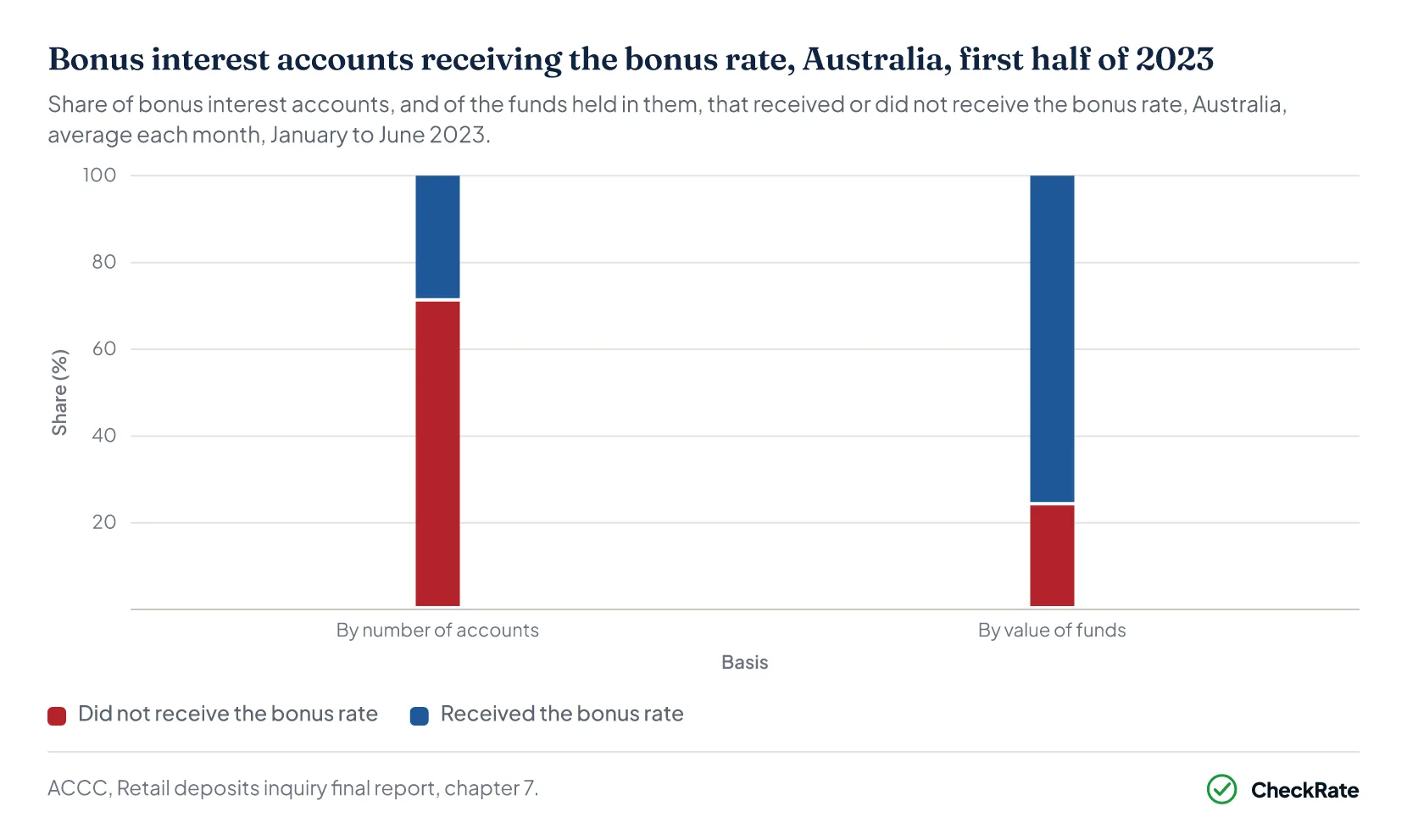
The ACCC found that 71 per cent of bonus interest accounts did not receive the bonus rate in an average month during the first half of 2023, based on data provided by nine banks2. Those accounts represented 24 per cent of the total funds in bonus interest products over the same period. The shares that did receive the bonus rate, 29 per cent of accounts holding 76 per cent of funds, are derived by subtracting the ACCC's figures from 100 per cent. The analysis includes inactive accounts, which the ACCC noted could not be reliably removed from the data.
This pattern suggests accounts with larger balances are more likely to meet bonus conditions, consistent with conditions that encourage customers to accumulate balances, such as balance growth requirements and withdrawal limits2. During the inquiry, the ACCC reported that several banks could not say how many of their customers had missed out on bonus interest, or which specific condition they failed to meet3.
The inquiry reported that consumers held more than $1.4 trillion in retail deposit products in 2023, and that banks on average relied on household deposits for close to 30 per cent of their funding needs2.
Section 04 · Cash rate
How do savings account rates move with the RBA cash rate?
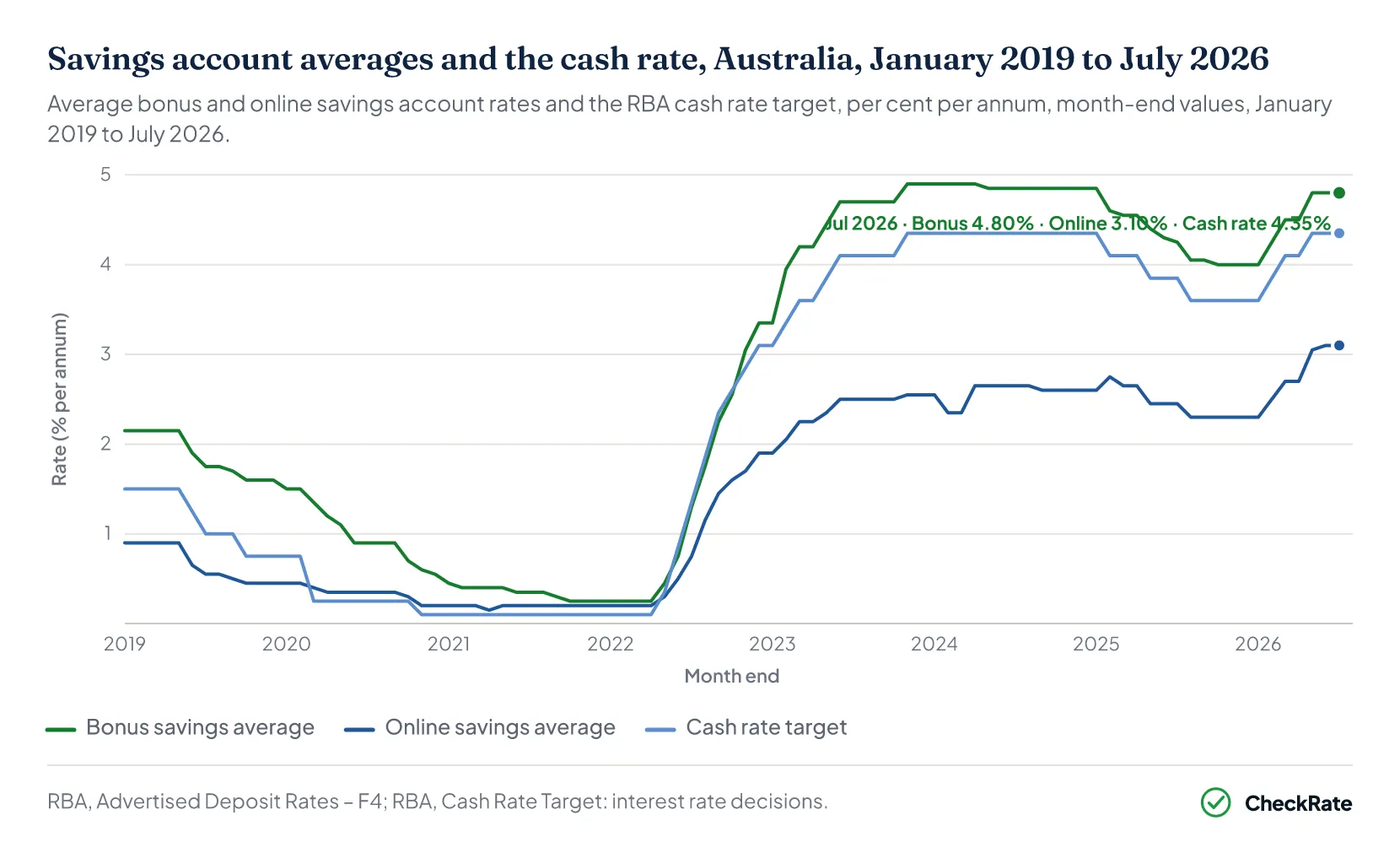
The cash rate target was 4.35 per cent as at 23 August 2026. This was after three 0.25 percentage point increases took effect between February and May 2026 and the Monetary Policy Board held the target at its June and August meetings4. At the end of July 2026, the bonus savings average of 4.80 per cent was 0.45 percentage points above the cash rate, and the online savings average of 3.10 per cent was 1.25 points below it. Both differences are derived by subtracting the month-end cash rate from each average1.
The two averages have moved by different amounts across recent cash rate cycles. Between the end of April 2022, before the first increase of the 2022–23 tightening cycle, and the end of November 2023, after the last, the cash rate rose from 0.10 to 4.35 per cent, an increase of 4.25 percentage points. The bonus savings average rose from 0.25 to 4.90 per cent, an increase of 4.65 points, while the online savings average rose from 0.20 to 2.55 per cent, an increase of 2.35 points1. The bonus average rose by more than the cash rate over that period, while the online average rose by about half as much.
The 2025 cuts and 2026 increases produced different results. Across the three cuts of 2025, measured from the end of January 2025 to the end of January 2026, the cash rate fell 0.75 points, the bonus average fell 0.85 points and the online average fell 0.30 points1. Across the three increases of 2026, measured from the end of January 2026 to the end of July 2026, the cash rate rose 0.75 points and both savings averages rose 0.80 points. This was a closer movement between the online savings average and the cash rate than during the 2022–23 tightening cycle.
The full list of cash rate decisions behind these windows is in the RBA cash rate history.
| Savings rate changes across recent RBA cash rate cycles | |||
|---|---|---|---|
| Window (month-end to month-end) | Cash rate (points) | Bonus average (points) | Online average (points) |
| April 2022 to November 2023 (13 increases) | +4.25 | +4.65 | +2.35 |
| January 2025 to January 2026 (3 cuts) | −0.75 | −0.85 | −0.30 |
| January 2026 to July 2026 (3 increases) | +0.75 | +0.80 | +0.80 |
Source · RBA, Advertised Deposit Rates – F4; RBA, Cash Rate Target: interest rate decisions
Section 05 · Since 2002
How have savings account rates changed since 2002?
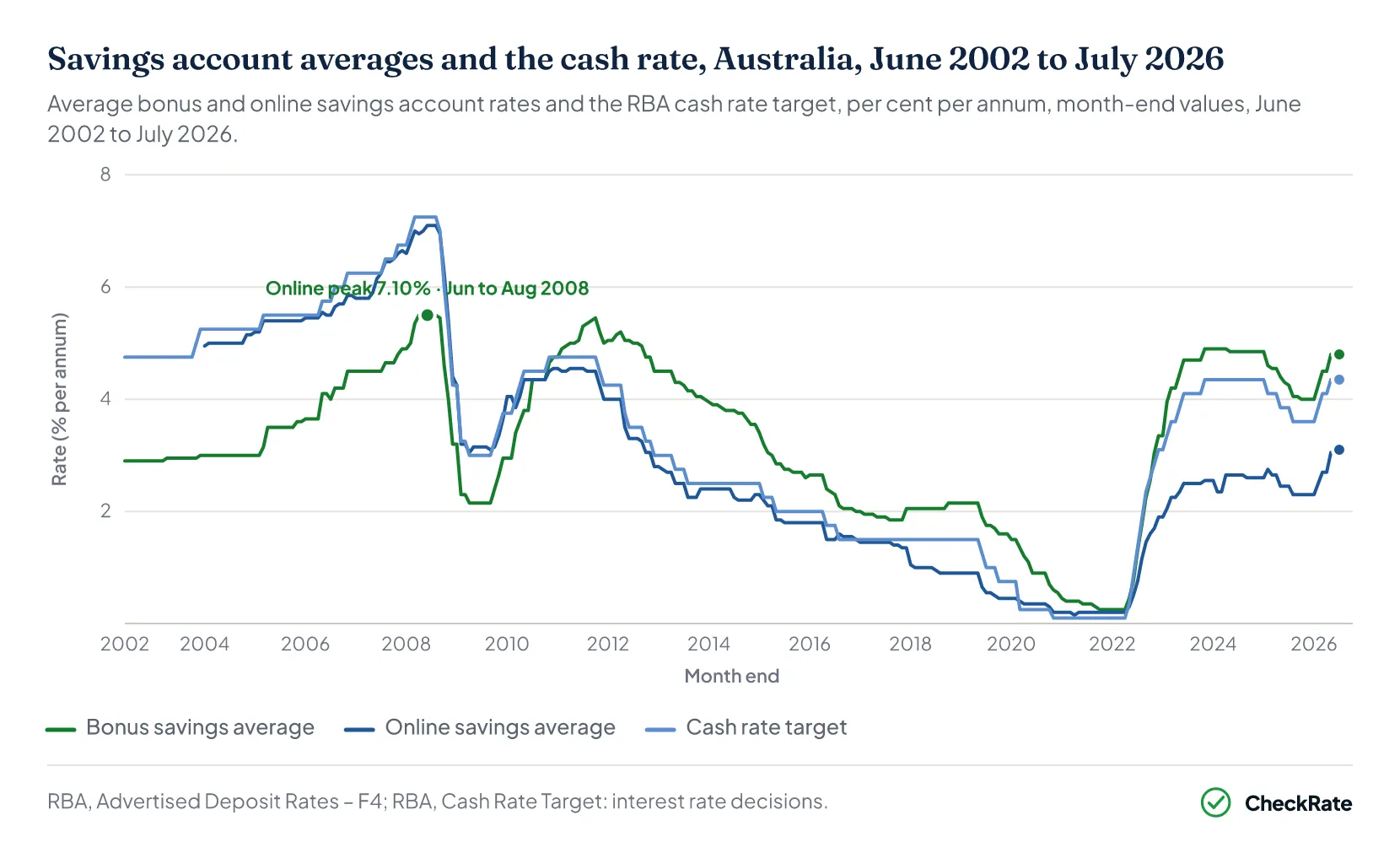
The relationship between the two savings series has reversed over their history. When the online series began in January 2004, its average of 4.95 per cent was above the bonus average of 3.00 per cent. The online average's widest margin above the bonus average, 2.25 percentage points, occurred in March 20051. Both series reached their record highs in 2008. The online average held at 7.10 per cent from June to August 2008, and the bonus average held at 5.50 per cent from April to August 2008.
The ordering reversed in 2010. The two averages were equal at 4.35 per cent from July to October 2010. In November 2010, the bonus average moved to 4.65 per cent while the online average was 4.50 per cent, and the bonus average has remained higher in every month through July 20261. The bonus average's widest margin above the online average, 2.55 percentage points, occurred in February and March 2024, when the bonus average was 4.90 per cent and the online average was 2.35 per cent.
The record lows occurred while the cash rate target stood at 0.10 per cent: the online average fell to 0.15 per cent in April 2021, and the bonus average held at its record low of 0.25 per cent from October 2021 to April 20221. Months in which the online average matched or exceeded the cash rate have been uncommon. There were 45 such months out of the 271 from January 2004 to July 2026, derived by comparing each month's online average with the month-end cash rate. The longest continuous stretch ran from March 2020 to April 2022, and the online average has not matched or exceeded the cash rate since then.
| Record highs, lows and gaps in Australian savings account rates | ||
|---|---|---|
| Record | Rate / gap | Month |
| Highest online savings average | 7.10% | June to August 2008 |
| Highest bonus savings average | 5.50% | April to August 2008 |
| Lowest online savings average | 0.15% | April 2021 |
| Lowest bonus savings average | 0.25% | October 2021 to April 2022 |
| Widest gap, online above bonus | 2.25 pts | March 2005 |
| Widest gap, bonus above online | 2.55 pts | February and March 2024 |
Source · RBA, Advertised Deposit Rates – F4
Key milestones in Australian savings account rates since 2002
June 2002
The RBA's bonus savings series began, with the average at 2.90 per cent.
January 2004
The online savings series began at 4.95 per cent, 1.95 points above the bonus average of 3.00 per cent.
April to August 2008
Both series reached their record highs in 2008: 5.50 per cent for the bonus average from April to August, and 7.10 per cent for the online average from June to August.
November 2010
After four months of equal averages, the bonus average moved above the online average, 4.65 compared with 4.50 per cent, and has been higher in every month since.
April 2021 to April 2022
Both series fell to their record lows while the cash rate target stood at 0.10 per cent: 0.15 per cent for the online average in April 2021, and 0.25 per cent for the bonus average from October 2021 to April 2022.
November 2023
After the 13 cash rate increases of 2022 and 2023, the bonus average reached 4.90 per cent, its highest level since September 2012, while the online average reached 2.55 per cent.
December 2023
The ACCC's retail deposits inquiry reported that 71 per cent of bonus interest accounts did not receive the bonus rate in an average month during the first half of 2023.
July 2026
The bonus average stood at 4.80 per cent and the online average at 3.10 per cent, the online series' highest value since September 2012.
Source · Dates and values from RBA Statistical Table F4, the RBA cash rate decisions table and the ACCC Retail deposits inquiry final report.
Section 06
Savings account rates: quick answers
What is the average savings account interest rate in Australia?
In July 2026, the average bonus savings account rate at the five largest banks was 4.80 per cent, assuming the accounts' bonus conditions were met. The average online savings account rate at prominent providers was 3.10 per cent, according to the Reserve Bank of Australia. Both figures are averages for a $10,000 balance.
What is a bonus interest rate on a savings account?
A bonus interest rate is a conditional rate offered on top of a savings account's base rate. The base rate and the bonus rate together make up the advertised headline rate. Conditions can include growing the balance, making a minimum number of deposits, or making no withdrawals in a month. If a condition is missed, the account earns only the base rate for that month.
Do most savings accounts earn their bonus interest rate?
Most bonus interest accounts did not receive their bonus rate in the period the ACCC examined. Its retail deposits inquiry found that 71 per cent of bonus interest accounts did not receive the bonus rate in an average month during the first half of 2023, based on data from nine banks. Those accounts held 24 per cent of the funds in bonus interest accounts.
Are savings account rates higher than the RBA cash rate?
Average bonus savings rates were above the cash rate in July 2026, and average online savings rates were below it. The bonus savings average of 4.80 per cent was 0.45 percentage points above the 4.35 per cent cash rate target, assuming bonus conditions were met, while the online savings average of 3.10 per cent was 1.25 points below it. The online average has not been at or above the cash rate since April 2022.
What is the highest savings account rate Australia has had?
The highest average online savings account rate in the Reserve Bank of Australia's retail deposit rates series was 7.10 per cent, held from June to August 2008. The highest average bonus savings rate in the series was 5.50 per cent, held from April to August 2008. The series records averages, across the institutions covered by each series, not the highest single account on offer, and begins in June 2002 for bonus accounts and January 2004 for online accounts.
Why do savings accounts earn less than the advertised rate?
A savings account can earn less than its advertised headline rate when bonus conditions are not met or an introductory rate expires. In those cases, the account may revert to the lower base rate. The ACCC's retail deposits inquiry found that banks' strategic pricing of bonus and introductory rates creates complexity for consumers, and that some banks could not say how many of their customers had missed out on bonus interest.
References
- RBA, Advertised Deposit Rates – F4 · Reserve Bank of Australia ↑ b c d e f g h i
- ACCC, Retail deposits inquiry: final report · accc.gov.au ↑ b c d e
- ACCC, Bank customers missing out on earning more interest from savings (media release) · accc.gov.au ↑ b
- RBA Cash Rate Target · Reserve Bank of Australia ↑