


Published
 Can a person live overseas and still get the Australian Age Pension?The Age Pension can generally continue to be paid for as long as a recipient is outside Australia, whether the absence is temporary or permanent, provided the person continues to qualify under the inc…
 Married to a non-Australian: how a partner's income and assets affect the Age PensionA person is assessed as a member of a couple for the Age Pension if they are legally married, in a registered relationship or in a de facto relationship, providing they have not permanently separated,…
 Keeping an Australian home after moving overseas: what happens to the Age PensionA principal home stops being exempt from the Age Pension assets test when its owner states they definitely do not intend to return. It also stops being exempt when a temporary absence for a reason oth…
Section 01 · Reporting a death
How is a death overseas reported to the embassy and Services Australia?
The death of an Australian overseas can be reported to the nearest Australian embassy, high commission or consulate, or to the Department of Foreign Affairs and Trade's (DFAT) Consular Emergency Centre, according to Smartraveller, DFAT's travel advice service1. DFAT confirms the death with the local authorities before asking police in Australia to notify the family.
Local authorities decide how a death and the remains are handled in their country, and they may require an autopsy before issuing a death certificate1. The death is usually registered in the country where it happened2. Whether it can also be registered in Australia depends on the relevant state or territory's requirements.
Services Australia asks to be notified within 28 days when a person receiving a payment dies3. From outside Australia, the death can be reported through the Centrelink international phone line. When a single pensioner dies, Services Australia pays the regular payment covering the fortnight of the death, and the payment then stops4.
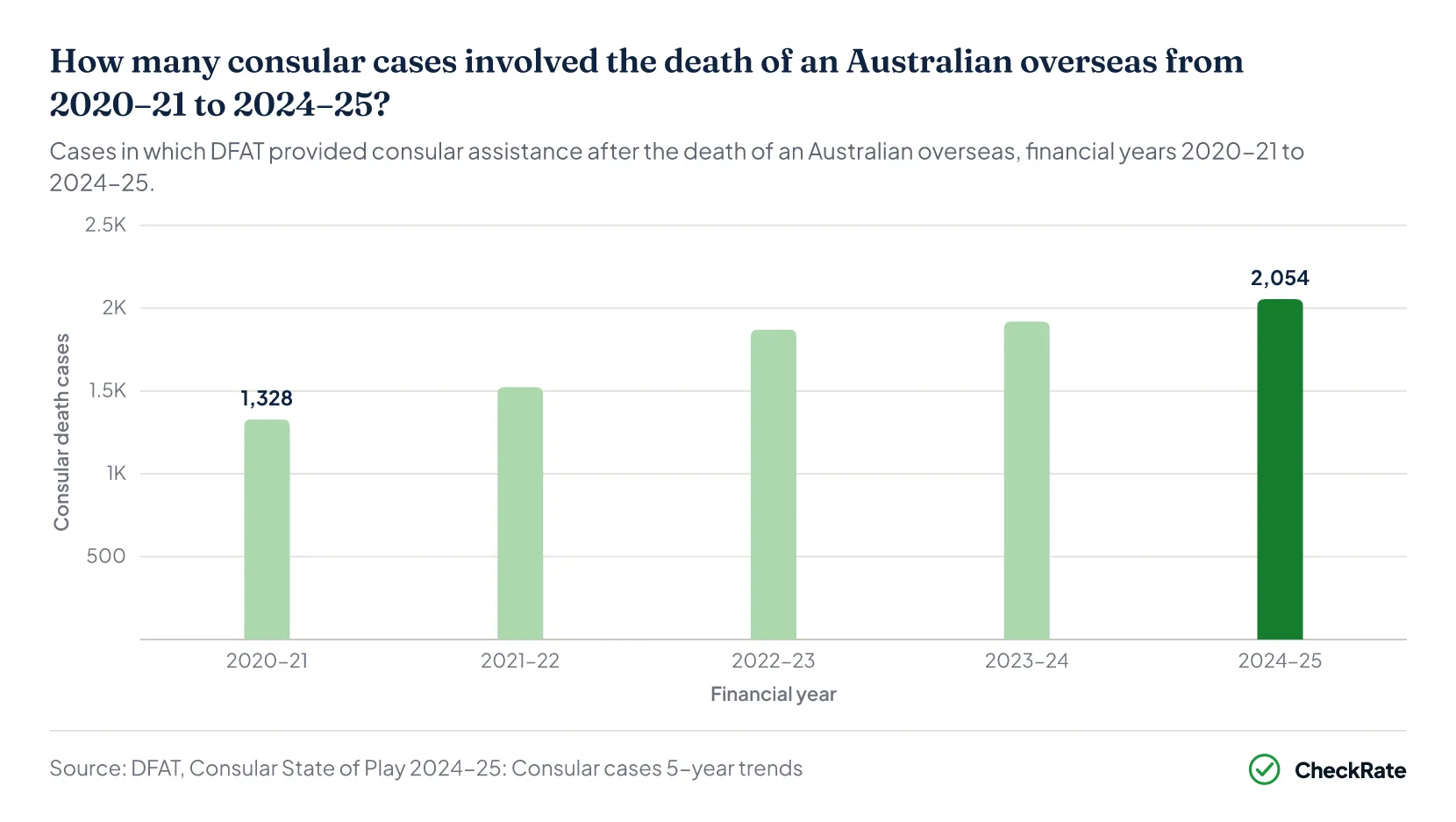
DFAT provided consular assistance in 2,054 cases involving the death of an Australian overseas in 2024–255. This was a 7% increase from 1,919 cases in 2023–24. The number increased each year from 2020–21, when 1,328 cases were recorded. Death cases accounted for 22.4% of the 9,171 consular cases DFAT handled in 2024–256.
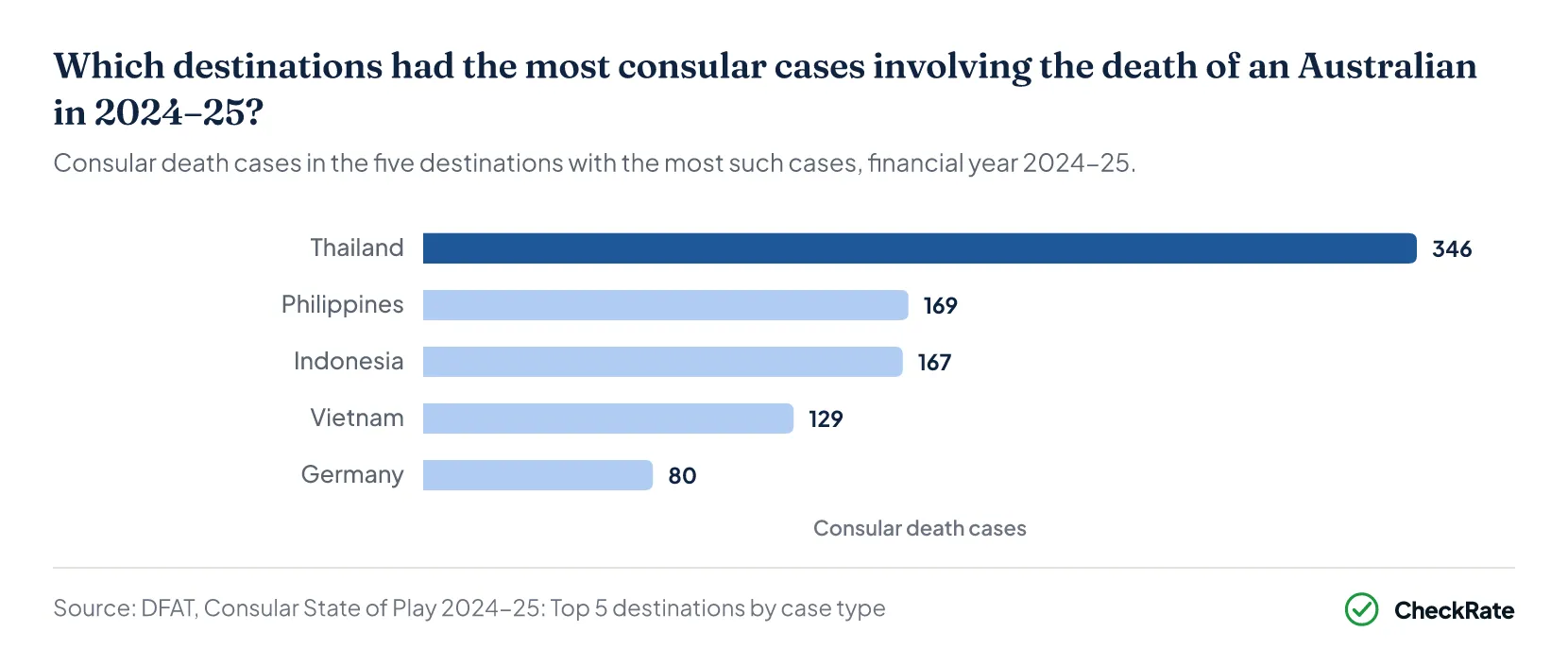
Thailand recorded the largest number of consular death cases among destinations in 2024–25, at 346 cases, followed by the Philippines at 169 and Indonesia at 1677. Death cases made up 34% of consular cases in Thailand in 2024–256. Many involved older Australians who had moved to Thailand to retire or for a late-in-life marriage.
Section 02 · Age Pension
What happens to a surviving partner's Age Pension and bereavement lump sum?
Services Australia reassesses a surviving partner's income and assets as a single person after the other partner dies. The survivor remains eligible for the Age Pension if their income and assets meet the single-person thresholds8.
If both partners were getting a pension, the survivor may also receive a lump sum bereavement payment, which is usually based on the difference between the couple's combined pension rate and the survivor's new single rate over 14 weeks from the date of death4.
The Department of Social Services (DSS) Social Security Guide counts the 14 weeks as seven fortnights9. Any payments already made in the deceased partner's name during this period are deducted from the lump sum. The surviving partner can keep those payments10.
If the survivor's single rate is higher than the couple's combined rate, for example because the deceased partner's earnings stopped, no lump sum is payable10. If the survivor's single rate is nil because of income or assets, a lump sum may still be payable.
| Illustrative lump sum bereavement payment, Age Pension couple on maximum rates, from 20 September 2026 | |
|---|---|
| Item | Amount |
| Couple's combined maximum rate, per fortnight | $1,866.0011 |
| Single maximum rate, per fortnight | $1,237.7011 |
| Difference, per fortnight | $628.30 |
| Fortnights in the 14-week bereavement period | 79 |
| Maximum illustrative lump sum | $4,398.10 |
| Range, depending on the day of death | $3,814.68 to $4,398.10 |
Source · Services Australia, How much Age Pension you can get; DSS, Social Security Guide 3.1.5.70.
A survivor can ask for a review of a decision to stop the Age Pension within 13 weeks of being notified of the decision8.
Services Australia does not publish separate bereavement payment rules for a survivor living outside Australia4.
The Age Pension rates for Australians living overseas are covered in the article how much Age Pension is paid to Australians living overseas.
Section 03 · Remains and ashes
What costs and quarantine rules apply to bringing remains or ashes to Australia?
Human remains brought into Australia for burial or cremation do not require an import declaration, but they must arrive with a copy of the official death certificate or an official register extract stating the cause of death, according to the Australian Border Force (ABF)12.
Where neither document is available, a medical practitioner's statement confirming that the body showed no indication of a communicable disease is accepted12. Remains without the required documents need permission from a Commonwealth Human Biosecurity Officer, through the Australian Government health department.
The remains must travel in a completely sealed container and, once cleared, must be transported under the supervision of a coroner or funeral director12. Documents not in English must have a certified translation.
Human ashes do not require an import declaration or documents12. The container must be free of contaminants such as soil, and a wooden container must be declared to the Department of Agriculture, Fisheries and Forestry on arrival. Airlines and shipping lines may set their own conditions for carrying ashes.
| Australian import requirements for human remains and ashes | ||
|---|---|---|
| Requirement | Human remains for burial or cremation | Human ashes |
| Import declaration | Not needed | Not needed |
| Documents | Copy of the official death certificate or a register extract stating the cause of death, or a medical practitioner's statement | None |
| Container | Hermetically sealed12 | Free of contaminants such as soil; a wooden container is declared on arrival |
| After clearance | Moved under the direction or control of a coroner or funeral director | Cleared as personal effects, cargo or post |
Source · Australian Border Force, Importing human remains or ashes.
Returning remains to Australia can take several weeks, or longer if an autopsy or coronial inquiry is required1. There is no published typical cost. Consular staff can estimate the cost of a local burial, a local cremation or transport back to Australia for a specific death2.
The Australian Government does not pay for or organise a burial, a cremation or the return of the deceased person to Australia, and it does not pay the deceased person's debts2.
The next of kin may need to pay local authorities or a funeral director before the remains are released1. They may also need to arrange funeral directors in both the country where the death occurred and Australia. Without travel insurance that covers the death, the next of kin may be responsible for these costs.
Section 04 · Overseas wills
Is a will made overseas valid in South Australia?
A will made overseas that is valid under the law of the country where it was made is generally accepted in South Australia, even if it does not meet the state's usual requirements for making a valid will13.
A will that is not written in English must be translated, and a sworn statement confirming the accuracy of the translation is required before probate is granted in South Australia13.
Under South Australian law, a will generally must be in writing and signed by the person making it in the presence of at least two witnesses, who must be present at the same time and also sign the will13.
If a document does not meet these requirements, the court may still accept it as a valid will if it is satisfied that the document reflects the deceased person's wishes for how their estate should be distributed13.
| How South Australia treats a will, by where and how it was made | ||
|---|---|---|
| Situation | Treatment in South Australia | Provision |
| Will made in South Australia | In writing, signed in front of two or more witnesses present at the same time, then signed by the witnesses | Succession Act 2023 (SA) s 8 |
| Will made overseas | Generally accepted if valid under the law of the country where it was made13 | Succession Act 2023 (SA) s 37 |
| Will not in English | Translation and an affidavit verifying it needed before probate13 | Law Handbook (SA) |
| Document that misses the formal requirements | The court may admit it if it expresses the deceased person's testamentary intentions | Succession Act 2023 (SA) s 11(2) |
Source · Legal Services Commission of South Australia, Law Handbook, Valid wills.
Other states and territories have their own wills legislation.
Section 05 · Probate
How does probate work for NSW property after a death overseas?
The Supreme Court of NSW can recognise certain probate grants issued outside New South Wales through a process called resealing. This gives the original grant the same legal effect in NSW as one issued by the Supreme Court itself14.
Resealing is available for grants issued by courts in territories covered by NSW law, including the United Kingdom. The legislation refers to these territories using the historical term "Her Majesty's dominions"14.
A grant issued by a court in Thailand or Poland cannot be resealed under these rules because those countries are not covered14. Where the person who died left property in New South Wales, the Supreme Court of NSW can instead issue its own grant of probate or administration.
Before resealing, any duties that an original NSW grant would attract must be paid14. A notice of the application must also be published at least 14 days before it is submitted. The court may require the executor to provide financial security for managing the estate in New South Wales.
| Using a probate grant made outside New South Wales | ||
|---|---|---|
| Where the grant was made | Route in New South Wales | Provision |
| A court in Her Majesty's dominions, such as the United Kingdom | Reseal by the Supreme Court of NSW14 | Section 107 |
| A court outside those dominions, such as in Thailand or Poland | A grant by the Supreme Court of NSW where the person left property in New South Wales14 | Section 40 |
Source · Probate and Administration Act 1898 (NSW).
Other states and territories have their own probate legislation.
Section 06 · Before moving
How can wills, insurance and emergency contacts be organised before moving overseas?
Australians moving overseas can make arrangements for their will, insurance and emergency contacts before leaving. Smartraveller identifies three preparations that can help family members manage the practical arrangements if someone dies overseas1:
- An updated will, with a copy left with the next of kin or a lawyer
- A power of attorney given to a trusted person
- Travel insurance that includes cover for death
For people moving overseas to live, Smartraveller also lists copies of important documents, including passports, visas, travel insurance policies and emergency contact details. These may be kept with a trusted person15.
Australia's reciprocal health care agreements with some countries give access to certain medical treatment, but they do not replace full travel insurance15.
According to Services Australia, a will can name an executor and record funeral, burial or cremation wishes16. Unless a superannuation fund member has made a binding death benefit nomination or another arrangement, the fund's trustee may decide who receives the death benefit.
Tax residency, super and Age Pension rules for people leaving Australia are covered in retiring overseas from Australia: tax residency, super and Age Pension rules.
Section 07
Australian pensioners dying overseas: quick answers
What happens to the Age Pension when a partner dies overseas?
Services Australia reassesses the surviving partner's income and assets as a single person, and the survivor may receive a lump sum bereavement payment if both partners were getting a pension. Services Australia does not publish separate bereavement payment rules for people living overseas, so the amount payable depends on the survivor's circumstances.
How much is the bereavement payment for an Age Pension couple?
The lump sum bereavement payment usually equals the couple's combined rate minus the survivor's new single rate, calculated over the 14 weeks from the date of death. Based on the maximum Age Pension rates from 20 September 2026, the illustrative payment ranges from $3,814.68 to a maximum of $4,398.10, depending on the day of the fortnight on which the death occurred. Actual payments depend on individual circumstances and any pension instalments already paid.
Who is notified when an Australian dies overseas?
A death overseas can be reported to the nearest Australian embassy, high commission or consulate, or to DFAT's Consular Emergency Centre on +61 2 6261 3305 from overseas or 1300 555 135 in Australia. Services Australia asks to be notified within 28 days if the person was receiving a payment.
Who pays to bring a body back to Australia?
The Australian Government does not pay for a burial, a cremation or the return of the deceased person to Australia. Travel insurance may cover these expenses, depending on the policy. Without cover, the next of kin may be responsible for the costs.
Can ashes be brought into Australia from overseas?
Human ashes can be brought into Australia without an import declaration or documents, but the container must be free of contaminants such as soil. A wooden container must be declared to the Department of Agriculture, Fisheries and Forestry on arrival.
Does a will made overseas need a translation for probate in South Australia?
A will made overseas that is not written in English needs a translation and an affidavit verifying the translation before probate is granted in South Australia. The will itself is generally accepted if it was valid under the law of the country where it was made, under section 37 of the Succession Act 2023 (SA).
Can a Thai or Polish probate grant be resealed in NSW?
No. A Thai or Polish grant cannot be resealed under section 107 of the Probate and Administration Act 1898 (NSW), which covers grants from courts in Her Majesty's dominions. The Supreme Court of NSW can instead make its own grant where the person left property in New South Wales.
References
- Smartraveller, What happens if someone dies overseas · smartraveller.gov.au ↑ b c d e f
- Smartraveller, Fact sheet: Death overseas · smartraveller.gov.au ↑ b c
- Services Australia, Who to tell when someone dies · servicesaustralia.gov.au ↑
- Services Australia, What help there is when an adult dies · servicesaustralia.gov.au ↑ b c
- DFAT, Consular State of Play 2024-25: Consular cases 5-year trends · smartraveller.gov.au ↑
- DFAT, Consular State of Play 2024-25 · smartraveller.gov.au ↑ b
- DFAT, Consular State of Play 2024-25: Top 5 destinations by case type · smartraveller.gov.au ↑
- Services Australia, Your Age Pension after your partner dies · servicesaustralia.gov.au ↑ b
- DSS, Social Security Guide 3.1.5.70: The lump sum bereavement payment, member of a couple · guides.dss.gov.au ↑ b
- DSS, Social Security Guide 3.1.5.30: Bereavement payment provisions for couples · guides.dss.gov.au ↑ b
- Services Australia, How much Age Pension you can get (rates from 20 September 2026) · servicesaustralia.gov.au ↑ b
- Australian Border Force, Importing human remains or ashes · abf.gov.au ↑ b c d e
- Law Handbook (Legal Services Commission of South Australia), Valid wills · lawhandbook.sa.gov.au ↑ b c d e f
- NSW Legislation, Probate and Administration Act 1898 (NSW) · legislation.nsw.gov.au ↑ b c d e f
- Smartraveller, Going overseas to live, work or study · smartraveller.gov.au ↑ b
- Services Australia, What to organise before you die · servicesaustralia.gov.au ↑