How do established house prices compare with income by capital city?
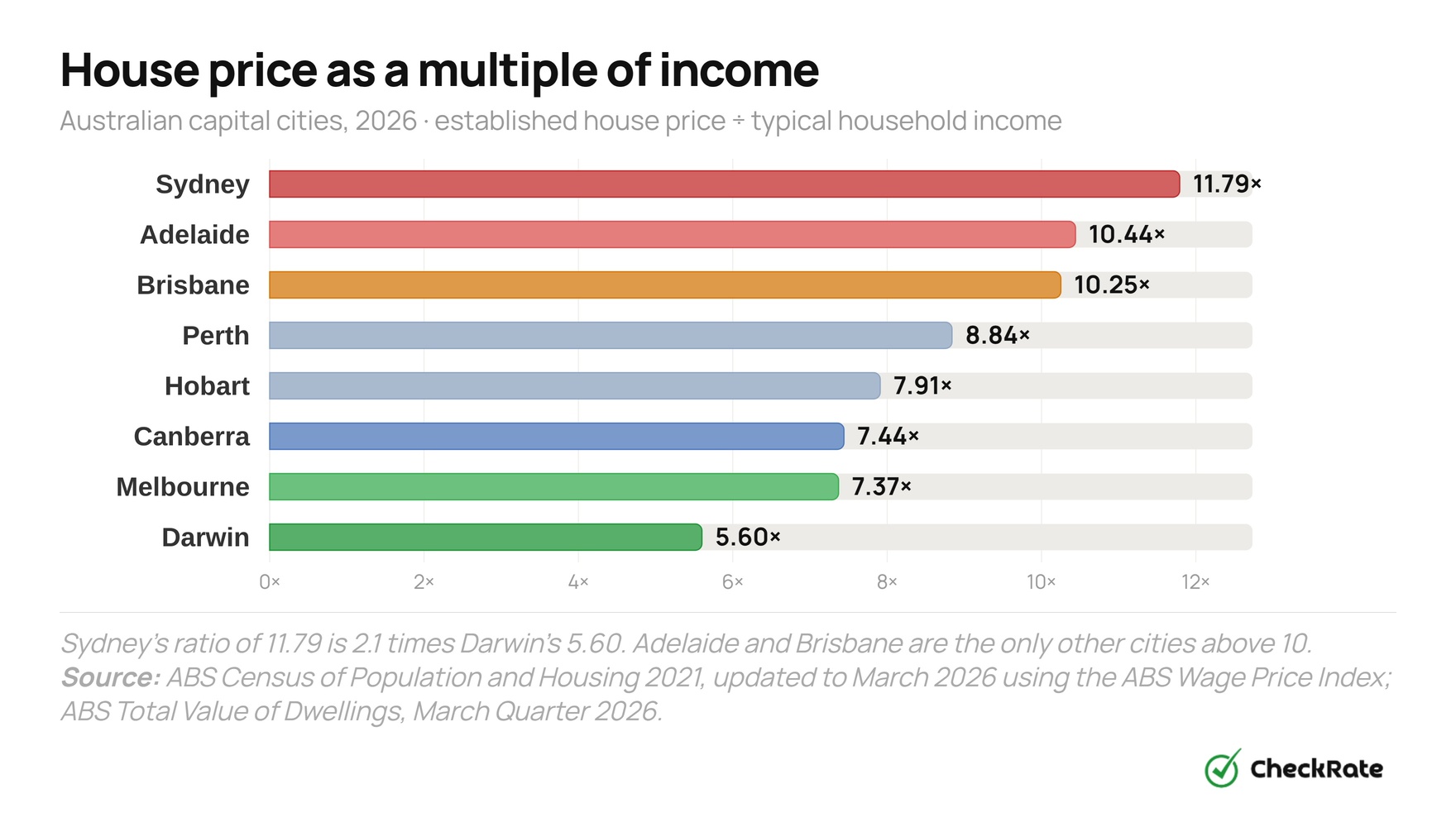
A typical established house costs between 5.60 and 11.79 times yearly household income across Australia's capital cities, with the lowest ratio in Darwin and the highest in Sydney. The measure divides the ABS March quarter 2026 median established house transfer price by household income updated from the 2021 Census using the ABS Wage Price Index, giving a single figure that compares prices against local earnings in each city.
- In Sydney, a typical established house costs 11.79 times yearly household income, the highest figure of any capital city.
- Darwin is the most affordable capital city on this measure. A typical established house there costs 5.60 times yearly household income, supported by lower house prices and higher typical household income.
- Adelaide has the second-highest ratio at 10.44 times yearly household income, followed by Brisbane at 10.25, Perth at 8.84, Hobart at 7.91, Canberra at 7.44 and Melbourne at 7.37.
- Canberra has the highest typical household income of any capital at $143,947 a year, which keeps the city at 7.44 times yearly household income even with a typical established house price of $1,071,300.

| City | Typical established house price | Typical annual household income | Years of income |
|---|---|---|---|
| Sydney | $1,485,000 | $125,992 | 11.79 |
| Adelaide | $980,000 | $93,902 | 10.44 |
| Brisbane | $1,150,000 | $112,161 | 10.25 |
| Perth | $1,000,000 | $113,132 | 8.84 |
| Hobart | $740,000 | $93,538 | 7.91 |
| Canberra | $1,071,300 | $143,947 | 7.44 |
| Melbourne | $850,000 | $115,315 | 7.37 |
| Darwin | $750,000 | $133,999 | 5.60 |
How much income goes to home loan payments by capital city?
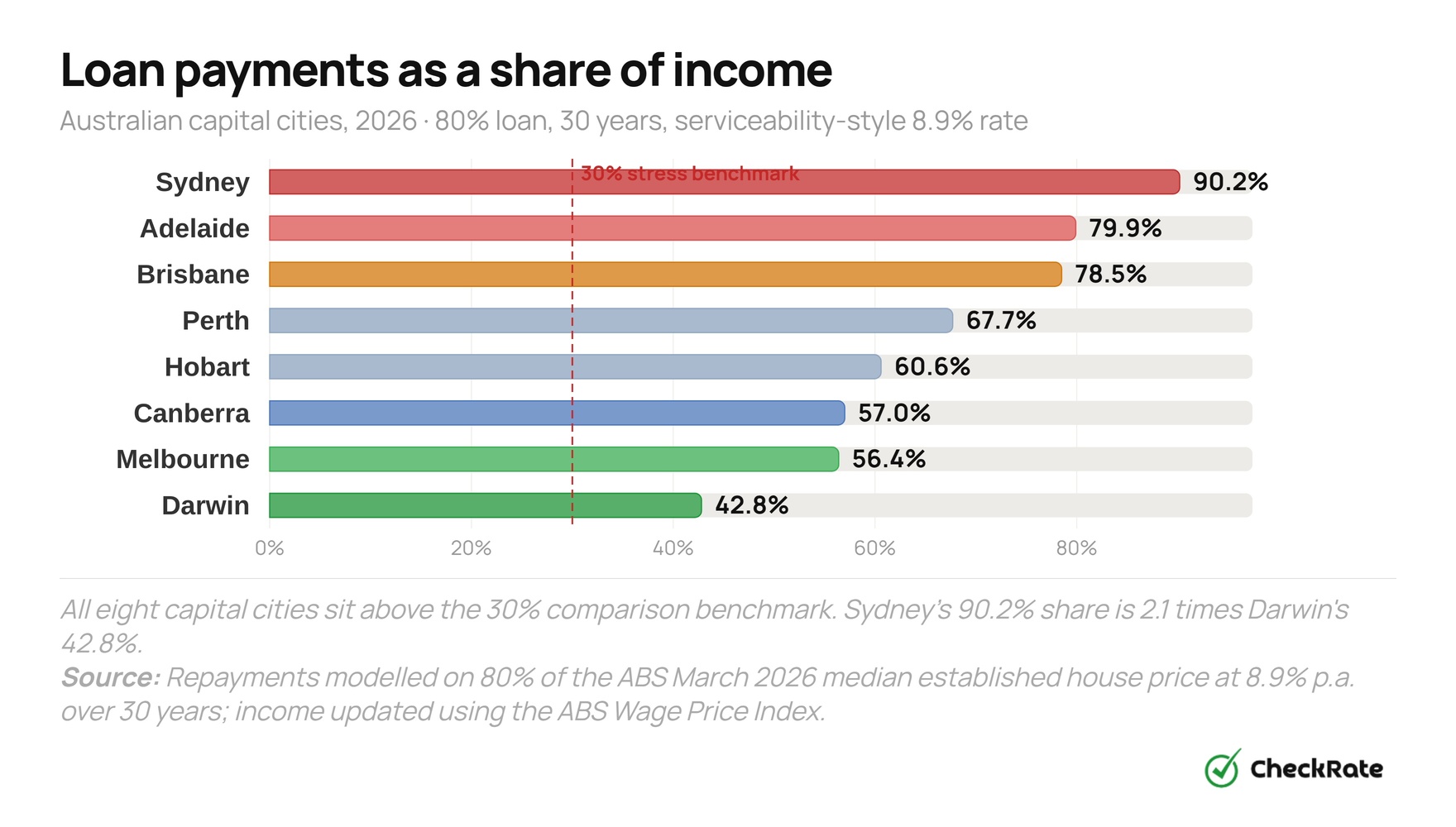
Modelled home loan payments range from 42.8% of typical monthly household income in Darwin to 90.2% in Sydney, and exceed the 30% comparison benchmark in all eight capital cities. The 30% threshold is commonly used as a broad housing-cost benchmark, especially for lower-income households; this article uses it as a comparison threshold, not a borrowing-capacity test. The figures model an 80% loan at a serviceability-style rate, so they sit above what many borrowers would pay at advertised rates.
| City | Amount borrowed | Modelled monthly payment | Monthly income | Share of pay | Above 30% benchmark? |
|---|---|---|---|---|---|
| Sydney | $1,188,000 | $9,474 | $10,499 | 90.2% | Yes |
| Adelaide | $784,000 | $6,252 | $7,825 | 79.9% | Yes |
| Brisbane | $920,000 | $7,336 | $9,347 | 78.5% | Yes |
| Perth | $800,000 | $6,380 | $9,428 | 67.7% | Yes |
| Hobart | $592,000 | $4,721 | $7,795 | 60.6% | Yes |
| Canberra | $857,040 | $6,834 | $11,996 | 57.0% | Yes |
| Melbourne | $680,000 | $5,423 | $9,610 | 56.4% | Yes |
| Darwin | $600,000 | $4,785 | $11,167 | 42.8% | Yes |
How long does it take to save a 20% deposit by city?
Saving a 20% deposit takes from 7.5 years in Darwin to 15.7 years in Sydney, a gap of 8.2 years across the eight capital cities. The estimate assumes a household saves 15% of typical yearly income, starting from zero; the spread tracks differences in established house prices and household incomes by city.
- In Sydney, a 20% deposit comes to $297,000, the largest of any capital. At a saving rate of 15% of typical yearly household income, the timeline is 15.7 years.
- In Darwin, the same deposit is $150,000, $147,000 less than Sydney's, and it takes 7.5 years to save.
- Adelaide at 13.9 years and Brisbane at 13.7 years take the second and third longest of any capital, for different reasons: Adelaide's timeline is long relative to its $980,000 established house price because its household income is the second-lowest of any capital, while Brisbane's reflects its $1,150,000 established house price, the second-highest after Sydney.
- Melbourne has the shortest timeline after Darwin at 9.8 years, 0.1 years below Canberra's 9.9 years; Canberra's larger deposit of $214,260 is offset by household income of $143,947, the highest of any capital.
- Hobart takes 10.5 years and Perth 11.8 years, placing them between Canberra's 9.9 years and Brisbane's 13.7 years.
| City | 20% deposit needed | Saved per year (15% of income) | Years to save |
|---|---|---|---|
| Sydney | $297,000 | $18,899 | 15.7 years |
| Adelaide | $196,000 | $14,085 | 13.9 years |
| Brisbane | $230,000 | $16,824 | 13.7 years |
| Perth | $200,000 | $16,970 | 11.8 years |
| Hobart | $148,000 | $14,031 | 10.5 years |
| Canberra | $214,260 | $21,592 | 9.9 years |
| Melbourne | $170,000 | $17,297 | 9.8 years |
| Darwin | $150,000 | $20,100 | 7.5 years |
Why Darwin ranks as the most affordable capital city
Darwin records the lowest figure on all three measures: a price-to-income ratio of 5.60, a modelled repayment share of 42.8%, and a 7.5-year deposit timeline. It is the only capital to rank lowest on each. Hobart has the lowest typical established house price at $740,000, $10,000 below Darwin's $750,000, but its household income of $93,538 compared with Darwin's $133,999 places it behind Darwin on affordability.
Melbourne at 9.8 years and Canberra at 9.9 years have the shortest deposit timelines after Darwin's 7.5 years. Hobart's modelled loan payment of $4,721 a month is the lowest of any capital in dollar terms, but household income of $93,538 means the payment still takes 60.6% of monthly pay.
Which Australian capital city is least affordable?
Sydney records the highest figure on all three measures: a price-to-income ratio of 11.79, a modelled repayment share of 90.2%, and a 15.7-year deposit timeline. Adelaide ranks second on each, even though its typical established house price of $980,000 sits below Perth's $1,000,000, the difference comes down to Adelaide's lower household income.
Capital city affordability measures compared
Across the three measures, the same order holds: Sydney ranks least affordable and Darwin ranks most affordable, with the deposit timeline spanning 7.5 to 15.7 years, the price-to-income ratio ranging from 5.60 to 11.79, and the modelled repayment share ranging from 42.8% to 90.2%. Cities below are ordered from least to most affordable by deposit timeline; red marks the three least affordable cities on this measure, while green marks the two most affordable.
| City | Established house price | 20% deposit | Annual saving | Years to save | Price/income | Share of monthly pay |
|---|---|---|---|---|---|---|
| Sydney | $1,485,000 | $297,000 | $18,899/yr | 15.7 yrs | 11.79× | 90.2% |
| Adelaide | $980,000 | $196,000 | $14,085/yr | 13.9 yrs | 10.44× | 79.9% |
| Brisbane | $1,150,000 | $230,000 | $16,824/yr | 13.7 yrs | 10.25× | 78.5% |
| Perth | $1,000,000 | $200,000 | $16,970/yr | 11.8 yrs | 8.84× | 67.7% |
| Hobart | $740,000 | $148,000 | $14,031/yr | 10.5 yrs | 7.91× | 60.6% |
| Canberra | $1,071,300 | $214,260 | $21,592/yr | 9.9 yrs | 7.44× | 57.0% |
| Melbourne | $850,000 | $170,000 | $17,297/yr | 9.8 yrs | 7.37× | 56.4% |
| Darwin | $750,000 | $150,000 | $20,100/yr | 7.5 yrs | 5.60× | 42.8% |
Select a city from the chart to see its key figures
Why do affordability gaps differ between capital cities?
Household income, not price, is what separates the closest-priced capitals. Adelaide and Perth differ by just $20,000 on price, yet land at very different price-to-income ratios, at 10.44 compared with 8.84, because Perth's typical household income runs well ahead of Adelaide's. The same pattern runs through the wider table: the cities that rank as most affordable in this comparison tend to pair moderate prices with relatively high incomes, rather than simply having the cheapest houses.
Darwin also ranks most affordably because it combines a typical established house price of $750,000 with household income of $133,999, the second-highest of any capital after Canberra and above Sydney, Melbourne, Brisbane, Perth, Adelaide and Hobart. Sydney sits at the other end of the table, with a typical established house price equal to 11.79 times yearly household income.
Are regional areas more affordable than capital cities?
Capital city established house prices in this data span $745,000, from $740,000 in Hobart to $1,485,000 in Sydney. Regional towns fall outside this capital-city comparison, and a lower regional price tag does not by itself settle whether an area is more affordable, because local incomes and access to services also vary.
- Regional towns sit outside this dataset, so this comparison cannot rank them against the capitals. The ABS source also includes rest-of-state figures, but those figures combine many different regional markets and are not used in this capital-city ranking.
- Regional areas can also differ from capital cities in wages, job availability, and access to services like hospitals, schools, and public transport. These broader trade-offs vary by location and are not captured in a price-only comparison or in this article's data.
- Some regional areas, particularly those close to a capital city or in a mining area, may have recorded price rises in recent years and may not be as affordable as a low headline price suggests.
- A broader affordability comparison includes both typical local established house prices and typical local income. This can give a clearer measure than prices alone.
References
- 1.ABS: 2021 Census QuickStats: 2021 median weekly household income by Greater Capital City Statistical Area.
- 2.ABS: Wage Price Index, March quarter 2026: Wage growth applied to the 2021 Census household income figures.
- 3.ABS: Total Value of Dwellings, March quarter 2026: March quarter 2026 median established house transfer prices by capital city.
- 4.AIHW: Housing affordability: 30% housing-cost benchmark.
- 5.RBA: Lenders' Interest Rates, Table F6: April 2026 owner-occupier principal-and-interest new-loan rate.
- 6.APRA: Macroprudential policy settings: 3 percentage point mortgage serviceability buffer.
- 7.Methodology. All figures are indicative comparisons based on publicly available data. They are designed to compare housing affordability across Australian capital cities and are not a prediction of what any individual buyer may experience.
- Household income: Typical household income for each capital city is based on the 2021 Census median weekly household income by Greater Capital City Statistical Area, annualised and updated to March quarter 2026 using the ABS Wage Price Index. This provides a wage-adjusted income proxy, not a direct 2026 household-income measurement.
- Established house prices: Typical capital city prices are the ABS median established house transfer prices from ABS Total Value of Dwellings, March Quarter 2026, Table 2: Median price and number of transfers, capital city and rest of state. These cover established houses and exclude attached dwellings such as units and apartments. March quarter 2026 figures are preliminary and may be revised by the ABS.
- Loan payments: Repayments are modelled on borrowing 80% of the typical established house price and repaying it over 30 years at 8.9% per year. The 8.9% rate is a serviceability-style assumption, based on the April 2026 RBA owner-occupier principal-and-interest new-loan rate of 5.92%, rounded to about 5.9%, plus APRA's 3 percentage point serviceability buffer. It is a stress-test comparison, not a live loan quote.
- Saving a deposit: Deposit-saving timelines are based on a 20% deposit and assume 15% of household income is saved each year, starting from zero, with no interest earned on savings.
- Housing-cost benchmark: The article uses the common 30% housing-cost benchmark, most often applied to lower-income households, to compare repayments with household income. It is used only as a comparison threshold and does not assess individual borrowing capacity or personal financial circumstances.
Data Snapshots