


Published
- Countries with a reciprocal health care agreement
- 111
- Medically necessary care for people who live in Australia while visiting
- Medicare enrolment kept by permanent residents overseas
- 12 months2
- From the date they first left Australia
- Time overseas after which citizens re-enrol
- 5 years3
- Australian citizens moving back to live in Australia
- Lifetime days without hospital cover before a loading
- 1,094 days4
- Lifetime Health Cover Days of Absence. Time overseas is excluded after cancelling cover for a stay of at least one continuous year
 Retirement visas compared: Thailand, Malaysia and PolandThailand's Non-Immigrant O-A (long stay) visa is open to applicants aged 50 and over. According to the Thai Ministry of Foreign Affairs, applicants must have a bank deposit of at least 800,000 baht, a…
 How is the Age Pension paid into an overseas bank account?The Age Pension is paid every four weeks to people who live outside Australia long term, according to Services Australia. A recipient who intends to be away for less than 12 months continues to…
 Married to a non-Australian: how a partner's income and assets affect the Age PensionA person is assessed as a member of a couple for the Age Pension if they are legally married, in a registered relationship or in a de facto relationship, providing they have not permanently separated…
Section 01 · Eligibility
When does Medicare eligibility end for Australians who retire overseas?
An Australian permanent resident who moves overseas stays enrolled in Medicare for 12 months from the date they first left Australia, according to Services Australia2. A permanent resident who lives overseas for more than 12 months is no longer enrolled in Medicare and can no longer use a reciprocal health care agreement.
Medicare is available only to Australian residents, according to the Department of Foreign Affairs and Trade’s Smartraveller service5. Medicare does not cover medical treatment outside Australia, whether a person is travelling or living overseas.
Australian citizens have a longer period. Smartraveller’s guidance for Australians retiring overseas states that Medicare can be accessed for treatment in Australia for up to five years after a move overseas5. After five years, Medicare is not available unless the person moves back to Australia to live and re-enrols. Services Australia sets the same five-year point for citizens, who can re-enrol after more than five years overseas3.
Tax residency, superannuation and the Age Pension follow separate rules when a retiree leaves Australia, as explained in Retiring overseas from Australia: tax residency, super and Age Pension rules.
Section 02 · Travel or move
Does Medicare cover you while travelling or living overseas?
Medicare does not cover medical treatment overseas, whether a person is travelling or living there. Whether a person needs to re-enrol in Medicare when they return to Australia depends on how long they were away6. Travel insurance can help cover medical costs outside Australia7.
A traveller who was eligible for Medicare before a holiday may still be enrolled on return and, in most cases, does not need to notify Services Australia8. A person who has been living overseas for more than 12 months may need to re-enrol.
Smartraveller suggests a temporary move of six to 12 months before a longer-term move, partly to assess the standard and availability of local healthcare5.
Medicare and Age Pension rules for people who split time between Australia and another country are set out in Splitting retirement between Australia and another country: Age Pension, tax and Medicare rules.
Section 03 · Reciprocal agreements
Which countries have a reciprocal health care agreement with Australia?
Australia has reciprocal health care agreements with 11 countries, according to Services Australia1. The countries are Belgium, Finland, Ireland, Italy, Malta, the Netherlands, New Zealand, Norway, Slovenia, Sweden and the United Kingdom.
The agreements help a person who lives in Australia pay for medically necessary care while visiting one of those countries, including emergency care and treatment for an illness or injury that cannot wait until they return to Australia1.
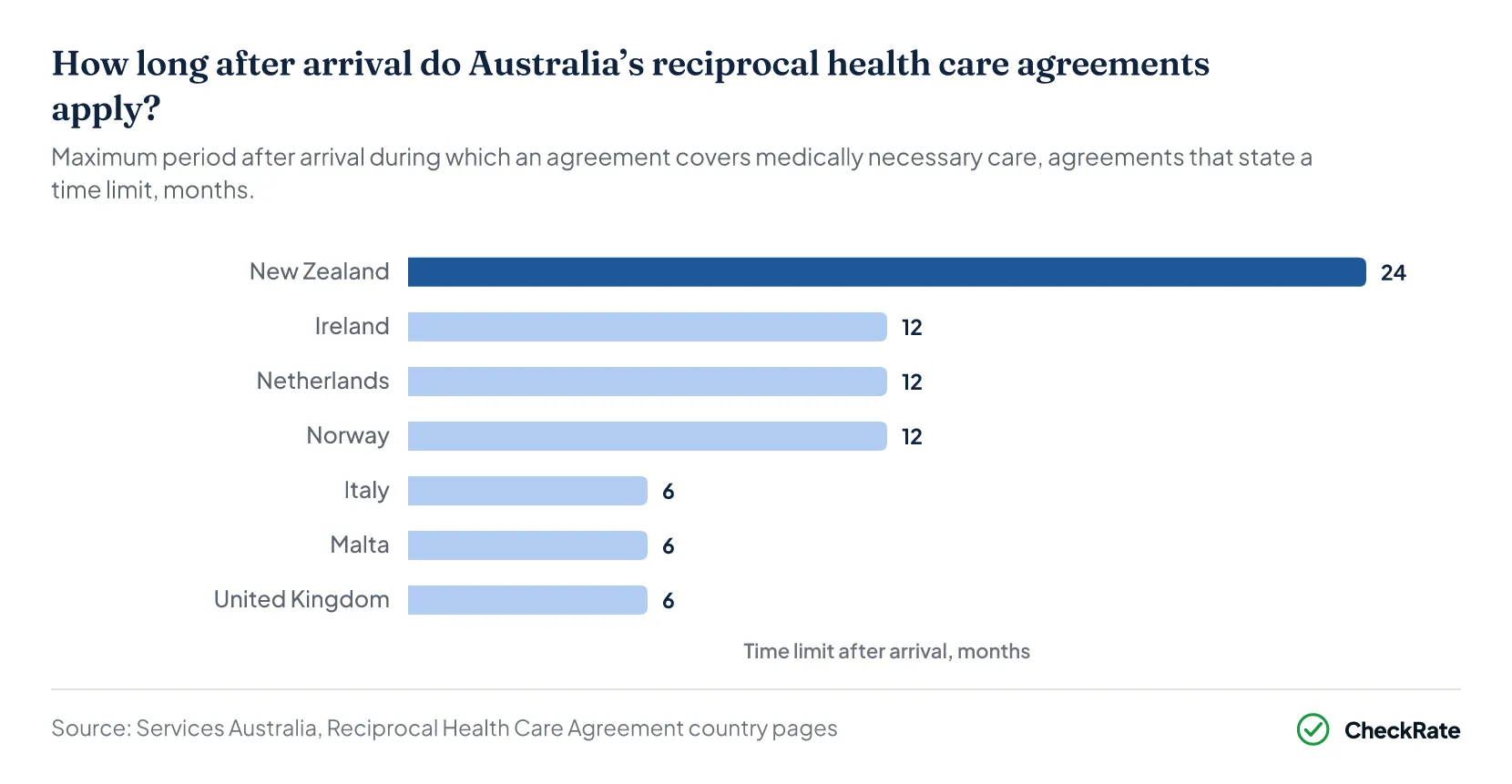
Seven of the 11 agreements have a time limit after arrival10111213. The agreement with New Zealand has the longest limit, at two years14. The agreements with Ireland, the Netherlands and Norway apply for up to 12 months after arrival, and those with Italy, Malta and the United Kingdom for up to six months151617181920.
To receive treatment under an agreement, a person must present a current Medicare card and an Australian passport, or another valid passport that shows they are a permanent Australian resident21. In the Netherlands, a person must also apply for an A111 certificate of eligibility.
Services Australia states that a person staying in Belgium for more than one year should register with a Belgian health insurance fund10.
| Reciprocal health care agreements with Australia, by country | |||
|---|---|---|---|
| Country | Time limit after arrival | Covered | Not covered |
| Belgium | None stated | Hospital stays and services, GP and specialist care (the patient pays 25% to 40%), some prescription medicines, half the cost of ambulance travel10 | Some pharmaceutical medicines; services outside the benefit package |
| Finland | None stated | Health centre medical and nursing care, hospital out-patient care, some dental care, prescription medicines | Daily hospital accommodation fees; fees for specialist or out-patient care |
| Ireland | 12 months15 | Public patient care in a public hospital, maternity care, part of prescription costs above a set monthly amount | GP visits; private patient care |
| Italy | 6 months18 | In-patient and out-patient care at public and authorised hospitals, GP and specialist care at public clinics, urgent dental care at public hospitals | Medicines and tests may need to be paid for |
| Malta | 6 months19 | Government hospital care, out-patient care from government specialists, health centre care, emergency ambulance travel, immediate dental care | Non-urgent dental work; dental prostheses and appliances |
| Netherlands | 12 months, extendable in some cases16 | Hospital care including specialist care, nursing and childbirth; GP and specialist care; part or full refund of prescription medicine | Non-specialist dental care for adults; repatriation costs |
| New Zealand | 2 years14 | Hospital care, maternity services, pharmaceuticals | GP and other primary care; ambulance travel; the full cost of GP-prescribed medicines |
| Norway | 12 months17 | National Insurance Scheme GP and hospital care, referred specialist care, ambulance travel, emergency dental care, prescription medicine above an annual spending amount | Students and diplomats are not eligible |
| Slovenia | None stated | Part of the cost of public system treatment and of contracted private GPs, specialists and dentists; 30% of the cost of positive-list medicines12 | Providers without a contract with the national insurer; negative-list medicines |
| Sweden | None stated | Doctor and hospital out-patient care, free health services for children, free maternity services, part of prescription costs | Daily fees for staying in hospital |
| United Kingdom | 6 months20 | NHS GP and nurse care, public ward and out-patient NHS hospital care, ambulance travel to NHS facilities, NHS prescriptions with a fee | Dental services; non-subsidised medicines; private care |
Source · Services Australia, Reciprocal Health Care Agreement country pages.
Section 04 · Private cover
Does Australian private health insurance cover retirees living abroad?
Australian private health insurance funds do not pay for medical treatment overseas, according to Smartraveller5. Outside the 11 countries with reciprocal health care agreements, public healthcare generally does not cover Australians, who must pay the full cost of treatment.
International health insurance may cover medical treatment overseas and the cost of repatriation to Australia for medical care5. Such policies can be costly and may not be available to people with pre-existing conditions.
Smartraveller states that returning someone to Australia for medical treatment can cost hundreds of thousands of dollars5. A person moving overseas may also be eligible for local health insurance in the country where they live22.
How does moving overseas affect the Lifetime Health Cover loading?
Cancelling Australian hospital cover can affect the Lifetime Health Cover (LHC) loading on a later policy. A person who takes out hospital cover after their LHC base day pays a 2% loading for every year they are aged over 304. The base day is the later of 1 July 2000 and the 1 July after a person’s 31st birthday.
A person who has previously held hospital cover can be without it for a lifetime total of 1,094 days, known as Days of Absence, without the loading changing4. A gap of 1,095 days or more adds a 2% loading when they take out hospital cover again, plus another 2% for every further year without cover.
Days spent outside Australia do not count towards the 1,094 days when a person cancels hospital cover after their LHC base day to go overseas for at least one continuous year4. Return visits of up to 90 consecutive days still count as time overseas, while periods of 90 days or more in Australia are counted towards the 1,094-day allowance.
An insurer may agree to suspend hospital cover for a short period, such as an overseas holiday, and an agreed suspension does not count towards the Days of Absence4. Suspension terms vary between insurers.
Section 05 · Retirement visas
What health insurance do retirement visas in Malaysia and Thailand require?
Thailand’s Non-Immigrant O-A (long stay) visa requires health insurance for the entire stay with cover of at least US$100,000 or 3,000,000 baht, according to the Royal Thai Embassy in Vienna23. The insurance cover must include general illnesses and COVID-19, and the requirement has applied since 1 October 2021.
The O-A visa is for applicants aged 50 or over and allows a stay of up to one year in Thailand23. Applicants in Australia apply through Thailand’s e-Visa system24.
The Royal Thai Embassy in Canberra accepts applications from residents of every state and territory except New South Wales, whose residents must apply through the Royal Thai Consulate-General in Sydney24.
The Malaysia My Second Home (MM2H) program requires health insurance from a Malaysian or foreign provider with worldwide coverage as one of the documents submitted after conditional approval, and health insurance again for pass renewals and applications to add dependants, although applicants over 60 are exempt, according to the guidelines of Malaysia’s Ministry of Tourism, Arts and Culture2526. The main applicant and their dependants must also have a medical check-up at a clinic or hospital appointed by the ministry after approval27.
Applicants for the Silver, Gold and Platinum categories must be aged 25 or over27.
MM2H pass holders may receive long-term medical treatment in Malaysia while their pass is valid27.
| Health requirements for retirement visas in Malaysia and Thailand | |||
|---|---|---|---|
| Country | Visa or pass | Age requirement | Health requirement |
| Malaysia | Malaysia My Second Home (MM2H) pass, Silver, Gold and Platinum categories | Aged 25 or over27 | Medical check-up at an appointed panel clinic or hospital after approval; health insurance from a provider with worldwide coverage required after conditional approval, and health insurance for pass renewal and add-on applications, except for applicants over 60272625 |
| Thailand | Non-Immigrant O-A (long stay) visa, one-year stay23 | Aged 50 or over23 | Health insurance for the entire stay covering general illnesses, including COVID-19, with a sum insured of not less than US$100,000 or 3,000,000 baht23 |
Source · Ministry of Tourism, Arts and Culture Malaysia, MM2H requirements, Application Guidelines Booklet and Guide – Malaysia My Second Home; Royal Thai Embassy, Vienna, Non-Immigrant Visa O-A.
Income, deposit and age rules for long-stay visas are compared in Retirement visas compared: Thailand, Malaysia and Poland.
Section 06 · Coming back
How do retirees re-enrol in Medicare after moving back to Australia?
An Australian citizen who returns to live in Australia after more than five years overseas can re-enrol in Medicare without visiting a service centre, according to Services Australia3. They can re-enrol online through myGov or by completing a Medicare enrolment form.
To re-enrol, a citizen must provide a current passport for each person and two documents dated within the last six months that prove the family now live in Australia3. The documents can be either two from Australia, or one from Australia and one from the country where the person last lived.
| Documents accepted to show an Australian citizen now lives in Australia, Medicare re-enrolment | |
|---|---|
| Documents from Australia | Documents from the country last lived in |
| A rental or lease agreement and a gas or electricity account in the same name | Proof the person sold their property |
| Proof of purchase of a property and a gas or electricity account in the same name | Proof the person ended their lease |
| Proof of a job | Proof the job ended |
| Proof a child is enrolled in childcare, school or university | Proof household goods or furniture were moved |
| Proof of a current bank account in Australia | Proof a bank account was closed |
| Proof of health, property or contents insurance | Proof health, property or contents insurance was cancelled |
Source · Services Australia, Enrolling in Medicare if you’re an Australian citizen.
A permanent resident who has lived overseas for more than 12 months must re-enrol in Medicare when they return to live in Australia, through myGov or with the enrolment form2.
An Australian citizen or permanent resident who was overseas on the 1 July following their 31st birthday, if that birthday was after 1 July 2000, pays no LHC loading if they take out hospital cover by the first anniversary of their return4.
Under the Lifetime Health Cover rules, the return is the first period of 90 days or more in Australia4.
A break in hospital cover may also mean having to serve waiting periods again4.
Section 07 · Common questions
Medicare and retiring overseas: quick answers
Can Australians use Medicare while living overseas?
Medicare does not pay for medical treatment outside Australia and is available only to Australian residents, according to Smartraveller. Australian citizens can still access Medicare for treatment in Australia for up to five years after a move overseas5. Permanent residents remain enrolled for only 12 months after first leaving Australia, according to Services Australia2.
How long does a permanent resident stay enrolled in Medicare after leaving Australia?
A permanent resident stays enrolled in Medicare for 12 months from the date they first left Australia, according to Services Australia2. After more than 12 months living overseas, they are no longer enrolled and cannot use a reciprocal health care agreement.
Do reciprocal health care agreements cover Australians who move to an agreement country?
Reciprocal health care agreements generally cover eligible Australian residents visiting an agreement country, rather than people who have moved there permanently, according to Services Australia. A permanent resident who has lived overseas for more than 12 months cannot use them2, and seven of the 11 agreements set a time limit of six months18 to two years after arrival14.
Does cancelling hospital cover to move overseas increase the Lifetime Health Cover loading?
Cancelling hospital cover after the Lifetime Health Cover base day to go overseas for at least one continuous year generally does not increase the loading, because the days overseas are not counted towards the 1,094-day absence allowance4. Periods of 90 days or more spent in Australia during that time are deducted from the 1,094 days.
What health insurance does a Thai O-A retirement visa need?
The Non-Immigrant O-A (long stay) visa needs health insurance for the entire stay, covering general illnesses including COVID-19, with cover of at least US$100,000 or 3,000,000 baht23. The visa is for applicants aged 50 or over, according to the Royal Thai Embassy in Vienna.
What documents are needed to re-enrol in Medicare after returning to Australia?
An Australian citizen returning after more than five years overseas provides a current passport for each person and two documents dated within the last six months showing the family lives in Australia, according to Services Australia3. The documents can both be from Australia, or one can be from the country where the person last lived.
References
- Services Australia, About reciprocal health care agreements · servicesaustralia.gov.au ↑ b c
- Services Australia, Enrolling in Medicare if you’re an Australian permanent resident · servicesaustralia.gov.au ↑ b c d e f
- Services Australia, Enrolling in Medicare if you’re an Australian citizen · servicesaustralia.gov.au ↑ b c d e f
- PrivateHealth.gov.au: Lifetime Health Cover · privatehealth.gov.au ↑ b c d e f g h i j
- Smartraveller, Going overseas to retire · smartraveller.gov.au ↑ b c d e f g
- Services Australia, Before you leave Australia · servicesaustralia.gov.au ↑
- Services Australia, Health care planning when going overseas · servicesaustralia.gov.au ↑ b
- Services Australia, When you’re returning to Australia from overseas · servicesaustralia.gov.au ↑
- Smartraveller, Reciprocal healthcare agreements for Australians overseas · smartraveller.gov.au ↑ b
- Services Australia, Reciprocal Health Care Agreement: visiting Belgium · servicesaustralia.gov.au ↑ b c
- Services Australia, Reciprocal Health Care Agreement: visiting Finland · servicesaustralia.gov.au ↑
- Services Australia, Reciprocal Health Care Agreement: visiting Slovenia · servicesaustralia.gov.au ↑ b
- Services Australia, Reciprocal Health Care Agreement: visiting Sweden · servicesaustralia.gov.au ↑
- Services Australia, Reciprocal Health Care Agreement: visiting New Zealand · servicesaustralia.gov.au ↑ b c
- Services Australia, Reciprocal Health Care Agreement: visiting Ireland · servicesaustralia.gov.au ↑ b
- Services Australia, Reciprocal Health Care Agreement: visiting the Netherlands · servicesaustralia.gov.au ↑ b
- Services Australia, Reciprocal Health Care Agreement: visiting Norway · servicesaustralia.gov.au ↑ b
- Services Australia, Reciprocal Health Care Agreement: visiting Italy · servicesaustralia.gov.au ↑ b c
- Services Australia, Reciprocal Health Care Agreement: visiting Malta · servicesaustralia.gov.au ↑ b
- Services Australia, Reciprocal Health Care Agreement: visiting the United Kingdom · servicesaustralia.gov.au ↑ b
- Services Australia, Reciprocal Health Care Agreements: how to prove you’re eligible under the agreement · servicesaustralia.gov.au ↑
- Smartraveller, Going overseas to live, work or study · smartraveller.gov.au ↑
- Royal Thai Embassy, Vienna, Non-Immigrant Visa “O-A” (long stay/retirement stay visa) · web.archive.org ↑ b c d e f
- Royal Thai Embassy, Canberra, Visa · canberra.thaiembassy.org ↑ b
- Ministry of Tourism, Arts and Culture Malaysia, MM2H Programme Application Guidelines Booklet · motac.gov.my ↑ b
- Ministry of Tourism, Arts and Culture Malaysia, Guide Malaysia My Second Home · motac.gov.my ↑ b
- Malaysia My Second Home, Guidelines · mm2h.gov.my ↑ b c d e