


Published
Section 01 · Marginal rates
What is a marginal income tax rate?
A marginal income tax rate is the rate that applies to the next dollar of a person's taxable income. Australia's resident tax scale for 2026–27 has five brackets: taxable income up to $18,200 is not taxed, and the parts above that are taxed at 15%, 30%, 37% and 45% as income moves above $18,200, $45,000, $135,000 and $190,0001. A person with taxable income of $80,000 has a marginal rate of 30%, because their next dollar falls in the $45,001 to $135,000 bracket.
The scale applies to taxable income, which is assessable income less allowable deductions2. The ATO's published rates apply to people who were Australian residents for tax purposes for the full income year and entitled to the full tax-free threshold. Foreign residents and working holiday makers are subject to different tax scales1. The marginal rate shows the tax rate that applies at the top of a person's taxable income, such as to additional income or a deduction claimed. It is not the share of total income paid in tax. That share, the effective rate, is lower at every income above $18,200.
Section 02 · Crossing a bracket
Why does entering a higher bracket not reduce take-home pay?
Under the resident scale, entering a higher bracket cannot reduce take-home pay, because the higher rate applies only to the part of taxable income above the bracket boundary. The tax already charged on income below the boundary does not change when income crosses it.
An illustrative calculation on the 2026–27 resident scale shows how this works. Income tax on $45,000 of taxable income is $4,020, which is 15% of the $26,800 between $18,201 and $45,000. Income tax on $46,000 is $4,320. The extra $1,000 falls into the 30% bracket, so $300 of income tax applies to that amount, leaving $700 after income tax1. A pay rise that crosses a bracket boundary changes the rate on the new dollars only. On the resident scale itself, earning an extra dollar never creates more than a dollar of additional income tax.
What changes when taxable income passes $45,000
The rate on further dollars increases from 15% to 30%
The person's marginal rate becomes 30%
What stays the same
No income tax on the first $18,200
15% on the part from $18,201 to $45,000, which is $4,020
The rate on every dollar below the boundary is unchanged
Source · Illustrative reading of the 2026–27 resident scale at the $45,000 boundary. The tax on income below a boundary is unaffected by income above it.
Section 03 · Across brackets
How is income taxed across multiple brackets?
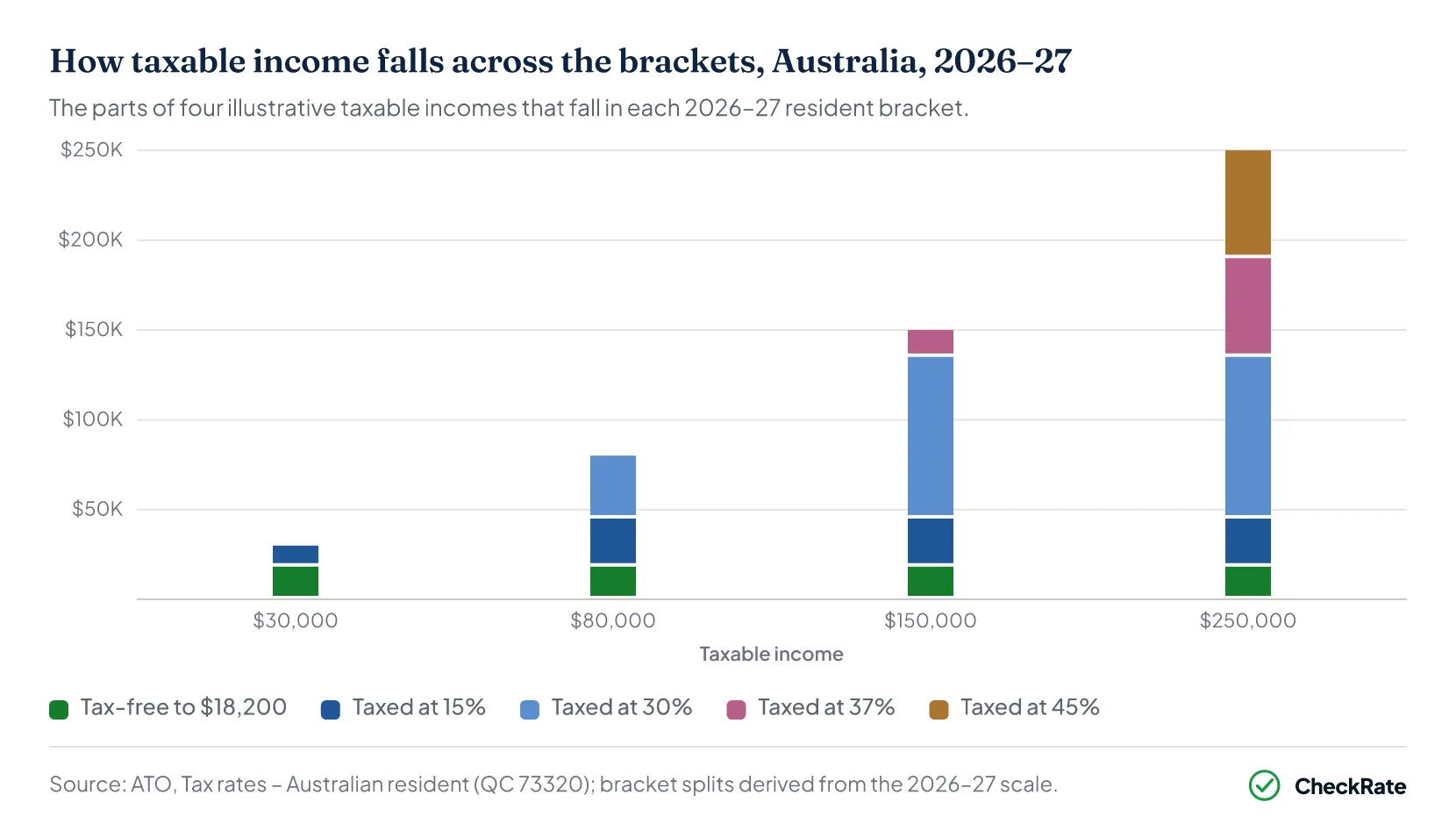
Income tax is worked out in parts. Each bracket's rate applies to the portion of taxable income that falls inside that bracket; these amounts are added together to calculate the total.
On the 2026–27 scale, a person with $80,000 of taxable income pays nothing on the first $18,200, then 15% of the $26,800 between $18,201 and $45,000, which is $4,020, and 30% of the $35,000 between $45,001 and $80,000, which is $10,500. Their income tax is $14,520, the sum of the two taxed parts1.
The ATO's rate table builds this addition in. The flat dollar amount at the start of each row, such as the $4,020 that opens the $45,001 to $135,000 row, is the full tax on all the brackets below it. Only the rate for the highest bracket reached is then applied to income above that boundary1.
The same bracket boundaries were used in 2025–26, but the rate on the $18,201 to $45,000 bracket was 16% that year. As a result the flat amounts were higher: $4,288, $31,288 and $51,6381. From 1 July 2027, the rate on that bracket is legislated to fall again, from 15% to 14%, with the other rates and boundaries unchanged3.
| Australian resident income tax rates by taxable income, 2026–27 | |
|---|---|
| Taxable income | Tax on this income |
| 0 – $18,200 | Nil |
| $18,201 – $45,000 | 15c for each $1 over $18,200 |
| $45,001 – $135,000 | $4,020 plus 30c for each $1 over $45,000 |
| $135,001 – $190,000 | $31,020 plus 37c for each $1 over $135,000 |
| $190,001 and over | $51,370 plus 45c for each $1 over $190,000 |
Source · ATO, Tax rates – Australian resident (QC 73320),
How the brackets, rates and flat amounts have moved over four decades, including the 44 resident scales since 1983–84, is covered in the income tax brackets history article.
Section 04 · Tax-free threshold
How does the tax-free threshold work?
The tax-free threshold means an Australian resident for tax purposes generally pays no income tax on the first $18,200 of taxable income in an income year. The ATO states the threshold is equivalent to earning $350 a week, $700 a fortnight or $1,517 a month4.
The threshold is the tax-free bracket at the bottom of the resident tax scale. The first $18,200 of a resident taxpayer's taxable income falls within this bracket, regardless of their total income. It appears as the base of every column in the chart above.
The tax-free threshold is generally claimed through the tax file number declaration given to a payer. A person who claims the threshold with a payer has less tax withheld from each pay; income above $18,200 has tax withheld as usual4. The threshold has been $18,200 since the 2012–13 income year, when it replaced the previous $6,000 threshold1.
Section 05 · Effective rates
What is an effective tax rate and how does it differ from a marginal rate?
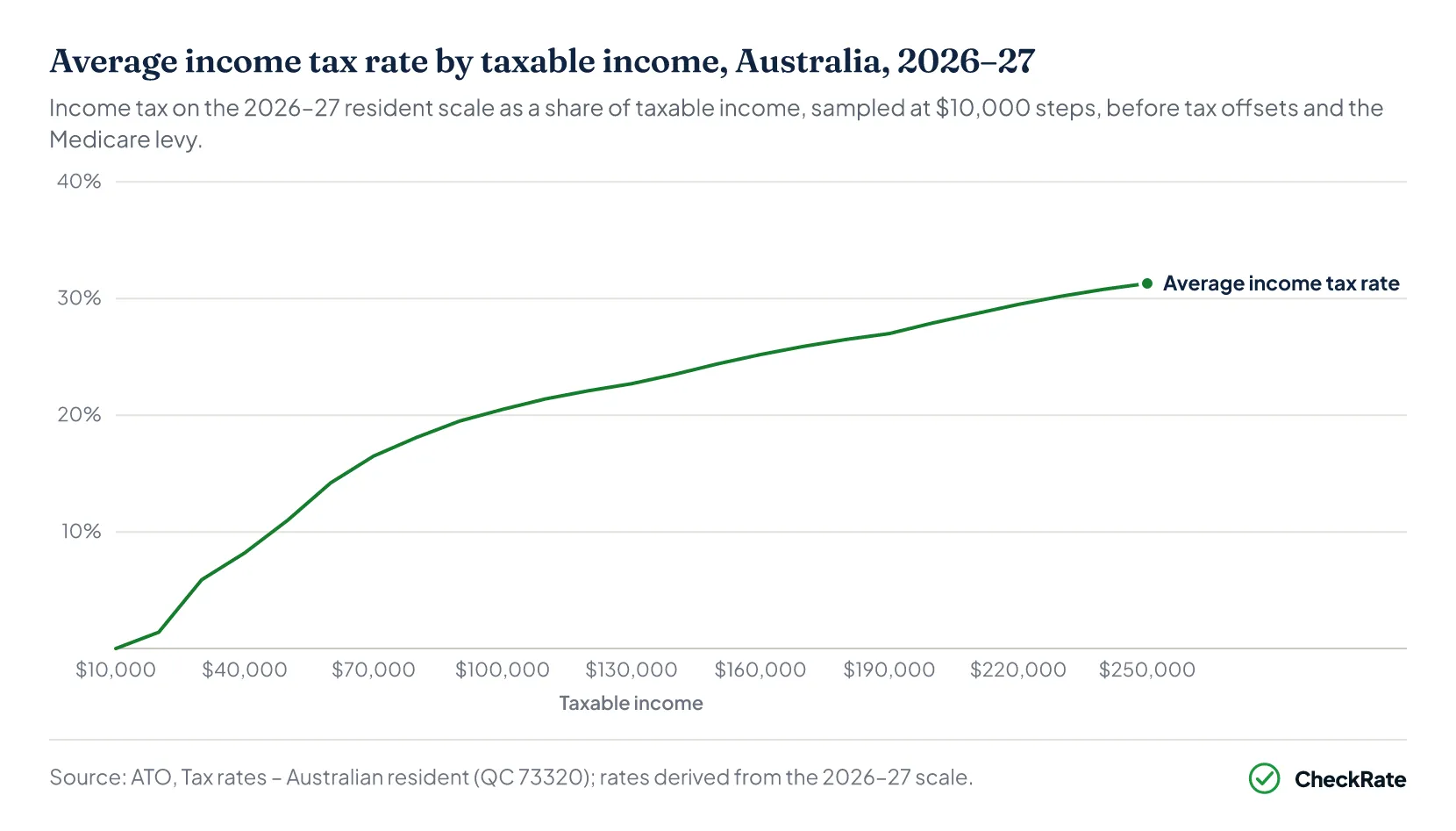
An effective tax rate, also called an average tax rate, is income tax payable divided by total taxable income. It differs from the marginal rate because the marginal rate applies only to the next dollar of taxable income. On the 2026–27 scale, a person with $100,000 of taxable income has a marginal rate of 30%, but their income tax of $20,520 is equal to 20.5% of their taxable income. This is an illustrative calculation on the published scale, before tax offsets and excluding the Medicare levy1.
The effective rate is lower than the marginal rate at every income above $18,200, because different parts of taxable income are taxed at different rates. The 45% top rate begins at $190,001, but even at $250,000 of taxable income the income tax of $78,370 is an effective 31.3%. The chart below shows the average rate at each income across the scale.
How much income tax individuals paid, measured from ATO taxation statistics rather than the scale, is covered in the average income tax article.
Section 06 · Medicare levy
How is the Medicare levy added to income tax?
The Medicare levy is generally 2% of taxable income, paid in addition to the income tax worked out on the scale. It is not included in the resident income tax rate tables2. In the ATO's example, a taxpayer with $76,000 of assessable income and $1,000 of allowable deductions has $75,000 of taxable income and pays a levy of $1,500, which is 2% of $75,000. The levy is calculated when the return is assessed, and the amounts a payer withholds through the year generally include an amount to cover it.
Low-income thresholds can reduce or remove the levy. For 2025–26, the most recent year with published thresholds, a single person with taxable income of $28,011 or less pays no levy, and a reduced levy applies up to taxable income of $35,013. Higher thresholds of $44,268 and $55,335 apply to single people entitled to the seniors and pensioners tax offset5. In the ATO's example, a single taxpayer with taxable income of $29,000 and no dependants pays a reduced levy of $98.90 rather than the full $580 that 2% would produce. Separate family thresholds apply based on combined family taxable income, and some people, including certain foreign residents and defence force members, can claim a levy exemption.
| Medicare levy low-income thresholds, 2025–26 | ||
|---|---|---|
| Category | Lower threshold | Upper threshold |
| Entitled to the seniors and pensioners tax offset | $44,268 | $55,335 |
| All other taxpayers | $28,011 | $35,013 |
Source · ATO, Medicare levy reduction for low-income earners (QC 27031).
Section 07 · Worked examples
How much tax is paid at different taxable incomes in 2026–27?
On the 2026–27 resident scale, income tax ranges from $4,020 on $45,000 of taxable income to $78,370 on $250,000, and the Medicare levy at the full 2% adds between $900 and $5,000 at those incomes.
The table below applies the published scale and the 2% levy across seven taxable incomes. Every figure is an illustrative calculation with the method stated in the notes, before tax offsets1.
| Income tax and Medicare levy by taxable income, 2026–27 | ||||
|---|---|---|---|---|
| Taxable income | Income tax | Medicare levy at 2% | Combined | Combined share of income |
| $45,000 | $4,020 | $900 | $4,920 | 10.9% |
| $60,000 | $8,520 | $1,200 | $9,720 | 16.2% |
| $80,000 | $14,520 | $1,600 | $16,120 | 20.2% |
| $100,000 | $20,520 | $2,000 | $22,520 | 22.5% |
| $135,000 | $31,020 | $2,700 | $33,720 | 25.0% |
| $190,000 | $51,370 | $3,800 | $55,170 | 29.0% |
| $250,000 | $78,370 | $5,000 | $83,370 | 33.3% |
Source · ATO, Tax rates – Australian resident (QC 73320) and What is the Medicare levy? (QC 71228)
Worked example · $190,000 taxable income
A resident with $190,000 of taxable income in 2026–27 pays nothing on the first $18,200, then 15% of the $26,800 between $18,201 and $45,000, which is $4,020. They then pay 30% of the $90,000 between $45,001 and $135,000, which is $27,000, and 37% of the $55,000 between $135,001 and $190,000, which is $20,350.
The income tax is $51,370, matching the flat amount at the start of the scale's top row. The 2% Medicare levy adds $3,800, taking the combined amount to $55,170, which is 29.0% of taxable income1.
Deductions reduce taxable income before the scale applies, so they can change the bracket in which a person's final dollar falls, as well as the amount of income tax payable.
The new $1,000 standard deduction for work-related expenses, which first applies to 2026–27 returns, is covered in the standard deduction article.
Section 08
Income tax brackets: quick answers
Does moving into a higher tax bracket reduce take-home pay?
No. Moving into a higher tax bracket does not reduce take-home pay, because the higher rate applies only to the part of taxable income above the bracket boundary. On the 2026–27 resident scale, income tax on $45,000 is $4,020 and income tax on $46,000 is $4,320, so the extra $1,000 results in $300 of additional income tax, leaving $700 after income tax. This is an illustrative calculation based on the published scale.
What is the tax-free threshold in Australia?
The tax-free threshold is $18,200 of taxable income in an income year. An Australian resident for tax purposes generally pays no income tax on income up to that amount, which the ATO states is equivalent to $350 a week. The threshold has been $18,200 since the 2012–13 income year.
What is the highest income tax rate in Australia in 2026–27?
The highest resident marginal rate in 2026–27 is 45%, which applies to the part of taxable income over $190,000. The ATO's rate tables exclude the Medicare levy, which is generally 2% of taxable income and is paid in addition to income tax.
How much income tax is paid on $100,000 in Australia in 2026–27?
Income tax on $100,000 of taxable income is $20,520 on the 2026–27 resident scale, before any tax offsets. The Medicare levy at 2% adds $2,000, taking the combined amount to $22,520, which is 22.5% of taxable income. This is an illustrative calculation based on the published scale.
Is the Medicare levy included in the income tax brackets?
No. The Medicare levy is not included in the resident tax rate tables. It is generally 2% of taxable income and is paid in addition to income tax, although low-income thresholds can reduce or remove it. The Medicare levy surcharge is a further, separate charge that depends on income and private hospital cover.
What income tax rates will apply from 1 July 2027?
From the 2027–28 income year, the legislated resident rate on the part of taxable income from $18,201 to $45,000 falls to 14%, down from 15% in 2026–27. The other rates and brackets are unchanged: 30% to $135,000, 37% to $190,000 and 45% above that. No further change is currently legislated.
References
- ATO, Tax rates – Australian resident (QC 73320) · ato.gov.au ↑ b c d e f g h i j
- ATO, What is the Medicare levy? (QC 71228) · ato.gov.au ↑ b
- Treasury Laws Amendment (More Cost of Living Relief) Act 2025 (Cth), No. 28 of 2025 · legislation.gov.au ↑
- ATO, How to claim the tax-free threshold (QC 103970) · ato.gov.au ↑ b
- ATO, Medicare levy reduction for low-income earners (QC 27031) · ato.gov.au ↑