A decade of rising household costs
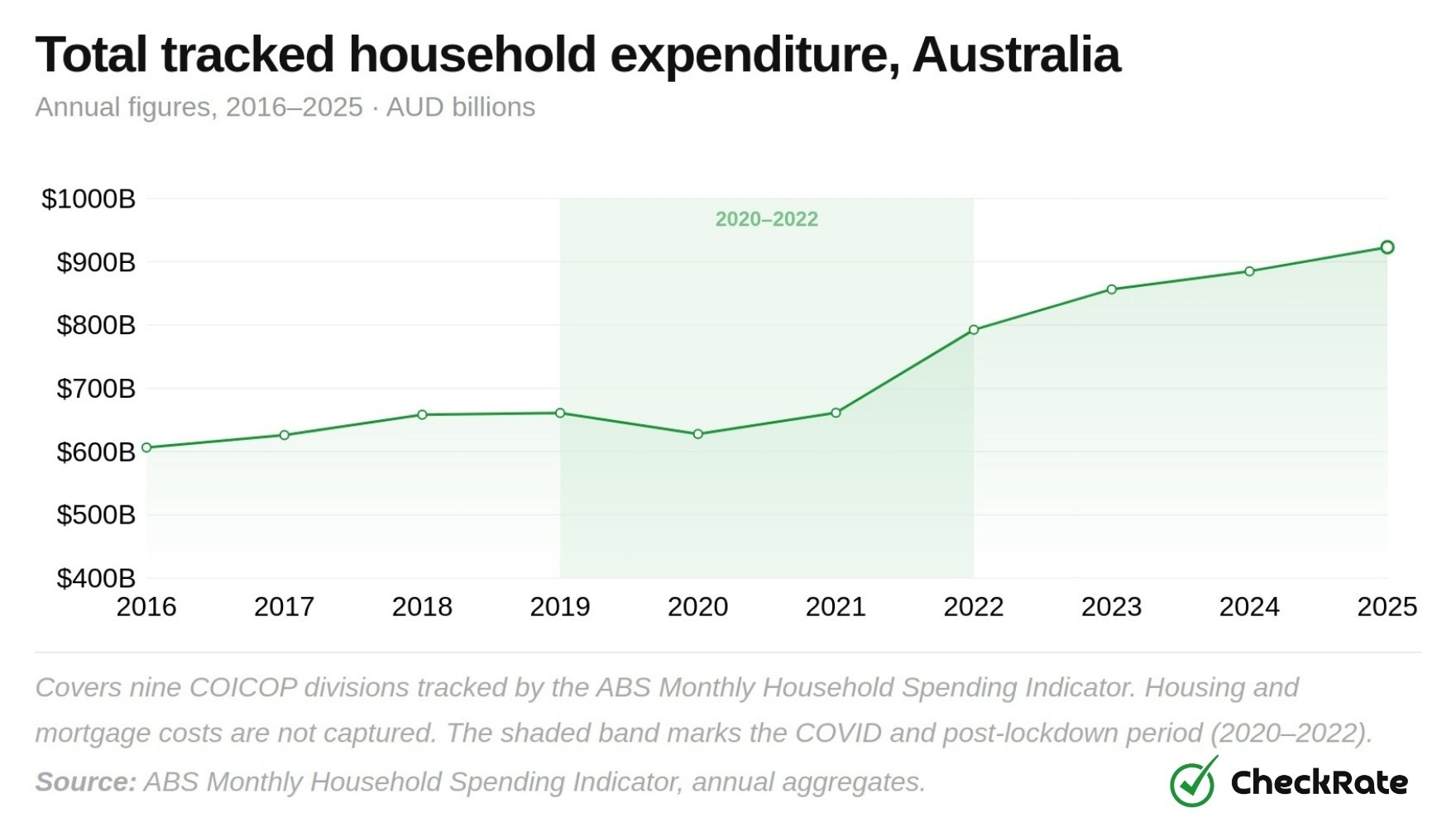
Australian households spent a combined $923 billion across tracked consumer categories in 2025, up 52% from $606 billion in 2016. When housing costs are included, the average household is estimated to need around $12,376 per month to maintain its standard of living.
The ABS Monthly Household Spending Indicator tracks nine categories: food, health, transport, recreation, hospitality, clothing, furnishings, alcohol and tobacco, and miscellaneous goods. Mortgage repayments and rent are not included, so these figures only show part of total household spending.
2016

Between 2016 and 2019, spending rose steadily, increasing by 9% over four years of contained inflation. The pandemic interrupted that pattern. In 2020, total tracked expenditure fell to $627.6 billion, the only annual decline in the dataset.
The lowest month on record was April 2020, when Australians spent just $39.8 billion nationally as lockdowns closed large parts of hospitality, retail and transport almost overnight.
2020
SURGE
When do Australians spend the most?
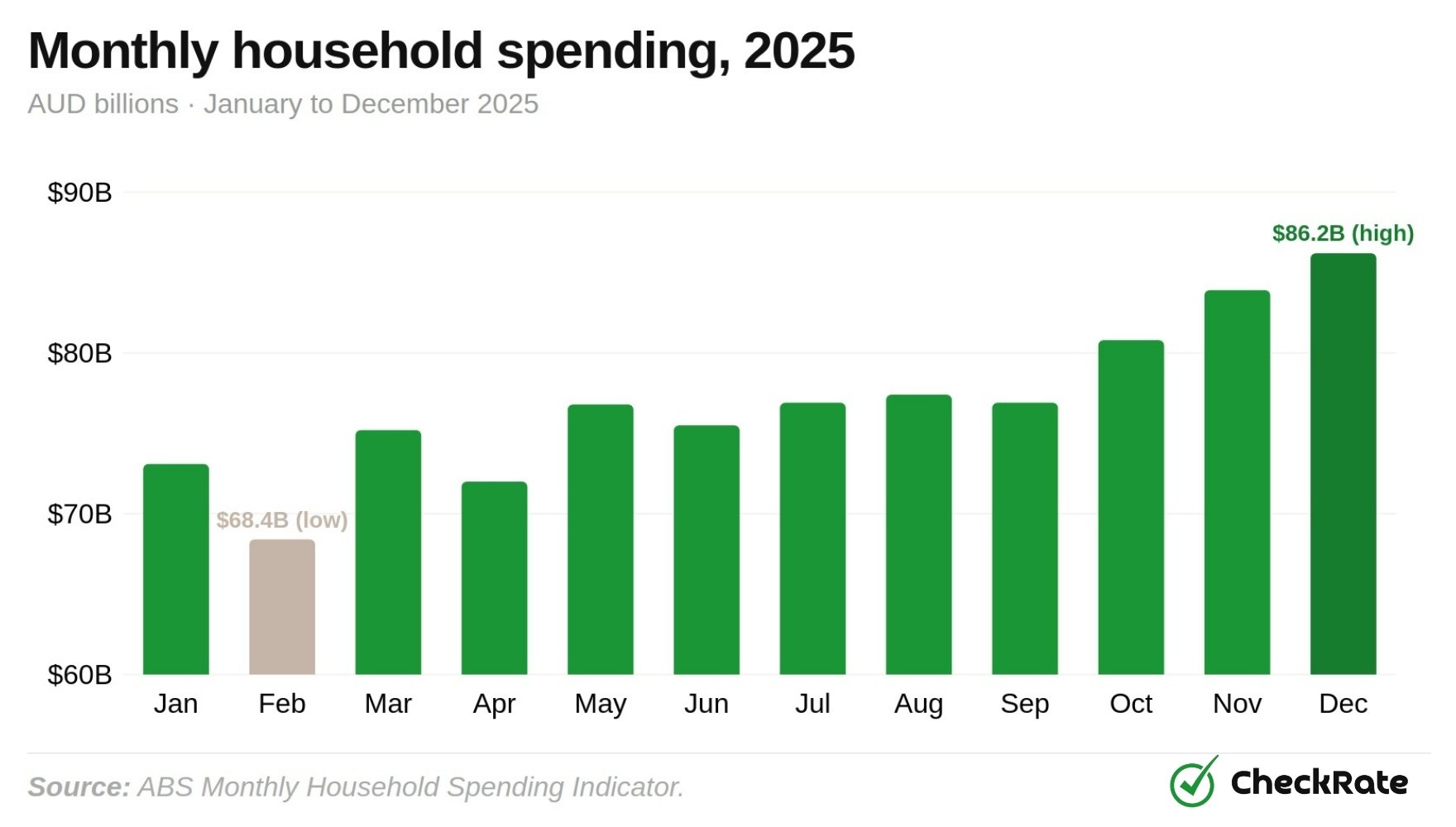
Seasonal patterns are a consistent feature of Australian household spending. In 2025, monthly totals climbed from a February low of $68.4 billion to a December high of $86.2 billion, a swing of $17.8 billion within a single calendar year. That December figure was 5.2% higher than December 2024 and the highest month recorded in the dataset.
December spending consistently runs 15–20% above the February trough, driven by Christmas retail, summer hospitality and school-year preparation. February is usually lower because it has fewer days and follows the holiday spending period. This seasonal pattern holds across every year in the dataset.
Jan
What do Australians spend their money on?
Transport is the single largest tracked category at $157.3 billion in 2025, up from $101.9 billion in 2016. Recreation and culture ($152.6 billion) and food ($143.2 billion) follow closely, with those three categories together accounting for nearly half of all tracked national expenditure.
Health spending was among the fastest-growing categories, rising 73% from $62.7 billion in 2016 to $108.7 billion in 2025.
Hotels, cafes and restaurants rose by 75%, from $72.8 billion to $127.3 billion, reflecting both higher spending on eating out and rising service-sector costs after the pandemic.
Transport
Category data: 2016 vs 2025
Highlighted rows show the fastest-growing categories and the only category to decline.
| Category | 2016 ($B) | 2025 ($B) | Change | National share |
|---|---|---|---|---|
| Hotels, cafes and restaurants | 72.8 | 127.3 | +74.9% | 13.8% |
| Health | 62.7 | 108.7 | +73.3% | 11.8% |
| Food | 92.6 | 143.2 | +54.7% | 15.5% |
| Transport | 101.9 | 157.3 | +54.3% | 17.0% |
| Recreation and culture | 100.5 | 152.6 | +51.8% | 16.5% |
| Clothing and footwear | 35.3 | 51.7 | +46.5% | 5.6% |
| Miscellaneous goods and services | 58.3 | 83.1 | +42.5% | 9.0% |
| Furnishings and household equipment | 45.6 | 63.9 | +40.0% | 6.9% |
| Alcohol and tobacco | 36.4 | 35.4 | −2.8% | 3.8% |
| Total (tracked categories) | 606.3 | 923.0 | +52.2% | 100% |
Household spending by state: where costs are rising fastest
New South Wales accounts for the largest share of national tracked expenditure at $292.1 billion in 2025, representing 31.6% of the national total.
Victoria follows at $224.9 billion and Queensland at $190.7 billion. These figures largely reflect population size, with NSW and Victoria home to the largest shares of Australia's population.
Growth rates since 2016 show a different pattern. Western Australia (+65.1%) and Queensland (+63.0%) both grew well above the national average of 52.2%. NSW (+43.9%) and Victoria (+47.7%) recorded slower growth despite their larger spending bases.
Queensland's faster growth closely tracks strong interstate migration, which has tightened housing availability and increased service costs across south-east Queensland.
State and territory data: 2016 vs 2025
Green rows indicate states with above-average growth since 2016.
| State / Territory | 2016 ($B) | 2025 ($B) | Growth | National share (2025) |
|---|---|---|---|---|
| NSW | 203.1 | 292.1 | +43.9% | 31.6% |
| VIC | 152.3 | 224.9 | +47.7% | 24.4% |
| QLD | 117.0 | 190.7 | +63.0% | 20.7% |
| WA | 64.5 | 106.5 | +65.1% | 11.5% |
| SA | 39.3 | 62.5 | +59.0% | 6.8% |
| TAS | 12.3 | 19.3 | +57.3% | 2.1% |
| ACT | 11.2 | 17.0 | +51.6% | 1.8% |
| NT | 6.7 | 10.1 | +51.1% | 1.1% |
| Australia total | 606.3 | 923.0 | +52.2% | 100% |
How much does one household actually spend?
Behind the national total of $923 billion is a more personal figure: the amount flowing out of a single Australian household each week.
In 2025, that is estimated at $2,856 per week, or $12,376 per month. This includes housing, utilities and other living expenses.
A decade ago, the equivalent figure was $1,956 per week. That is a 46% rise in nominal terms over nine years.
Of the $2,856 weekly total, housing alone accounts for $634, making it the largest household expense and more than twice the discretionary spend on recreation and culture ($292).
Household spending broadly falls into three groups. Essential non-discretionary costs, including housing, food, health, utilities, insurance and education, account for around $1,509 per week, or 52.8% of total spending. Transport makes up $298 per week (10.4%), while discretionary spending accounts for $1,049 per week (36.8%).
Full weekly cost breakdown per household
| Category | Type | Weekly | Monthly | Annual | Share of total |
|---|---|---|---|---|---|
| Rent and dwelling services | Essential | $634 | $2,747 | $32,968 |
|
| Recreation and culture | Discretionary | $292 | $1,265 | $15,184 |
|
| Food | Essential | $272 | $1,178 | $14,144 |
|
| Hotels, cafes and restaurants | Discretionary | $244 | $1,057 | $12,688 |
|
| Insurance and financial services | Essential | $227 | $983 | $11,804 |
|
| Health | Essential | $210 | $909 | $10,920 |
|
| Other goods and services | Discretionary | $162 | $702 | $8,424 |
|
| Operation of vehicles | Transport | $127 | $550 | $6,604 |
|
| Furnishings and equipment | Discretionary | $120 | $520 | $6,240 |
|
| Clothing and footwear | Discretionary | $102 | $442 | $5,304 |
|
| Education services | Essential | $101 | $437 | $5,252 |
|
| Transport services | Transport | $98 | $424 | $5,096 |
|
| Purchase of vehicles | Transport | $73 | $316 | $3,796 |
|
| Electricity, gas and fuel | Essential | $65 | $282 | $3,380 |
|
| Alcoholic beverages | Discretionary | $52 | $225 | $2,704 |
|
| Communications | Discretionary | $52 | $225 | $2,704 |
|
| Cigarettes and tobacco | Discretionary | $25 | $108 | $1,300 |
|
| Total | — | $2,856 | $12,376 | $148,493 | 100% |
Per-household weekly spend by state
Weekly household costs vary widely across Australia. The Northern Territory is the most expensive, partly because geographic isolation pushes up freight and living costs. Western Australia also sits above the national average, supported by higher wages in the resources sector. Tasmania is the lowest, reflecting lower median wages, an older population and lower property values.
NT and WA figures from 2025 cost-of-living research. TAS and national are ABS estimates.
Cost of living by household type
The national average of $2,856 per week masks very different financial realities depending on household size, income and life stage. A single student in inner-city Sydney will face very different costs from a couple nearing retirement in regional Tasmania, even within the same national economy.
Singles
For a single person, monthly living costs are estimated between $2,500 and $3,500 nationally, though that range is heavily skewed by location. In inner-city Sydney, total monthly expenses, including rent, can exceed $6,000, driven by an average one-bedroom rental of around $3,771 per month. Excluding rent, a single Sydneysider's everyday costs average approximately $1,984 per month.
Couples without children
Sharing income and expenses changes the cost calculation. For a working-age couple without children, monthly living costs typically fall between $3,500 and $5,500. Splitting housing costs provides a buffer that single-person households do not have. A couple sharing a $2,500 monthly rental effectively halves that cost per person.
Families with children
A family of four typically requires between $5,000 and $7,000 per month nationally, rising to $7,500 to $8,000 in major metropolitan areas. The marginal cost of children is substantial and largely unavoidable.
Even within nominally free public schooling, families face unavoidable annual costs of between $500 and $1,200 per child. These essential costs leave families with less room for discretionary spending. Families may cut back on domestic travel, dining and entertainment to manage fixed child-rearing costs.
Retirement
The Association of Superannuation Funds of Australia (ASFA) publishes quarterly benchmarks for retirement living standards. In the December 2025 quarter, a comfortable retirement required near-ideal conditions: good health, an owned home, and a substantial superannuation balance at drawdown.
Weekly cost of modest and comfortable retirement living standards
| Category | Couple comfortable | Couple modest | Single comfortable | Single modest |
|---|---|---|---|---|
| Housing (rates, insurance, repairs) | $161.25 | $148.45 | $154.42 | $131.38 |
| Electricity and gas | $62.88 | $53.75 | $50.70 | $40.02 |
| Food and groceries | $263.41 | $217.31 | $151.55 | $117.22 |
| Household goods and services | $101.64 | $48.11 | $80.19 | $40.76 |
| Clothing and footwear | $53.59 | $40.94 | $28.78 | $21.54 |
| Transport (car and public) | $189.88 | $117.30 | — | $110.28 |
| Health (insurance, chemist, co-payments) | $225.46 | $114.86 | $120.29 | $59.28 |
| Leisure (dining, holidays, media) | $360.21 | $196.49 | $238.79 | $126.78 |
| Total weekly | $1,482 | $983 | $1,051 | $680 |
| Annual equivalent | $77,375 | $51,299 | $54,792 | $35,360 |
Source: ASFA Retirement Standard, December Quarter 2025.
- ABS Monthly Household Spending Indicator: aggregate household expenditure across nine COICOP divisions, 2016–2025 annual totals. Housing and mortgage costs not captured.
- ABS National Accounts: per-household weekly and monthly expenditure estimates; 2016 baseline figures from ABS 2016 Household Expenditure Survey.
- ABS Lending Indicators: state-by-state expenditure totals, 2016 and 2025 annual aggregates used for growth rate comparisons.
- ASFA Retirement Standard, December Quarter 2025: weekly expenditure benchmarks for comfortable and modest retirement; couple and single scenarios. Superannuation lump-sum estimates assume partial Age Pension eligibility.
- ABS Household Income and Wealth, Australia 2024: gender savings gap data; average savings by age group and sex.
- ABS National, State and Territory Population: population data used for per-household expenditure modelling by state and territory.
- AMP Financial Services: cost of raising children: annual cost estimates for first and subsequent children on median household income.
- Reserve Bank of Australia: housing lending data: average mortgage repayment estimates for owner-occupier households, 2025.
Data Snapshots