How much is rent in Australia?
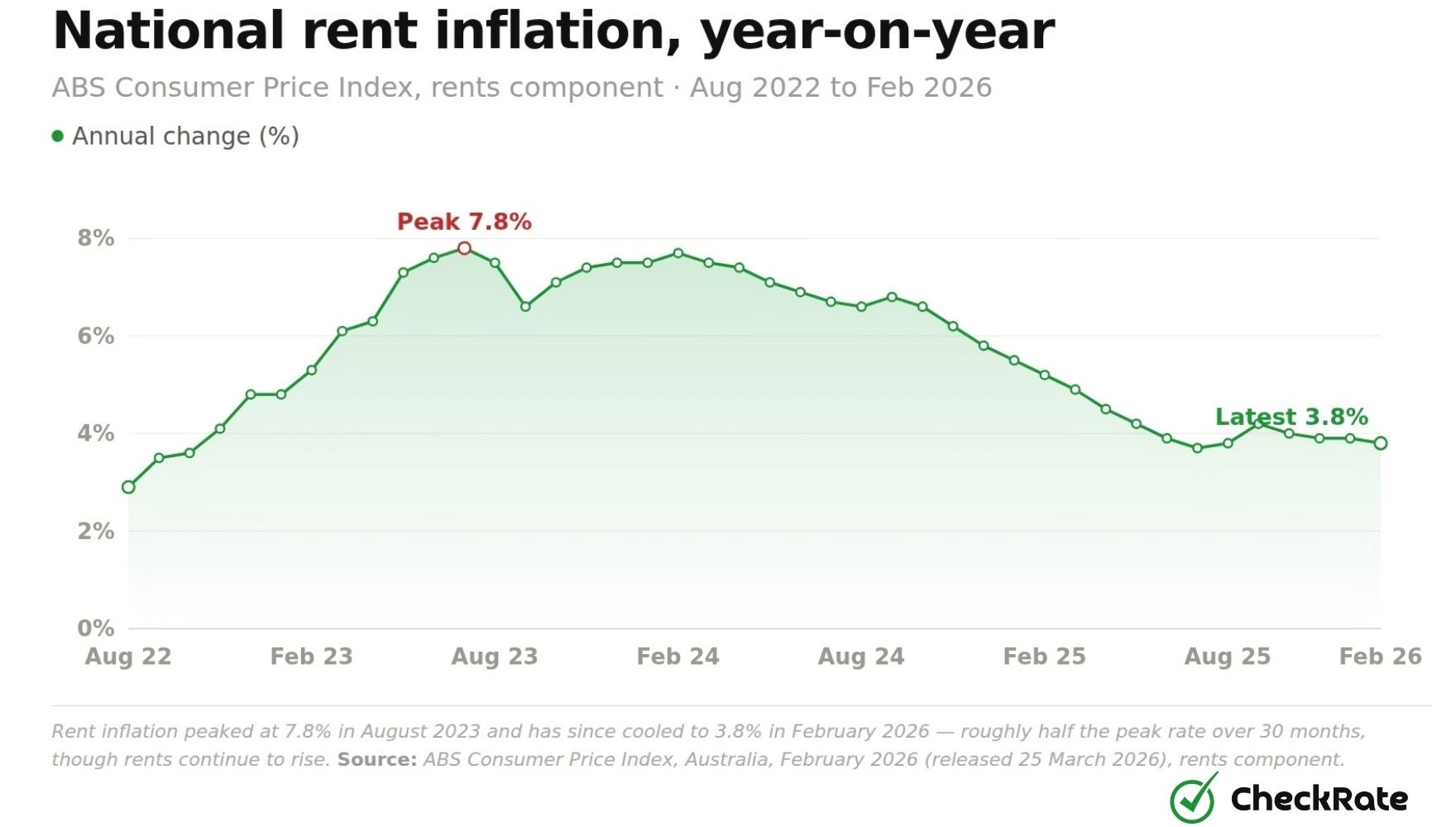
Australian rent inflation eased to 3.8% year-on-year in February 2026, down from a peak of 7.8% in August 2023. The pace of rent growth has roughly halved over the past 30 months, although rents themselves are still rising.
There is no single official "average rent" dollar figure for 2026. The two main national benchmarks are:
- 2021 Census: median weekly rent of $375
- 2019–20 Survey of Income and Housing: mean weekly housing cost of $379, or about 20% of gross weekly household income
Both figures are now several years old, but they remain the most complete official national dollar snapshots available.
- v
- Annual change (%)

How much is the average rent in Australia in 2026?+
As of February 2026, CPI rent inflation sat at 3.8% year-on-year, down from a peak of 7.8% in August 2023.
The latest official state-level medians, published for April 2025, put NSW at $650 a week and Tasmania at $430. Applying national rent inflation through to February 2026 gives an estimated NSW median of around $670 a week. There is no single official 2026 national rent dollar figure. The most recent national snapshot is the 2021 Census median weekly rent of $375, which is now several years old.
What is the average monthly rent in Australia?+
In NSW, median rent worked out to about $2,817 a month in April 2025, based on $650 a week. The estimated February 2026 figure is around $2,903 a month.
Australian rent data is reported weekly, so monthly figures are estimates calculated as weekly × 52 ÷ 12. Using the latest official April 2025 medians:
- NSW: $2,817 ($650 a week)
- WA: $2,656 ($613 a week)
- Queensland: $2,427 ($560 a week)
- Victoria: $2,253 ($520 a week)
- Tasmania: $1,863 ($430 a week)
Average rent by state and territory in Australia
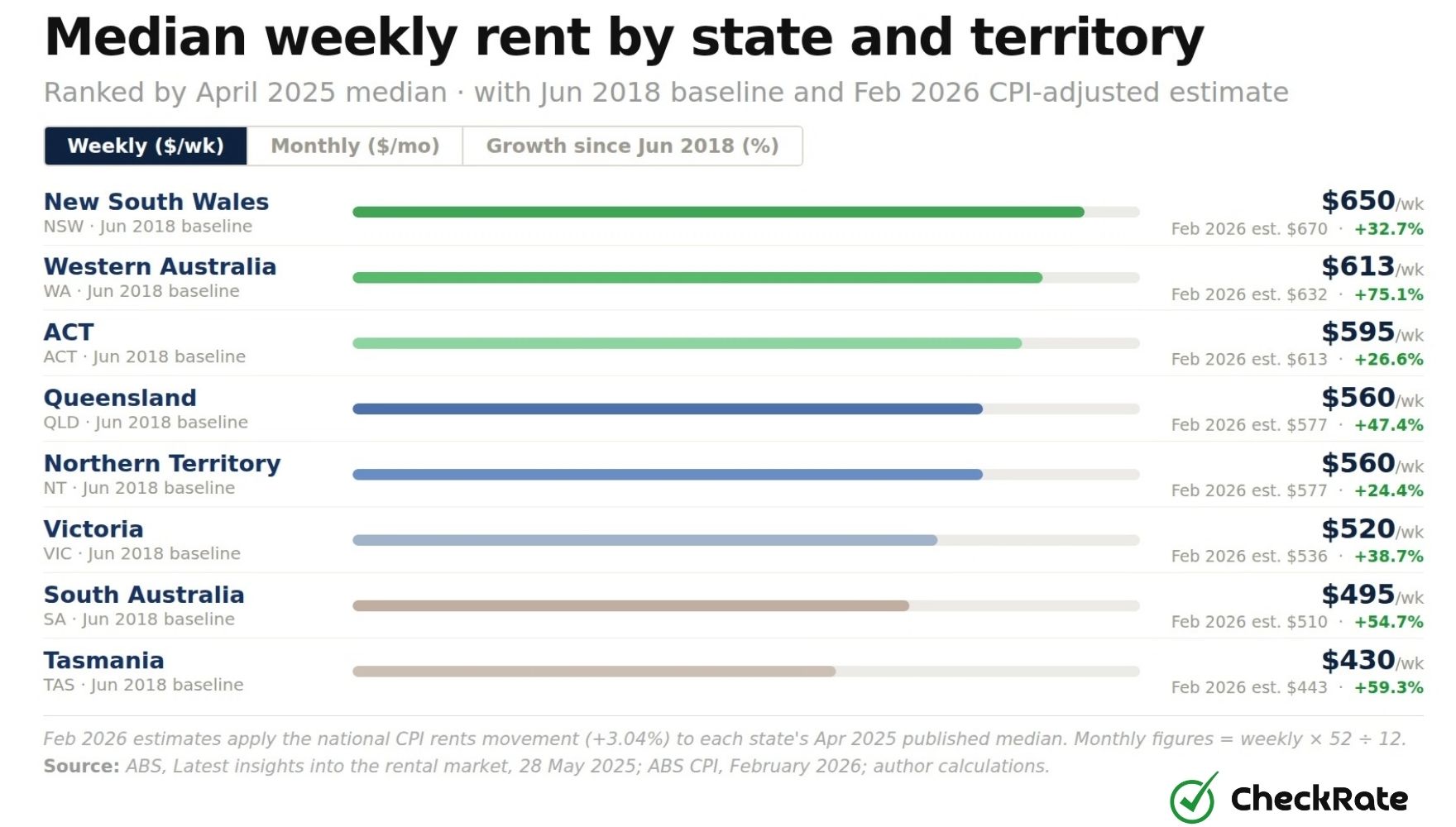
NSW had the highest median weekly rent of any state or territory at $650, or about $2,817 a month, in April 2025. Tasmania was the cheapest at $430 a week, or about $1,863 a month. That leaves a gap of about $940 a month between the most and least expensive states.
Most other states and territories sat in the middle: WA at $613, ACT at $595, Queensland and NT at $560, Victoria at $520, and South Australia at $495.
Growth over the seven years to April 2025 tells a different story. Western Australia stands out, with its median weekly rent rising from $350 to $613, an increase of 75%.
Other states with above-average growth:
- Tasmania: up 59%
- South Australia: up 55%
The slowest growth was in the Northern Territory, up 24%, and the ACT, up 27%.
Total private dwellings excluding rent assistance. Monthly figures are estimates, not directly published. Source: ABS, Latest insights into the rental market, released 28 May 2025; author calculations.
Applying the national CPI rents monthly movements to the April 2025 medians gives an estimated set of February 2026 figures.
- ABS weekly median
- Feb 2026 estimate
| State / territory | Jun 2018 | Apr 2025 | Feb 2026 (est.) | Growth 2018–2025 |
|---|---|---|---|---|
| New South Wales | $490 | $650 | $670 | +32.7% |
| Victoria | $375 | $520 | $536 | +38.7% |
| Queensland | $380 | $560 | $577 | +47.4% |
| South Australia | $320 | $495 | $510 | +54.7% |
| Western Australia | $350 | $613 | $632 | +75.1% |
| Tasmania | $270 | $430 | $443 | +59.3% |
| Northern Territory | $450 | $560 | $577 | +24.4% |
| Australian Capital Territory | $470 | $595 | $613 | +26.6% |
February 2026 figures are CPI-adjusted estimates, not ABS-published medians. Source: ABS, Latest insights into the rental market (April 2025); ABS Consumer Price Index (February 2026); CheckRate calculations.
Which Australian state has the cheapest rent?+
Tasmania has the lowest median weekly rent of any state or territory. The Tasmanian median was $430 a week in April 2025, compared with NSW at $650. After applying national rent inflation through to February 2026, the estimated Tasmanian figure sits near $443 a week.
Tasmania also recorded one of the largest percentage increases since 2018, up 59%, which has narrowed the gap.
What is the average rent in NSW, Victoria and Queensland?+
The most expensive of the three is NSW at $650 a week, or about $2,817 a month in April 2025. Estimated February 2026 figures are around $670 for NSW, $577 for Queensland, and $536 for Victoria.
NSW has held the highest state median throughout the series, but Queensland and Victoria have grown faster in percentage terms since 2018.
Why has Western Australia seen the fastest rent growth?+
WA's median weekly rent rose from $350 to $613 between June 2018 and April 2025, a 75% increase. By April 2025, WA had moved from the cheapest mainland state to the second-most-expensive, behind only NSW.
Average rent by city: Australian capital city rents compared
Greater Sydney topped Australian capitals at the 2021 Census, with a median weekly rent of $470, or about $2,037 a month. Greater Adelaide was the cheapest of the major cities at $320 a week, or around $1,387 a month. That was a difference of about 47% between the most and least expensive major capitals.
Those 2021 Census figures are now several years old, but they remain the only fully comparable official city-by-city dollar series available. Current rent inflation data is published at state level, not for individual capitals, so there is no clean current dollar figure for a single city like Brisbane on its own.
Capital-city dollar levels do not always reflect the pressure renters feel. Greater Hobart's $350 median rent is lower than Sydney's $470, but household incomes in Hobart are also lower. That means lower dollar rents do not always translate into lower rent pressure.
Which Australian city has the highest rent?+
Greater Sydney recorded the highest median weekly rent of any Australian capital at the 2021 Census, at $470 a week.
- Greater Sydney: $470/week
- ACT: $450/week
- Greater Melbourne: $390/week
- Greater Adelaide: $320/week, the lowest of the major capitals
How much has Sydney rent gone up since the Census?+
The NSW state median rose 34% from $485 in August 2021 to $650 in April 2025, making it the closest available official proxy for Sydney rent growth since the Census. The next national Census is scheduled for 11 August 2026.
Regional rent vs city rent: which is growing faster?
Regional rents have grown faster than capital-city rents since 2018. Using June 2018 as a base of 100, the rent price index reached 122.3 in capital cities by April 2025, against 128.6 in regional areas. That leaves a gap of 6.3 points in regional growth's favour.
In dollar terms, capital-city rents still sit higher than regional rents in every state. Regional Australia is generally the cheaper market overall, but the gap has been narrowing.
The pattern flipped during the 2023 inflation peak. Annual capital-city rent inflation reached 8.5% in late 2023, ahead of regional inflation at 6.3%.
Regional growth had run faster through 2021 and 2022, when remote-work patterns and limited rental supply placed more pressure on some regional, country and coastal markets. Capital-city markets then caught up as migration resumed and rental vacancies tightened.
- Capital cities
- Regional areas
Is rent cheaper in regional Australia?+
In dollar terms, yes. Regional rents generally sit below capital-city rents in every state and territory.
Victoria's most recent official figures (September 2025 quarter) show:
- Metropolitan Melbourne: $580/week
- Regional Victoria: $470/week
The rent price index rose 28.6% in regional areas against 22.3% in capital cities, so regional rents have grown faster than capital-city rents over that period.
When did capital-city rent inflation overtake regional inflation?+
Capital-city rent inflation peaked at 8.5% in late 2023, against a regional peak of 6.3% earlier the same year. The crossover happened around mid-2023.
House rent vs unit rent in Queensland
In Queensland's March 2026 figures, a 2-bedroom flat had a median weekly rent of $650, which was $120 a week more than a 2-bedroom house at $530. The same pattern appears at three bedrooms, with 3-bedroom flats at $700 compared with 3-bedroom houses at $620.
Houses only pull ahead at four bedrooms, where the median is $720 a week.
There is no clean nationwide comparison of house and unit rents, because national rent series do not publish dollar medians split by dwelling type. State bond authorities publish more detailed data, but each one uses its own methodology. Queensland's quarterly data is used here as a current state-level example.
| Dwelling type | Mar 2024 | Mar 2025 | Mar 2026 | 1-year change |
|---|---|---|---|---|
| Flat, 1 bedroom | $450 | $470 | $525 | +11.7% |
| Flat, 2 bedroom | $580 | $620 | $650 | +4.8% |
| Flat, 3 bedroom | $600 | $650 | $700 | +7.7% |
| House, 2 bedroom | $460 | $480 | $530 | +10.4% |
| House, 3 bedroom | $555 | $590 | $620 | +5.1% |
| House, 4 bedroom | $650 | $680 | $720 | +5.9% |
| Townhouse, 2 bedroom | $530 | $550 | $600 | +9.1% |
| Townhouse, 3 bedroom | $630 | $650 | $690 | +6.2% |
| All dwellings, Queensland | $580 | $580 | $620 | +6.9% |
Medians from new rental bonds lodged each quarter. Source: Queensland Residential Tenancies Authority, Median rents quarterly data workbook, updated 1 April 2026.
Are houses or units cheaper to rent in Australia?+
There is no single national answer. In Queensland's March 2026 bond data, a 2-bedroom flat cost $650 a week, compared with $530 for a 2-bedroom house. That is a difference of $120 a week in favour of houses at this bedroom count. The cheaper option depends on bedroom count, dwelling type and location.
In the Queensland example, houses pulled ahead at four bedrooms.
Why are 1-bedroom flats rising so fast in Queensland?+
Queensland one-bedroom flats rose 11.7% in the year to March 2026, the largest one-year rise of any category in the bond data. Two-bedroom houses were close behind, up 10.4%. Both sit at the lower end of the market, where population growth, tight vacancy conditions and demand for smaller rentals may be placing extra pressure on rents.
Rent affordability: which states have the highest rental stress?
Around 32.2% of Australian renting households, or 915,317 households, were paying more than 30% of gross household income on rent at the 2021 Census. This threshold is commonly used to identify rental stress in Australian housing research. NSW had the highest rate at 35.5%, while the Northern Territory had the lowest at 16.3%, a gap of nearly 20 percentage points.
Rents have risen significantly since 2021, but the Census is still the most complete dataset on the share of renters above that line.
Renter-stress rates by state:
- NSW: 35.5%, the highest
- Tasmania: 34.2%
- Queensland: 32.3%
- Northern Territory: 16.3%, the lowest
The NT's low share may partly reflect public-housing tenancies that carry below-market rents. WA was the only mainland state below 30%.
At the lower-income end, 58% of private-renter households were spending more than 30% of gross income on housing costs, with a mean weekly housing cost of $353, or about 32% of gross income on average. That figure comes from the 2019–20 Survey of Income and Housing.
Lower-income renters in NSW had the highest state share, with 51% spending more than 30% of income on rent.
How many Australian renters are in rental stress?+
At the 2021 Census, 915,317 renting households, or 32.2% of the total, paid more than 30% of gross household income on rent.
- Highest: NSW, 35.5%, and Tasmania, 34.2%
- Lowest: Northern Territory, 16.3%
What counts as rental stress in Australia?+
Rental stress is commonly measured as a household paying more than 30% of gross household income on rent. This is sometimes called the 30/40 rule when restricted to households in the bottom 40% of the income distribution.
References
- 1.ABS Consumer Price Index, Australia, February 2026: rents component, monthly and annual movement, released 25 March 2026
- 2.ABS Latest insights into the rental market (28 May 2025): median weekly rent by state and territory June 2018 to April 2025; capital city versus regional rent price indices
- 3.ABS 2021 Census of Population and Housing, All persons QuickStats: median weekly rent by state, territory and Greater Capital City SAs; rent affordability indicator
- 4.ABS Housing Occupancy and Costs, 2019–20 financial year: mean weekly housing costs and housing-cost-to-income ratios by state, tenure and landlord type, lower income households.
- 5.Queensland Residential Tenancies Authority median rents data: quarterly medians by dwelling type and bedroom count, statewide; workbook updated 1 April 2026
- 6.Victorian Department of Families, Fairness and Housing Rental Report: September quarter 2025 metropolitan and regional rent indices
- Methodology: Estimated February 2026 state medians apply the national ABS CPI rents monthly movements from May 2025 to February 2026 (cumulative +3.04%) to each state's April 2025 published median. The result is an indicative bridge to the most current national price-change reading and should not be treated as an ABS-published median.
Data Snapshots